Today was the last day of school for seniors. I have my students fill out an exit survey in which I ask them what they were most proud of, what surprised them and what was the most important thing they learned this year. I was really excited to read some of my student responses. More on that in a moment.
Norms are the rules of the game. They are what dictate conduct in social settings. In society they are often the unwritten rules, very often defined by cultural norms. I remember when I went to France for my honeymoon. A lot of Americans go to France assuming the French are rude. The reality, as my Aunt and Uncle explained to us, is that Americans go to France assuming they can act like Americans, rather than learning the cultural norms, and this becomes off-putting. In the US we expect our waiter to check in when we sit down and when we are done with our food. In France, the restaurant expects you to enjoy the experience for as long as you need or would like. You call the waiter over when you are ready to order and when you’re ready for the check. No one is going to rush you out of the restaurant with a check, you can sit and talk as long as you like!
I bring up this example for two reasons. One, it is an example where the norms dictate the expectations and behaviors, but secondly, the conflict in expectations due to cultural differences is what can lead to one or both parties either being upset or in active conflict.
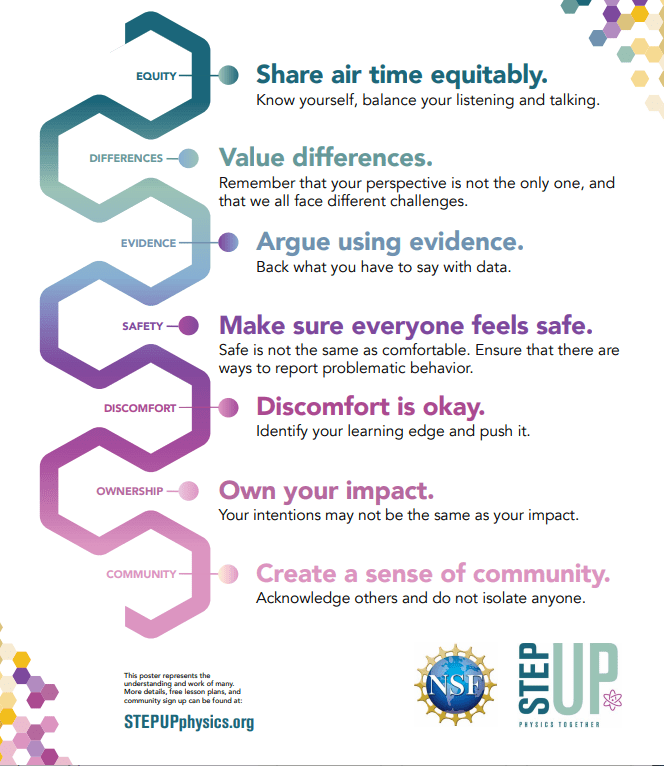
Conflict very often arises when the unwritten norms of one person/group do not match the other. This is why it is especially important in the classroom setting to make these norms very much written and visible.
One set of particularly important norms are the ones we use regarding our content. The previous post mentioned the scientific practices from NGSS. These are excellent norms to have as part of learning, discovering and justifying. We must ask ourselves, what is the norm for engaging in learning activities? Is the norm that the teacher is the keeper of knowledge and the students are passive receptacles? Or are the students active participants? Are they expected to continue asking themselves “how do I know this”? Are they expected to give answers based on intuition or based on evidence? The norms we set for how we engage with science in our classroom are the norms we are teaching our students are part of the scientific community.
This school year I found that students were very uncomfortable having conversations or working in groups with students who were not their besties coming in. Sometimes holding the norm looked like actively telling students we weren’t going to comment on “good” or “bad” groups. Other times this meant actively coaching students on engaging in discourse with one another. It felt like an uphill battle all year.
But then the end of year comments came in:
“I feel like I talked to more people in the class than I usually would, I actually met people and worked well with them”
“Proud of surviving this course. but more specifically, being able to step outside my comfort zone and discuss with peers. At the beginning, I was too timid.”
“I am proud of the improvements I was able to make throughout the year, especially when it came to checking my wrong answers. I also am happy with my collaboration skills.”
Particularly as an AP teacher, it can be easy to get caught up in the exam, the scores, the grades. After all, its one of our primary measures of success. But honestly, for myself, success also looks like these student reflections. It looks like students telling me that tests are feedback, and that they learned it’s ok to fail sometimes. Because those lessons? Those are the ones that last a lifetime.
Marianna is a nationally acclaimed and award-winning physics educator in Northern Illinois. She teaches AP and on-track physics, is a teacher-leader for the Illinois Physics and Secondary Schools Partnership with the University of Illinois at Urbana-Champaign, a former APS STEPUP Advocate, and an active leader in the American Association of Physics Teachers. Marianna's interests lie in the intersection of the brain science (information processing theory) of learning and physics pedagogies.
View all posts by Marianna Ruggerio



2 thoughts on “ABCs of How We Learn… N is for Norms”