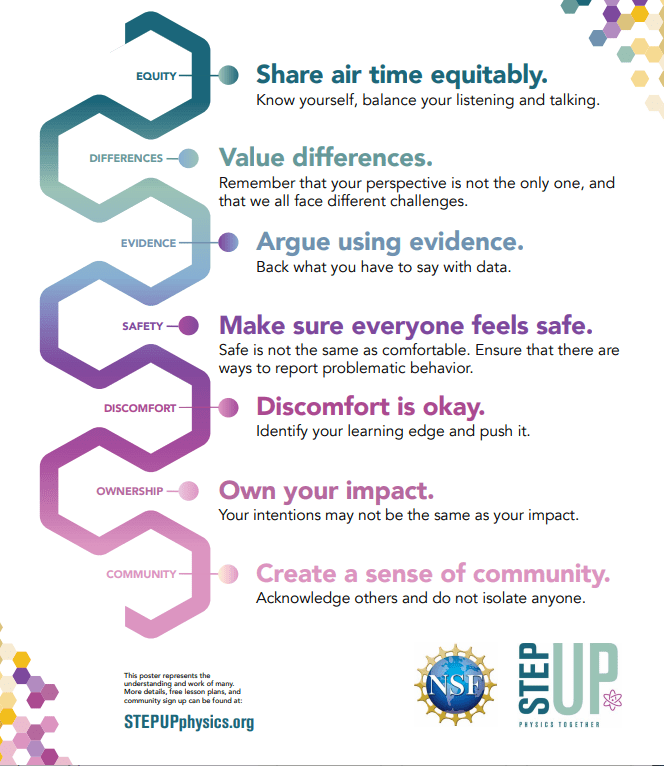
Today was the last day of school for seniors. I have my students fill out an exit survey in which I ask them what they were most proud of, what surprised them and what was the most important thing they learned this year. I was really excited to read some of my student responses. More on that in a moment.
Norms are the rules of the game. They are what dictate conduct in social settings. In society they are often the unwritten rules, very often defined by cultural norms. I remember when I went to France for my honeymoon. A lot of Americans go to France assuming the French are rude. The reality, as my Aunt and Uncle explained to us, is that Americans go to France assuming they can act like Americans, rather than learning the cultural norms, and this becomes off-putting. In the US we expect our waiter to check in when we sit down and when we are done with our food. In France, the restaurant expects you to enjoy the experience for as long as you need or would like. You call the waiter over when you are ready to order and when you’re ready for the check. No one is going to rush you out of the restaurant with a check, you can sit and talk as long as you like!
I bring up this example for two reasons. One, it is an example where the norms dictate the expectations and behaviors, but secondly, the conflict in expectations due to cultural differences is what can lead to one or both parties either being upset or in active conflict.
Conflict very often arises when the unwritten norms of one person/group do not match the other. This is why it is especially important in the classroom setting to make these norms very much written and visible.
One set of particularly important norms are the ones we use regarding our content. The previous post mentioned the scientific practices from NGSS. These are excellent norms to have as part of learning, discovering and justifying. We must ask ourselves, what is the norm for engaging in learning activities? Is the norm that the teacher is the keeper of knowledge and the students are passive receptacles? Or are the students active participants? Are they expected to continue asking themselves “how do I know this”? Are they expected to give answers based on intuition or based on evidence? The norms we set for how we engage with science in our classroom are the norms we are teaching our students are part of the scientific community.
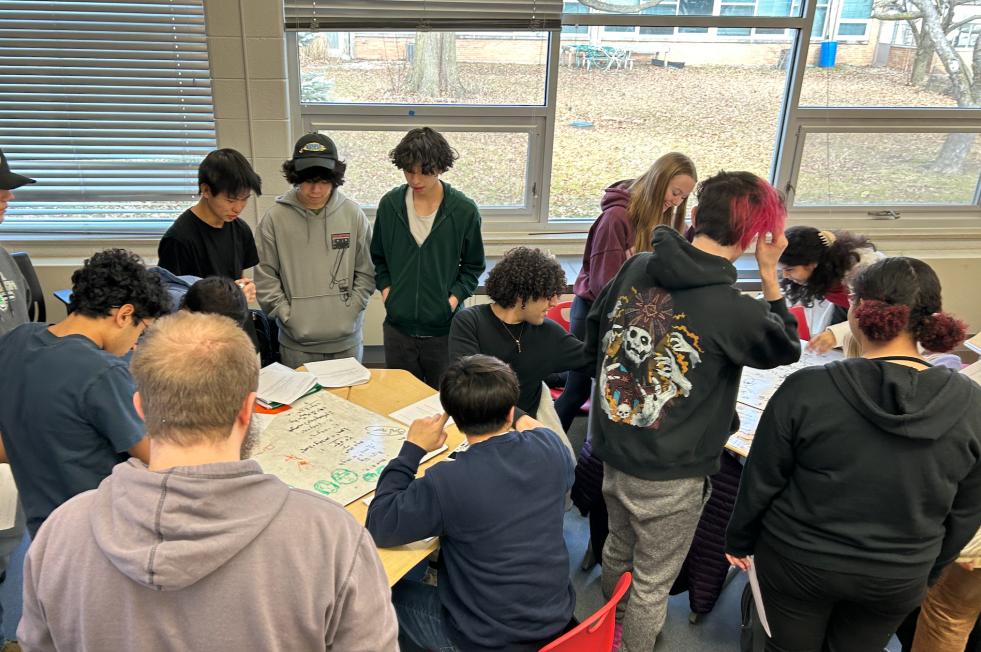
This school year I found that students were very uncomfortable having conversations or working in groups with students who were not their besties coming in. Sometimes holding the norm looked like actively telling students we weren’t going to comment on “good” or “bad” groups. Other times this meant actively coaching students on engaging in discourse with one another. It felt like an uphill battle all year.
But then the end of year comments came in:
“I feel like I talked to more people in the class than I usually would, I actually met people and worked well with them”
“Proud of surviving this course. but more specifically, being able to step outside my comfort zone and discuss with peers. At the beginning, I was too timid.”
“I am proud of the improvements I was able to make throughout the year, especially when it came to checking my wrong answers. I also am happy with my collaboration skills.”
Particularly as an AP teacher, it can be easy to get caught up in the exam, the scores, the grades. After all, its one of our primary measures of success. But honestly, for myself, success also looks like these student reflections. It looks like students telling me that tests are feedback, and that they learned it’s ok to fail sometimes. Because those lessons? Those are the ones that last a lifetime.
I have a saying for students, “The 100% is in the room”.
What I mean by that is that, collectively, the 100% exists. Not necessarily within one student, but when students engage in true collaboration, very often, the 100% exists.
L is for Listening and Sharing and is based on the idea that we learn more together than we do alone.
This would then suggest the power of working in small groups. However there are a few flaws that teachers fall into very often:
Putting students in small groups alone is not going to lead to learning. Students need to know how to speak and listen to one another.
Group selection can be powerful, but students will make assumptions about why they are in a certain group, which will influence their behavior in the group
Setting Norms for Group Behaviors/Interactions
We have all seen this in our classrooms and even in PD sessions or workshops. Some groups function together excellently, while others flounder fantastically. Setting the norms, expectations and even scaffholding the conversation is a critical component of our work.
Protocols
When we implement highly structured protocols we provide students with a predictable framework for engagement. The book Protocols for Allis a great place to start and has some ideas that you’ve probably encountered. Many of these protocols are what you might classify under “ice breakers” or “team building activities.” Research has shown that taking the time to get students to work collaboratively outside of the specific content area supports their ability to work collaboratively when its time to get content-specific. What I like about a lot of these protocols is the emphasis on listening because often our best talkers are our worst listeners. In a profession that frequently values and rewards extraversion, it’s really important that we take the time to hone the seemingly less charismatic skills.
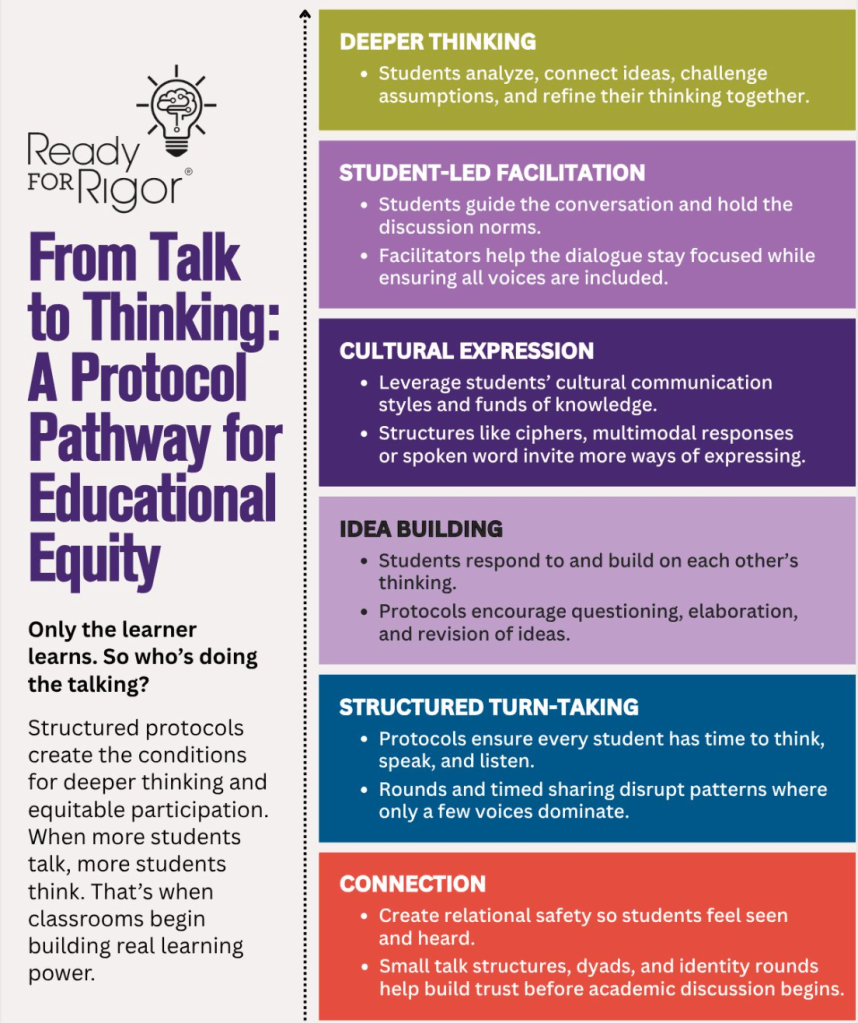
I just so happened to run across this graphic from Zaretta Hammond, author of Culturally Responsive Teaching and The Brain, that outlines a progression of protocols to support student discourse and equity.
She is leading an online summer PD on this topic that you can currently register for and has a previous article with additional ideas described here
Group-Worthy Tasks
Along the same lines, the kind of task we select is critical. This has been named “group-worthy tasks”. A group-worthy task has a few key features. First, it cannot be completed in the time allotted alone, the group members must depend on each other. This requires the task to have a certain level of complexity. Second, the task must have multiple entry points for success. This means that there is a way for the students who are at a lower performance level to positively contribute, but there are higher order thinking tasks available for the upper-performance level students to address.
Marta Stoeckel and Kelly O’Shea wrote a fantastic article about Group-Worthy Tasks for The Physics Teacher in 2024. A few additional features I’d like to bring your attention to is assigning group roles of Skeptic, Facilitator, Summarizer and Navigator and providing students with a role-card during the task. The second feature is discussions around what makes someone good in science (asking good questions, making astute observations etc).
Mitigating Student-Assigned Roles of “Smartness”
In addition to frequent discussions around competencies in science and shared norms, utilizing visibly random grouping can help alleviate any self-assigned roles students create. Regardless of whether or not the groupings were random, students will often assume they’ve been placed in a group by the teacher to either carry the team, or because they are the kid who needs help. When groups are chosen randomly, and visibly (drawing cards, using a random group generator online) students are unable to make these assumptions as a choice you the teacher made. Visibly random grouping is one of the tenets in Peter Liljidahl’s Building Thinking Classrooms. I’d like to address another key aspect of his work that is critical for the effectiveness of groups, listening and sharing. When work is complete on the boards, it is now time for the teacher to implement Just in Time Telling while continuing to engage student thinking. It looks like this:
The teacher re-groups the students away from their boards, perhaps in the center of the room or on the side. The teacher may share some key noticings about the work at this point.
The teacher informs students we are going to “Take a walk”. The teacher moves students to a particular board she has selected in order to discuss one step of the problem that has been completed correctly.
The teacher directs students to this particular piece and poses the question “turn to someone next to you and discuss what this group was thinking when they wrote this part down”
The teacher then asks “someone not in this group, share with us what this person was thinking”
What do to With That Really Smart Student Who Can’t Listen
A few years back I had a group of AP students where the dynamics couldn’t have been more disparate. I had a few hyper-competitive, confident, brilliant students who would do all of the talking and solving, and then I had a few students who were quiet and thoughtful but also lacked confidence. In more than one instance the confident students convinced the quiet ones that their incorrect answer was the answer. So I tried something new. As students worked in groups to solve a problem I assigned the following roles:
The quiet students were required to do all of the writing on the whiteboard. (By the way, having a shared visual also enhances the team-experience!) They were welcome to contribute in any way they desired, but the marker was in their hands so they were responsible for the documentation.
The average students were allowed to discuss the problem, but they were not allowed to write.
The confident students were only allowed to ask questions. The way I framed it was that they were in my role as the teacher. They needed to create and frame questions in such a way so as to get their peers to get on the same wavelength that they were on… without actually giving them the answer.
The result of this was pretty cool. At least one of the kids who normally ran the show was super frustrated at first, but its because I was pushing a different skill set. Rather than just solving the problem and talking it through out loud, he now was required to carefully listen to the conversation so that he could ask the right questions to move his classmates along. The quiet students were all required to be active participants, even if they weren’t doing the talking. Since they had to do the recording, however, this required them to be engaged and ask for clarification as needed.
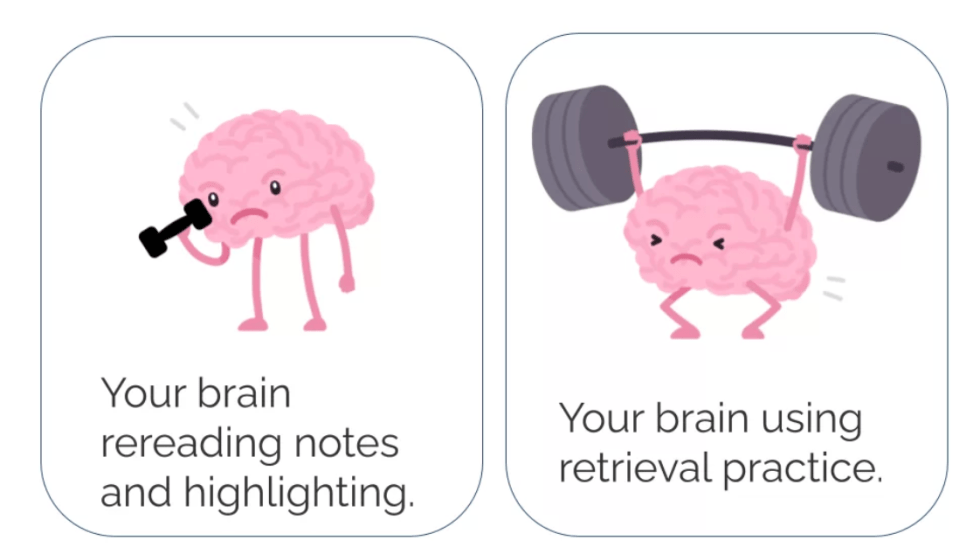
Generation is all about working that brain muscle. The more often we need to remember something, the more likely we are to remember it!
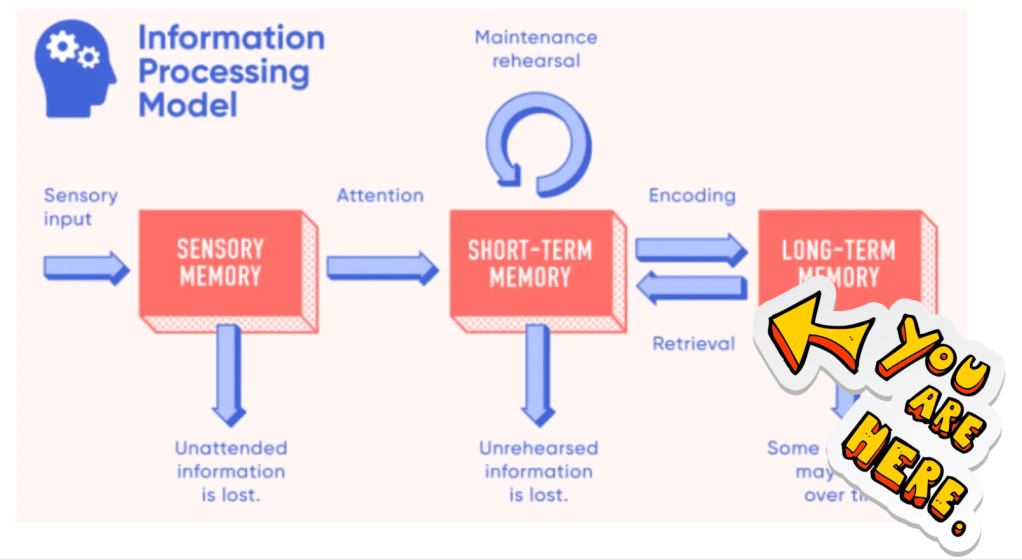
In the information processing model of cognition, this is the retrieval portion
Retrieval has a great deal of benefits when used correctly and there are a lot of misconceptions about retrieval.
First of all: you cannot retrieve what has not been encoded into long term memory. Why is this important? Because asking students to write down what they remember from today’s lesson as an exit ticket is not retrieval. That information is still in the maintenance rehearsal stage. What is rehearsal is asking them to write down two things they remember from yesterday’s lesson.
Retrieval isn’t just good for memories, it also raises student confidence and lowers testing anxiety! In my own classrooms as well as in the classrooms of colleagues, we’ve seen that when students engage in retrieval exercises often, student confidence in the classroom increases significantly. This is particularly true when you ask students to regularly engage in “brain dumps” where they write everything down they remember about a particular unit. As the unit progresses they should be able to write down more and more. It creates a visible piece of evidence of their learning with zero stakes attached to it.
Retrieval is probably something you already do, but to use it effectively we have to use it intentionally. I have two older blog posts about retrieval as a class activity and a study tool in my classroom with a few strategies. Personally, I always prefer to link up retrieval with some sort of additional strategy, whether its engaging students in discourse, having them compare and contrast or concept map.
Retrieval Might be the MOST important activity to support student assessments. Why? Because when students take an assessment they are asked to retrieve. However, if we are only ever pushing information during class, students rarely get the chance to practice that retrieval. Students should use retrieval to study, but they do not know or understand it typically, so we need to teach them (and their parents!) the benefits. If you’re saying “oh but I don’t lecture all hour, I have an active learning environment!” then I’m going to challenge you with this question: but do your students retrieve? Or are they only ever working in maintenance rehearsal? Relying on peers and notes to get to the answer?
My Favorite Use of Retrieval – Retrieve and Engage
Retrieval can be done as an act and of itself. However, while retrieval alone will enhance the memory pathways, it will not necessarily lead to a stronger application of that knowledge. In a science classroom we are constantly aiming for that higher order thinking: explain, create, evaluate. So we need to ensure that students are engaging in that thinking as often as possible.
The first way in which I enjoy using retrieval is by having students engage in a “brain dump”. Students write as much as they can about a given topic. To engage, students share their lists with classmates in small groups. We mix up the groups until eventually all students have the same information written on their papers. The 100% is in the room after all!
Another way in which I use retrieval is to ask students to complete a task identical to the previous day’s work, but then they pull out that work from their notes and evaluate themselves. The goal in this task, however, is for students to identify gaps. This task remains ungraded.
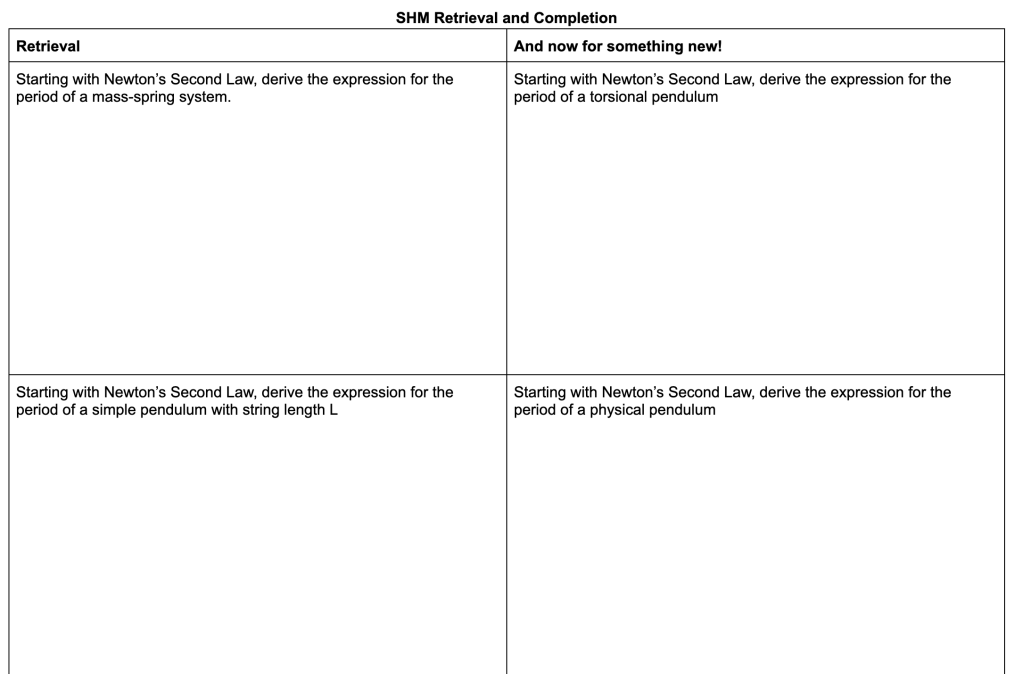
As I mentioned in a previous post, another way I like to use retrieval is to have students retrieve the content from the previous day, but then ask them to consider a similar, but slightly different case. In this instance students are first retrieving the example, and then are immediately asked to compare, contrast and then apply that knowledge to a new context. Below is an example activity that I used with AP Physics C students when going through simple harmonic motion derivations. We had already derived the simple and mass-spring pendula, so I asked students to retrieve those, then take a crack at the torsional and physical pendula.
Retrieval is not Endgame
While retrieval is an incredibly powerful tool that is easy to implement and we often forget to access, it is not endgame. It is simply one strategy amongst what should be an entire playbook. I see retrieval as a strong tool to motivate growth mindset and also as a strong tool to support teaching students how to properly study for the course and better identify their own gaps. However, especially in our science classrooms, it must continue to be paired with active learning cycles and opportunties for students to apply, create, do and evaluate.
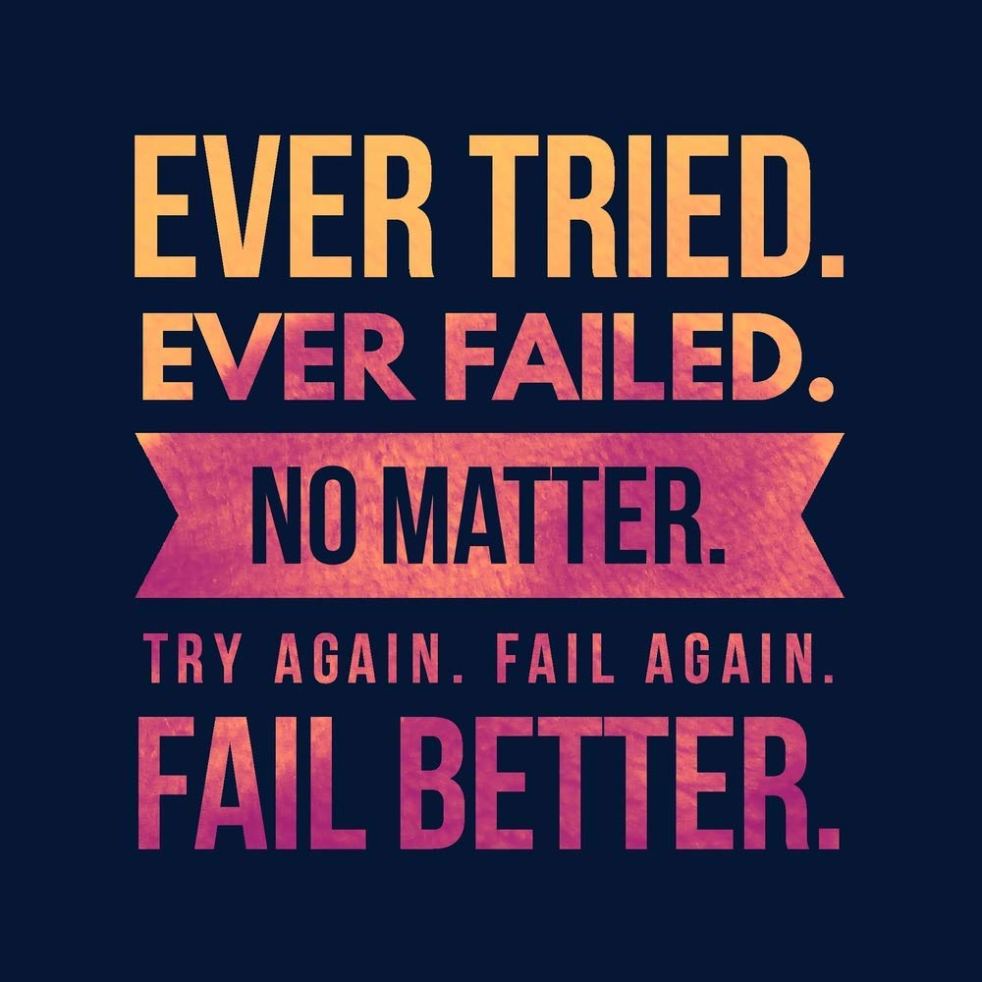
I’ve seen these words by Samuel Beckett on posters and in classrooms. The intention is to support the idea of the classroom as a safe space to try and fail. But failure without actional feedback is just failure. The classroom environment that has high expectations and high support is also an environment with ample opportunities for feedback.
Feedback can come in a lot of degrees, from a minimal “correct/incorrect” to highly detailed narrative regarding the student choices. For most of our students, the feedback they require should fall somewhere between specific discrepancy and elaborative.
Unfortunately many students are used to only getting feedback after a summative assessment, and without retakes any feedback is usually worthless. (Consider the student who crumples the test and throws it away immediately).
In order for feedback to be effective, it needs to be specific, timely, understandable, nonthreatening and revisable. (For the Hattie/Visible Learning enthusiasts, the weighted mean effect size is 0.92)
Teacher Led Peer Evaluations
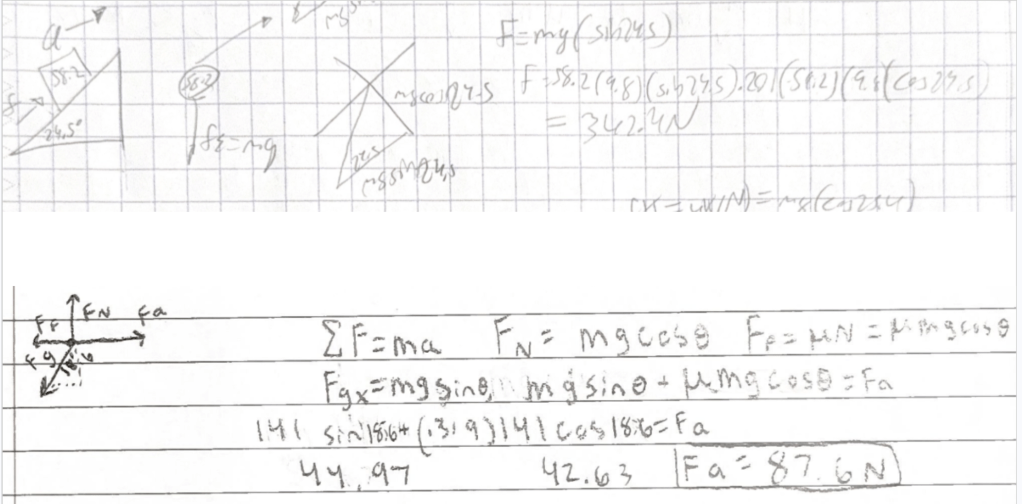
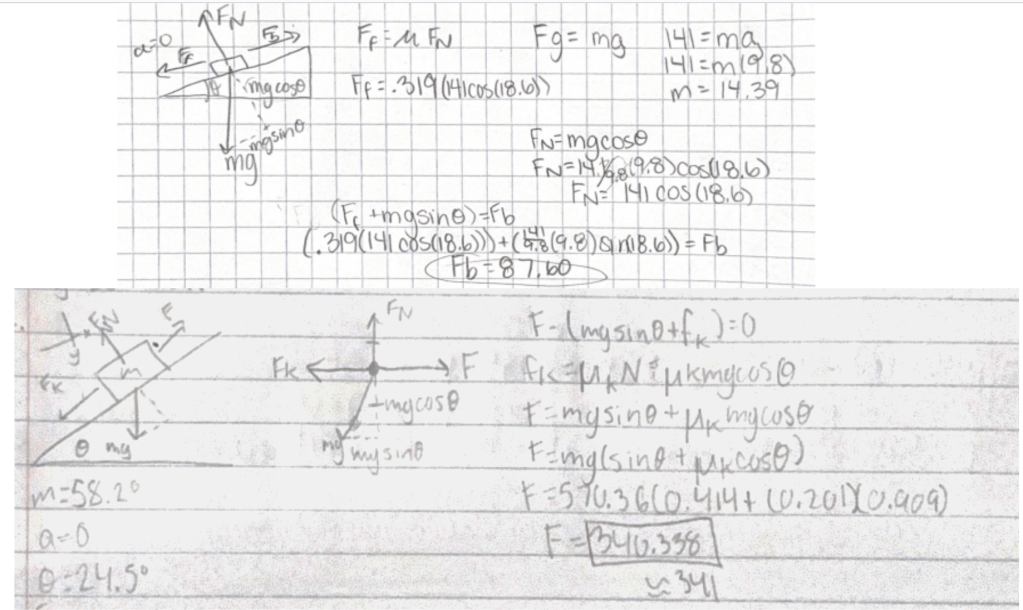
A few years ago I started requiring homework submissions as scans to google classroom by the start of the school day. This allows me to do a quick skim through student work and make decisions for class prior to seeing students. Below is a sequence of student work I wanted to review and discuss with students.
Responses are left anonymous, but I use them as a way to provide feedback via whole group discussion. In this sequence you can see the work going from pretty disorganized to much more logical and detailed. I can lead this discussion, or I can ask for student observations about the work.
Student Self-Evaluations
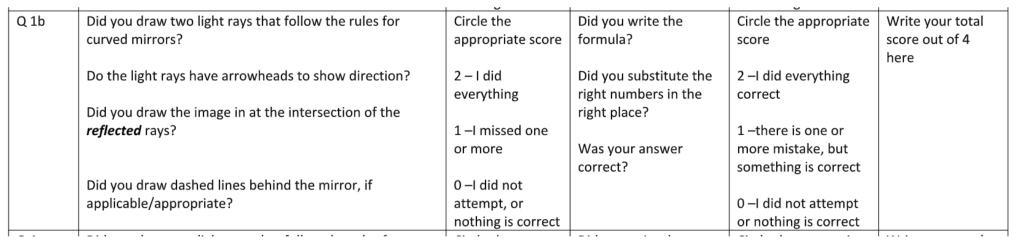
I’ve written before about using self-evaluations for student problem solving process. I haven’t crafted these rubrics for every unit, but I’ve found that for some students this helps them focus on the problem solving routine, rather than just the answer.
Google Form Check Ups
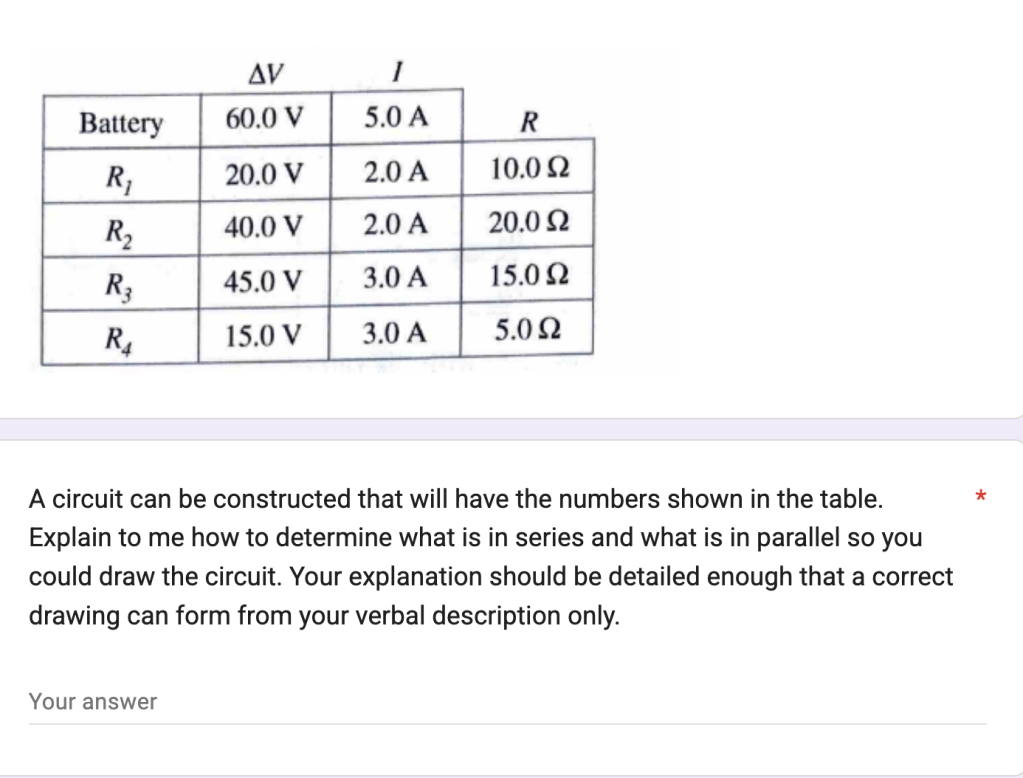
The check up is a follow up I use when students are engaging in practice that is not scored, checked or graded by me the teacher. You can see the full blog post on this process here. During the last 10-15 minutes of class I have students engage in several activities in the google form. The first is a self-evaluation of the learning objectives. Sometimes I will ask them to rate their work from the problem set using a rubric I provide. Last, I will put 1-2 items from the day’s practice and ask students to explain the answer. An example from this past week is below:
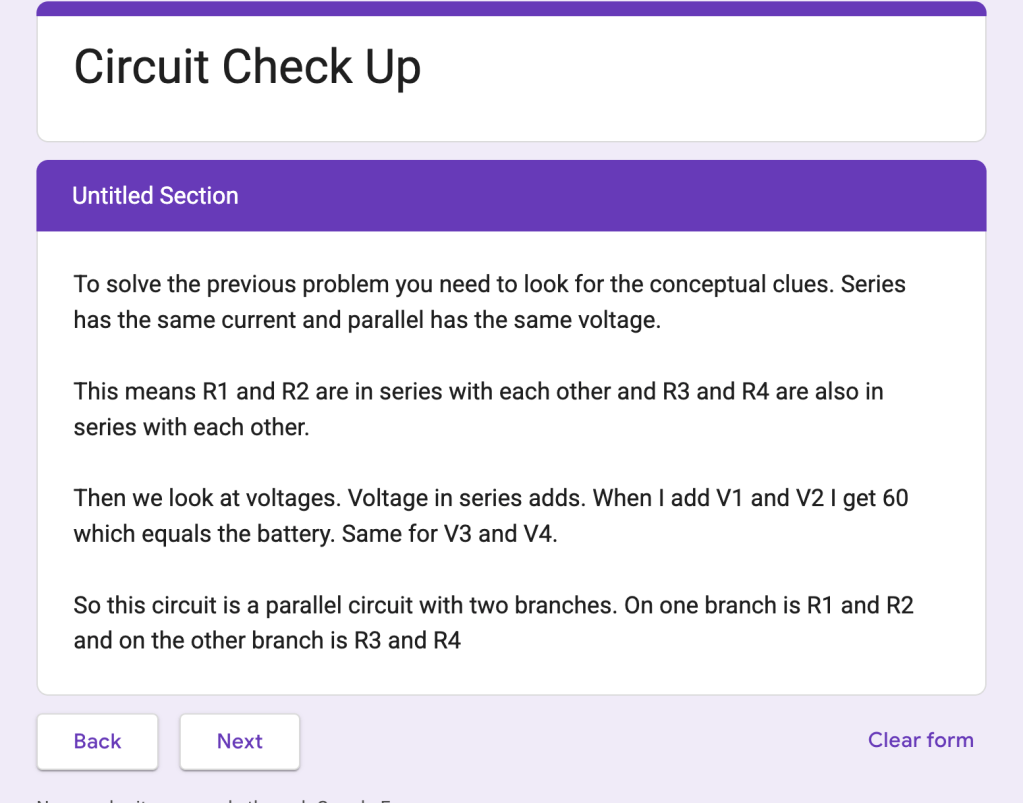
After students submit their answer and click next, the following pops up. It provides them with the answer and an explanation behind it.
For what it’s worth, I was VERY impressed by the number of students who got a similar problem to this one correct on their exams this past week! Students are reporting that circuits has been the easiest unit yet, but the reality is that there is a great deal of conceptual heavy lifting!
One of the most important features of all of these feedback forms is that they are happening during the learning process. This means that students can very quickly adjust their course of action in order to move towards the desired results.
Shortly after completing my MEd I was asked to teach the intro to educational psychology course at Rockford University. The course had recently been redesigned to focus on cognitive psychology and the science of learning. Eager, I looked around for other models at various institutions and reached out to a few collegues. One of whom referred me to the book “The ABCs of How We Learn.” It’s a wonderful and digestable text that goes into the research, provides some examples and good/bad uses of each strategy.
At a recent institute day the keynote speaker shared that in his personal research he found that, on average, teachers could only name and accurately describe three strategies they use in the classroom. So, here’s my challenge to myself: 26 strategies and 26 direct applications to the physics classroom.
A is for Analogy
What makes an analogy? Can you name one in physics? God please not the water pump as a circuit example. An analogy is where two examples have the same deep structure. Analogy then becomes a valuable tool for helping novices begin to pay attention to deep vs surface structures.
There are two ways in which we use analogies. The first is the one you are probably thinking of when you consider analogy… the water pump for a circuit, or lanes of traffic to explain what happens to current in series vs. parallel. As teachers I think we use these examples readily in the classroom as we make abstract ideas more concrete.
There is, however, an additional way to use analogy and that is by taking two or more examples and asking students to identify what about those examples is similar. I noticed that my students this year were having a more difficult time that my previous students making this leap. Have your students ever said to you “but you never taught us this problem!” or “you need to show us more problems!”. It’s not really the number of problems, it’s really a transferrence and deep structure problem. Students are not recognizing that the problem at hand is, indeed, the same problem.
To address this I decided to set up a two-for-one cognitive strategy task (document here). First, I asked students to retrieve the worked example from the previous day. In the first instance of this task I asked them to retrieve the derivation for the moment of inerta of a rod about its end. Next, I provided students with a similar, but different problem.
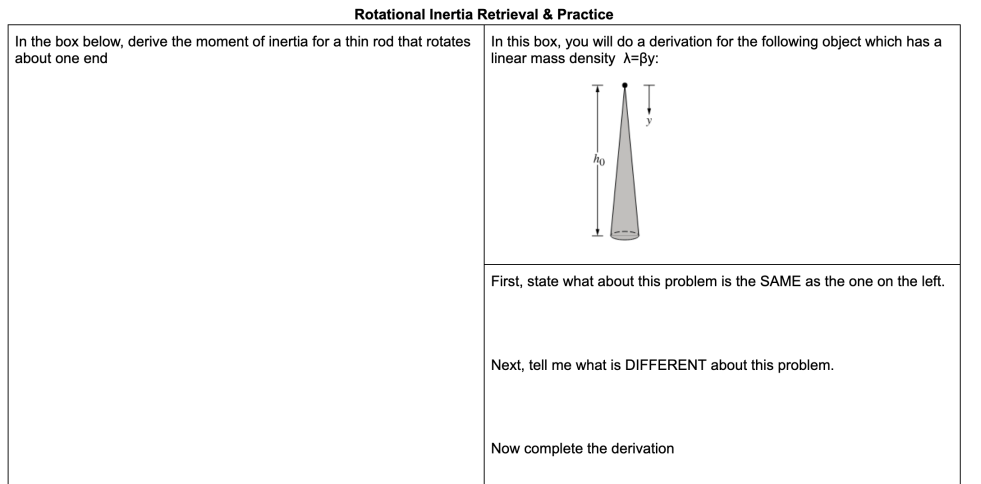
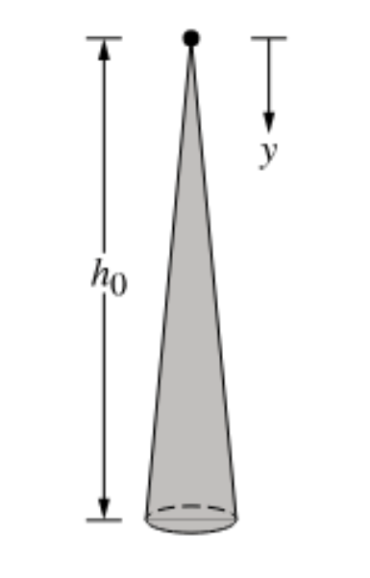
For this first task I felt the problem was almost too similar, but their hesitation proved otherwise. The task was to derive the moment of inertia for a triangular rod about its end where the linear mass density was provided as a function of position. (see below)
However, what I asked students to do first was to identify what about this problem was similar and different to the previous problem. After they took a stab at this we regrouped so we could discuss what I was looking for. It is similar in that it’s the rotational inertia of a rod-like object about its end. It’s different in that the linear mass density is non-uniform and is a function. Then students executed the task. As we moved through the rest of the rotation unit (where analogies abound!) this became my go-to phrase! “Before you begin, what is similar and different to what you’ve seen before?”
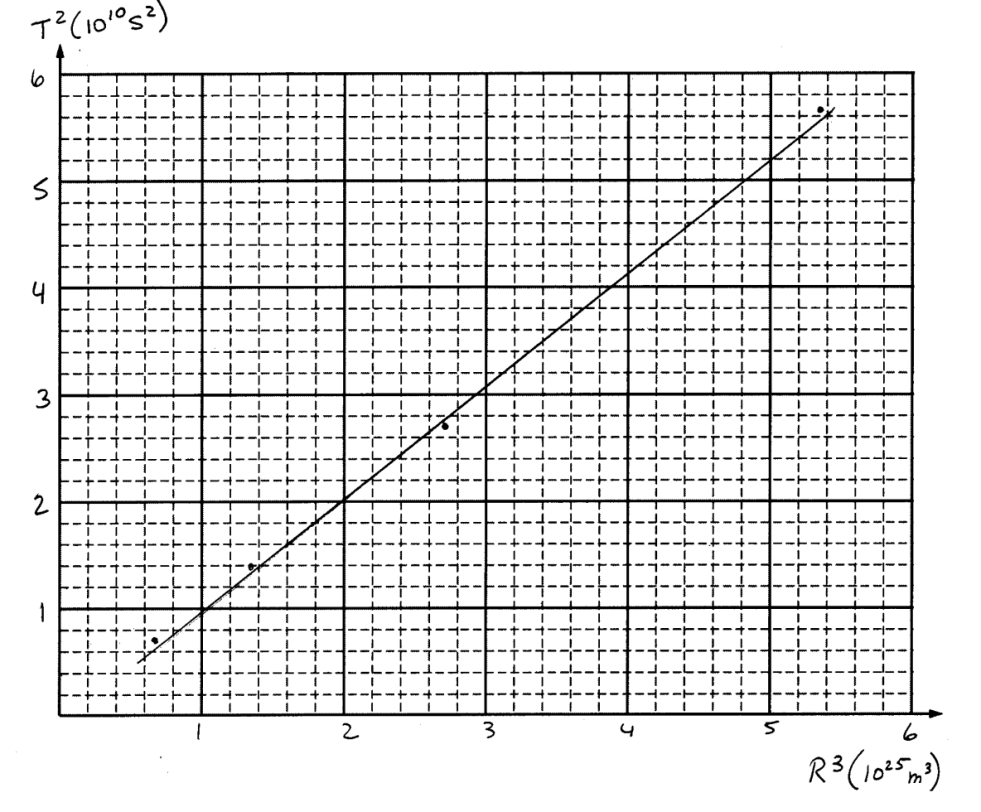
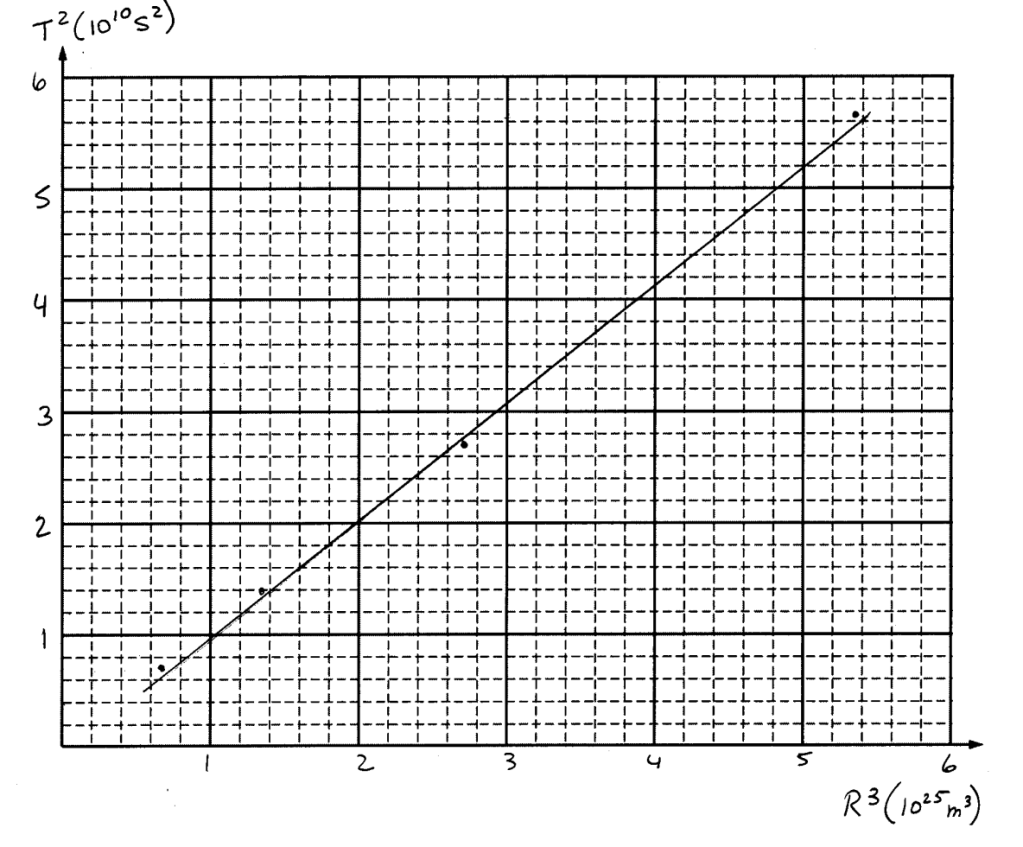
One of the struggles this year with my students has been linearization. Maybe it’s because I ditched Unit 0: Linearization because I wanted them to enjoy physics instead of getting bogged down in the math. Maybe it’s because I was panicking that their skills, overall, weren’t where I wanted them to be. Maybe it’s because unlike in previous years, this group of students were unable to transfer the skills from the labs to FRQs. Either way, I had a clear problem on my hands and I needed to solve it. So I decided to do a skill blitz.
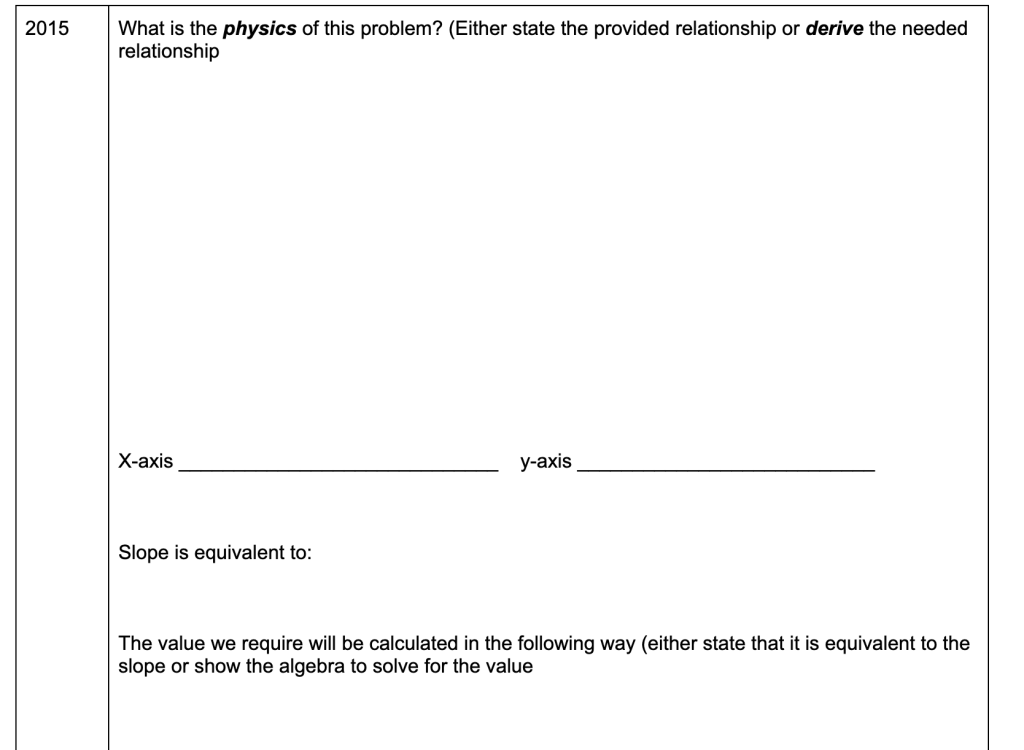
I went through old AP FRQs and settled on the lab FRQ from 2011, 2018, 2025, 2015 and 2005. I printed the page with the data table only on different colored paper for each year. Then I gave students a document with the following table (full doc here):
Students are asked to do the derivation, state the axis labels, the slope and then whatever algebra, if necessary, to obtain the necessary value.
When students believe they’ve completed the task, I come check their work. If it’s correct they go obtain the next problem. If it’s incorrect I provide some feedback/clues and they continue.
In hindsight, I should have provided the 2018 problem first, so what happened was this. I gave them 10-15 minutes to grapple with the 2011 problem. After a while and noticing students were spinning their wheels, I went ahead and walked them through the problem. Then I let them get started on the next one. Once they got started they were on a roll. I realized during class that I had actually managed to select 5 problems that also represented the entire scope of the course!
I wanted students focused on speed and accuracy. They were allowed to use notes, but obviously that could slow them down (and wasn’t overly helpful with this particular task). First group to complete all 5 tasks gets to pick treats for when we watch Interstellar next week!
I’m thinking about how I might do this blitz with the other styles of questions. Maybe for continued review next week. We shall see!
When I took high school physics almost everything was online. From physics classroom assignments, to the dreaded WebAssign, it was online. And because it was online, I like others, gamed the system (pre chat GPT). You know a certain number is going to show up somewhere in the answers? Enter it in all the blanks for the first submission so you can focus on the actual calculations. On the flip side was the part where you tried the problem so many times by the time you got it right you had no idea what actually worked. For the better part of my career I’ve been vehemently against all forms of online homework. There’s something about that screen that just puts a stop to the idea of using scratch paper for novice learners and we can’t have that!
(For what it’s worth, when AP went all digital I did NOT feel the urge to go digital in my classroom. I continued to do everything on paper. When APs came around I found my goal was acheived: I proctored the macro exam and did a count. 80% of physics students were using their scratch paper during the exam, while only 30% of non-physics students used their paper.)
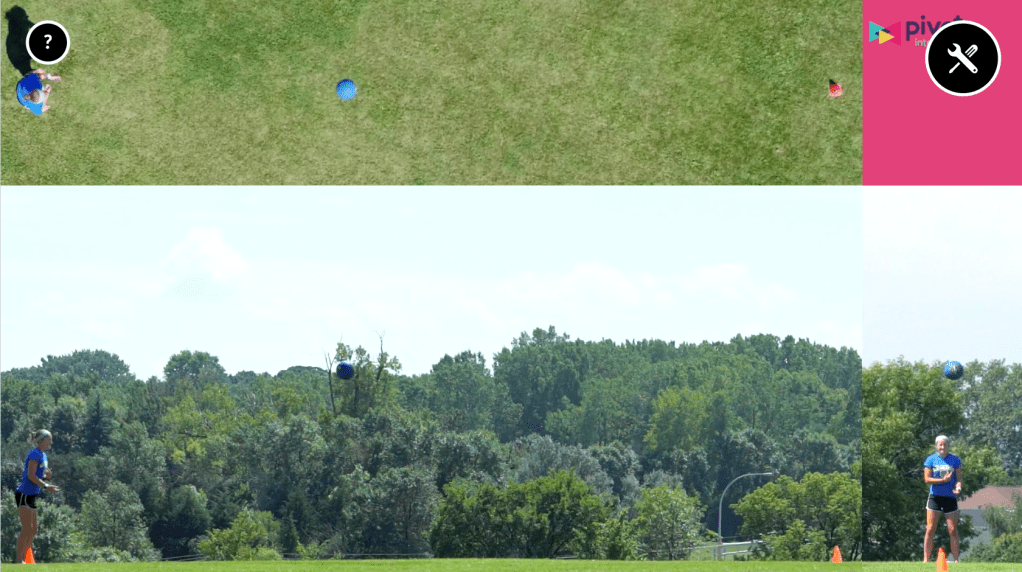
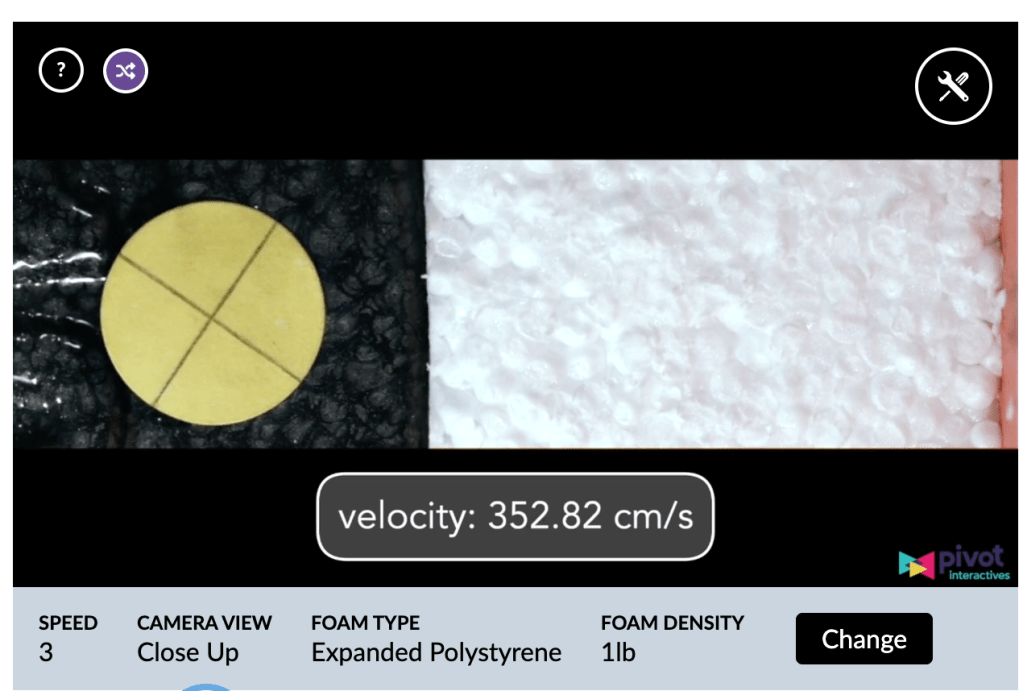
The first exception I made to online learning was Pivot Interactives. I was using Peter’s work back when they were “Direct Measurement Videos” which meant I had paper copies originally, anyway. As Pivot upped their game (including deep randomization and autograding) I started using some of these assignments since it sure made my life easier!
However, what I’m finding with my students this year is that like my Webassign days, students are doing the minimum to get all the green checks. This looks like not reading the prompts that explain what they’re about to do next and why, not actually collecting the data for the graph and totally missing the connections between the sample measurements and the data collection.
So, I’ve started to reimplement some paper versions.
The Activities: A Journey of Trial and Error
Earlier this year I assigned the helmet collisions activity. I added a prompt at the end that requested students to do the following:
What was the purpose of the activity?
Describe the procedure for conducting the investigation
Describe the calculations you made and why we made each calculation. You should include details regarding your values!
Describe what we learned from this activity about helmets as it relates to the impulse-change in momentum relationship.
This was ok, but I, arguably did this a bit hastily. I realized I wanted these documents handwritten and maybe a bit more depth/scaffholding.
A few weeks later I assigned the Explosions (Not Really) activity.
I knew that students would totally ditch all of the methods we had been using, so I decided to give them a paper to complete before the activity that related to the activity. This required them to complete the calculations with similar, but easy numbers and then have me check their work prior to the activity. This got a good chunk of kids on board, but some still struggled with the transference.
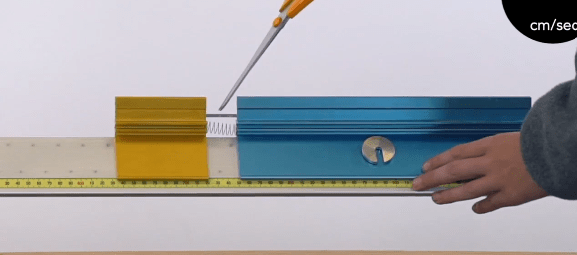
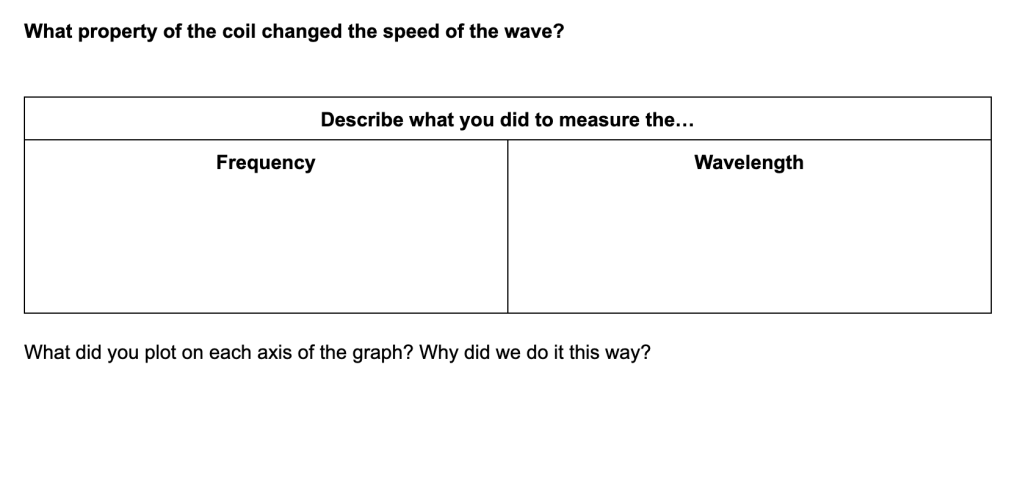
Still not completely satisfied, this past week I assigned the “Intro to Transverse Waves” activity. In this activity students are going to linearize a graph. This is a skill we don’t really cover in my regular level physics, but I like doing it at this point in the year because it’s such a powerful tool. As I anticipated, many students were ignoring the text about linearization completely. I chose a different approach to the paper copy.
First, I asked them to describe to me some of the new vocab as well as how we obtained our measurements
Next, I use a modified template from the Patterns Curriculum when students write conclusions in labs where we have graphs. It looks like this:
After investigating the behavior _______________, I conclude that there is a ______________________relationship between the [independent variable name] and the [dependent variable name] As the [independent variable] kept increasing, the [dependent variable]_____________________________. This system of a ___________________ can be mathematically modeled as:
[write the final equation]
where the constant [slope value] is the [description of slope for this experiment] .
I require students to write the ENTIRE paragraph from start to finish. This is not a fill in the blank activity.
This is currently my favorite interaction of the paper follow up and I’ll probably build more of these moving forward. I’m really in love with the patterns physics conclusions because it really requires students to put everything together.
Grading
I’ve noticed there’s a VERY strong correlation on these summaries between students who took the activity seriously and learned from it, vs students who did not. Because of this, the only thing I really need to grade with care is the conclusion paragraph itself. If students did the lab correctly, this paragraph looks great. If not, they usually don’t do well on this.
Do you do anything like this? What does it look like? How do you support genuine learning using online platforms?
At the American Association of Physics Teachers Winter Meeting I had the privilege of presenting in literally the best session of the entire conference (no bias here at all). Magically, all four of our presentations beautifully complimented one another and related deeply to engaging students in metacognitive skills.
I transitioned districts this year. In my previous district I worked with a lot of students in the gifted program, a lot of students in the creative and performing arts program (who are basically also gifted) and within this culture and climate, all kids benefitted, even the ones who were not in a special program. For years I was able to get students on board with the Expert Game, and the Science of Learning Physics some trust in the process, and good relationships. This year, that hasn’t quite cut it. I’d been thinking about a way to somehow “teach” students in a way that feel like “teaching” to them about how to learn, study and grow so they might buy into the idea (which is really nothing new).
I had been digging back into Powerful Teaching and some kind of workshop was begining to materialize, albeit very, very fuzzy. And then, at Winter Meeting, Aaron Titus gets up and shares that he offers a “How to Do Better on the Test” workshop which turns out to be “How to Learn”
The workshop is grounded in the work of Dr. Saundra McGuire. There are a lot of resources of hers around the web, like this lecture here on metacognition, but primarily she has a sweet little book called Teach Yourself How to Learn. It’s short, sweet, to the point and a lot of fun to read. Dr. McGuire is a retired chemistry professor and Director Emerita of the Center for Academic Success. She is also an awardee of the Presidential Award for Excellence in Math and Science Mentorship.
Immediately in chapter one she discusses one of the aspects about college that is hardest for students: getting As and Bs in high school often comes down to memorization and regurgitation. Now, before you come with fire I know that many of us (especially if we teach AP, and definitely if you enjoy my blog) are making students do incredible things. But I also know that you can probably name more than a handful of colleagues who don’t push their students beyond memorization. Teachers who produce study guides that are basically a carbon copy of the exam. Exams that are almost all multiple choice and the math is strictly plug and chug. The dreaded triangle to “support” students doing equations like F=ma. And if not the teachers themselves, some really great high school students simply don’t get pushed beyond needing to simply show up to class to learn the information. They can get away with minimal to no homework and no studying and still do okay in the class because we see them every single day and they work hard in our rooms.
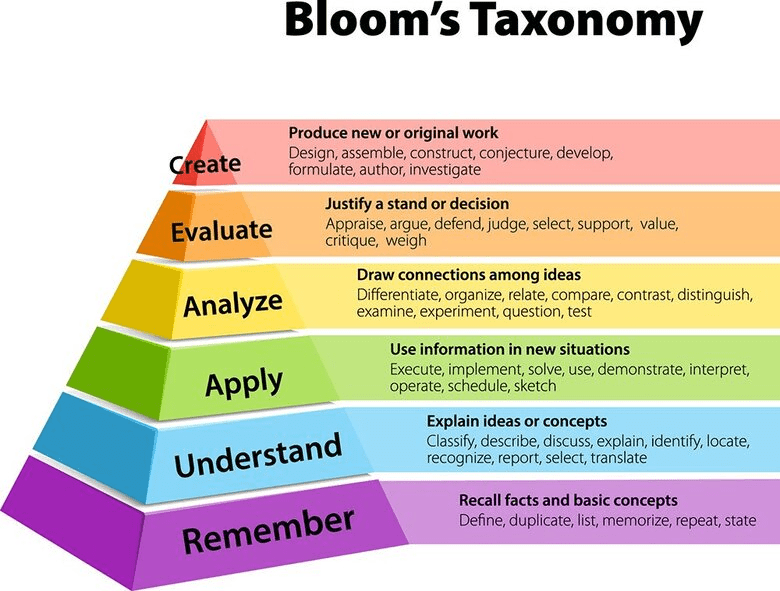
So the workshop starts by introducing students to Bloom’s Taxonomy and we have a conversation about what level they are operating at most of the time, compared to what level they need to operate at for AP Physics. What level do they think they need to operate at in college?
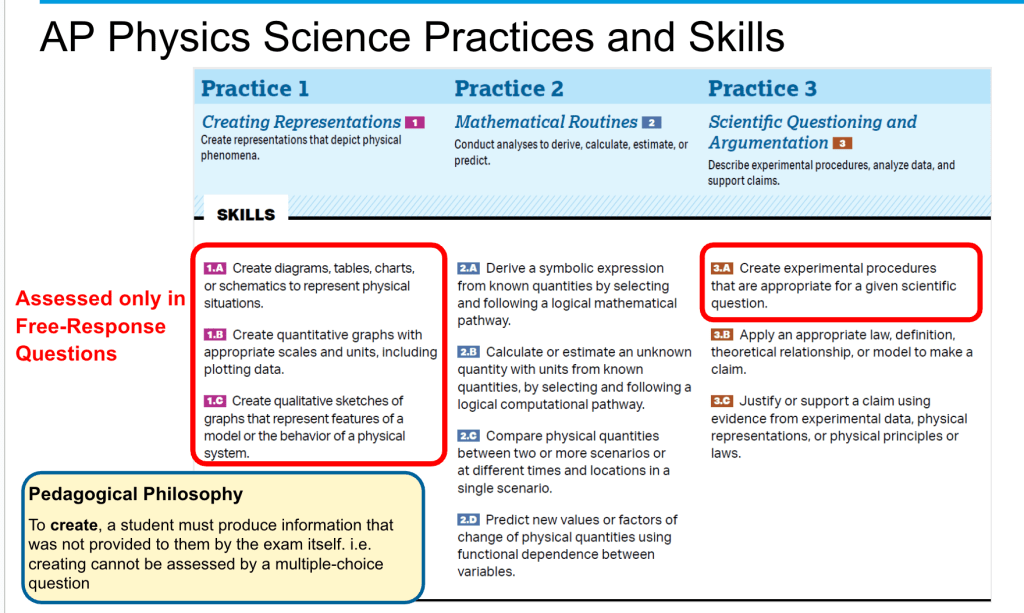
And sure enough, if you pull up the science practices and skills for AP the word “create” is literally all over the place. The top of the pyramid.
From here we took a look at a recent exam question. First I asked them a simple question:
Which of the following is true about work?
Work is effort
Work is a change in energy
Work is a force
They all know the answer. And this is a recall answer.
Then I showed them the exam question (they did really poorly on). While the question fundamentally was about the fact that work is a change in energy, what they were asked to do was apply the concept of taking an integral to calculate work and then create a graphical representation.
From here we discussed the differences between studying and learning and posed the question, “which would you work harder for? To study to get an A on a test, or prepare to teach the material to the class?”
The latter half of the workshop is about sharing strategies for doing homework, reading the text, and using practice exams. (You can find all of these in Dr. McGuire’s work and resources!)
I summarized some of these along with my personal favorites into the following list:
When you get home from school, write down everything you can remember from class that day, then compare with your class notes to identify/fill the gaps
Did you solve some problems? Grab a clean sheet of paper and solve the problem again. Compare to the example and make notes regarding your forgetting/gaps
Create a concept map to tie together big ideas and conceptual details
Make “teacher notes” as if you were preparing to teach the material
Aim for 100% mastery when you sit to study, not 85-90
As we wrapped up, the most important part of this workshop was asking students to make a commitment to do something different in the next 24 hours. I had students submit these along with some additional reflections. There were two that stood out to me today. One student reflected, “The reason this class is so challenging for me is because I haven’t had a class besides maybe Calc that required me to be at that creating level.”
A second student made an observation that knocked me over in joy:
“Physics is more than just who is smarter and has the ability to think at a higher level.”
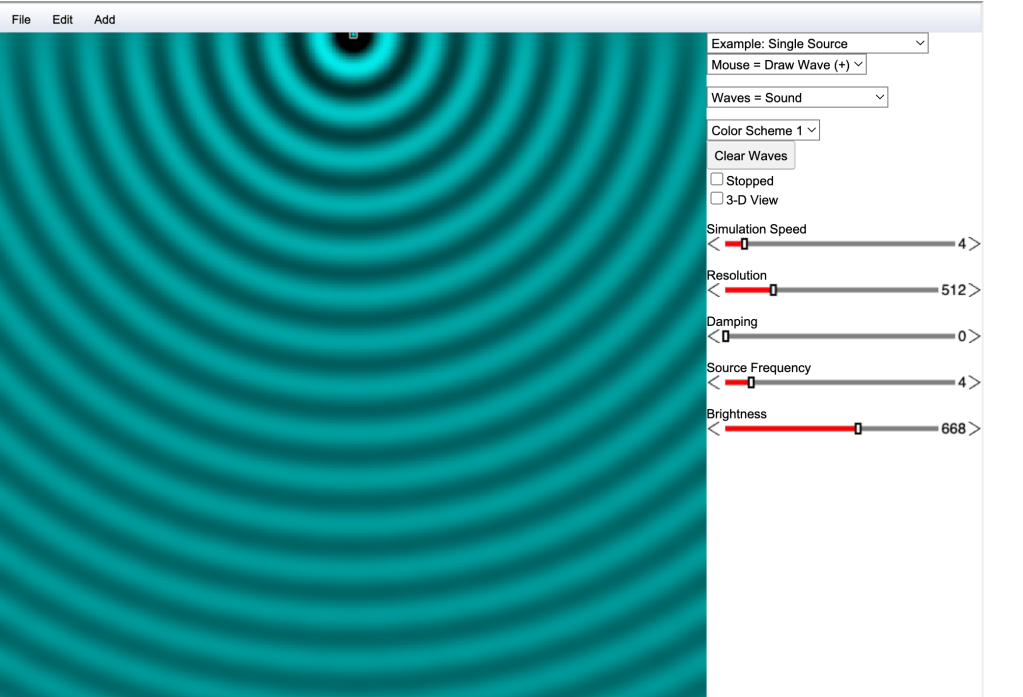
When I was in college my E&M professor introduced me to the falstad apps. It was literally this guy who created a bunch of different JAVA sims. E&M is notoriously challenging due to needing to think and reason in three-dimensional space, so we were encouraged to use the apps to help us visualize static fields.
When I started teaching I decided to poke around and see what else Falstad had created. One of his simulations I use year over year is his ripple tank. It’s incredibly powerful and way less cumbersome than setting up the actual water tables (which was just unfeasible being the only physics teacher with 3 preps)
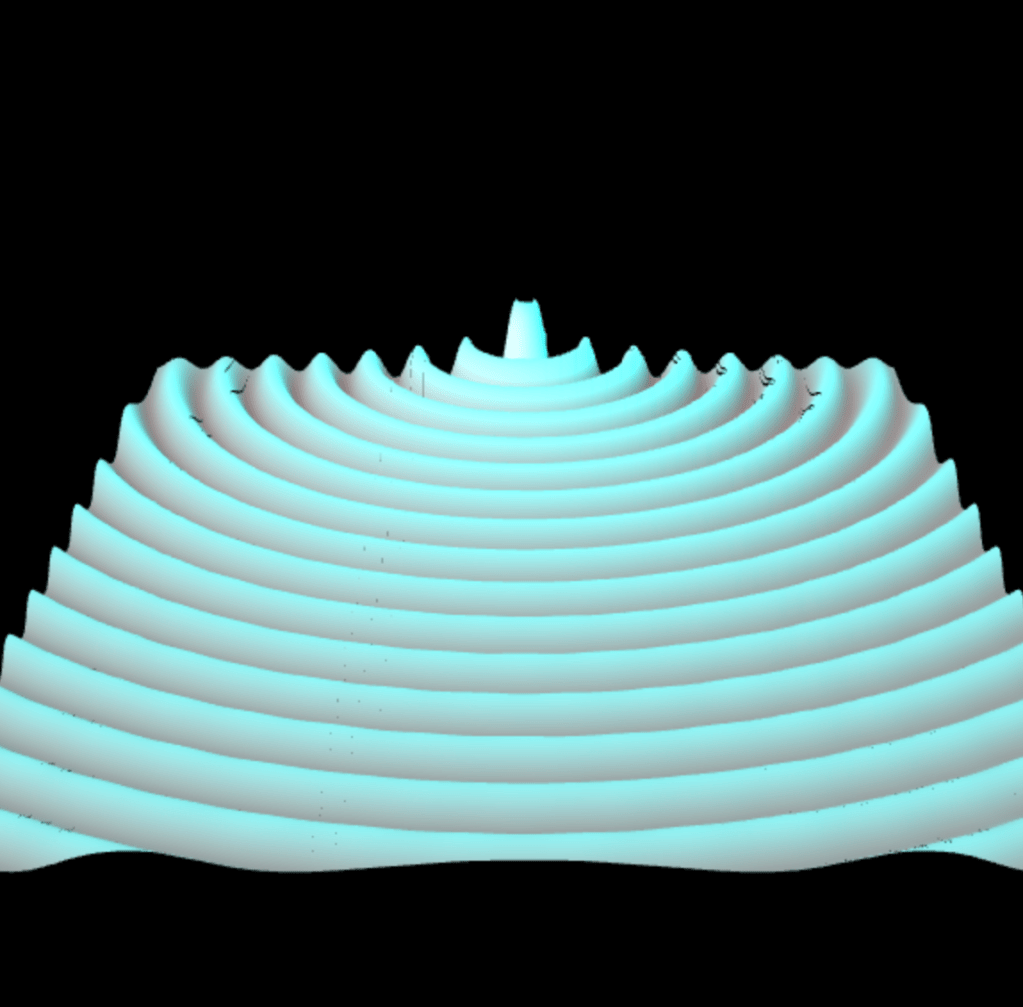
When the app opens it’s pretty simple. A “faucet” wave like the one in the Phet sim is present. You can see the sliders to adjust for damping and frequency. You can move the source where ever you like and can even toggle into 3D view
What’s pretty awesome is the list of “examples” you can select from the drop down menu.
Single slit, double slit, two-sources, refraction, total internal reflection and a whole slew of topics. You also have complete freedom to add to the simulation using the “add” menu bar at the top.
For my students, we start our waves unit in the following way.
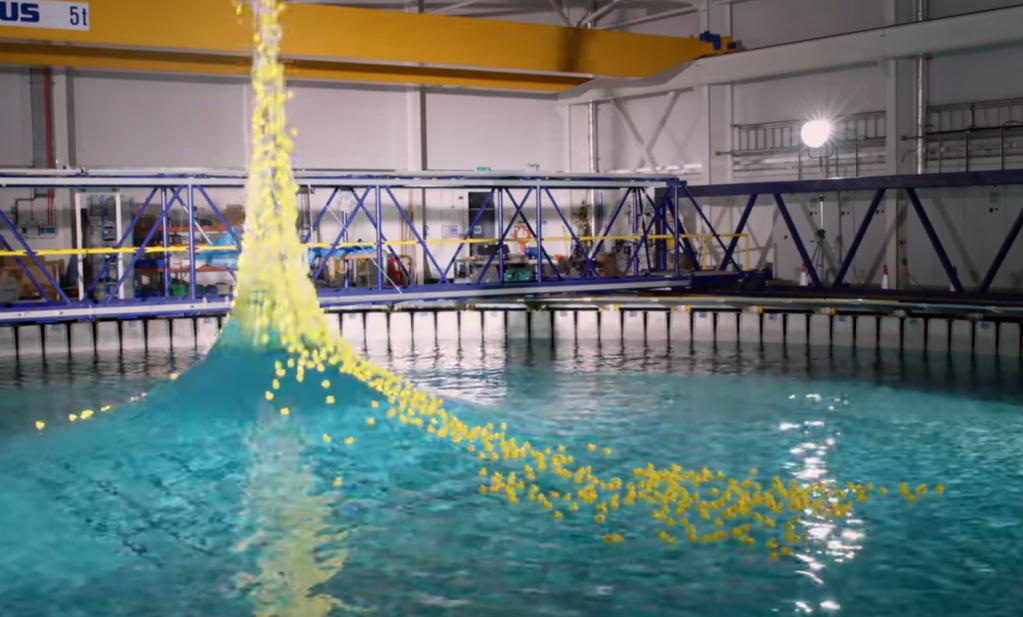
There’s a lot of really great phenomena here. From constructive interference, to refraction and lenses (pay attention to the grid image in the column) to the idea that waves transport energy, not matter.
This activity typically takes a class period and a half. For my advanced students they can usually finish in a class period or I can assign the rest for homework.
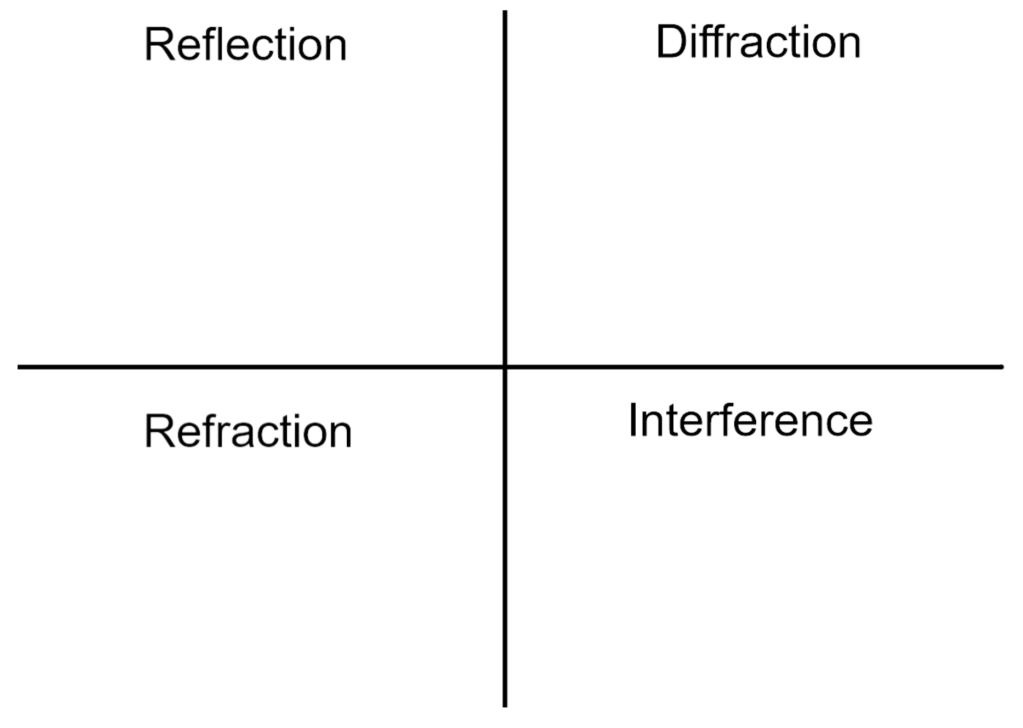
When students return the following day, I put this graphic organizer up and prompt them to write their own definition of the behavior based on their observations and a diagram to go with it
During the unit I come back to this app quite often.
We discuss how the design of an auditorium is based on nodal lines
I can drag the single source around to demonstrate doppler effect and sonic booms
If there’s a phenomena I want students to be able to observe, pause and manipulate… there’s usually a way to do it.
The Physics Classroom holds a place near and dear to my heart.
For years I thought it was my special secret. Long, long ago the url was something like physicsclassroom.glenbrook225.k12.il.us because it was a site hosted on my High School’s sever. The main author was Tom Henderson, one of the best educators at GBS. Tom taught the most advanced freshman in chem-phys, as well as the conceptual physics course. He had a great handle on meeting kids where they were at and explaining physics in a way that made sense as a student.
It wasn’t until much later I realzied that physics classroom was a well known resource for physics teachers across the nation.
As a student, something I realized was that what I found fun, challenging and helpful to my learning in physics was often a barrier and frustration to my classmates. Getting an “O Drats” without a way or opportunity to reflect or see where an error was made became maddening and frustrating. At the same time the essence of drilling a tiny skill is so valuable for long term learning.
I steered clear of most online homeworks for a long, long time (webassign also traumatized me). I knew that too often the real work that needed to happen to actually learn was skipped by most students in search of elusive green checks. By the time you got the checks, you had no memory of what actually worked.
Over the last few years I’ve started developing handouts to go along with some of the physics classroom activity sets. I only have a few, but enough that I feel like they are worth sharing publicly at this point. The goal is to get students thinking, writing and documenting as they work through the physics classrom activities. It also provides me with documentation. I will admit, another motivation for this was the fact that I did not have a paid subscription to task tracker. Now that I do, I’m developing more of these and will continue to share and post them here as I develop them.
What I’ve found is that more students are able to move through more problems with more success and confidence. Definitely a win! They hate me for slowing them down with the paper documentation, but I see it as a win.
In the paper document (preview below) I ask students to first describe the motion in words. This way, when they watch the little car drive across the screen and make the dot diagram, they know what they are looking for
Kinematics Calculator Pad Sets
In the paper document, students are prompted to make their picture, their chart of variables and solve the problem by selecting an equation then substituting values as needed. This is a second version (sample below) that is specific to set 12, and provides more room for student work.
The first few pages of this document are notes in which we construct the momentum bar charts for different situations and identify what is the same and different. Then students go to the concept checker and I ask them to create the bar charts and document the similarities/differences prior to making their selections. A preview is below and here is the handout