Activities · Science of Learning · Teaching Methods

ABCs of How We Learn… X is for eXcitement

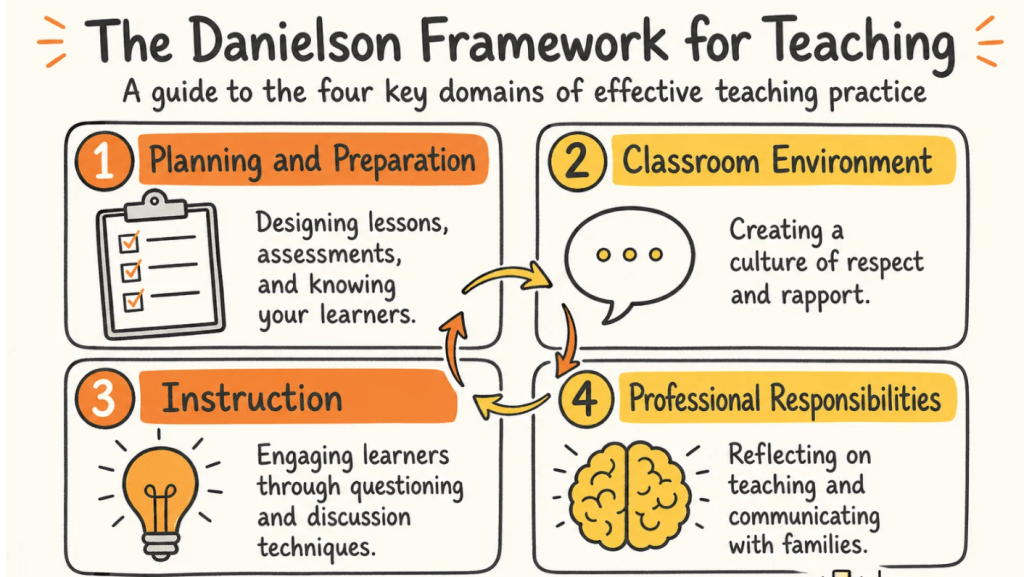
Engagement is one of those trendy buzz-words in education. From the Danielson Framework (domain 3) to SilverStrong to Marzano, engagement is a major focus of all of these evaluation tools and typically a “sell point” for curriculum packages and methods.
When Building Thinking Classrooms was gaining popularity, one of the frequent complaints from folks deeply embedded in the science of learning/explicit teaching was that the program looked like “engagement” but engagement doesn’t necessarily equal learning. While this statement in and of itself is certainly true, there are quite a few points to Building Thinking Classrooms that are right on point when it comes to the science of arousal and learning.

When we are aroused, engaged, excited our brains are primed for more learning. Researchers describe the relation between arousal and performance as the Yerkes-Dodson law (Yerkes & Dodson, 1908). While this law applies to known skills, it is transferrable to learning new ones as well. In short, when aroused we release cortisol which activates the fight or flight response but also impacts the way in which we process and store information. This process is ultimately why we have stronger memories tied to stronger emotional events. The science around emotions and learning is a bit murky, but we do know that when the mind is aroused there is, indeed, a measurable impact on learning.

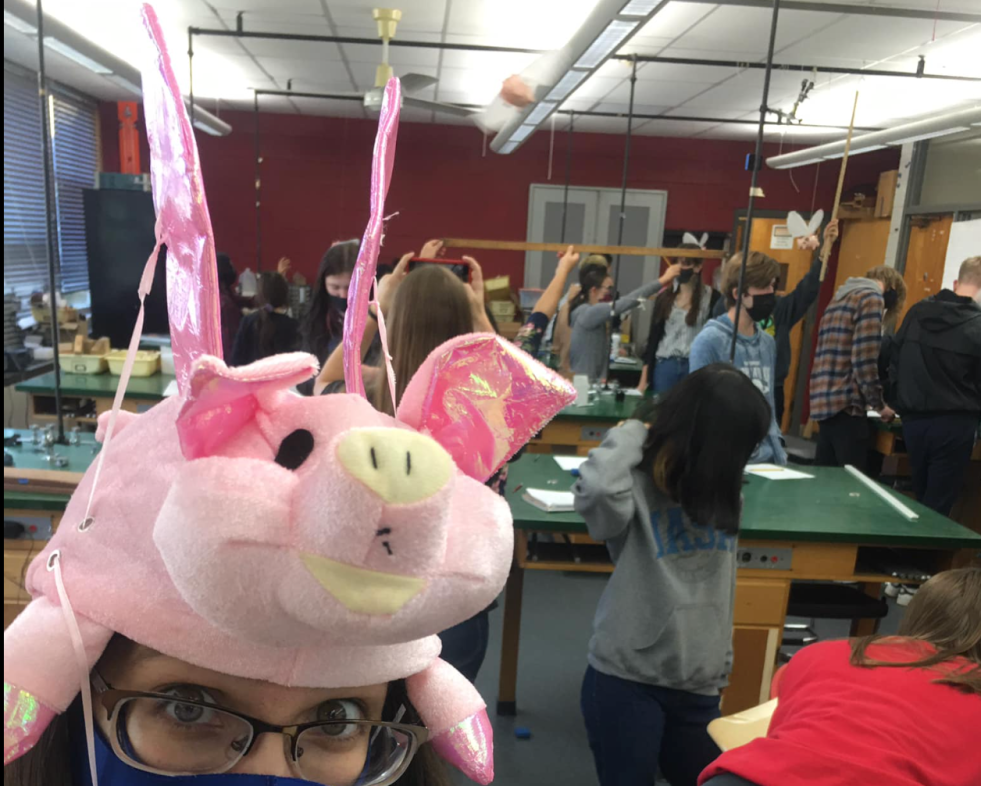
Arousal can take many forms in the classroom, which might be anything as extreme as the teacher coming into class with a ridiculous costume or schtick that day, to an impressive demo or video, but it can also be less intense such as interacting with engaging questions, or incorporating kinesthetic movement into the lesson.
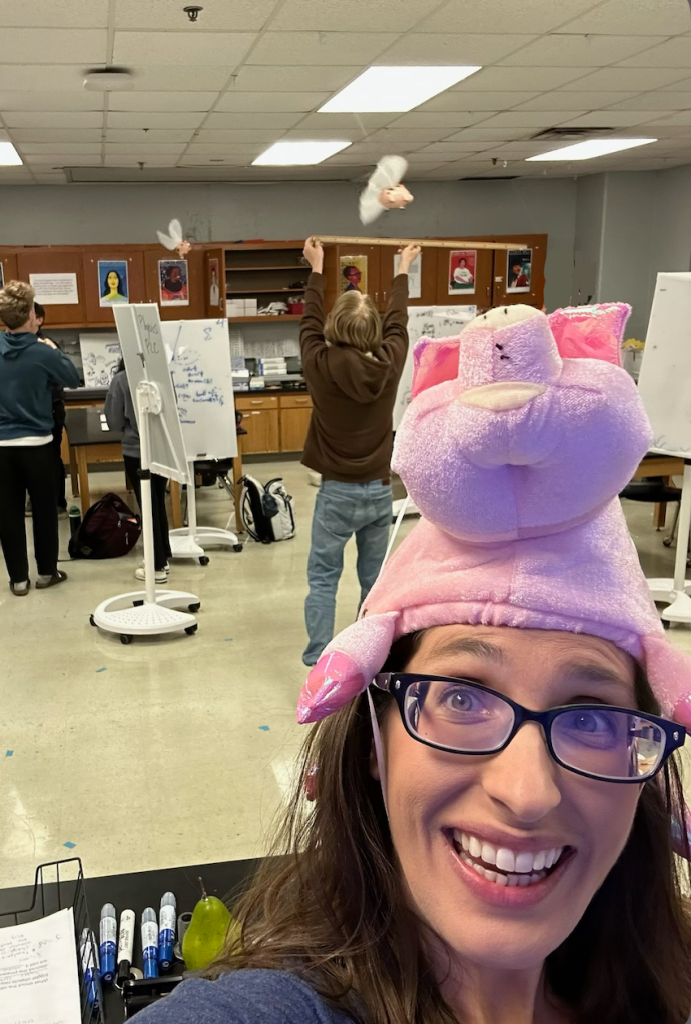
My one and only schtick of the year… the flying pig hat. I can actually make the wings flap!

From the lens of physics teaching, this brings us back to why an active learning environment is beneficial for our students and has been proven over and over again to be more effective than lecture alone. An active classroom takes advantage of arousal to our learner’s benefit.

Coming back to Building Thinking Classrooms let’s take a look at some of the micro-moves and paradigm shifts that leverage arousal:

  • A lesson typically starts with an engaging story or interesting problem. In the ABCs of How We Learn, Schwartz, Tsang and Blair explain that arousal helps us consolidate focal information, and pushes out nonfocal information. The bits of the story which are applicable to the problem itself are most likely to be retained.
  • In a BTC lesson students never sit down. You’ve probably heard of “brain breaks”. Since whiteboards are vertically mounted, student bodies are now in an active, rather than passive position. This requires the biophysical response int he body for action, which requires a certain level of arousal.
  • A BTC lesson involves not only working in pairs or triads, but the cross-pollination of ideas from other groups. Research has shown that people perform better in social situations. The design of a BTC leverages the social aspect, while the carefully crafted consolidation phase reduces any negative anxiety that would be present in a “typical” classroom where students are called upon to give their answers for their own work.

When I started this project the initial motivator was our EduInfluencer keynote speaker. He made the claim that in his research the average teacher could only accurately name and explain three strategies. Today marks the 24th post in which I’ve explained the science of learning and then matched each topic with one or more classroom strategies.

Very, very often when teachers select an idea, tool or strategy for the classroom the reason they share they love it is because “it gets the kids engaged and they have so much fun”. We need to recognize that in the ongoing battle for the respectability of our profession, that line of reasoning is weak and harmful to us as professionals. Tools we choose that are “so much fun” are effective because tools which excite and engage our students activate the arousal systems in the brain, which change the way the brain receive, processes and encodes new information and subsequently increases the strength of the neurological pathways and the amount of knowledge retained. Let’s continue to have conversations about our work that can only be adequately criticized if done with additional evidence.

Activities · Science of Learning · Teaching Methods

ABCs of How We Learn… U is for Undoing

“A bullet is dropped at the exact same time that one is shot horizontally from a gun. The bullets start from the same height. Which lands first?”

We know how this question goes when posed to students. Aside from the fact that we’ve primed them to answer one of the bullets, knowing full well the answer is “neither” we are leaning into student misconceptions, or rather an incomplete conception.

Students know, and are correct, that the shot bullet is initially travelling faster than the dropped one. Students also know, and are correct, that the shot bullet is always moving with a faster speed than the dropped one. Students also know, and are correct, that faster objects will travel the same distance in a shorter time than a slower moving object. All of these notions are true, and because students know these to be true, they will typically answer that the shot one lands first.

Well… except for those students who think about it a little more. See, those students reason that because the shot bullet is travelling faster and because it was shot horizontally, it is going to travel more distance, so perhaps the dropped one lands first due to its shorter distance.

Then there’s the one kid who of course has to say “air resistance!” in some way because fast things experience air resistance. Also not wrong.

Every bit of this reasoning is true until you get to the conclusion.

The issue here has to do with the fact that the reasoning and concept are incomplete. Students are not taking into account that the vertical properties of the two bullets are all identical, and since gravity, a vertical force, is responsible for accelerating the bullets towards the ground with the same vertical acceleration, they will land at the same time.

In a course where students are already coming in with preconcieved notions about who can do physics, the last thing we should be doing is blatantly demonstrating everything wrong with their thinking. Instead, we should leverage and aknowledge the good, while also giving them the tools to make a complete judgement.

Physics students come to us with a lot of incomplete conceptions, they want the ball to roll out in a curved path…

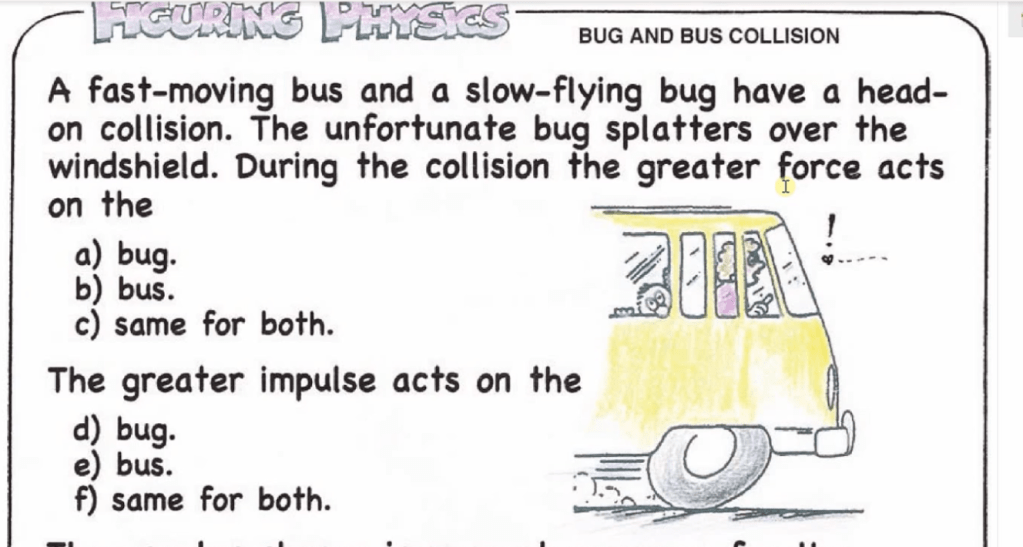
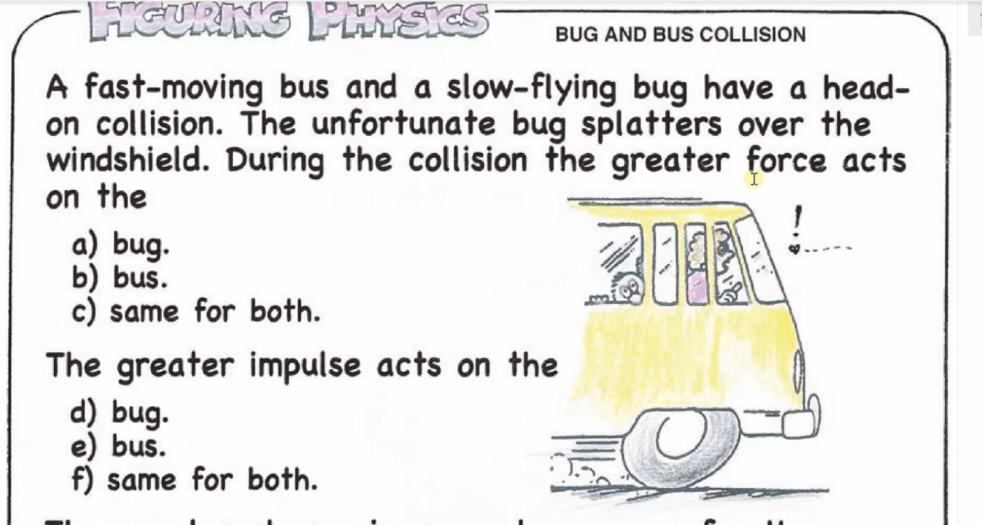
They want the force on the bug to be more than the force on the bus

They want acceleration at the peak of a projectile’s flight to be equal to zero, an object that flies out the window is moving backwards, waves should push matter, and more resistors to always mean more resistance.

Physics misconceptions are frustration for student and teacher alike because they are very much grounded in elements of truth and lived experience, but they are always incomplete.

Making these notions complete and providing many opportunities to encounter the complete notion is imperative to unlearning the previous notion. In order to do this we must:

  1. Increase student precision of thought; so they can reconize the difference between arguing with evidence vs intuition.
  2. Provide students with an alternative conception. This is where our representations such as force diagrams, motion maps etc. come in.
  3. TIME – students need time and exposure for the new conceptions to take hold.

This is a critical component built into the Investigative Science Learning Environment framework, and it is immensely effective at completing these conceptions. What I particularly like about ISLE is that when we are providing the alternative conception, especially for the first time, we are not leaving it up to students to just make the representation. Instead, that representation is carefully drawn through observational evidence.

Coming back to the original question of the two bullets, let’s discuss how the ISLE cycle approaches this particular conception.

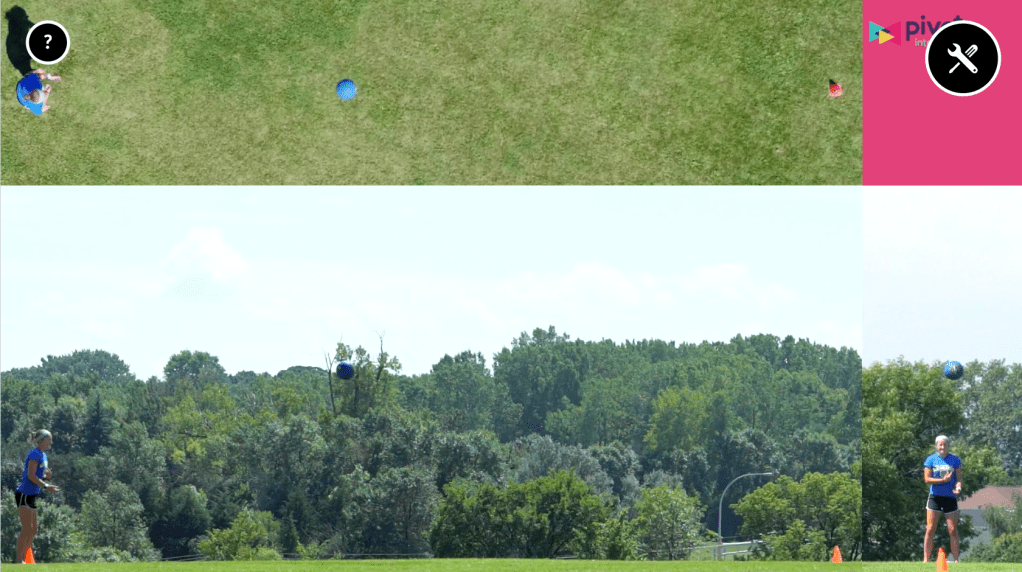
In my class, I use the “three views of a ball” in pivot interactives for their observational experiement.

First, I ask students to construct the motion map for each of the three views. Even here students will sometimes rely on their incomplete conceptions over their observations. I will gently remind students to construct the maps based on the evidence in the video. (This is why we use an experiment!) How is the distance changing (or not) as the ball travels accross the screen? Be sure to represent it appropriately!

After students have done this, we discuss how the side-view actually works (Just in Time Telling!). It’s a composite of the top and front views. That is, the top (horizontal motion) is totally constant. This makes sense because there are no horizontal forces (I do projectiles after forces). The front view looks like an object experiencing gravity.

When students get the question with the classic ball drop demo (now a testing experiment rather than a demonstration) instead of just asking the question about landing, I ask them to first carefully construct the motion map for each ball based on what we’ve just learned and discussed then make their prediction. They should then be able to explain the reasoning for their prediction based on their motion maps.

Students all come to the agreement they should land at the same time.

In this manner of approaching the misconception, we have equipped students with tools to support their thinking, and forced them to slow down that thinking so they can achieve success at reaching a final answer.

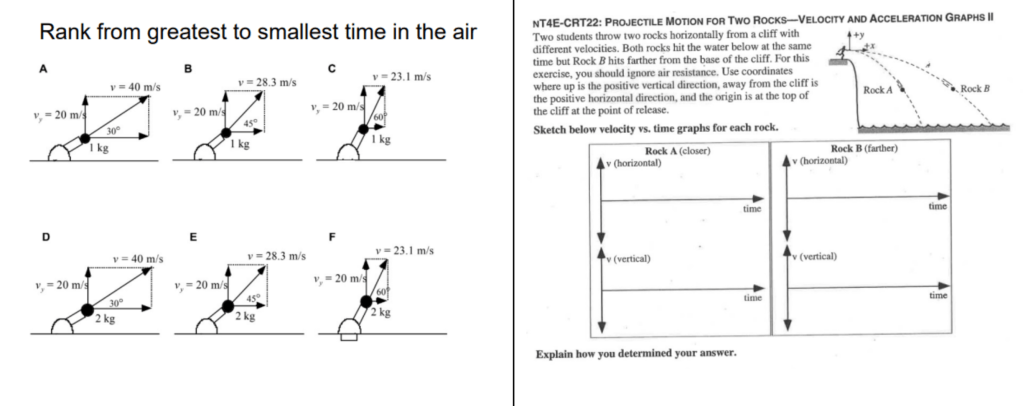
From here, students need additional opportunities to represent and reason, so I will use problems like the ones from TIPERS

Teachers that have learned about ISLE for the first time often feel overwhelmed by the idea of “changing everything” but in truth, it’s really more about shifting the overarching perspective and intention, and then you can continue to do a lot of the same activities you’ve done before! Consider any of the other misconceptions presented here, or that you can think of. What might be a way to develop an observational and testing experiement to support the undoing of their misconceptions?

Science of Learning

ABCs of How We Learn… N is for Norms

Today was the last day of school for seniors. I have my students fill out an exit survey in which I ask them what they were most proud of, what surprised them and what was the most important thing they learned this year. I was really excited to read some of my student responses. More on that in a moment.

Norms are the rules of the game. They are what dictate conduct in social settings. In society they are often the unwritten rules, very often defined by cultural norms. I remember when I went to France for my honeymoon. A lot of Americans go to France assuming the French are rude. The reality, as my Aunt and Uncle explained to us, is that Americans go to France assuming they can act like Americans, rather than learning the cultural norms, and this becomes off-putting. In the US we expect our waiter to check in when we sit down and when we are done with our food. In France, the restaurant expects you to enjoy the experience for as long as you need or would like. You call the waiter over when you are ready to order and when you’re ready for the check. No one is going to rush you out of the restaurant with a check, you can sit and talk as long as you like!

I bring up this example for two reasons. One, it is an example where the norms dictate the expectations and behaviors, but secondly, the conflict in expectations due to cultural differences is what can lead to one or both parties either being upset or in active conflict.

Conflict very often arises when the unwritten norms of one person/group do not match the other. This is why it is especially important in the classroom setting to make these norms very much written and visible.

One set of particularly important norms are the ones we use regarding our content. The previous post mentioned the scientific practices from NGSS. These are excellent norms to have as part of learning, discovering and justifying. We must ask ourselves, what is the norm for engaging in learning activities? Is the norm that the teacher is the keeper of knowledge and the students are passive receptacles? Or are the students active participants? Are they expected to continue asking themselves “how do I know this”? Are they expected to give answers based on intuition or based on evidence? The norms we set for how we engage with science in our classroom are the norms we are teaching our students are part of the scientific community.

This is part of what I really enjoy about Building Thinking Classrooms. Many of the strategies turn what students know as the norms of school on its head. Specifically defronting the classroom, the consolidation process and note-making.

Since Listening and Sharing is also a critical feature of education, norms for discourse are particularly important in the classroom.

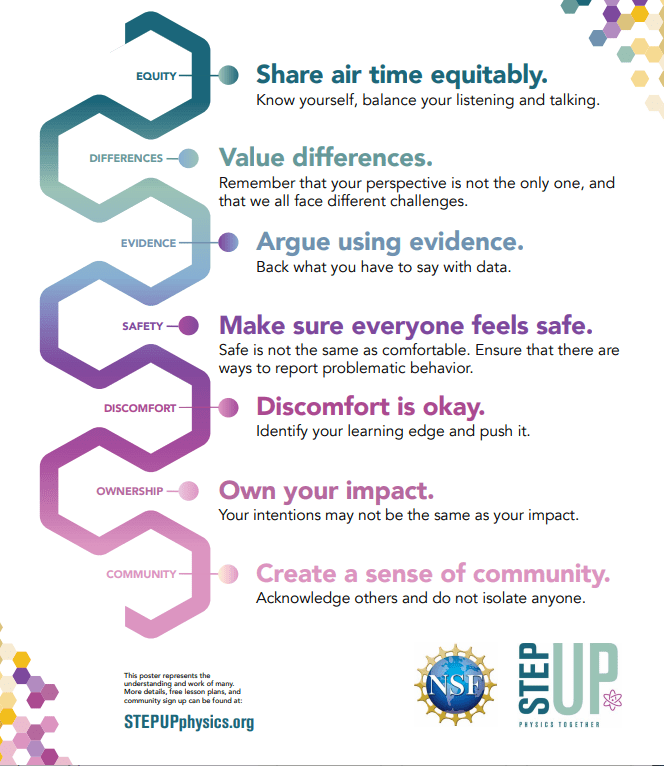
STEP UP has a great poster of norms for the classroom:

EQUITY Share air time equitably. Know yourself, balance your listening and talking. DIFFERENCES Value differences. Remember that your perspective is not the only one, and that we all face different challenges. EVIDENCE Argue using evidence. Back what you have to say with data. SAFETY Make sure everyone feels safe. Safe is not the same as comfortable. Ensure that there are ways to report problematic behavior. DISCOMFORT Discomfort is okay. Identify your learning edge and push it. OWNERSHIP Own your impact. Your intentions may not be the same as your impact. COMMUNITY Create a sense of community. Acknowledge others and do not isolate anyone.

This school year I found that students were very uncomfortable having conversations or working in groups with students who were not their besties coming in. Sometimes holding the norm looked like actively telling students we weren’t going to comment on “good” or “bad” groups. Other times this meant actively coaching students on engaging in discourse with one another. It felt like an uphill battle all year.

But then the end of year comments came in:

Particularly as an AP teacher, it can be easy to get caught up in the exam, the scores, the grades. After all, its one of our primary measures of success. But honestly, for myself, success also looks like these student reflections. It looks like students telling me that tests are feedback, and that they learned it’s ok to fail sometimes. Because those lessons? Those are the ones that last a lifetime.

Science of Learning · Teaching Methods

The ABCs of How We Learn: L is for Listening and Sharing, Strategies to Enhance Group Work

I have a saying for students, “The 100% is in the room”.

What I mean by that is that, collectively, the 100% exists. Not necessarily within one student, but when students engage in true collaboration, very often, the 100% exists.

L is for Listening and Sharing and is based on the idea that we learn more together than we do alone.

This would then suggest the power of working in small groups. However there are a few flaws that teachers fall into very often:

  1. Putting students in small groups alone is not going to lead to learning. Students need to know how to speak and listen to one another.
  2. Group selection can be powerful, but students will make assumptions about why they are in a certain group, which will influence their behavior in the group

Setting Norms for Group Behaviors/Interactions

We have all seen this in our classrooms and even in PD sessions or workshops. Some groups function together excellently, while others flounder fantastically. Setting the norms, expectations and even scaffholding the conversation is a critical component of our work.

Protocols

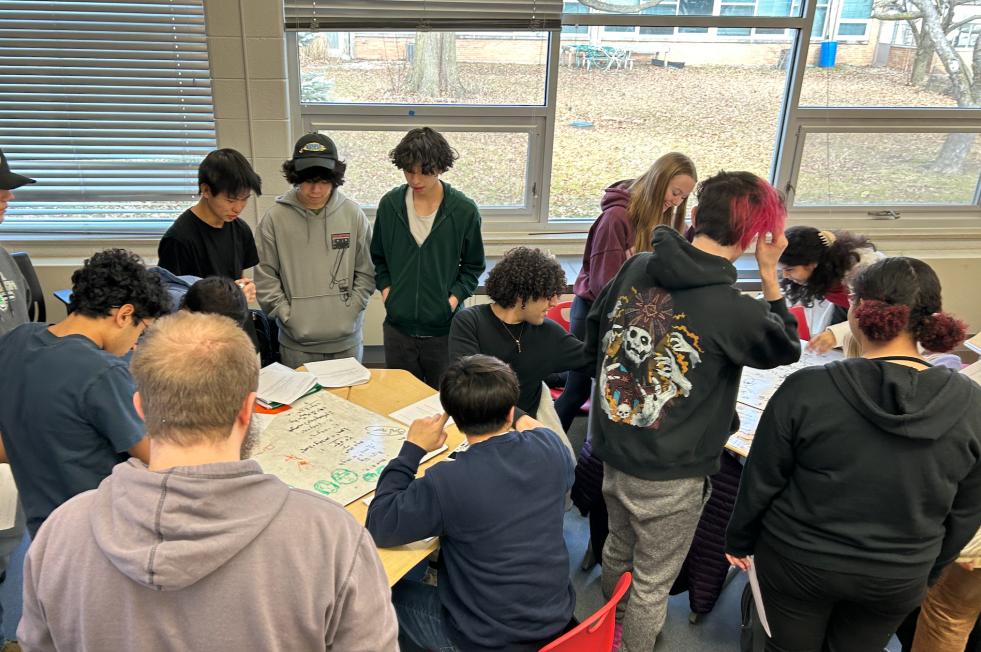
When we implement highly structured protocols we provide students with a predictable framework for engagement. The book Protocols for All is a great place to start and has some ideas that you’ve probably encountered. Many of these protocols are what you might classify under “ice breakers” or “team building activities.” Research has shown that taking the time to get students to work collaboratively outside of the specific content area supports their ability to work collaboratively when its time to get content-specific. What I like about a lot of these protocols is the emphasis on listening because often our best talkers are our worst listeners. In a profession that frequently values and rewards extraversion, it’s really important that we take the time to hone the seemingly less charismatic skills.

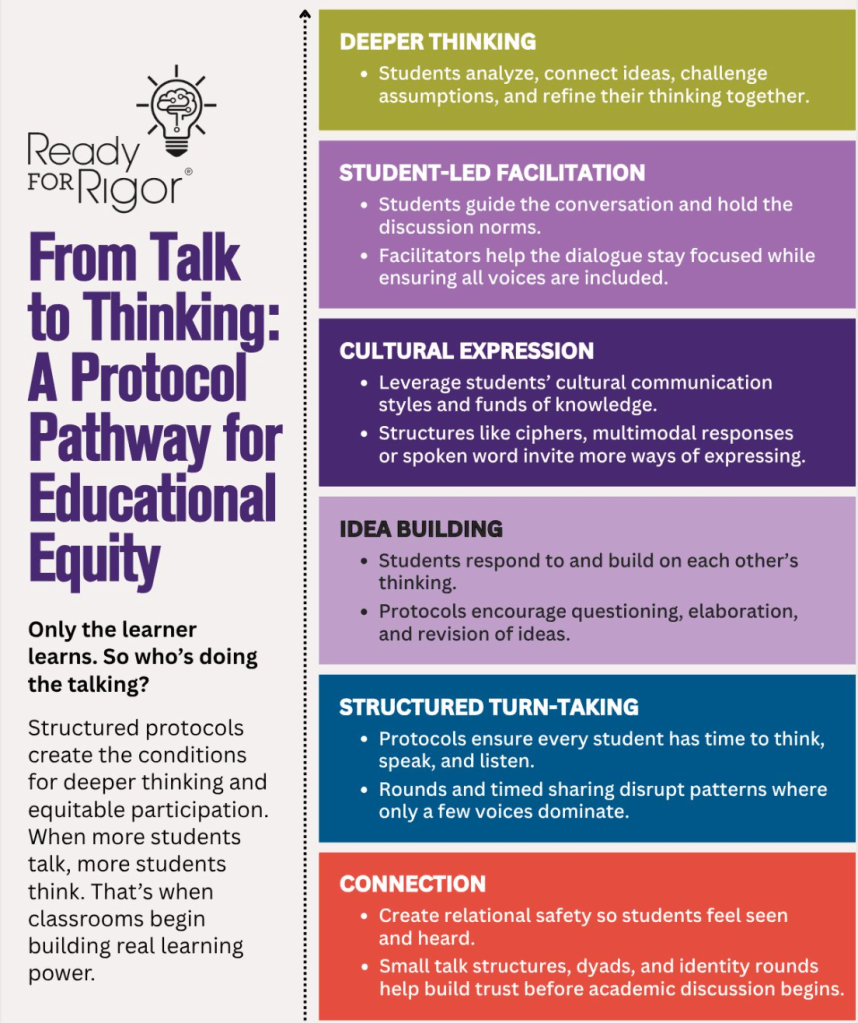
I just so happened to run across this graphic from Zaretta Hammond, author of Culturally Responsive Teaching and The Brain, that outlines a progression of protocols to support student discourse and equity.

She is leading an online summer PD on this topic that you can currently register for and has a previous article with additional ideas described here

Group-Worthy Tasks

Along the same lines, the kind of task we select is critical. This has been named “group-worthy tasks”. A group-worthy task has a few key features. First, it cannot be completed in the time allotted alone, the group members must depend on each other. This requires the task to have a certain level of complexity. Second, the task must have multiple entry points for success. This means that there is a way for the students who are at a lower performance level to positively contribute, but there are higher order thinking tasks available for the upper-performance level students to address.

Marta Stoeckel and Kelly O’Shea wrote a fantastic article about Group-Worthy Tasks for The Physics Teacher in 2024. A few additional features I’d like to bring your attention to is assigning group roles of Skeptic, Facilitator, Summarizer and Navigator and providing students with a role-card during the task. The second feature is discussions around what makes someone good in science (asking good questions, making astute observations etc).

Mitigating Student-Assigned Roles of “Smartness”

In addition to frequent discussions around competencies in science and shared norms, utilizing visibly random grouping can help alleviate any self-assigned roles students create. Regardless of whether or not the groupings were random, students will often assume they’ve been placed in a group by the teacher to either carry the team, or because they are the kid who needs help. When groups are chosen randomly, and visibly (drawing cards, using a random group generator online) students are unable to make these assumptions as a choice you the teacher made. Visibly random grouping is one of the tenets in Peter Liljidahl’s Building Thinking Classrooms. I’d like to address another key aspect of his work that is critical for the effectiveness of groups, listening and sharing. When work is complete on the boards, it is now time for the teacher to implement Just in Time Telling while continuing to engage student thinking. It looks like this:

  1. The teacher re-groups the students away from their boards, perhaps in the center of the room or on the side. The teacher may share some key noticings about the work at this point.
  2. The teacher informs students we are going to “Take a walk”. The teacher moves students to a particular board she has selected in order to discuss one step of the problem that has been completed correctly.
  3. The teacher directs students to this particular piece and poses the question “turn to someone next to you and discuss what this group was thinking when they wrote this part down”
  4. The teacher then asks “someone not in this group, share with us what this person was thinking”

What do to With That Really Smart Student Who Can’t Listen

A few years back I had a group of AP students where the dynamics couldn’t have been more disparate. I had a few hyper-competitive, confident, brilliant students who would do all of the talking and solving, and then I had a few students who were quiet and thoughtful but also lacked confidence. In more than one instance the confident students convinced the quiet ones that their incorrect answer was the answer. So I tried something new. As students worked in groups to solve a problem I assigned the following roles:

The quiet students were required to do all of the writing on the whiteboard. (By the way, having a shared visual also enhances the team-experience!) They were welcome to contribute in any way they desired, but the marker was in their hands so they were responsible for the documentation.

The average students were allowed to discuss the problem, but they were not allowed to write.

The confident students were only allowed to ask questions. The way I framed it was that they were in my role as the teacher. They needed to create and frame questions in such a way so as to get their peers to get on the same wavelength that they were on… without actually giving them the answer.

The result of this was pretty cool. At least one of the kids who normally ran the show was super frustrated at first, but its because I was pushing a different skill set. Rather than just solving the problem and talking it through out loud, he now was required to carefully listen to the conversation so that he could ask the right questions to move his classmates along. The quiet students were all required to be active participants, even if they weren’t doing the talking. Since they had to do the recording, however, this required them to be engaged and ask for clarification as needed.

In November 2025, this article was published in The Physics Teacher. In the article the group lays out their summary of suggestions for effective group work based on the current litterature. Their findings are summarized in this guide:

Activities · Science of Learning

ABCs of How We Learn: G is for Generation

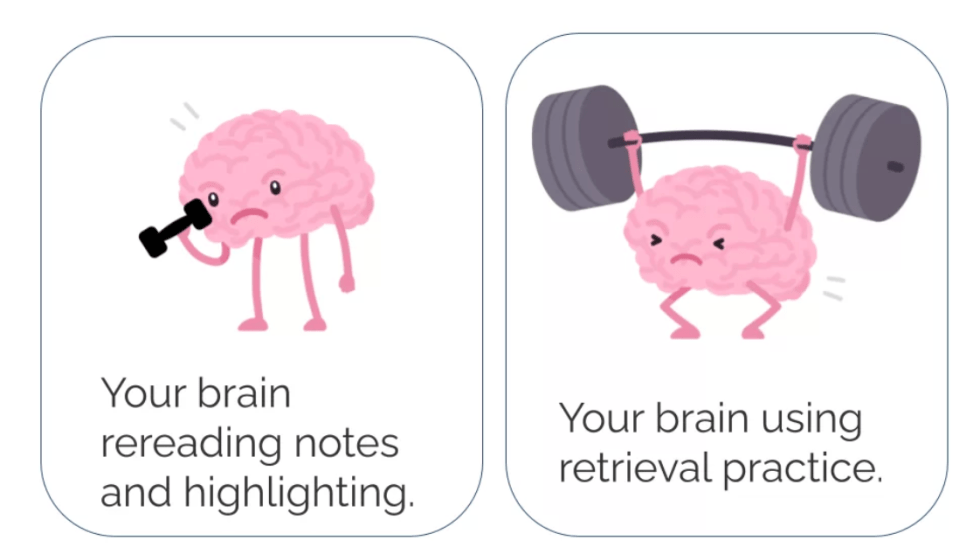
Generation is all about working that brain muscle. The more often we need to remember something, the more likely we are to remember it!

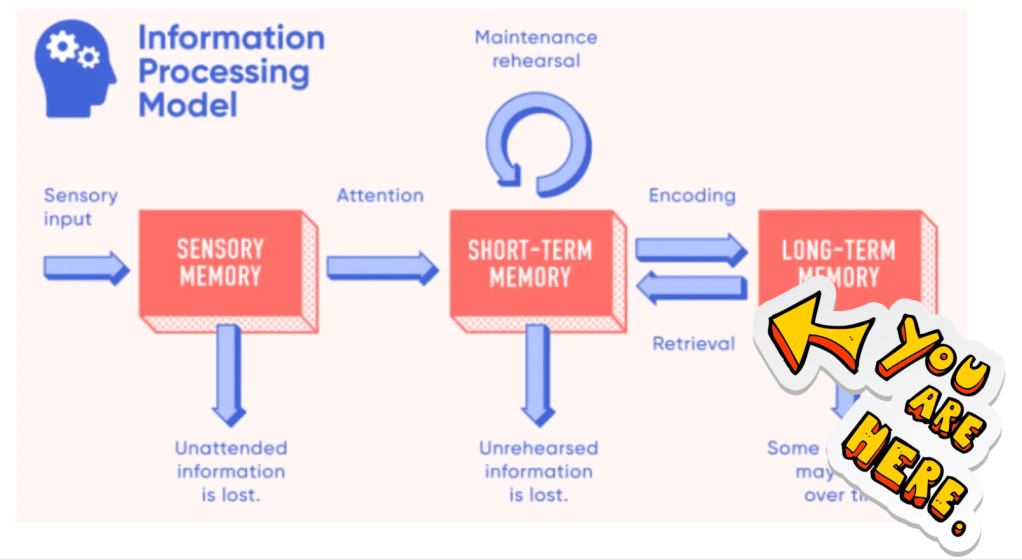
In the information processing model of cognition, this is the retrieval portion

Retrieval has a great deal of benefits when used correctly and there are a lot of misconceptions about retrieval.

First of all: you cannot retrieve what has not been encoded into long term memory. Why is this important? Because asking students to write down what they remember from today’s lesson as an exit ticket is not retrieval. That information is still in the maintenance rehearsal stage. What is rehearsal is asking them to write down two things they remember from yesterday’s lesson.

Retrieval isn’t just good for memories, it also raises student confidence and lowers testing anxiety! In my own classrooms as well as in the classrooms of colleagues, we’ve seen that when students engage in retrieval exercises often, student confidence in the classroom increases significantly. This is particularly true when you ask students to regularly engage in “brain dumps” where they write everything down they remember about a particular unit. As the unit progresses they should be able to write down more and more. It creates a visible piece of evidence of their learning with zero stakes attached to it.

Retrieval is probably something you already do, but to use it effectively we have to use it intentionally. I have two older blog posts about retrieval as a class activity and a study tool in my classroom with a few strategies. Personally, I always prefer to link up retrieval with some sort of additional strategy, whether its engaging students in discourse, having them compare and contrast or concept map.

Retrieval Might be the MOST important activity to support student assessments. Why? Because when students take an assessment they are asked to retrieve. However, if we are only ever pushing information during class, students rarely get the chance to practice that retrieval. Students should use retrieval to study, but they do not know or understand it typically, so we need to teach them (and their parents!) the benefits. If you’re saying “oh but I don’t lecture all hour, I have an active learning environment!” then I’m going to challenge you with this question: but do your students retrieve? Or are they only ever working in maintenance rehearsal? Relying on peers and notes to get to the answer?

My Favorite Use of Retrieval – Retrieve and Engage

Retrieval can be done as an act and of itself. However, while retrieval alone will enhance the memory pathways, it will not necessarily lead to a stronger application of that knowledge. In a science classroom we are constantly aiming for that higher order thinking: explain, create, evaluate. So we need to ensure that students are engaging in that thinking as often as possible.

The first way in which I enjoy using retrieval is by having students engage in a “brain dump”. Students write as much as they can about a given topic. To engage, students share their lists with classmates in small groups. We mix up the groups until eventually all students have the same information written on their papers. The 100% is in the room after all!

Another way in which I use retrieval is to ask students to complete a task identical to the previous day’s work, but then they pull out that work from their notes and evaluate themselves. The goal in this task, however, is for students to identify gaps. This task remains ungraded.

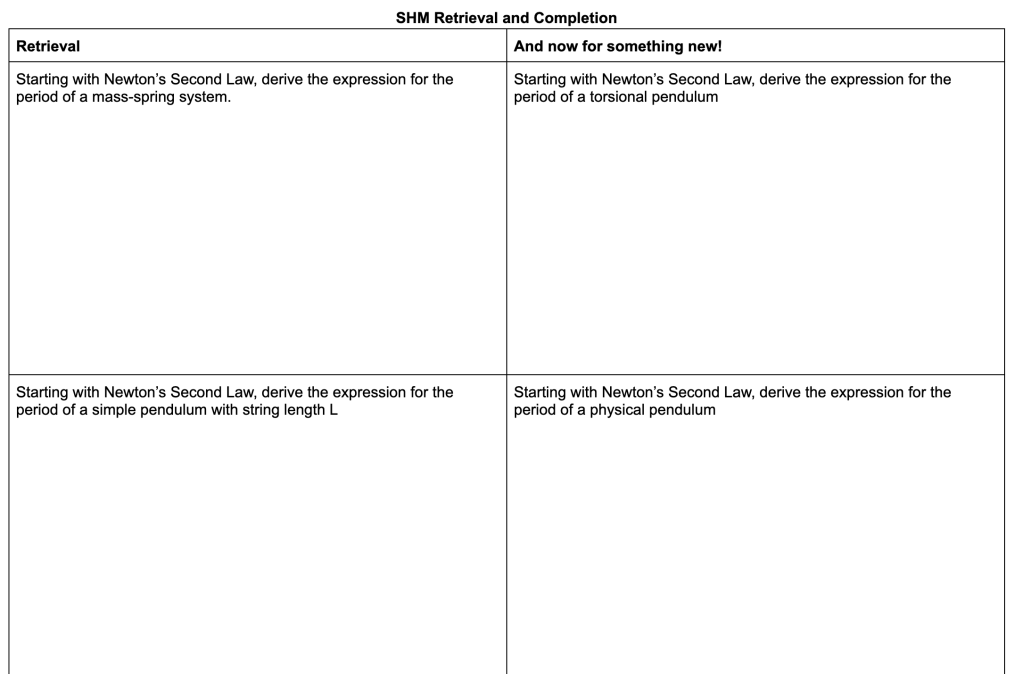
As I mentioned in a previous post, another way I like to use retrieval is to have students retrieve the content from the previous day, but then ask them to consider a similar, but slightly different case. In this instance students are first retrieving the example, and then are immediately asked to compare, contrast and then apply that knowledge to a new context. Below is an example activity that I used with AP Physics C students when going through simple harmonic motion derivations. We had already derived the simple and mass-spring pendula, so I asked students to retrieve those, then take a crack at the torsional and physical pendula.

Retrieval is not Endgame

While retrieval is an incredibly powerful tool that is easy to implement and we often forget to access, it is not endgame. It is simply one strategy amongst what should be an entire playbook. I see retrieval as a strong tool to motivate growth mindset and also as a strong tool to support teaching students how to properly study for the course and better identify their own gaps. However, especially in our science classrooms, it must continue to be paired with active learning cycles and opportunties for students to apply, create, do and evaluate.

Concept Modeling · In My Class Today · Teaching Methods

Multiple Representations for Momentum Conservation

I did it. I finally revised how I teach momentum conservation to my on-track physics students and I’m never looking back!

It can be really hard to shift something that “works” especially if you don’t have a team. For my on-track physics students collision/explosion problems were always an “easy win” for students. We would define that “momentum is conserved” and then talk about how to solve the problems. I would lecture and show them the “table method” and then the “brute force method” and allow them to choose how they wanted to solve.

This was satisfying for students. It felt easy and students gained confidence in physics. However I was always irritated by this. They were performing a series of algorithms to get to an answer with no real understanding of the underlying ideas.

Sometimes we don’t make changes until we are forced to. I had yet to see this part of momentum done in a way that was in alignment with my overall pedagogy and it “worked” …enough. However this year during this particular set of lessons I was to be observed in my classroom. I wanted to ensure that the observation showed who I really am as a teacher, rather than a snapshot of something I had yet to address. So I started digging.

I had seen some work with momentum bar charts around the twitterverse and in Pivot Interactives and in the modeling community, but I wasn’t entirely sold on it. It felt like taking a good idea from energy and forcing it into a place it didn’t need to exist.

I looked to see what Kelly Oshea had done and found her momentum card sort, but I knew that would be too much for an introduction to the content, but it got me thinking.

The following set of four representations is what I settled upon, and here’s how it went:

First, for each of these I would demo the collision first so students had an idea of what was happening before and after the collision. We spend one day on elastic, one on inelastic and one on explosions and for each day we went through several different examples. I’m going to use our final inelastic case for this post.

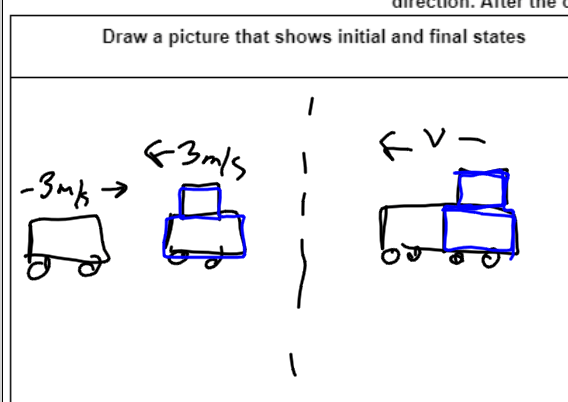
1 – Draw a picture

There is a reason why “a picture is worth a thousand words”. A picture allows us to easily see and locate information that we might miss in text. For example, in this problem it becomes clear that we have some direction issues, so we know that negatives are going to come into play. For the purposes of my pictures I draw my more massive cars with the added mass on top. You’ll notice I’ve also color coded the larger car as blue.

2 – Momentum Bar Charts

I finally decided to implement the bar charts. For my intro problems I used whole numbers so that we could represent them with tangible “blocks” of momentum. The block width is the mass and the height is the velocity, so in this particular case the total number of blocks is the momentum. I found my students had a hard time shifting this to a more abstract view where you could use area so this will be an emphasis next time.

You’ll notice I’ve brought the color scheme over for the blocks. In class we have already discussed that the total momentum is constant. So we draw the initial case and then we discuss what the final case is going to look like in order to keep momentum constant. Students are able to recognize that we have a total of -3 units of momentum on the initial side, so we need 3 in the final. Since this is an inelastic collision the width has to be three which means the height can only be -1. Students are already solving collision problems without realizing they are doing math! This felt like a really cool win.

3 – Momentum vs time graphs

This part is something I need to think about a little more. It was something that was “obvious” to me, but was very much not obvious to students. To me, it was “obvious” because you just slap those initial and final values on the graph. The hard part, I thought, was ensuring that you are accounting for each car in the inelastic case.

I absolutely LOVE this representation because this is where students can SEE WHY momentum is constant. The CHANGE of each object is the same size, but different in direction! It’s super satisfying!

The challenges my students had came from notions about what it “should” do. Because the cars are moving together, they want the lines to go together at the end. When I recognized this, we spent a day looking at the representations as a whole and locating where momentum is represented in each in order to construct this graph of momentum. There were a lot of “ah ha” moments when we did this. I think next time I will save this graph for last.

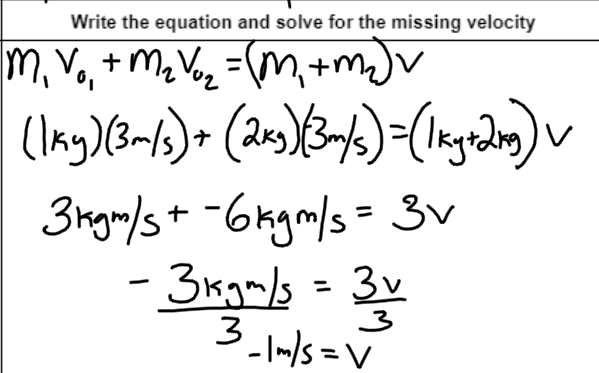
4 – Mathematical Model

The tables are no more! With this mathematical model right next to the other representations, student can see where everything is coming from. The momentum terms, the momentum values, and the final velocity value at the end.

While this was definitely a harder task for students to complete, I feel a lot better about their conceptual understanding of what is happening in a collision. The multiple representations also mean that students have multiple ways of showing me that they understand what is happening.

Activities · Teaching Methods

How I Teach… Forces (Intro, the Observational Experiments)

The first set of posts I wrote for this series was about momentum because I made such a large shift from how I used to teach to how I currently teach.

In the same vein my teaching of forces has also changed.

In the past my force unit looked like this:

  1. Inertia Day! Lots of Demos, initiation into the inertia club with club cards (you hold the card on your index finger with a penny on top and figure out how to flick the card out from the penny)
  2. F=ma. Define it, notes, define force diagrams, practice force diagrams. Practice F=ma problems.
  3. One day on action-reaction. Gloss over it; “it’s easy”

I cringe writing this out now. It was so boring! Inertia and action-reaction felt like fluff. We don’t need fluff!

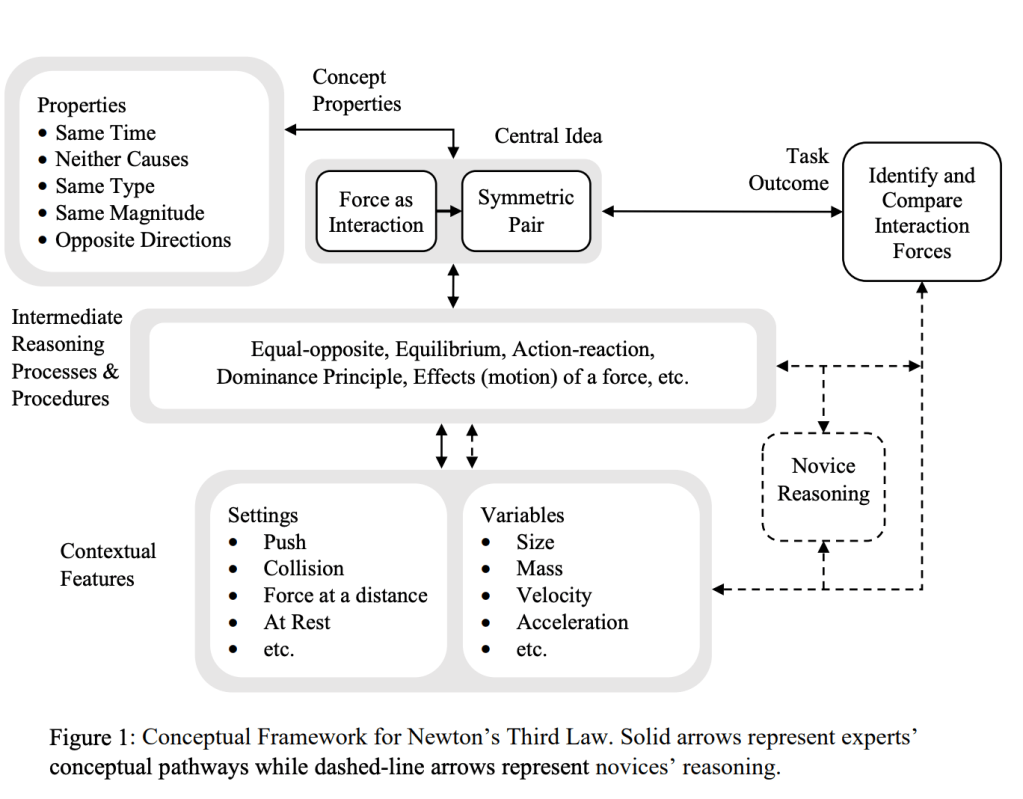
Currently, my unit structure is designed with the big ideas in mind. (Because, tenet 3: Order Matters, Language Matters) I was excited to see that the idea that teaching in a structure that models the thinking we are targetting to improve outcomes is actually supported by research, so my model draws on Lei Bao’s frameworks for force:

One of my biggest frustrations was students putting random “F(applied)” on force diagrams. It irked me to no end!

So starting with the framework for Newton’s Third Law, I turned my force unit on its head. The fundamental piece we begin with is:

A force is an interaction between objects

Observational Experiments

We start with the activity from Pivot Interactives where two cars collide.

Students are asked to separately write what they observe about the car motion and also what they observe about the force acting on each car.

After making the observations we discuss.

The primary aspect students recognize is that heavier/faster cars result in bigger forces. That’s all well annd good, but what about the force that each car experiences. Even though they’ve literally just witnessed and recorded it, they still want the heavier one to hit harder than the light one within the same collision! We closely observe this together and see that, indeed, the forces are always the same.

This is what allows us to define a force as an interaction between objects. Without a second object pushing on the ring, the ring won’t squish. Since the force is something that happens between, it must be equal and opposite.

This very small shift has been a game-changer. It is very rare for me to have students putting totally random forces on objects because “it should have one”.

From here we dive into Eugina Etkina’s ISLE cycle.

Students are asked to hold a heavy and a light object in each hand, palms up and then represent those objects with arrows on a diagram. Students are asked to label each arrow with the object interaction. This is a fun one because a lot of kids are quick to label “gravity” but when I inform them that gravity, is not in fact, an object, they have a moment of pause. Eventually all students arrive at the correct diagrams: equal sized forces on each object, bigger forces on the heavier object.

From here I diverge between AP and regular physics. In regular physics we will go directly to the mass vs weight lab where students will ultimately derive the expression F(earth) = mg. With AP we continue to follow a modeling cycle with experiments with a bowling ball down the hallway: rolling, constant force forward, constant force backward. Then I ask how we could have constant velocity AND constant force. Students are quick to say “push down” (and we are fresh off of projectiles where x and y are independent!). Then realize if we alternate “taps” that will do it (balanced forces). Students are asked to represent and reason by drawing a complete motion map, an accompanying force diagram and then look for patterns. In this way students then recognize that balanced forces will result in constant motion (including v=0) and unbalanced forces result in accelerations. For homework students will complete two exercises from the Active Learning Guide from Etkina’s book where they will continue to practice drawing motion maps and force diagrams together in order to find relevant patterns. From here we get ready for labs!

Up next… labs labs and more labs!
Quantitative Experiments with Forces

In My Class Today · Teaching Methods

Deliberate Practice with Mild, Medium & Spicy Problems

As a high school teacher homework is a constant battle.

At my high school it’s an equity issue. Many of my students lack the time, space and resources to complete homework.

But also, we also know that the fundamental differentiator between excellence and mediocracy is discipline and deliberate practice. And on a very fundamental level “use it or lose it”. So how to ensure practice and ensure it in a way where learning is happening for all students?

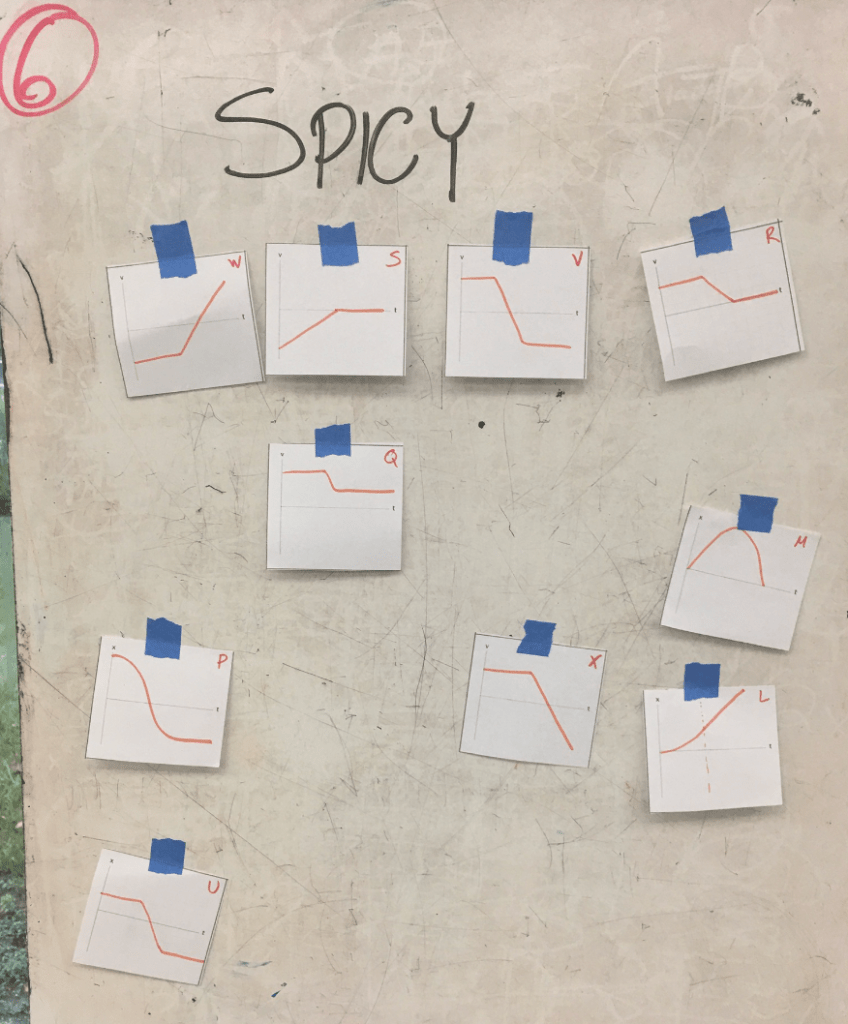
Enter Mild, Medium and Spicy questions.

I picked this idea up from Peter Liljidahl when he joined our nationwide physics book study in April on his book Building Thinking Classrooms in Mathematics. He’s been researching this type of practice most recently in classrooms and I was finally ready to give it a try.

I knew that my students needed some extra practice on calculating quantities from kinematic graphs. They just weren’t quite there yet. I could have assigned problems. If I did, I’d get a 25-50% completion rate and mostly students who did not need the practice provided.

Instead, I did the following:

1) I made a variety of position, velocity and acceleration vs time graphs. Mild graphs had one segment, medium had 2 and spicy had 3 or more. Then, I wrote out the solutions to all of the problems. I put the problems up with tape on 3 individual whiteboard for the three flavors. The answers were on a cabinet on the other side of the room

2) We reviewed the previous week’s quiz and identified that this was the area that needed work. I explained to students they could choose the problems, gave them a paper to document their work, and pointed out the answers were provided.

3) I kid you not, I had 100% of students working for 100% of the hour.. to the point where my last class of the day (who normally line up early) were shocked that the bell rang!

Why it works:

1)Taste vs Aptitude Instead of “levels” the questions are sorted by “flavor” there is something psychologically motivating about choosing your preference rather than feeling pigeonholed by ability.

2) Do What you need – give students a task with a number of items and they want to finish as quickly as possible. Alternatively, the task is overwhelming and they don’t even begin. A single graph at a time, that is student selected (hello autonomy!) is manageable. There’s no pressure! No pressure to complete a spicy, no pressure to complete x number of problems. Just do what you need. I had two students go for the spiciest spicy. I made a comment about it and they asked me if they did it correctly if they needed to do more. Ironically, because it was so complex they were going to end up doing 7 different problems in the process anyway!

3) Get to the deep stuff – honestly, the best part of this for me were the conversations I heard students having. Some of them would get into heated arguments about the correct answer, even though they could have just looked. But just looking was like skipping to the end of the movie. The puzzle was more important than the answer. (I’m going to remind folks real quick that this is NOT my AP course)

4) Student Wins – I heard several students comment that day “I feel smart in this class.” and I cannot tell you how big of a statement that is coming from this group of students. If you know, you know.

  • Have any of you tried anything like this?
  • How do you deal with the homework problem?
  • What are you thinking about regarding this idea?
In My Class Today · Teaching Methods

Day 2: Thinking about Relationships

Day 1 I run a HUGE physics smorgy: 11-15 demos/lab set ups with minimal directions. Students are told to play, investigate, explore, PAY ATTENTION and ask lots of questions. This is my hook into the class for the year. I’m able to observe the students, act ridiculous and ease the MASSIVE anxiety they walk into this class with.

The next four days we actually spend working with data and relationships. Specifically to build the skills necessary to analyze data on a graph and straighten it when needed. I have a reading I ask students to do ahead of time and then we go through the straightening process. These brilliant students (half of whom are in AP Calc) are completely flabbergasted by the straightening process. It just doesn’t. make. sense to them.

I decided to try something different today on the fly, and it brought about some great conversations. First I put up blank sketches of graphs depicting a linear, squared, inverse and square root function. I asked them to put the graphs on their white boards and write the relationships. The answers consisted of the following:

  • “linear, squared, inverse and square root”
  • y=x, y=x^2 (etc)
  • y∝x y∝x^2 (etc)

This kicked off some great conversations. Are we in agreement, generally, about which is which? (yes). Are the equations really representative of the sketches? (We don’t know, there are no labels or numbers on the axes)

Next, I gave students four statements

  1. “Momentum is proportional to velocity”
  2. “A spring loaded gun is fired upward. The height of the bullet is proportional to the compression squared”
  3. “Velocity is inversely proportional to mass”
  4. “The period squared is proportional to the length of a simple pendulum”

I asked them to label the axes of their graphs with the physical quantities to match the statements. Here’s where the fun began. Students took a lot longer than I had originally anticipated completing this task. Here were the great conversations to be had:

  • In science, we usually put the independent and dependent variables on the x and y axis. With these statements, is it obvious which is which?
  • Since it’s not obvious, are answers where the axis are flipped wrong? (Not if they picked the appropriate shape!)
  • So, we often are going to use slope to talk about relationships. Like, say, if we plotted distance on the y and time on the x what would we get? (speed…minds are blown)  The cool thing is if you plot the graph “wrong” you can look at the units,  and decide if they need to flip because you’d have seconds per meter or something. The important thing is whatever you tell me the relationship is, needs to match your graph.
  • Then, of course, I let them in on the secret: we always list the y thing first. Literally all we are doing in these sentences is taking the math proportions, like y∝x^2 and saying, instead, height ∝ compression^2. It’s like the hugest lightbulb moment for students ever.

Now that they have that substitution thing in their brain, explaining how to straighten graphs is a snap. I was really pleased with the lack of frustrated and confused faces. Last year, I sadly, lost several kids during this unit. I wanted to cry so hard because we hadn’t even started physics and seriously questioned my lesson plans.

Tomorrow they finish their pendulum labs, so we’ll see how this all goes.

Meanwhile, AP Physics C is dabbling in computational physics for kinematics. More on that later.


Teaching Methods

Modeling vs Intentional Modeling

“I use modeling, do you?”
“Uh…no, but I’m interested in learning about it”

I felt like such a noob when I had this conversation a few months ago because literally, everyone else at my group seemed to be doing this already. I was at a workshop on whiteboarding after a talk on standards-based grading and modeling and I thought, “wow, she really has it together… I have a LOT of work to do” (Does anyone else have this overwhelming feeling of inadequacy in the classroom all. the. time. or is it just the mom-guilt extended into the classroom?)

So I have started incorporating some things here and there as I’ve gone along, and I recently looked into Etkina’s resources (I started using parts of her book last year). As I poured over Etkina’s labs and our workshop speaker’s resources I realized: I HAVE BEEN DOING MODELING ALL ALONG! Mostly because it’s just the way I already think about problems. It just didn’t have a fancy name, and more importantly, I wasn’t always doing it intentionally as a teaching strategy.

I’ve decided that the intention is really the key in modeling as a teaching strategy. I think good physicists are good at models but bad at teaching them. We do it so seamlessly in our own work we fail to realize that type of thinking is not seamless or natural to the general public.

Cue modeling curriculum

Models are just any representation we use for a situation: pictures, free body diagrams, motion diagrams, graphs, mathematics etc. We need to work our kids like gymnasts, very intentionally using and practicing these models so that our students become flexible and natural at using them on their own for any scenario.

This is the paradigm shift: teach the model first, and the physics as a result of the model. Too often physics teachers (especially physics teachers not trained in physics) teach all this physics stuff, then all these equations for particular problems and then maybe shove in some graphs at the end. The problem is that students fail to see the bigger picture and physics becomes a class where students are attempting to memorize a million procedure for a million different problems, rather than learning a handful of approaches and selecting the best one or two for the problem at hand. The clearest example of this in my current classroom is how I am teaching two-body problems. I have made a huge deal about the fact that all of the physics is in the FBD. Because learning the general process for FBDs is a lot easier than trying to memorize separate processes for ramps, Atwood machines, modified atwood’s and oops! Now there’s friction!

The next most important part of this is to teach students how to communicate with one another using their models, and this is where the value of whiteboarding comes into play. I believe very strongly in letting the kids move around the room to see whiteboards without having a board representative at each board. The reason for this is that the students begin to realize that it’s hard to make sense of what someone has done if you don’t provide enough detail. Students can then ask these questions and leave them at the board before we come together as a whole group for discussion.

I decided to use modeling very intentionally in the classic coffee-filter air resistance lab. The original lab I had snagged from someone had a bunch of background info and then asked students to skets the velocity and acceleration graphs. I got really tired of marking the same things on everyone’s papers last year and realized this year that this is a perfect opportunity for modeling.

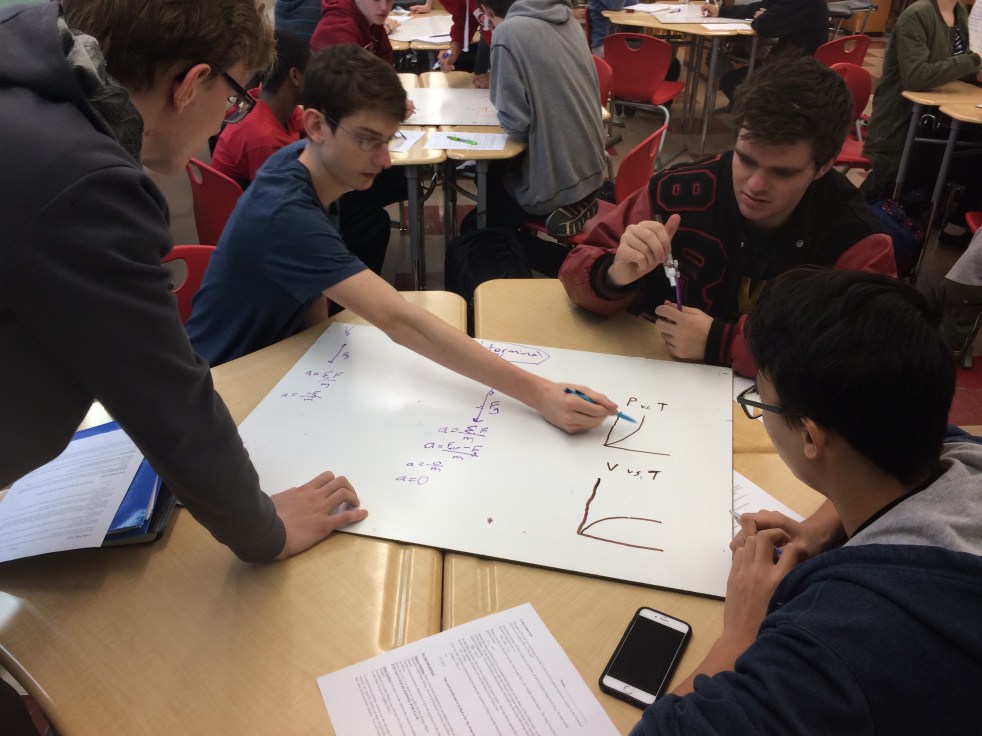
When students walked in today their desks were in groups of four with a whiteboard. I asked them for the following

  1. A free body diagram at t=0, sometime before terminal velocity, and at terminal velocity
  2. Acceleration expressions for each of the diagrams
  3. position, velocity and acceleration vs time graphs.

IMG_1632It was so cool to watch them work, discuss and argue. The FBD’s were relatively easy, the discussions mostly about whether or not to put air resistance on the t=0 diagram.
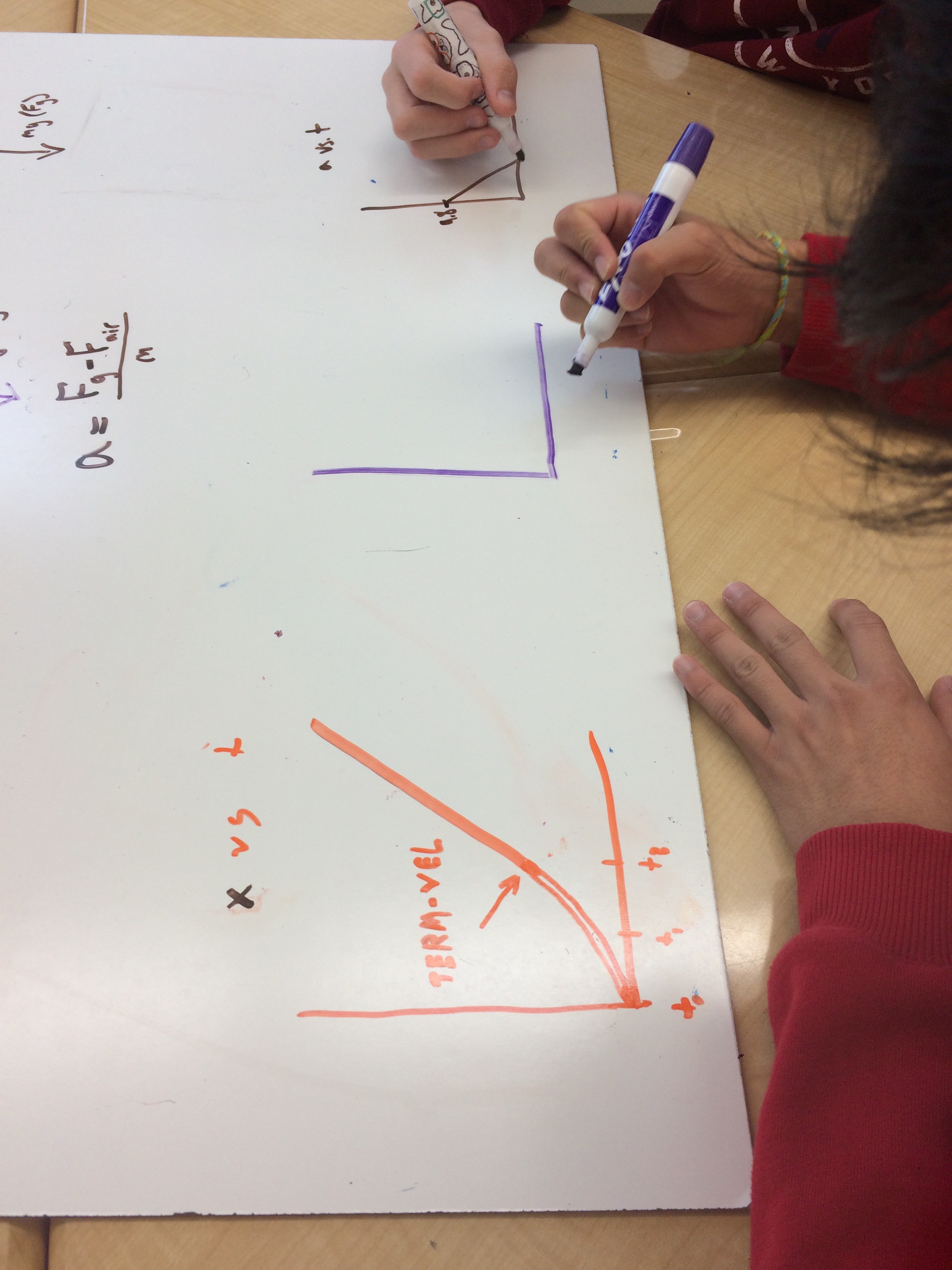
The discussions about the graphs were far more interesting. Many students were working with the graphs as unique units, rather than considering the relationships from one to the next. Inevitably we had piecewise acceleration graphs and linear acceleration graphs and linear piece-wise vs curved velocity graphs.

IMG_1633


I asked the kids to cite similarities and ask questions about differences. One group today started changing their board before attention was drawn to them. It offered a fantastic opportunity to review the graph models and review the relationships.

One of my favorites was a group that decided the curve of the velocity graph was quadratic, so they started taking the antiderivative for the position function. They noticed the constant slope portion in many of the other graphs and asked the question about it. Then they realized (#overachievers) the velocity graph wasn’t really quadratic.

I realize this particular example isn’t quite model-based learning through and through as I did not allow them to experimentally discover the exponential function relationships, rather after discussing that all of these changes were continuous I gave them a brief taste of the calculus/diff eqs ending in “solution is always in the form….” and hey, doesn’t that look like the curve we agreed upon?

We only collected data today, so I’m really curious and excited for what their write-ups are going to look like Wednesday!

I’ll keep you posted 🙂