
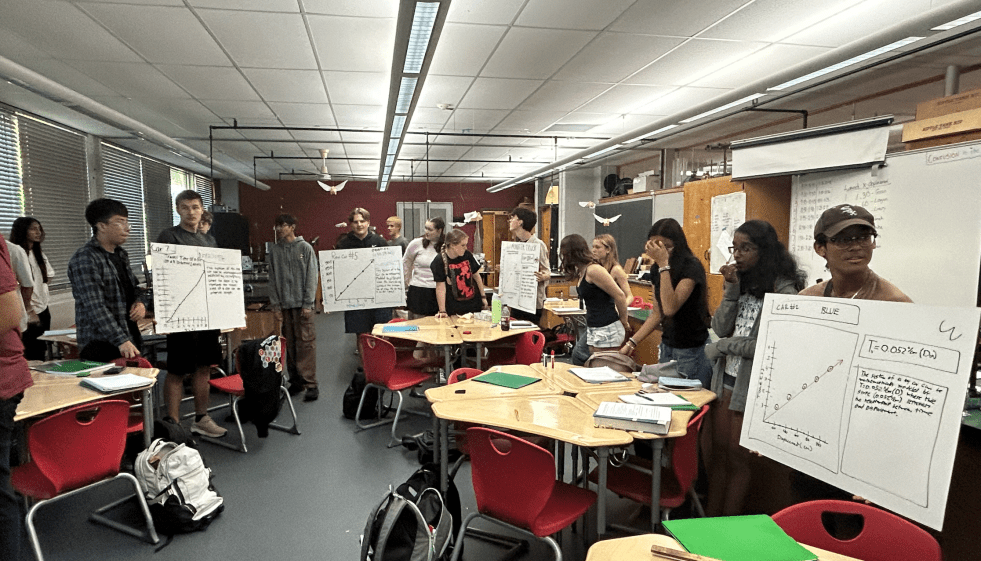
One of the most cringe comments I hear from students working in class is “she said that…” When I hear this instead of “what we need to do next is…” or “I know that the answer is … because… ” I personally feel that I have not yet done my job for students. Why? Because students are not yet taking ownership of their knowledge, the answer still rests in my hands, not theirs.
We could argue that the goal of education is to impart knowledge to students, but knowing that our students are not going to remember all things, what knowledge do we truly want them exiting our classrooms with, and to whom does that knowledge belong?
Knowledge is the bedrock for all learning. The more a student knows, they more connections they can make, the deeper they can go with that material. We’ve already discussed that when students can tie new knowledge to previous knowledge, whether its through analogy, elaboration, generation or a hands on experience, the pathway for memory becomes stronger. In the brain, the physical neural pathway is what has literally grown and strengthened.
If we are going to implement strategies in our classrooms to enhance learning, and we are going to do that from a lens of evidence-based practices, then we need to understand the foundational underpinnings of the brain and how knowledge, skills and creativity are built and work together.
Knowledge and the Science of Learning Conversation
The science of learning has its set of cognitive principals upon which learning instruction can be built. Deans for Impact has a nice document that outlines most of them. Below are a few of them:
- New ideas are connected to old ones, but students working memory is limited. Therefore so too must be our presentation so as not to overload them.
- There exists a core set of facts in any area of study. Once these are memorized, a person can tackle more challenging problems as their working memory is now freed up. (this is the foundation for phonics in Science of Reading and memorization of math facts for fluency)
- Learning transfer is difficult as it requires knowledge of deep structure, which is often not apparent to the novice. (This is argument for contrasting cases)
I want to say first, that all of these core ideas are valid and have the research to support them.
Next, I need to say that unfortunately, due to either a lack of nuance or the inevitable polarization of our current society’s expression of social media, there exist some pretty strong feelings that pit science of learning against constructivist teaching as entirely incomparable.
Through Hattie’s research constructivist teaching has an mean effect size of 0.92 which puts it on par with the jigsaw method and strategies to integrate prior learning. Constructivist teaching is designed with the learner at the center, involves active teaching methods and allows students to explore ideas, solutions and explanations and then take action. This is not to be confused with pure inquiry or discovery based learning. Another set of strategies which has come under great scrutiny are the methods developed in Building Thinking Classrooms in Mathematics. The hard-lined science of learning folks argue that having students engage in activities without prior instruction or knowledge is problematic due to the conflict with the previous statements above. Simply put, students are novices, therefore they lack the background knowledge and skill set to engage in a doing or creating activity, and as novices students will not be able to engage in truly meaningful ways that will impact learning. Instead, they will flounder around with great cognitive overload, little success and too much room for mistakes and misconceptions.
I’d like to take a moment to address this in the context of the kind of learning we see in curricula such as modeling and the Investigative Science Learning Environment (ISLE). First, students are not blank slates. They come to us with a wealth of experiences which have shaped the background knowledge they bring to us. None of our students walk into our room with the same background, but there exists a background nonetheless. Both the experiences and the background knowledge need to be acknowledged in order for us to to our job properly, which is why constructivist teaching is student-centered. Second, I’d like to think that in an ideal educational setting our students are able to move from passive receivers of knowledge to active doers and producers of knowledge. In order for this to happen, we must create the environment where experience is central to developing knowledge.
I took on a collaborative project/conversation with another peer at the beginning of the year in which we took the principals from the Dean’s for Impact document and began aligning the principals with strategies and practices from a physics classroom that is centered on active-learning, constructivist pedagogies. If you’re interested you can take a look here.
Knowledge as a Cycle of Experience, Reflection and Testing
David Kolb, psychologist and educational theorist defined the learning process as the following cycle:
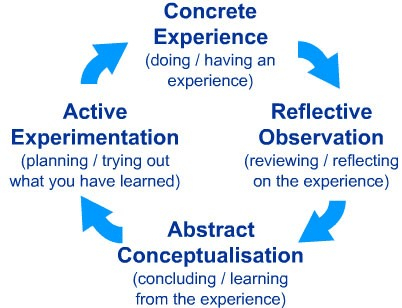
This cycle makes sense for any learning we encounter, not just school-learning. Consider perhaps the kid who “doesn’t like school” Very often that student’s dislike for school can be traced to a concrete experience, whether it was a teacher, and administrator or other students. That experience made them notice and feel things about themselves and/or their environment and made them determine that school was not the place for them. Perhaps this meant they withdrew socially or academically. Maybe it means they transfer schools all together. Either way, some action follows which creates a new concrete experience.
As humans we are learning all the time, and that learning is very often starting from an experience rather than a textbook. (Or perhaps the textbook motivates us to seek an experience!) Shouldn’t it only make sense then, that our students’ learning also begins in a place of experience?
In a previous post, Just in Time Telling, I discussed the fact that when a carefully selected and targeted experience is provided to students and then follow up with Just in Time Telling, the learning gains are strongest for the student than with lecture alone, or discovery-based learning alone. (Schwartz & Bransford, 1998) When we then follow up the Just in Time Telling with a testing experiment, we are providing students into the action, doing and ownership part of knowledge. During this phase of the learning cycle student can make a claim, “if ____ then ______ because______” This testing experiment then creates a new concrete experience from which the cycle can begin anew.
What is a testing experiment you ask? A testing experiment can be any of your traditional labs in which you’e asked students to calculate g, find the theoretical period for the flying pig, find the location where the two cars collide and so forth. Rather than making it a “challenge” task, we can reframe these activities as an opportunity to test our current understanding of forces, circular motion or kinematics.
A testing experiment might also look like one of your traditional labs. For example, we have a lab in which students determine if the friction of the wheels of their lab car are negligible. In this case the hypothesis might look like “if the friction is not negligible, then when we attach a mass to the car and allow it to drop, we expect the change in gravitational potential energy to be different from the change in kinetic energy of the car”.
A Paradigm of Ownership and Action is a Paradigm of Equity and Liberation
There is another critical component here regarding this particular concept of learning and discussing ownership. There is something that inherently sits very wrong with me around some of the language in the science of learning that sounds like language and expectations which are ultimately choosing compliance over creation and collaboration, and maintaining the power differential between teacher and student. When we can move students from passive receivers of knowledge to active producers of knowledge we are also transforming the seat of power. In a world in which we continue to have discussions around social justice, equity and power structures it is a natural conclusion that knowledge and the ability to act on that knowledge is also empowerment. Creating a learning environment where students become doers, producers and drivers of their own learning is creating a learning environment where students can become agents of equity and justice within their circles of influence and their communities.
Why is this conversation important?
When students are subject to strict direct instruction, in which students are assumed to be inadaquate at creative thinking until some benchmark base of knowledge has been established, what we are effectively doing is creating a bunch of minds with fantastic routine expertise (solve these exact problems this exact way). This kind of expertise might easily demonstrate strong effect with high grades and high standardized test scores, but what it doesn’t support is adaptive expertise where students can take a set of skills and move those skills to something novel. As is true in most of life, somewhere in the middle there exists the ideal balance. Routine expertise is important for some aspects, but so is adaptive expertise. We need both. I suppose another essay entirely could be written on why this is even more important in the age of AI.
Here are some questions for your consideration:
- When you consider your classroom environment currently, does your teaching lean more towards the passive passing of knowledge, the active producing of knowledge, or have you struck the balance?
- When you consider your students and their expectations for your classroom does they lean more towards the passive passing of knowledge, the active producing of knowledge, or have they struck the balance?
- If there is discrepancy between your environment and your student expectations, how do you resolve this tension?


Hi Marianna. Interesting piece. Where is the empirical evidence that constructivist teaching is better at building adaptive expertise than direct instruction?
LikeLike
You can start with these two:
Click to access Practicing_versus_inventing.pdf
https://www.tandfonline.com/doi/abs/10.1207/s1532690xci2202_1
LikeLike
Thanks. I will take a look.
LikeLike