
Contrasting cases is about noticing the difference between two or more examples that seem the same at a glance.
That core learning mechanic should absolutely scream physics problems to you!
Acceleration is a FANTASTIC example of the benefit of contrasting cases. Students frequently come to us believing the following to be true:
- “Acceleration” describes speeding up only
- “Positive acceleration” describes speeding up while “negative acceleration” describes slowing down
- “If an object’s velocity is zero, its acceleration must be zero because it has stopped”
How do we help unlodge these incomplete conceptions in our physics students? If we could “just tell them” then it wouldn’t be a problem. However, these ideas are engrained deeply in students, and they need another way to approach the idea.
In the Investigative Science Learning Curriculum students conduct several observational experiments using a bowling ball. We drop a mark (bean bag for example) at equal time intervals as the ball rolls. Students copy the resulting pattern and then construct motion maps. This is how we begin to make sense of velocity change, acceleration and force.
The contrasting cases, in this instance, are the diagrams themselves.
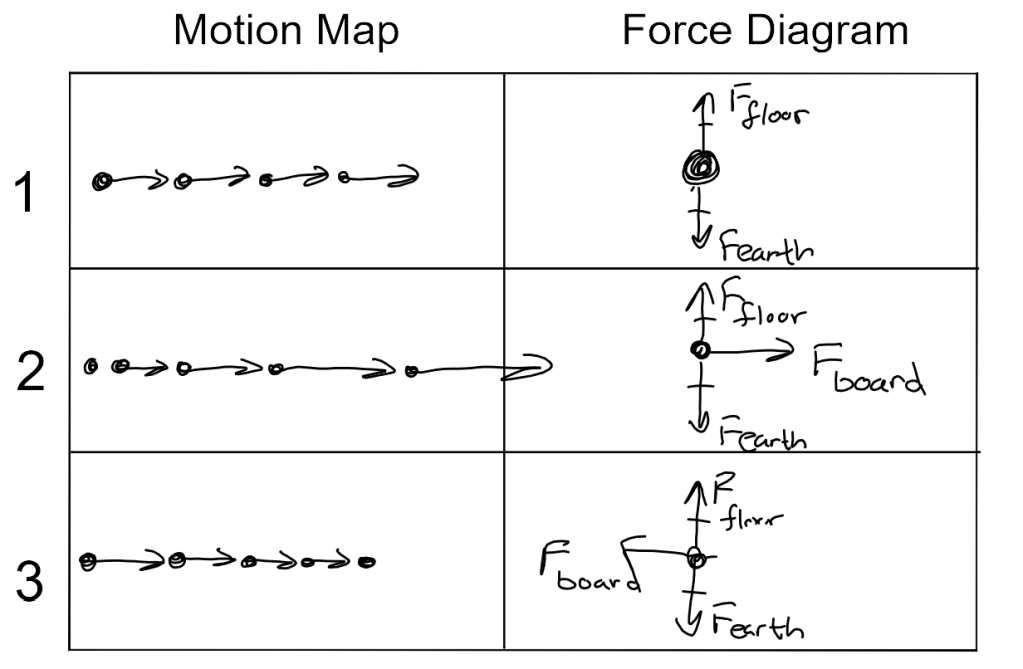
Through a simple series of activities, we can build the ideas that constant velocity is not the absence of force, but the absence of an unbalanced force. Accelerations happen due to unbalanced forces and the direction of the acceleration is the direction of the unbalanced force.
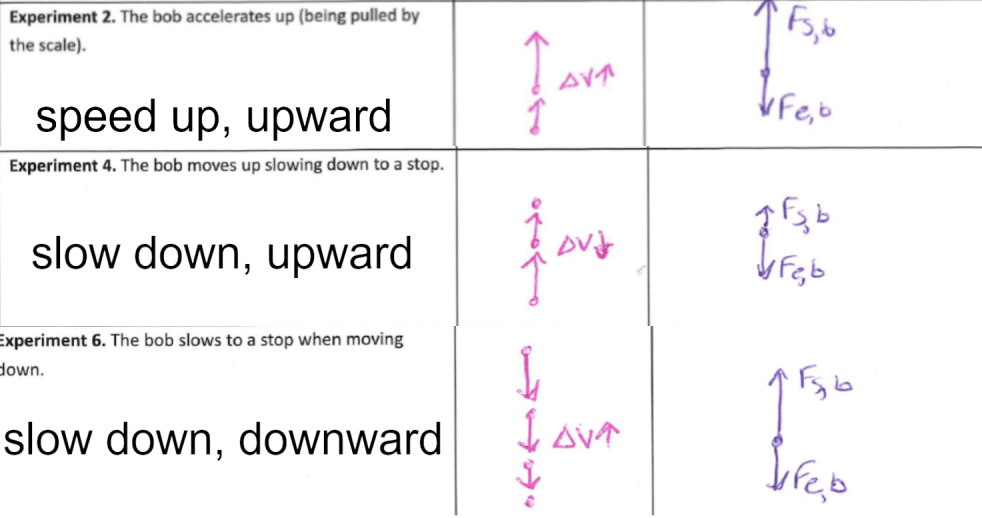
We do a similar task shortly thereafter with an object that is accelerated vertically. When I review the material, I specifically grab the set of activities shown below. In the top two cases, the bob is experiencing upward motion. However, we see the change in velocity is different due to the difference in accelerations.
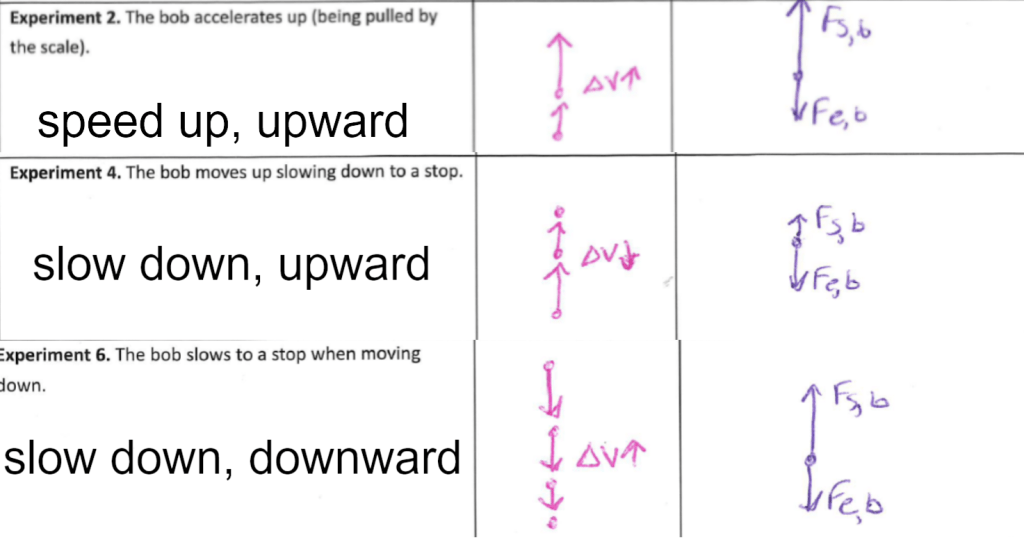
Next, I have students compare the top and bottom experiement (4 and 6). In both of these instances the delta v (acceleration) is directed upwards, however these both describe two very different motions, up and speeding up, and down while slowing down).
Again, while I could certainly just tell them, there is a lot more power to students constructing the diagrams based on their observations and then we can look for patterns and we can look at the fine details in contrasting cases. We can then use these details in the contrasting cases to more deeply understand the concept. We are also doing something incredibly critical for our students in the science classroom. We are teaching them to argue with evidence. That their answers and assumptions about how the world works need to be grounded in evidence over feeling and intuition. I would argue that fact is far more important than any piece of content they remember 10 years from now.
I recently heard an eduinfluencer make the claim that teachers can only name and describe 3 evidence based strategies they use in their classroom. Challenge accepted. Each day I’m working through the book The ABCs of How We Learn and pairing a strategy with physics content/activities in my classroom.


One thought on “ABCs of How We Learn: C is for Contrasting Cases”