
I don’t think I need to tell a bunch of science teachers the benefits of Hands on Learning, so let’s take this in a different direction: What makes for a hands-on experience that is positively impactful on student learning?
Not all hands on is equal! Hands on activities need to be carefully constructed in order to produce intended impacts. According to the authors Schawtz, Tsang and Blair, An exemplary hands-on procedure “allows students to find meaning and structure rather than copy a symbolic procedure” in other words, hands-on activities are sense-making activities.
In the Investigative Science Learning Environment (ISLE) framework every cycle begins with observational experiements and those observational experiments very often involve some sort of hands on experience.
Take the introduction to forces, for example. Students are asked to hold a light and a heavy object in each hand, palms up. Next, they are asked to sketch a diagram that shows the interactions on each object. Most students quickly indicate that both the hand and the earth are interacting with the objects and correctly reason that these forces must be equal due to the fact that the objects are not moving.
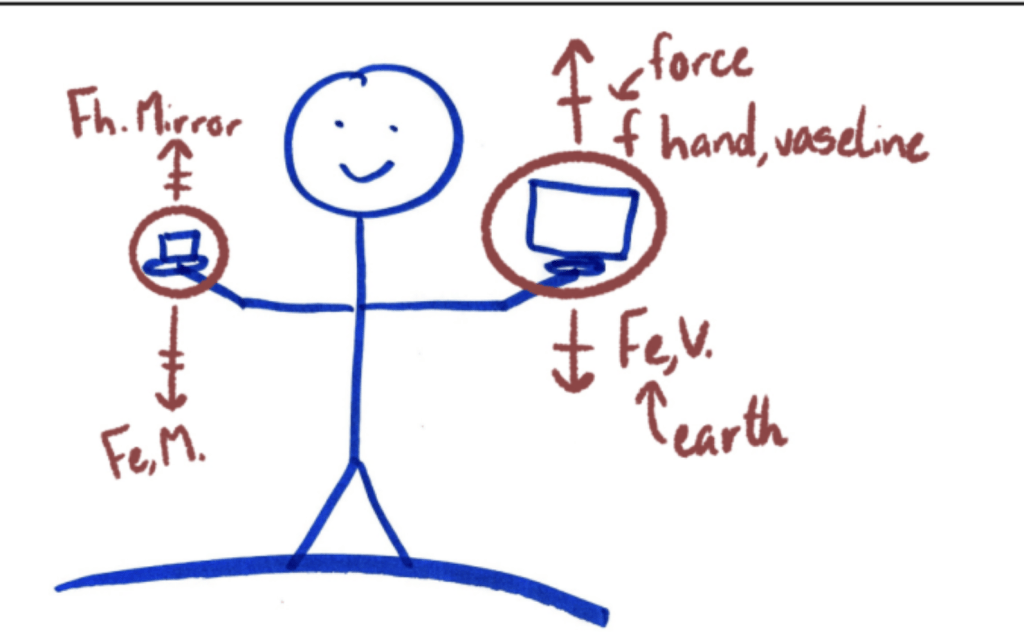
This seemingly simple activity is incredibly rich. Not only are students constructing the correct understanding of the fact that an object at rest experiences balanced forces, they are also beginning to understand the concept of a normal force (though we aren’t calling it that yet) and the begining of creating a force diagram. All by simply sketching what they feel through observation.
Another excellent example from the ISLE curriculum is the introduction to work and energy.
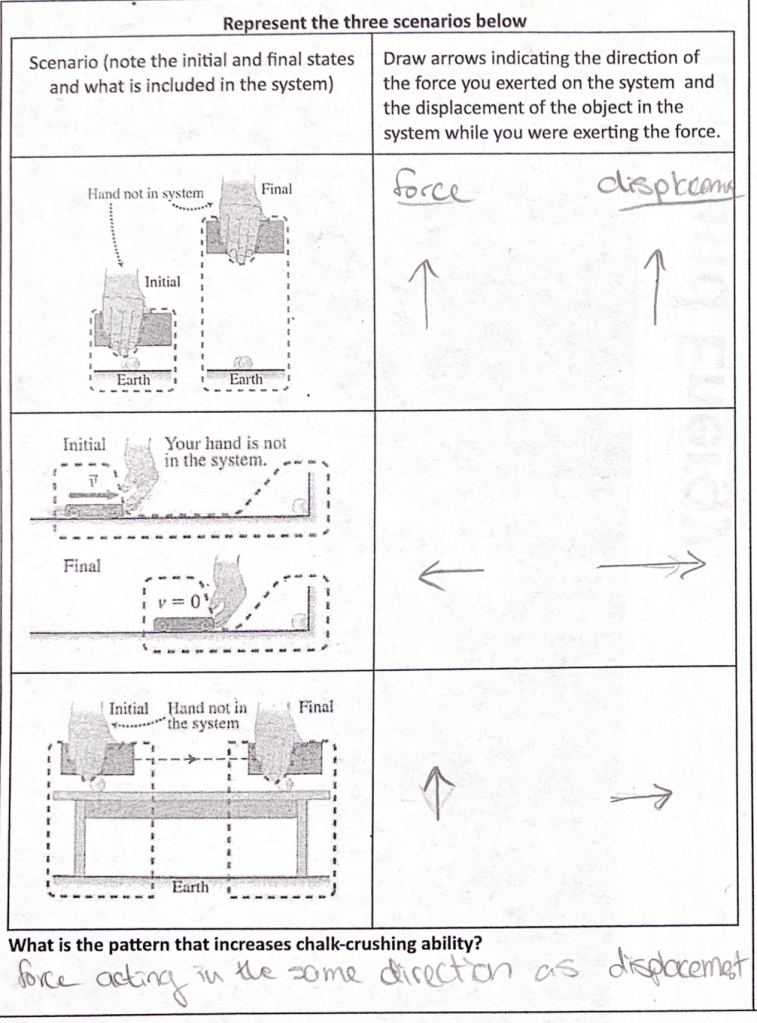
I provide students with an individually wrapped life-saver mint and ask them to think of ways in which we can crush the live-saver. The ideas of dropping it (or dropping something on it), throwing it (slingshotting it), and smashing something into it all come about and then I give students some materials to do it. However, I include one very critical instruction: there likely exists a way that you could drop it, throw it etc. in which the live saver doesn’t break. I want you to find the edge between breaking it and not breaking it.
Through executing these hands-on, very simple excercises, we are able to construct the idea that candy-crushing-ability (CCA…aka energy) can be increased as we increase the force and the displacement, but ONLY so long as those two attributes are parallel. In addition, in order to “save” the candy from say a falling brick, we need to exert a force in the OPPOSITE direction of the movement to reduce CCA.
In both cases we could have simply taught “here’s how you draw a force diagram” “this is the definition of normal force” “work is the dot product of force and displacement” but none of these definitions ground students in the physical real-world that we are describing in diagrams and mathematics. The hands on experience gives students additional neural pathways and memories to access as they learn new information and tie it to previous experiences.
There are a camp of explicit-instruction/science of learning enthusiasts who will enter into aguments against this kind of constructivist learning because students, as novices, lack the background knowledge to efficiently get to the learning/conclusions we want them to reach in the classroom. I’d argue that the examples provided here are exactly what is called for in direct-instruction. The examples are carefully crafted, the tasks for the students are simple, and after students have done the requested work we as the teachers will indeed tell students exactly what they need to know.
One of the biggest challenges/risks around hands on learning is that students may not notice what we need/intend them to notice. The most critical component here is that these tasks are carefully planned, and in many cases may even appear overly simplistic, like the examples above.


3 thoughts on “ABCs of How We Learn: H is for Hands On – Activate Before Dictate”