Uncategorized

ABCs of How We Learn… Y is for Yes I Can

How many times have you heard a student claim “I’m not a math person.” Better yet, how many times have you heard a peer or colleuge say something to the same effect when you tell them you teach physics! It’s typically followed up with “you must be really smart” or “I’m not smart enough for ____”. Coaching our students through their low self-efficacy in physics is often one of the greatest initial challenges in our classrooms.

Albert Bandura writes, “Self-belief does not necessarily ensure success, but self-disbeleif assuredly spawns failure (1997). Bandura describes four factors that influence people’s self-efficacy: mastery experiences to build previous success, seeing others like you achieve similar goals, hearing that you can do this, and an awareness of the time and effort required to be successful. Of these four, three are also identified in the body of research around physics identities which are critical to persistence in physics classes. (We discussed some of this in the Belonging section). In addition to some of the activities listed there, engaging our students in the learning process is also important!

For 10 years the American Institute of Physics has put together a series of lesson plans that highlight a variety of underrepresented groups within the field (click here and scroll down) The lesson plans tie together physics content with the stories of various scientists that tell of their journey, struggles and success. Hearing these stuggles and seeing a variety of people represented are both critical features to supporting our students’ self-efficacy. It also provides a more-full picture of the history of our field. (Like my friend Elissa says, we are all teachers of history in our classrooms)

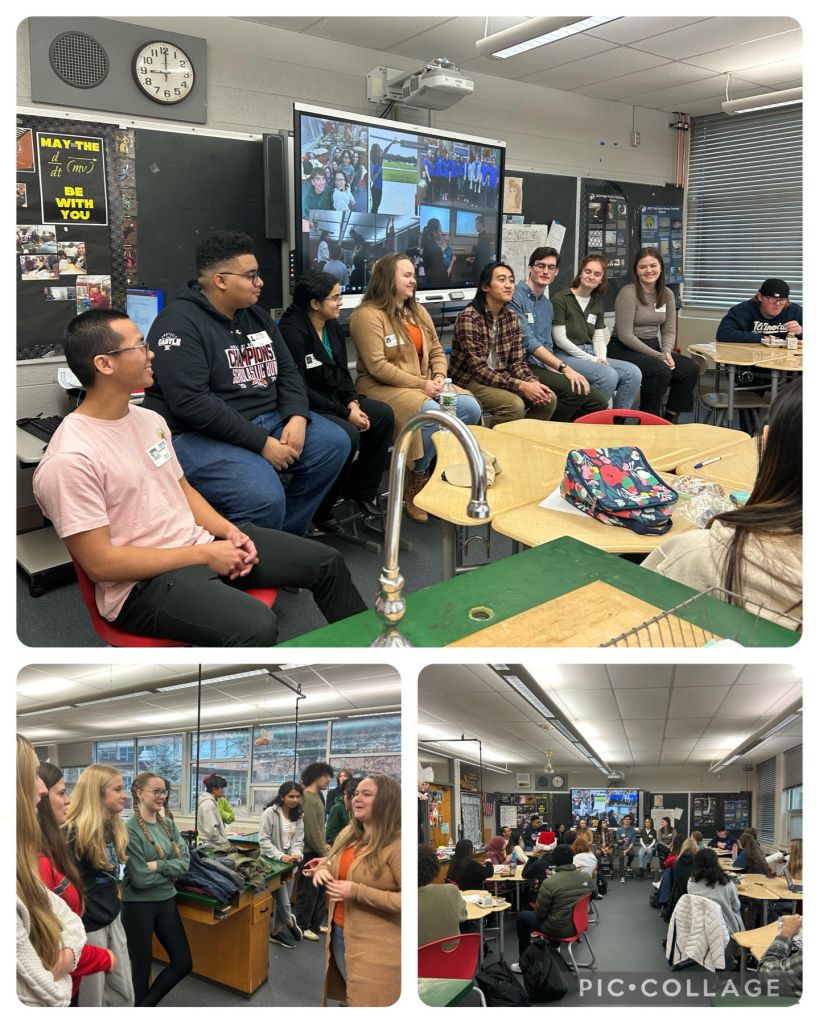
Another strategy that is helpful is when students can hear about success from a former student. For years I’ve had an alumni wall posted by my door to share their stories. A few years ago I was particularly concerned about the future of my AP Physics C enrollment. I specifically reached out to alumni who had taken AP Physics C and were in all walks of life to come and speak to my current students. It was one of the very few times I offered extra credit as a reward. On a personal level, I was not prepared for the joy that I experienced that day when a decade worth of former students showed up.

On a professional level I was so impressed by what happened next. I had students I hadn’t even considered might want to take AP Physics C eager to take the course! The panel was primarily focused on college and beyond, but I did let them know that course selection was on the horizon. After a 25 minute panel we broke out into small groups for engineering, healthcare and physics for students to have a more intimate conversation. This is an experience I’m particularly looking forward to bringing back next year at my new district. When I learned about the “Teach Yourself How to Learn” workshop from Aaron Titus, the power of student testimonials was also strongly iterated.

Lastly, I cannot undervalue the importance of each of us being that coach and support for our students. Finding any moment where our students are doing anything right and praising their efforts of working hard and finding a solution.

This is the last of the posts in this series about strategies for supporting student learning in physics as the final chapter in the original book is Z is for Zzzz The Importance of Sleep. Rhett Allain frequently shares that his primary reason for blogging is to remind himself of the things he’s done before. This project has been an opportunity for my own self-reflection on my practice. So often as educators we try and find things that work. At the same time we don’t always know the evidence behind it. When I attended institute day in April our EduInfluencer speaker said that his research showed educators could only name and describe three strategies. (Describe the actual science/evidence behind it). He said you won’t find this research anywhere because he doesn’t want to publish something that reflects back poorly on our profession. But this is something we need to be talking about in our professional circles! We need to have discussions grounded in evidence. We need to be ok with challenging each other when we are not working with the highest expectations of ourselves as professionals. We need to stop giving the public reason to believe we are replaceable by being able to knowledgeably talk about the art and craft of teaching as a rigorous field of science in the same way that we can talk about physics. If you’ve read 3, 5, 25 of this posts thanks for taking the ride with me this spring. I hope to connect with many of you at AAPT Pasadena!

Teaching Methods · Science of Learning · Activities

ABCs of How We Learn… X is for eXcitement

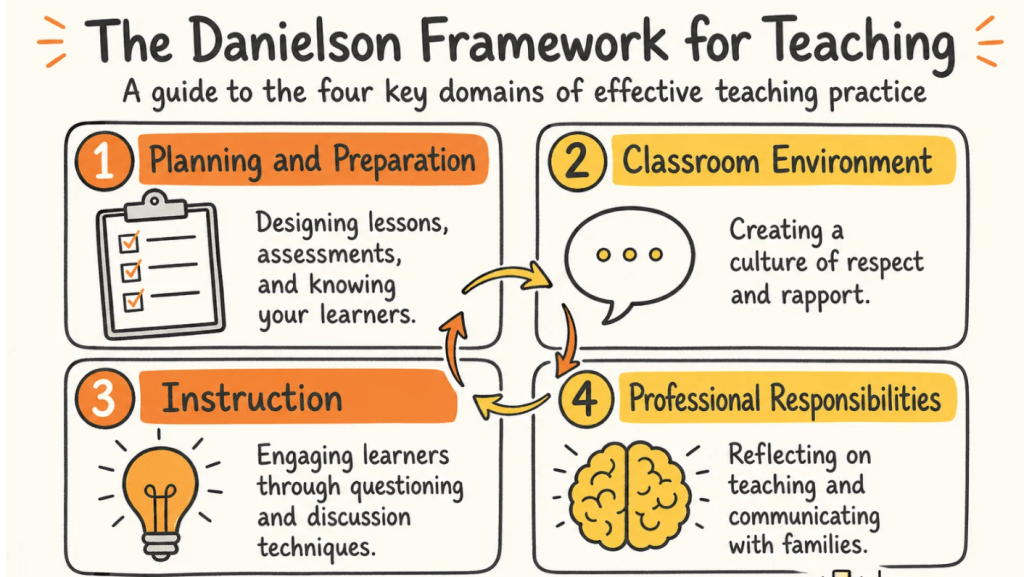
Engagement is one of those trendy buzz-words in education. From the Danielson Framework (domain 3) to SilverStrong to Marzano, engagement is a major focus of all of these evaluation tools and typically a “sell point” for curriculum packages and methods.

When Building Thinking Classrooms was gaining popularity, one of the frequent complaints from folks deeply embedded in the science of learning/explicit teaching was that the program looked like “engagement” but engagement doesn’t necessarily equal learning. While this statement in and of itself is certainly true, there are quite a few points to Building Thinking Classrooms that are right on point when it comes to the science of arousal and learning.

When we are aroused, engaged, excited our brains are primed for more learning. Researchers describe the relation between arousal and performance as the Yerkes-Dodson law (Yerkes & Dodson, 1908). While this law applies to known skills, it is transferrable to learning new ones as well. In short, when aroused we release cortisol which activates the fight or flight response but also impacts the way in which we process and store information. This process is ultimately why we have stronger memories tied to stronger emotional events. The science around emotions and learning is a bit murky, but we do know that when the mind is aroused there is, indeed, a measurable impact on learning.

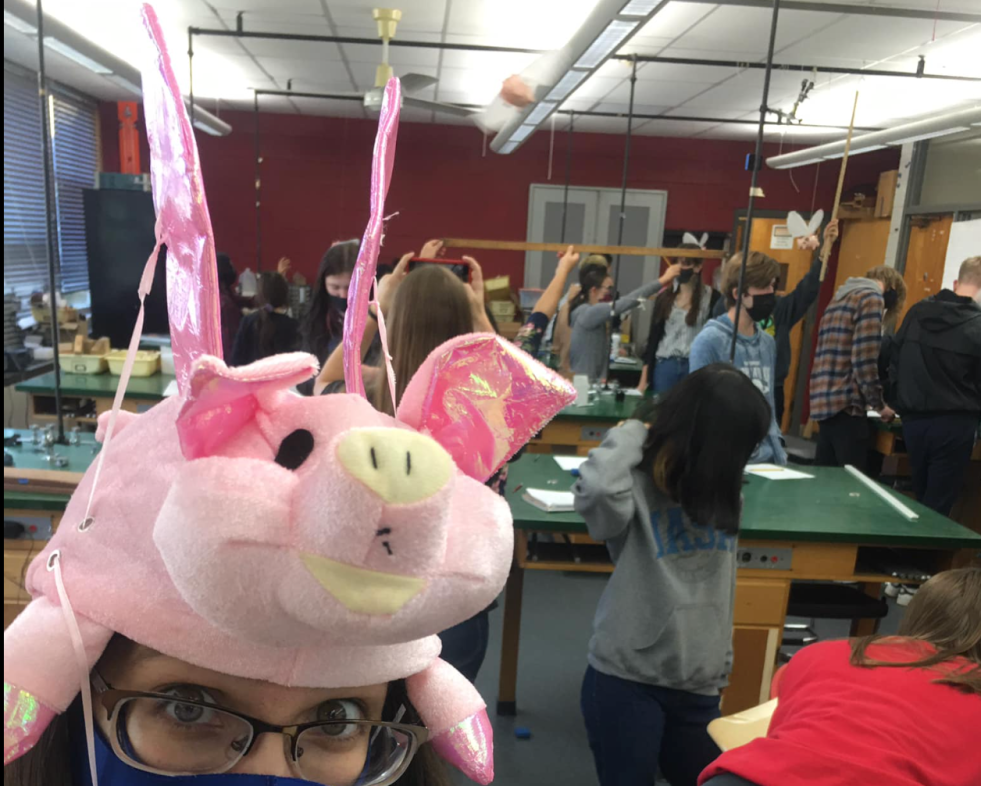
Arousal can take many forms in the classroom, which might be anything as extreme as the teacher coming into class with a ridiculous costume or schtick that day, to an impressive demo or video, but it can also be less intense such as interacting with engaging questions, or incorporating kinesthetic movement into the lesson.

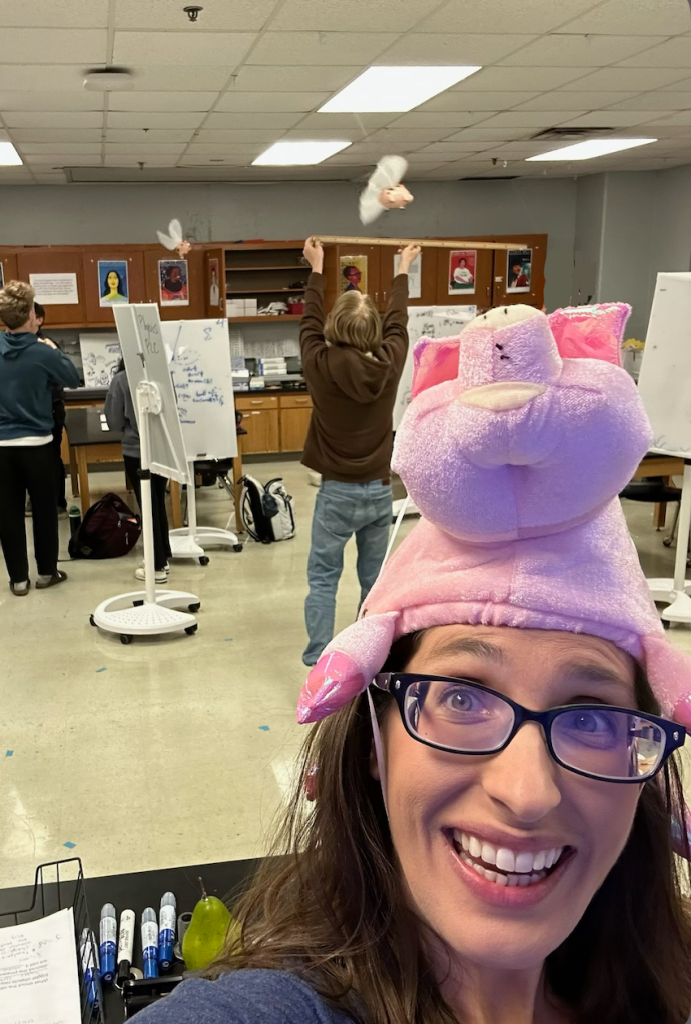
My one and only schtick of the year… the flying pig hat. I can actually make the wings flap!

From the lens of physics teaching, this brings us back to why an active learning environment is beneficial for our students and has been proven over and over again to be more effective than lecture alone. An active classroom takes advantage of arousal to our learner’s benefit.

Coming back to Building Thinking Classrooms let’s take a look at some of the micro-moves and paradigm shifts that leverage arousal:

  • A lesson typically starts with an engaging story or interesting problem. In the ABCs of How We Learn, Schwartz, Tsang and Blair explain that arousal helps us consolidate focal information, and pushes out nonfocal information. The bits of the story which are applicable to the problem itself are most likely to be retained.
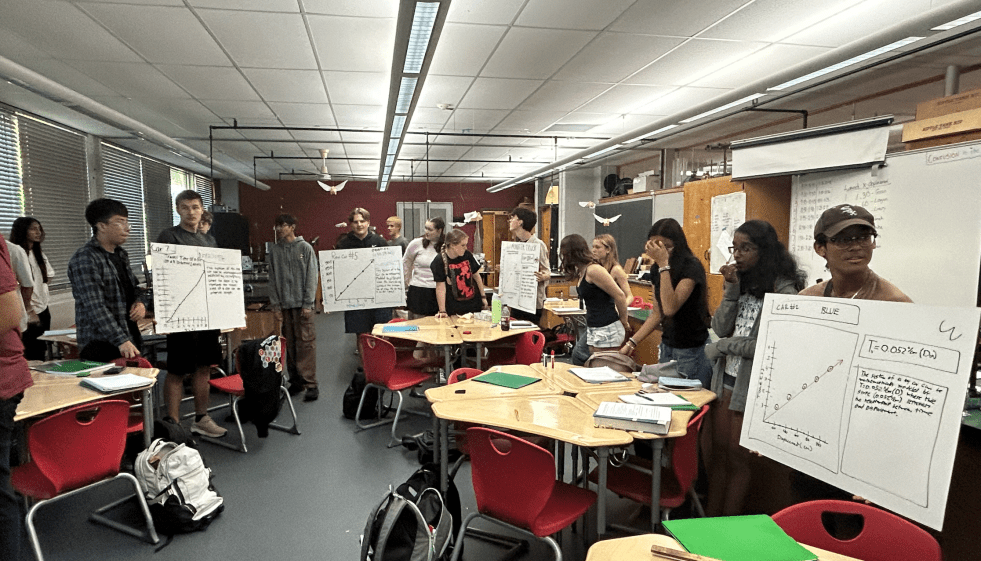
  • In a BTC lesson students never sit down. You’ve probably heard of “brain breaks”. Since whiteboards are vertically mounted, student bodies are now in an active, rather than passive position. This requires the biophysical response int he body for action, which requires a certain level of arousal.
  • A BTC lesson involves not only working in pairs or triads, but the cross-pollination of ideas from other groups. Research has shown that people perform better in social situations. The design of a BTC leverages the social aspect, while the carefully crafted consolidation phase reduces any negative anxiety that would be present in a “typical” classroom where students are called upon to give their answers for their own work.

When I started this project the initial motivator was our EduInfluencer keynote speaker. He made the claim that in his research the average teacher could only accurately name and explain three strategies. Today marks the 24th post in which I’ve explained the science of learning and then matched each topic with one or more classroom strategies.

Very, very often when teachers select an idea, tool or strategy for the classroom the reason they share they love it is because “it gets the kids engaged and they have so much fun”. We need to recognize that in the ongoing battle for the respectability of our profession, that line of reasoning is weak and harmful to us as professionals. Tools we choose that are “so much fun” are effective because tools which excite and engage our students activate the arousal systems in the brain, which change the way the brain receive, processes and encodes new information and subsequently increases the strength of the neurological pathways and the amount of knowledge retained. Let’s continue to have conversations about our work that can only be adequately criticized if done with additional evidence.

Activities · Classroom Issues · Science of Learning · Teaching Methods

ABCs of How We Learn… V is for Visualization

If there’s one thing I find myself iterating repeatedly to my students its the importance of writing things down. Students who are used to doing well in school, and especially in math, often find they are able to solve most problems without showing a great deal of work. In physics, however, that becomes nearly impossible. Aside from showing work for the strict mathmatical portion of a problem, what is almost always more important is that initial diagram.

One of the critical and beneficial features of drawing a picture is that it allows for cognitive offloading. By sketching a graph or a force diagram or even just a physical diagram, now there are details about the problem that no longer need to be held in the working memory, which clears space for the problem solving.

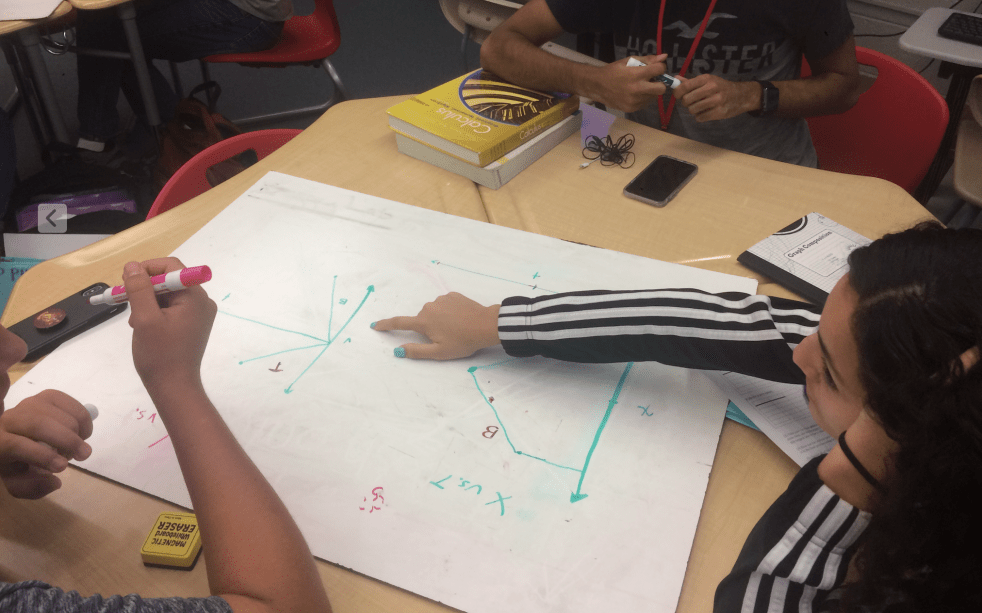
When we use whiteboards in class this also creates the additional benefit of having a shared focal point for the group, which enhances attention and focus on problem solving when working as a team.

The other benefit is that once we begin to create visualizations, we may begin to notice structures and patterns that were not initially obvious or intuitive.

In a 2011 paper, Drawing to Learn in Science, Ainsworth, Prain, and Tytler advocate bringing drawing into the science curriculum because visualization enhances student engagement, helps students learn how to represent information, helps students learn to reason in science, is a major way to communicate scientific data and models, and is a learning strategy.

Drawings also provide us, as educators, quick and descriptive insights to student understanding and possible misconceptions. What students may not be able to adaquately articulate in words may be articulated through a picture.

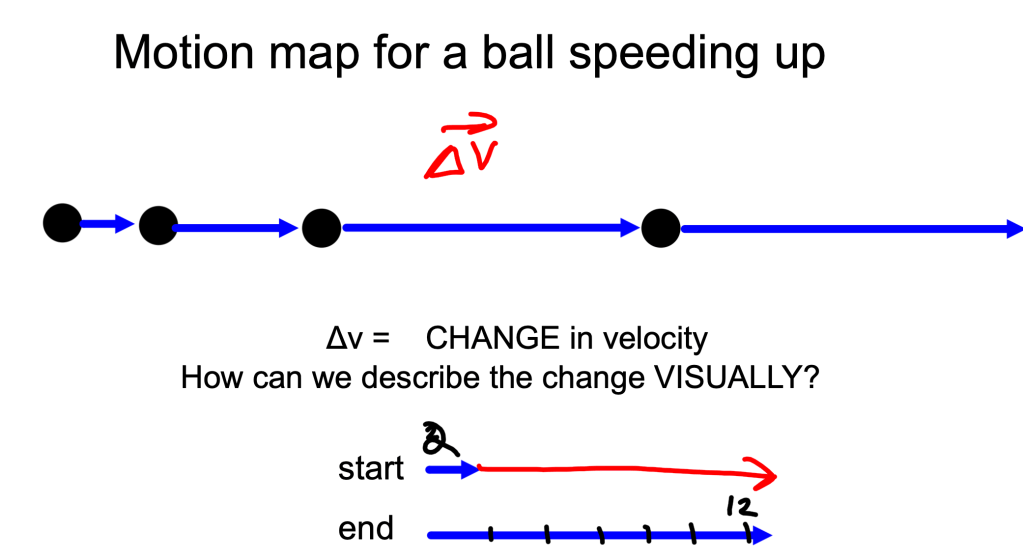
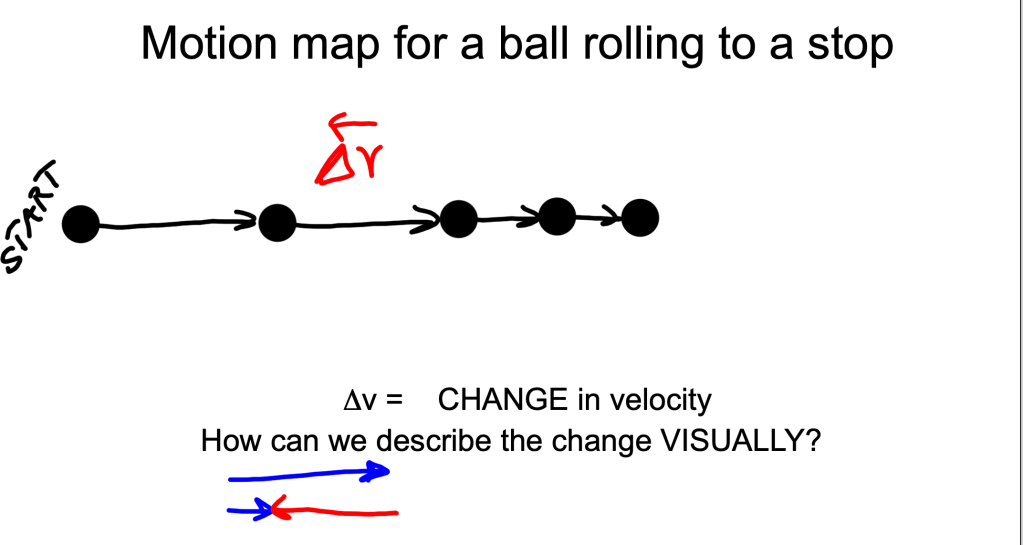
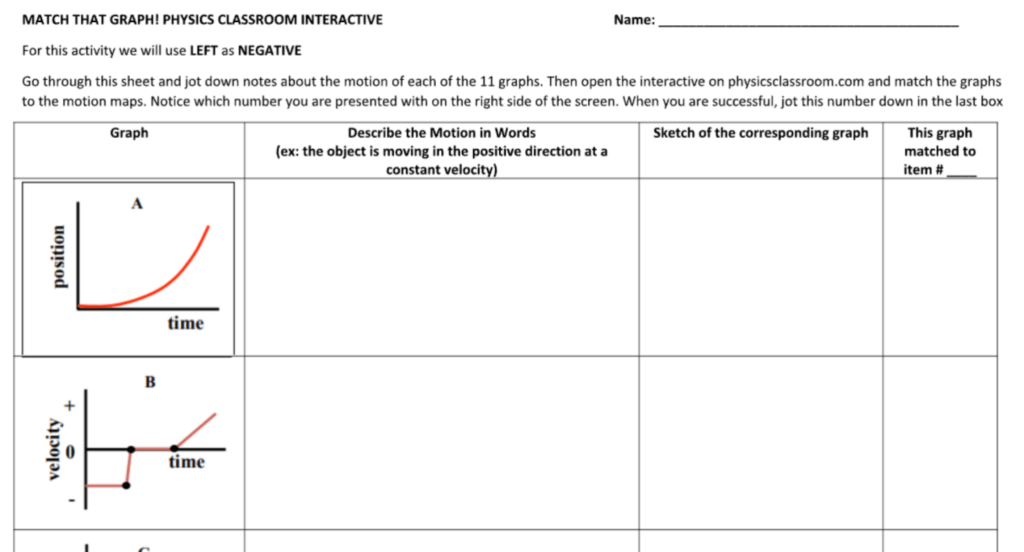
The initial construction of motion maps with students and a bowling ball is a great example of this. First we run several experiments: letting the ball roll freely, constantly pushing the ball in the direction of motion, pushing the ball opposite motion. As this is happening we drop a mark behind the ball at equal time intervals. This creates a physical visual on the floor which students are then asked to translate to their white boards.

Once students have completed this pattern, they are instructed to craft the arrows to indicate the direction of travel of the ball.

After this we can discuss the meaning of and how to obtain the direction of the change in velocity.

These steps are generally well-received by most students. The misconception that most students initially bring to us is that “negative acceleration means slowing down”. In this case, as we continue to provide additional cases (such as an object moving to the left while speeding up) he visualizations serve as a tool to help students undo this particular misconception. They can see for themselves that when the direction of Δv and v match, the object is speeding up, when when Δv and v are opposite the object is slowing dow.

Force diagrams and energy bar charts are additional examples of visualizations that end up being imperative for problem solving.

What frequently seems to be the challenge is that students will generally not choose to complete these vizualizations. I cannot count the number of times I’ll have a very bright student come to me in frustration and the first comment I need to make is “where is your force diagram” “where is your bar chart”. It is for this reason I believe that its critical that the vizualizations become a no-excuses requirement in the work at all times.

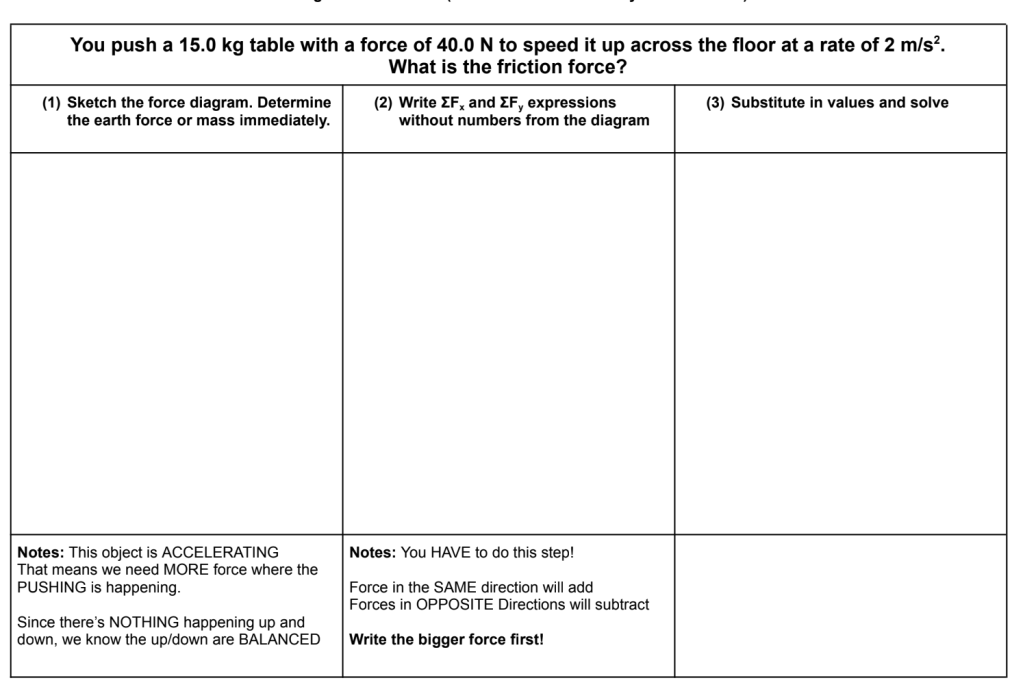
For example, here is the hand-out I provide my students as part of their force notes. Their homework takes an identical three-column format

While the physicsclassroom.com interactives and conceptu builders are fantastic drill practice, the fact that they are on a screen reduces student uptake on physically creating the necessary representations. This is why I’ve created paper companions for most of the assignments I assign students. (Example below)

Like our students, we should actively shift our thoughts around diagrams from something we just happen to do in physics, to a critical learning tool that is backed by research and allows our students more engagement and depth thanks to cognitive offloading, emergent structure (finding patterns), and reorganization of material to get a new perspective.

Activities · Science of Learning · Teaching Methods

ABCs of How We Learn… U is for Undoing

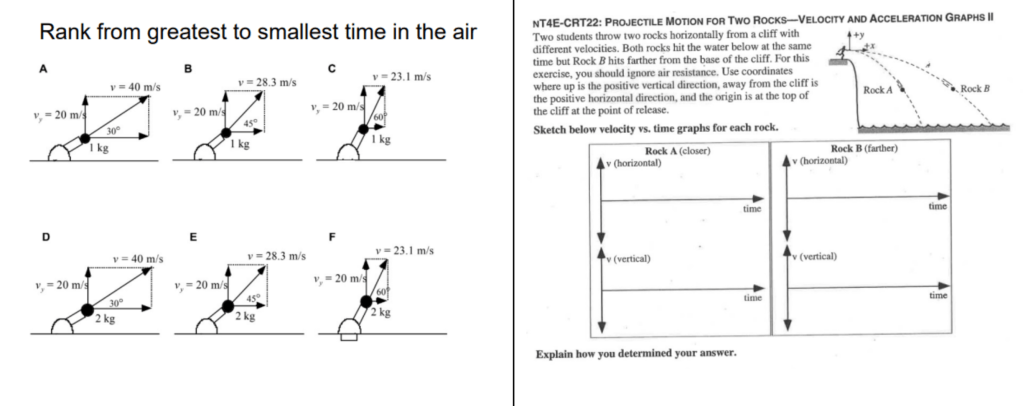
“A bullet is dropped at the exact same time that one is shot horizontally from a gun. The bullets start from the same height. Which lands first?”

We know how this question goes when posed to students. Aside from the fact that we’ve primed them to answer one of the bullets, knowing full well the answer is “neither” we are leaning into student misconceptions, or rather an incomplete conception.

Students know, and are correct, that the shot bullet is initially travelling faster than the dropped one. Students also know, and are correct, that the shot bullet is always moving with a faster speed than the dropped one. Students also know, and are correct, that faster objects will travel the same distance in a shorter time than a slower moving object. All of these notions are true, and because students know these to be true, they will typically answer that the shot one lands first.

Well… except for those students who think about it a little more. See, those students reason that because the shot bullet is travelling faster and because it was shot horizontally, it is going to travel more distance, so perhaps the dropped one lands first due to its shorter distance.

Then there’s the one kid who of course has to say “air resistance!” in some way because fast things experience air resistance. Also not wrong.

Every bit of this reasoning is true until you get to the conclusion.

The issue here has to do with the fact that the reasoning and concept are incomplete. Students are not taking into account that the vertical properties of the two bullets are all identical, and since gravity, a vertical force, is responsible for accelerating the bullets towards the ground with the same vertical acceleration, they will land at the same time.

In a course where students are already coming in with preconcieved notions about who can do physics, the last thing we should be doing is blatantly demonstrating everything wrong with their thinking. Instead, we should leverage and aknowledge the good, while also giving them the tools to make a complete judgement.

Physics students come to us with a lot of incomplete conceptions, they want the ball to roll out in a curved path…

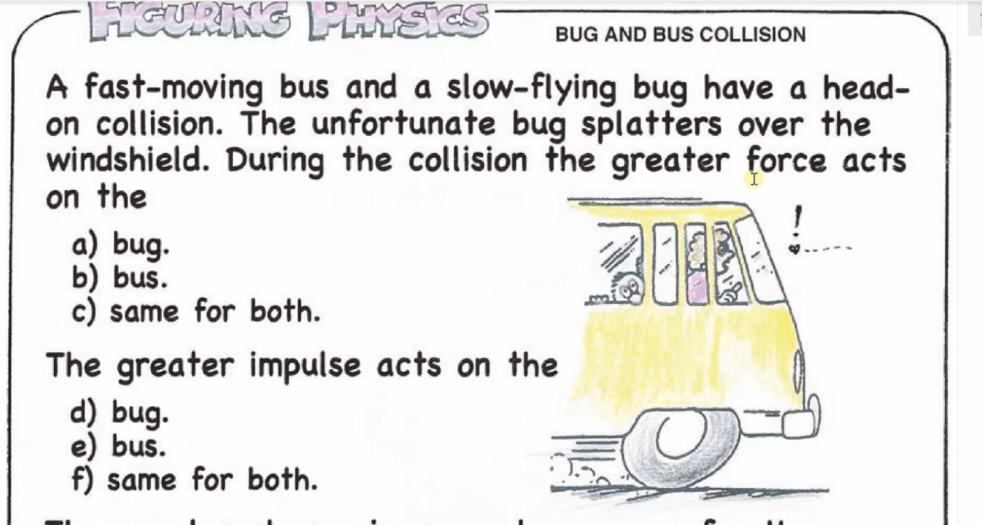
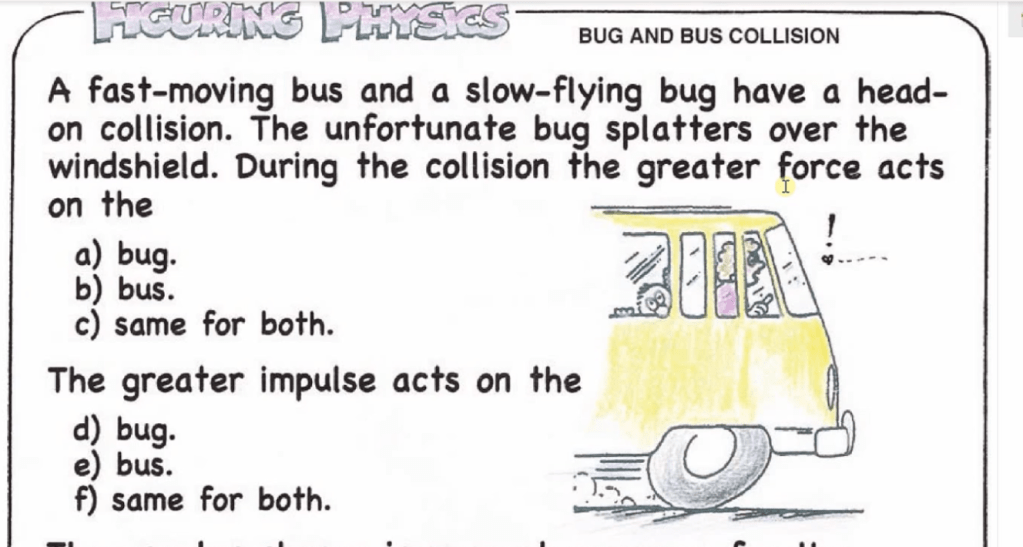
They want the force on the bug to be more than the force on the bus

They want acceleration at the peak of a projectile’s flight to be equal to zero, an object that flies out the window is moving backwards, waves should push matter, and more resistors to always mean more resistance.

Physics misconceptions are frustration for student and teacher alike because they are very much grounded in elements of truth and lived experience, but they are always incomplete.

Making these notions complete and providing many opportunities to encounter the complete notion is imperative to unlearning the previous notion. In order to do this we must:

  1. Increase student precision of thought; so they can reconize the difference between arguing with evidence vs intuition.
  2. Provide students with an alternative conception. This is where our representations such as force diagrams, motion maps etc. come in.
  3. TIME – students need time and exposure for the new conceptions to take hold.

This is a critical component built into the Investigative Science Learning Environment framework, and it is immensely effective at completing these conceptions. What I particularly like about ISLE is that when we are providing the alternative conception, especially for the first time, we are not leaving it up to students to just make the representation. Instead, that representation is carefully drawn through observational evidence.

Coming back to the original question of the two bullets, let’s discuss how the ISLE cycle approaches this particular conception.

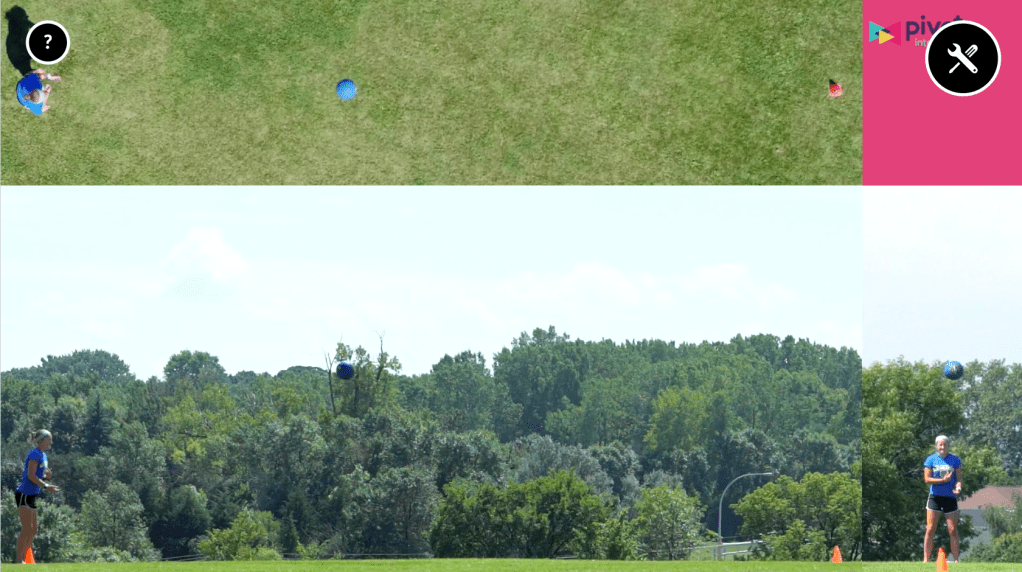
In my class, I use the “three views of a ball” in pivot interactives for their observational experiement.

First, I ask students to construct the motion map for each of the three views. Even here students will sometimes rely on their incomplete conceptions over their observations. I will gently remind students to construct the maps based on the evidence in the video. (This is why we use an experiment!) How is the distance changing (or not) as the ball travels accross the screen? Be sure to represent it appropriately!

After students have done this, we discuss how the side-view actually works (Just in Time Telling!). It’s a composite of the top and front views. That is, the top (horizontal motion) is totally constant. This makes sense because there are no horizontal forces (I do projectiles after forces). The front view looks like an object experiencing gravity.

When students get the question with the classic ball drop demo (now a testing experiment rather than a demonstration) instead of just asking the question about landing, I ask them to first carefully construct the motion map for each ball based on what we’ve just learned and discussed then make their prediction. They should then be able to explain the reasoning for their prediction based on their motion maps.

Students all come to the agreement they should land at the same time.

In this manner of approaching the misconception, we have equipped students with tools to support their thinking, and forced them to slow down that thinking so they can achieve success at reaching a final answer.

From here, students need additional opportunities to represent and reason, so I will use problems like the ones from TIPERS

Teachers that have learned about ISLE for the first time often feel overwhelmed by the idea of “changing everything” but in truth, it’s really more about shifting the overarching perspective and intention, and then you can continue to do a lot of the same activities you’ve done before! Consider any of the other misconceptions presented here, or that you can think of. What might be a way to develop an observational and testing experiement to support the undoing of their misconceptions?

Science of Learning

ABCs of How We Learn: Knowledge … To Whom Does it Belong?

One of the most cringe comments I hear from students working in class is “she said that…” When I hear this instead of “what we need to do next is…” or “I know that the answer is … because… ” I personally feel that I have not yet done my job for students. Why? Because students are not yet taking ownership of their knowledge, the answer still rests in my hands, not theirs.

We could argue that the goal of education is to impart knowledge to students, but knowing that our students are not going to remember all things, what knowledge do we truly want them exiting our classrooms with, and to whom does that knowledge belong?

Knowledge is the bedrock for all learning. The more a student knows, they more connections they can make, the deeper they can go with that material. We’ve already discussed that when students can tie new knowledge to previous knowledge, whether its through analogy, elaboration, generation or a hands on experience, the pathway for memory becomes stronger. In the brain, the physical neural pathway is what has literally grown and strengthened.

If we are going to implement strategies in our classrooms to enhance learning, and we are going to do that from a lens of evidence-based practices, then we need to understand the foundational underpinnings of the brain and how knowledge, skills and creativity are built and work together.

Knowledge and the Science of Learning Conversation

The science of learning has its set of cognitive principals upon which learning instruction can be built. Deans for Impact has a nice document that outlines most of them. Below are a few of them:

  1. New ideas are connected to old ones, but students working memory is limited. Therefore so too must be our presentation so as not to overload them.
  2. There exists a core set of facts in any area of study. Once these are memorized, a person can tackle more challenging problems as their working memory is now freed up. (this is the foundation for phonics in Science of Reading and memorization of math facts for fluency)
  3. Learning transfer is difficult as it requires knowledge of deep structure, which is often not apparent to the novice. (This is argument for contrasting cases)

I want to say first, that all of these core ideas are valid and have the research to support them.

Next, I need to say that unfortunately, due to either a lack of nuance or the inevitable polarization of our current society’s expression of social media, there exist some pretty strong feelings that pit science of learning against constructivist teaching as entirely incomparable.

Through Hattie’s research constructivist teaching has an mean effect size of 0.92 which puts it on par with the jigsaw method and strategies to integrate prior learning. Constructivist teaching is designed with the learner at the center, involves active teaching methods and allows students to explore ideas, solutions and explanations and then take action. This is not to be confused with pure inquiry or discovery based learning. Another set of strategies which has come under great scrutiny are the methods developed in Building Thinking Classrooms in Mathematics. The hard-lined science of learning folks argue that having students engage in activities without prior instruction or knowledge is problematic due to the conflict with the previous statements above. Simply put, students are novices, therefore they lack the background knowledge and skill set to engage in a doing or creating activity, and as novices students will not be able to engage in truly meaningful ways that will impact learning. Instead, they will flounder around with great cognitive overload, little success and too much room for mistakes and misconceptions.

I’d like to take a moment to address this in the context of the kind of learning we see in curricula such as modeling and the Investigative Science Learning Environment (ISLE). First, students are not blank slates. They come to us with a wealth of experiences which have shaped the background knowledge they bring to us. None of our students walk into our room with the same background, but there exists a background nonetheless. Both the experiences and the background knowledge need to be acknowledged in order for us to to our job properly, which is why constructivist teaching is student-centered. Second, I’d like to think that in an ideal educational setting our students are able to move from passive receivers of knowledge to active doers and producers of knowledge. In order for this to happen, we must create the environment where experience is central to developing knowledge.

I took on a collaborative project/conversation with another peer at the beginning of the year in which we took the principals from the Dean’s for Impact document and began aligning the principals with strategies and practices from a physics classroom that is centered on active-learning, constructivist pedagogies. If you’re interested you can take a look here.

Knowledge as a Cycle of Experience, Reflection and Testing

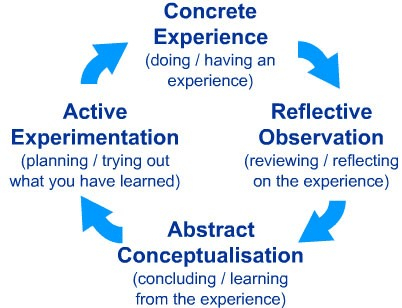
David Kolb, psychologist and educational theorist defined the learning process as the following cycle:

This cycle makes sense for any learning we encounter, not just school-learning. Consider perhaps the kid who “doesn’t like school” Very often that student’s dislike for school can be traced to a concrete experience, whether it was a teacher, and administrator or other students. That experience made them notice and feel things about themselves and/or their environment and made them determine that school was not the place for them. Perhaps this meant they withdrew socially or academically. Maybe it means they transfer schools all together. Either way, some action follows which creates a new concrete experience.

As humans we are learning all the time, and that learning is very often starting from an experience rather than a textbook. (Or perhaps the textbook motivates us to seek an experience!) Shouldn’t it only make sense then, that our students’ learning also begins in a place of experience?

In a previous post, Just in Time Telling, I discussed the fact that when a carefully selected and targeted experience is provided to students and then follow up with Just in Time Telling, the learning gains are strongest for the student than with lecture alone, or discovery-based learning alone. (Schwartz & Bransford, 1998) When we then follow up the Just in Time Telling with a testing experiment, we are providing students into the action, doing and ownership part of knowledge. During this phase of the learning cycle student can make a claim, “if ____ then ______ because______” This testing experiment then creates a new concrete experience from which the cycle can begin anew.

What is a testing experiment you ask? A testing experiment can be any of your traditional labs in which you’e asked students to calculate g, find the theoretical period for the flying pig, find the location where the two cars collide and so forth. Rather than making it a “challenge” task, we can reframe these activities as an opportunity to test our current understanding of forces, circular motion or kinematics.

A testing experiment might also look like one of your traditional labs. For example, we have a lab in which students determine if the friction of the wheels of their lab car are negligible. In this case the hypothesis might look like “if the friction is not negligible, then when we attach a mass to the car and allow it to drop, we expect the change in gravitational potential energy to be different from the change in kinetic energy of the car”.

A Paradigm of Ownership and Action is a Paradigm of Equity and Liberation

There is another critical component here regarding this particular concept of learning and discussing ownership. There is something that inherently sits very wrong with me around some of the language in the science of learning that sounds like language and expectations which are ultimately choosing compliance over creation and collaboration, and maintaining the power differential between teacher and student. When we can move students from passive receivers of knowledge to active producers of knowledge we are also transforming the seat of power. In a world in which we continue to have discussions around social justice, equity and power structures it is a natural conclusion that knowledge and the ability to act on that knowledge is also empowerment. Creating a learning environment where students become doers, producers and drivers of their own learning is creating a learning environment where students can become agents of equity and justice within their circles of influence and their communities.

Why is this conversation important?

When students are subject to strict direct instruction, in which students are assumed to be inadaquate at creative thinking until some benchmark base of knowledge has been established, what we are effectively doing is creating a bunch of minds with fantastic routine expertise (solve these exact problems this exact way). This kind of expertise might easily demonstrate strong effect with high grades and high standardized test scores, but what it doesn’t support is adaptive expertise where students can take a set of skills and move those skills to something novel. As is true in most of life, somewhere in the middle there exists the ideal balance. Routine expertise is important for some aspects, but so is adaptive expertise. We need both. I suppose another essay entirely could be written on why this is even more important in the age of AI.

Here are some questions for your consideration:

  • When you consider your classroom environment currently, does your teaching lean more towards the passive passing of knowledge, the active producing of knowledge, or have you struck the balance?
  • When you consider your students and their expectations for your classroom does they lean more towards the passive passing of knowledge, the active producing of knowledge, or have they struck the balance?
  • If there is discrepancy between your environment and your student expectations, how do you resolve this tension?

Activities · Science of Learning

ABCs of How We Learn in Physics: Analogy

Shortly after completing my MEd I was asked to teach the intro to educational psychology course at Rockford University. The course had recently been redesigned to focus on cognitive psychology and the science of learning. Eager, I looked around for other models at various institutions and reached out to a few collegues. One of whom referred me to the book “The ABCs of How We Learn.” It’s a wonderful and digestable text that goes into the research, provides some examples and good/bad uses of each strategy.

At a recent institute day the keynote speaker shared that in his personal research he found that, on average, teachers could only name and accurately describe three strategies they use in the classroom. So, here’s my challenge to myself: 26 strategies and 26 direct applications to the physics classroom.

A is for Analogy

What makes an analogy? Can you name one in physics? God please not the water pump as a circuit example. An analogy is where two examples have the same deep structure. Analogy then becomes a valuable tool for helping novices begin to pay attention to deep vs surface structures.

There are two ways in which we use analogies. The first is the one you are probably thinking of when you consider analogy… the water pump for a circuit, or lanes of traffic to explain what happens to current in series vs. parallel. As teachers I think we use these examples readily in the classroom as we make abstract ideas more concrete.

There is, however, an additional way to use analogy and that is by taking two or more examples and asking students to identify what about those examples is similar. I noticed that my students this year were having a more difficult time that my previous students making this leap. Have your students ever said to you “but you never taught us this problem!” or “you need to show us more problems!”. It’s not really the number of problems, it’s really a transferrence and deep structure problem. Students are not recognizing that the problem at hand is, indeed, the same problem.

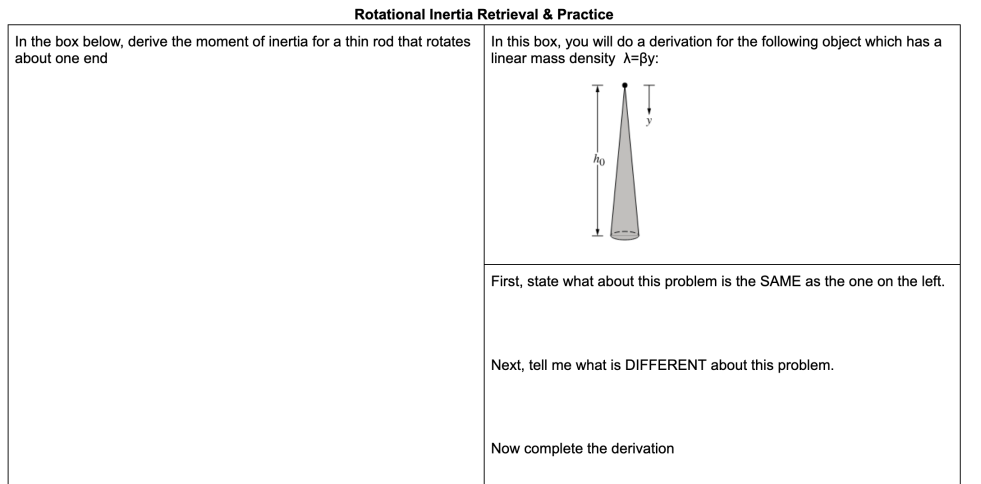
To address this I decided to set up a two-for-one cognitive strategy task (document here). First, I asked students to retrieve the worked example from the previous day. In the first instance of this task I asked them to retrieve the derivation for the moment of inerta of a rod about its end. Next, I provided students with a similar, but different problem.

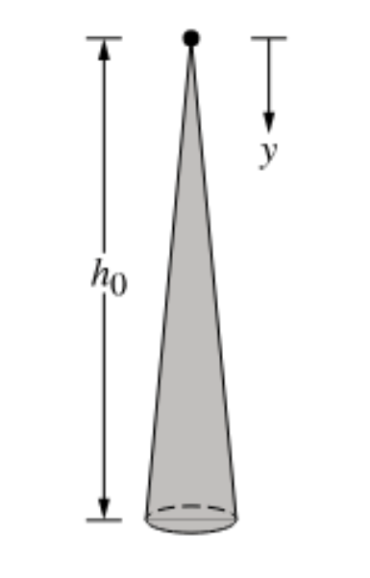
For this first task I felt the problem was almost too similar, but their hesitation proved otherwise. The task was to derive the moment of inertia for a triangular rod about its end where the linear mass density was provided as a function of position. (see below)

However, what I asked students to do first was to identify what about this problem was similar and different to the previous problem. After they took a stab at this we regrouped so we could discuss what I was looking for. It is similar in that it’s the rotational inertia of a rod-like object about its end. It’s different in that the linear mass density is non-uniform and is a function. Then students executed the task. As we moved through the rest of the rotation unit (where analogies abound!) this became my go-to phrase! “Before you begin, what is similar and different to what you’ve seen before?”