
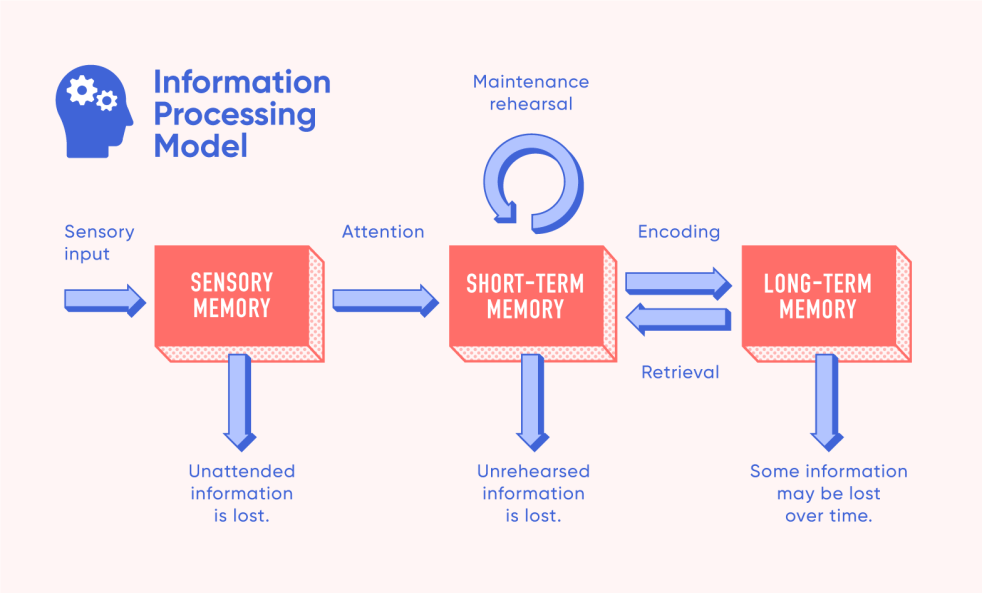
The Information Processing Model for memory is an incredibly important foundation for establishing much of the what and how around teaching strategies.
We begin with the sensory input… the words on this page, the hum of my air conditioning, the sound of my typing, the sound of my husband reading to my son, the motorcycle that just passed by. The edge of my sleeve is a bit damp from washing my face a few minutes ago which feels a bit tight and needs moisturizer and my foot itches. All of these are inputs into my sensory memory, and my brain makes decisions about what I will attend to. I will typically ignore most of the sensations as I’m writing in order to focus on the task at hand. The words that I’m writing, and where I plan do go with this post are living in my short term memory. Meanwhile, I am simulaneously retrieving knowledge from my long term memory about this topic, while also reviewing certain details and aspects so I can correctly quote them here. Writing this post requires all parts of my memory: working, long term, retrieval and rehearsal.
The same is true when students are engaged in the learning process, and it is something we must be particularly attuned to.
When we learn something new and we have a way to connect it to prior knowledge, we are engaging in elaboration which provides us with some additional pathways to access when the time comes to retrieve the information.
I recall when I was taking AP psychology and the teacher warned us that the biopsych unit was often difficult for students due to the amount of vocabulary required. I can also still recall the various ways in which I attempted to elaborate in order to remember the terms we were given. For example, I can still retrieve that the cerebellum is responsible for fine motor movements and balance. My elaboration? It’s the cere-BELLE-um and Belle was a beautiful and graceful dancer.
Making connections like this is one way we can elaborate. For example, I will tell my students they can remember that a CONcave is also known as a CONverging mirror. Many of us are familiar with remembering that velocity is a vector while speed is a scalar. Velocity vs speed is often the first place we make the distinction between vector and scalar quantities and they convienently start with the same letters.
But elaboration does not need to be confined to definitions. We use elaboration in science classrooms quite often if we are asking our students how, why and making connections! This is referred to as elaborative interrogation. Elaborative interrogation is about asking questions to make those connections between ideas.
One of the features of the Investigative Science Learning Environment (ISLE) I found truly appealing is the use of the textbook. Unlike a traditional textbook, Etkina’s Exploring and Applying Physics engages readers with the experiments which were hopefully conducted in class and the text is meant to elaborate on those experiences. Additionally, students are expected to engage in an interrogation of the text, which then becomes elaborative interrogation. Rather than passively reading, students are taught to read the text by asking questions about the claims, “why is this true” seeing if the reasoning makes sense, and actively connecting the material to what was presented in class. It is also teaching students to behave like scientists because this is the way in which a scientist would read an article or paper while making a discerning judgement about the content they are reading.
I recently heard an eduinfluencer make the claim that teachers can only name and describe 3 evidence based strategies they use in their classroom. Challenge accepted. Each day I’m working through the book The ABCs of How We Learn and pairing a strategy with physics content/activities in my classroom.


4 thoughts on “ABCs of How We Learn: E is for Elaboration”