
Memories are stronger when we are able to connect a new experience to a prior one. The concept of “just in time telling” leverages this idea. Rather than dumping a bunch of new information on students, we recognize that students will be able to do more with the new information when we tell them the answer at just the right time.
Curricula in which students are engaged in activities to “discover for themselves” often gets a bad rap from the science of learning community. However, when experiences are paired with the just-in-time telling afterwards, the results are more robust than either method alone. In fact, if we are only lecturing our students are greatly limited by the amount of sense they can make due to their lack of background knowledge. This is often touted as the reason why constructivist learning is a problem, however when the activities are carefully selected and followed by just in time telling, we have provided students the background knowledge in an experience that permits us to then provide a lecture through which they can then make more meaning!
You’ve likely done this before in some context for students. Demos frequently take this experiential role. But what if we made experience before telling the cornerstone of our work? What if we viewed experiences not just as “fun demos” but as critical components to the learning cycle?
Here again is where I am going to sing the praises of the Investigative Science Learning Environment (ISLE) curriculum because it does exactly this! (In ISLE it’s called “Time for Telling”)
During the learning cycle for uniform circular motion students engage in a series of experiments. The first are observational experiments: get a bowling ball moving in a circle on the floor, swing a force sensor in a vertical circle and observe the force readings for the tension in the string, make a constant velocity buggy move in a circle. When I do this with students the next step is to ask them to represent and reason based on their observations. In this case, I ask them to sketch the force diagrams and look for patterns.
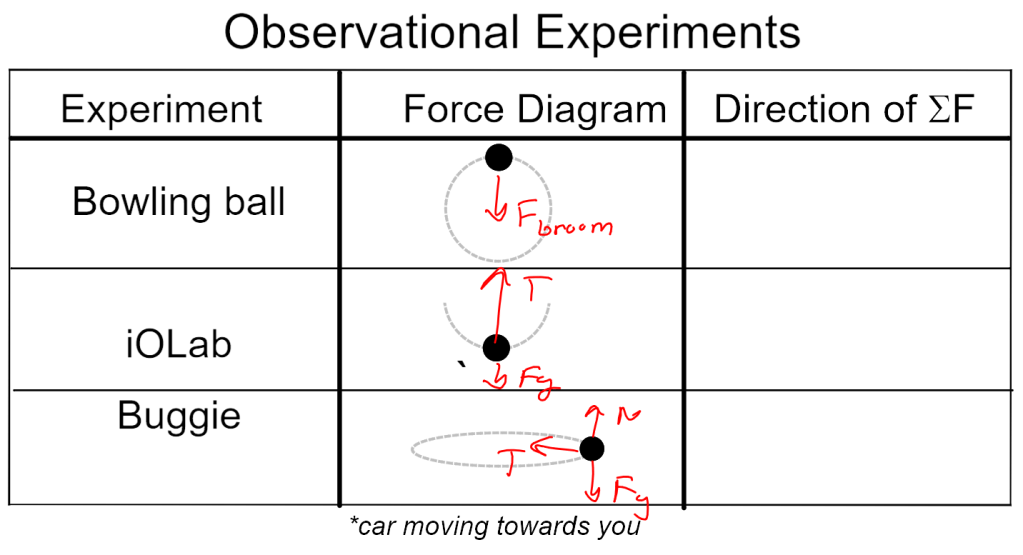
One of the key features in this sequence of activities is that the experiences chosen are very carefully constructed to be precise and matched to the intended learning outcomes. At the end of this series of experiments we do, indeed just tell students that in order to move in a circle we require an unbalanced force AND that force is directed towards the center of the circle. I provide my students with the following page for their notes (modeled after notes from Building Thinking Classrooms)
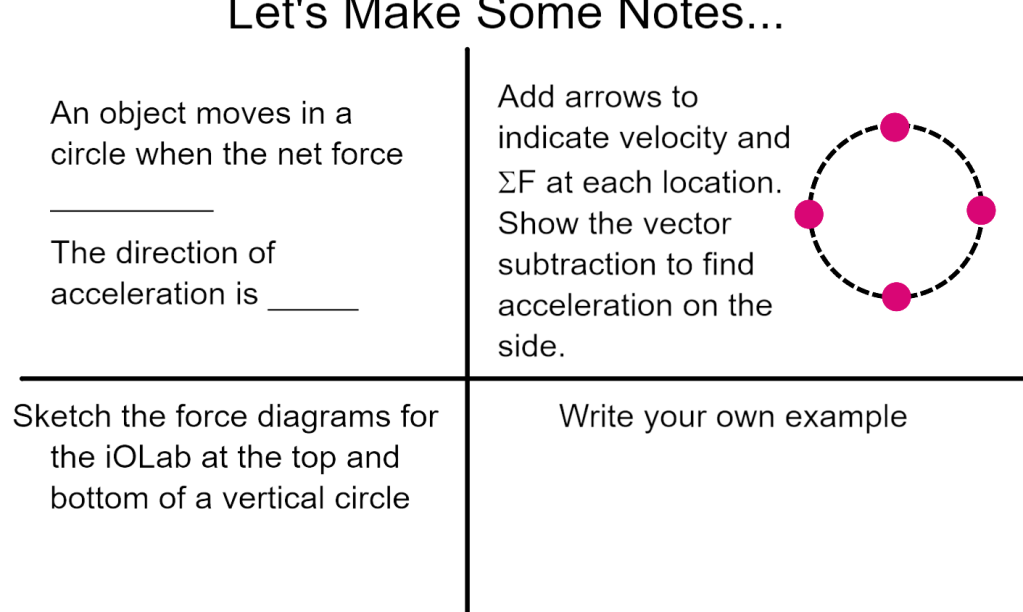
Students are indeed told the correct physics, but since it is after engaging in experiences, the memories should be more robust. This work is then also paired with the elaborative interrogation of the textbook that evening to prepare for the following day.
Today I challenge you to think of one topic where you have started the class by “just telling them”. What is an experiment that students could engage with prior to telling them?
A word of caution: As you take on this exercise I want to strongly discourage you from falling into the “trick your students” trap. A classic example of this is setting up the projectile demo where one ball drops straight to the floor while the other is launched horizontally. Many teachers set this demo up at the beginning of projectiles, ask students to make a prediction, they pretty much all guess wrong, we run the demo and say “aha!”. If we want to create a classroom of belonging, its important to take advantage of any opportunity to provide our students with recognition. In order to create an experience that will enrich our student minds, build their knowledge and support their self-perception, the experiences must be carefully chosen and scaffolded so that the answer we need is the answer we are going to obtain from our students. This typically requires students to engage in data collection in some way, even if that data collection is visual (such as dropping beanbags behind a rolling bowling ball, or observing the direction of an applied force).


4 thoughts on “ABCs of How We Learn: J is for Just in Time Telling – Why Active Learning FIRST is BEST”