Uncategorized

ABCs of How We Learn: C is for Contrasting Cases

Contrasting cases is about noticing the difference between two or more examples that seem the same at a glance.

That core learning mechanic should absolutely scream physics problems to you!

Acceleration is a FANTASTIC example of the benefit of contrasting cases. Students frequently come to us believing the following to be true:

  • “Acceleration” describes speeding up only
  • “Positive acceleration” describes speeding up while “negative acceleration” describes slowing down
  • “If an object’s velocity is zero, its acceleration must be zero because it has stopped”

How do we help unlodge these incomplete conceptions in our physics students? If we could “just tell them” then it wouldn’t be a problem. However, these ideas are engrained deeply in students, and they need another way to approach the idea.

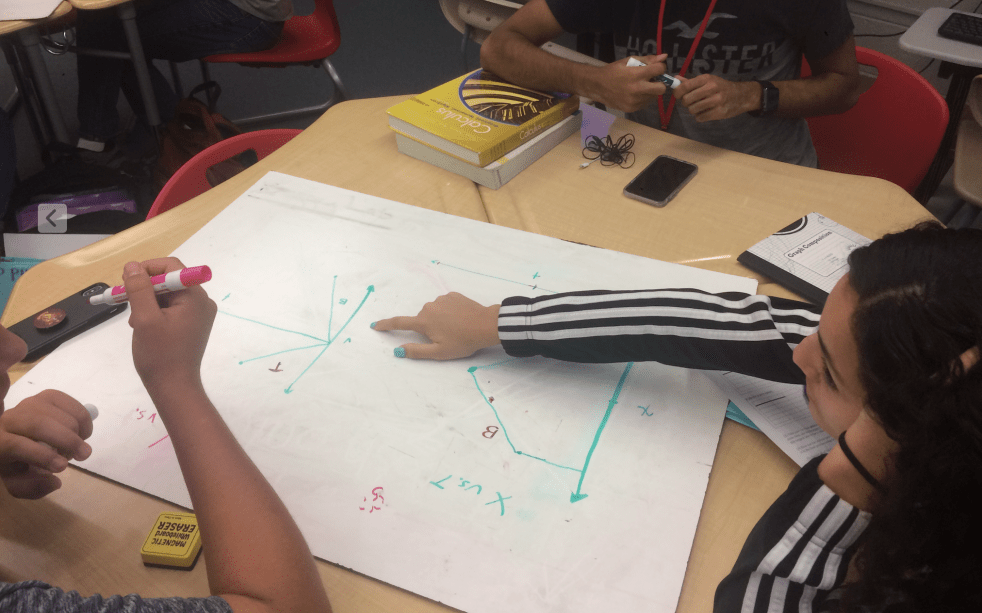
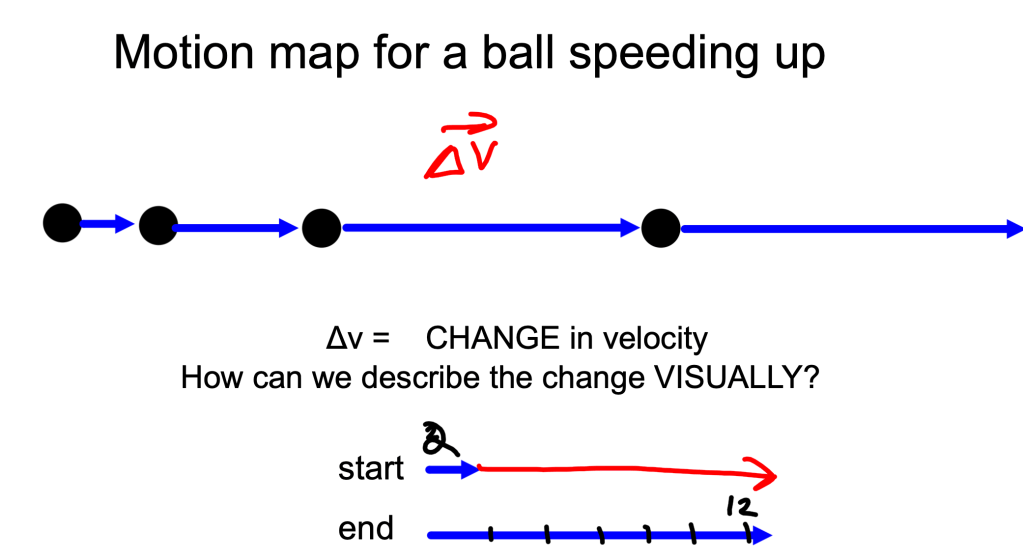
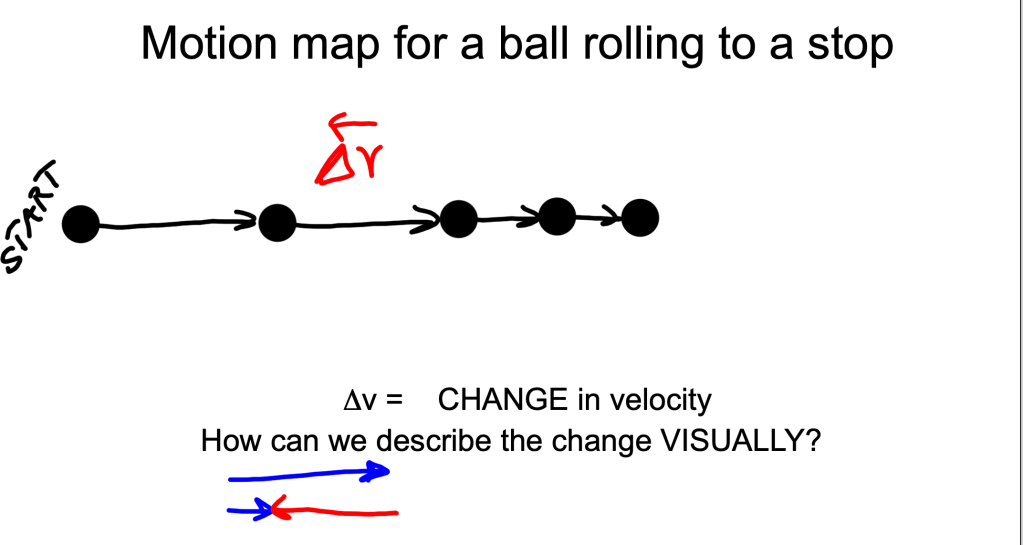
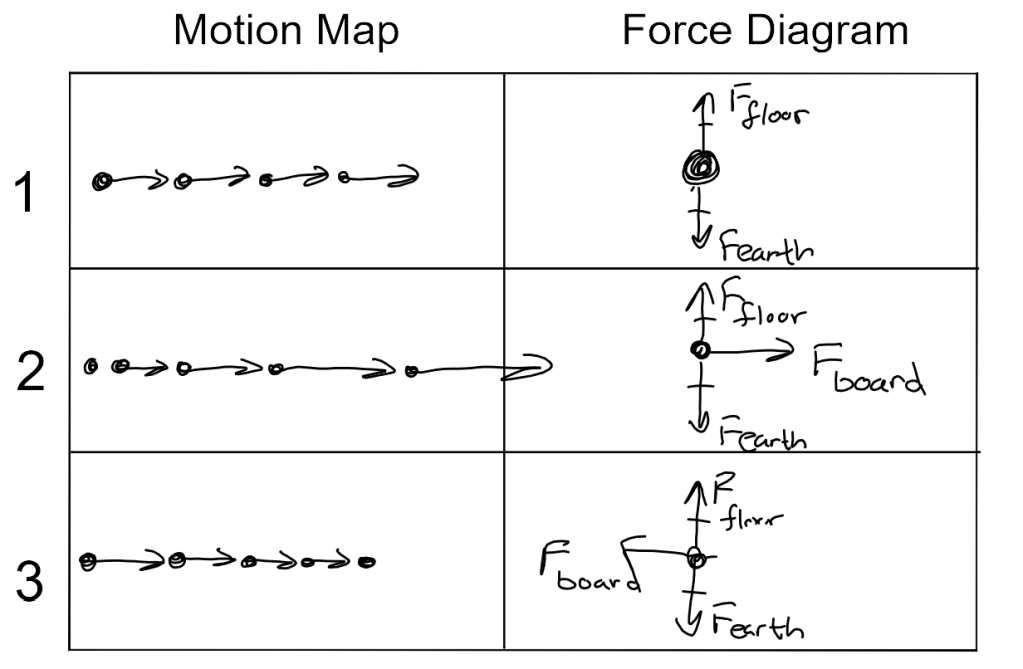
In the Investigative Science Learning Curriculum students conduct several observational experiments using a bowling ball. We drop a mark (bean bag for example) at equal time intervals as the ball rolls. Students copy the resulting pattern and then construct motion maps. This is how we begin to make sense of velocity change, acceleration and force.

The contrasting cases, in this instance, are the diagrams themselves.

Through a simple series of activities, we can build the ideas that constant velocity is not the absence of force, but the absence of an unbalanced force. Accelerations happen due to unbalanced forces and the direction of the acceleration is the direction of the unbalanced force.

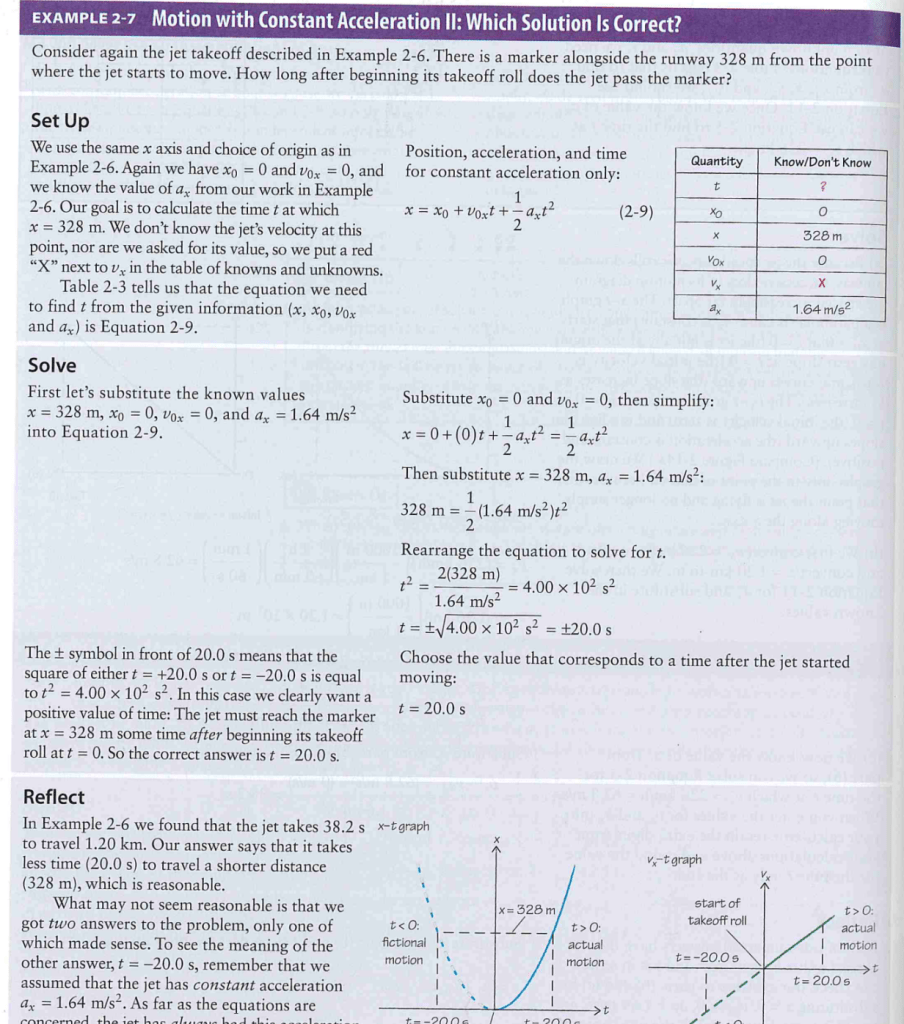
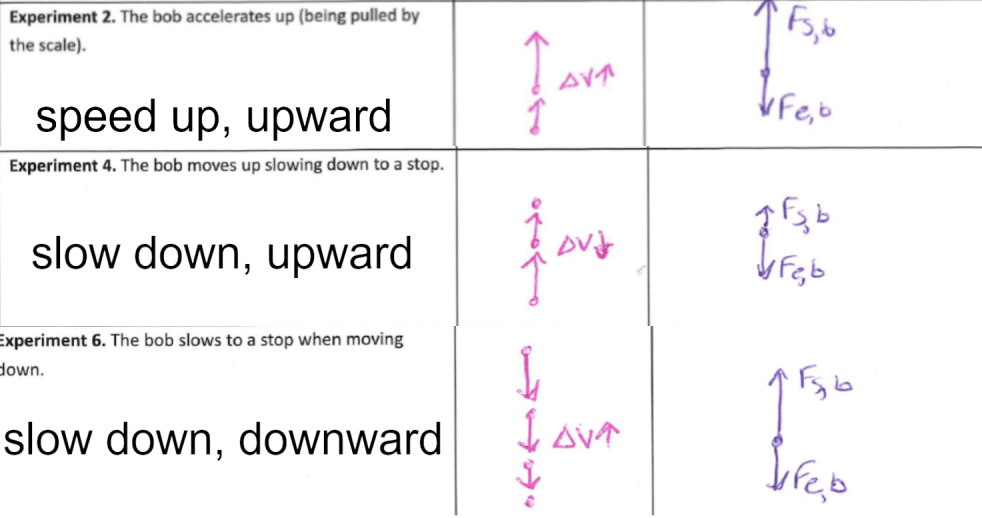
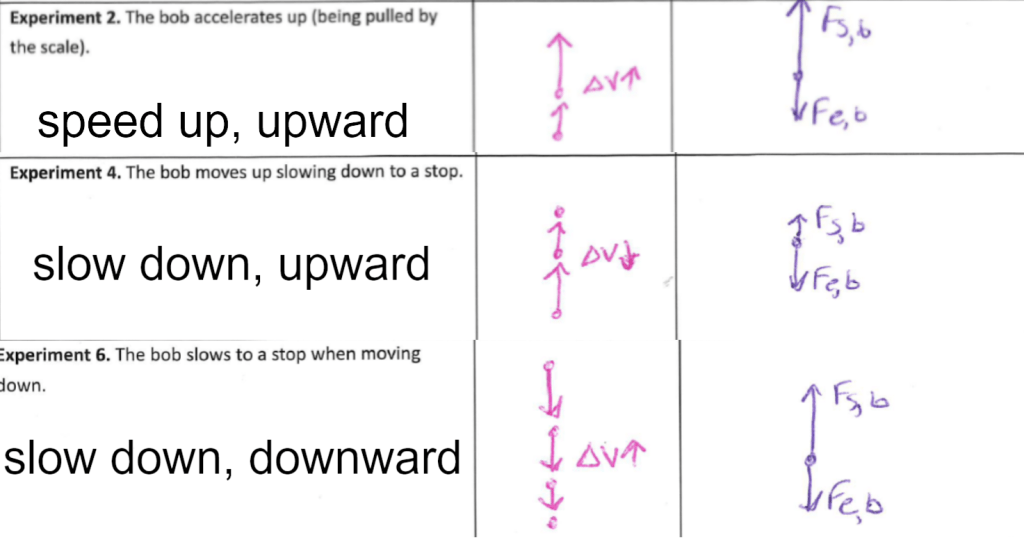
We do a similar task shortly thereafter with an object that is accelerated vertically. When I review the material, I specifically grab the set of activities shown below. In the top two cases, the bob is experiencing upward motion. However, we see the change in velocity is different due to the difference in accelerations.

Next, I have students compare the top and bottom experiement (4 and 6). In both of these instances the delta v (acceleration) is directed upwards, however these both describe two very different motions, up and speeding up, and down while slowing down).

Again, while I could certainly just tell them, there is a lot more power to students constructing the diagrams based on their observations and then we can look for patterns and we can look at the fine details in contrasting cases. We can then use these details in the contrasting cases to more deeply understand the concept. We are also doing something incredibly critical for our students in the science classroom. We are teaching them to argue with evidence. That their answers and assumptions about how the world works need to be grounded in evidence over feeling and intuition. I would argue that fact is far more important than any piece of content they remember 10 years from now.

I recently heard an eduinfluencer make the claim that teachers can only name and describe 3 evidence based strategies they use in their classroom. Challenge accepted. Each day I’m working through the book The ABCs of How We Learn and pairing a strategy with physics content/activities in my classroom.

Activities · Science of Learning

ABCs of How We Learn in Physics: Analogy

Shortly after completing my MEd I was asked to teach the intro to educational psychology course at Rockford University. The course had recently been redesigned to focus on cognitive psychology and the science of learning. Eager, I looked around for other models at various institutions and reached out to a few collegues. One of whom referred me to the book “The ABCs of How We Learn.” It’s a wonderful and digestable text that goes into the research, provides some examples and good/bad uses of each strategy.

At a recent institute day the keynote speaker shared that in his personal research he found that, on average, teachers could only name and accurately describe three strategies they use in the classroom. So, here’s my challenge to myself: 26 strategies and 26 direct applications to the physics classroom.

A is for Analogy

What makes an analogy? Can you name one in physics? God please not the water pump as a circuit example. An analogy is where two examples have the same deep structure. Analogy then becomes a valuable tool for helping novices begin to pay attention to deep vs surface structures.

There are two ways in which we use analogies. The first is the one you are probably thinking of when you consider analogy… the water pump for a circuit, or lanes of traffic to explain what happens to current in series vs. parallel. As teachers I think we use these examples readily in the classroom as we make abstract ideas more concrete.

There is, however, an additional way to use analogy and that is by taking two or more examples and asking students to identify what about those examples is similar. I noticed that my students this year were having a more difficult time that my previous students making this leap. Have your students ever said to you “but you never taught us this problem!” or “you need to show us more problems!”. It’s not really the number of problems, it’s really a transferrence and deep structure problem. Students are not recognizing that the problem at hand is, indeed, the same problem.

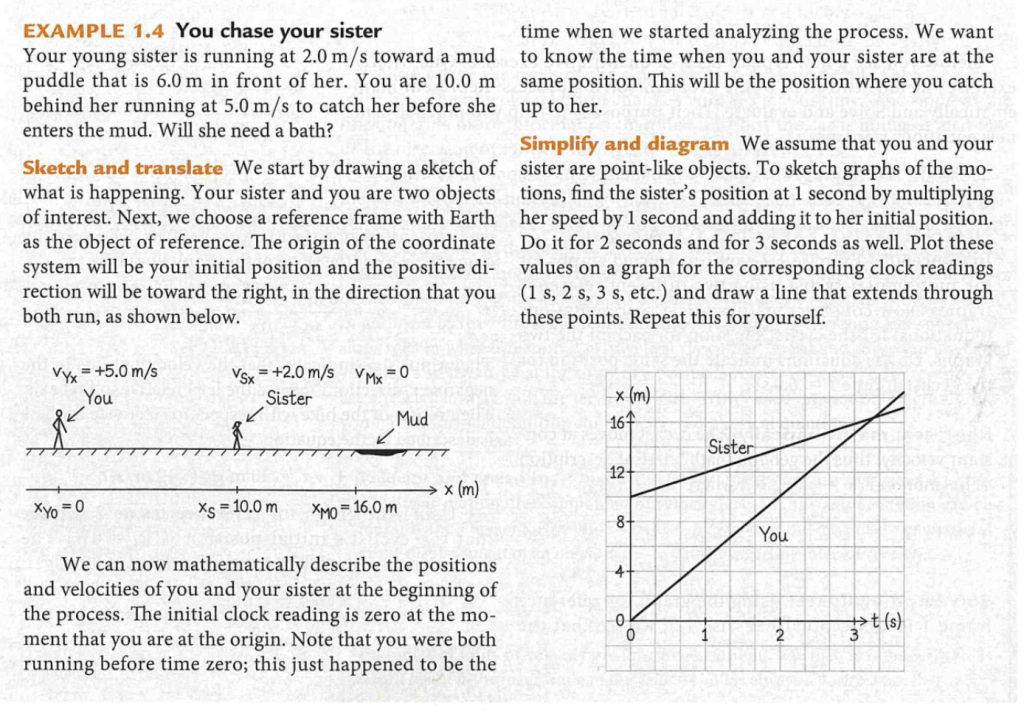
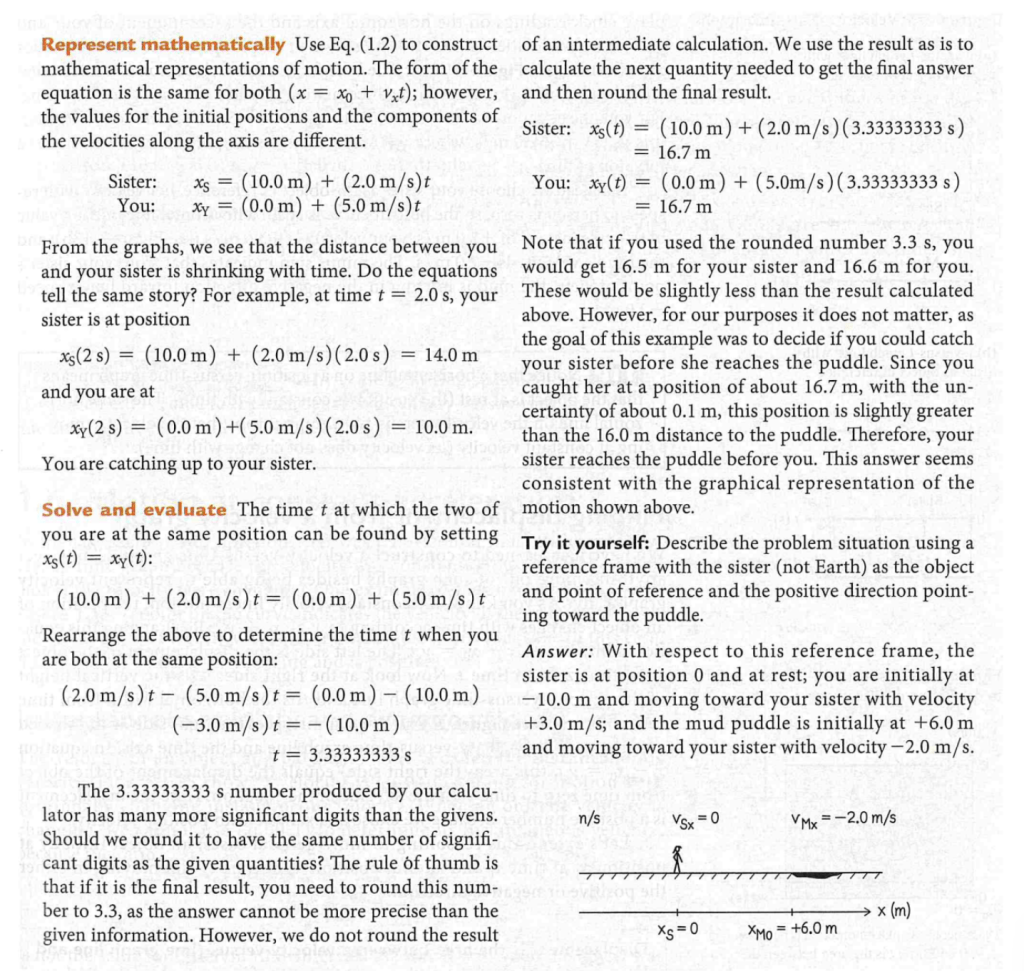
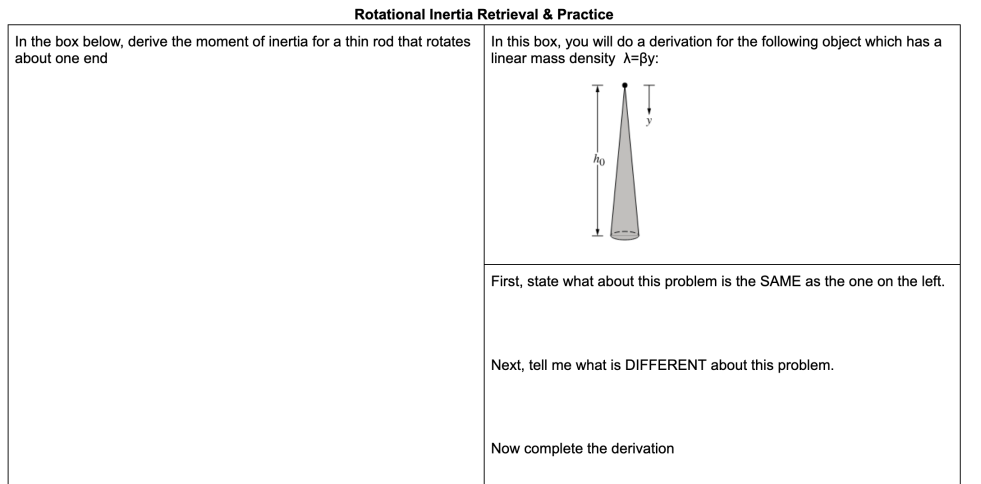
To address this I decided to set up a two-for-one cognitive strategy task (document here). First, I asked students to retrieve the worked example from the previous day. In the first instance of this task I asked them to retrieve the derivation for the moment of inerta of a rod about its end. Next, I provided students with a similar, but different problem.

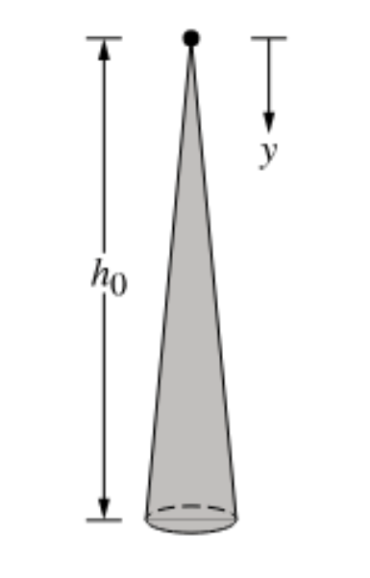
For this first task I felt the problem was almost too similar, but their hesitation proved otherwise. The task was to derive the moment of inertia for a triangular rod about its end where the linear mass density was provided as a function of position. (see below)

However, what I asked students to do first was to identify what about this problem was similar and different to the previous problem. After they took a stab at this we regrouped so we could discuss what I was looking for. It is similar in that it’s the rotational inertia of a rod-like object about its end. It’s different in that the linear mass density is non-uniform and is a function. Then students executed the task. As we moved through the rest of the rotation unit (where analogies abound!) this became my go-to phrase! “Before you begin, what is similar and different to what you’ve seen before?”

Uncategorized

Three Lesson Plans for Student Growth

I returned from doing work at the district office to a disaster.

My students were supposed to take their “check-in” (that’s what I call quizzes because their function is to literally check in on student learning) and at first glance I was walking into a mess.

Students should of had enough time to finish the two problems, however the vast majority of my class had half of the assessment blank.

I started looking at the students who finished.

Only three.

All three had done great!

But I have 30 students in this class. Not good.

At first, I will admit I was really upset for a number of reasons.

So I started planning what we were going to do. When I looked more closely at the assessment I noticed that about two thirds of the class was actually doing pretty ok, they just needed more time. Regardless of the fact that I felt strongly that they had enough time, I couldn’t argue the evidence that what was complete was good.

The students who had not done anything beyond opening the assessment were the same ones who have been disengaging with the material and straight up refusing to attempt. As much as I was frustrated that this was on the student (because, after all, my other class is flying and the students who are doing things every day are succeeding). I took a deep breath and regrouped.

What if I made it tactile?

We’ve been working on multiple representations for momentum. So I made up little squares to represent units of momentum. I made a set of red and blue (for each car) and added labels for 1 kg across the bottom and 1 m/s upward.

Sample of cards. This could represent a 2kg and a 1kg object stuck together post-collision moving at 2 m/s

Within table groups I assigned group roles that I borrowed from Marta Stoeckel (check out her article with Kelly OShea!) and then also added a task, one representation needed to be done by each student in the group on the large white board and then they were all responsible for doing it on their own paper.

Step by step we worked through the original problem in small groups. Since I had reduced my “class size” to eight, I was able to give the students with the most need all the attention they needed while the rest of my class completed their assigned tasks.

One of the cool features, aside from students commenting that they liked placing the blocks, was that it allowed us to discuss the limitations of using discrete blocks. In the assessment problem the final velocity was 3.6 m/s, so while I had some students show 22 blocks, demonstrating they understood that the total momentum was constant, they had uneven heights for an inelastic collision. It’s better, then, to just label height and width and go from there.

By the end of the hour everyone was happy.

My three students who did great were given this handout. They were asked to come to consensus and then reflect on their gaps/needs. I checked in with them at the end and they were able to communicate confidence and what they needed.

The large group felt satisfied that they had the chance to go back into their assessment. When I went back in to review the work I found that their performance matched my previous hour, even though they take more time.

The small groups were kind of amazing. Most of these students had been really checked out, but this small shift got pretty much everyone fully on board and verbalizing that they understood what was happening. In order to make up for the assessment, a second problem was on the backside of the worksheet for them to do independent of my help.

At the end of the day I reflected on how the only reason I was able to do this on the fly is due to the fact that I’ve been teaching for a long time. This was a new-to-me activity (although I’ve set up differentiated groups like this before) but at the same time this was effectly three different lesson plans in the same space. Elementary teachers might laugh at my overwhelm, but the reality is that teachers (all of us) are simply not given the kind of time required to plan high quality experiences for our students. This also shows how important data is in our work. Data can allow us to be a bit more objective in our judgements, moving from “they didn’t do anything” to “what else could I try to fill their needs?”

This job is challenging, but it wouldn’t be fun if it wasn’t!

Uncategorized

Drafting Theory Before Lab Day

I used to do lab notebooks. I used to give students grace and flexibility. Labs had due dates in the calendar, we had board meetings, time in class and I would collect the notebooks at the time of the unit exam.

The inevitable happened. Many students spent hours upon hours of time getting notebooks done the night before the test. It wasn’t that they weren’t given time in class or during the week, they just did the student thing and other classes became more important until physics was important.

That all changed a while ago.

One of the shifts I made a few years ago was adding vertical whiteboarding to the lab. Specifically, I set up the physics of the lab as a vertical white board task. I gather students together and demo the intention of the lab. Then I verbally tell students what I’d like them to go figure out.

In building thinking classrooms the key piece is the consolidation piece. I’ve done the consolidation for the lab, but what I’ve found is actually more effective is the following prompts:

  • You are not there until we are all there
  • If you’re done or stuck, go take a walk.

I first tried this the day of a formal observation(!) and I’m never going back. The energy in the room was unmatched, and the sense of accomplishment by the students was so much greater than if I had told them outright. In previous years I’d let them work the problem in their lab groups, but this meant some groups would get it right away and dive in, while others really struggled and then were behind in data collection. Doing the physics this way instead builds the community.

One year I had two challenges. The first was that my students simply were not putting in the same time, effort and care as students in previous years. I know I sound like a crabby veteran teacher, but it was truly different. I also had one student, in particular, who had extreme anxiety. My flexibility with them inevitable created more anxiety as they tackled the most pressing assignments in their heavy school load. The infrequent lab collection was a complete nightmare for them.

Meanwhile, I’ve been adamant that certain lab writeups will have theory sections. I ask that students explain using diagrams, words, and mathematical models the physics behind what we are doing. Getting students to craft an excellent theory and how it then connects to the procedure is something I’ve been trying to figure out how to best present for many years.

Although we obviously discuss these ideas before students head into the lab, students inevitably dive into the lab, record their data and would come back to writing the formal theory later.

And later is almost always an afterthought.

To support my student with anxiety and to get the rest of the class doing physics on a more regular basis, I started requiring the theory sections submitted to me the day we would begin the lab. I explained that the theory would be a draft (and in practice, I did not penalize students for not submitting it, the consequence was they had to do it all the night before the lab due date and didn’t get a chance for actionable feedback).

Student response was overwhelmingly positive. First, by putting the hard-ish deadlines in place, the quality of student work rose dramatically. Second, students had the time and space to prepare for their unit exams, rather than trying to write a bunch of physics for the lab. Third, and most persuasive, the students verbalized how much more they liked this. I had one student say “I actually feel like I know what I’m doing in the lab now!”

We can show and tell students all day long, but until they work with the content themselves and make it their own, they haven’t yet become owners of their learning.

Take a look at these two drafts submitted by the same student.

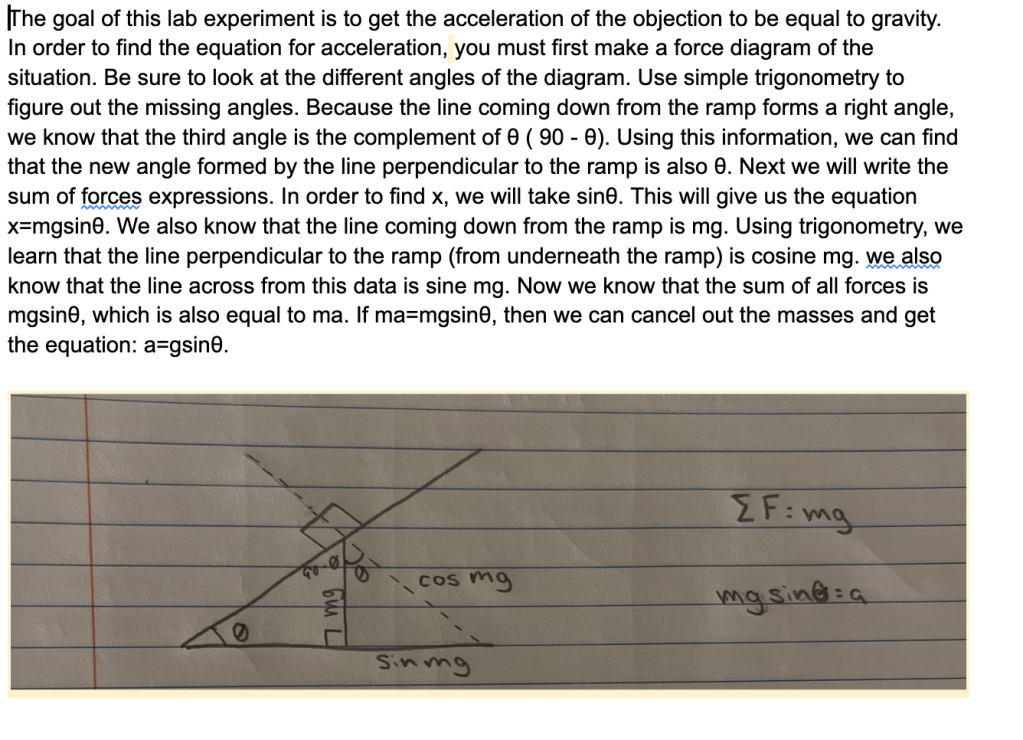
The first draft was for a lab where we found the acceleration due to gravity with a ramp. This draft is typical of what I used to see often the first time I asked for a theory section:

This is done fairly well, but the representations are after-thoughts and it’s not entirely cohesive yet. I left comments on this draft and the student responded positively.

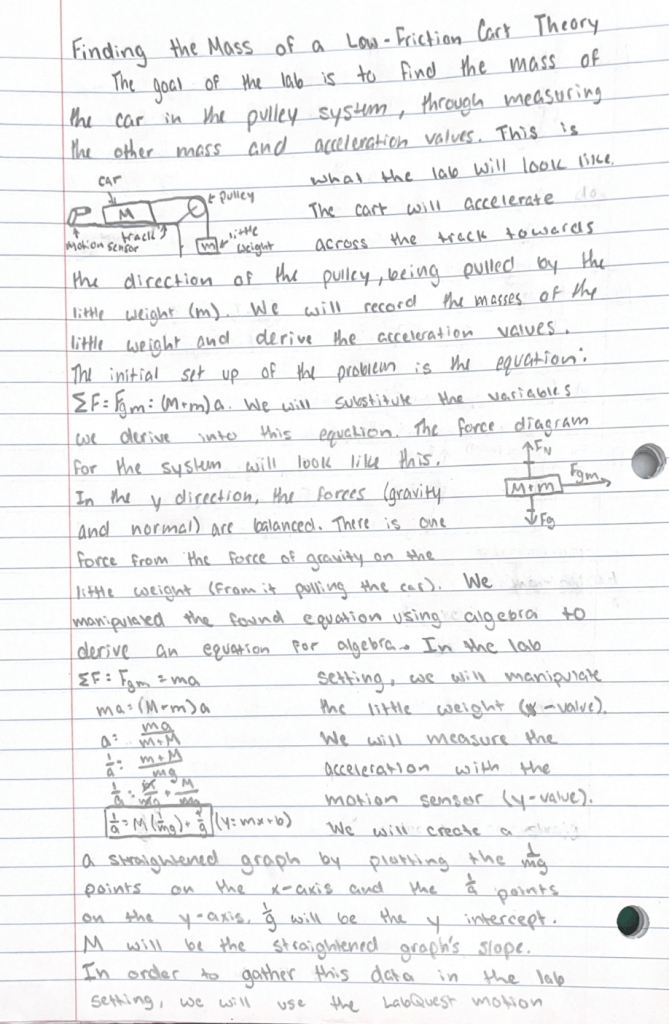
Now take a look at this same student who wrote this draft. There is one physics misconception that needs to be addressed and I’d like the formatting cleaned up, but notice the quality of the content at this point:

I’ve taken this as a win-win-win

Win 1) Students are not scrambling to provide this level of detail the night before the test or the night before lab collection way after the lab is done

Win 2) Students feel confident going into the lab about what they are doing and why they are doing it, which lets us focus our conversation on the how, which includes the procedure, the equipment, uncertainties, assumptions and error sources

Win 3) I feel way more confident that students know what they’re doing. AND, I get to support and fill some of the incomplete thinking as soon as possible.

If you’ve followed me for a while you know that I’m a huge advocate for building capacity in communication skills. I firmly believe that communication is the single most important skill in which we can educate our students. Without it brilliance has no impact.

In My Class Today · Science of Learning · Teaching Methods

Note Making in an Active Classroom

I like to be challenged. In the last year as the Science of Reading has surged in use/popularity so too have the direct instruction advocates. Specifically in my space I’ve seen a lot of attacks on student-centered instruction (the type of instruction that is promoted by the National Council of Teachers in Mathematics and the NSTA) which argue that an emphasis on student thinking and problem-solving is harmful to all but the top tier students.

None of us educators who truly care about the craft are blindly and deliberately acting every day in ways to exclude students. Most of us are intentionally considering what is presented to us and how it impacts our students in the classroom. I graduated college fresh on the latest expression of inquiry-based learning making its rounds as all the rage. At that time the idea was to let students explore and then let them go where they wished. This concept drove my first day activities where my students play with various demos and lab set-ups, but it was very clear that the kinds of questions and ideas students would come up with on that first day were predictable and lacked meat. True to the advocates of direct instruction (DI) and grounded in cognitive science, the more you know the better questions you can ask.

My first year teaching was also a shift from my previous experiences in affluent schools to one where the majority of my students were highly dependent learners, for various reasons. I quickly realized that I needed to scaffold most of the resources I had from student teaching in order to support students reaching the intended goal.

In the years that followed I had a wealth of opportunities with student groups. I ended up teaching everything from co-taught freshman physics to honor’s physics at that first school and then everything from kindergarten astronomy to middle school integrated math at Northwestern’s gifted enrichment programming. Then I was back at my old high school where I tutored over 2,000 different students in science and math. That experience was eye opening in terms of how instruction impacted students, and yes, some students need more direct support.

I attended my first Investigative Science Learning Environment (ISLE) in the summer of 2018 and it was earth-shattering. Roughly a decade into teaching and the method from Rutgers University gave language and research to many of the things I had figured out along the way.

In 2022 I discovered Building Thinking Classrooms in Mathematics and in 2023 I attended a workshop with the author, Peter Liljidahl. At that workshop we focused on the later-half of the book which is arguably the most difficult to understand how to execute from the text alone. Peter explained to us that in their research what they noted was that consolidation and note-making were the critical components that made the different in lasting learning. Let me reiterate that: Peter himself shared with us that random groups, vertical whiteboarding, thinking tasks are easy to implement and certainly promote engagement but in order to get the learning to stick, the consolidation was key.

I started thinking about this in the context of any kind of active learning environment. In ISLE students go through the process of observational experiments and testing experiments and are also “representing and reasoning” along the way. After each round students are supposed to be “interrogating the text” and then practicing with problems. This works great for my gifted AP level students, but as many of us have found other student groups need more scaffolding and support. During the workshop Peter shared his latest idea for note-making.

Some context from the book. Everything is about considering the psychological messages we send to students about our expectations and their roles, and how we can make moves to flip that to re-center the student and their thinking. As renowned cognitive psychologist Daniel Willingham points out, thinking is hard and our brains do everything possible to avoid it. At the same time we also enjoy puzzles and figuring things out (did you do wordle or connections today?). In the book the idea is that notes are something that happens after engaging with thinking and in a way that you continue to think while making (not taking) the notes.

Think about that for a second. When you take notes in lecture how does that go? Are you furiously copying everything and then find yourself not remembering the actual lecture? Are you trying to furiously copy and then falling behind, leaving you frustrated? Or do your prior experiences prohibit you from taking any notes at all so you give up. We know that the act of note taking is helpful for remembering, but there are also a lot of barriers and challenges when trying to get a group of 30+ individuals to all obtain the information pertinent to their learning.

The book discusses having students “go make notes” and to write things down for “their future forgetful selves” which is a good framing, but I noticed in class that many of my students were still unsure about what that would mean.

What it Looks Like

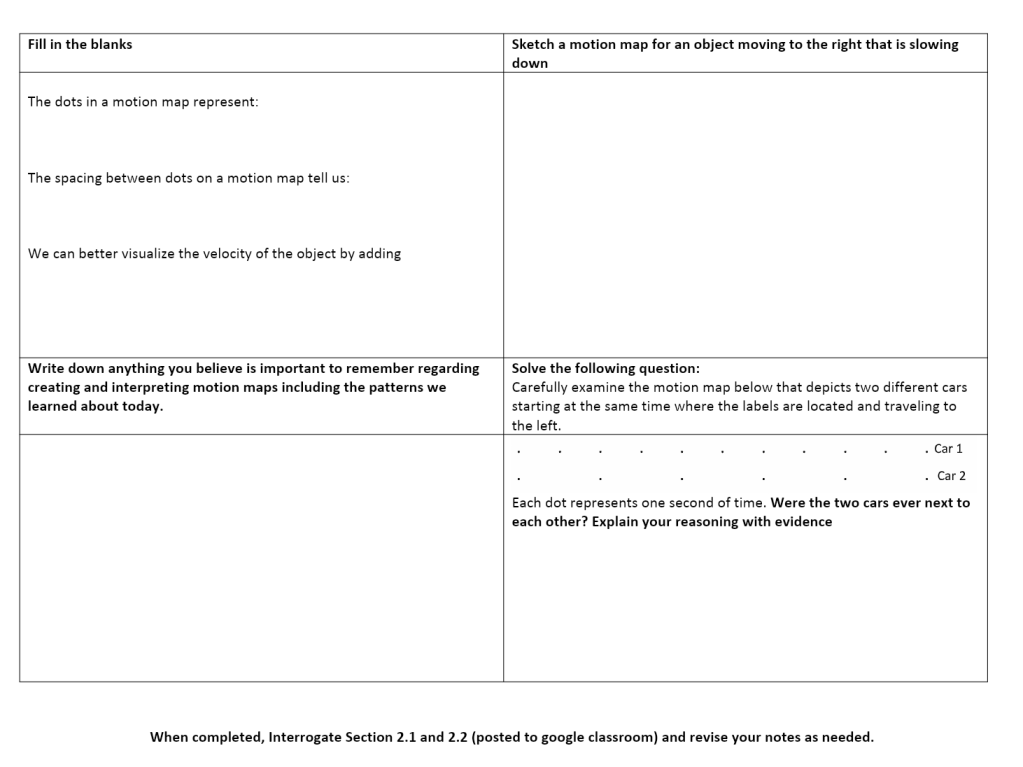
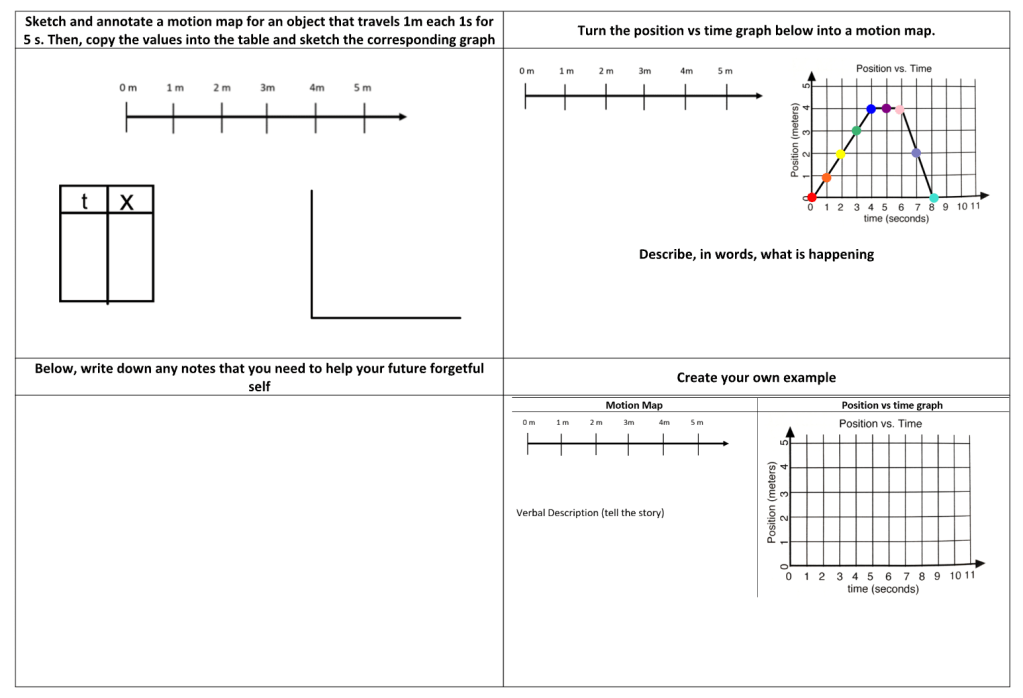
At the workshop Peter shared this really cool template (these are my notes from the workshop):

Check it out! It’s all the things the DI folks love to share are necessary and supposedly non-existent in a thinking classroom. The top is structured by the teacher. In fact, it’s two worked examples. The first is for students to fill in the blanks while the second is a similar, but different example. The bottom half is for student autonomy, though it should be noted that the “create your own example” can come from homework, the textbook etc.

The way this was presented was that students would create these notes on the whiteboards and then transfer them to their own notebooks. I cannot fathom running a lesson, and then doing the notes on boards and then having the transfer happen, so I needed something different.

Meaningful Notes in My Classroom

What I chose to do was to create the template and provide it to students with that teacher part already prepared. Here are a few samples:

This first set is what students completed after doing the observational experiements dropping bean bags behind a bowling ball and creating their first motion maps:

The following day I have students engage in a desmos sorting activity to continue working with motion maps as we continue the reasoning process. ISLE folks will recognize the content that is directly from the Active Learning Guides:

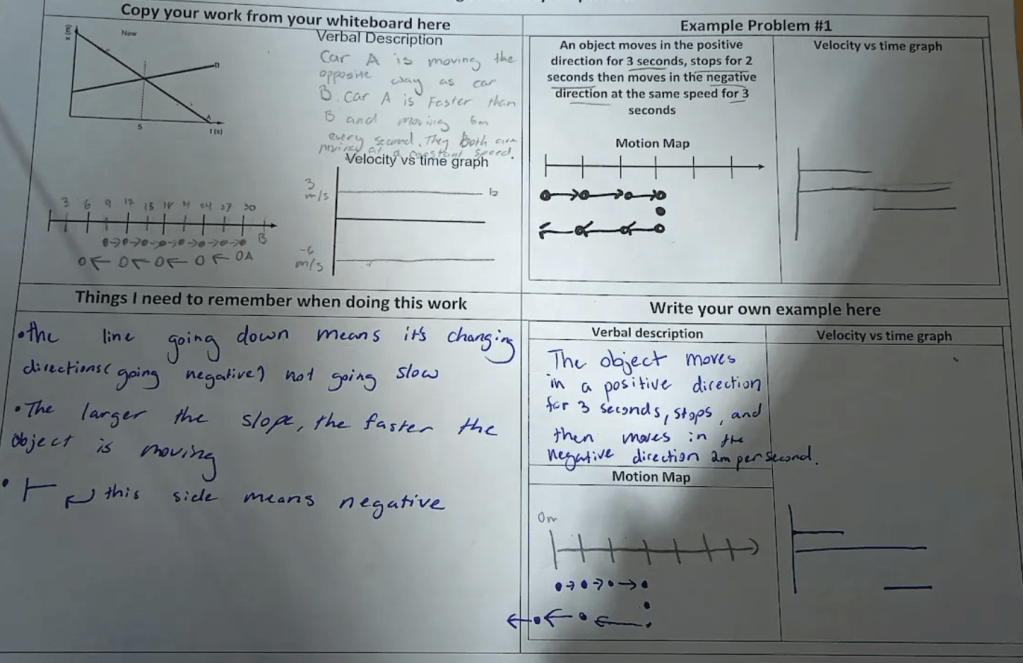
Next I borrow from the AMTA curriculum to start translating representations. The top half of this page was all work we do together on whiteboards.

Here’s what’s been really cool about using this style for notes:

  1. Students (and I!) are able to recognize what actually translated/processed during the class discussion. Since the first box is often work that was exactly from the discussion and whiteboarding we can hit those problem areas right away using the discussion we just had.
  2. The example is manageable. Instead of giving students 5-10 practice problems, they have just one they are required to complete. This example is either very similar to an example that was done in class or identical to the example done in class, but the example is no longer available to copy (yeah, I’m sneaking some retrieval practice in!)
  3. As students work on the top half and we have those conversations about what they are stuck on or missed I’m able to say “ok, that’s something you should probably put in the things I need to remember box!” This is also true any time I hear a student go “oooooooh!” when the lightbulb turns on.
  4. Create your own examples are actually pretty decent! Sometimes they are pretty similar to the first example, other times I see students stretching themselves.

The notes that get submitted also paint a great picture of where my students are at. Check this one out. This student is pretty quiet in a class of students who are generally super vocal and asking for my help frequently.

I’m able to make a few judgements here from the work. First, this student doesn’t yet understand how to represent stop on the velocity vs time graph. Second, even though that’s the case, she does have a pretty good handle on what they were supposed to learn in the lesson that day (see the “things I need to remember”)

I’m still experimenting with this and finding ways to adjust and ensure that students are ultimately getting what I want them to get from the notes. I do feel, however, that now the notes that are on the papers are resulting in more meaningful work than when I’m expecting them to copy as I work on the board. I can still craft these so students get what I want them to get on the paper, but also provide space for autonomy and small wins to build confidence.