
The skeleton for this blog series has been the book The ABCs of How We Learn by Daniel Schwartz, Jessica Tsang and Kristen Blair at Stanford. As I am doing my prep work for my blog series where I include and adapt the ideas within my physics classroom there are a few chapters that don’t quite have a 1:1 connection. In the original book, the authors write chapter I for Imaginative Play. The research is a bit on the weaker side (causation or correlation?) and is focused on the youngest students and their social dynamics. Although we could absoultely discuss the ideas of imagination and creativity in the physics classroom (consider the utilization of movies like Interstellar, or the discussions that launch units in OpenSci ed, for example) I’m going to make the decision to stick to the strategies that I feel most confident discussion. So here I diverge from the text and we will discuss Interleaving.
Interleaving simply means that students are engaging in activities that require them to problem-solve out of the order in which they were taught and/or by jumping around in terms of ideas/topics within a practice set. By requiring students to retrieve from a variety of topics/skills, students create even stronger neural networks in their brain which leads to stronger retention and comprehension.
For example, perhaps you have a homework set that looks like this: 4 balanced force questions, 4 unbalanced force questions where the object is speeding up and 4 unbalaned force questions where the object is slowing down. Interleaved practice would jumble these questions up.
Another example of interleaving is that perhaps students are currently learning about momentum but on a particular problem they are asked to calculate force from a force diagam, then determine the impulse and solve for the change in kinetic energy. In this case students are interleaving entire topics.
The value of interleaving is at its best when implementing similar problems (in terms of deep structure, which may look like different topics on the surface). This allows students to begin to focus on the problem solving structure, rather than the algorithm, and they can begin to notice subtle differences.
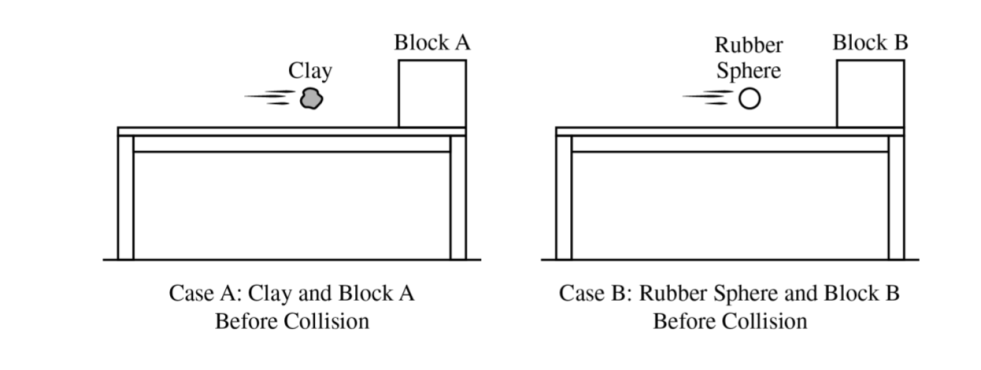
AP problems are often a great example of interleaving. Very often students need to pull from multiple units in order to complete the problem. Recently I provided students with this momentum practicum challenge as part of their AP review. The physical task was modeled after an old FRQ, but students were not initially aware of this fact. Students rolled a happy and sad ball down a hotwheel track where the ball collides with a block at the end of the track which falls to the floor.
Students are asked to do the following:
- Make a claim: Which ball will result in the wooden block traveling farthest (this should be physics-ly correct)
- Gather some evidence and quantify as much as possible. The more things you can quantify (momentum, energy, force, velocity etc) the more points you get!
- Reasoning/Discussion: Does your evidence support your claim? Explain in detail why or why not. For every quantity you measured or calculated you should be able to explain how that piece of evidence supports or refutes your claim! It is possible that you evidence does not support your claim. If it doesn’t examine your videos carefully and look for anything that happened that we were not anticipating.
To “level up the spiciness” students are asked to find a different way to find the ratio of distances. I provide students a hint to drop the balls vertically. The goal here is to investigate with energy methods.
The last level includes the following prompt: The balls rolled down the track and you should have determined the velocity of the ball at the bottom. Assuming the balls are solid spheres (moment of inertia 2/5MR2) determine how much energy was lost on the track from the top of the track to the bottom.
In this final challenge students are using energy and rotation.
For the “glass of milk” I have students work through the original FRQ and link it up with the practicum they just completed.
This example takes advantage of a number of previously mentioned strategies. In addition to the interleaving we have engaged students in a hands on exercise that ultimately leads to working through a problem with feedback.


