Uncategorized

ABCs of How We Learn: C is for Contrasting Cases

Contrasting cases is about noticing the difference between two or more examples that seem the same at a glance.

That core learning mechanic should absolutely scream physics problems to you!

Acceleration is a FANTASTIC example of the benefit of contrasting cases. Students frequently come to us believing the following to be true:

  • “Acceleration” describes speeding up only
  • “Positive acceleration” describes speeding up while “negative acceleration” describes slowing down
  • “If an object’s velocity is zero, its acceleration must be zero because it has stopped”

How do we help unlodge these incomplete conceptions in our physics students? If we could “just tell them” then it wouldn’t be a problem. However, these ideas are engrained deeply in students, and they need another way to approach the idea.

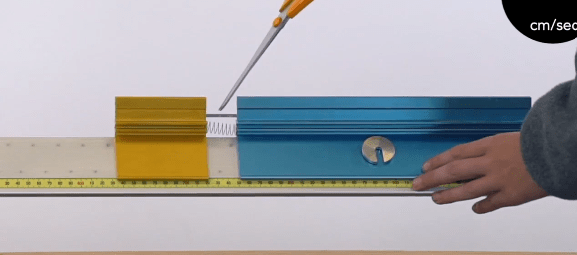
In the Investigative Science Learning Curriculum students conduct several observational experiments using a bowling ball. We drop a mark (bean bag for example) at equal time intervals as the ball rolls. Students copy the resulting pattern and then construct motion maps. This is how we begin to make sense of velocity change, acceleration and force.

The contrasting cases, in this instance, are the diagrams themselves.
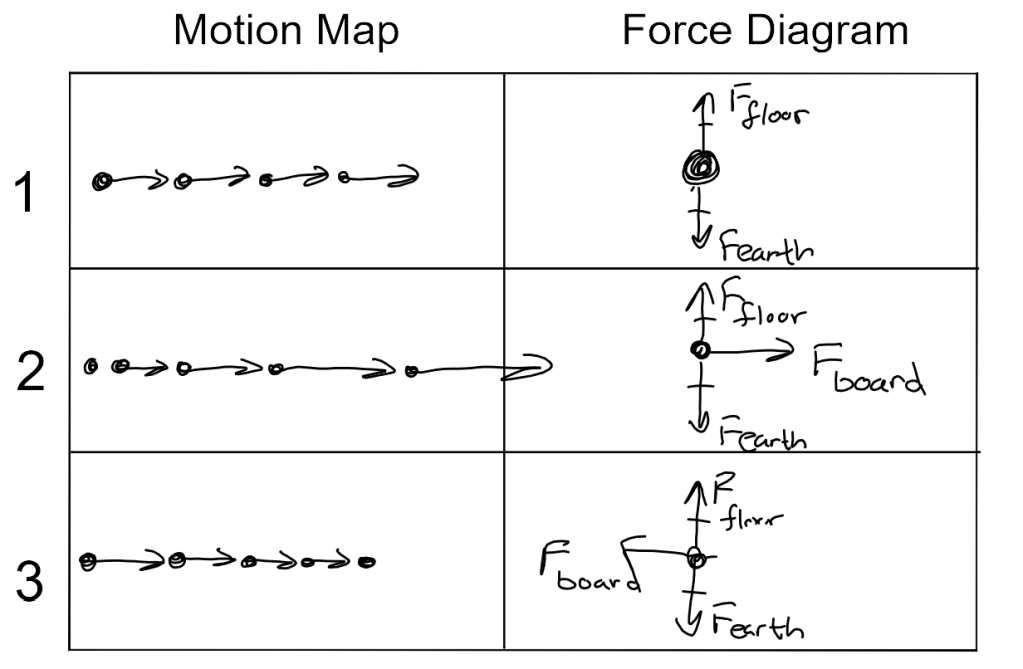
Through a simple series of activities, we can build the ideas that constant velocity is not the absence of force, but the absence of an unbalanced force. Accelerations happen due to unbalanced forces and the direction of the acceleration is the direction of the unbalanced force.

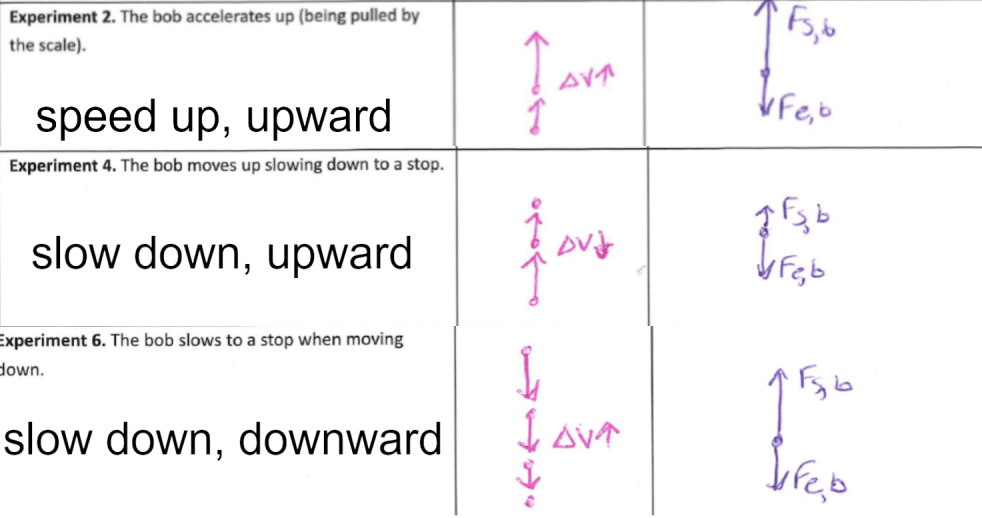
We do a similar task shortly thereafter with an object that is accelerated vertically. When I review the material, I specifically grab the set of activities shown below. In the top two cases, the bob is experiencing upward motion. However, we see the change in velocity is different due to the difference in accelerations.
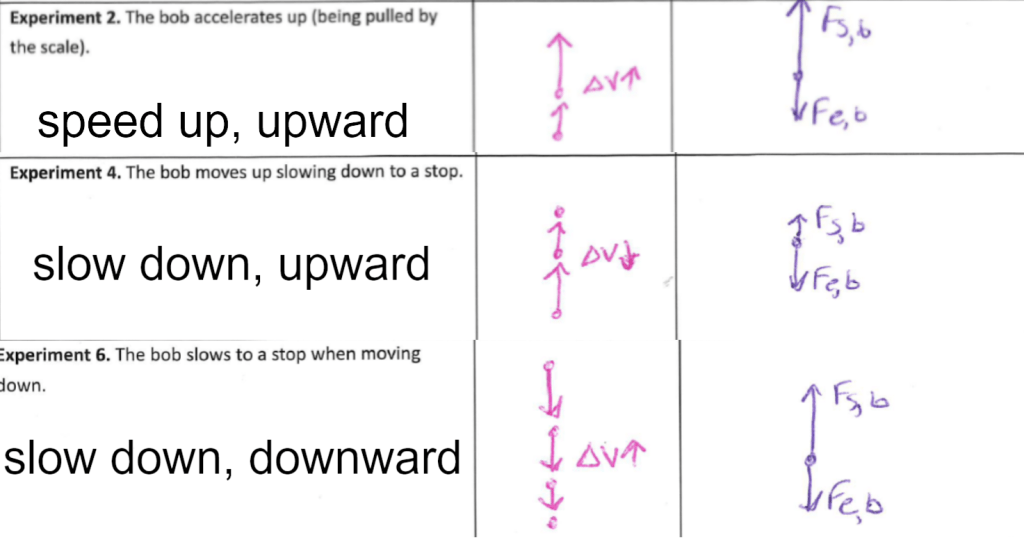
Next, I have students compare the top and bottom experiement (4 and 6). In both of these instances the delta v (acceleration) is directed upwards, however these both describe two very different motions, up and speeding up, and down while slowing down).

Again, while I could certainly just tell them, there is a lot more power to students constructing the diagrams based on their observations and then we can look for patterns and we can look at the fine details in contrasting cases. We can then use these details in the contrasting cases to more deeply understand the concept. We are also doing something incredibly critical for our students in the science classroom. We are teaching them to argue with evidence. That their answers and assumptions about how the world works need to be grounded in evidence over feeling and intuition. I would argue that fact is far more important than any piece of content they remember 10 years from now.

I recently heard an eduinfluencer make the claim that teachers can only name and describe 3 evidence based strategies they use in their classroom. Challenge accepted. Each day I’m working through the book The ABCs of How We Learn and pairing a strategy with physics content/activities in my classroom.
Activities · Science of Learning

ABCs of How We Learn in Physics: Analogy

Shortly after completing my MEd I was asked to teach the intro to educational psychology course at Rockford University. The course had recently been redesigned to focus on cognitive psychology and the science of learning. Eager, I looked around for other models at various institutions and reached out to a few collegues. One of whom referred me to the book “The ABCs of How We Learn.” It’s a wonderful and digestable text that goes into the research, provides some examples and good/bad uses of each strategy.

At a recent institute day the keynote speaker shared that in his personal research he found that, on average, teachers could only name and accurately describe three strategies they use in the classroom. So, here’s my challenge to myself: 26 strategies and 26 direct applications to the physics classroom.

A is for Analogy

What makes an analogy? Can you name one in physics? God please not the water pump as a circuit example. An analogy is where two examples have the same deep structure. Analogy then becomes a valuable tool for helping novices begin to pay attention to deep vs surface structures.

There are two ways in which we use analogies. The first is the one you are probably thinking of when you consider analogy… the water pump for a circuit, or lanes of traffic to explain what happens to current in series vs. parallel. As teachers I think we use these examples readily in the classroom as we make abstract ideas more concrete.

There is, however, an additional way to use analogy and that is by taking two or more examples and asking students to identify what about those examples is similar. I noticed that my students this year were having a more difficult time that my previous students making this leap. Have your students ever said to you “but you never taught us this problem!” or “you need to show us more problems!”. It’s not really the number of problems, it’s really a transferrence and deep structure problem. Students are not recognizing that the problem at hand is, indeed, the same problem.

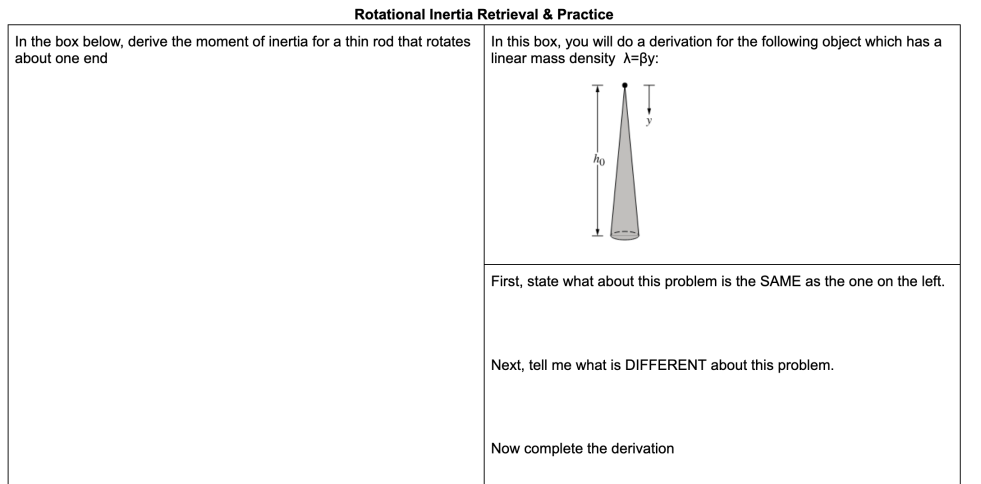
To address this I decided to set up a two-for-one cognitive strategy task (document here). First, I asked students to retrieve the worked example from the previous day. In the first instance of this task I asked them to retrieve the derivation for the moment of inerta of a rod about its end. Next, I provided students with a similar, but different problem.

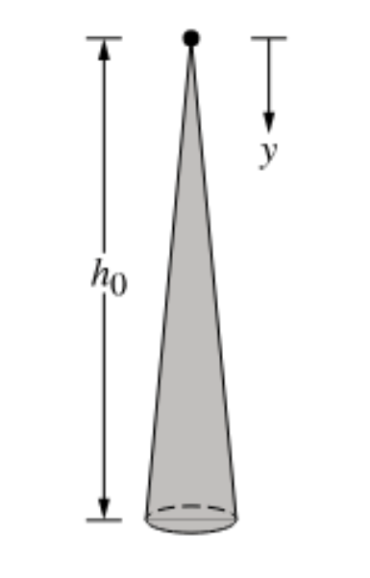
For this first task I felt the problem was almost too similar, but their hesitation proved otherwise. The task was to derive the moment of inertia for a triangular rod about its end where the linear mass density was provided as a function of position. (see below)

However, what I asked students to do first was to identify what about this problem was similar and different to the previous problem. After they took a stab at this we regrouped so we could discuss what I was looking for. It is similar in that it’s the rotational inertia of a rod-like object about its end. It’s different in that the linear mass density is non-uniform and is a function. Then students executed the task. As we moved through the rest of the rotation unit (where analogies abound!) this became my go-to phrase! “Before you begin, what is similar and different to what you’ve seen before?”

Activities · Teaching Methods

Paper Companion Activities for Pivot Interactives

You know how I feel about online work! (Looking for Physics Classroom Companion Worksheets? Find them Here!)

When I took high school physics almost everything was online. From physics classroom assignments, to the dreaded WebAssign, it was online. And because it was online, I like others, gamed the system (pre chat GPT). You know a certain number is going to show up somewhere in the answers? Enter it in all the blanks for the first submission so you can focus on the actual calculations. On the flip side was the part where you tried the problem so many times by the time you got it right you had no idea what actually worked. For the better part of my career I’ve been vehemently against all forms of online homework. There’s something about that screen that just puts a stop to the idea of using scratch paper for novice learners and we can’t have that!

(For what it’s worth, when AP went all digital I did NOT feel the urge to go digital in my classroom. I continued to do everything on paper. When APs came around I found my goal was acheived: I proctored the macro exam and did a count. 80% of physics students were using their scratch paper during the exam, while only 30% of non-physics students used their paper.)

The first exception I made to online learning was Pivot Interactives. I was using Peter’s work back when they were “Direct Measurement Videos” which meant I had paper copies originally, anyway. As Pivot upped their game (including deep randomization and autograding) I started using some of these assignments since it sure made my life easier!

However, what I’m finding with my students this year is that like my Webassign days, students are doing the minimum to get all the green checks. This looks like not reading the prompts that explain what they’re about to do next and why, not actually collecting the data for the graph and totally missing the connections between the sample measurements and the data collection.

So, I’ve started to reimplement some paper versions.

The Activities: A Journey of Trial and Error

Earlier this year I assigned the helmet collisions activity. I added a prompt at the end that requested students to do the following:

  • What was the purpose of the activity?
  • Describe the procedure for conducting the investigation
  • Describe the calculations you made and why we made each calculation. You should include details regarding your values!
  • Describe what we learned from this activity about helmets as it relates to the impulse-change in momentum relationship.

This was ok, but I, arguably did this a bit hastily. I realized I wanted these documents handwritten and maybe a bit more depth/scaffholding.

A few weeks later I assigned the Explosions (Not Really) activity.

I knew that students would totally ditch all of the methods we had been using, so I decided to give them a paper to complete before the activity that related to the activity. This required them to complete the calculations with similar, but easy numbers and then have me check their work prior to the activity. This got a good chunk of kids on board, but some still struggled with the transference.

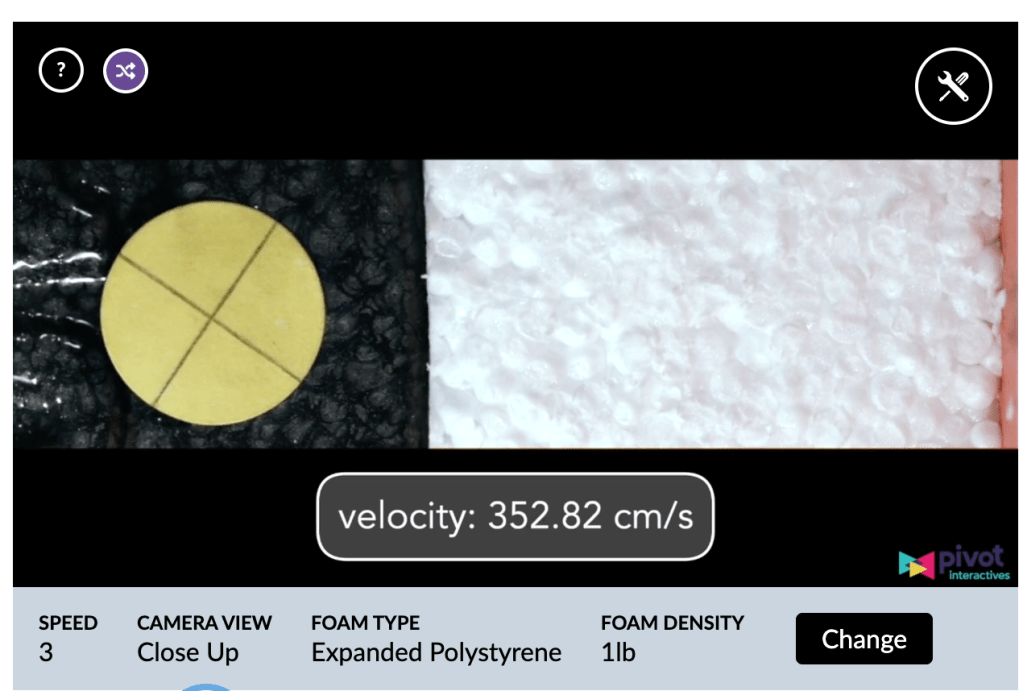
Still not completely satisfied, this past week I assigned the “Intro to Transverse Waves” activity. In this activity students are going to linearize a graph. This is a skill we don’t really cover in my regular level physics, but I like doing it at this point in the year because it’s such a powerful tool. As I anticipated, many students were ignoring the text about linearization completely. I chose a different approach to the paper copy.

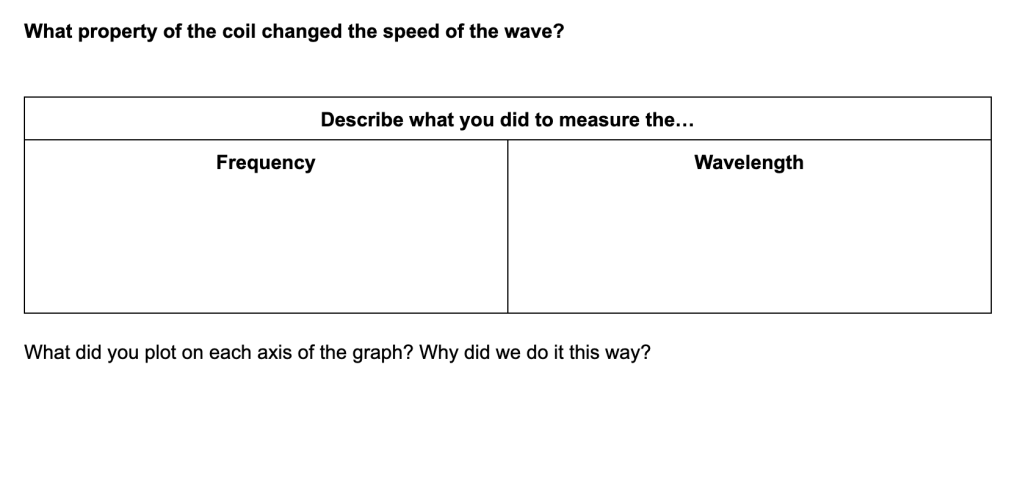
I gave students this document which contains the following prompts:

First, I asked them to describe to me some of the new vocab as well as how we obtained our measurements

Next, I use a modified template from the Patterns Curriculum when students write conclusions in labs where we have graphs. It looks like this:

After investigating the behavior _______________, I conclude that there is a ______________________relationship between the [independent variable name]  and the [dependent variable name] As the [independent variable] kept increasing, the [dependent variable]_____________________________. This system of a ___________________ can be mathematically modeled as:

[write the final equation]

where the constant  [slope value]  is the [description of slope for this experiment]

I require students to write the ENTIRE paragraph from start to finish. This is not a fill in the blank activity.

This is currently my favorite interaction of the paper follow up and I’ll probably build more of these moving forward. I’m really in love with the patterns physics conclusions because it really requires students to put everything together.

Grading

I’ve noticed there’s a VERY strong correlation on these summaries between students who took the activity seriously and learned from it, vs students who did not. Because of this, the only thing I really need to grade with care is the conclusion paragraph itself. If students did the lab correctly, this paragraph looks great. If not, they usually don’t do well on this.

Do you do anything like this? What does it look like? How do you support genuine learning using online platforms?