
First of all, I got one of those special notes today that just made my day:
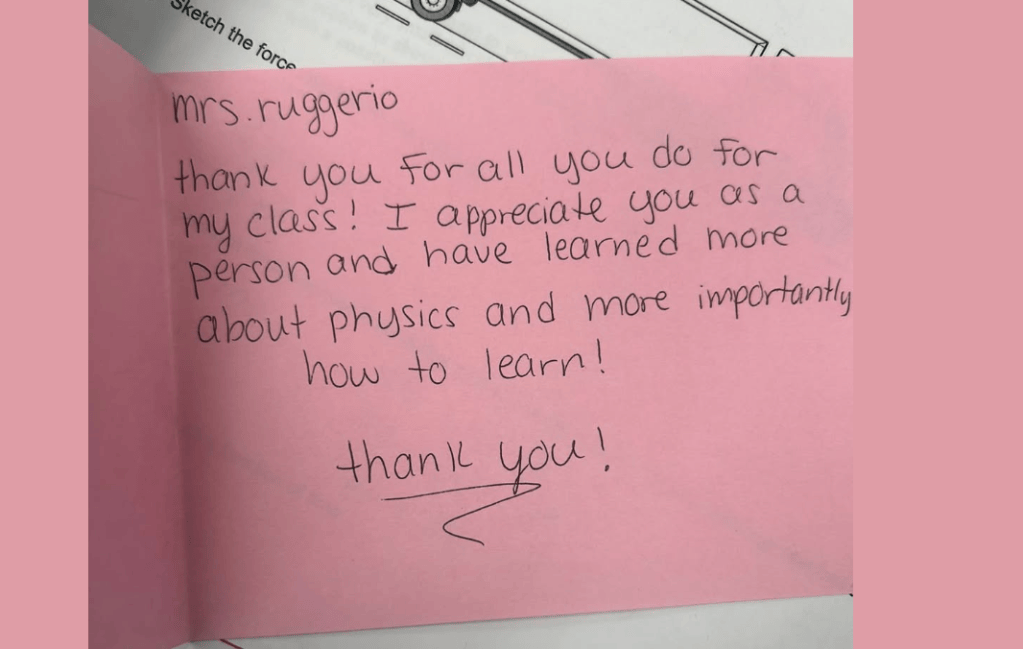
I’ve really focused on shifting some of my emphasis around how students should be engaging with their work from “trust me, trust the process, and you will be able to do this” to “you can learn anything with the right strategies. Let’s talk about strategies and mindset”. (See more on the “How to Score Better on Tests” page). Due to that intentionality, this note means the world to me. I started making a running list of the shifts I implemented this year, but I will be honest, I have not updated it since September!
AP now provides pretty detailed reports on student performance. In the last two years I’ve started to take better advantage of using a combination of the score reports and the AP classroom reports to inform my teaching.
The first shift I made towards the end of last year was homework quizzes. I had been regularly assigning AP classroom quizzes for homework and would go over the top 3 worst performing items in class the following day. However, I was noticing a trend that the patterns of behavior that lead to those incorrect answers were not, in fact, being rectified when it came to the exams. Too often students confuse familiarity with competence and don’t put in the effort required to truly learn the content. Now, after I’ve reviewed problems from AP classroom students expect that there might be a homework quiz in which I will take 1-2 of the problems, strip away the ABCD in favor of calculate/determine/justify and require them to really know the content.
We just wrapped up our forces unit and the final iteration of the test is tomorrow. I break most of my tests into 2. The first exam covers 80-90% of the content. The second exam covers 100% of the content and serves as a built-in retake for the first test. Score higher and the new score goes in for both exams. Score the same or lower and both scores are in the gradebook as is. We discussed our forces test part 1 Friday and I had students evaluate their results based on the AP skills to identify what skill(s) need the most support. I also encouraged students to use THEIR version of AP Classroom reports to make up a plan for study. Well, we all know how things go if you just show and tell students without actually making them do it.
So today, I provided students with this document and guided them to record their data.
Here is what a student sees on their end. This student typically scores in the green and dark green on most AP classroom quizzes, so it looks like they are fantastic (and they are). But closes analysis reveals that they have some significant areas for growth nonetheless.
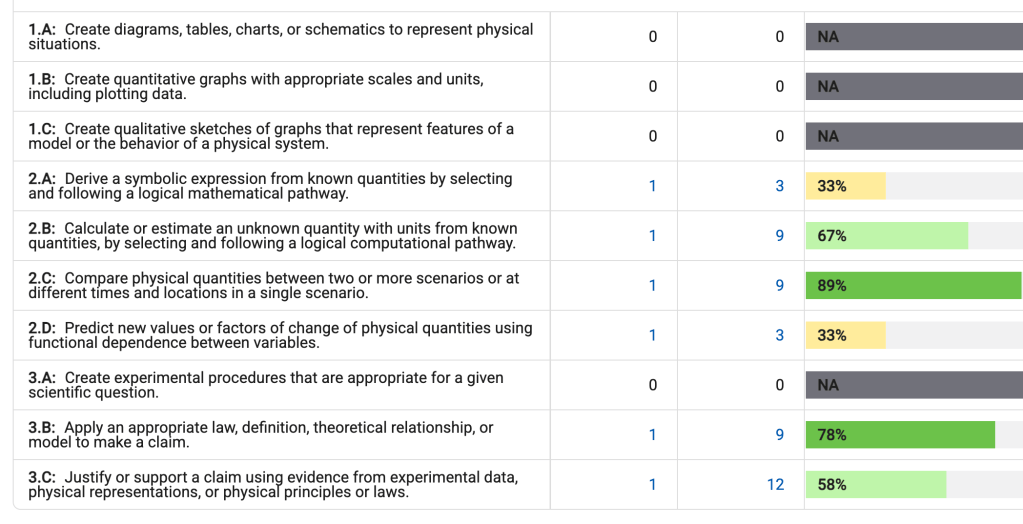
It was actually particularly interesting for me to see the spread in student strengths and growth areas as student dug into their own data.
On the handout students needed to document each of these percentages and then identify the one they would focus on tonight to study.
My line to the students is that when we approach our studies this way its a lot easier to look at is as improving ONE thing instead of improving ALL the things.
I’m actually really surprised and excited to see how many of these papers have already come in for submission. Here is one example
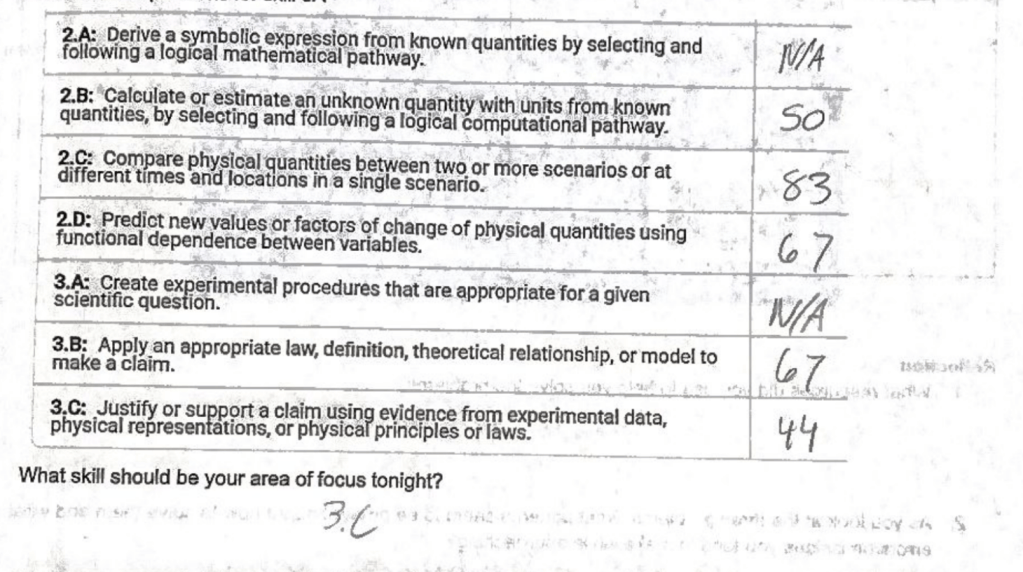
Here, the student has recorded their data and identified their skill (I probably should have made them write out the learning objective as a sentence).
Now some insiders info… this student has no data for 2A, and I can tell you that this student ABSOLUTELY needs to work on 2A… but take a look at what happened when this student did the sample problems in a moment.
The next part is doing problems related to the skill. I asked students to identify 3 problems from previously assigned quizzes within this unit. I wanted them to show the work to solve the problem and describe the steps to solving the problem in words.
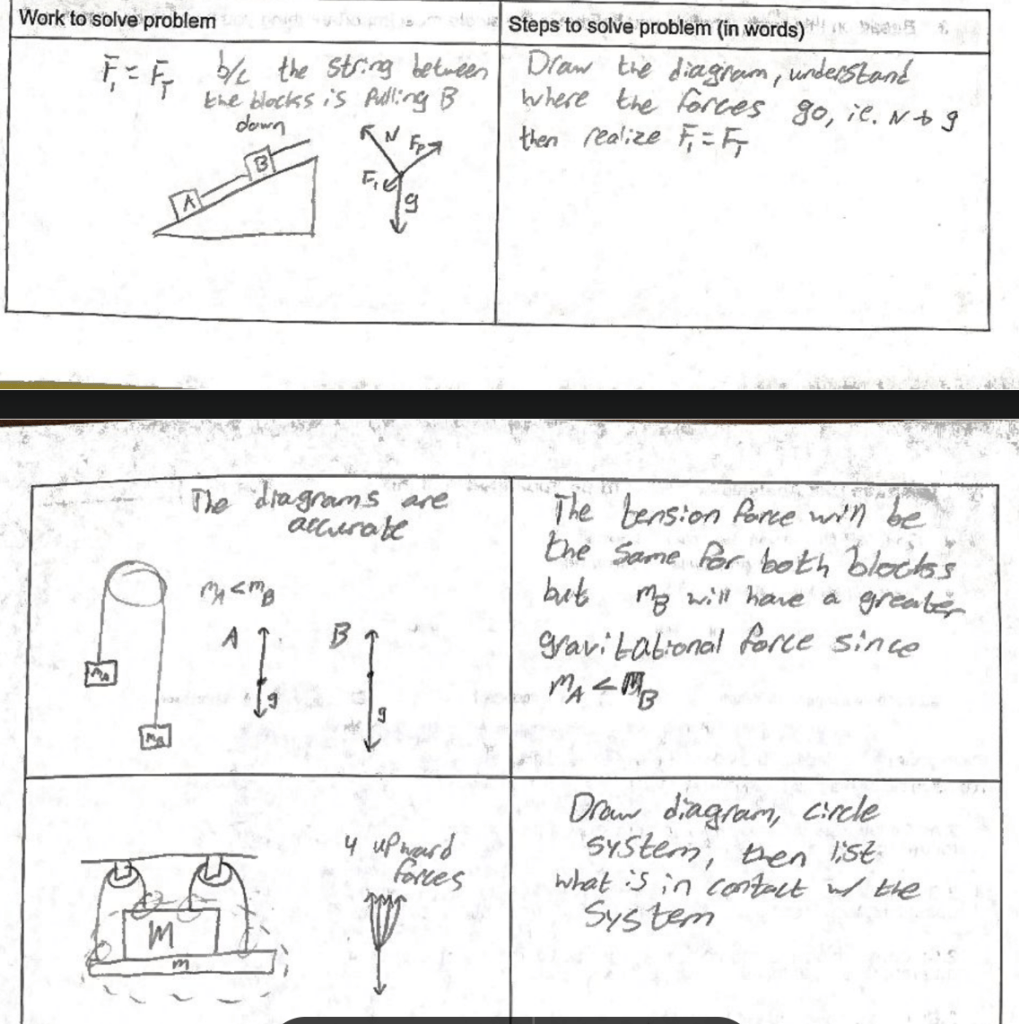
Notice the student indicated repeatedly “draw the diagram, identify the system”. The fact of the matter is that if a derive is hard for a student it’s because the problem solving process has gaps… such as identifying the system and sketching the diagram.
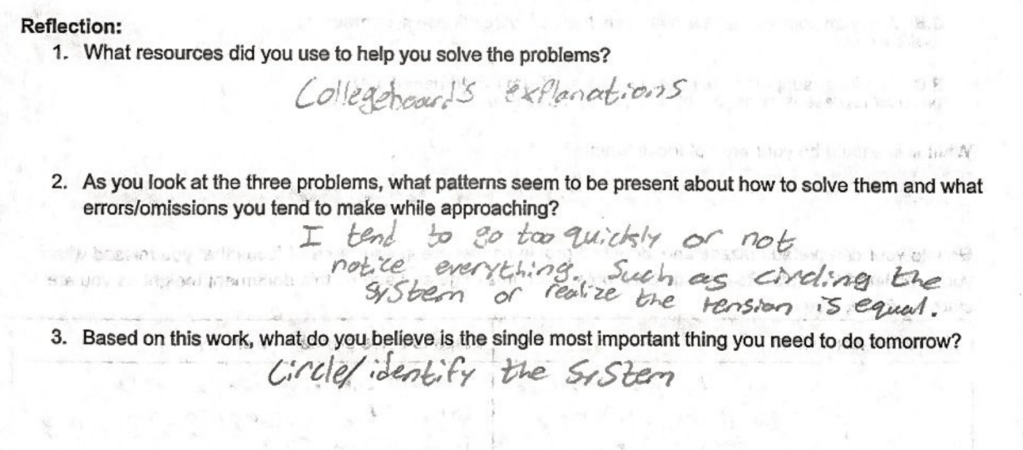
Last is the reflection. I really want to see students using their resources. Having this documented will give me a starting place if they are struggling and have not used the breadth of resources available to them. I think that the insights this student documented for #2 are particularly valuable, especially knowing this student well enough to know where their challenges currently are.
That’s all well and good, but what is the brain-science behind it all?
- Students are being asked to think reflectively and critically about their own work, but I’m providing a structure and a way to laser focus
- Students are engaging in metacognition… what are they thinking about these worst-performing problems, what do they need to be thinking about?
- I’m secretly forcing them to use my favorite strategy for studying: making teacher notes. This is the right hand column of the paper. I often tell my students that their work gives insight to their thinking… disorganized work is often indicative of disorganized thinking. Disjointed work? Disjointed thinking. But clear, coherent work.. now we can think clearly!
- Deliberate practice – this kind of practice requires work on a specific skill, and practice on the part(s) we suck at. I was super clear with students that I was assigning 3 for the sake of time, but 3 is not enough to adaquately prepare. They should be aiming for 5-9.
As I was preparing today’s activity I was thinking about how I could start designing resources that would be more skills-focused than specific content. I’ve decided to give this job to the students. More on that later this semester when I have student work!


