
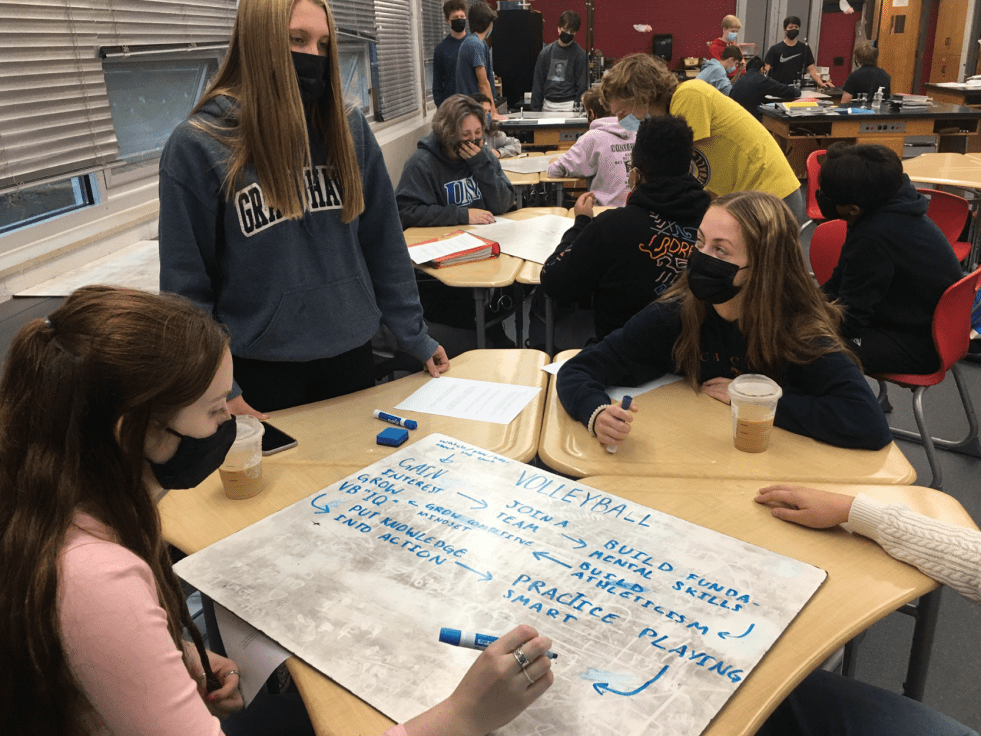
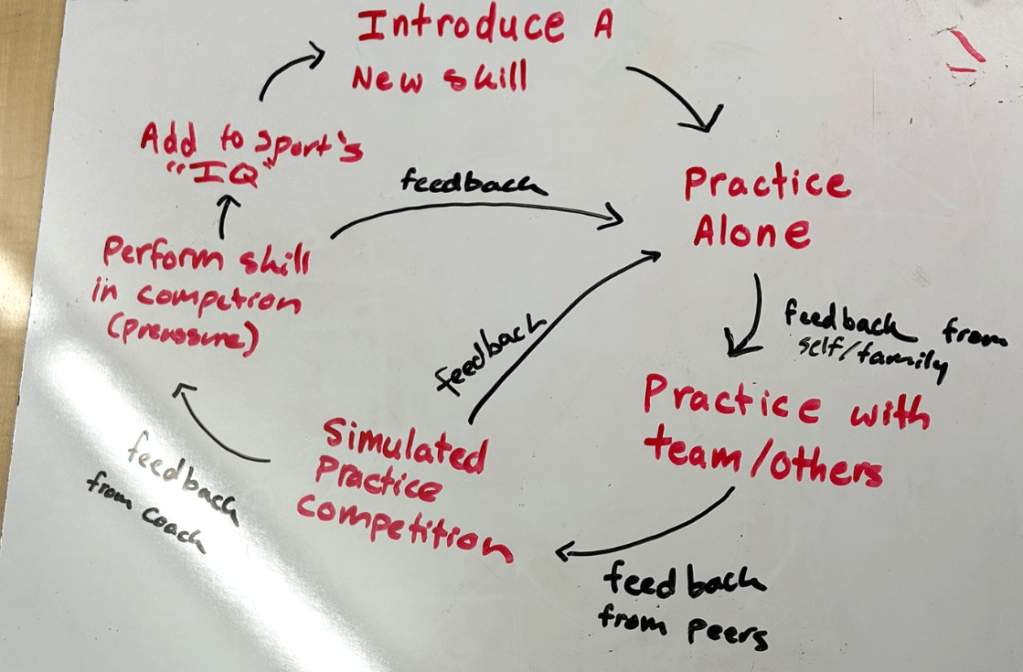
Before the Science of Reading train took off en masse, I was already excited about applying ideas from cognitive psychology in physics. In 2020 I was in the midst of my graduate studies and noticed that strategies I had “discovered” as effective were grounded in research. Previously I had attended an ISLE workshop with Eugenia Etkina and had much of the same experience, during which I learned about The Expert Game.
I chose to implement The Expert Game immediately after the first exam. The idea was that students needed an opportunity to experience the full learning cycle, and in some instances “fail” (by their standards) so that the expert game held meaning.
As I dove into the science of learning, the book The Science of Learning Physics was also published. One of the authors, Jennifer Docktor, gave a talk for Harvard’s PoLS-T series that summarized the chapters. I decided to add this video as a homework assignment for my students. They are given the following prompt,
Watch the talk and write a short reflection (minimum 300 words)
Include the following. Please dig deep and synthesize rather than simply agreeing or disagreeing.
- What ideas challenged your current thinking?
- What resonated with you?
- What ideas challenged your current thinking about how we learn and learn best?
- What do you now wonder after listening to this talk?
- What resulted in an “aha” moment for you.
Lastly, as a student, what can YOU take away that you’ve learned in order to improve your learning this semester?
The reflections are always really cool to read. Check out this one reflection:
I must say that one of the things that challenged me the most was the idea of a gap between what methods students think teaches them the most and what methods actually teach them the most. The human brain can be incredibly annoying, and this feels like a prime example of it. It follows to reason that when I feel like a method is working better, I should trust those thoughts and engage with that method. However, the human brain likes things to be easy, not necessarily successful, which is something I must remain aware of and try to put into practice, seeking out the difficulties that generate learning, even if they might not be the most pleasant at first.
In particular, some students verbalize that they finally understand why my class is structured the way that it is. This was particularly noticable from students when I first assigned the lecture during the pandemic. Unlike many of my collegues I avoided lecture like the plague and put students in breakout rooms constantly. At first students complained a lot that “I wasn’t teaching them” but as the semester progressed they realized they were learning more in physics than their other classes:
The biggest realization in the video was in the “Active Learning” section (Chapter 5), where Docktor says that sharing ideas is an excellent way to learn. It’s as if she’s saying that students should keep working together. While working in groups is fun, I wasn’t sure if I was learning as much as if we did it on our own. The evidence she cites implies that the jamboards and group labs are some of the best ways for us to spend our time.
This school year I’ve been a bit overwhelmed. For the first time since I’ve been at this school my classes are all at 30+ students. We have also been given a directive that every summative must have a retake opportunity. It’s been a lot. Thanks to that, I have not gotten to reading my student reflections from three weeks ago until today.
It turns out this is a gift!
One of the shifts I made to make the retake process easier is the following: For each unit, we take the summative when we are nearly done with the content. For kinematics we covered everything except projectiles. For forces we will do everything except pulley problems and other multi bodied systems. You get the idea. Then, after we cover the final topic we take a second summative. The second summative contains all of the content and is a “built-in retake”. If students score higher on the second summative, the score will replace the first score. If they score lower then both grades stand as is in the grade book. Students can then request an additional retake. This naturally reduces the volume of extra retakes I have to give, as I already had this multiple assessment per unit practice in place.
Since I’m behind on grading, I am reading the reflections after the first exam with student data about the second exam. It’s really cool! Students who took the message to heart: that practice and active strategies trump passive ones, generally performed better on the reassessment! Students who wrote a reflection that seems stuck in their ways performed the same or worse on the second assessment. As I am reading the reflections I can now point to their own words as we go into the retake process and continue through the year.
A student who saw an entire letter grade shift on the second assessment wrote, “When studying last year, I mainly reviewed my notes. Although this process was somewhat beneficial and better than not studying at all, Dr. Docktor argues that the act of practicing the material is much more effective for students attempting to retain the information. Now that I know this, I plan to incorporate active processes into my studying for physics and my other classes.”
Meanwhile, a second student wrote, “I find the most effective method for me is a mix of passive and active learning. Using passive methods to set a base level and active methods to solidify the concepts.” this student struggled greatly on the second assessment and we will be discussing these ideas at his conference.
I think too often we get so caught in the grind of the content we need to teach, we forget that this kind of self-reflection is really the key component to deep learning. It’s not an easy thing to do well, especially when physics teachers are rarely the “touchy feely” types like you might find in english or social studies, but our students are whole humans!

 Physics.Teacher.Momma.
Do you have students watch the entire video you posted, or a segment?
LikeLike
Ooof they changed what is published on youtube. Students watch just the lecture portion which runs 33 minutes (and I know many of them, like myself, will watch in double time!) I have that video linked in my google classroom and I can’t seem to locate it separate from the full discussion.
LikeLike