
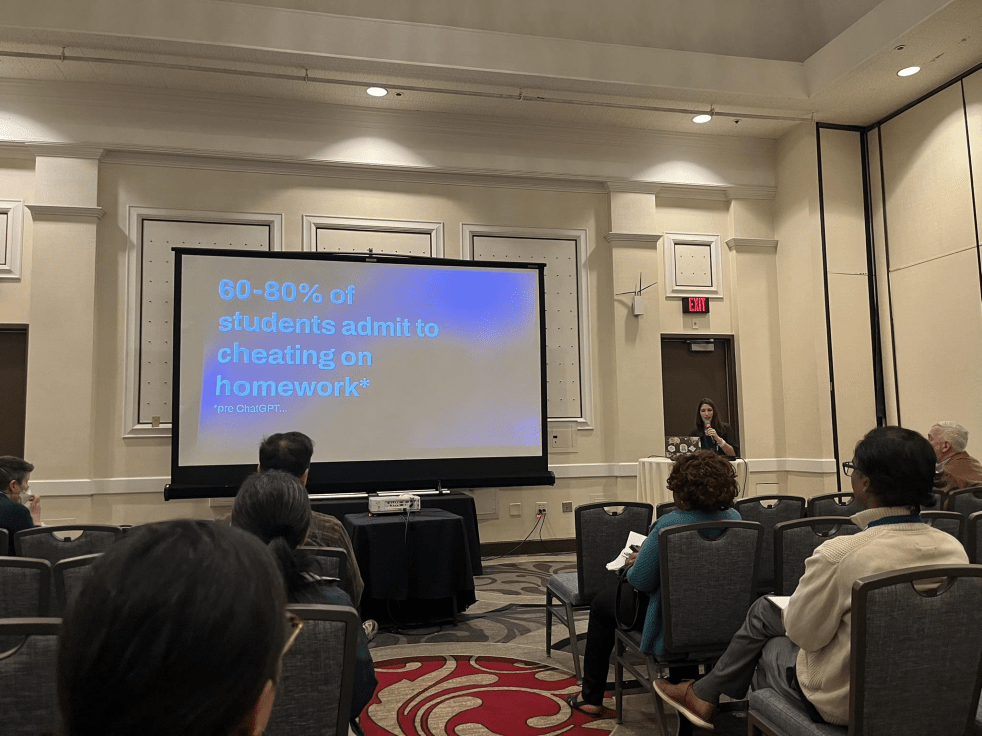
It’s been two weeks since I got back from the AAPT Winter meeting inVegas and I’ve barely had time to sit and reflect. I’ve made some big changes this school year. Exactly one year ago I interviewed for the AP Physics position in a new district. It was one of the more challenging decisions I’ve needed to make in my career, and the first time I was walking into an interview fully confident of who I am as an educator, what I want in my future and in complete control. (When I took my position at Auburn I was confident, but hadn’t yet taught an AP course). With a new position comes new challenges and adjustments, but a new position paired with experience and confidence also brings the opporuntity to recognize challenge for what it is: an opportunity to search for innovative solutions. That’s one of the best parts of teaching; getting challenged in ways that require creativity.
With challenge comes a heavy mental load and so when the deadline came around for the AAPT abstracts I quickly threw together an abstract related to holding students accountable when we do work a la Building Thinking Classrooms (Accountability on Ungraded Homework) but had only shared here on the blog. A part of me felt pretty lame as this particular idea didn’t feel as exciting as I thought it should be for presentation, but I’ve learned that we are typically our own worst critics, and it’s always valuable to go ahead and present anyway. (Here are the presentation slides)
As it turned out, my session was loaded with three other awesome talks that all complemented one another really, really well. Aaron Titus talked about his “how to test better” workshop which is secretly a “How to Learn” workshop. Another faculty member talked about standards based grading at his college and Kathy Willard at Case Western talked about some metacognitive work she’s engaging students with. This session, tied with the AP sessions that took a deep dive into the science practices got me thinking about how to put all of this together to support my students.
The result? An FRQ reflection form.
Part of this spawned from the fact that we had -30 windchills last Friday and a remote learning day. With remote learning obtaining student feedback is more critical than ever for me, but I realized this would be a good strategy to maintain for all FRQ practice.
The Process
- Students complete an FRQ alone under timed conditions
- Students flip their work upside down and move to vertical whiteboards. They are permitted the next 15 minutes to discuss the problem and they can whiteboard their work/discussion as they go. This is a riff on friends-no-pens due to the complexity of the problem.
- As students wrap their discussion, I ask them to consider how the points are distributed.
- Students return to their original work and have 10 minutes to revise/add to their work. The way my room is set up students CANNOT see the work on the whiteboards
- Students self-score the FRQ. I ask them to give themselves a first pass and second pass score.
- Students complete the reflection
The reflection is a google form. The nice thing about this is that in addition to collecting this data easily, I can link multiple forms to the same spreadsheet to track changes over time.
The Google Form Reflection
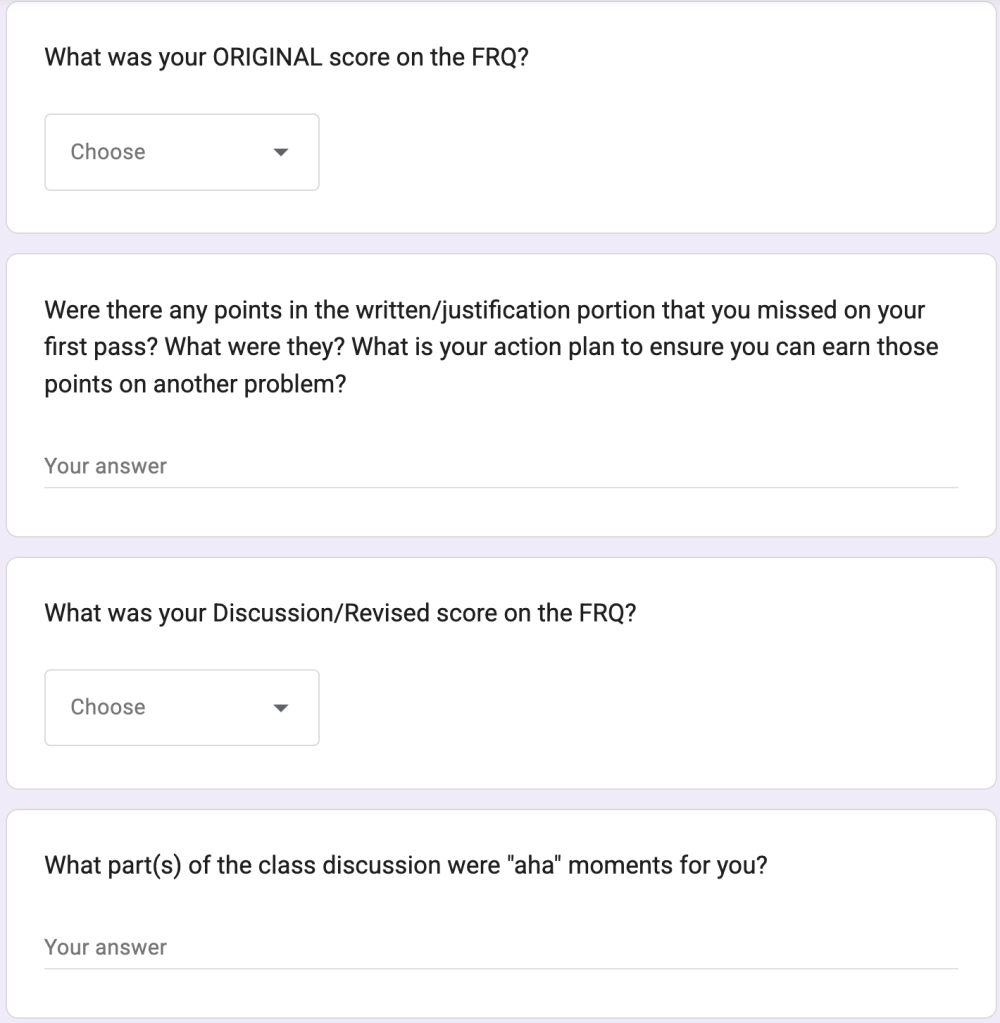
This first part is asking students to think metacognitively in a few ways. First, I want them to see the gap between their individual and group-think. In a highly collaborative classroom, sometimes students think they have a better handle on the material than they actually do. The first pass at the FRQ gives them a chance to see what they are capable of alone. The second pass allows them to see that they can and do understand more physics than they might give themselves credit for, but it’s not currently encoded in their long term memory. This gives students a place to identify as a study need.
Next, I use the standards information available in AP classroom to provide students a check-list of the skills that were assessed. I ask them to identify both what they did well on and what they did not do well on.
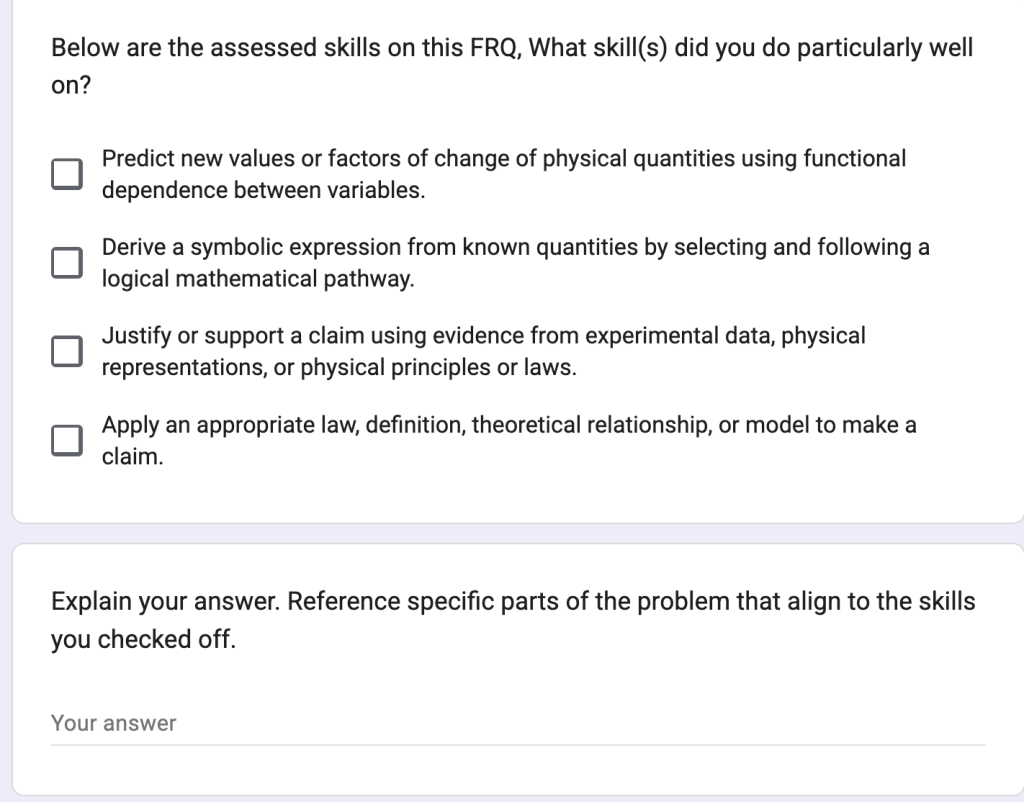
To wrap it all up I ask a final question to get a guage on what my students believe they need more of.
Looking At Results
Below is a snapshot of some of my student results and reflections. I sorted the original scores from lowest to higest so you can see the improvements. This was a Translation Between Representations question which is worth a total of 8 points.
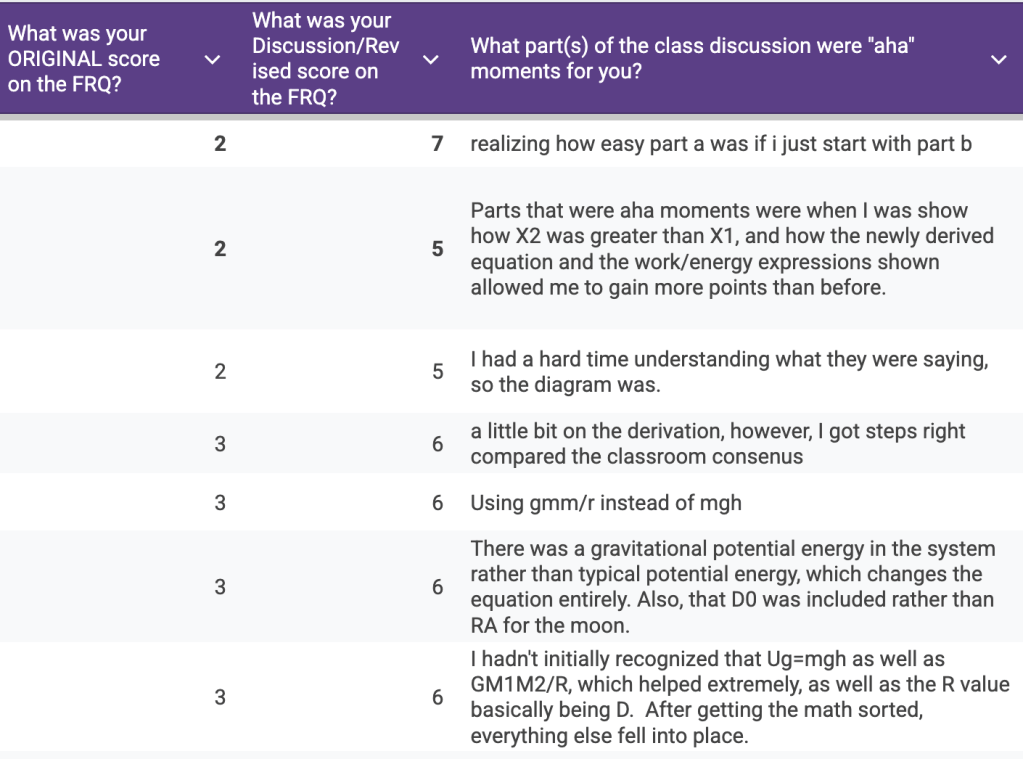
First, observe how much scores increased from original to group think! But what I think is particularly important is that this work happened without access to notes of any kind before and after conversation. When students return to their papers they no longer had access to the whiteboard work.
Next, I think some of the “aha” moments are particularly important and poingnent. I especially love the first one that is more about testing strategy. (This particular student is a rockstar, but the physics assessments have been rough for them).
I thought this data was particularly interesting:
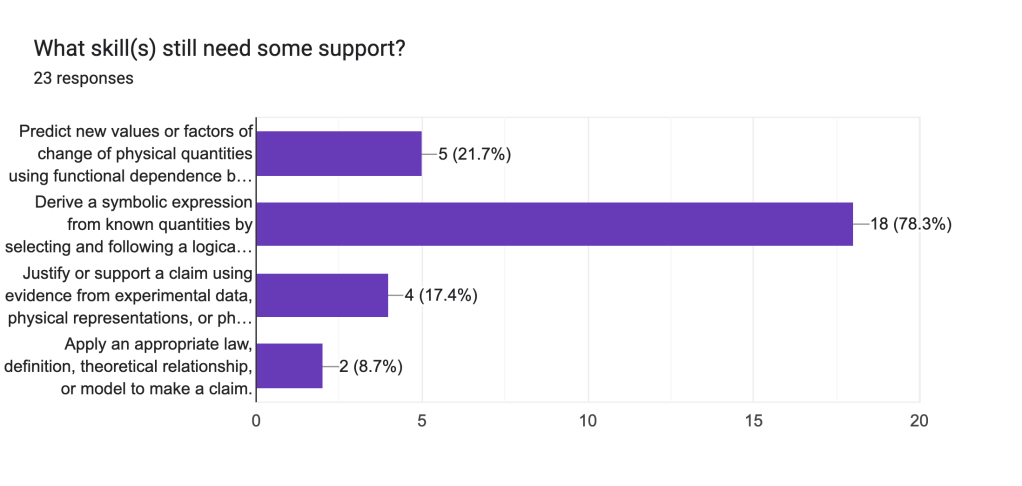
I think anyone who teaches AP knows kids dread the word “derive” like we’re asking them to be Einstein Geniuses (more on that in another reflection another day). Interestingly, my students reported that they all need help on derive, but actually my data from AP classroom and testing informs me that functional dependence is actually one of their weak spots. And yet, students aren’t overwhelmingly identifying it as one. I’ve determined that this particular blind spot is going to be an area of focus these last few months as we enter the final lap.
Asking students where they struggle is always telling regarding their thought processes. Currently many of my students are still stuck in a very algorithmic way of thinking/approaching physics rather than working big picture down and it remains telling in their responses. This is still really valuable information because in order to get students where I need them to be I need to meet them were they are at first.

 Physics.Teacher.Momma.