
I used to do lab notebooks. I used to give students grace and flexibility. Labs had due dates in the calendar, we had board meetings, time in class and I would collect the notebooks at the time of the unit exam.
The inevitable happened. Many students spent hours upon hours of time getting notebooks done the night before the test. It wasn’t that they weren’t given time in class or during the week, they just did the student thing and other classes became more important until physics was important.
That all changed a while ago.
One of the shifts I made a few years ago was adding vertical whiteboarding to the lab. Specifically, I set up the physics of the lab as a vertical white board task. I gather students together and demo the intention of the lab. Then I verbally tell students what I’d like them to go figure out.

In building thinking classrooms the key piece is the consolidation piece. I’ve done the consolidation for the lab, but what I’ve found is actually more effective is the following prompts:
- You are not there until we are all there
- If you’re done or stuck, go take a walk.
I first tried this the day of a formal observation(!) and I’m never going back. The energy in the room was unmatched, and the sense of accomplishment by the students was so much greater than if I had told them outright. In previous years I’d let them work the problem in their lab groups, but this meant some groups would get it right away and dive in, while others really struggled and then were behind in data collection. Doing the physics this way instead builds the community.
One year I had two challenges. The first was that my students simply were not putting in the same time, effort and care as students in previous years. I know I sound like a crabby veteran teacher, but it was truly different. I also had one student, in particular, who had extreme anxiety. My flexibility with them inevitable created more anxiety as they tackled the most pressing assignments in their heavy school load. The infrequent lab collection was a complete nightmare for them.
Meanwhile, I’ve been adamant that certain lab writeups will have theory sections. I ask that students explain using diagrams, words, and mathematical models the physics behind what we are doing. Getting students to craft an excellent theory and how it then connects to the procedure is something I’ve been trying to figure out how to best present for many years.
Although we obviously discuss these ideas before students head into the lab, students inevitably dive into the lab, record their data and would come back to writing the formal theory later.
And later is almost always an afterthought.
To support my student with anxiety and to get the rest of the class doing physics on a more regular basis, I started requiring the theory sections submitted to me the day we would begin the lab. I explained that the theory would be a draft (and in practice, I did not penalize students for not submitting it, the consequence was they had to do it all the night before the lab due date and didn’t get a chance for actionable feedback).
Student response was overwhelmingly positive. First, by putting the hard-ish deadlines in place, the quality of student work rose dramatically. Second, students had the time and space to prepare for their unit exams, rather than trying to write a bunch of physics for the lab. Third, and most persuasive, the students verbalized how much more they liked this. I had one student say “I actually feel like I know what I’m doing in the lab now!”
We can show and tell students all day long, but until they work with the content themselves and make it their own, they haven’t yet become owners of their learning.
Take a look at these two drafts submitted by the same student.
The first draft was for a lab where we found the acceleration due to gravity with a ramp. This draft is typical of what I used to see often the first time I asked for a theory section:
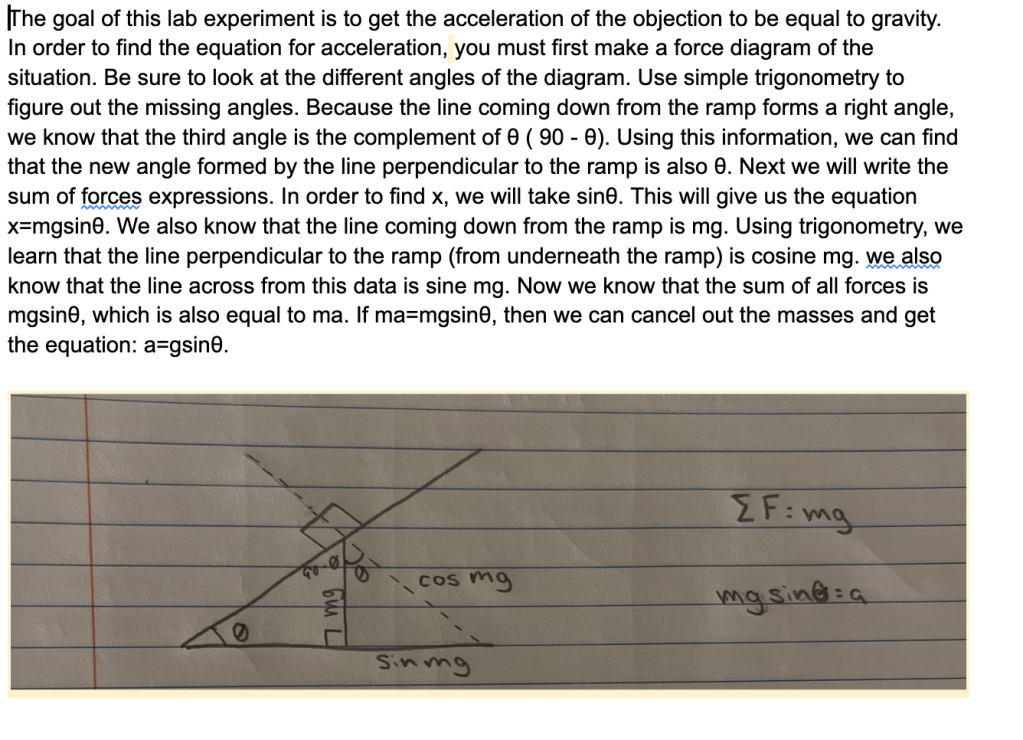
This is done fairly well, but the representations are after-thoughts and it’s not entirely cohesive yet. I left comments on this draft and the student responded positively.
Now take a look at this same student who wrote this draft. There is one physics misconception that needs to be addressed and I’d like the formatting cleaned up, but notice the quality of the content at this point:
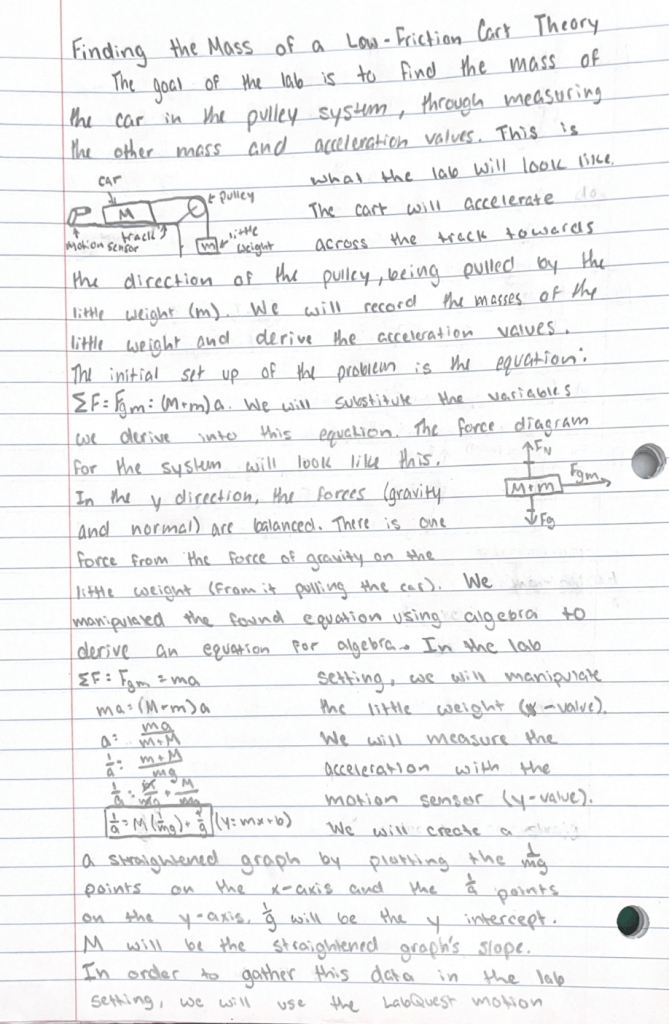

I’ve taken this as a win-win-win
Win 1) Students are not scrambling to provide this level of detail the night before the test or the night before lab collection way after the lab is done
Win 2) Students feel confident going into the lab about what they are doing and why they are doing it, which lets us focus our conversation on the how, which includes the procedure, the equipment, uncertainties, assumptions and error sources
Win 3) I feel way more confident that students know what they’re doing. AND, I get to support and fill some of the incomplete thinking as soon as possible.
If you’ve followed me for a while you know that I’m a huge advocate for building capacity in communication skills. I firmly believe that communication is the single most important skill in which we can educate our students. Without it brilliance has no impact.

 Physics.Teacher.Momma.