
In the previous post on self-explanation I mentioned how one of the strategies I provide to students is to create their version of “teacher notes” to reference and use.
When we engaged in our “How to Score Better on the Test” workshop (aka, how to learn) students were presented with the following question:
Which case would you work harder?
A) Study the material to get an A on the test
B) Learn the material so you can teach it to the class?
As you would expect, students overwhelmingly chose “B”
A 2013 study furthermore found that when students do, in fact, teach the information they learn more than if they only prepare to teach the content.
The idea of teaching content to another person to enhance one’s own learning is the reason why the jigsaw approach works so effectively in the classroom.
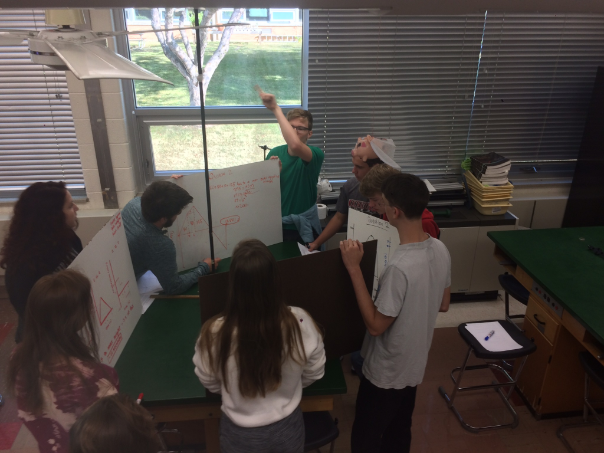
In my physics courses this has looked like a number of activities, but most frequently looks like this:
- Students have a selection of homework problems they were required to solve in class or the previous night. All students were expected to complete all problems. This works best with 3 problems.
- Students are divided into visibly random groups of 2-3 students and are assigned one of the problems. The team discusses the problem, comes to consensus and provides their final solution on their board.
- Teams with the same problem come together to discuss their approaches to the problem. The team needs to come to a final consensus. Both teams must have the agreed upon solution on their respective boards.
- Teams then move into new groups where one team for each problem. Each team is presents the solution to the problem to the rest of the group.
Why this works:
- Students are individually responsible for making an attempt at the homework. I’m not a huge fan of doing this with problems they’ve never seen before unless I’m selecting a very, very specific skill.
- Students are able to discuss the problem in a non-threatening setting.
- Students get to confirm the answer, which increases confidence in the work BUT..
- Students are still accountable in small groups to do the teaching. That means that the group can’t rely one the one “really smart kid” out of the group of 6.
I think another great example of leveraging the idea of teaching as a non-threatening classroom activity is Kelly OShea’s Mistake Game.
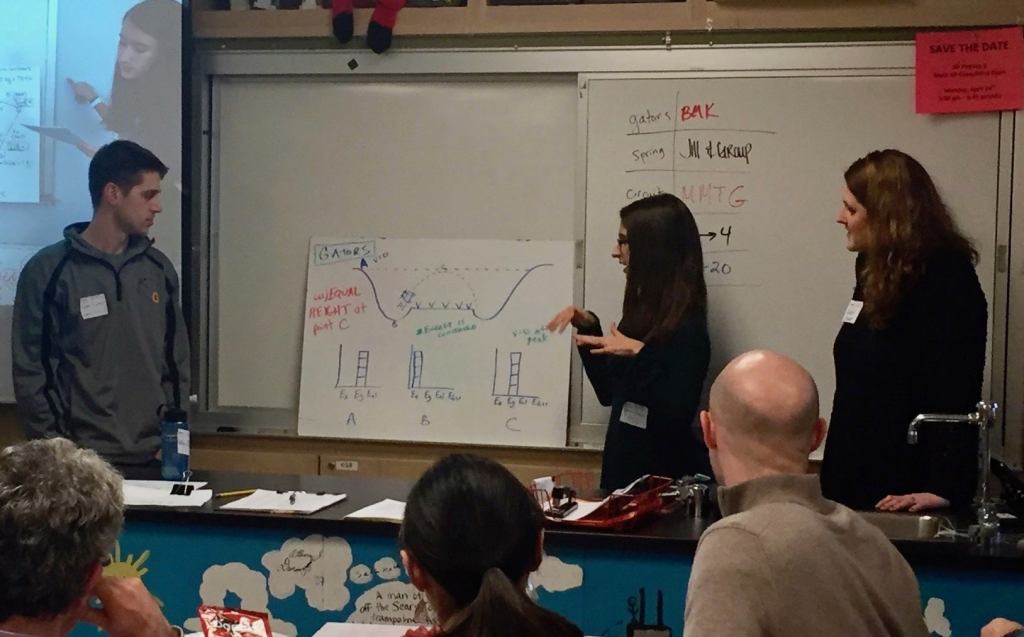
The premise is simple: solve the problem, but leave one intentional mistake in the work…something a student would do. The group then presents the problem and its the class’s responsibility to help the presenters “find” their “mistake” by asking questions.
Why This Works
From the cognitive science lens, students are still required to solve a problem with the goal of presenting/teaching it to the class. Additionally, they have been specifically asked to build in a challenge (because often in teaching students will throw us for a loop!) and work that logic through to its completion. In order to do this, students need to be able to meaningfully connect ideas through elaboration, which, in turn, increases their retention and neural connections.
What’s great about this method is that the mistake is inevetable: it was part of the assignment! But this does something else so important for developing STEM identities: if the group made a valid mistake, no one needs to know which mistake was “intentional” and which was an unintentional mistake actually made by the team.
What this is NOT
I was talking about writing this post with my 10-year-old son and he groaned that he does this in math all the time and it’s not helpful. In order to use teaching and be effective it’s critical that students have time ti actually prepare what they are teaching. Too often teachers will group the “smart” and the “struggling” student together, expecting the smart student to “teach” the struggling one. And too often this leads to nothing but frustration. Both students know their respective “role” in the pairing, and the “smart” student is expected to effectively communicate without any prior preparation. Recognizing that students are not the teacher-expert in the room, it’s our responsibility to craft experiences where that preparation can happen and we can facilitate effective communication of the process while students are preparing their problems.

