In My Class Today · Teaching Methods

A Spin on Energy

Last week I ran a pretty straightforward lab:

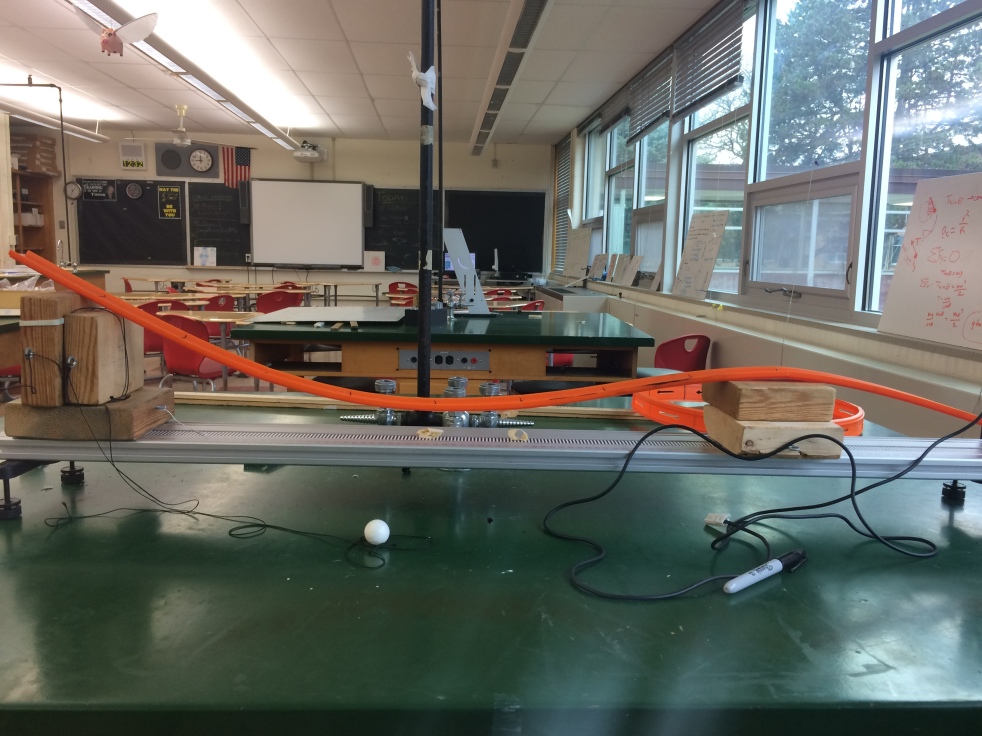
  1. Put 120cm of hot wheel track into a design of your choosing
  2. Run a ball down the track
  3. Record velocity with a photogate
  4. Repeat at 10-12 locations
  5. Plot the energy curves.
  6. Plot Translational vs Rotational Kinetic energies and find the rotational inertia constant.
 

IMG-2085
Sample track set up


Students should see a transfer of kinetic and potential energy which makes sense. Of course, students should also expect to see a decreasing total energy curve because of friction constantly taking energy from the system.

I had two fun surprises I got to incorporate:

  1. The shape of the TME curve

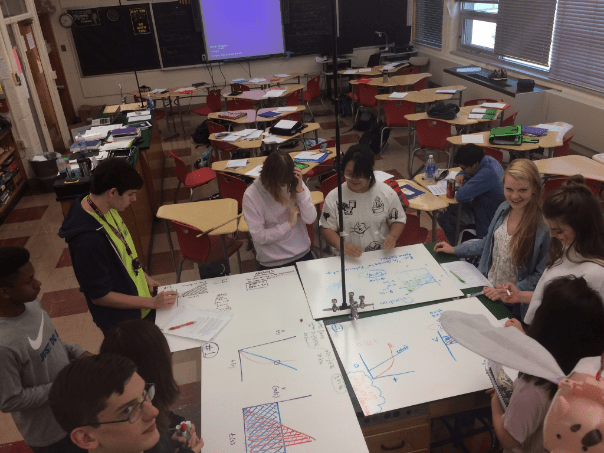
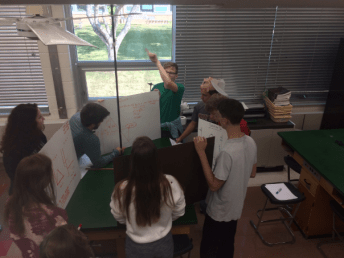
Inevitably this curve had a particularly sharp drop off at one moment in time. I had students sketch their tracks on their whiteboards in addition to their lab results. IMG-2087IMG-2088Do you notice anything? The largest drop off in TME corresponds to the moment where the ball is at the bottom of the hill. This serves as a great review of work and circular motion. Frictional force, as we know, is dependant on normal force. The normal force of the track changes and corresponds with its shape. We can actually predict the drop-offs in TME based on shape and even determine the work done by friction.

  1. A group with “bad” data.

Their data wasn’t actually bad, they obviously had forgotten something when they set up their formulas in the spreadsheet. But was there a way to find this without redoing the whole data spread? Absolutely. After creating a large circle to share whiteboards, we honed in on the group where the TME curve was mirroring the potential energy curve. The rest of the data seemed good…there was an obvious trade-off of PE and KE…although the curves weren’t as high as they should have been. So what was the problem? I selected a student to draw in where the energy curve should be, based on the shape of their track and everyone else’s data. She drew in the curve. Next, I asked students to note where this curve was and where the PE curve began. It was at 0.3 J with PE starting at 0.6 J Then I asked them to note where the KE curves were at… they were at 0.03 J. Notice anything??? They were off by a factor a 10! Where could a factor of 10 be? Did they forget a 9.8? Did they convert grams to kilograms properly? cm to m? Upon examination of their equations, they found the missing 10 and…TA-DA! Fantastic results.

I think it’s really important to note the value of both exercises. The lab itself was relatively simplistic, but it lent itself to fairly complex conversations.  I think this is especially true for the group with the “bad” results. How often do our students present with this and either (1) Default to “well my data must be bad” or (2) Start from scratch, rather than locating the mistake? In this way, students were able to critically analyze, strategize and problem-solve. It turned out to be a really easy fix.

Oh and the slope of the translational vs rotational KE? Yea that came out to 2/5….exactly. That’s super exciting!

Teaching Methods

Radical Renovations: The iOLab

I visited my alma mater today. The entirety of Green Street on campus is closed to traffic due to all of the construction. Buildings have gone down and come up and I half expected time to still be frozen in the year 1967 in the physics building.

When I walked in I found quite the opposite. Not only newly renovated rooms, but there is actually a women’s bathroom on the fourth floor. (This was always a running joke)

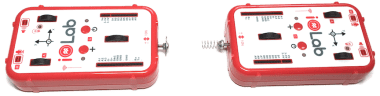
The reason I spent 6 hours in my car today, however, was to visit the Physics 101 class. iolab_remotes_redMy former adviser, Mats Selen, has been working on a new project: the iOLab. The concept is simple, it’s a multisensor system in a box. And it can do everything your $10,000 of Vernier equipment can do… for a little over $100. It connects wirelessly to your computer and runs with free, opensource software that does all of the analysis our expensive programs run.

On the other side of the coin, however, is a radical change in how the introductory level classes are being taught. When students walked into the lab, they had done a pre-lab experiment earlier…..at home…..with their iOLabs. Quite simply, they made a stack of books, put another book on top by its edge and then looked to see how the force changed with the iOLab as it was placed at different distances from the book stack. Data were submitted ahead of time for credit. Students discussed the results at the beginning of the lab and then were given their task. It’s the classic peg-board demo, however, students had to find a way to relate the force to the placement of the probe if the pivot was located in the top corner.

This was the sum total of the direction given to students.

Within about 20 minutes all students were taking measurements. Some were looking only horizontally, others were looking both horizontally and vertically. Questions arose about the approach: if we change the angle at which we hold the probe the force will change. Are we supposed to do this with a horiztontal force too? I think that’s impossible.

They were told it’d be great if they came up with a mathematical relationship, but they’re just looking for the trends.

Within an hour students were plotting their data, recognizing it was an inverse relationship and running the curve.

One group really wanted to get the formula.

Another group recognized the torques should be equal and started calculating all of the torques. Percent uncertainty was one of the objectives focused on, so I wanted to see how well they were grasping that concept. I looked at the torques and noticed the values were .14, .14, .14, .15, .16. So I asked them how they were going to decide that those were constant and not increasing. They responded that they would have to determine their percent uncertainty and compare what was acceptable to those values.

Now, clearly there are major differences between high school junior and seniors and pre-med juniors and seniors, but at the same time, it was still remarkable how they were approaching the lab, developing their experiment and writing up their labs. It is something that very much excites me about the potential use in the high school classroom (and online classrooms, and college classrooms etc)

I also asked students about their previous physics experiences. About half reported they had taken physics in high school, ranging from regular level to AP Physics 1. ALL students reported that they felt they had a FAR BETTER grasp of physics now in this course, compared to their high school course. Several students who said this felt the need to insist they still had a great high school teacher 🙂

The message, however, is clear: we need to give our students the opportunity to design and evaluate their experiments.

Also, the iOLab is a very exciting new piece of equipment. Morten Lundsgaard, currently the Coordinator of Physics Teacher Development
Instructor, is hoping to run workshops and/or a camp for high school teachers. If you are interested you should contact him!

Concept Modeling · Teaching Methods

Slicing a Cylinder for Moment of Inertia Integration

Guys….we’re in the throws of rotation. And at least one of my poor students has calculus immediately preceding AP Physics C. I feel so bad for her. The day we started she had made up a calc quiz, came to day 1 of rotational inertia, then went to calculus. Oh did I feel her pain.

Arguably the most difficult part of deriving rotational inertia is the visualization of how to go about the integration. I mean, let’s be honest, once we find how to express dm the integration is always an easy one.

Part of the problem is getting students to understand what it means to say things like dm, dV, dA, etc. They understand the definition linguistically, but it’s really hard to think of it practically. Tell them that dr^2 is zero and their minds are blown and bothered.

Day 1 of cylinders did not go well. Arguably, in part, because we were short on time. But also because the what why how was overwhelming.

I remembered a demo someone had shown where they 3D printed their objects to roll down the incline. They had actually made nesting cylinders, which then served as a great way to discuss integration.

I’m trying to think of a way to visualize each of the d-steps of the cylinder integration for my students with materials I have on hand. As I’m digging through the closet I notice the slinky coil. It’s nearly perfect!!!

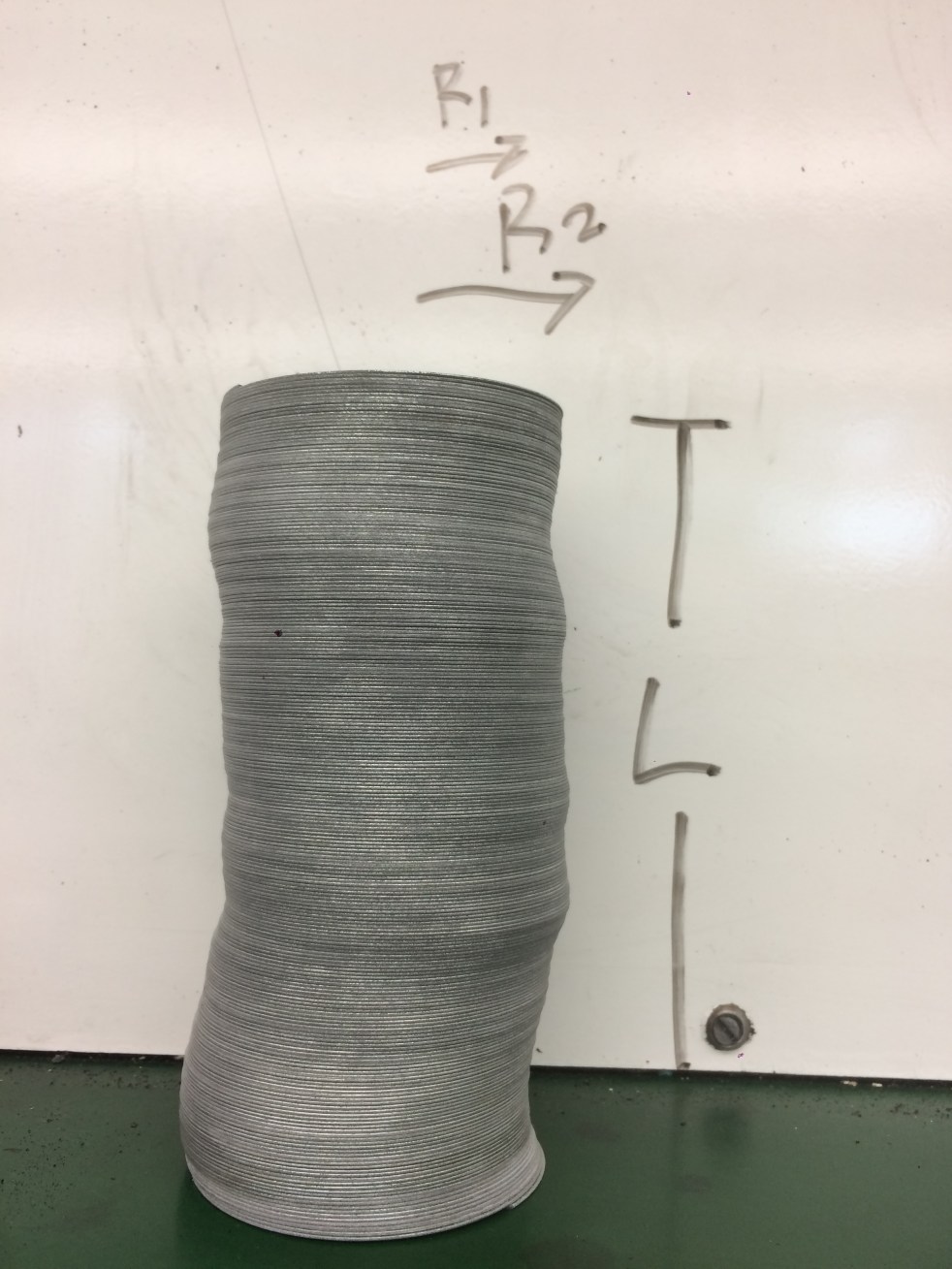
Ideally, I wish I had one with nice thick coils so we could take about the cylinder with R1 and R2, but this will suffice for the most challenging part.

So imagine you have a cylinder of length L, and inner radius R1 and outer radius R2 and would like to determine the moment of inertia about its center…

IMG-2037 (1)

First, as always let’s define rho, but we have to find dm in terms of r. So how do we do that?

Well, let’s take some horizontal slices, where each slice is dm… now we can see that dm = rho*dV…but wait… what is dV?

Well, if we make those slices infinitely small…is there really a volume left?

IMG-2040

Ah! so dV is really dA, and we are looking at it across the length of the slinky, so dm = dA*L!

Conveniently, I know that A=pi*r^2, so dA = 2*pi*r dr

And the rest is substitution!

Teaching Methods

Pumpkin Projectiles

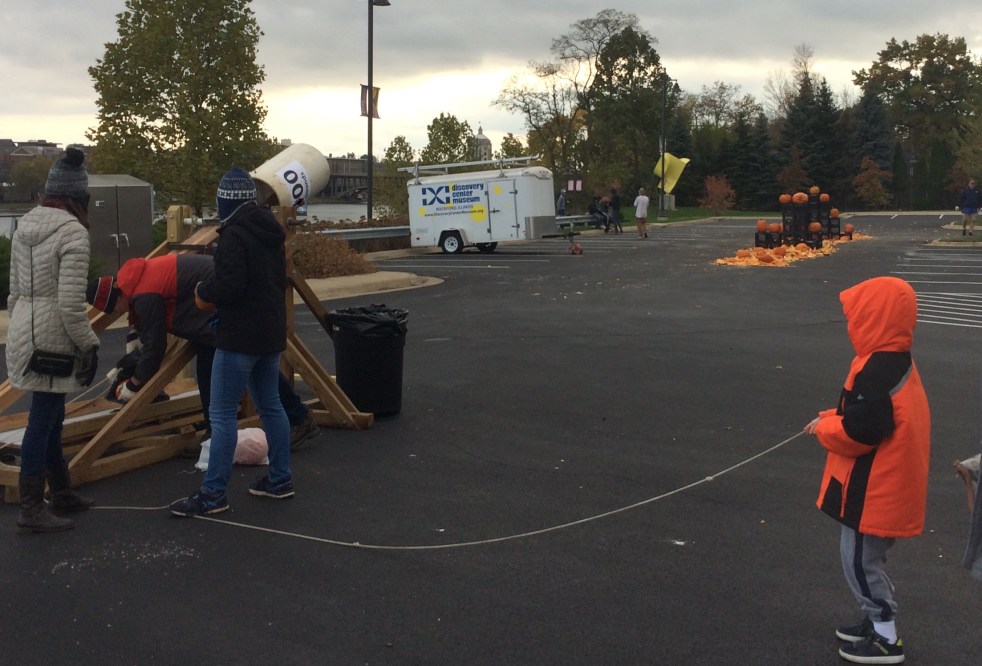
You can smash your Halloween pumpkins! Each year at our science center, Discovery Center Museum, they will launch your pumpkins (up to 8kg) with their 10 ft trebuchet which is loaded with 400 lbs. (Why they limit by kg, but load with lb, I have no idea)

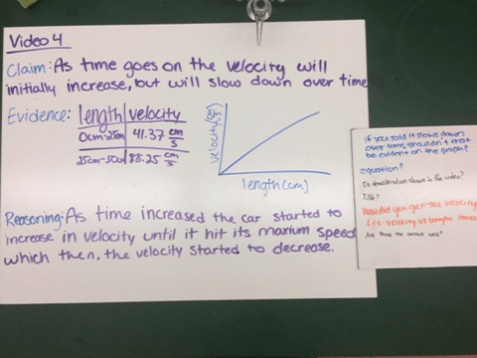
As a last minute thought, I blasted a text to my students: determine the initial launch velocity of the pumpkins. Double the points if you confirm the presence or absence of air resistance. Present in claim, evidence reasoning form. Have it ready for Monday.

Naturally, I couldn’t let my kids have all the fun (or the answers) so we went together as well. The pumpkins go way too fast/far/high to collect enough data at 60 fps, so I filmed in slo-mo (here is the original video), tracked the pumpkins on Vernier’s Video Physics app…

IMG_1964

Of course, I had to see the graphs right away…oh so pretty…

then loaded the spreadsheet into excel and adjusted the times for the slow-mo camera. Additionally, since I had been given the specs in feet, I had to convert the units to meters. (I used the length of the base of the trebuchet to set the scale).


Screen Shot 2017-11-06 at 9.09.14 PM
Can we just discuss the beauty of these regressions? The vertical velocity is broken into three parts: the launching, from release to peak, and from peak to ground. You can see how quickly air resistance comes into play. The weird fall off tail is where the iphone goes back to 60 fps in the last moments of the video


Oh how beautiful thou art, quadratic functions! Yes, air resistance is a factor, slowing the acceleration to about 3 m/s/s. There’s also a horizontal acceleration of about 1 m/s/s as well. Launch speed worked out in the ballpark of 12 m/s.

My kids who went are still crunching their numbers…we’ll see what they can produce!


Teaching Methods

Modeling vs Intentional Modeling

“I use modeling, do you?”
“Uh…no, but I’m interested in learning about it”

I felt like such a noob when I had this conversation a few months ago because literally, everyone else at my group seemed to be doing this already. I was at a workshop on whiteboarding after a talk on standards-based grading and modeling and I thought, “wow, she really has it together… I have a LOT of work to do” (Does anyone else have this overwhelming feeling of inadequacy in the classroom all. the. time. or is it just the mom-guilt extended into the classroom?)

So I have started incorporating some things here and there as I’ve gone along, and I recently looked into Etkina’s resources (I started using parts of her book last year). As I poured over Etkina’s labs and our workshop speaker’s resources I realized: I HAVE BEEN DOING MODELING ALL ALONG! Mostly because it’s just the way I already think about problems. It just didn’t have a fancy name, and more importantly, I wasn’t always doing it intentionally as a teaching strategy.

I’ve decided that the intention is really the key in modeling as a teaching strategy. I think good physicists are good at models but bad at teaching them. We do it so seamlessly in our own work we fail to realize that type of thinking is not seamless or natural to the general public.

Cue modeling curriculum

Models are just any representation we use for a situation: pictures, free body diagrams, motion diagrams, graphs, mathematics etc. We need to work our kids like gymnasts, very intentionally using and practicing these models so that our students become flexible and natural at using them on their own for any scenario.

This is the paradigm shift: teach the model first, and the physics as a result of the model. Too often physics teachers (especially physics teachers not trained in physics) teach all this physics stuff, then all these equations for particular problems and then maybe shove in some graphs at the end. The problem is that students fail to see the bigger picture and physics becomes a class where students are attempting to memorize a million procedure for a million different problems, rather than learning a handful of approaches and selecting the best one or two for the problem at hand. The clearest example of this in my current classroom is how I am teaching two-body problems. I have made a huge deal about the fact that all of the physics is in the FBD. Because learning the general process for FBDs is a lot easier than trying to memorize separate processes for ramps, Atwood machines, modified atwood’s and oops! Now there’s friction!

The next most important part of this is to teach students how to communicate with one another using their models, and this is where the value of whiteboarding comes into play. I believe very strongly in letting the kids move around the room to see whiteboards without having a board representative at each board. The reason for this is that the students begin to realize that it’s hard to make sense of what someone has done if you don’t provide enough detail. Students can then ask these questions and leave them at the board before we come together as a whole group for discussion.

I decided to use modeling very intentionally in the classic coffee-filter air resistance lab. The original lab I had snagged from someone had a bunch of background info and then asked students to skets the velocity and acceleration graphs. I got really tired of marking the same things on everyone’s papers last year and realized this year that this is a perfect opportunity for modeling.

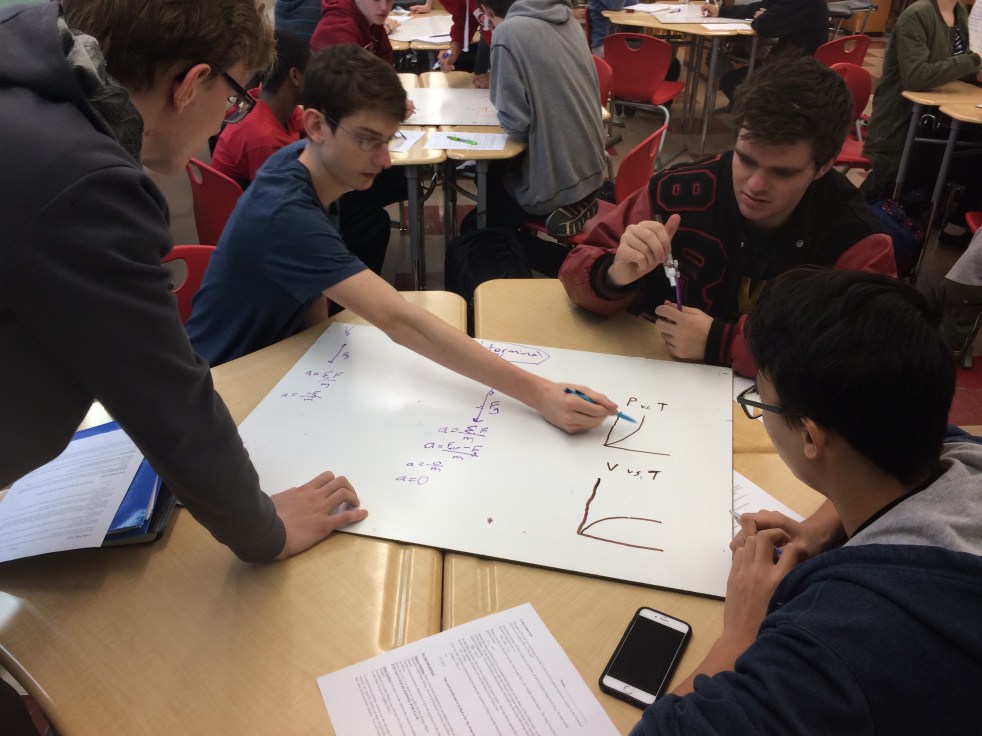
When students walked in today their desks were in groups of four with a whiteboard. I asked them for the following

  1. A free body diagram at t=0, sometime before terminal velocity, and at terminal velocity
  2. Acceleration expressions for each of the diagrams
  3. position, velocity and acceleration vs time graphs.

IMG_1632It was so cool to watch them work, discuss and argue. The FBD’s were relatively easy, the discussions mostly about whether or not to put air resistance on the t=0 diagram.

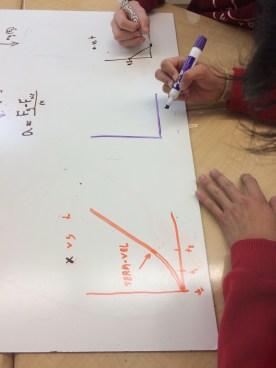
The discussions about the graphs were far more interesting. Many students were working with the graphs as unique units, rather than considering the relationships from one to the next. Inevitably we had piecewise acceleration graphs and linear acceleration graphs and linear piece-wise vs curved velocity graphs.

IMG_1633


I asked the kids to cite similarities and ask questions about differences. One group today started changing their board before attention was drawn to them. It offered a fantastic opportunity to review the graph models and review the relationships.

One of my favorites was a group that decided the curve of the velocity graph was quadratic, so they started taking the antiderivative for the position function. They noticed the constant slope portion in many of the other graphs and asked the question about it. Then they realized (#overachievers) the velocity graph wasn’t really quadratic.

I realize this particular example isn’t quite model-based learning through and through as I did not allow them to experimentally discover the exponential function relationships, rather after discussing that all of these changes were continuous I gave them a brief taste of the calculus/diff eqs ending in “solution is always in the form….” and hey, doesn’t that look like the curve we agreed upon?

We only collected data today, so I’m really curious and excited for what their write-ups are going to look like Wednesday!

I’ll keep you posted 🙂


Teaching Methods · Uncategorized

Teaching to Reach the Introvert

My second-grade teacher called my mom concerned that I didn’t play with any of the kids at recess: I read a book under a tree instead. When my mom asked if this was a problem the teacher reported that I wouldn’t have any friends. I was elected to represent our class for the school council that year.

Research indicates that as much as 50-74% of the population is extroverted. It is generally viewed as a valued quality: put yourself out there, be friendly, be social. These are the rules society dictates whether it is on the elementary playground or in the workplace. Our culture favors extroversion, and many of the qualities associated with introversion are erroneously viewed as a failure to be able to advocate and insecurities with oneself.

Nowhere does extroversion seem to get a higher reward than in the classroom.  There is a huge emphasis on team and group projects, and the excellent teacher is often seen as the one where energy runs high in the room, rather than examining student behaviors and conversations. During the majority of my high school experience, most classes had a participation grade. If I did not speak in class I was guaranteed nothing higher than an 80% for participation, regardless of the fact that the rest of my work was A-work. I despised the participation grade. Some teachers pride themselves on their use of the Socratic method, but research has indicated that it’s execution this can offer the opportunity for gender bias: male students are more likely than female students to shout out or offer answers to questions, regardless of if they are correct. Teachers, in turn, are more likely to respond to those students and the quiet students are left in the dust.

I want to make perfectly clear that I am in no way, shape or form suggesting that classroom participation, presentations, and conversations should be abandoned, far from it! All of these skills are important and required for any field and for success. At the same time, if we are trying to reach all students in a way that they learn best, then we have to offer comfortable environments for the introverts in addition to the extroverts.

present
One of my extroverts discussing the solution to the problem. All students in this group worked on the same problem in pairs, then came to consensus before presenting to the class

Science is all about collaboration and presentation. Students who think otherwise are in for a very rude awakening as they approach their senior year of college and enter the workforce or graduate school. A method I have recently adopted is whiteboarding. At the spring meeting of the Chicago Section of AAPT, Kelley O’Shea presented on standards-based grading in physics and lead a workshop on whiteboarding methods. (See her blog!) One of the most important aspects of whiteboarding (and teaching, for that matter) is fostering an environment where it is safe to share and safe to be wrong. In the lab setting, this consists of all of the students putting their lab results on a large whiteboard and standing in a large circle. Students comment on similarities and ask questions about differences on the boards.


whiteboard1
Sample board and commentary from students. Students assess each other’s final answers and reasoning in addition to the quality of the presented work. 

I have used this method in my teaching, but I have also included a variation on the model. Occasionally (and in the interest of time and space) I have students circulate the room to examine each of the boards. They are still asked to consider similarities and differences, but I ask them to write questions and comment down on a smaller whiteboard next to each of the large ones. After we have done this, students return to their boards, read the feedback and then I open the floor to comment on similarities and differences. This provides the introverts with a huge advantage: they still get to collaborate in their small groups, but they receive the wealth of information in the large group as well as having another avenue to participate in the whole group discussion.


The second whiteboarding method I find to be highly effective with my introverts, shy students and students who struggle is what Kelley fondly dubs, “whiteboard speed dating”. In this exercise, students are paired at a board and the entire class is given the same problem. Here’s the catch: the problem is goalless, it does not end in “calculate the _____”. Students are two write anything on the board they can (diagrams, equations, graphs, etc) in the time allotted (1-3 minutes). When time is up, partners split, everyone moves around the room to an adjacent desk and now they have a new board, a new partner, and a new perspective. The first time I tried this I, admittedly, was anxious for my most introverted student. She did not speak. ever. even to me. ever. even when asked a question. about anything. Within 3 rotations she was explaining the problem to her partner, and I’ll add: not a student she typically worked with. Working in this manner gave her the confidence to collaborate with another student. Would she get up in front of the class and explain the problem? Not today. But maybe eventually.