Have you ever looked at the gender discrepancies on those who score a 5 on the AP Physics 1 exam? It’s nearly a 3-1 ratio! AP scrapped all of the data in 2021, so probably not. I started analyzing this data around 2019/2020 and was pretty shocked. It got way worse when you looked by race
Percentage of male and female test takers who earned a 5 on the APP1 exam in 2018. Of 17,589 underrepresented female test takers, only 58 earned a 5
“Surely not MY students” I thought. “I’m a female teacher AND I’m super aware of the issues around female performance in the physics classroom”
I checked my data. The same patterns persist.
So I dug a little deeper. I knew that I had female students who were on or above the playing field of some of my male students. What was going on that it was so hard for my female students to earn 5’s?
BY THE WAY… this is NOT a physics problem nor is it a math problem. Check out the gaps on AP Physics C and AP Calc…. WAY smaller
Notice the gaps are more consistent across racial groups than they are for APP1
What I realized was it was their performance on the multiple choice.
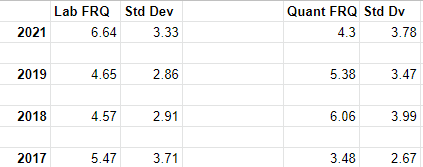
Then 2020 offered an incredible opportunity. I could test my hypothesis by pulling the national data when AP had no multiple choice on the exam.
Guess what happened? The gaps were reduced.
Notice the gaps are more in line with the gaps on APPC and Calculus when there was no MCQ
In my college experience the classes I recall learning the most were the ones where exams were not “gotchas” but opportunities to deepen our understanding of the material. I had one teacher give legit take-home exams. It was nice, but not exactly a learning opportunity.
The next professor did something different. He gave us twice as many problems as would be on the exam a week ahead. We got together as a group and worked all of the problems over the week. The exam was “open annotated textbook” and the questions were ever so slightly different from the originals. The course was Physics 470 – subatomic physics. It’s the class I learned the most in.
The third professor who did something similar orally read us the exam the week before. He would leave out important details or specifics. “You have a circuit that looks like this… you will need to find the potential across two of the nodes” I also learned a lot in that course.
Taking all of these things into consideration, I’ve really modified the way I approach unit exams in my class. After seeing success with this model it has become a model I use starting on unit one and continue to implement until the semester mark.
I give students the entire test the day before the test.
But won’t they memorize the answers?
Isn’t that cheating?
How do you know it’s really their work?
Simple! I take off the part of the question that says “determine the _______”.
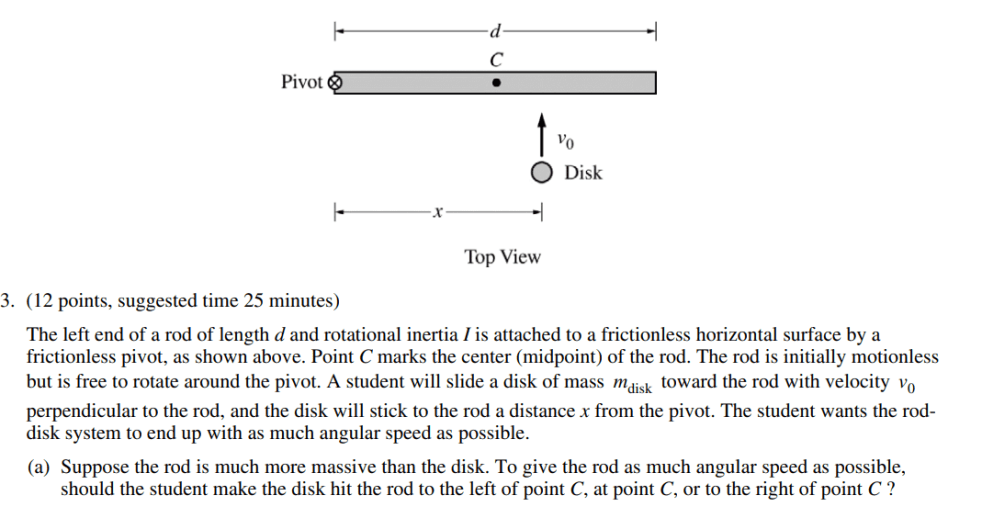
What do I mean by that? Here’s an example problem:
Now let me make this clear: students are expected to stow away all electronic devices before we begin so there’s no photos or google searches. Additionally, students are only allowed to use whiteboards. No paper. Nothing leaves the room.
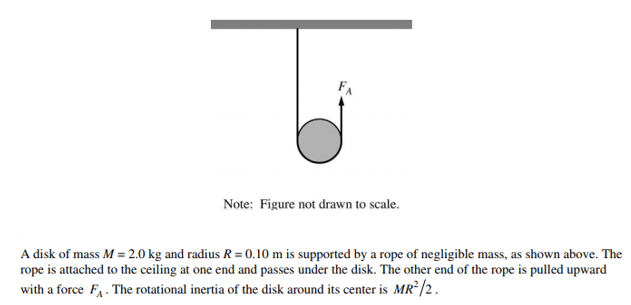
Here’s another example
At first students are probably more stressed. The questions could be ANYTHING! The only thing students CAN do is EVERYTHING I want them to do! They have to draw force diagrams! Make graphs! Write out expressions for sum of torque and sum of forces. They have to consider all of the possibilities. And this is exactly what they need.
And the results?
First and foremost, implementing this strategy did NOT cause a huge increase in scores. In fact, some students still did kind of awful. What it DID do, what move up the mid-group from an anxiety score to a score that matched their classroom performance. This was particularly noticeable for.. you guessed it… my female students. The pretest in this case was a sample of questions from the unit one progress check. Students answered these in “test mode”. The post test was the actual kinematics exam. Below are the results:
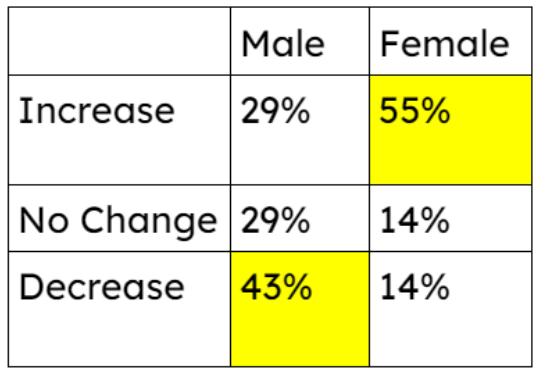
Of course then I had to find out if it stuck. So when we got to the momentum test in January, I ran the data again. This time, there was no intervention: no sneak peek. And guess what happened?
What’s interesting is the number of male students who actually saw a decrease in score. I have a number of theories on this one, part of which being that they generally performed well on the first exam and so did not have that push to improve over time.
Due to the results of these data I have continued to implement this practice. After all, the goal is to get students working the problem, not searching for an answer!
That was an exclamation I received from a student that made my entire week. What gave this student so much confidence? Retrieve note-taking.
Here’s how retrieve note-taking works.
You lecture to the students as normal. Students have their full attention on you. No one is permitted to write.
You stop talking and let the kids start writing.
That’s pretty much it! But wait… we can make it more powerful
3. Let students discuss their notes together so they can fill in any of the gaps 4. Put the slides back up on the screen so students can fill any gaps that remain.
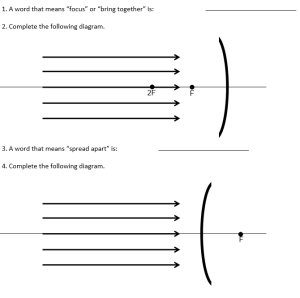
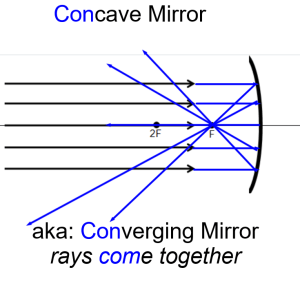
I did today’s retrieve-note taking with my lecture on curved mirror rules. The first time I did this I was really concerned about the extra time it took. However, I’ve learned that the right kind of extra time always pays off in the end, and this is a perfect example.
I break the lecture down into 3 parts, and I have a packet for students to follow along. The packet also reduces the cognitive load and allows students to feel at ease that they don’t have to remember EVERYTHING
Here’s page 1. I do these notes up on the smart board for the first round:
Note: my smartboard notes are NOT a carbon copy of the packet. See below
Next we do the rules for the concave mirror, and last we do the rules for a convex mirror.
Here’s where the magic happens. When students are left to retrieve the information and record it in their packets, they are immediately processing the information. They are asking each other clarifying questions, it’s AMAZING. And because they are working with the material right away, there’s not a lot of time to forget.
So where’s the big pay off? In the homework. Previously I would find myself going from group to group re-explaining how to do the ray diagramming. Using the retrieval method I no longer have to do this and I can work with just the few students who really need extra support! My students actually complete more work more quickly and with more confidence than had I lectured traditionally.
So why does this work?
Whenever we receive new information our brain tries to fit it in to what we already know. The more connections the brain can make, the stronger the new connection will be, and the better we will be able to retrieve that information later. Making connections also allows you to chunk information, similar to why phone numbers are written like 123-456-7890.
This retrieval exercise provides students four different encounters with the material: orally, visually, written and verbal.
First they get the material orally and visually as it’s presented on the slides.
Then they reproduce this material by drawing and writing
They are also discussing the information
By the time they are using and practicing, since they have engaged at such a high rate they are more than ready to go!
Did you like this? Read more about how I use retrieval practices in my classroom here!
We are finally here! Thank you to everyone who has embarked on this journey of reflection with me. If you missed the first few posts check out the introduction to the entire series here. This is part 3 of a 3 part series on momentum. You can read how I introduce the unit with impulse and check out some of the follow up activities I do before we move into collision.
Today we are going to talk about momentum conservation. I find that most novice-style teaching approaches look something like this:
Momentum is conserved. That means initial = final
Write an mv term for each object in the collision before and after the collision
Solve for the unknown variable.
An even more novice approach is to use MVP charts to help students organize the information.
I’ll start with this: I hate charts almost as much as I hate formula triangles. Why? Because if students exclusively use charts to exclusively calculate values with no other expectations the “learning” is “I multiply these boxes” and “I divide these boxes”. This is not demonstrating much of anything except that the student could probably play sudoku (I’m also not a fan). I do however incorporate the charts for those “easy wins” with my regular level students as an option…but only after we’ve done some of the heavy lifting first.
Say what you will about AP as a program, it has made my teaching more thoughtful and as a result, way better than before I taught AP.
Recall that in the early days of impulse, students were asked to sort of consider conservation without outright stating it. We now go through this process formally. I begin with the following prompts:
From here we collectively work our way to the final statement that -Dmv1 = Dmv2…. and THAT is conservation. It is a transfer of momentum from one object to another such that the total of the system remains constant.
At this point it’s all about application for my AP students. They get thrown into the lab for a few days so they can collect data for the various collision types and determine whether or not momentum was conserved. (Lab handout)
After the lab students are given one collision type they are responsible for in a board meeting. Rather than having a class conversation I let students circulate and provide written feedback. (The prompts for the boards are at the bottom of the image below, feedback prompts at the top)
Board meetings are always opportunities for students to check their work, collaborate, and ensure they can submit the best possible product. While I took the idea from here, I do make modifications depending on the activity because some students… no matter what… will never speak in a whole group setting, but they will offer written feedback. Some students (myself included!) freeze “on the spot” but when given time to reflect, have amazing things to offer! I think too often we create classrooms that are driven by extroversion but never take the time to consider what learning looks like for introverts, and write it off as “shyness” or “refusal to participate”. I also like to have students circulate when we have a significant amount of information on the boards, so it doesn’t lend itself to a traditional board meeting.
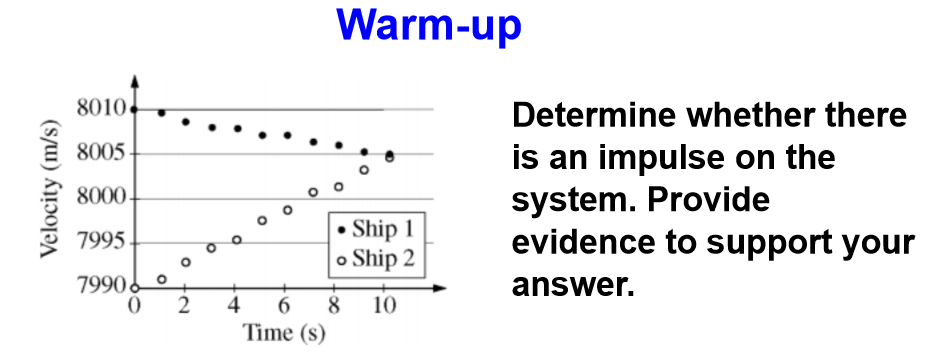
We do some conceptual practice (which has a bigger Force? a ball that bounces or one that lands?) and we discuss how we could know if there were an external impulse acting on the cars during a collision. I love using this graph from AP and asking students to determine if there is an external impulse
Oh! But let’s not forget all of the richness we learned earlier in the unit! I need to make sure to weave in the first half of our learning with this second half! I assign students what I call “special problems“. This problem set is a few problems that are neither perfectly elastic nor perfectly inelastic, but something in between or there’s an extra nuance added. For each problem I ask students to sketch the force vs time graphs, solve the question, and then answer an additional conceptual item about the problem.
Sample “special problem” solution. These are great discussion questions for students!
When we review these problems here’s what I do: I randomly select 6 students to put up the graph or mathematical solution to each problem. Then I select 6 more students and their task is to either explain the answer on the board if they agree, or write a different solution on the board if they disagree. When there is a disagreement we open the floor to a class discussion about the two different answers to decide which is correct.
What about 2D Collisions?
2D isn’t really a major emphasis in APP1. We discuss it briefly in terms of the vector nature of momentum so momentum must be conserved in each direction
In my regular physics class have to scale back just a bit and shift my focus. I give students opportunities for “wins” so they can feel like they “understand” and then I start layering some of the more complex problem solving tasks.
We begin with a marble activity. Students use the grove between their desks and run collisions with marbles (kind of like a Newton’s Cradle). They are asked to record observations about the velocity, and therefore the momentum of the objects. After this activity we have the same conservation discussion as my regular students.
The other major difference between regular and AP is that I present and have students practice each of the collision types one day at a time. When I present these I will show them the chart method first, explaining that it is an option, but not my personal favorite.
I also explain WHY it’s not my favorite. The reason is that you have to remember the important physics idea in the MIDDLE of your work… that initial momentum is the same as final. If, however, they do it in the algebraic way, they start with the physics idea and then they can forget about it. I generally have a 50-50 split in my room who does which method. The other important part about how I teach this lesson is I want to make it super clear that we get all of the same numbers both ways. For this reason I will copy the chart over to the next slide and solve the same problem in the algebraic way
The collision lab is also different. I give students one lab at a time and students collect the data in pre-made tables. Since students need to determine initial AND final AND keep track of signage, there’s just a lot going on to also add the layer of “do this without a guide”. It’s not my finest moment, but, again, my students need some wins.
Problem Solving Skill Building
Another layer I add to momentum is that since the equation and relationships are simple, I introduce proportional reasoning with students (what happens if we double the mass, half the velocity, do both?). Many of my regular level students really struggle with thinking in this way (so does AP!) but I feel it’s important that they get some exposure to this. We talk about how you could choose to make up numbers and see what you get, but it’s also more efficient to shove the changes into the equation and see what comes out
I’ve also started incorporating more ranking task type items that are conceptual in our classroom practice to push their problem solving skills. I intro with the following
Students then solved tasks like the ones below in groups on whiteboards. Notice that the tasks chosen are ultimately fairly simple. I did the colliding carts first because it provided numbers and allowed students to calculate in order to come to a conclusion
However in this final problem we did, there are nearly no numbers at all! This was a good place to really discuss the relationships within momentum, and in this case focus on what is the same, greater and less in order to come up with an answer. Student groups ended up being highly successful. We did about 4 of these tasks in the 50 minute class period.
I suppose I should discuss what assessments look like in my classroom at some point, especially for the non-AP students. Another day, another post! (Spoiler: it’s changed quite a bit since I first started teaching!)
In this post I will outline 3 activities I do in my classes. Each serves a different purpose and function depending on the group of students, but most could be used interchangeably between levels depending on your own goals. They are the following:
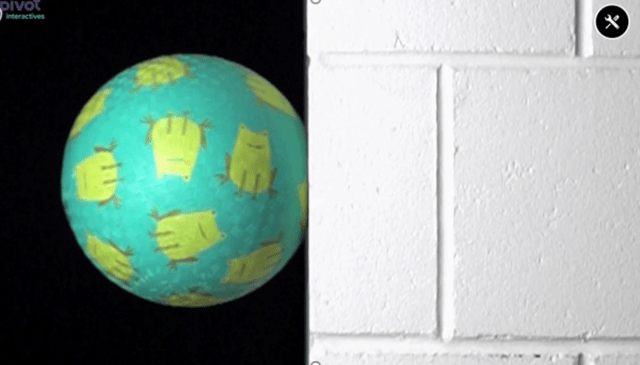
Pivot Interactives: Ball on a Wall
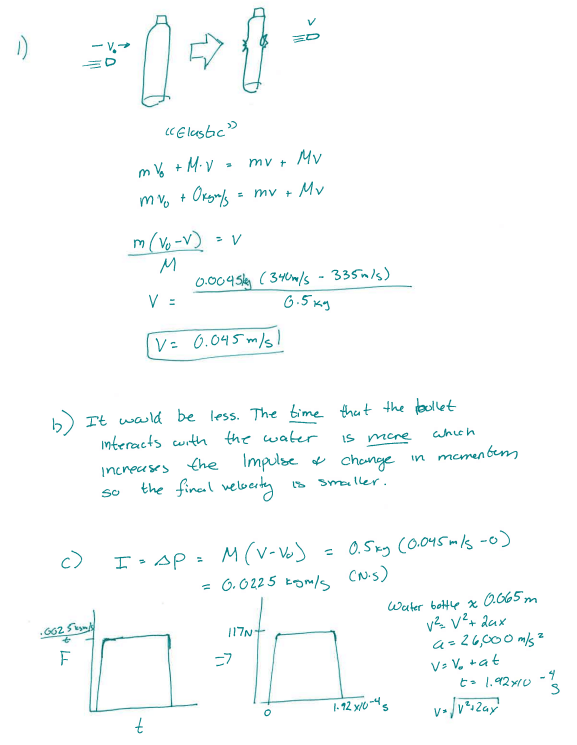
Popper Lab
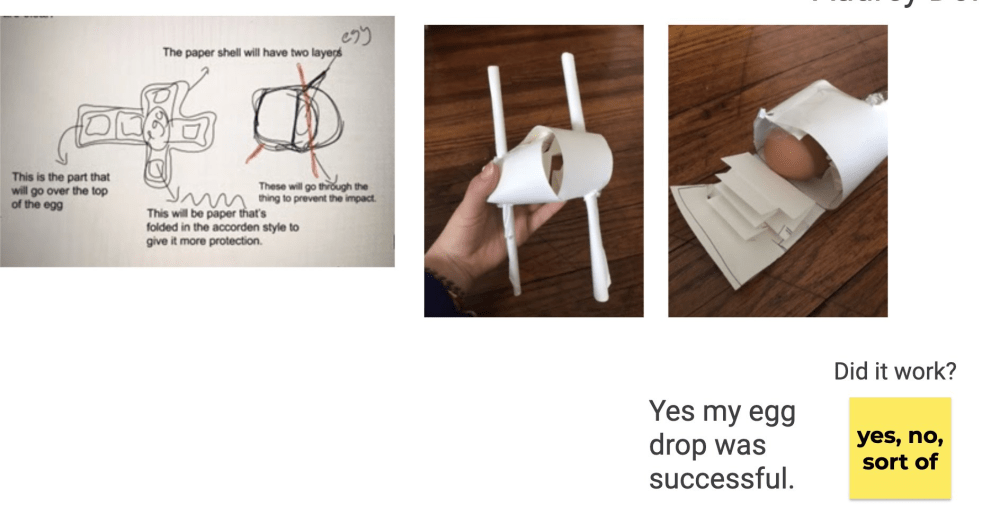
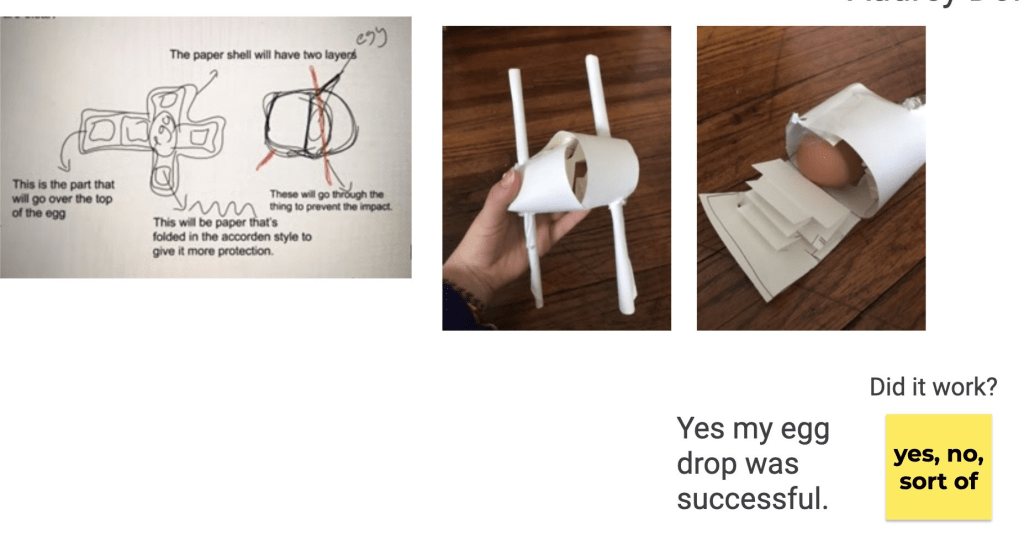
Egg Drop Challenge (with a data-driven testing phase)
These activities are all about giving students a “real-world” opportunity to collect data and calculate quantities from the course. There’s not a lot of “discovery” going on here, a primary driver is practice. However, each activity presents rich opportunities for different conversations.
Please don’t steal for profit on TPT. That harms the teachers who share, those who are in need, and our profession as a whole.
Pivot Interactives Activity: Ball Against a Wall (regular level)
Many of us came on to Pivot Interactives after the original library was migrated from “Direct Measurement Videos” many more of us came on to PI when we had to teach in the pandemic. If you can push for a subscription it’s very much worth it. Labs that are too expensive or cumbersome for a class set become attainable, make-up work, homebound, remote learning… you name it. There are a lot of benefits. I love this very simple activity that just involves a ball colliding with a vertical wall. Important note: I don’t use the built-in questions/grading set up in pivot. It’s very well done, but I find that computer work usually hinders collaboration, so I moved away from having students answer in pivot even before the pandemic.
Ball against a wall in Pivot Interactives
Students begin this activity by reviewing the transformation of F=ma to the impulse-change in momentum relationship. The mass of the ball is provided and students have access to a ruler tool and stopwatch. There are a lot of ways this could be done. For my regular students I have them determine the pre and post collision velocity as a simple x/t calculation (we verify it’s moving constantly by seeing it move equal intervals down the ruler in equal frames). The biggest challenge is determining the time of the collision. This is one thing I love about this activity. In day to day life collisions happen so fast we don’t really consider the impact lasted for a measurable time. I love how this visualizes. You can see my original handout here. Last year I discovered that remote students do better when labs were broken into very small tasks through jamboards, so also check out thejamboard activity here. (2026 Update: Take a look at some of my new summaries for pivot activities!) You will notice a lot of scaffolding. This is necessary for my regular level students, but it may not be for yours. When I run this activity in AP I simply inform them of the goal and send them on their way.
Popper Lab (APP1)
I took this lab from an AP summer institute I attended under the direction of Martha Lietz. Students pop a popper toy (the half-spheres you turn inside out). The ultimate goal is to calculate the time for the “pop”. While students end up using impulse-change in momentum, they also have to use kinematics and F=ma along the way. I find that many students have a hard time with this interleaving because up until this point (remember I do momentum right after forces) we haven’t had too much of a chance to interleave yet. That is one of the main reasons this lab has been a mainstay for me, even if it’s really just a “glorified homework problem” as I tell my students. Students are taken step by step through the process. See the activity here. At the end of the lab I ask students to submit their calculated times to a google form where I aggregate all of the responses. We will first do a quick skim on day 2 so if students calculated an egregious answer, they can obviously see they need to check something. Once we remove the outliers, we do an average and standard deviation. It’s SO COOL to see how close student answers all are when it feels like such an imprecise activity! Because this is a glorified homework problem we can take some time to have a solid conversation about measurement, uncertainty and standard deviations, making it appropriate for AP.
Egg Drop Lab
Whenever students hear we are going to do the egg drop they respond gleefully “we did this in middle school!” I am quick to explain why this is not like middle school and the middle school experience was not like science. In middle school students are typically given tons of supplies, they can use as much as they want and they just cobble whatever together and start chucking. Can you imagine if engineers did this? What a waste of dollars and materials! Besides, you shouldn’t even think about messing with materials unless you have some kind of idea about what is going to happen.
I explain the parameters: 5 sheets of 8.5×11 paper and 1 meter of masking tape. The device must be attached to the egg. No parachutes.
The reason for these parameters is I want students to be thoughtful about the why behind their device.
But no devices are built without prototypes!
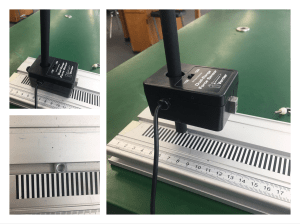
So on day one we have a testing phase. (See handout here) Students use force probes and cars or iOLabs and run “prototypes” into the probe (see image below for how I set up the probe). This might be folder paper, crumpled paper, tubes… whatever! But we know that our eggs will be saved by one thing: increasing the time of impact and decreasing the force.
This activity is by no means precise, but it gets students thinking about what to actually do with the paper.
On drop day students have roughly 35 minutes to build their devices which we drop in the last 15. Students present their devices to their classmates and then drop from 2.0 m. Eye of the Tiger plays on loop in the background.
Egg drops in physics today! Students tested how to use paper to increase collision time in order to decrease force to protect an egg! Today they got to drop! Next year I’m totally using wrapping paper! 😆 #iteachphysicspic.twitter.com/JWbu93bDv9
The following day I ask students to whiteboard diagrams of their devices that also show where the egg was located. We discuss the designs in relation to their smashing or success. View the activity here.
None of these activities are ones I would consider particularly awesome and certainly not flashy, however often its these kinds of activities that allow the nuances to shine.
Any student can learn physics, and curiosity about the physics world around us is an innate attribute of humanity.
Intuition can be a powerful tool to co-construct knowledge
Order matters. Language matters.
Shut Up and Listen
EVERYTHING is an opportunity for an experiment
My primary responsibility is to ensure a safe space for students to learn
When I was taught momentum it looked something like this:
define momentum as mass x velocity.
Talk about how to change momentum through impulse
Revisit action-reaction pairs. Throw an egg into a bedsheet.
Define conservation of momentum as initial = final. Solve collision problems accordingly.
In my experience there was also no mention or use of various graphs. When I started teaching I was able to get a hold of the entire curricular materials from a prestigious, high achieving, highly affluent school in the area. They taught the sequence very much the same way. Obviously this was the “best” way to teach momentum… right?
Over the years through a combination of teaching the AP curriculum, exposure to the ISLE method of learning and the modeling curriculum, this sequence has shifted dramatically. I have aligned many of my routines with these two models. However, my structure for teaching momentum is not the same order as ISLE or modeling. In both of those curricula, students are first tasked with discovering conservation through a series of experiments to kick off the unit. My order is slightly different.
One of the critical choices I make about momentum is to teach it before energy and after forces. I do this because change in momentum is a natural consequence of an object experiencing a force. Momentum is really just forces repackaged! I don’t want students to discover conservation first, because I want them to think about the processes during the collision first, then we can apply those to different scenarios.
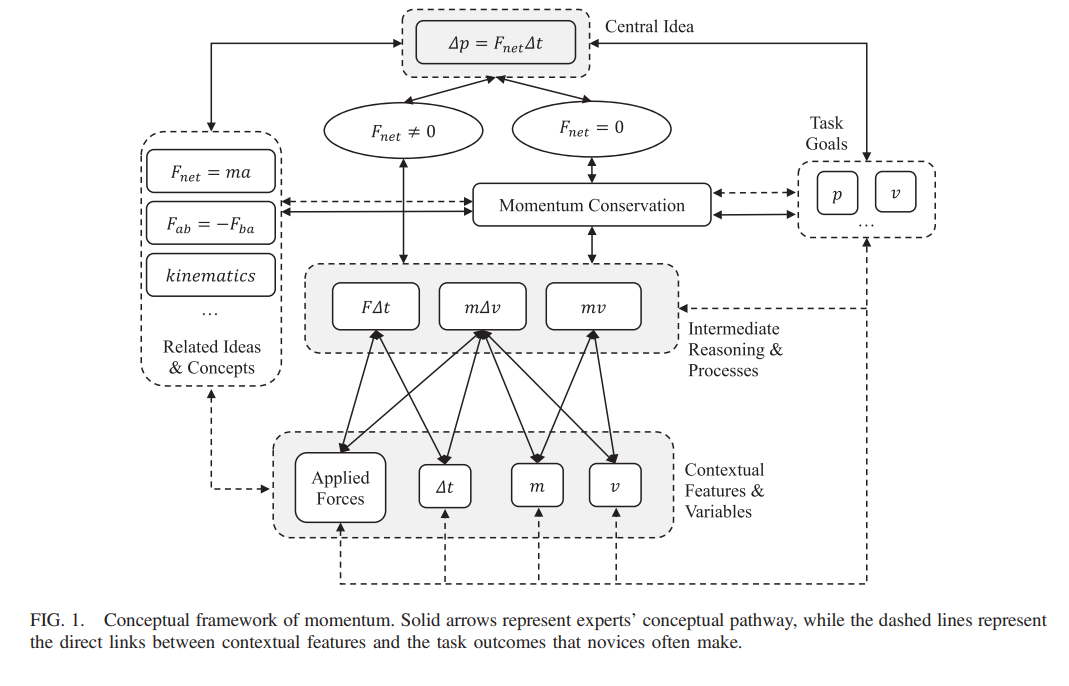
I was super excited to find out recently this has actually been studied. You can read the article here, but here’s the Tl;Dr –when students are taught from big idea down, they learn the material better, making more connections, and this study was specifically done with a framework for momentum. (See the framework below)
Momentum is a huge, critical unit, so I’m going to break this down into three separate posts. This first one will take a look at impulse. The second post will be a short explanation of two activities I do, one for regular students and one for AP. The last post will discuss conservation. I want to note that I do not plan on including every detail, activity and problem set in these posts, only the ones I think have substantial value to you, the reader, and those that constitute major shifts in my teaching over time.
One thing that remained true, even in the very first years of teaching was my attempts at emphasizing that momentum is not something new, it is simply forces repackaged. The other statement I would make often is that the impulse-change in momentum relationship is two ways of saying the same thing. Like “Hi” and “Hello.” Yet, these ideas were not sticking in students minds. Furthermore, I was fully aware that students were making no connections between impulse and conservation. How do we get students to understand these ideas with full integrity?
The realization for me came after a vocabulary shift: rather than defining a force as a push or pul we now explicitly define a force as an interaction between objects. This definition became the driving force for my reframing of momentum.
Classroom Activities
Please don’t steal for profit on TPT. That harms the teachers who share, those who are in need, and our profession as a whole.
Observational Experiment: We begin with an old demonstration from earlier in the year: our lovely bowling ball friend. We are already familiar with the fact that an unbalanced force will cause the ball to accelerate from the forces unit. I ask a student to give the bowling ball the hardest whack they can with a hammer. Unsurprisingly, the ball barely moves. But the force was so strong! What can we do instead? Well, if we tap the ball repeatedly, then it will begin to accelerate. This is how we first define the impulse-change in momentum relationship. We need a force exerted for a certain amount of time in order to change an object’s velocity. We do not define this yet as a formal equation, but we recognize that force and time must be multiplied. To define momentum itself I do a live google news search for the word momentum. The headlines are always sports, politics and stocks. We talk about what the word means in those contexts. We typically arrive at something like “having a lot of momentum means hard to stop” and then we formally define it as mass times velocity. I’ve never been one to do elaborate day plus activities to define simple terms when we can use their lay knowledge as a foundation for their scientific definitions. At least for something like this. We have much more important work I’d rather spend that precious time on. This is important as we move to the next phase. My students hear from me frequently: whenever you get a graph your first question should be does the slope tell me anything (division) does the area tell me anything (multiplication).
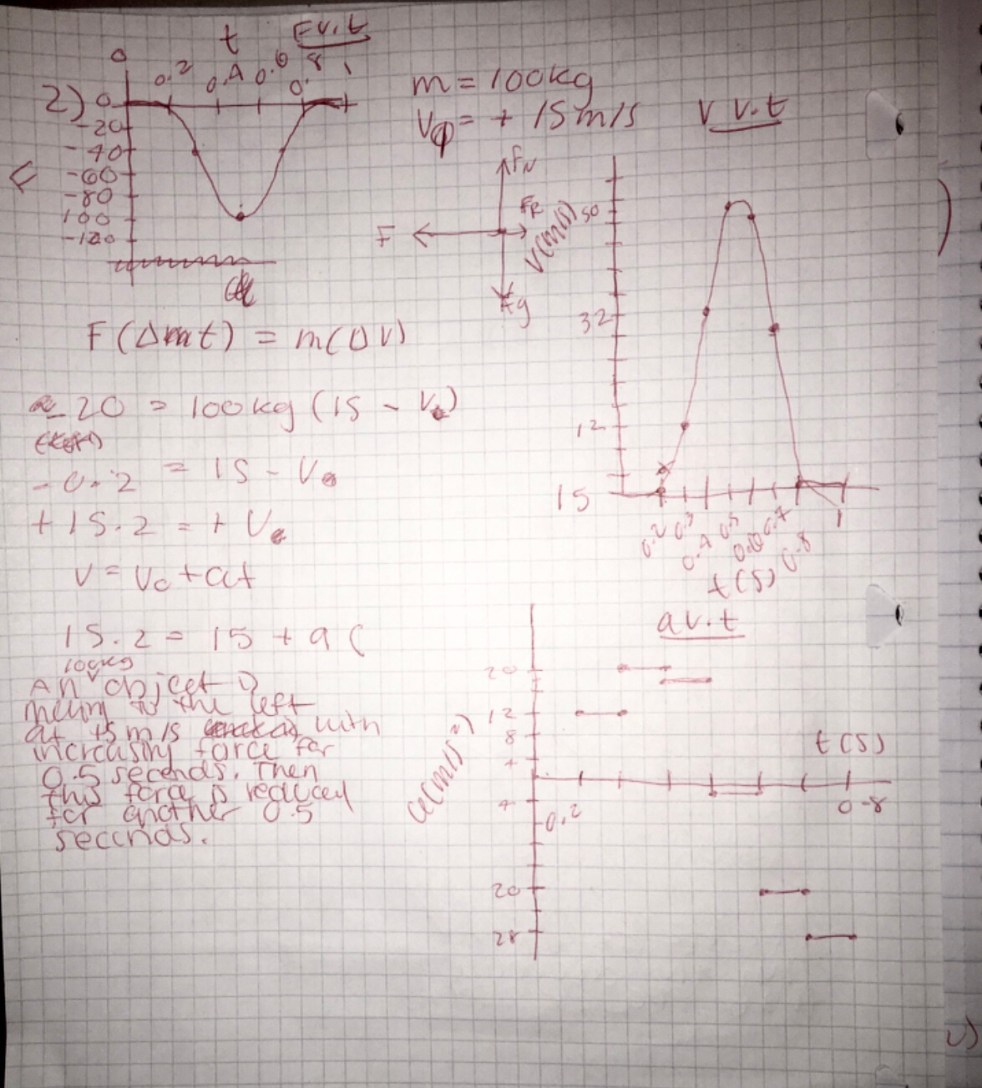
Quantitative Experiment: I have run this lab two ways, but the idea is the same: have students quantitatively compare impulse and momentum change. The original way I performed this lab was to affix a force probe to the track, then run a car into it with the pistton out. The piston allows the time frame of impact to extend so students can see the curve. A motion sensor is set up on the opposite end so students can obtain velocity values. When we open class I have sketches of the graphs they will see and I asked them how they could determine impulse and momentum change from the graphs. Students are asked to sketch the graphs, determine the change in momentum and determine the impulse by using the software to take the area under the curve. In a newer iteration of this activity I use the iOLab to the same effect. Students run the iOLab into a wall or textbook and analyze the same data. I ask students to determine the relationship between impulse and momentum change. Then I ask them to write that relationship down and rearrange the equation until they get something they recognize.
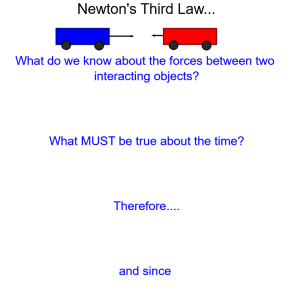
Recap and Multiple Representations – We will recap yesterdays activity through a discussion and whiteboard presentations. By the time we finish students recognize that the impulse-momentum relationship is just F = ma rearranged. This is where I emphasize again we are not really doing anything new. The next thing I ask them to do is to imagine the force probe/wall (depending on the iteration of the lab) was replaced with a second car of equal mass…what would the force graphs look like for each car? We are, in effect, previewing the law of conservation. If we go back to the definition of force: a force is an interaction between objects, then it follows that the force on object 1 must be equal and opposite to the force on object 2. The time must be the same. Therefore, the impulse is equal and opposite. While we could easily jump into conservation laws from here, we continue working with representations focusing on impulse and momentum change.
In a whiteboarding exercise I provide students with several scenarios. In each scenario I have provided one representation. Students are asked to create the other 4 representations. The purpose of this is to ensure they are accessing everything they have learned already. This is, in some ways, I type of interleaved practice since they are pulling from the whole year.
One Final Problem Solving Example
Over the next few days we continue our practice with an emphasis on multiple representations, graphing and the fact that an impulse causes a momentum change and that they are one and the same. One of my favorite questions is the following one.
Identical forces push two different pucks the same distance. Puck A has four times the mass of puck B. Which experiences the greater change in momentum?
Can you describe what student responses look like? They come in three levels.
Level 1: Puck A will have the greater change in momentum because it is bigger. More mass means more momentum. These students have missed the point completely. They are focusing on formulas and completely disregarded the velocity piece. While “puck A” is the correct answer, I cannot give credit for this response.
Level 2: These students make some attempt to determine the velocity but end up writing a lot of circular statements and attempting a lot of calculations. Some of them get there, but this process is long and arduous!
Level 3: These students correctly recognize that since impulse and momentum change are the same thing, they can easily look at the impulse to determine the answer. The force is the same, but the mass is different, resulting in puk A taking longer to get to the finish line, therefore puck A is greatest.
I LOVE this problem so much. It’s a fantastic example of why expert-level thinking is so important for students learning physics. Students see the word “momentum” and they want to do p=mv. While you could do this, it takes a long time to get to the answer. If, instead, you take a step back and recall that impulse and change in momentum are the same, you see that you only have to figure out what is going on with time, since the force is the same. This piece is a lot more intuitive than determining the final velocities of each puck. I have used this as a warm up and as a quiz item.
We also take advantage of the AP question bank and we will begin probing the idea of what it means for an impulse to be external vs internal. This falls in line with previous experiences related to defining forces and systems and serves as a good launch point for conservation of momentum.
Scaling Up and Down
Regular physics generally gets all of the same structure materials as AP minus the AP practice FRQs. I will, however, spend a little less time on multiple representations and a little more time on calculations for the sake of “easy wins” so students can gain some confidence.
AP Physics C: My students in this course have all taken APP1. We instead have a “momentum mastery” project, a quick 2D lab and AP FRQ practice.
One positive aspect of working with other teachers nationwide is you are forced to think carefully and critically about precisely what you do and why. Arguably we are supposed to be doing this as part of our daily practices, but too often we get so lost in the day to day we lose sight of the art.
It is my hope in this next series of posts to reflect and share on how I (currently) teach various topics in physics, and how that has shifted from how I used to teach those ideas. Before we begin on this journey together, it is important to lay out my values and beliefs around teaching this course.
Any student can learn physics, and curiosity about the physics world around us is an innate attribute of humanity. Look at any group of people from across the globe and you will find scientific curiosity and thinking. You will find ingenuity and creativity. Humans are constantly looking to explain nature and then use what is available to us to create, build and explore. This innate curiosity isn’t limited to rich, white men, it is literally a piece of our very humanity.
Intuition can be a powerful tool to co-construct knowledge: I was educated in a physics room where we regularly engaged in what Eugina Etkina calls “expose and shame”. Students are given a scenario with no prior knowledge and asked to guess the outcome. The outcome is always the opposite of what students expect. The unexpected is supposed to “stick” in students minds. Not only does the result not stick in students minds, this creates a classroom culture where students avoid taking risks and making mistakes. What I’ve learned from the modeling curriculum and the ISLE method is that we can help set up specific experiments and demonstrations where we first let student intuition help construct an understanding about an idea. As that idea becomes more solidified we can begin to introduce scenarios where student intuition may not have previously led them to the correct answer, but they can get there using the knowledge they have built in the course.
Order matters. Language matters. This idea is one that I have finally begun to fine-tune and refine just over the last few years. All of mechanics really comes down to 2 ideas: forces or conservation. When we boil physics down to the “big ideas” we can see what is truly important. The challenge, however, is that students tend to work in a very granular manner. They like to do things a particular way each time (algorithmic thinking) and they like to go equation hunting, thinking that thee “plug and chug” part of the problem is “the work” rather than all of the work that comes before the work. As a teacher I have two roles here: emphasize and make clear the big picture, and make all of the work before the work visible to my students. These ideas have shifted how I first present material to my students as well as where the emphasis lies within the classroom.
Shut Up and Listen: Not them… YOU! Getting out of student conversations and letting them run the room is a big challenge. Actually listening really carefully to the conversations happening in the room is another challenge entirely. I cannot count the number of time’s I’ve wanted to bring everyone back in after a time limit, only to realize groups were just getting to the good stuff in their conversations. So much of their learning happens while engaging in conversation, so we need to the make space for it.
EVERYTHING is an opportunity for an experiment: I learned this after working with Eugina Etkina’s ISLE curriculum and workshop and it finally solidified what I always believed to be true but struggled to put in a concrete way. I’ve never been one for showmanship, and I started my career around a lot of physics showmen. When I was in college it was the big “learn through inquiry” push, which was a step in the right direction but lacked structure. When I student taught I was supposed to do a day of thermo demos, but instead I turned it into stations. This is one part of my teaching style that has only grown over the years. “Demonstrations” are and should always be treated as observational experiments. If we want to treat our students as aspiring scientists, we should model our classroom on the scientific research structure.
My primary responsibility is to ensure students learn. This can only be achieved if a certain culture exists in my classroom. My room must be a place that is culturally relevant and responsive. It must be a place where students can take risks, ask questions and be heard. It must be a place where failure is part of the process, but never the end result. Where students know I care about their well-being and mental health as much as “finishing” the content by the end of the year. My classroom must be a place where the grade students earn is a reflection of what they have accomplished and learned in a semester, not an average of mistakes and compliance. These norms are achieved in many different ways within and outside of the actual curriculum.
I imagine I will add to the list as I start formalizing my thoughts around how I teach each of the units and build my classroom culture. One of the beautiful parts of blogging is actually taking the time to reflect on practices and receive feedback!
One of the distinguishing attributes of first year physics students is the novice-style approach to solving problems, typically based upon common variables or equation hunting. Having students shift to more expert-like strategies, based upon more over-arching ideas or concepts is often a challenge in physics teaching. This talk will discuss several strategies implemented in an urban-emergent high school for both traditional junior level students, as well as AP level students to help shift student approaches from novice to expert.
If you plan on attending AAPTSM21 I hope you will engage in conversation with me! If not, this talk is accessible to all!
Physics Education Researchers know that active learning is better for students than lectures. At the same time, anyone who has attempted active learning environment knows that students do not always believe this to be true. The same holds true for study methods and habits. Instead students will balk and complain that “my teacher doesn’t teach”. Most recently a student told me they believed that by asking them to actively learn and collaborate, “the burden of the teacher has been placed on me”. I believe it was at this point I was ready to post Rhett Allain’s Telling you the Answer isn’t the Answer on every tangible and virtual learning environment I occupy. I didn’t do that.
At the end of Chapter 6 of The Science of Learning Physics, Mestre and Docktor share that students should learn about the research surrounding effective studying. I would argue that the same should be true about the active learning environment. In the past I have mentioned this casually to students, however the challenges of COVID required me to shift casual mentions to intentional direction.
Brian Frank shared that Jennifer Docktor had a webinar on the book. Excited and curious I watched the video. I was most excited that it was only 30 minutes, meaning it would be digestible for my students. The talk is an overview of the highlights of each chapter of the book. If you haven’t already ordered it and are interested, this is a great entry point!
Hey #iteachphysics#modphys friends, Dr. Jennifer Docktor is giving a talk (pre-recorded, can watch any time, with live discussion on Jan 30) on "The Science of Learning Physics: Cognitive Strategies for Improving Instruction", check out the linkhttps://t.co/v0DdhTVY04
Shortly thereafter I assigned the video in google classroom and provided the following:
As you prepare for finals and reset for semester two, I’d like you to listen to this talk by Dr. Jennifer Docktor. She is a professor of physics at UW Lacrosse and recently co-authored a book about how students learn physics. Watch the talk and write a short reflection. Include the following. Remember, you should be digging deep and synthesizing, rather than simply agreeing or disagreeing.
What resonated with you?
What ideas challenged your current thinking about how we learn and learn best?
What do you now wonder after listening to this talk?
What resulted in an “aha” moment for you.
Lastly, as a student, what can YOU take away that you’ve learned in order to improve your learning next semester?
I will be completely honest. I have a few students who have been extremely verbal about their hatred for active learning. I read their reflections last. I was also nervous because as a teacher, I’m a life-long learner. There are components that Docktor discusses and shares that I haven’t yet implemented or perfected, especially thanks to the COVID monkey wrench. Would students call me out? However, I was really impressed by what the students had to say.
Some students reflected on recognizing the intentionality put into our classes:
“I like our weekly practice tests, but I didn’t know they had an educational backing. When she started talking about interleaved practice, I thought about the momentum problems with a twist and some other homework problems that we’ve had.”
I had several students comment about applicability and connections to education outside of physics
“I now wonder, after listening to this talk, if other fields of science education, and other education in general, put this much effort into how material is taught to students, or if I have just never been aware of how I am being taught in the past.”
Another student actually posed that physics exposure happen at the elementary level so that kids have a better scaffold of experiences, rather than needing to uproot firmly held misconceptions in high school. (Big YES to that!)
What I really enjoyed, however, was students seeing themselves in the studies. Many students admitted to equation-hunting rather than starting with the big picture. I found this particular statement to be really fascinating about why they default to equation-hunting,
“I do this myself sometimes the reason why I do this is when I don’t feel confident in the work or I don’t know what I’m doing.”
Students overwhelmingly reported that an idea that resonated with them was how they are not blank slates, and experiences shape misconceptions. They saw themselves in the research and were shocked (and in some cases bothered) to hear that lecture and note-taking are ineffective, along with many of their tried and true, but passive study habits. One student who has been particularly insistent shared “the studies she talks about seem to prove me wrong about the lecturing method being more effective”
After completing this excersise here are my lingering questions:
Given the demands of AP 1, how can we encourage students that they are growing and learning by leaps and bounds, even if they aren’t at a 4 or 5-level for AP yet? I feel this is easy for me in my non-AP courses because I set the bar, and so I can raise the bar as the year progresses, without students realizing this has occurred.
Many students shared the sentiment of “well everyone is different, and this doesn’t apply to me” neglecting that this is a large body of work and research spanning decades and involving thousands of students. I’m wondering if more work in the realm of cognitive science and how we learn would be beneficial. But how to weave this into the structure of my courses?
In my previous post we discussed strategies for metacognition to help provide students a clear, objective judgement of learning in order to help students see their own improvement and laser-focus where they need to put in more time.
Today we are going to further explore practice and studying.
We have already discussed some of the following: that students tend to judge their own competence poorly, students mistake familiarity with competence, and student study habits, if existent, tend to rely on passive methods such as “looking over notes” and highlighting. This is part of the reason why active learning is so beneficial in the physics classroom; it creates a norm for how we approach any problem.
In the book The Science of Learning Physics, Mestre and Docktor discuss the work of cognitive scientists Elizabeth Bjork and Robert Bjork of UCLA that suggests the implementation of “desirable difficulties”. Implementing these desirable difficulties is providing students with a challenge that is just out of their comfort or familiarity zone, but not so far removed that the student shuts down. Desirable difficulties can be produced by creating certain experiences for students that, in a way, de-contextualize the problem. These methods include varying the condition of practice, spacing and interleaving.
Spaced practice is commonly known: we don’t really learn much by cramming, but students will cram nevertheless. Knowing this reality we, as teachers, can incorporate spaced practice into our classroom as part of our warm-ups and retrieval exercises or focused activities. We can also incorporate these practices in order to help students built their own study guides (particularly when combined with metacognitive strategies) I really enjoy embedding spacing as a retrieval practice like the one below. You’ll notice I give students a single word to help jog their memory just a little, because remembering from a week or two ago can be really hard!
This practice also works excellently with interleaved practice, which is when students are asked to use multiple ideas at once or in random succession (the opposite is blocked practice such as items 1-10 are newton’s laws and 11-12 are energy). Physics truly lends itself beautifully to this process because, in truth, working through a semester of physics is really working through new and layered understandings and models for how and why things happen.
Last year I had my students do a retrieval exercise to get them to retrieve everything they could remember about reflection and refraction. After cycling through pairs and groups of fours I asked them to create a Venn diagram of the two concepts. This got students actively thinking about how refraction and the problem-solving tools connected to reflection and lead to some phenomenal conversations. It also produced a desirable difficulty: students had not thought about refraction in this way before and they were asked to interleave with reflection. Students got to walk around and look at the other boards and then come back to their board to shift or add anything they felt needed to move.
Goall-less problems are a really great way to incorporate these practices. In a goal-less problem you take off the last part of the sentence that says “find the velocity” and so on. Instead, students are asked to write down and solve everything they can about the problem. The benefit to this method is that it is the epitome of a low floor, high-ceiling activity. Even your poorest performing student should be able to draw a picture or write at least one thing down. It also removes the narrow student focus of trying to solve for the specific thing asked for, and rather makes students consider all of the possibilities. In my on-track physics classes I typically put a list of all of the representations and options they have available up on the board the first few times we do this. Goall-less problems also make for fantastic final review or assessment items.
One final note that is more personal experience than anything else. I really, really hate Webassign and other similar online homework platforms. I worked as a full time tutor in a school for two years and I was typically inundated with physics students wanting to get all of the green checks. No matter my goal, hope or intent, the majority of students generally did not care until I got them through all of the steps. In contrast, the couple of students I tutored from small, private schools without an online platform were far more interested in process. There is something about the green check and the correct numerical answer that strips away all of the process and metacognition that we work so hard to cultivate in our classrooms. I’m not sure what the answer is to this (other than this type of homework being worth close to nothing). But I am sure that when the focus in class is truly about helping students create their own knowledge that much of this type of homework becomes obsolete. I would much rather have students working out solutions on paper that they can then bring to class and have a conversation. In Webassign success is binary: you get a red X or a green check, but comprehension and learning are not binary processes, they are fluid and messy. Students need to work through the mess and celebrate the small wins along the way.
I distinctively remember this being a topic in one of my teacher prep classes. I also remember several failed attempts at weaving metacognition into my assignments. I don’t know about you, but trying to get students “thinking about their own thinking” seems really challenging, clunky and too often inauthentic. Students are fantastic at sniffing out inauthenticity, and the moment they recognize something as garbage, they approach it in full B.S. mode.
The challenge with this, of course, is that metacognition is an incredibly powerful tool within the cognitive science toolkit, and is one of the marked differences between expert vs novice thinking.
Metacognition allows students to evaluate their learning and problem solving approach, and focus for studying. Unfortunately, students frequently misjudge their skills and abilities, often confusing familiarity with content for competence. Furthermore, students who struggle may lack enough familiarity to properly identify the edge of their learning. So how do we teach students to be authentic reflective learners?
One of Mestre’s suggestions in The Science of Learning Physics is to provide students objective measures to judge their learning. Specifically, access to old exams and questions. While this is an excellent method, many high school and AP teachers may lack a deep pool of questions to make available to students. Additionally, this is limited to student studying outside of the classroom. What Dr. Agarwal suggests in her book Powerful Teaching is “engagement with feedback” in other words, whenever we have students working in our classroom, they should have the opportunity to receive meaningful feedback on their work in short order so they can reflect on their process while it is fresh, and course-correct as needed. How often do we ask a student to tell us their thought process and they respond, “I don’t even know anymore”
A method I’ve adapted to aid in this task weaves together retrieval practices with metacognition. Recall in the retrieval process students first write. down everything they can remember using only their brain. Then, if you so desire, students can pair and share (I typically do a pair and then have pairs get together into groups of four). Last, you permit students to dive into their notes. In each of these progressive phases, students should be adding the parts they received from. other sources to their papers. Adding the metacognitive level is as simple as a highlighter. Perhaps students highlight everything from their partner in yellow. Then, they highlight everything they added from their notes in green. This produces a very clear visual of what they know and what they do not know. It also produces a visual of how much they can reap from their friends and what topics or ideas were “really hard” for everyone because no one could remember it.
If. you’ve started to dig into retrieval ideas on twitter or on Dr. Agarwal’s. book or website, you’ve. seen that there are so many different ways to do retrieval, from lists to graphic organizers. Any and. all of these can utilize this highlighting method. Not only does this allow for metacognition. and accurate judgement of learning, over. time it demonstrates to students how much they have learned over a time-frame and how their own retrieval improves with practice.
Here is another brilliant idea by Jess Kirby. Not only does this incorporate metacognition and judgement of learning, it also requires students to organize the questions by the big idea (another “expert-level” concept).
Magpied a retrieval idea. Tried with high ability year 10 for intervention on physics paper 1. (Meant to be 99 questions). They have to choose a question, decide what topic it is by colour coding. Then answer it. Will be trying again! #retrievalpracticepic.twitter.com/XpsGjy3Rlg
For a more complex version of this process as it relates to problem solving I have had students combine retrieval with cornell notes.
In this example I had lectured students on how to solve this exact problem the previous day. I provided them with the following notes sheet
First, I asked students to solve this problem as best they could using only their brain and what they could remember from the previous day. I only asked them to focus on the left hand side where they solved the problem.
Next, I allowed students to pull out their notes and add, edit or correct any of the steps they had missed. I asked them to color code these edits and then write out the steps in words on the right hand side.
Finally, I told students to look over their paper. Anything that needed an edit or addition (especially if “I just forgot that..”) needed to go down in the “reminders to yourself” box.
These three ideas really only scratch the surface of what is possible! If you have picked up Powerful Teaching, head over to chapter 5 for more great ideas and then share what you’ve implemented in your own classroom!