Teaching Methods

How I Teach… Work & Energy

Interestingly enough the work and energy unit/chapter has become my litmus test for whether or not I’m going to invest time in a resource. It was what spurred my frustration with The Physics Girl’s AP review series (although I’ve learned that when you’re actually commissioned by someone like PBS you have to bend to the whims of the corporation).

So what’s the litmus test? Open the resource to the first page of the Work & Energy chapter. If you see “work is defined as force times distance” close it and move along! First of all, let me be totally clear, that was me early in my career. I taught that work was the dot product of force and distance, we did a lot of different calculations and then we defined energy and did conservation of energy. My frustrations began with the fact that students were not transferring the idea of work over to conservation of energy. They deepened when upon reflection I realized my angst was because the core idea is not just that “energy is conserved” but that work causes a change of energy in a system.

Enter the new dynamics. I’ve talked about how the structure of your units is really going to guide students to what is important. If you start the lesson with an equation, then they are going to assume that equations are what’s most important. However, if we start with their preconceptions, build on that knowledge and form models we can get a little farther than equation hunting.


This is part of a series!
Part 1 (Work) Part 2 (energy bar charts) Part 3 (problem solving) Part 4 (Lab)


I start by asking students to name types of work. The list looks something like this:

  • Homework
  • Housework
  • Yardwork
  • work work (a job)
  • Wood working

and so on…

Then I ask students what is shared amongst all of those ideas. I’m looking for two answers, that they all require effort and that they all end in a change: Do your homework and your brain grows, work a job and you get paid… and so on.

So then I give students a list of tasks: lifting your backpack, holding your backpack, dropping your backpack, walking with your backpack (at a constant speed), climbing the stairs with your backpack, and I ask students which of the following are an example of doing work. We don’t share answers quite yet because I don’t want to participate in “expose and shame” where we trick students into marking the wrong answer. After they come up with this list then we formally discuss work as “a change in energy of a system due to the application of forces”. I emphasize the change which is in alignment with our original definition and “application of forces” which is the “effort” part they mentioned earlier. We go back through the examples and have a discussion about which are work and how.

Note: We’ve already discussed systems when we did forces, so there is a review of this idea as well.. the concept of systems is critical to student understanding of work and energy so if you’ve not done systems yet you need to hit this hard!

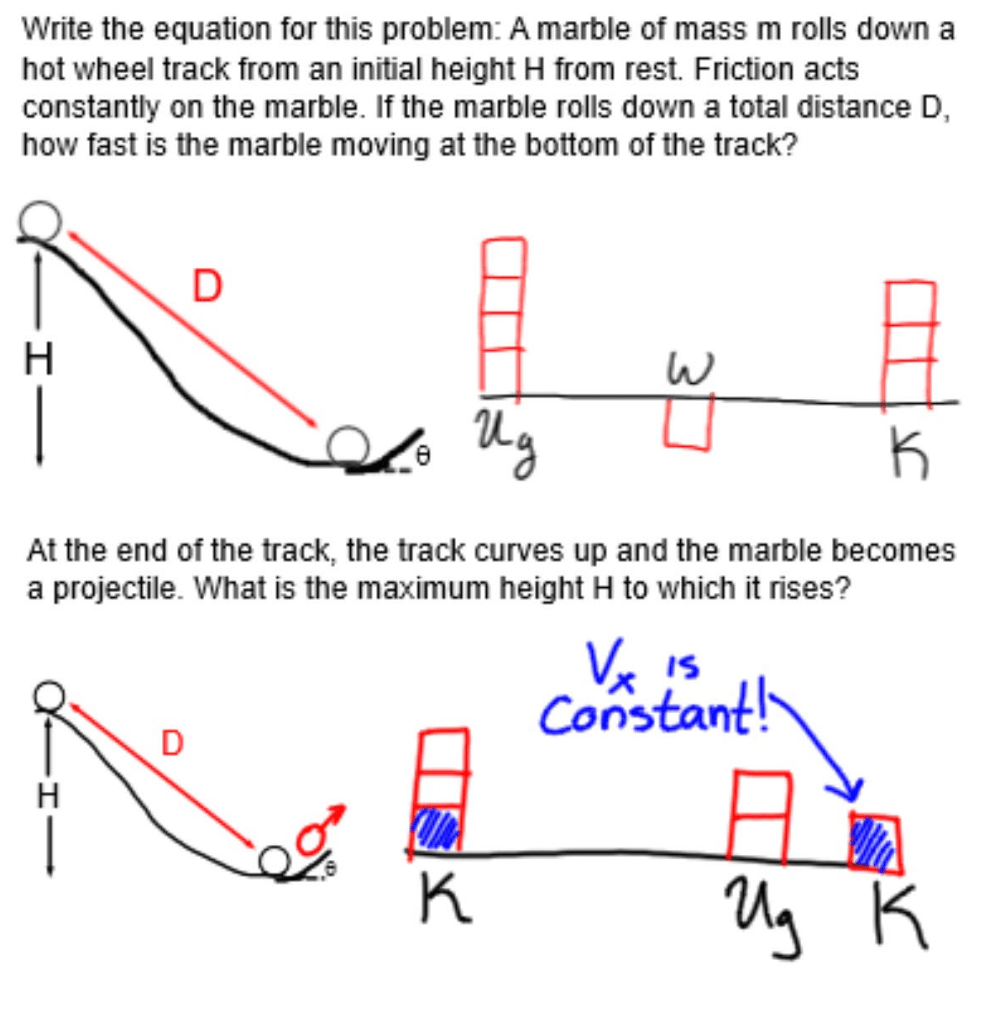
I’m going to include a few of the sample problems we work together in class to hit different ideas:

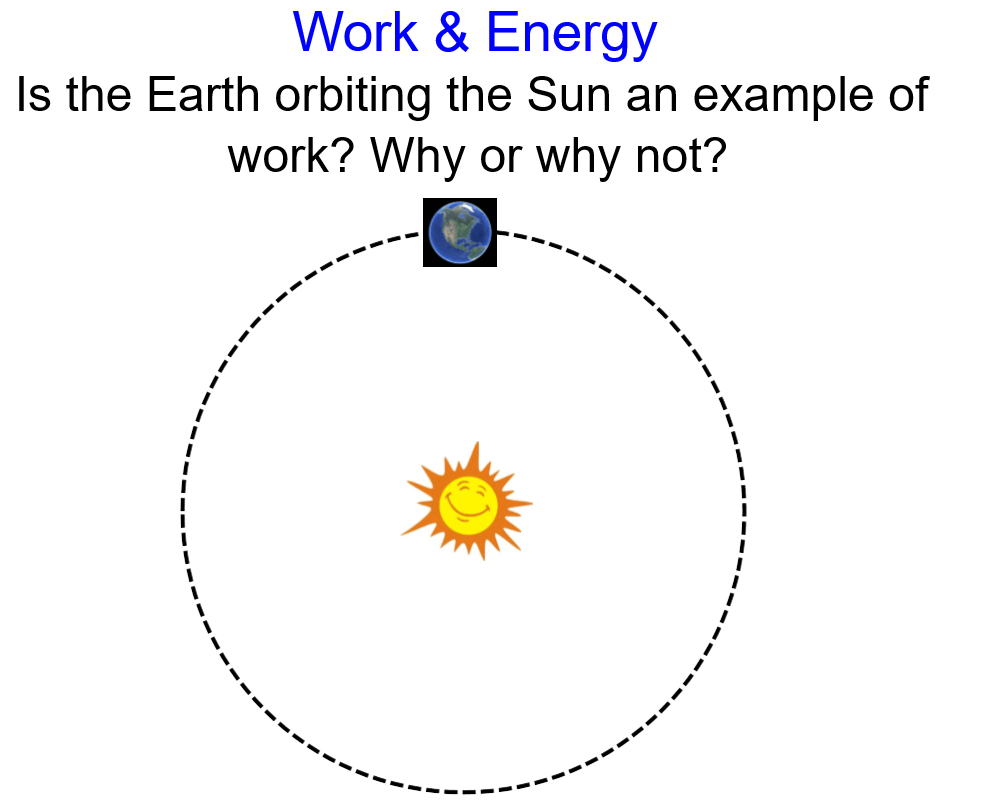
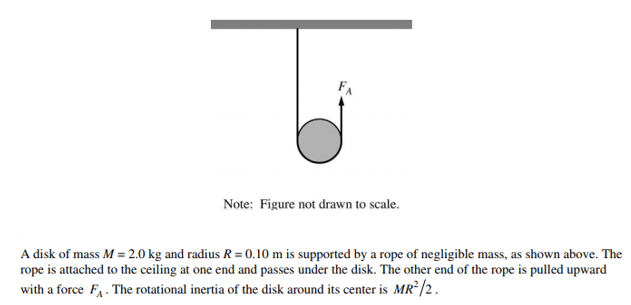
I ask this question right after our intro to work. I let students come up with lots of ways to reason the answer. The “correct” answer is that the force is perpendicular to the displacement, but this is also a good time to discuss that a “before” and “after” snapshot would also look identical, or that with each orbit the displacement is zero!

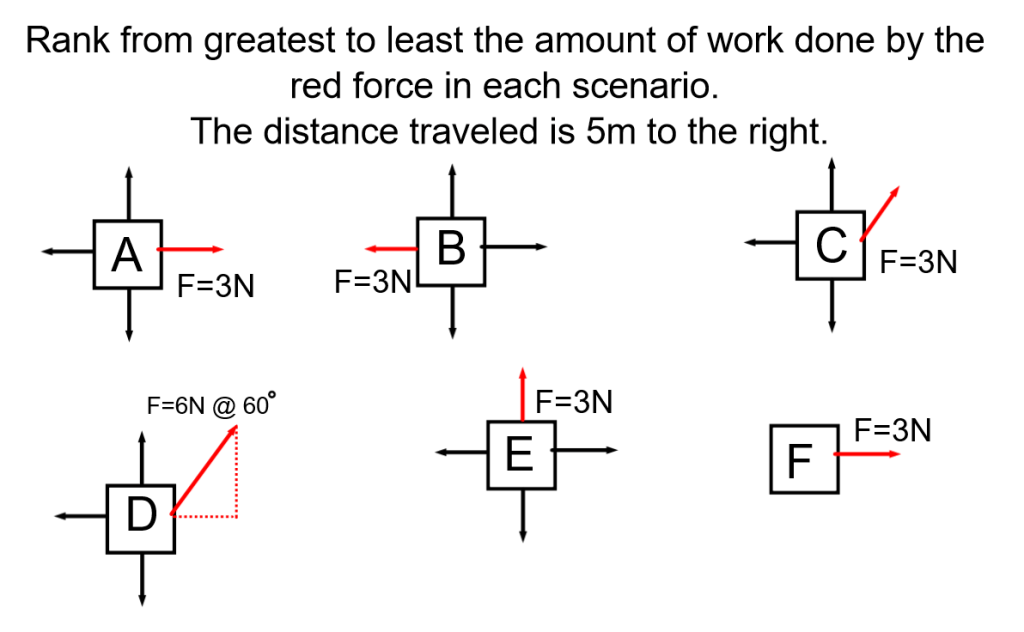
I ask this question in two ways: first as presented, then I ask them how the ranking changes if they were asked about the work done on the OBJECT. This is also a good place to discuss what negative means in the sense of work (positive work ADDS to the system while negative work takes away from the system)

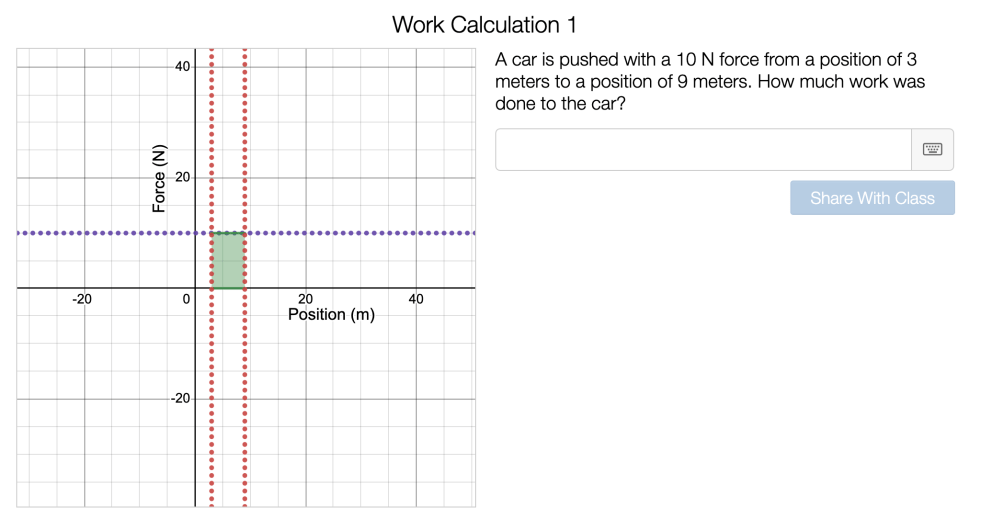
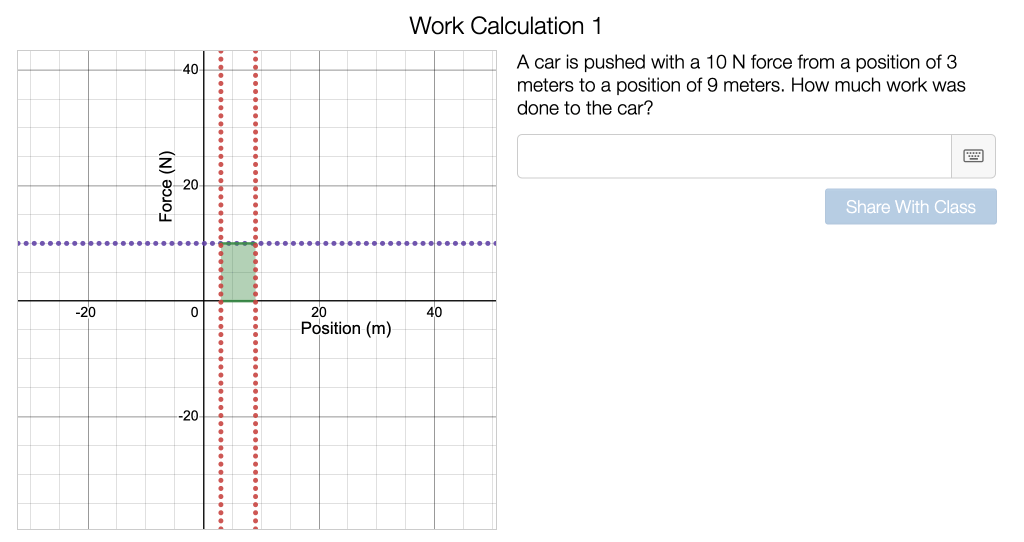
Also of note: in AP I tell them that any time they get a graph they should ask themselves “does the slope tell me anything, does the area tell me anything” slope is essentially dividing the properties while area is multiplying (I know this is a major oversimplification, but it’s an algebra based course). I show them a graph of force vs displacement and ask how they find the work done (area!) they have a few practice items with these.

We run the spring lab where students discover Hooke’s Law and then I ask them to determine the amount of work done on the spring. Most students are able to get to the idea that its 1/2kx^2, but I do always have a few groups that want to just sub in kx for force and end up omitting the 1/2. This is a great conversation to have in a board meeting.

In my regular classes I run this great desmos activity I found by another teacher (try it out here).

First, students move the sliders to make the graph match the scenario…

Then that graph is reproduced on the next slide so students can use it to perform the calculation

This familiarizes students with graphical representations and the idea of how positive and negative work affect the system. I added one last slide to the original asking students to review what they learned in the activity and predict the work done by the spring in their lab

When we are ready to move to energy, I open with the following question:

A ball is dropped from rest.

  1. Define the system to be just the ball. Sketch a diagram showing the ball and the earth and identify the system by drawing a dashed circle around the objects in the system. Include any relevant forces. Is work being done on the ball? Explain your answer.
  2. Define the system to be the ball and the earth. Sketch a diagram showing the ball and the earth and identify the system by drawing a dashed circle around the objects in the system. Include any relevant forces. Is work being done on the ball? Explain your answer.

This is a great way to talk about how the same situation can describe work or not. The gravitational force is clearly inside of the system in #2 and therefore is a NON example of work.

We’ll discuss how I move from work to energy another day!

Teaching Methods

My Favorite Retake

At some point while considering equitable grading practices, I found myself searching the archives of TPT looking for some ideas regarding retakes. While I appreciate the idea of an honest retake, my experience has been that it is simply more time and effort on my part, and minimal effort and a hope to just “do better this time” on the part of my students. I ran across Jeff McManus’ article regarding the “box score” (“Retests”: A better method of test corrections)

 In short, when the students turn in their exam, they receive a blank copy of the exam and they get to redo it, using any resources. If the redo is perfect, their old score gets a bump on the square root curve. I liked this notion,  but had a dilemma—my exams in AP Physics are taken from secure college board documents which are not to leave my classroom. Additionally, I knew that certain groups of kids would work together, while others would not take the initiative to join a group, attempt to work on their own, and not reap as much of the benefits. Not wanting to lose the integrity or security of the exams I needed to make a modification on the assignment.

I informed students of the opportunity to do a retake. Since they needed time to really work the exam, I offered them a “collaboration day” during lunch (our students have a shared lunch hour). The retake would be the following day at lunch as well. (Collaboration day came and I was enthralled. Two thirds of my students came (this has increased to as high as 80%) , received a blank copy of the test, and started talking and working together. Large groups of students formed around white boards to tackle problems, the energy was palatable and the camaraderie was invigorating. Since the students had no number to form an idea how they had actually done on the exam, there was a wide range of abilities in the room.

One of my best students commented to me after collaboration day, “I thought I did really well, but I realize there was a lot I didn’t know” The need to score a perfect in order to obtain an increase in points also motivated students to grill each other for explanations until they understood and could reproduce the work themselves.

Retake day arrived and I had a full house. Students were able to finish their previously 40 minute exam in 20 or less because they knew how to attack the problems and most students were able to perfectly answer the problems.

I struggled, however, with the notion that students might memorize steps to a solution, rather than it being truly valid. I added a reflection component to the retake. Students needed to explain to me what they had previously misunderstood that now they comprehended. The reflections were telling. Students who had obtained 100% on the exam could clearly indicate their faults in either concept or problem-solving approaches. Students who were unable to obtain 100% were unable to adequately reflect on what they misunderstood.

I have continued this practice, in particular with the energy exam, for the last 5 years since I first came across the article. It is not my first or only method for re-assessments, but it is certainly a powerful one. A few changes and observations I’ve made over the years:

  1. To avoid the memorization piece, instead of testing next day, we test 5-7 days after the collaboration day in order for students to “forget”
  2. I had a really hard time not bumping a student who earned a 60% and then got all of the FRQ right and missed one MC. So I do a half-bump… so if the full bump is 10*sqrt(60) = 77, the half bump is 77-60/2 = 8.5 60+8.5 = 68.5, which I’ll likely round to 70 out of generosity.
  3. I’ve had one instance where a student with extreme anxiety and perfectionism this was problematic. I made alternative arrangements for that student ahead of the retake (they got 100 anyway).
Teaching Methods · Uncategorized

“Physics of” Projects – End of Year

Did you come here from a schoolology link? I’d love to know how you’re using this post! Feel free to contact me!

That time between AP exams and summer break is weird and special all at the same time. (If you’re looking for review ideas, here’s what I do before the exam) Depending on when your year starts it’s also possibly extensive. Watching movies and playing games is really only fun for about a week. If you are in all AP classes it gets old pretty fast when the whole day is mind-numbing for the next four weeks.

To use the time productively, and enjoyably, I assign a “physics of project”. I was actually inspired to do something like this after seeing Professor Gordon Ramsey continuously bring his undergraduate students in to Chicago Section AAPT meetings to present their original research. Most memorably I recall a project on music. The student who played saxophone in marching band, make a sax out of PVC and compared the tonal quality to a real sax using the same mouthpiece. He also did an acoustical analysis of his playing vs Professor Ramsey’s playing (which was really cool to basically see the differences between a “novice” marching band player vs an experienced improvisational player).

I believe that same meeting was the one where we hosted Rhett Allain who presented on the Science of Superheros.

The Prompt and Parameters

The prompt is simple: students are asked to research the physics behind anything they want.

The only real parameter is that whatever they choose they need to be able to collect and analyze data. If they cannot directly collect data then they need to find a way to come up with assumptions for measurements (analyzing videos, researching quantities) or find a way to model what they hope to research.

That’s it.

Ok, ok… I provide a little more structure than that, because we all know if given 2-4 weeks to complete a major project most students will put in 40 hours of work the 2 days before the deadline.

Here is what I provide:

Your task: In a group of 1-3 people:

  • Pick a topic to study the physics of. This can literally be anything, but it needs to be something that you can find a way to either physically model and/or otherwise collect data.
  • Research the topic and collect data. You may collect data inside or outside the classroom. Inside the classroom you have access to all probeware and software. If you are wondering if I have something, ask because I probably do. Outside the classroom your cell phone is your largest asset. Additionally, I have 4 iOLabs from the University of Illinois that can run nearly all of the data collection as my Vernier probes can. You may check one out for 2 consecutive days at a time. A sign up will be available next week.
  • Write a formal lab report (background, theory, purpose, procedure, data, analysis, conclusion etc)
  • Present your results in a 10-15 minute presentation. Come prepared with either a poster or slides because physics is visual!
    • When you present, you will be asked questions about the physics of your project and considerations to make it better. Be sure you’ve considered all of the assumptions you’ve made carefully and intentionally!

The first assignment students must provide me with is a project proposal. They need to have a concrete plan for how they plan to measure and analyze their data. This is submitted to me within the first week of the project. I provide students with feedback regarding their plans and suggestions as appropriate.

Next, I ask them to do some background research. It’s like a super watered down literature review. I want them using sources and learning a bit about what they are planning to study before they dive in. I ask for just a page.

The following few weeks they have a simple check in: what have you accomplished, what challenges are you running into, what do you need to do next. These check ins hold them accountable. All of the smaller assignments are included in the final grade.

The final product is a presentation and a paper. The paper is effectively a large lab report.

Students are given the following outline (dates were when we used to end on Memorial Day)

Student Products

Student projects are AMAZING

I will have many students analyze real data they’ve collected like this student who looked at the oscillations of her dog drying himself

Or I will have students analyze the physics of something they maybe cannot capture data directly, but they find ways to make estimates. Like this project on the physics of Nathen Chen

These projects have spanned everything from “is it possible?” in the movies, to students analyzing themselves in their own sport, to topics like rainbows that we don’t cover in AP Physics 1.

Students regularly report that this is their favorite activity the entire year, and the activity they are most proud of. (It also gives me a great story to tell in rec letters!)

When students give their presentations I want to run this much like if they were presenting research. I expect them to talk about what they might do or change if they did it again, or if they wanted to explore further. I ask them questions about their methodology and assumptions. During this process we also open the discussion to the whole class to brainstorm ideas as well.

Student work

If you want to see a sample, here is The Physics of Nathen Chen paper and the Wet Dog Slides and because we all need a little Monty Python, here’s a really extensive student paper on the Black Knight

Teaching Methods

Student Self-Evaluations for Growth

Grading. Feedback. Oh how we want it to be effective, but too often our time is not exchanged for valuable student learning. When the focus is the grade, rather than the learning, and the grade is “final” with no opportunities to grow, why would students care about the feedback? They look at the grade, make a judgment of themselves as learners of physics, and toss it. Not only do they miss out on the growth opportunity, they miss out on all of the things they did correctly. 

I always love when students come to me and we have one on one conversations because these are really fruitful, but there’s literally not enough time in the day to do this for 100-200 students. 

Besides, as a high school teacher my lasting lessons need to be the ones that will carry them through college and beyond. None of those have to do with properly using F=ma. 

Recently in my regular physics classes I’ve worked to make the process more transparent. We do regular “check-in’s” (yes, they are quizzes) that are focused on 1-2 objectives, but the other piece I’ve added is having students self-evaluate their work in the same way I evaluate their work. 

This is not about providing solutions (yes, it’s part of it). It’s about making the students go through the process in a non-threatening way so they can look for trends and patterns in their work. 

Here’s what it looks like

Currently we are wrapping up reflection. I want students to be able to do ray tracing and mathematical calculations. 

One of the changes I made years ago was to ask students to do the ray diagram first, making it roughly proportional, and then work the math and verify the two answers check out with one another. I proclaim to students they won’t need me to ask if they did it right, they should know

Historically I’ve had the solutions available at my desk for students to check the work. But you know what they do? They look at the final answer and move on. 

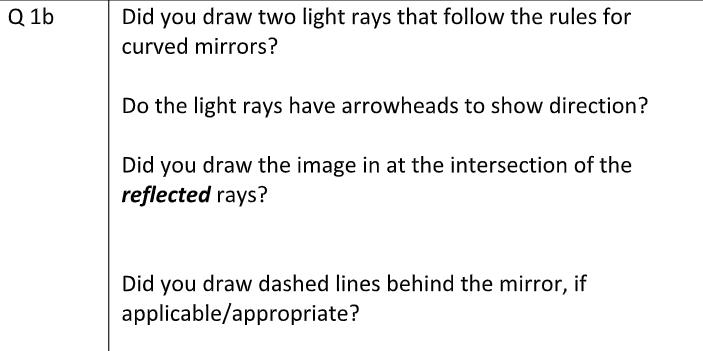
My biggest problem? Students just will not draw that image in on their ray diagram! I also have a problem with students not putting arrowheads on their light rays. Now, from a student learning objective process, both of these omissions are not problematic if the goal is to locate and describe the image. However, for a student who is struggling, these omissions can make it really difficult. I don’t want to punish students who clearly know what’s going on, but I don’t want to settle for incomplete work, either. 

Enter the self-evaluation. 

I create a checklist for students to go through, and I have them go through this checklist for each question. I reproduce the checklist for each question so students are required to look at each piece of their work rather than trying to summarize everything from the start. Why do I do this? I want them to see patterns in their work.

Here’s what it looks like for ray diagrams

Here’s what the math check list looks like. 

I ask students to evaluate their answers with my solution guide. I also ask them to give themselves a score. 2 points if everything is right. 1 point if something is right but there are things missing or incorrect. 0 points if nothing is correct. Their score out of 4 gives them an idea of the letter grade they would earn from the work. 

So the whole document looks like this:

I explain they might notice they are marking “no” over and over again. When they notice this, that piece is the piece they now know they need to work on. 

To make sure students are self-aware, I asked them to summarize what they did correctly, and what they did incorrectly or omitted. 

I will be honest, part of me expected students to kind of half-ass the assignment. But something magical happened: students who hadn’t finished the assignment evaluated the ones they did… and then they worked the rest of the problems and corrected themselves!!!

We will see how the test goes next week, but I’m really hopeful! 

Teaching Methods

AP Physics 1 Review Unit

As a general rule I kind of hate reviews. They make the students feel good, but I’m not sure how much they actually get from the traditional review session a day or so before the test. I do a lot of problem solving work with my students all year long, using different strategies to help maximize their efforts on both the multiple choice and the FRQs. So by the time we are two weeks from the AP exam I want to build their confidence, let them have some fun and have some meaningful conversations along the way.

We dedicate a day to each of the topics on the AP exam. Each day there is a new challenge. (Links to activities provided!)

For the kinematics challenge students have to “match the graph” but unlike the first week of school, I want them matching the values and intercepts as well!

Last year for day 2 we did a long forces FRQ practice. We had 25 minute classes in SY 2020-21, so I did not have time to do the practice as I described in this post until finals week. My practicum asks students to determine coefficients of friction using only a meterstick.

For UCM I focus students in on rote practice drawing force diagrams and writing sum of forces expressions for multiple scenarios.

Work and energy has so many cool opportunities for a lab practicum. I have students choose their own adventure from one of several Pivot Interactives videos

For momentum I give students a random ziploc bag of stuff (beans, pennies, highlighters…literally anything I can find)… and I ask students to come up with two methods to determine the mass of the bag!

Simple harmonic motion is a card sort. I have position, velocity and acceleration vs time graphs generated for a mass-spring system and a simple pendulum. (link to jamboard version from 2020-21 SY) I also have some extra graphs. (Here’s an example of a completed assignment!)

I believe firmly in the power of deep conversations. The challenge is making those conversations into something cohesive and reflective. Each year I move further away from “traditional” review. At some point we have to trust that we’ve done the best we can as their educators and that at some point we have to let them fly.

Teaching Methods

Tackling the Long AP FRQ

Sometimes APP1 is literally the worst.

The folks on the writing committee for questions must get really excited about writing interesting questions for the long FRQs… the issue, however, is that students generally suck at them.

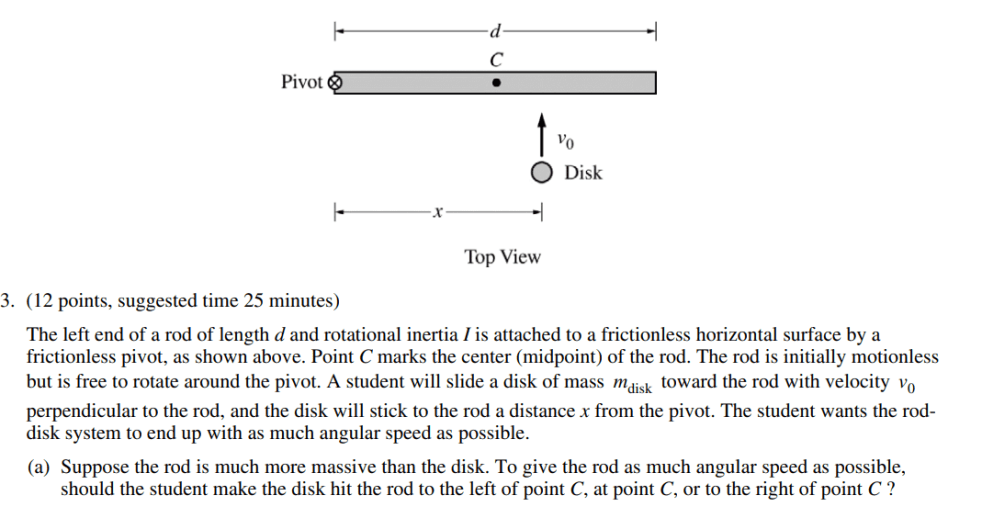
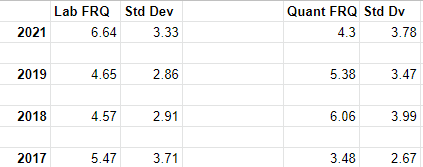
Average and standard deviations for the last 4 years of long FRQs (2020 omitted for obvious reasons)

Here’s the thing though: I know that in a non-testing environment, my students should be able to perform way better than these national numbers. However student responses in an exam setting tend to be long-winded, lacking a clearly defined direction and often taking too much time down useless avenues.

So how do we correct this?

Firstly, I believe it is more important to give students the confidence that they can tackle these problems than insisting they do tackle these on a unit exam. Mindset makes a major difference.

Also, given the suggested time of 25 minutes, it’s not fair or appropriate to put one of these on a unit exam because it means the students grade will mostly be based on the question type, rather than their actual mastery.

To build student skills and prepare for the exam I set a few days aside during the year to specifically practice the long FRQs. Sometimes it’s the lab question, sometimes it’s the quantitative reasoning problem, but I try to do it at least once per unit.

Here’s the cycle:

Round 1: Skim and annotate on your own (5 minutes) I want students to have the feeling of sitting down for this question cold, with only their brain available to them. However, I also want to build their testing strategies and problem solving skills. For English we teach students to skim the passage and annotate the text by making a note of big ideas for each paragraph (I’ve worked as an ACT tutor). Why shouldn’t we do the exact same thing for these items in physics?! In fact, sometimes there are some easy points nestled in at the end… or… we can find the meat of the problem doesn’t show up until part c or d. Students often sit at the problem and begin at the begining and work until the end. While this is ok for homework, on a high stakes exam they are possibly leaving minutes and points to waste.

Round 2: Friends No Pens (10 minutes) you may have seen me talk about this strategy before a test. Many folks comment about how this reduces anxiety. I see friends no pens serving two extremely valuable purposes. First, it helps students organize their thoughts by saying them aloud. Second, it forces students to clearly and accurately communicate with their peers. By doing this, they will write more succinctly when it comes time to do the work.

Round 3: Individual Work (10-15 minutes). I explain to students they’ve already had 15 minutes to “work” the problem, so they should only need 10 more to finish. I ask them to complete as much as they can in the time.

Round 4: Discuss in a group: Sometimes I omit this phase and give them the scoring guides immediately. Other times I let them discuss their solutions in a group. When I do this, I mix up the groups from the students they talked with during friends no pens. Students are asked to make corrections as needed

Round 5: Self-score: Lastly I give students the AP scoring guidelines. This is a really important piece because they should see exactly how they are evaluated. A student noticed today “Ms R… there’s no point for the answer” NOPE! It’s all about the work. Other students noticed how stating momentum is conserved is worth points. At this time in the year we’ve pretty much covered all of the physics and now I want to work to maximize the points they can earn on the exam so their score reflects what they are actually capable of.

Sometimes (especially the first one we do) we debrief afterwards about the activity. Sometimes I have them turn these in for quiz points. Sometimes I let them keep the assignment. Sometimes I skip friends no pens. I will have them annotate, then solve the problem then discuss. I ask them to give themselves a “my score” grade and a “with friends” grade so they can see the difference between the two. Much of our conversation is focused on identifying big ideas and writing in a conscience manner.

How do you tackle preparing students for these items on the AP exam?

Teaching Methods

Sneak Peak to Reduce Test Anxiety

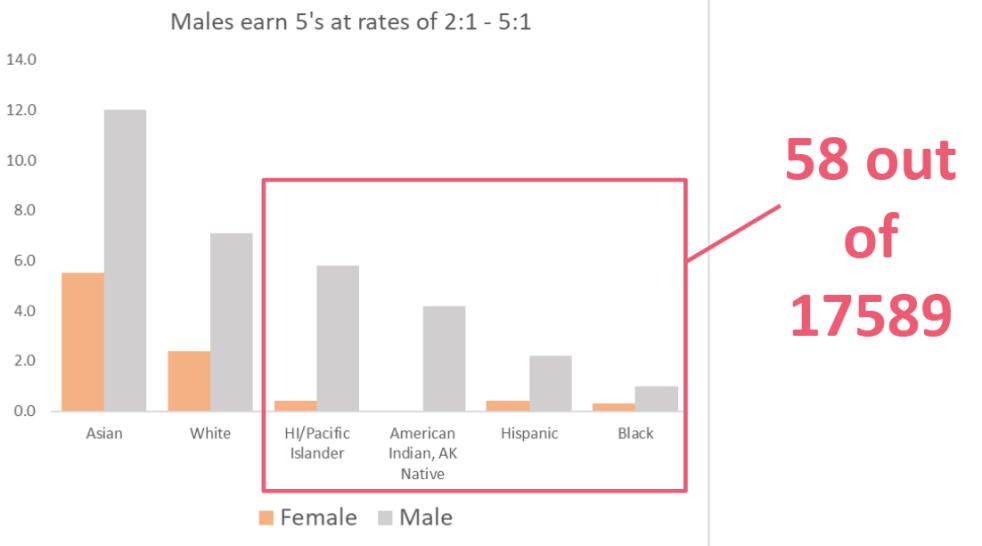
Have you ever looked at the gender discrepancies on those who score a 5 on the AP Physics 1 exam? It’s nearly a 3-1 ratio! AP scrapped all of the data in 2021, so probably not. I started analyzing this data around 2019/2020 and was pretty shocked. It got way worse when you looked by race

Percentage of male and female test takers who earned a 5 on the APP1 exam in 2018. Of 17,589 underrepresented female test takers, only 58 earned a 5

“Surely not MY students” I thought. “I’m a female teacher AND I’m super aware of the issues around female performance in the physics classroom”

I checked my data. The same patterns persist.

So I dug a little deeper. I knew that I had female students who were on or above the playing field of some of my male students. What was going on that it was so hard for my female students to earn 5’s?

BY THE WAY… this is NOT a physics problem nor is it a math problem. Check out the gaps on AP Physics C and AP Calc…. WAY smaller

Notice the gaps are more consistent across racial groups than they are for APP1

What I realized was it was their performance on the multiple choice.

Then 2020 offered an incredible opportunity. I could test my hypothesis by pulling the national data when AP had no multiple choice on the exam.

Guess what happened? The gaps were reduced.

Notice the gaps are more in line with the gaps on APPC and Calculus when there was no MCQ

In my college experience the classes I recall learning the most were the ones where exams were not “gotchas” but opportunities to deepen our understanding of the material. I had one teacher give legit take-home exams. It was nice, but not exactly a learning opportunity.

The next professor did something different. He gave us twice as many problems as would be on the exam a week ahead. We got together as a group and worked all of the problems over the week. The exam was “open annotated textbook” and the questions were ever so slightly different from the originals. The course was Physics 470 – subatomic physics. It’s the class I learned the most in.

The third professor who did something similar orally read us the exam the week before. He would leave out important details or specifics. “You have a circuit that looks like this… you will need to find the potential across two of the nodes” I also learned a lot in that course.

Taking all of these things into consideration, I’ve really modified the way I approach unit exams in my class. After seeing success with this model it has become a model I use starting on unit one and continue to implement until the semester mark.

I give students the entire test the day before the test.

But won’t they memorize the answers?

Isn’t that cheating?

How do you know it’s really their work?

Simple! I take off the part of the question that says “determine the _______”.

What do I mean by that? Here’s an example problem:

Now let me make this clear: students are expected to stow away all electronic devices before we begin so there’s no photos or google searches. Additionally, students are only allowed to use whiteboards. No paper. Nothing leaves the room.

Here’s another example

At first students are probably more stressed. The questions could be ANYTHING! The only thing students CAN do is EVERYTHING I want them to do! They have to draw force diagrams! Make graphs! Write out expressions for sum of torque and sum of forces. They have to consider all of the possibilities. And this is exactly what they need.

And the results?

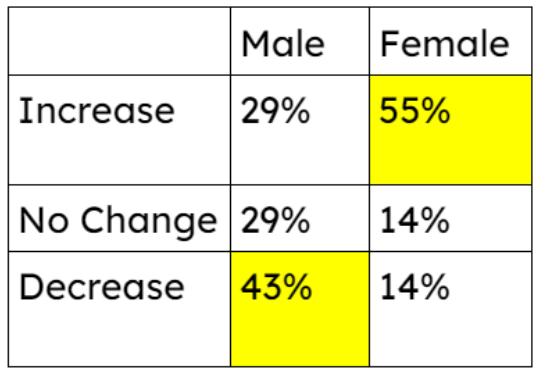
First and foremost, implementing this strategy did NOT cause a huge increase in scores. In fact, some students still did kind of awful. What it DID do, what move up the mid-group from an anxiety score to a score that matched their classroom performance. This was particularly noticeable for.. you guessed it… my female students. The pretest in this case was a sample of questions from the unit one progress check. Students answered these in “test mode”. The post test was the actual kinematics exam. Below are the results:

Of course then I had to find out if it stuck. So when we got to the momentum test in January, I ran the data again. This time, there was no intervention: no sneak peek. And guess what happened?

What’s interesting is the number of male students who actually saw a decrease in score. I have a number of theories on this one, part of which being that they generally performed well on the first exam and so did not have that push to improve over time.

Due to the results of these data I have continued to implement this practice. After all, the goal is to get students working the problem, not searching for an answer!

Teaching Methods

Retrieve Note Taking

“Ms. R I feel smart today!”

That was an exclamation I received from a student that made my entire week. What gave this student so much confidence? Retrieve note-taking.

Here’s how retrieve note-taking works.

  1. You lecture to the students as normal. Students have their full attention on you. No one is permitted to write.
  2. You stop talking and let the kids start writing.

That’s pretty much it! But wait… we can make it more powerful

3. Let students discuss their notes together so they can fill in any of the gaps
4. Put the slides back up on the screen so students can fill any gaps that remain.

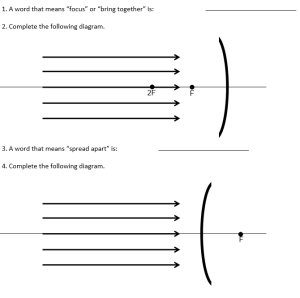
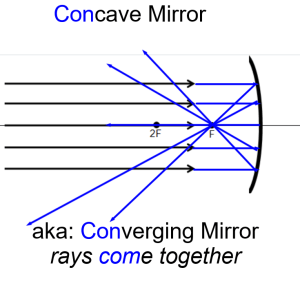
I did today’s retrieve-note taking with my lecture on curved mirror rules. The first time I did this I was really concerned about the extra time it took. However, I’ve learned that the right kind of extra time always pays off in the end, and this is a perfect example.

I break the lecture down into 3 parts, and I have a packet for students to follow along. The packet also reduces the cognitive load and allows students to feel at ease that they don’t have to remember EVERYTHING

Here’s page 1. I do these notes up on the smart board for the first round:

Note: my smartboard notes are NOT a carbon copy of the packet. See below

Next we do the rules for the concave mirror, and last we do the rules for a convex mirror.

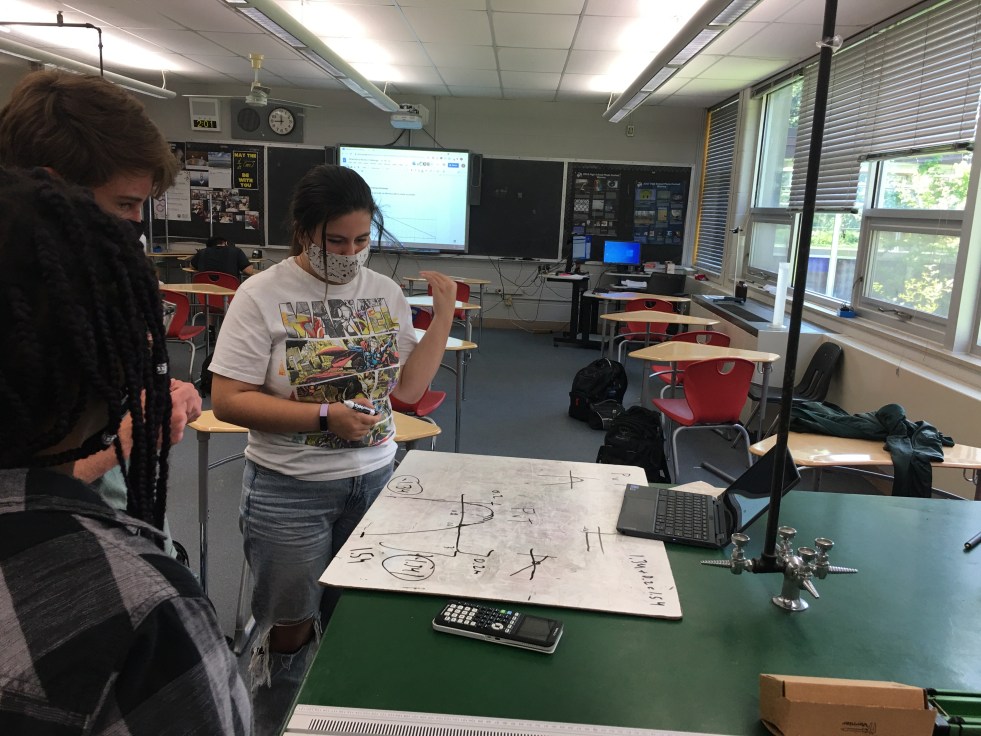
Here’s where the magic happens. When students are left to retrieve the information and record it in their packets, they are immediately processing the information. They are asking each other clarifying questions, it’s AMAZING. And because they are working with the material right away, there’s not a lot of time to forget.

So where’s the big pay off? In the homework. Previously I would find myself going from group to group re-explaining how to do the ray diagramming. Using the retrieval method I no longer have to do this and I can work with just the few students who really need extra support! My students actually complete more work more quickly and with more confidence than had I lectured traditionally.

So why does this work?

Whenever we receive new information our brain tries to fit it in to what we already know. The more connections the brain can make, the stronger the new connection will be, and the better we will be able to retrieve that information later. Making connections also allows you to chunk information, similar to why phone numbers are written like 123-456-7890.

This retrieval exercise provides students four different encounters with the material: orally, visually, written and verbal.

  1. First they get the material orally and visually as it’s presented on the slides.
  2. Then they reproduce this material by drawing and writing
  3. They are also discussing the information

By the time they are using and practicing, since they have engaged at such a high rate they are more than ready to go!

Did you like this? Read more about how I use retrieval practices in my classroom here!

Teaching Methods

How I Teach… Conservation of Momentum

We are finally here! Thank you to everyone who has embarked on this journey of reflection with me. If you missed the first few posts check out the introduction to the entire series here. This is part 3 of a 3 part series on momentum. You can read how I introduce the unit with impulse and check out some of the follow up activities I do before we move into collision.

Today we are going to talk about momentum conservation. I find that most novice-style teaching approaches look something like this:

  • Momentum is conserved. That means initial = final
  • Write an mv term for each object in the collision before and after the collision
  • Solve for the unknown variable.
  • An even more novice approach is to use MVP charts to help students organize the information.

I’ll start with this: I hate charts almost as much as I hate formula triangles. Why? Because if students exclusively use charts to exclusively calculate values with no other expectations the “learning” is “I multiply these boxes” and “I divide these boxes”. This is not demonstrating much of anything except that the student could probably play sudoku (I’m also not a fan). I do however incorporate the charts for those “easy wins” with my regular level students as an option…but only after we’ve done some of the heavy lifting first.

Say what you will about AP as a program, it has made my teaching more thoughtful and as a result, way better than before I taught AP.

Recall that in the early days of impulse, students were asked to sort of consider conservation without outright stating it. We now go through this process formally. I begin with the following prompts:

From here we collectively work our way to the final statement that -Dmv1 = Dmv2…. and THAT is conservation. It is a transfer of momentum from one object to another such that the total of the system remains constant.

At this point it’s all about application for my AP students. They get thrown into the lab for a few days so they can collect data for the various collision types and determine whether or not momentum was conserved. (Lab handout)

After the lab students are given one collision type they are responsible for in a board meeting. Rather than having a class conversation I let students circulate and provide written feedback. (The prompts for the boards are at the bottom of the image below, feedback prompts at the top)

Board meetings are always opportunities for students to check their work, collaborate, and ensure they can submit the best possible product. While I took the idea from here, I do make modifications depending on the activity because some students… no matter what… will never speak in a whole group setting, but they will offer written feedback. Some students (myself included!) freeze “on the spot” but when given time to reflect, have amazing things to offer! I think too often we create classrooms that are driven by extroversion but never take the time to consider what learning looks like for introverts, and write it off as “shyness” or “refusal to participate”. I also like to have students circulate when we have a significant amount of information on the boards, so it doesn’t lend itself to a traditional board meeting.

We do some conceptual practice (which has a bigger Force? a ball that bounces or one that lands?) and we discuss how we could know if there were an external impulse acting on the cars during a collision. I love using this graph from AP and asking students to determine if there is an external impulse

Oh! But let’s not forget all of the richness we learned earlier in the unit! I need to make sure to weave in the first half of our learning with this second half! I assign students what I call “special problems“. This problem set is a few problems that are neither perfectly elastic nor perfectly inelastic, but something in between or there’s an extra nuance added. For each problem I ask students to sketch the force vs time graphs, solve the question, and then answer an additional conceptual item about the problem.

Sample “special problem” solution. These are great discussion questions for students!

When we review these problems here’s what I do: I randomly select 6 students to put up the graph or mathematical solution to each problem. Then I select 6 more students and their task is to either explain the answer on the board if they agree, or write a different solution on the board if they disagree. When there is a disagreement we open the floor to a class discussion about the two different answers to decide which is correct.

What about 2D Collisions?

2D isn’t really a major emphasis in APP1. We discuss it briefly in terms of the vector nature of momentum so momentum must be conserved in each direction

Regular Level Physics

EDIT 2/7/2024 – I have TOTALLY shifted this piece in regular level physics! Check out what I did this year here!

In my regular physics class have to scale back just a bit and shift my focus. I give students opportunities for “wins” so they can feel like they “understand” and then I start layering some of the more complex problem solving tasks.

We begin with a marble activity. Students use the grove between their desks and run collisions with marbles (kind of like a Newton’s Cradle). They are asked to record observations about the velocity, and therefore the momentum of the objects. After this activity we have the same conservation discussion as my regular students.

The other major difference between regular and AP is that I present and have students practice each of the collision types one day at a time. When I present these I will show them the chart method first, explaining that it is an option, but not my personal favorite.

I also explain WHY it’s not my favorite. The reason is that you have to remember the important physics idea in the MIDDLE of your work… that initial momentum is the same as final. If, however, they do it in the algebraic way, they start with the physics idea and then they can forget about it. I generally have a 50-50 split in my room who does which method. The other important part about how I teach this lesson is I want to make it super clear that we get all of the same numbers both ways. For this reason I will copy the chart over to the next slide and solve the same problem in the algebraic way

The collision lab is also different. I give students one lab at a time and students collect the data in pre-made tables. Since students need to determine initial AND final AND keep track of signage, there’s just a lot going on to also add the layer of “do this without a guide”. It’s not my finest moment, but, again, my students need some wins.

Problem Solving Skill Building

Another layer I add to momentum is that since the equation and relationships are simple, I introduce proportional reasoning with students (what happens if we double the mass, half the velocity, do both?). Many of my regular level students really struggle with thinking in this way (so does AP!) but I feel it’s important that they get some exposure to this. We talk about how you could choose to make up numbers and see what you get, but it’s also more efficient to shove the changes into the equation and see what comes out

I’ve also started incorporating more ranking task type items that are conceptual in our classroom practice to push their problem solving skills. I intro with the following

Students then solved tasks like the ones below in groups on whiteboards. Notice that the tasks chosen are ultimately fairly simple. I did the colliding carts first because it provided numbers and allowed students to calculate in order to come to a conclusion

However in this final problem we did, there are nearly no numbers at all! This was a good place to really discuss the relationships within momentum, and in this case focus on what is the same, greater and less in order to come up with an answer. Student groups ended up being highly successful. We did about 4 of these tasks in the 50 minute class period.

I suppose I should discuss what assessments look like in my classroom at some point, especially for the non-AP students. Another day, another post! (Spoiler: it’s changed quite a bit since I first started teaching!)

Teaching Methods

Impulse-Momentum Activities

This is post 2 of 3 on how I (currently) teach momentum in my physics classes. See how I introduce the momentum unit here

In this post I will outline 3 activities I do in my classes. Each serves a different purpose and function depending on the group of students, but most could be used interchangeably between levels depending on your own goals. They are the following:

  • Pivot Interactives: Ball on a Wall
  • Popper Lab
  • Egg Drop Challenge (with a data-driven testing phase)

These activities are all about giving students a “real-world” opportunity to collect data and calculate quantities from the course. There’s not a lot of “discovery” going on here, a primary driver is practice. However, each activity presents rich opportunities for different conversations.

Please don’t steal for profit on TPT. That harms the teachers who share, those who are in need, and our profession as a whole.

Pivot Interactives Activity: Ball Against a Wall (regular level)

Many of us came on to Pivot Interactives after the original library was migrated from “Direct Measurement Videos” many more of us came on to PI when we had to teach in the pandemic. If you can push for a subscription it’s very much worth it. Labs that are too expensive or cumbersome for a class set become attainable, make-up work, homebound, remote learning… you name it. There are a lot of benefits. I love this very simple activity that just involves a ball colliding with a vertical wall. Important note: I don’t use the built-in questions/grading set up in pivot. It’s very well done, but I find that computer work usually hinders collaboration, so I moved away from having students answer in pivot even before the pandemic.

Ball against a wall in Pivot Interactives

Students begin this activity by reviewing the transformation of F=ma to the impulse-change in momentum relationship. The mass of the ball is provided and students have access to a ruler tool and stopwatch. There are a lot of ways this could be done. For my regular students I have them determine the pre and post collision velocity as a simple x/t calculation (we verify it’s moving constantly by seeing it move equal intervals down the ruler in equal frames). The biggest challenge is determining the time of the collision. This is one thing I love about this activity. In day to day life collisions happen so fast we don’t really consider the impact lasted for a measurable time. I love how this visualizes. You can see my original handout here. Last year I discovered that remote students do better when labs were broken into very small tasks through jamboards, so also check out the jamboard activity here. You will notice a lot of scaffolding. This is necessary for my regular level students, but it may not be for yours. When I run this activity in AP I simply inform them of the goal and send them on their way.

Popper Lab (APP1)

I took this lab from an AP summer institute I attended under the direction of Martha Lietz. Students pop a popper toy (the half-spheres you turn inside out). The ultimate goal is to calculate the time for the “pop”. While students end up using impulse-change in momentum, they also have to use kinematics and F=ma along the way. I find that many students have a hard time with this interleaving because up until this point (remember I do momentum right after forces) we haven’t had too much of a chance to interleave yet. That is one of the main reasons this lab has been a mainstay for me, even if it’s really just a “glorified homework problem” as I tell my students. Students are taken step by step through the process. See the activity here. At the end of the lab I ask students to submit their calculated times to a google form where I aggregate all of the responses. We will first do a quick skim on day 2 so if students calculated an egregious answer, they can obviously see they need to check something. Once we remove the outliers, we do an average and standard deviation. It’s SO COOL to see how close student answers all are when it feels like such an imprecise activity! Because this is a glorified homework problem we can take some time to have a solid conversation about measurement, uncertainty and standard deviations, making it appropriate for AP.

Egg Drop Lab

Whenever students hear we are going to do the egg drop they respond gleefully “we did this in middle school!” I am quick to explain why this is not like middle school and the middle school experience was not like science. In middle school students are typically given tons of supplies, they can use as much as they want and they just cobble whatever together and start chucking. Can you imagine if engineers did this? What a waste of dollars and materials! Besides, you shouldn’t even think about messing with materials unless you have some kind of idea about what is going to happen.

I explain the parameters: 5 sheets of 8.5×11 paper and 1 meter of masking tape. The device must be attached to the egg. No parachutes.

The reason for these parameters is I want students to be thoughtful about the why behind their device.

But no devices are built without prototypes!

So on day one we have a testing phase. (See handout here) Students use force probes and cars or iOLabs and run “prototypes” into the probe (see image below for how I set up the probe). This might be folder paper, crumpled paper, tubes… whatever! But we know that our eggs will be saved by one thing: increasing the time of impact and decreasing the force.

This activity is by no means precise, but it gets students thinking about what to actually do with the paper.

On drop day students have roughly 35 minutes to build their devices which we drop in the last 15. Students present their devices to their classmates and then drop from 2.0 m. Eye of the Tiger plays on loop in the background.

The following day I ask students to whiteboard diagrams of their devices that also show where the egg was located. We discuss the designs in relation to their smashing or success. View the activity here.

None of these activities are ones I would consider particularly awesome and certainly not flashy, however often its these kinds of activities that allow the nuances to shine.