Classroom Issues · In My Class Today

Identity Development in the Physics Classroom

Download posters from the featured image here

Why do you teach? It’s certainly not for the competitive salary, the great respect from society or the flexible work schedule. Do you remember writing that philosophy of education statement? What did it say then, what does it say now? Most statements say something along the lines of “I believe all students can learn” “students learn at different rates” “students need to be met where they are at” so on and so forth. What is critical here, is the use of the word “all”.

The reality is that while every teacher might say they believe in “all” our school systems are not designed for “all”. They never were designed for all. When the rubber hits the road and we’re deep in the muck of teaching we categorize “those” students, whatever that means. “Those students” will go straight to military/factory/automotive shop so “they” aren’t interested in higher math or physics. “Those” students don’t need physics because they aren’t majoring in science. A far more insidious part of this reality is that “those” students are overwhelmingly growing up in poverty and are often our Black and Hispanic students.

Furthermore, in spaces such as physics, this idea of “who” does physics is even more exacerbated in the larger scientific community. The work of identity building, literacy development and social justice do not exclusively live in the realm of english and history courses and “African American Study” courses, it is work that belongs to every single teacher who claims “all students” deserve the opportunity to learn and grow.

This work is challenging and it begins with most of us sitting with a lot of discomfort. It also involves a large volume of reading and listening on our part. In physics, especially, this work can seem even more challenging (and some argue unnecessary!) because it is not clear how this work fits in the scope of a physics class or perhaps if you are ready to tackle the work you are unsure where to begin.

I had the pleasure of diving into two incredible books this year, Culturally Reponsive Teaching and the Brain by Zaretta Hammond and Cultivating Genius by Gholdy Mohammed. I truly believe that these two texts together serve as an excellent foundation for engaging in the work of narrative shifting within you classroom. Hammond shows us how our cultural underpinnings shape the way we interpret and learn information while Mohammed brings hundreds of years of Black excellence and literacy to the forefront of education in today’s classroom.

Muhammed lays out what she calls the Historical Relevant Literacy (HRL) framework. In the framework she identifies four critical components: identity, skill development, criticality and intellectualism. One of the most important details of the framework is that culturally relevant learning should not be a one-off lesson in a particular month to celebrate a particular group, but rather engrained in every fiber of the curriculum to consistently give students the opportunity to learn about others and themselves within their coursework. 

Physics Identity Encounters

For the last few years I’ve made a deep dive into issues of representation in physics and the largest recurring theme is the importance of developing a physics identity. It became clear to me how the HRL framework could apply to my own classroom. With the added challenge of the pandemic I knew that trying to recreate and do everything with excellence would quickly lead to burn-out and failure, so I made the decision before the year began that I would make connections and relationships my number one priority, with identity development as a critical component of that priority.

Twitter and the sweeping social justice conversations has made it easier than ever. With everyone working, teaching and learning from home, many people began to develop content that was accessible to all in the form of webinars and other livestreams. I began to integrate these opportunities in a rather fluid manner into my classes. For each, I asked students to reflect on what they had heard. Specifically, I asked them to do the following:

  • Discuss a concept or theory that resonated with you
  • Discuss a concept or theory that challenged you
  • Discuss a concept or theory that left you wondering
  • Discuss a concept or theory that resulted in an “aha” moment for you.
  • Last, (if not included already), discuss how the concepts discussed might apply to you as a student.

In October I livestreamed an event from Women in Science that featured Dr. Jessica Esquivel (here’s a link to the talk). She talked about identity and the sciences, but perhaps more importantly she told her story as an AfroLatinx woman from Texas who wanted to pursue a PhD in physics and what that meant as she navigated conversations with her family, peers and colleagues.

Dr. Esquivel was also a foundational member of the #BlackInPhysics movement, which was primarily geared towards college physics students. The movement included a roll call, in which black physicists used the hashtag to introduce themselves and their work. Through this movement I learned about Tamia Williams who has put together an incredible project called Being Seen of interviews where physicists and physics students talk about how they integrate physics into their passion for the arts. Her participants reflect an immense diversity of backgrounds. Aside from the obvious coolness of this, many of my students are part of our district’s highly competitive creative and performing arts program.

The last guest of the year was a former student of mine who is finishing her physics degree. She already has an incredible story about her own journey and future plans. Not only did my students get to interact with someone who is underrepresented in physics, they heard it from someone who has truly been in their shoes.

Student Reactions

Students shared how much they enjoyed the assignments. Many of my students saw themselves in the stories that were shared. One of my students, after reflecting on her shared experience ended her reflection with, “I think videos like this should be shown more often to high school students. It was inspiring to me so I know it will be to others as well.”

Students shared themes of resilience and recognition of the systems in play in their reflections. “a theory that blew my mind was that if you can’t go down the path that you want. then you should make your pack and do not let anyone bring down your path and not let you reach your goal.”

“How and when can we all breakout of that cycle and until when will we be able to help each other instead of judging and being ashamed of mistakes that we will learn from? She really opened my eyes to see how not just physics in general but all types of sciences are competitive expertise and how some people really struggle with the subject and that it’s ok to not get it right away. Her words were comforting for me and now I really have a different perspective and input on physics from listening to her.”

Another reflected (unknowingly) on stereotype threat, “Most of the time I do ask whatever questions I have to those around me but I often hesitate in doing so for fear of sounding unintelligent. But like Olivia Lowe said, we’re all learning. No one in the class is an expert in physics. It’s likely everyone’s first course and even if it isn’t, physics is a difficult subject. It’s okay to be confused. No one should have a fear of getting the help they need.”

I was also really impressed by the impact the assignments had on my white students. One shared “I was just wondering why people struggle for being different. I don’t understand because I have never had that experience.”

I could say all of these things to my students all day long, but hearing it from someone who is in the field, who is a current student and who has shared lived experiences is far more powerful than anything I could ever lecture them about.

In case you were wondering, this is what I believe about teaching and learning. As a teacher in physics, and as a female teacher in physics, I believe it is my obligation to give all students who come to me the opportunity to expand their minds not just as students of science, but as stewards of our world and society. I belong to a school where the rich student diversity in background and expression is what gives life and vibrance to our school hallways. As an educator it is my responsibility to show students that they belong and are capable of success in any course of study they desire, because we need that same vibrance from diversity of thought and experience in order to tackle the complex problems in our world.

Teaching is so much more than ensuring students have content and content-related skills. We have the very special opportunity to help children envision and create their future trajectories in life. This is a great responsibility that we can never forget.

current news

5 Stages of Pandemic Teaching

I need some space to pause and reflect and I’ve chosen to do it here. Perhaps you might relate to some of these reflections and we can recognize and accept our shared experiences admist these impossible hardships.

I’ve been reflecting on the stages of my own emotions and disposition over the last few months. While the commonly known 5 Stages of Grief are recognized as unfounded in empirical evidence, I feel it serves as a decent framework through which to organize and express my own experiences.

We have often discussed that the experience of the pandemic is one of ongoing trauma, and with trauma as a current “hot topic” in the education world having conversations from that frame have been helpful to many. I also feel that it is important and valid to frame our experiences as teachers as one of grief and loss. These reflections are mine and relate to my situation in my school, district and community.

I mourn for energetic and busy hallways that are now empty or less full
I mourn for the students who find a safe haven in our buildings that we can no longer provide
I mourn for the silly interactions with students
I mourn for normalcy.

Yet I’ve found myself growing increasingly comfortable with our current normal, while still yearning for what was and what could be.

Denial

Over the summer many of us assumed districts would make the choice to go fully-remote. If districts opted for in-person learning we assumed we would be closed by Thanksgiving. We talked about how it’s impossible to teach with spacing and masks covering mouths and facial expressions. How everything that is good teaching is forbidden. How students cannot learn under the constraints of an in person setting. Yet Thanksgiving came and went without much incident. Our district, like others, put students on an “adaptive pause” and then after winter break we were back.

Anger

I felt this in my absolute core. If you caught me in the hallway and asked how I was doing I would say, “I’m fine. I’m always fine” the reality was I was not fine at all. I was feeling like a failure daily. I felt unsupported from every angle, even if that wasn’t the reality. I felt enraged about what we were being asked to do. I felt disheartened that no one seemed to value our thoughts and opinions on anything. I felt helpless in supporting my students and families. And I blamed everyone with fire from my core.

Bargaining

Some teachers made pleas for a shift to fully remote learning. Some tried to find a way to get by, bargaining with themselves that trying to do one mode well would be better than juggling two modes poorly. We struggled with student learning losses “if only they would turn on their cameras” “if only I could connect with them more than twice a week” “if only we taught full remote instead of hybrid”. I spent many days wondering what life would be like “if only”

Depression

I think I cycled though the first three phases every time a change was laid out, and not only when school started but also leading up to school. I had a meeting with teachers from other districts a week before my school started. They had already begun. While I was still eager and hopeful I could make things work, the exhaustion and frustration was already apparent on their faces. I would soon join them the following week. Once the anger ran its course depression took center stage. I found myself plugging my headphones in to listen to cathartic music and just cry, something I haven’t done since I was a high school student. Simultaneously realizing I was at my edge and also recognizing I had a lot of anxiety as a high schooler. I didn’t care about finishing my master’s. I wanted to not care about anything at school. Seeing cases rise and hospitals fill again, coupled with increased mitigations brought on the cloud of despair that this was unending.

Acceptance

I’m not entirely here because every new curveball sends me though all of these emotions all over again. (We are starting a new schedule in two weeks). However I’ve realized a few things.

  1. The end is in view. Every day another friend of mine is getting vaccinated. Every day treatments are getting better in the hospitals. Every day we creep a little closer.
  2. I am more resilient than I realized. I generally have a strong dislike for change, but each time change has come around I realize that certain things I was worried were going to be the worst thing in the world aren’t quite as bad as I imagined. We have shifted so many times I’m now able to tell myself to wait and see.
  3. I am continuing to focus on my circle of control. I don’t have the emotional energy to complain about everything that I cannot change.
  4. I am surrounded by a lot of good people. The colleagues in my hallway are all similar-minded. We can agree this sucks, but we keep finding ways forward.
  5. My kids aren’t actually doing as bad as I feel. This last one is enormous. I told my husband in October (the usual teacher slump month) that teaching right now feels like being a failure every day. It’s true because I know what my best teaching looks like. It’s true because there are students who might otherwise be succeeding right now. It’s true because of a million things that are out of my control. And yet, when I look at my student work, they are actually doing ok. They are resilient and brilliant.

I have to also be very real with myself that I have not had a normal year in three school years. Last year we started the year with ransomware and ended with the shutdown. The year prior I had a baby in April. I am constantly reminding myself that this too will end. We will not, and should not go back to normal. I’m still working through so many emotions daily and everything is intensified with the backdrop of events in our nation and world. There is a lot I’ve learned and in many ways I’ve grown. I will continue to practice gratefulness and seek the bright spots, even in these dark days.

New Teacher

Culture of Communication

This is part of a series for new teachers. See the other posts here

In my letter to a student teacher the first piece of advice I shared was that sarcasm has no place in the classroom. I want to take that a bit further to discuss not only communication with students, but interactions on a broader scale.

My first encounter with the importance of language was working with 4th-6th graders at Northwestern’s Gifted summer program. I had only completed my first year teaching, but it was my 5th year working for this program. This blog is about physics teaching, and that typically means high school. If you’ve never taught 4th-6th grade: they don’t hold back. I had collected some surveys for feedback from my kids and one comment in particular stood out, “when you said “what” to me it felt like you were annoyed with me” I had a stone drop in my stomach. I knew exactly what the student was referencing. They were busy creating mousetrap cars. Summer programming often put classes in the most absurd spaces and I had 18 nine, ten and eleven year olds crammed in a conference room for 10 adults. We only had the large conference table for workspace each 8 hour day for two weeks. In the chaos of building if I heard my name I responded “what” not at all with any poor intent, but simply “what?” as I would respond to anyone. However, this student communicated to me that single word made them feel uncomfortable. With a single word I had destroyed what should be a safe space. From that moment on I made it a point to always respond to my name with “yes” or “how can I help you” or something comparable. Perhaps it seems silly, or even obvious that I should have used a different response, but in the moment it can be hard to be intentional until intention becomes habit.

How we respond and who we respond to shapes our classroom in subtle but massively impactful ways. Research has shown that boys often blurt out answers and be called upon than girls. Studies also show that when race is layered into the mix teachers will not engage or primarily engage negatively with Black and Hispanic students. None of us wants to think that we do such a thing in our classroom, but our preconceived notions, stereotypes and biases, all of which are founded in our previous experiences, shape how we interact and respond, especially when we do things without intention.

It is a common practice during an observation that the observer will ask you what you would like them to focus on during the lesson. It’s really hard to think critically and reflectively on our own practice, especially as a new teacher. Ask your observer to keep a log of who you are interacting with and what those interactions are (alternatively you can record the lesson and do this yourself). This can be done easily by giving the observer a seating chart where they can indicate positive (+) , redirection(⤾), neutral(Ø) and question(?) interactions with simple marks. When the lesson is complete you can look at the marks and analyze and interpret your data. Who received the most interaction from you? The least? The most positive attention? Negative attention? Are there any trends in terms of race and/or gender? Awareness is the first step in course-correction.

There are so many ways to ensure voices are equally heard and respected (and no, not just with cold-calling). Creating this space is part of building your classroom culture and climate. If you were to implement a single thing today to begin to create this culture it would be this norm: when a student speaks they have the right to the space to speak without interruption, and the rest of the class (and you the teacher!) has the right to listen without distraction.

I would be remiss if I skipped this opportunity to discuss conflict in the classroom. The biggest challenge regarding conflict is taking your own emotions out of the equation so you can work through the conflict with your student. You might be agitated or frustrated, you might feel indignant if the behavior is directed towards you. You might be anxious about what happens next. All of these emotions are real, and necessary and important. You can acknowledge these but then you need to move forward. This conversation deserves it’s own blog post, so for this one I will leave you with this: be curious. Have curiosity with your own response and emotions. Be curious about why your student feels the way they do right now. Consider what alternatives might be available to your gut response.

Your students have developing minds and we cannot forget that. We have a responsibility to keep our own cool so we can help our students work through their struggles while also giving them the tools to work through future conflicts independently. We also have a responsibility to ensure our classrooms are safe spaces for each and every voice to be heard and for each and every student to learn and grow.

New Teacher

Time for Reflection, Reflection for Time

To everything (turn, turn, turn)
There is a season (turn, turn, turn)
And a time to every purpose

This is part of a series for new teachers. See the other posts here

The other night I ran across this tweet from a first year teacher asking for some perspective

There is a lot of good advice in the thread, but I couldn’t help but notice the teachers who shared that this is a normal career thing.

Let me be very clear: it is not normal for the rest of your career.

Maybe let me clarify: Normal is what you choose it to be.

To answer Caroline’s actual question: yes. As a first year teacher you put in ridiculous hours. Full disclosure: every teacher is putting in ridiculous hours right now thanks to the pandemic. However, it is something that can and should get better as you gain experience.

I know plenty of teachers who work 10+ hours on the weekends. They wear it like a badge of honor, talking in the breakroom about how much work they put in over the weekend. My observations have lead me to understand that experienced teachers (5+ years) who put in this time fall into one of three camps, although I think the vast majority of teachers (and likely you, reader) fall into the last one:

The Aggressive Complainers: These teachers spend every valuable minute at school complaining about every aspect of their job. They rarely complete any work at school so it all comes home with them. Side-note: it’s really easy to get caught up in this, and often the complaints aren’t wrong. However, constant complaining is toxic and leads to burnout. If you find yourself caught in a word-vomit spiral, step out and away. Write down three things you are grateful for or appreciative of today. You need to find your own bright spots to avoid the death spiral.

The Chronic Obsessors: These teachers feel that every minute detail is of utmost importance. They struggle to see the bigger picture and feel that the only way their students will learn adequately is by meticulously offering feedback for each fraction of a point they award or remove.

The Compassionate Perfectionists: These teachers often have the biggest hearts. They want their students to succeed. Each and every one. They also want to ensure they are doing their absolute best work in every single aspect of teaching and learning. None of this is a bad thing! This was (is) me, and I think the overwhelming majority of over-worked teachers are in this camp. This is a really hard thing to reconcile. Many of us were “good students” in school and our perfectionism drove us in a positive way to excel in all of our classes. When you are good at the school game, doing well at everything is within grasp. Life is not like that though. We have to realize that being a teacher is being immersed in the lives of our students, our colleagues and teaching is only an aspect of our own life. We cannot be a perfect teacher in all ways at all times. It’s not reality, and it quickly leads to burn-out.

I know that the answer “it gets better” does nothing to help a new teacher right now. So instead I’m going to leave you with a few questions. Bear in mind that these questions are really part of a career-long journey and they will shift and change as your career progresses. As such I think these questions are important to circle around to each year.

  1. What is most important to you this year? This question really drives a lot of decision making. You cannot excel at all things, so you need to pick a single thing that you can really focus on. As a new teacher this might very simply be routines and reflection. I distinctively recall that feeling as a new teacher of needing and wanting to make everything about my teaching excellent now. Over time I have come to terms with the fact that in order to make anything excellent, I need to focus my efforts in a very specific place. In light of the pandemic this thing for me has been building relationships and forming science identities in my class. In other years I’ve focused on a specific prep or a skill for students. What is your one thing that you want to rock? Feedback is important, but are you giving students the kind of feedback that they are actually reflecting upon, or are they just looking at the number? How much of the grading you are doing is directly correlated to the demonstration and encouragement of student learning? What do you want your students to walk away from your class with more than anything else?
  2. What is absolutely critical for your students? I’ve had to give up a lot this year. In the past I frequently mix my student groups, I do a lot of collaboration and student-led discussions. I do the traditional homework and lab experiences, I have unit exams. With the pandemic, its critical that my students demonstrate evidence of learning and growth. I’ve significantly cut down the homework I normally assign. I’ve eliminated all late policies. I am ok with letting students skip assignments all together if they can demonstrate mastery of the learning objectives. At the same time if you were to ask what the most important thing students learn from me is, I would answer scientific thinking. I have made it a focus to continue to get students to observe, question and structure arguments based on evidence. I continue to emphasize structures for students to solve problems, pushing them a little closer to expert thinking every day.
  3. What is the specific learning outcome of (fill in the blank practice). If your answer to this question ultimately comes down to it was how you were taught, then you need to reevaluate its place in your work. Homework points, late policies, grading schemes, there is a lot that we often do without thinking critically about the practice. Is your practice helping or hurting your students? If it’s helping, how does it help? Does it help because it inspires growth and learning or because it instills fear of losing an A? If the practice is neither helping nor hurting then can you forgo it all together? Practices that hurt or have no purpose might as well be scrapped so you can expend your energy elsewhere.
  4. Who can you talk to? Start building your network. There are a lot of incredible people out there who want to mentor you and help you out. No one needs to reinvent the wheel and no one’s circumstances are so unique that you have to do this alone. Find your people. They might be at your school, but they might not be, and that’s ok. Find your professional organizations and tap into them. Find folks on Twitter and tap in to the conversations.

Somewhere there is a statistic that teachers make more decisions in a day than brain surgeons. It’s true that teaching is an incredibly dynamic, mentally-challenging art. As such, choosing to reflect and think critically on our practice feels like extra, unneeded work. However, in the long run, thinking critically about our practices makes us more efficient and more intentional in our work.

New Teacher

An Ounce of Preparation is Worth a Pound of Cure…and embarrassment.

“Those that know do, those that understand teach.”
Aristotle

It was the first day of circular motion. My cooperating teacher had a smorgasboard of demonstrations to perform for the class. I walked in fully confident that this would be no big deal. After all, how much skill is required to spin a pie plate around?

The fun part of the demo was you told the students it was a plate of jello. It was actually water that was dyed red. I picked up the plate by the strings whipped it over my head with full confidence and…SPLASH…Red water absolutely everywhere. It was a huge mess, I was thoroughly embarrassed, and the demo was a flop.

Always. Always practice the demos the morning of the class.

I realized that I had grabbed the strings under the knot, rather than above. This caused me to pull unevenly which tilted the tray. I was ready for the afternoon class. Will full confidence I whiled the pie tray over my head. Success! Pleased with myself I began to talk to the class about the forces keeping the water in the tray. As I talked…SPLASH

I dumped the red water everywhere. AGAIN. When I was a student teacher, in my nervousness, I tended to fidget with whatever was in my hands. Often this was the cap of the whiteboard marker, but with the demo in hand I tugged on one of the strings under the knot.

As a student teacher you are entering the classroom with a wealth of content knowledge as well as a solid foundation of pedagogical practices.

But knowing content is not teaching.

It’s challenging to try and anticipate every single question that a student might ask, or point of confusion. This is even more true the first time teaching a topic. The most important thing we can do is prepare and practice on repeat. As a new teacher this means doing every demo, every lab and every homework problem in advance. Even if it looks like something you could do in your sleep. Even if you know the outcome of the lab. Even if you’ve done the demo before. Do it anyway. Weird quirks always manage to pop up, especially on the day you didn’t practice in advance. Lab equipment fails, software decides to be incompatible. Murphy’s Law.

The other component of preparation that I hadn’t previously considered was the importance of thinking critically about the guiding questions I would ask in class. While the concept of not telling students the answer and getting them to build their knowledge came naturally to me, how to do that really well did not. I would often start with a generalized idea of what I wanted to get to and how I’d get there, and it showed. My cooperating teacher pointed out that often times I would pose a question and the students had no idea what I was even asking. Early on in teaching I was told my methods would be good “for honor’s students, but not these kids (which is another post, entirely). Writing down my thoughts ahead of time and then drafting the scaffolded questions was critical in my early years.

Here’s an example from today. I’m having students work through the impulse-change in momentum relationship. Students had the item below and were asked to rank by change in momentum.

A student asked me a question, “So D is first because it has the biggest force right?” I could have jumped to the answer “yes” but students often oversimplify and “correct” answers lack deep understanding. So I asked her how she knew to rank by force if change in momentum is m∆v. At first she was puzzled, but then she realized, “well because impulse and change in momentum are the same thing!”

It’s too easy to rush through these important conversations to “get to the point” of the lesson. However, once again, we must ask ourselves, what is actually important? What are the enduring skills and understandings we hope students leave us with? If I really think about it, I could care less what my students can name and calculate. What I want my students to do is to be able to question, discern and analyze. I want them to engage in deep, critical conversations. I want them to be able to listen and argue logically and with evidence. These skills are all developed while students are engaged in the process of doing science, not “the point” of whatever the lesson is that day. Only recently I’ve begun to learn how to get the students to be the drivers of these conversations rather than myself.

If you thought my embarrassing story was over on the second splash, it’s not. A month after the pie-plate water fiasco I attended the national winter AAPT meeting that happened to be in Chicago, where I lived. I was in a room for “Take 5’s”, where teachers took five minutes to share an idea or demo. I sat in a row with some of the most well-loved and respected teachers in the Chicago-area, including my cooperating teacher and my former AP Physics teacher. The teacher presenting was sharing the brilliance of using the cardboard pizza circle for nothing less than…you guessed it…the spin some water in a circle demo. The teacher asked if anyone wanted their sample. My cooperating teacher stands up and points at me, “this one! Right here!” I was mortified all over again. Naturally the story then had to be told of my epic disaster. The cardboard circle did not get to me until it was passed around all of the Chicago-area teachers who signed it with words of encouragement and advice. I still have it as a reminder to always prepare, never take myself too seriously, and remember that there are a lot of people in my court to help and encourage me each step of the way.

New Teacher

Letter to a student teacher


You may also be interested in:
For the New TeacherStudent Teacher Celebration KeynoteThe Science of Learning Physics

Congratulations! Your student teaching semester has finally arrived!

If you are looking to this post for virtual hugs and encouragement, you will not find them here. Not because I’m bitter and jaded, but because for you to enter student teaching in the middle of the COVID-19 pandemic, you clearly have the drive, passion and motivation for this work and certainly do not need my encouragement.

Rather, I think back on my student teaching experience and my first few years teaching in conjunction with my current experience and I think “wow, if only I knew then”

  1. Sarcasm has no place in education. None. It doesn’t matter if that’s just who you are, students will. not. take it the way you intend. Even though you certainly don’t feel like it, you are an authority figure to the kids, even if they are only two years younger than you. It’s weird, but it’s real, and so is the hurt if you use sarcasm.
  2. No matter how much you think you know, the best teachers are the ones who are always intellectually humble and curious. Even if you think your cooperating teacher is the complete opposite of what you believe in your core “should” be, keep your mind and heart open because their vast breadth of experience means there is something you will glean from them. (Tl;dr: Don’t be an ass)
    • My story: When I was a college student I worked at a summer program with a teacher that, frankly, I thought was gruff and lazy. He would say to me all the time “you know…there’s always only so much you can do” I scoffed at this statement, thinking of it as his excuse to kick back. I realized later that this was about maintaining a healthy work-life balance. I also recognized, in hindsight, that my overdrive, perfectionist attitude is likely what prompted him to tell me this.
  3. Back to number 1, if a veteren teacher reflects on your teaching or their teaching, remember that it is because the purpose of student teaching is for you to LEARN. Don’t get defensive about your beliefs. If you’re lucky to have to video tape yourself you’ll be shocked at what you learn!
    • My story: My student teaching advisor (NOT my cooperating teacher, this woman met with me only 3 times) was hyper-critical of my laid-back, inquiry-based approach to teaching and learning. While I’m sure we probably still wouldn’t click as colleagues, when I got my own classroom I learned quickly that her criticism of me was 100% legit and the only reason I wasn’t eaten alive during student teaching was because of the relationship and routines the students had with their actual teacher. Student teaching is a safe place to make mistakes, learn and grow, but the fall is softer than when you have your own classroom. Take in and reflect on all of the feedback. Everyone wants to help you.
  4. You’re most worried about classroom management. To be honest, 50% of management is careful planning and 50% of is experience. The best you can do right now is tot be really thoughtful about your rules and procedures. It’s hard to anticipate exactly what you will do under different scenarios because you haven’t lived them yet, but things like material distribution, attendance and so on you can plan. You will likely have this part easy because routines will already be established, so keep it on the back burner as you prepare for the fall.
    • My story: I remember this was all we wanted to know before we entered student teaching. I honestly wish someone told us to STOP focusing on that. First of all, we can go all day on this topic as it relates to equity, but as a new teacher what I needed was the establishment of procedures, routines, and the ability to be super clear and explicit about my expectations and outcomes in order to provide my students with the maximum amount of consistency possible, 90% of management “issues” are a direct result of lack of preparation and lack oof consistency. The other 10% is whether or not you are listening to your students.
  5. Ok well maybe you’re not worried most about management because its 2021, we’re still in the pandemic and you are doing some crazy hybrid-flex-virtual model..which is still pandemic teaching. Many of us have gotten in a groove by now, some might have been tossed a curveball this new term. Extend grace to everyone. What worked for you last semester and what works in K12 is not entirely transferrable. There are different challenges and barriers, but you have a really unique perspective in that you’ve already lived the online schooling process. You are familiar with the lack of relationship and decreased motivation. Use that to be empathic with your students.
  6. Knowing your content is not the same as knowing how to teach your content. Focus on how you scaffold your lessons and units, and what your classroom procedures look like. You know your stuff, but actually teaching real live K12 kids is a very different skill:
    • Prepare your worked examples ahead of time and put yourself back into student mode to ask WHY on each step
    • Prepare your questions ahead of time so they are really targeted not just opening questions, but all of those probing questions. Your language is really important, so you want to ensure you are saying what you hope to say and that it is received the way in which you intend it to be received.
    • Solve all of the student homework problems yourself before you help students. You never know when a curveball is going to show up!
    • Do all of the labs and demos yourself before you do them for and with the students. First rule of physics teaching: the demo always fails if you didn’t do it that morning.
  7. Be a scientist and ask WHY about everything. WHY do I think my students/cooperating teacher etc. do this in that way? WHY do I feel so strongly about ____? What does my identity, positonality, relationships and prior experience bring to this classroom? What do my students value and why? And most importantly, when you ask these questions about your students and their families, don’t answer the question based on your own observations. Literally ask them.
  8. Find the Bright Spots and celebrate them. This year is hard on all of us. Even still, those bright spots tend to pop up. Find them, write them down, celebrate them. You chose this path for a reason. This work is challenging, but it can also be invigorating, rewarding and more meaningful to your students than you might ever know.

With so much joy, support and anticipation,
Marianna Ruggerio

Your “Do Now” List:

  1. Sign up for AAPT. The student rate is super-crazy cheap! Opt for the hard copies of The Physics Teacher journal and skim through them. There are so many excellent nuggets!
  2. Find your local section(s) of AAPT and get on the mailing lists. Go to whatever meetings you can.
  3. Go to at least one National AAPT meeting in the next 3 years. Make a point to go to high school teacher camp and/or one of the other big workshops.
  4. Get a twitter. Now. Let me know you joined from my post and I’ll help get you connected.
  5. Look up Eugina Etkina and her facebook page Exploring Physics and start getting connected
  6. Purchase and read the book The Science of Learning Physics by Jose Mestre and Jennifer Docktor.
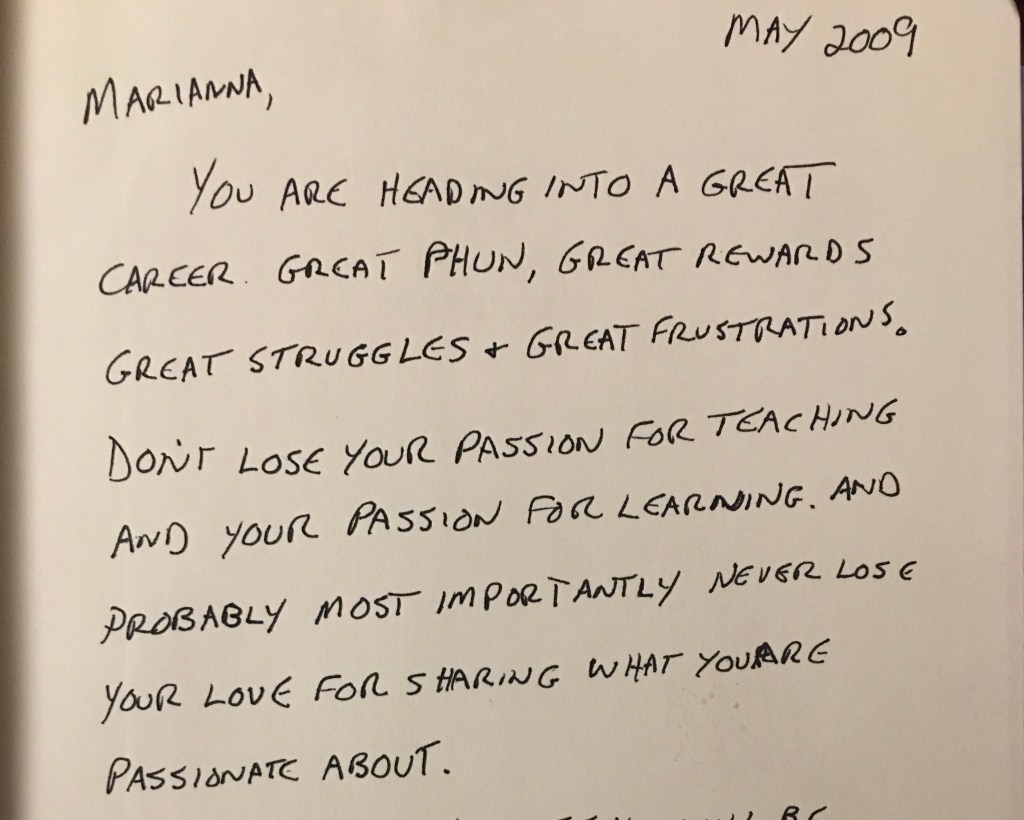
Parting letter from my cooperating teacher to me upon completing student teaching
Science of Learning

Drill and Kill? Or Drill for Skill?

This post is part of a series on the Science of Learning Physics

A few weeks ago Frank Noschese posted this question on twitter

Some of you may recognize the diagrams as coming from physicsclassroom.com curriculum, which, I will admit upfront I have a big bias towards because the site is developed and maintained by one of my favorite teachers at the high school I attended. As a students I felt the website really bolstered by comprehension of physics and I continue to refer students and teachers to it.

However, if you’ve been following my posts, particularly this one, you will have read about the importance of creating “desirable difficulties” through spacing and interleaving problem types and topics. There are also some great methods out there to help students scaffold their problem-solving process to get them to take advantage of the metacognitive process so they can begin to think more like experts in their approach.

As such, this type of practice looks like the antithesis of good learning! The problems are fill in the blanks! Every problem is the same! Do any of these problems even have real meaning to the student?

So back to the question, what role do these types of problems serve?

Chapter 5 of Daniel Willingham’s Book, Why Don’t Students Like School is dedicated to the value of drill work. Drill work has gotten a bad name in the age of NGSS and common core as we push for deeper thinking and learning. However, when we practice skills repeatedly so they can become habit or second-nature, that frees up space in our working memory to focus on more difficult tasks that require deeper thinking.

We discussed earlier that the very reason novices struggle with seeing the bigger picture and conversing with themselves while they solve a problem is simply because no part of that problem is second-nature, it is all coming from working memory. A beautiful example Willingham uses is tying your shoes. Do you remember when you first learned how to do this fine-motor task? Now you can likely tie your shoes without stopping your conversation, and maybe don’t even remember you did it! Another example is driving a car. Did you ever find yourself at your destination, not quite sure how you arrived because your mind was so preoccupied with literally everything else except driving?

Your working memory has a finite limit and there’s not much you can do about it. However, when we commit processes such that they are automated, we free up some RAM, so to speak. This is where the above practice is, in fact, an excellent tool. When we drill students, we allow certain processes to automate so that they can focus on more complex ones. Consider what kinds of processes are automatic for yourself when solving these problems. You probably don’t think much about the mass-gravitational force calculation and that normal will be equal in all of these cases and you likely know immediately the direction of acceleration. Each of these would be good for a student to also have automated.

At the same time, these exercises can not be the sole mode of practice and instruction. This type of drill work should be reserved only when we are hoping to embed skills in our students in which automation will help them with more challenging tasks. However, when this type of practice is paired with retrieval, interleaving and spaced practice, it can be a powerful way for students to begin to recognize underlying structures of the problems which will provide them a solid foundation upon which to build their learning.

By the way! Drilling doesn’t have to look like a worksheet of identical problems! Check out Kelly Oshea’s Whiteboard Speed dating! It’s a phenomenal activity for several reasons, but at it’s core it’s making students do the same problem repeatedly, but in a fun way.

Questions for Consideration

  1. What skills deserve drilling in each topic?
  2. What skills have you drilled that should get shifted to “desirable difficulty” exercises?

Science of Learning · Teaching Methods

The Science of Learning Physics: Practice and Study Skills

In my previous post we discussed strategies for metacognition to help provide students a clear, objective judgement of learning in order to help students see their own improvement and laser-focus where they need to put in more time.

Today we are going to further explore practice and studying.

We have already discussed some of the following: that students tend to judge their own competence poorly, students mistake familiarity with competence, and student study habits, if existent, tend to rely on passive methods such as “looking over notes” and highlighting. This is part of the reason why active learning is so beneficial in the physics classroom; it creates a norm for how we approach any problem.

In the book The Science of Learning Physics, Mestre and Docktor discuss the work of cognitive scientists Elizabeth Bjork and Robert Bjork of UCLA that suggests the implementation of “desirable difficulties”. Implementing these desirable difficulties is providing students with a challenge that is just out of their comfort or familiarity zone, but not so far removed that the student shuts down. Desirable difficulties can be produced by creating certain experiences for students that, in a way, de-contextualize the problem. These methods include varying the condition of practice, spacing and interleaving.

Spaced practice is commonly known: we don’t really learn much by cramming, but students will cram nevertheless. Knowing this reality we, as teachers, can incorporate spaced practice into our classroom as part of our warm-ups and retrieval exercises or focused activities. We can also incorporate these practices in order to help students built their own study guides (particularly when combined with metacognitive strategies) I really enjoy embedding spacing as a retrieval practice like the one below. You’ll notice I give students a single word to help jog their memory just a little, because remembering from a week or two ago can be really hard!

This practice also works excellently with interleaved practice, which is when students are asked to use multiple ideas at once or in random succession (the opposite is blocked practice such as items 1-10 are newton’s laws and 11-12 are energy). Physics truly lends itself beautifully to this process because, in truth, working through a semester of physics is really working through new and layered understandings and models for how and why things happen.

Last year I had my students do a retrieval exercise to get them to retrieve everything they could remember about reflection and refraction. After cycling through pairs and groups of fours I asked them to create a Venn diagram of the two concepts. This got students actively thinking about how refraction and the problem-solving tools connected to reflection and lead to some phenomenal conversations. It also produced a desirable difficulty: students had not thought about refraction in this way before and they were asked to interleave with reflection. Students got to walk around and look at the other boards and then come back to their board to shift or add anything they felt needed to move.

Goall-less problems are a really great way to incorporate these practices. In a goal-less problem you take off the last part of the sentence that says “find the velocity” and so on. Instead, students are asked to write down and solve everything they can about the problem. The benefit to this method is that it is the epitome of a low floor, high-ceiling activity. Even your poorest performing student should be able to draw a picture or write at least one thing down. It also removes the narrow student focus of trying to solve for the specific thing asked for, and rather makes students consider all of the possibilities. In my on-track physics classes I typically put a list of all of the representations and options they have available up on the board the first few times we do this. Goall-less problems also make for fantastic final review or assessment items.

One final note that is more personal experience than anything else. I really, really hate Webassign and other similar online homework platforms. I worked as a full time tutor in a school for two years and I was typically inundated with physics students wanting to get all of the green checks. No matter my goal, hope or intent, the majority of students generally did not care until I got them through all of the steps. In contrast, the couple of students I tutored from small, private schools without an online platform were far more interested in process. There is something about the green check and the correct numerical answer that strips away all of the process and metacognition that we work so hard to cultivate in our classrooms. I’m not sure what the answer is to this (other than this type of homework being worth close to nothing). But I am sure that when the focus in class is truly about helping students create their own knowledge that much of this type of homework becomes obsolete. I would much rather have students working out solutions on paper that they can then bring to class and have a conversation. In Webassign success is binary: you get a red X or a green check, but comprehension and learning are not binary processes, they are fluid and messy. Students need to work through the mess and celebrate the small wins along the way.

Science of Learning · Teaching Methods

The Science of Learning Physics: Metacognition Strategies

This post is part of a series on the Science of Learning Physics

Metacognition.

I distinctively remember this being a topic in one of my teacher prep classes. I also remember several failed attempts at weaving metacognition into my assignments. I don’t know about you, but trying to get students “thinking about their own thinking” seems really challenging, clunky and too often inauthentic. Students are fantastic at sniffing out inauthenticity, and the moment they recognize something as garbage, they approach it in full B.S. mode.

The challenge with this, of course, is that metacognition is an incredibly powerful tool within the cognitive science toolkit, and is one of the marked differences between expert vs novice thinking.

Metacognition allows students to evaluate their learning and problem solving approach, and focus for studying. Unfortunately, students frequently misjudge their skills and abilities, often confusing familiarity with content for competence. Furthermore, students who struggle may lack enough familiarity to properly identify the edge of their learning. So how do we teach students to be authentic reflective learners?

One of Mestre’s suggestions in The Science of Learning Physics is to provide students objective measures to judge their learning. Specifically, access to old exams and questions. While this is an excellent method, many high school and AP teachers may lack a deep pool of questions to make available to students. Additionally, this is limited to student studying outside of the classroom. What Dr. Agarwal suggests in her book Powerful Teaching is “engagement with feedback” in other words, whenever we have students working in our classroom, they should have the opportunity to receive meaningful feedback on their work in short order so they can reflect on their process while it is fresh, and course-correct as needed. How often do we ask a student to tell us their thought process and they respond, “I don’t even know anymore”

A method I’ve adapted to aid in this task weaves together retrieval practices with metacognition. Recall in the retrieval process students first write. down everything they can remember using only their brain. Then, if you so desire, students can pair and share (I typically do a pair and then have pairs get together into groups of four). Last, you permit students to dive into their notes. In each of these progressive phases, students should be adding the parts they received from. other sources to their papers. Adding the metacognitive level is as simple as a highlighter. Perhaps students highlight everything from their partner in yellow. Then, they highlight everything they added from their notes in green. This produces a very clear visual of what they know and what they do not know. It also produces a visual of how much they can reap from their friends and what topics or ideas were “really hard” for everyone because no one could remember it.

If. you’ve started to dig into retrieval ideas on twitter or on Dr. Agarwal’s. book or website, you’ve. seen that there are so many different ways to do retrieval, from lists to graphic organizers. Any and. all of these can utilize this highlighting method. Not only does this allow for metacognition. and accurate judgement of learning, over. time it demonstrates to students how much they have learned over a time-frame and how their own retrieval improves with practice.

Here is another brilliant idea by Jess Kirby. Not only does this incorporate metacognition and judgement of learning, it also requires students to organize the questions by the big idea (another “expert-level” concept).

For a more complex version of this process as it relates to problem solving I have had students combine retrieval with cornell notes.

In this example I had lectured students on how to solve this exact problem the previous day. I provided them with the following notes sheet

First, I asked students to solve this problem as best they could using only their brain and what they could remember from the previous day. I only asked them to focus on the left hand side where they solved the problem.

Next, I allowed students to pull out their notes and add, edit or correct any of the steps they had missed. I asked them to color code these edits and then write out the steps in words on the right hand side.

Finally, I told students to look over their paper. Anything that needed an edit or addition (especially if “I just forgot that..”) needed to go down in the “reminders to yourself” box.

These three ideas really only scratch the surface of what is possible! If you have picked up Powerful Teaching, head over to chapter 5 for more great ideas and then share what you’ve implemented in your own classroom!

Science of Learning · Teaching Methods

The Science of Learning Physics: Active Learning part 2 – Convincing the Student

This post is part of a series on the Science of Learning Physics

I’m going to make an assumption that most readers of my blog do not need any convincing of the benefits of an active learning environment. Even still, in the name of these posts starting from a solid research foundation I will briefly discuss the value. However, I think the bigger challenge teachers face is persisting with the active learning environment in spite of feedback from students, parents and perhaps even colleagues along the way.

The active learning model is a natural consequence of constructivist learning. Active learning has been shown to be more effective than traditional lecture, as well as most effective at uprooting and replacing common student preconceptions.

In an active learning environment the teacher takes the role as coach, facilitator and guide. Not leaving students to their own devices, but rather carefully crafting the learning experience so as to set students upon a fruitful path. Mestre lays out in his text that active learning could consist of the following:

  • Opportunities for students to share their ideas and reasoning individually or with their peers
  • Encouraging qualitative reasoning based on physics concepts
  • Encouraging construction and sense-making of physics knowledge; for example students are prompted to figure things out for themselves
  • Providing opportunities for students to engage in the process of “doing science”
  • Providing opportunities for students to apply their knowledge flexibly across multiple contexts (transfer to new contexts)
  • Helping students organize content knowledge according to some hierarchy
  • Teaching metacognitive strategies to students

For the first time this year, and thanks to an idea from a friend and college, Joe Milliano, I had this discussion of “where the learning happens” with my students at the start of the year, anticipating more push-back than usual due to the hybrid environment

Part of my intent in this was to point out how the “information getting” part of the class is really small compared to the student-centered and constructivism part of the class.

Mestre, likewise, encourages teachers to be completely upfront with students regarding the science of learning in order to provide them with the context for the journey we are about to embark on together. It’s important for students to know we’re not just doing this “to them” but rather we are doing this for them because it is truly the best model for their learning.

Unless your school or department is built on a Problem Based Learning model, or something comparable it is very likely that your students have not engaged in an active learning environment to this extent before, ever. Your students will likely cite that they learn best based on their learning style, they enjoy lectures and seeing examples and they study by going over their notes and re-reading the text. In fact, you can fully expect your students to think and feel like they are not learning, when they really truly are!

These common student responses are riddled with challenges for the teacher and their own learning. The best thing you can do as the instructor is to begin to have these conversations from the first day of school. Firstly, while learning preferences is certainly a thing, the truth is that difference courses require students to perform in different ways, and the way in which we ask them to perform may not match their learning style, this mismatch can then appear as incompetence if we teach to the learning style rather than the intended performance objective. Next, lectures, watching examples, going over notes and re-reading the text are all ways in which students can gain familiarity with content, but students confuse familiarity with competence. How often have you heard a student report “I get it when we do it in class, but then I forget everything on the test”.

Eugina Etkina has a wonderful, non-physics exercise to discuss the importance of students “doing the doing” as I call it. She calls it the expert game. You ask students to go around and share their “thing” that they are really interested in or really good at. Then, you group the students based on similar interests. Students are asked to come up with a flow-chart or visual on how you go from being a novice to an expert in that craft. Inevitably the results consists of things like “watch an expert” “practice” “get feedback”. This conversation then comes back around to the work in the physics class. I can watch Michael Phelps all day long, but I’m never going to be able to even swim unless I jump in the pool. Same goes for the work of physics!

Students begin to get on board with the idea of active learning when they see they are reaping the benefits. Unfortunately, physics tests do not always reflect this for our students. Enter the retake. I do retakes in a very special manner in my classroom. It’s something of an adjustment from an idea I read in an old Physics Teacher journal. I have not let students do this until the energy unit exam, only because I want students to get through that “adjustment period” I’ve mentioned previously.

Students complete the energy exam and I tell them the following day that they have a retake opportunity. Here is how it works.

I will be upfront with scoring. Students will take the exact same test over again. They must score 100% in order to get the bump.

Students do NOT get to see their original exam. They do not know their score, they do not know what they missed. This is really important.

I arrange a designated day and time in which students can come to my room to collaborate. They will receive a blank copy of the same exact test they originally took. They can use any print resource. They may not ask me questions.

One week after the collaboration students come in at a designated time to take the retake.

Scoring is easy because I’m looking for perfect papers. The bump works on a square root curve, so if the original score was a 64, the bump will be 10*sqrt(64) = 80. I really like this way of adjusting since the student who had a 96 to begin with only goes up to a 98, which makes sense since they had small errors, but the student who had a 64 and pulled of a 100 gets up to a respectable 80.

The design is where and how the magic happens. They know that 100 is possible because they are ALL together. The teamwork and camaraderie is palpable and the energy in the room is invigorating! Students also realize that they are all in this together: there’s no geniuses here, and working alone is not the best use of time. Because they need 100, students argue their point to the finish. Because they need 100 a week after they get to talk, students are making sure they fully understand how to answer the questions.

I was really nervous the first time I did this with my students, but I knew I did the right thing at the end of the first session when my top student walked out of the room and said, “I thought I knew what I was doing on that test, but there was a lot I needed to learn” This student had an 87 on the first round!

I have found that one of the most critical components of an effective active learning model is creating the classroom culture where students not only feel safe to take risks, but feel safe to work together with every single student in the room. This takes a great deal of time and effort on the part of the teacher to properly construct. (Head over to Kelly OShea’s blog to learn about board meetings and speed dating, two of my favorites for building classroom culture!) Our current situation with the pandemic has made it much worse and I’m not sure how I can roll out my most favorite teaching tool under all of the current constraints (if you have ideas, drop them in the comments!)

To that end, if you are a new or novice teacher, or are looking to begin using active learning in your classroom, I would strongly encourage you to seek out teachers who also use active-learning in their classrooms. Create your own Professional Learning Network (PLC) of incredible teachers from across the country, sign up for the workshops at AAPT, or an AMTA modeling workshop so you can not only network, but have a place to have conversations about what is working and not working. Just as I tell my students, we are better together.