Infecting Students with Passion, Infusing Family with Love
Author: Marianna Ruggerio
Marianna is the Physics teacher at Auburn High School in Rockford, IL. She currently teaches AP Physics 1 and AP Physics C. When she's not in disguise as Nerdy Physics Teacher she is busy at home as Nerdy Physics Mom with her husband Fr. Jonathan and sons Adrian and George.
Only 15-25% of students in the region graduate with a physics course on their transcript.
Yet physics is seen as a gateway course to science, technology, engineering and mathematics majors.
Simply taking a physics course in high school correlates to higher ACT and SAT scores, success in any college science course and tenacity in college science programs.
Physics majors, on average score highest on both the medical (MCAT) and law (LSAT) entrance exams.
In the region, we have many employment opportunities in these fields such as Collins Aerospace, Thermal Fisher and three different hospitals. In short, robust high school physics programs have a direct impact on college admissions and future employment. Yet our programs are lacking.
This is not a problem unique to the Rockford region. Though the state of Illinois boasts some of the top physics degree programs in the nation and two of seventeen national labs, low enrollment is typical across the state outside of the Chicago area.
It’s a vicious cycle: few sections means a full-time physics teacher is not necessary so the physics sections go to an out-of-field teacher. This is not unusual; only 24% of physics teachers nationwide have a physics degree.
Without a robust background in physics, and without other colleagues with whom to collaborate, teaching physics can be an immense challenge and very isolating, particularly for out-of-field teachers. This directly impacts the quality of instruction which ultimately impacts the student population and the community at large. The physics enrollment problem also disproportionately affects communities with lower incomes and higher diversity.
In 2019 four “master” teachers were invited to the program, of whom I was one. For the second year, the program opened up eight more fellowship positions.
Three of those have gone to Rockford area teachers Jennifer Grady at Hononegah, Elizabeth Gonzalez at Belvidere High School and Leonard Friedhoff at Freeport High School. Anna Wetherholt at Dekalb High School and Julie Zaborac from West Aurora are also involved, creating a local network of skilled, passionate teachers.
The program consists of strong support from the university and intense professional development. Teachers spent two weeks together over the summer learning how to use the research-based materials from UIUC that are also used in their courses and then modified and developed these materials for their own use.
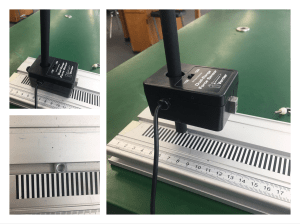
These materials include the online lectures, homework system as well as the iOLab, an innovative device created at the University that does everything the thousands of dollars of typical equipment can do, but in a small box for about $150. At UIUC every physics student purchases one of these devices for their lab sections, typically running smaller experiments at home prior to the lab section.
During the pandemic my high school students had these devices at home which allowed them to fully engage in labs remotely. Often students struggle with the college transition. Students of IPaSS teachers who move on to UIUC will use the same content and materials, bridging the gap between high school and college expectations.
The four of us “expert teachers” also lead daily workshops related to not only the University material use in classrooms but also strategies related to teaching physics and course layout ideas.
We have discussed using this model to prepare teachers to present at local and national conferences. Not only is the program equipping teachers with resources, it is also empowering teachers as leaders.
During the school year teachers meet every other week for an hour to check in on goals, share ideas, struggles and materials. Indeed, it is exactly what district administrators expect us to do in our professional learning communities, but we never have other physics teachers to work with.
All of the participants have positive reflections. Jennifer Grady at Hononegah shared how valuable having concentrated time to work and connect with so many physics teachers is for her own practice.
Elizabeth Gonzalez at Bleivdere shared that she would encourage others to apply because “We can always find other ideas and resources that can improve our practice and we can always help others to find what they need.” Julie Zaborac at West Aurora shared, “I get more ideas and feedback from this group than I could possibly receive anywhere else.”
Most teachers care deeply about their craft, but often must find a balance between the ideal classroom they envision and what they have the time and resources to create. The IPaSS program provides a space where teachers can make these decisions with evidence-based practices while also growing in our craft.
We are finally here! Thank you to everyone who has embarked on this journey of reflection with me. If you missed the first few posts check out the introduction to the entire series here. This is part 3 of a 3 part series on momentum. You can read how I introduce the unit with impulse and check out some of the follow up activities I do before we move into collision.
Today we are going to talk about momentum conservation. I find that most novice-style teaching approaches look something like this:
Momentum is conserved. That means initial = final
Write an mv term for each object in the collision before and after the collision
Solve for the unknown variable.
An even more novice approach is to use MVP charts to help students organize the information.
I’ll start with this: I hate charts almost as much as I hate formula triangles. Why? Because if students exclusively use charts to exclusively calculate values with no other expectations the “learning” is “I multiply these boxes” and “I divide these boxes”. This is not demonstrating much of anything except that the student could probably play sudoku (I’m also not a fan). I do however incorporate the charts for those “easy wins” with my regular level students as an option…but only after we’ve done some of the heavy lifting first.
Say what you will about AP as a program, it has made my teaching more thoughtful and as a result, way better than before I taught AP.
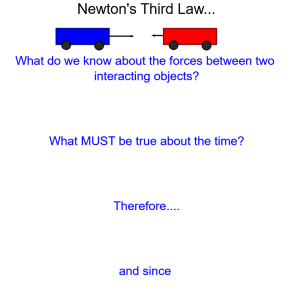
Recall that in the early days of impulse, students were asked to sort of consider conservation without outright stating it. We now go through this process formally. I begin with the following prompts:
From here we collectively work our way to the final statement that -Dmv1 = Dmv2…. and THAT is conservation. It is a transfer of momentum from one object to another such that the total of the system remains constant.
At this point it’s all about application for my AP students. They get thrown into the lab for a few days so they can collect data for the various collision types and determine whether or not momentum was conserved. (Lab handout)
After the lab students are given one collision type they are responsible for in a board meeting. Rather than having a class conversation I let students circulate and provide written feedback. (The prompts for the boards are at the bottom of the image below, feedback prompts at the top)
Board meetings are always opportunities for students to check their work, collaborate, and ensure they can submit the best possible product. While I took the idea from here, I do make modifications depending on the activity because some students… no matter what… will never speak in a whole group setting, but they will offer written feedback. Some students (myself included!) freeze “on the spot” but when given time to reflect, have amazing things to offer! I think too often we create classrooms that are driven by extroversion but never take the time to consider what learning looks like for introverts, and write it off as “shyness” or “refusal to participate”. I also like to have students circulate when we have a significant amount of information on the boards, so it doesn’t lend itself to a traditional board meeting.
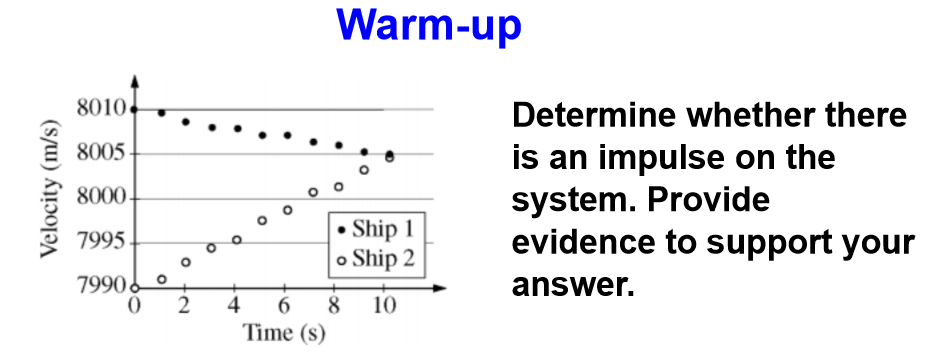
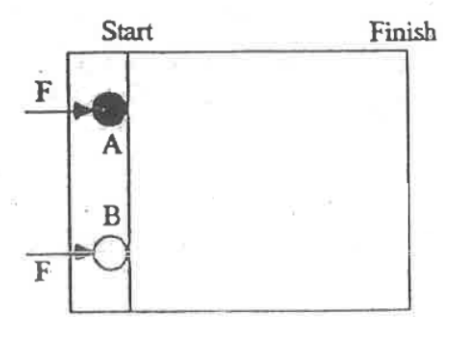
We do some conceptual practice (which has a bigger Force? a ball that bounces or one that lands?) and we discuss how we could know if there were an external impulse acting on the cars during a collision. I love using this graph from AP and asking students to determine if there is an external impulse
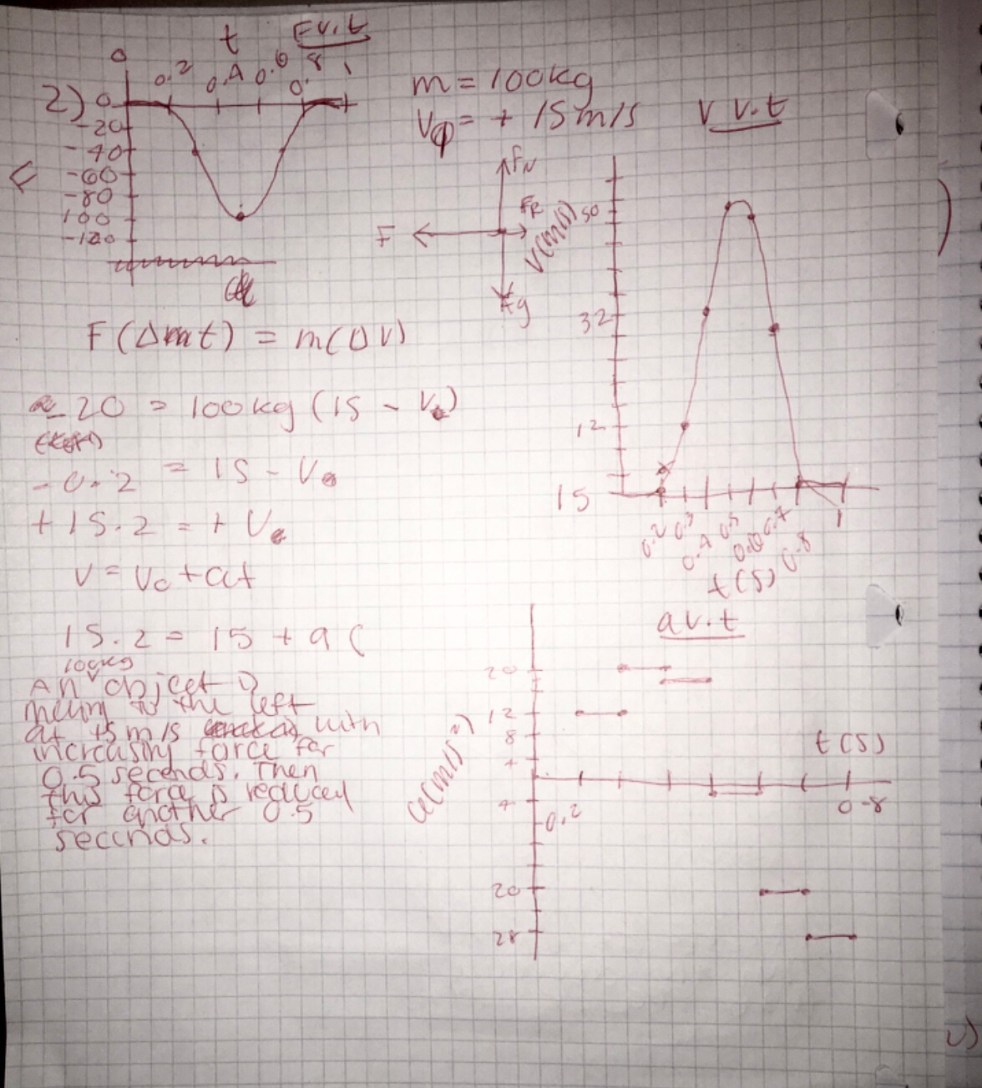
Oh! But let’s not forget all of the richness we learned earlier in the unit! I need to make sure to weave in the first half of our learning with this second half! I assign students what I call “special problems“. This problem set is a few problems that are neither perfectly elastic nor perfectly inelastic, but something in between or there’s an extra nuance added. For each problem I ask students to sketch the force vs time graphs, solve the question, and then answer an additional conceptual item about the problem.
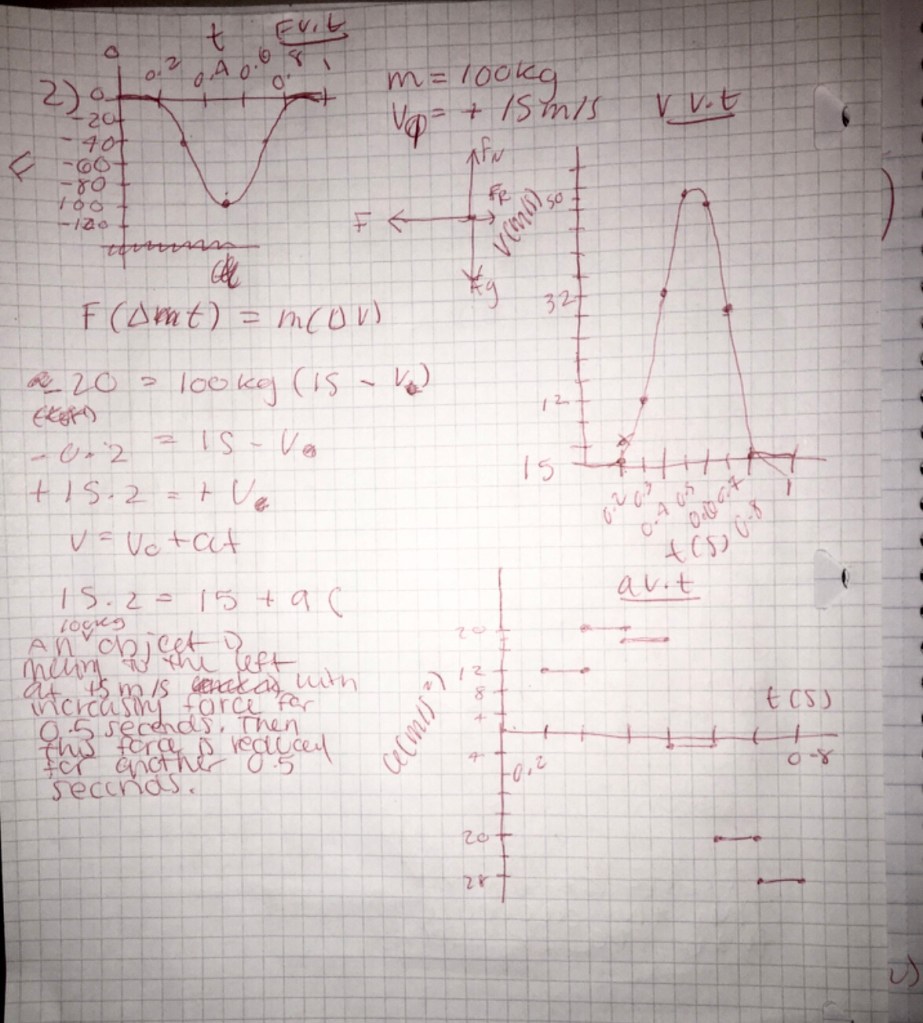
Sample “special problem” solution. These are great discussion questions for students!
When we review these problems here’s what I do: I randomly select 6 students to put up the graph or mathematical solution to each problem. Then I select 6 more students and their task is to either explain the answer on the board if they agree, or write a different solution on the board if they disagree. When there is a disagreement we open the floor to a class discussion about the two different answers to decide which is correct.
What about 2D Collisions?
2D isn’t really a major emphasis in APP1. We discuss it briefly in terms of the vector nature of momentum so momentum must be conserved in each direction
In my regular physics class have to scale back just a bit and shift my focus. I give students opportunities for “wins” so they can feel like they “understand” and then I start layering some of the more complex problem solving tasks.
We begin with a marble activity. Students use the grove between their desks and run collisions with marbles (kind of like a Newton’s Cradle). They are asked to record observations about the velocity, and therefore the momentum of the objects. After this activity we have the same conservation discussion as my regular students.
The other major difference between regular and AP is that I present and have students practice each of the collision types one day at a time. When I present these I will show them the chart method first, explaining that it is an option, but not my personal favorite.
I also explain WHY it’s not my favorite. The reason is that you have to remember the important physics idea in the MIDDLE of your work… that initial momentum is the same as final. If, however, they do it in the algebraic way, they start with the physics idea and then they can forget about it. I generally have a 50-50 split in my room who does which method. The other important part about how I teach this lesson is I want to make it super clear that we get all of the same numbers both ways. For this reason I will copy the chart over to the next slide and solve the same problem in the algebraic way
The collision lab is also different. I give students one lab at a time and students collect the data in pre-made tables. Since students need to determine initial AND final AND keep track of signage, there’s just a lot going on to also add the layer of “do this without a guide”. It’s not my finest moment, but, again, my students need some wins.
Problem Solving Skill Building
Another layer I add to momentum is that since the equation and relationships are simple, I introduce proportional reasoning with students (what happens if we double the mass, half the velocity, do both?). Many of my regular level students really struggle with thinking in this way (so does AP!) but I feel it’s important that they get some exposure to this. We talk about how you could choose to make up numbers and see what you get, but it’s also more efficient to shove the changes into the equation and see what comes out
I’ve also started incorporating more ranking task type items that are conceptual in our classroom practice to push their problem solving skills. I intro with the following
Students then solved tasks like the ones below in groups on whiteboards. Notice that the tasks chosen are ultimately fairly simple. I did the colliding carts first because it provided numbers and allowed students to calculate in order to come to a conclusion
However in this final problem we did, there are nearly no numbers at all! This was a good place to really discuss the relationships within momentum, and in this case focus on what is the same, greater and less in order to come up with an answer. Student groups ended up being highly successful. We did about 4 of these tasks in the 50 minute class period.
I suppose I should discuss what assessments look like in my classroom at some point, especially for the non-AP students. Another day, another post! (Spoiler: it’s changed quite a bit since I first started teaching!)
In this post I will outline 3 activities I do in my classes. Each serves a different purpose and function depending on the group of students, but most could be used interchangeably between levels depending on your own goals. They are the following:
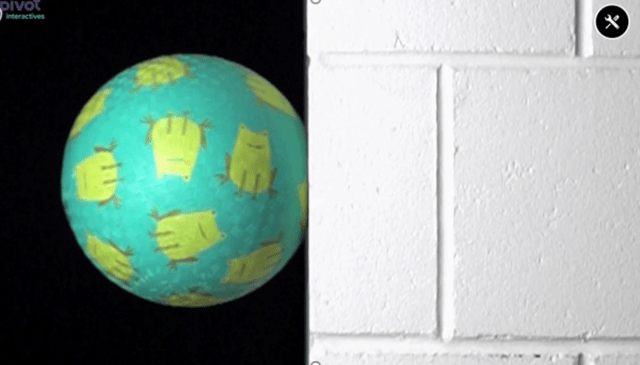
Pivot Interactives: Ball on a Wall
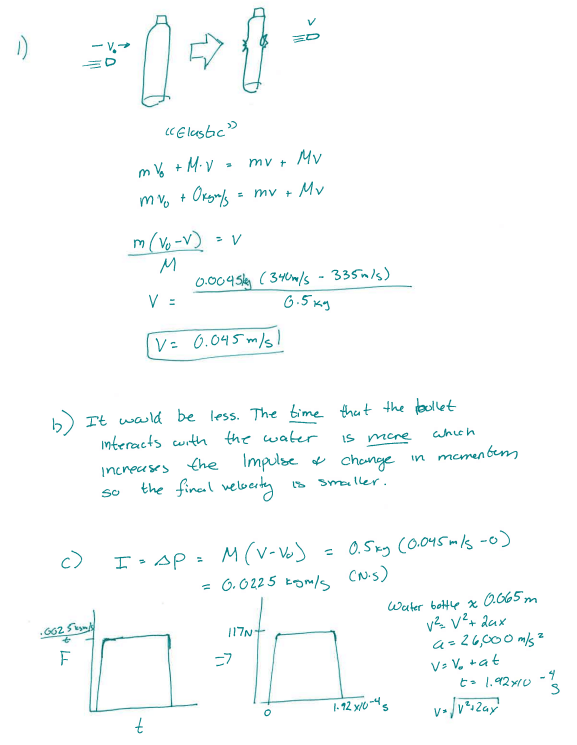
Popper Lab
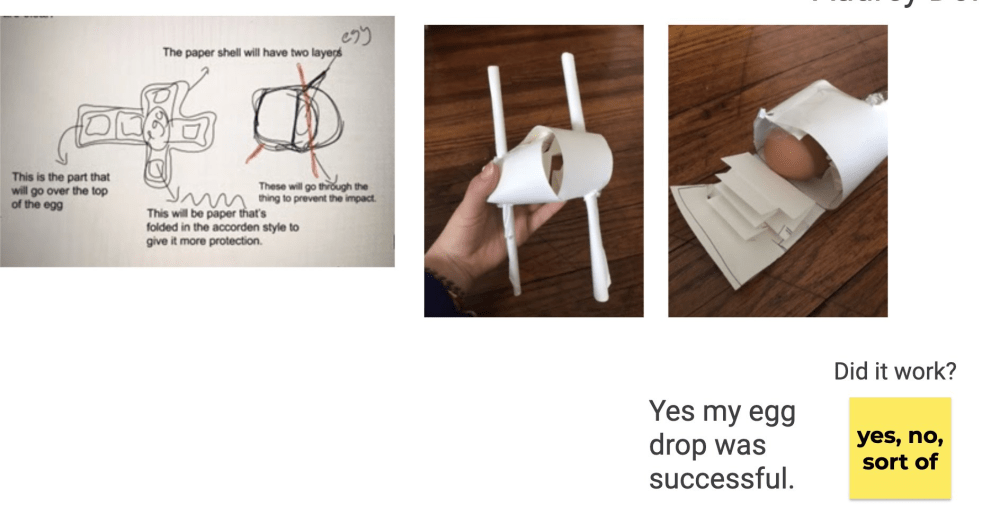
Egg Drop Challenge (with a data-driven testing phase)
These activities are all about giving students a “real-world” opportunity to collect data and calculate quantities from the course. There’s not a lot of “discovery” going on here, a primary driver is practice. However, each activity presents rich opportunities for different conversations.
Please don’t steal for profit on TPT. That harms the teachers who share, those who are in need, and our profession as a whole.
Pivot Interactives Activity: Ball Against a Wall (regular level)
Many of us came on to Pivot Interactives after the original library was migrated from “Direct Measurement Videos” many more of us came on to PI when we had to teach in the pandemic. If you can push for a subscription it’s very much worth it. Labs that are too expensive or cumbersome for a class set become attainable, make-up work, homebound, remote learning… you name it. There are a lot of benefits. I love this very simple activity that just involves a ball colliding with a vertical wall. Important note: I don’t use the built-in questions/grading set up in pivot. It’s very well done, but I find that computer work usually hinders collaboration, so I moved away from having students answer in pivot even before the pandemic.
Ball against a wall in Pivot Interactives
Students begin this activity by reviewing the transformation of F=ma to the impulse-change in momentum relationship. The mass of the ball is provided and students have access to a ruler tool and stopwatch. There are a lot of ways this could be done. For my regular students I have them determine the pre and post collision velocity as a simple x/t calculation (we verify it’s moving constantly by seeing it move equal intervals down the ruler in equal frames). The biggest challenge is determining the time of the collision. This is one thing I love about this activity. In day to day life collisions happen so fast we don’t really consider the impact lasted for a measurable time. I love how this visualizes. You can see my original handout here. Last year I discovered that remote students do better when labs were broken into very small tasks through jamboards, so also check out thejamboard activity here. (2026 Update: Take a look at some of my new summaries for pivot activities!) You will notice a lot of scaffolding. This is necessary for my regular level students, but it may not be for yours. When I run this activity in AP I simply inform them of the goal and send them on their way.
Popper Lab (APP1)
I took this lab from an AP summer institute I attended under the direction of Martha Lietz. Students pop a popper toy (the half-spheres you turn inside out). The ultimate goal is to calculate the time for the “pop”. While students end up using impulse-change in momentum, they also have to use kinematics and F=ma along the way. I find that many students have a hard time with this interleaving because up until this point (remember I do momentum right after forces) we haven’t had too much of a chance to interleave yet. That is one of the main reasons this lab has been a mainstay for me, even if it’s really just a “glorified homework problem” as I tell my students. Students are taken step by step through the process. See the activity here. At the end of the lab I ask students to submit their calculated times to a google form where I aggregate all of the responses. We will first do a quick skim on day 2 so if students calculated an egregious answer, they can obviously see they need to check something. Once we remove the outliers, we do an average and standard deviation. It’s SO COOL to see how close student answers all are when it feels like such an imprecise activity! Because this is a glorified homework problem we can take some time to have a solid conversation about measurement, uncertainty and standard deviations, making it appropriate for AP.
Egg Drop Lab
Whenever students hear we are going to do the egg drop they respond gleefully “we did this in middle school!” I am quick to explain why this is not like middle school and the middle school experience was not like science. In middle school students are typically given tons of supplies, they can use as much as they want and they just cobble whatever together and start chucking. Can you imagine if engineers did this? What a waste of dollars and materials! Besides, you shouldn’t even think about messing with materials unless you have some kind of idea about what is going to happen.
I explain the parameters: 5 sheets of 8.5×11 paper and 1 meter of masking tape. The device must be attached to the egg. No parachutes.
The reason for these parameters is I want students to be thoughtful about the why behind their device.
But no devices are built without prototypes!
So on day one we have a testing phase. (See handout here) Students use force probes and cars or iOLabs and run “prototypes” into the probe (see image below for how I set up the probe). This might be folder paper, crumpled paper, tubes… whatever! But we know that our eggs will be saved by one thing: increasing the time of impact and decreasing the force.
This activity is by no means precise, but it gets students thinking about what to actually do with the paper.
On drop day students have roughly 35 minutes to build their devices which we drop in the last 15. Students present their devices to their classmates and then drop from 2.0 m. Eye of the Tiger plays on loop in the background.
Egg drops in physics today! Students tested how to use paper to increase collision time in order to decrease force to protect an egg! Today they got to drop! Next year I’m totally using wrapping paper! 😆 #iteachphysicspic.twitter.com/JWbu93bDv9
The following day I ask students to whiteboard diagrams of their devices that also show where the egg was located. We discuss the designs in relation to their smashing or success. View the activity here.
None of these activities are ones I would consider particularly awesome and certainly not flashy, however often its these kinds of activities that allow the nuances to shine.
Any student can learn physics, and curiosity about the physics world around us is an innate attribute of humanity.
Intuition can be a powerful tool to co-construct knowledge
Order matters. Language matters.
Shut Up and Listen
EVERYTHING is an opportunity for an experiment
My primary responsibility is to ensure a safe space for students to learn
When I was taught momentum it looked something like this:
define momentum as mass x velocity.
Talk about how to change momentum through impulse
Revisit action-reaction pairs. Throw an egg into a bedsheet.
Define conservation of momentum as initial = final. Solve collision problems accordingly.
In my experience there was also no mention or use of various graphs. When I started teaching I was able to get a hold of the entire curricular materials from a prestigious, high achieving, highly affluent school in the area. They taught the sequence very much the same way. Obviously this was the “best” way to teach momentum… right?
Over the years through a combination of teaching the AP curriculum, exposure to the ISLE method of learning and the modeling curriculum, this sequence has shifted dramatically. I have aligned many of my routines with these two models. However, my structure for teaching momentum is not the same order as ISLE or modeling. In both of those curricula, students are first tasked with discovering conservation through a series of experiments to kick off the unit. My order is slightly different.
One of the critical choices I make about momentum is to teach it before energy and after forces. I do this because change in momentum is a natural consequence of an object experiencing a force. Momentum is really just forces repackaged! I don’t want students to discover conservation first, because I want them to think about the processes during the collision first, then we can apply those to different scenarios.
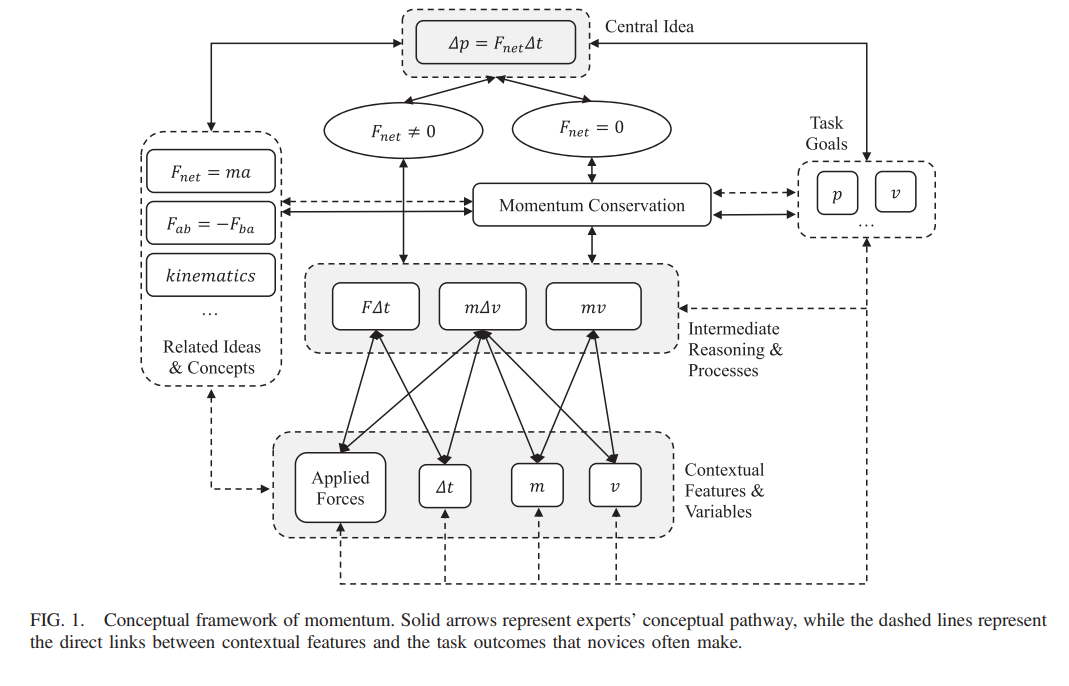
I was super excited to find out recently this has actually been studied. You can read the article here, but here’s the Tl;Dr –when students are taught from big idea down, they learn the material better, making more connections, and this study was specifically done with a framework for momentum. (See the framework below)
Momentum is a huge, critical unit, so I’m going to break this down into three separate posts. This first one will take a look at impulse. The second post will be a short explanation of two activities I do, one for regular students and one for AP. The last post will discuss conservation. I want to note that I do not plan on including every detail, activity and problem set in these posts, only the ones I think have substantial value to you, the reader, and those that constitute major shifts in my teaching over time.
One thing that remained true, even in the very first years of teaching was my attempts at emphasizing that momentum is not something new, it is simply forces repackaged. The other statement I would make often is that the impulse-change in momentum relationship is two ways of saying the same thing. Like “Hi” and “Hello.” Yet, these ideas were not sticking in students minds. Furthermore, I was fully aware that students were making no connections between impulse and conservation. How do we get students to understand these ideas with full integrity?
The realization for me came after a vocabulary shift: rather than defining a force as a push or pul we now explicitly define a force as an interaction between objects. This definition became the driving force for my reframing of momentum.
Classroom Activities
Please don’t steal for profit on TPT. That harms the teachers who share, those who are in need, and our profession as a whole.
Observational Experiment: We begin with an old demonstration from earlier in the year: our lovely bowling ball friend. We are already familiar with the fact that an unbalanced force will cause the ball to accelerate from the forces unit. I ask a student to give the bowling ball the hardest whack they can with a hammer. Unsurprisingly, the ball barely moves. But the force was so strong! What can we do instead? Well, if we tap the ball repeatedly, then it will begin to accelerate. This is how we first define the impulse-change in momentum relationship. We need a force exerted for a certain amount of time in order to change an object’s velocity. We do not define this yet as a formal equation, but we recognize that force and time must be multiplied. To define momentum itself I do a live google news search for the word momentum. The headlines are always sports, politics and stocks. We talk about what the word means in those contexts. We typically arrive at something like “having a lot of momentum means hard to stop” and then we formally define it as mass times velocity. I’ve never been one to do elaborate day plus activities to define simple terms when we can use their lay knowledge as a foundation for their scientific definitions. At least for something like this. We have much more important work I’d rather spend that precious time on. This is important as we move to the next phase. My students hear from me frequently: whenever you get a graph your first question should be does the slope tell me anything (division) does the area tell me anything (multiplication).
Quantitative Experiment: I have run this lab two ways, but the idea is the same: have students quantitatively compare impulse and momentum change. The original way I performed this lab was to affix a force probe to the track, then run a car into it with the pistton out. The piston allows the time frame of impact to extend so students can see the curve. A motion sensor is set up on the opposite end so students can obtain velocity values. When we open class I have sketches of the graphs they will see and I asked them how they could determine impulse and momentum change from the graphs. Students are asked to sketch the graphs, determine the change in momentum and determine the impulse by using the software to take the area under the curve. In a newer iteration of this activity I use the iOLab to the same effect. Students run the iOLab into a wall or textbook and analyze the same data. I ask students to determine the relationship between impulse and momentum change. Then I ask them to write that relationship down and rearrange the equation until they get something they recognize.
Recap and Multiple Representations – We will recap yesterdays activity through a discussion and whiteboard presentations. By the time we finish students recognize that the impulse-momentum relationship is just F = ma rearranged. This is where I emphasize again we are not really doing anything new. The next thing I ask them to do is to imagine the force probe/wall (depending on the iteration of the lab) was replaced with a second car of equal mass…what would the force graphs look like for each car? We are, in effect, previewing the law of conservation. If we go back to the definition of force: a force is an interaction between objects, then it follows that the force on object 1 must be equal and opposite to the force on object 2. The time must be the same. Therefore, the impulse is equal and opposite. While we could easily jump into conservation laws from here, we continue working with representations focusing on impulse and momentum change.
In a whiteboarding exercise I provide students with several scenarios. In each scenario I have provided one representation. Students are asked to create the other 4 representations. The purpose of this is to ensure they are accessing everything they have learned already. This is, in some ways, I type of interleaved practice since they are pulling from the whole year.
One Final Problem Solving Example
Over the next few days we continue our practice with an emphasis on multiple representations, graphing and the fact that an impulse causes a momentum change and that they are one and the same. One of my favorite questions is the following one.
Identical forces push two different pucks the same distance. Puck A has four times the mass of puck B. Which experiences the greater change in momentum?
Can you describe what student responses look like? They come in three levels.
Level 1: Puck A will have the greater change in momentum because it is bigger. More mass means more momentum. These students have missed the point completely. They are focusing on formulas and completely disregarded the velocity piece. While “puck A” is the correct answer, I cannot give credit for this response.
Level 2: These students make some attempt to determine the velocity but end up writing a lot of circular statements and attempting a lot of calculations. Some of them get there, but this process is long and arduous!
Level 3: These students correctly recognize that since impulse and momentum change are the same thing, they can easily look at the impulse to determine the answer. The force is the same, but the mass is different, resulting in puk A taking longer to get to the finish line, therefore puck A is greatest.
I LOVE this problem so much. It’s a fantastic example of why expert-level thinking is so important for students learning physics. Students see the word “momentum” and they want to do p=mv. While you could do this, it takes a long time to get to the answer. If, instead, you take a step back and recall that impulse and change in momentum are the same, you see that you only have to figure out what is going on with time, since the force is the same. This piece is a lot more intuitive than determining the final velocities of each puck. I have used this as a warm up and as a quiz item.
We also take advantage of the AP question bank and we will begin probing the idea of what it means for an impulse to be external vs internal. This falls in line with previous experiences related to defining forces and systems and serves as a good launch point for conservation of momentum.
Scaling Up and Down
Regular physics generally gets all of the same structure materials as AP minus the AP practice FRQs. I will, however, spend a little less time on multiple representations and a little more time on calculations for the sake of “easy wins” so students can gain some confidence.
AP Physics C: My students in this course have all taken APP1. We instead have a “momentum mastery” project, a quick 2D lab and AP FRQ practice.
One positive aspect of working with other teachers nationwide is you are forced to think carefully and critically about precisely what you do and why. Arguably we are supposed to be doing this as part of our daily practices, but too often we get so lost in the day to day we lose sight of the art.
It is my hope in this next series of posts to reflect and share on how I (currently) teach various topics in physics, and how that has shifted from how I used to teach those ideas. Before we begin on this journey together, it is important to lay out my values and beliefs around teaching this course.
Any student can learn physics, and curiosity about the physics world around us is an innate attribute of humanity. Look at any group of people from across the globe and you will find scientific curiosity and thinking. You will find ingenuity and creativity. Humans are constantly looking to explain nature and then use what is available to us to create, build and explore. This innate curiosity isn’t limited to rich, white men, it is literally a piece of our very humanity.
Intuition can be a powerful tool to co-construct knowledge: I was educated in a physics room where we regularly engaged in what Eugina Etkina calls “expose and shame”. Students are given a scenario with no prior knowledge and asked to guess the outcome. The outcome is always the opposite of what students expect. The unexpected is supposed to “stick” in students minds. Not only does the result not stick in students minds, this creates a classroom culture where students avoid taking risks and making mistakes. What I’ve learned from the modeling curriculum and the ISLE method is that we can help set up specific experiments and demonstrations where we first let student intuition help construct an understanding about an idea. As that idea becomes more solidified we can begin to introduce scenarios where student intuition may not have previously led them to the correct answer, but they can get there using the knowledge they have built in the course.
Order matters. Language matters. This idea is one that I have finally begun to fine-tune and refine just over the last few years. All of mechanics really comes down to 2 ideas: forces or conservation. When we boil physics down to the “big ideas” we can see what is truly important. The challenge, however, is that students tend to work in a very granular manner. They like to do things a particular way each time (algorithmic thinking) and they like to go equation hunting, thinking that thee “plug and chug” part of the problem is “the work” rather than all of the work that comes before the work. As a teacher I have two roles here: emphasize and make clear the big picture, and make all of the work before the work visible to my students. These ideas have shifted how I first present material to my students as well as where the emphasis lies within the classroom.
Shut Up and Listen: Not them… YOU! Getting out of student conversations and letting them run the room is a big challenge. Actually listening really carefully to the conversations happening in the room is another challenge entirely. I cannot count the number of time’s I’ve wanted to bring everyone back in after a time limit, only to realize groups were just getting to the good stuff in their conversations. So much of their learning happens while engaging in conversation, so we need to the make space for it.
EVERYTHING is an opportunity for an experiment: I learned this after working with Eugina Etkina’s ISLE curriculum and workshop and it finally solidified what I always believed to be true but struggled to put in a concrete way. I’ve never been one for showmanship, and I started my career around a lot of physics showmen. When I was in college it was the big “learn through inquiry” push, which was a step in the right direction but lacked structure. When I student taught I was supposed to do a day of thermo demos, but instead I turned it into stations. This is one part of my teaching style that has only grown over the years. “Demonstrations” are and should always be treated as observational experiments. If we want to treat our students as aspiring scientists, we should model our classroom on the scientific research structure.
My primary responsibility is to ensure students learn. This can only be achieved if a certain culture exists in my classroom. My room must be a place that is culturally relevant and responsive. It must be a place where students can take risks, ask questions and be heard. It must be a place where failure is part of the process, but never the end result. Where students know I care about their well-being and mental health as much as “finishing” the content by the end of the year. My classroom must be a place where the grade students earn is a reflection of what they have accomplished and learned in a semester, not an average of mistakes and compliance. These norms are achieved in many different ways within and outside of the actual curriculum.
I imagine I will add to the list as I start formalizing my thoughts around how I teach each of the units and build my classroom culture. One of the beautiful parts of blogging is actually taking the time to reflect on practices and receive feedback!
At an AP Institute I was introduced to the demonstration where you roll different cans down a ramp and a can of broth is ridiculously fast compared to others. The reason, of course, is that the low viscosity of the broth means the liquid does not spin. In turn the fast majority of the can + contents has translational energy only.
I wanted to do something more with this excersice than “guess which is which”. After some poking around I settled in on this lab that I now run each year. Be forewarned: the results aren’t spectacular, but the lab comes back with great data and a great experience. Students regularly report this is their favorite activity of the year.
We start by laying the foundation of the race. I have 5 cans: An empty can with the lids off, an empty can with lids, refried beans, condensed cream of mushroom soup and chicken broth. I provide students with the following information and ask students to rank by which gets down the fastest.
We share results and comment on similarities. Groups generally predict the empty can without lids will be last, but the rest gets messy. Did students put the refried beans because it was a cylinder or because it has the greatest mass? Where do you put the broth (many throw it in the middle). The cream of mushroom soup has a smaller diameter.. how does that matter? We’ve talked about all of this already, this is a great application.
After our discussion (mass is irrelevant, radius is irrelevant) we talk about modeling each can. The empty cans and the refried beans are obvious: hoops and cylinders. But what about the mushroom soup? When you dump it out you get a cylinder of soup in the pot, so it’s like a hoop + 2 disks + a cylinder of soup. We race the “obvious” ones…empty vs beans, empty + lids vs mushroom soup. Then we race the winners and losers… empty first. I poll the class about the beans and soup. It’s a 50-50 split. I tell them this is a good guess. We have tot race best 2 out of 3. Beans wins by a hair.
Then enter the broth.
After broth is the hands down winner, we talk about what’s happening. What is the liquid DOING? (Many studnets think itt’s spinning like a hoop). I demonstrate with a VOSS bottle and dyed water (VOSS is nice and smooth).
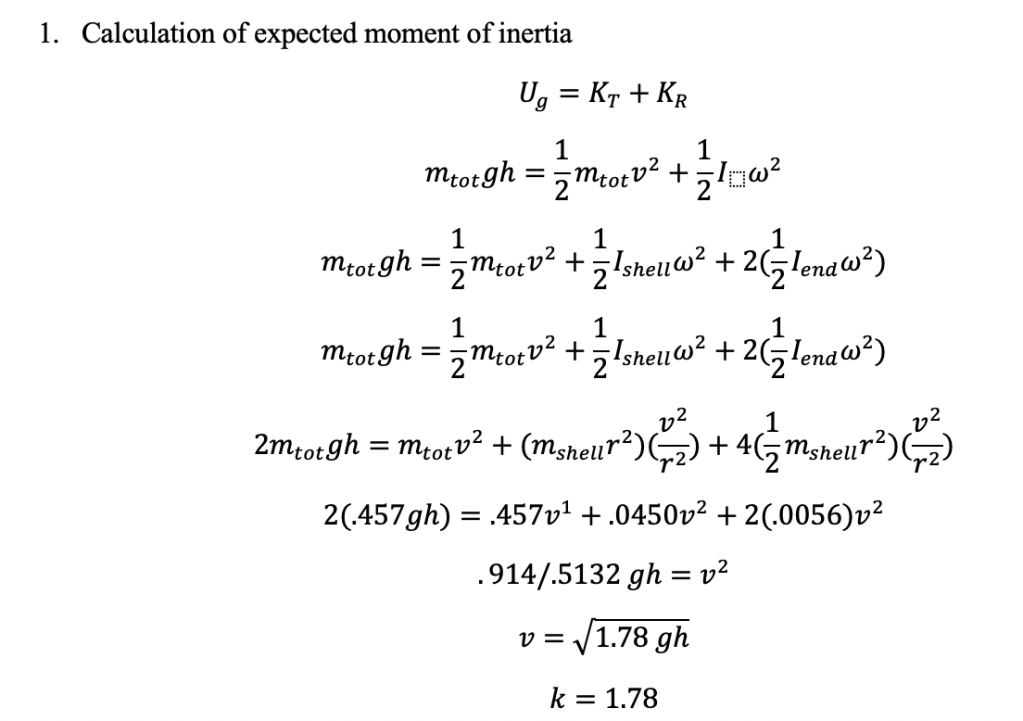
For homework I ask students to develop an expression for ANY object down the ramp. How can we do this? Well one thing worth noting is that every moment of inertia is some object MR². So let’s replace “some number” with k. I tell students they need to figure out the expression and what they will plot to yield a straight line and what the slope will represent.
The next day we review student work. It’s a cool derivation.
We get down to the fact that students need a graph of v² and height. Ok cool. But how will we compare our results? We go back to the models. Students are responsible for coming up with the velocity at the bottom of the ramp for their assigned can. For this activity I put students in ability-level groups, assigning the empty cans and the beans to the students who are usually C and lower, the broth to my B students and the mushroom soup to my A students. (more on that choice another day). After students have a chance to work through their derivation we review all of them. One of the things we discuss previously is that when determining velocity at the bottom it’s always the √number*g*h and that number is between 1 (hoop) and 2 (sliding only). The numbers we get all fall in line with our expectations and observations…including why mushroom soup and refried beans are such a close call!
Student work for can of chicken broth.
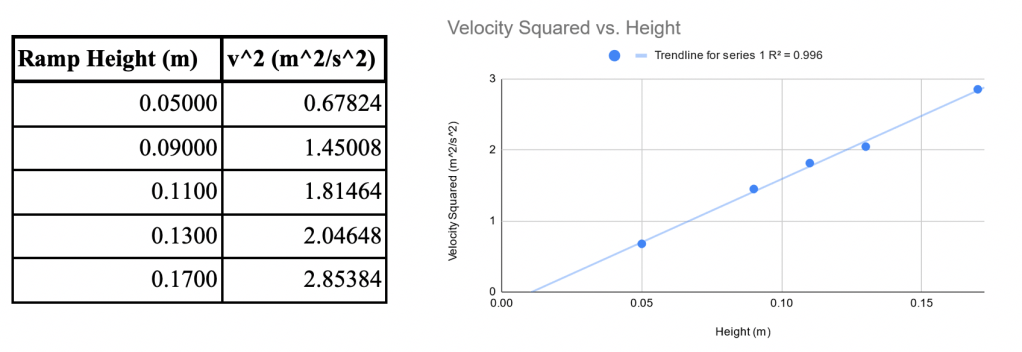
Before we begin the lab we need to have a discussion about reducing error. We have a major problem. Height is easy enough to measure with little uncertainty, but we are looking at an expression with final velocity SQUARED. This is problematic for several reasons. First, the square means that uncertainty is going to propagate and blow up. Second, we’re looking for FINAL velocity. Cherry-picking that data point is sure to be messy with tons of uncertainty and, frankly, a waste of our tools. So what IS consistent and reliable no matter what we do? Students quickly realize it’s acceleration! We know how to best collect that data from other labs: run a regression through the position or velocity graph. We can then use a spreadsheet to manually calculate the expected final velocity for a specified distance.
Students are able to get data that generates amazing straight lines and then they use that data to determine the moment of inertial of their cans.
Student data for chicken broth
Some of the cans will be pretty far off from the theoretical models, but that’s ok! We tried to really simplify something real and complex! (The original idea from which I got this the activity used cans filled with concrete and other materials that are much closer to the models.)
I think I’m ready to reflect on last school year: the year of COVID-19. While we may not be post-pandemic, and while a myriad of mitigations will likely still be in place next fall, we have three effective vaccines, and nearly no mystery left.
Over the course oof 180 days we had 4 different schedules.
For the first 130 days we had 100 contact minutes with students per week, down from what would normally be 250 minutes.
I created and recreated so. many. materials.
This was the word cloud from our employee engagement survey in September. In hindsight I’m able to see and respect the positive words much better now than a year ago today.
From our employee engagement survey. Any surprises there? And no, it’s not better now than in September. pic.twitter.com/cyKE4lRS3A
My students are far more incredible and capable than I’d ever given them credit. Even with half the instructional time, I’m pretty confident about my AP student preparation for the exam. My regular level physics students were doing incredible work by the end of the year, with much stronger evidence of learning.
I need to reevaluate my purpose. I believe my purpose is to equip students with skills to do science and to be critical thinkers about the field of science. This doesn’t require a specific number of topics, it requires depth of opportunity. In my regular level class I slowed the pace way down. Work and energy and momentum spilled into second semester and I did not get to electricity and magnetism. However, by testing students frequently, retrieval practices, standards based grading, among other things, my students truly learned and grew in ways I was surprised and delighted to see.
Digging into identity is a special privilege. I was really surprised by how much certain students opened up in their reflections. I also saw some of my students make growth in their own self-perceptions as we learned about scientist after scientist after scientist.
Where do we go from here?
The easy answer is: not back to the way things were.
We just can’t. It would make all of our time and energy this past year worthless.
I can’t go back to teaching in such a way that I lack trust in my students to truly drive their own learning
I can’t go back to teaching in such a way that my classroom is somehow a bubble of “classical Newtonian Mechanics” rather than a microcosm of the society and systems we live within.
I can’t go back to a place where compassion has boundaries, statutes and limitations.
This year is impossible. You better believe I'm taking and celebrating whatever wins I can find. I am thankful for my #ITeachPhysics community, I couldn't do this without you. I am also thankful for how much I learned in my MEd program. (we are running 8×25 min classes) pic.twitter.com/28JCpsRg1w
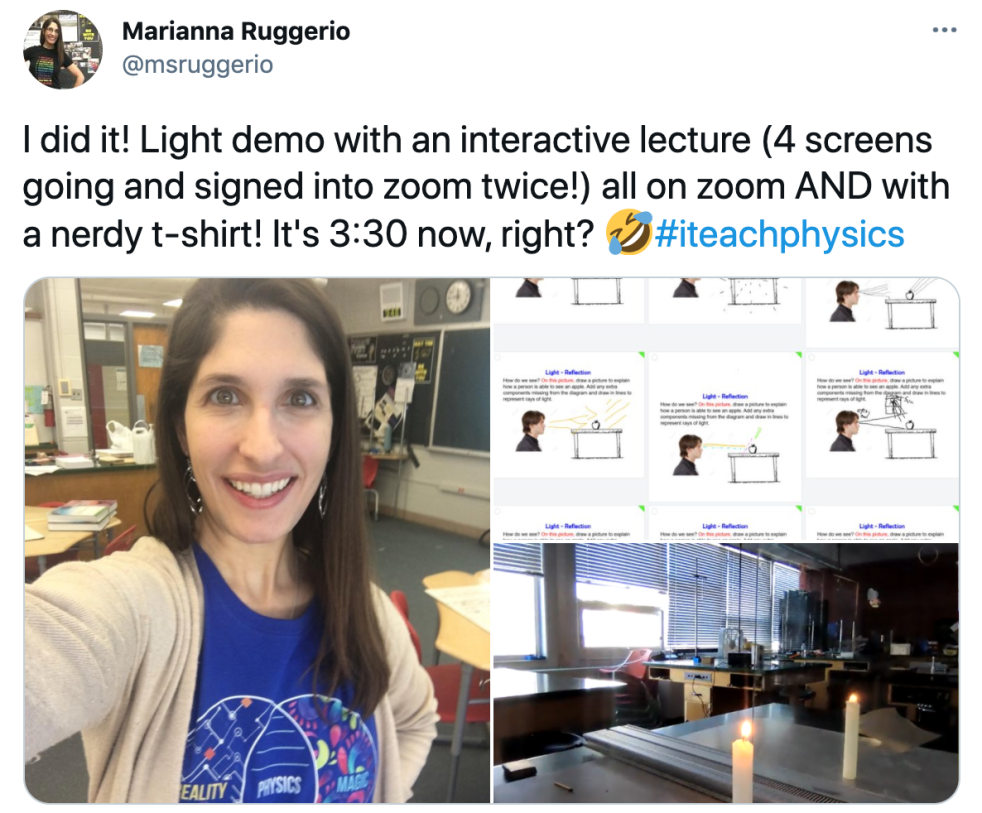
I did it! Light demo with an interactive lecture (4 screens going and signed into zoom twice!) all on zoom AND with a nerdy t-shirt! It's 3:30 now, right? 🤣#iteachphysicspic.twitter.com/0DxJ5LkYU7
Two physics Ss working on Snell's law, 2 APC Ss working on a magnetic field lab, 1 working on a test, 1 getting caught up. I had one in earlier and another one zoom in for help. Office hour time has been INCREDIBLE to TRULY support Ss, but district decided it wasn't worthwhile. pic.twitter.com/P7BKilCmA5
Seniors left today. Cue the cards Cue the tears 😭 I haven’t had a proper goodbye in THREE years since I had maternity leave the year before covid…it was super sad today! pic.twitter.com/GntAz7xPEa
One of the distinguishing attributes of first year physics students is the novice-style approach to solving problems, typically based upon common variables or equation hunting. Having students shift to more expert-like strategies, based upon more over-arching ideas or concepts is often a challenge in physics teaching. This talk will discuss several strategies implemented in an urban-emergent high school for both traditional junior level students, as well as AP level students to help shift student approaches from novice to expert.
If you plan on attending AAPTSM21 I hope you will engage in conversation with me! If not, this talk is accessible to all!
This week I had the incredible opportunity to keynote for RU’s student teacher celebration. I was super anxious about putting together such a speech… especially because I’ve sat through far too many graduation speeches I never liked… I had around 6 people read and listen to my drafts before delivering the final product. The result was deeply personal and really the product of my journey through education from student teacher until now, at the completion of my master’s.
Transcript:
On that first day of student teaching; the day we finally get to grasp the reigns; many of us believe we are more than ready to take on the world of education…though we might be grasping white-knuckled. We realize pretty quickly though that we still have a lot to learn
Two weeks into my student teaching experience I was expected to do a series of demonstrations on circular motion. You know, swinging buckets of water over your head. I had practiced the night before and with full confidence did not feel the need to practice the morning of. I got this I thought.
I grabbed the strings tied to the pie tin filled with red water, flung it over my head and SPLASH… red water everywhere…like a cheap horror flick. Except the only thing I had murdered was my pride. I learned one thing that day: always practice the demos that morning.
I proceeded to successfully complete the demo the next hour, only for my nervous fidgeting fingers to dump the water AGAIN as I explained the demo, my cooperating teacher laughing uncontrollably at me. The story should end here, lesson learned… but it doesn’t.
A week later I had the immense privilege of attending the national meeting for physics teachers which just happened to be in Chicago. I was sitting in a room with a handful of teachers I held in high regard, including my former AP Physics teacher. Teachers were presenting “take-5’s” 5 minutes to talk about a good idea for class, and one teacher shares the brilliant idea of using the cardboard circles from the pizza place as a platform for swinging water over your head.
I tried to sink low in my chair to avoid the elbowing and snickering happening next to me. After the take 5 the teacher asked if anyone wanted his sample. My cooperating teacher and his colleague sprung from their seats pointing at me: “she does!”… I was wishing I could dissolve into the chair. The story, of course, was shared with the REST of the teachers in the row (including my former AP teacher) but then…. something special happened. This cardboard circle got passed down the line of teachers and they each signed it leaving me words of encouragement and advice.
Today I have the great privilege and honor of doing the same for you. Hopefully without any embarrassment on your part.
If I were to ask what makes a great teacher we would all agree on one answer: relationships. A teacher who cares for their students as humans, shows compassion, goes above and beyond. We each know have been touched by at least one of these teachers. Many of you today might even be able to name THEE teacher who inspired you to go into the profession yourself. When tonight is over I call on each of you to send a note to that “one” great teacher.
My one is John Lewis, my AP Physics teacher from 2005 whose life and legacy continue to impact me to this day. Mr. Lewis was…quirky. His voice would crack at random, he seemed far too fascinated in minutia, and every day we started class by playing a game by his rules, not the normal ones. For example, “one of these things is not like the other” but then he would ask us to find a way to make everything go together. Mr. Lewis believed in celebrating “yes moments” which are similar to Annie’s “bright spots” but are a specific celebration of tenacity and the final breakthrough when reaching an accomplishment. Mr. Lewis continued to act as a mentor to me throughout and beyond my college years, pushing me to be involved in our professional organizations, and in short order pushing me to present..
I had the unique privilege of working with John back at my old high school. I got to observe him from a different lens, that of a colleague, and how he navigated negativity and school politics while continuously upholding his own values and morals. It is easy to believe that our systems are so broken that it is impossible to work in them when we are fundamentally at odds with the foundation of the system itself. John proved this to be otherwise: when you focus on that which you can control, you can create lasting impacts.
John’s mentorship was so subtle I almost didn’t realize it was happening. I truly believed it was my unique and special relationship…until I I met another new teacher who was also his former student. We ended up casually comparing notes and found that we had both experienced very much the same process, down to the graduation card signed “your colleague, John” this process was now revealed to me as subtle, methodical and absolutely brilliant. It has taken over a decade for me to recognize and decipher everything John did for me as a student and as a mentee, and none of this would have happened without a genuine relationship.
I want to pause for a moment and recognize that each and every one of you clearly has great capacity to be that teacher because you chose to complete this degree amidst a global pandemic. In a time where everything about relationship and connection was stripped from us. In a time of uncertainty, unrest and upheaval you finished this program and you are committed to this path. You already know that there is such a thing as depth of compassion that has no bounds, you have already gone above and beyond in so many ways and…..you haven’t even had to chaperone a field trip.
We also need to take a moment to recognize the community that formed and shaped you, supported you and grounded you. Whether this be a family member or a loved one, a friend or a faculty member. They need to know that this is their moment too. It is through the relationships around us that we are who we are.
Our very humanity is built on relationships. Relationships are the foundation that lays the cornerstone of trust, and once the foundation and the cornerstone are laid, the household of belonging can be built, and this household, when filled with the community becomes the home to many, and sometimes the children even come back to visit. Teachers do not get to know the idea of “empty nesting”.
Teaching is unique because as students we often only truly see the value of what we learned long after we have left. Eventually we realized that Mr. Lewis’s voice cracked not because he had a problem, but because we had stopped paying attention. I realized when I began teaching in the gifted academy at Auburn that the games we played at the start of class were to coax us out of offering only the “right” answer when we were sure, and make us comfortable thinking outside of the box and offering anything we could think of
As teachers we are not only shaping moments in our students lives in their present, but we are creating lessons, whether for good—-or bad, that will be carried a lifetime. This is a great responsibility. Are you creating a home of belonging for your children?
In each and every choice that you make, from the way you greet your students to how you offer feedback, to random interactions in the hallway, you are expressing to your students what you believe is important.
Relationships can only begin through communication. The words we say carry weight and the way we say them determines their value. What are the values you wish to impart on your students? Who do you see yourself as? Are you the sage on the stage, the imparter of the gift of knowledge and wisdom to your students? Or are you a life-long learner? Fallible? A leader but also member and facilitator of your learning community? Our words should create the image that we desire our students to aspire.
Relationships are built on compassion and understanding, when we listen to learn we can try to understand another point of view, even if we do not agree with it. If a student asks you a question and you can’t do better than “because that’s the way it is” or “that’s the rule” or “because I said so” you have not been intentional in your choices. Ask WHY all of the time. WHY did my student respond this way WHY do I feel so passionate about this? What does my identity, positonality, relationships and prior experience bring to this classroom? What do my students value and why? And most importantly, when you ask these questions about your students and their families, don’t answer the question based on your own observations. Ask THEM.
Relationships are the foundation upon which the cornerstone of trust is laid. Trust is being able to say every day “Center your own learning. Ask for what you need, make space for what others’ need” and to be able to give that freely, even if it wasn’t the lesson plan today. Trust is believing that each child that walks through your door wants to be successful, even if every barrier has been built around them and thrown in their path that it seems the child in front of you is choosing to disengage. Trust is the space where “I don’t know yet,, I can’t do this yet” are valued for their honesty and openness to keep trying. When we lay the cornerstone of trust we set a precedent that all answers have validity, because even an incorrect answer or an answer steeped in misconceptions is an answer of value. Conversation is more important than correct responses.
Relationships in education extend beyond your classroom. As a teacher you commit to being a life-long learner. The teacher who refuses to learn, to become stagnant in their ways because “it’s the way things have always been done” or because “it works for them” has reached a point of intellectual death. Keep your mind stimulated and alive and never be too afraid, too embarrassed or too proud to ask for help or feedback. Mentorship doesn’t end because your formal education has ended. Find your trusted group of colleagues and find a mentor (or two, or three!). They can be in your building, in another building, another district, another state even! The pandemic has shown us just how open our world can be. Go to the conferences, connect with the community, and before you even think you’re ready…. SHARE what you are learning with others in as many different ways as you can.
We think we know what is best for us as we live in whatever moment we are in, but the wisdom in lived experience is how our mentors know how much discomfort is necessary for growth. Surrounded by teachers I admired, I never felt worthy of presenting in their company. But when you keep things to yourself you are keeping a gift away from someone who needs it.
Relationships are the foundation that lays the cornerstone of trust, and once the foundation and the cornerstone are laid, the household of belonging can be built. Our students come to us with so many intersecting layers. Their identities are comprised of race, gender, class, citizenship, age, and ability. Students are also potentially coming to our classes with stereotype threat and imposter syndrome, which work together to cloud the joy and potential they could have in our classes. It is possible that for up to 17 years the child in front of you has been told explicitly or implicitly that they do not belong here, whether here means this country or this city, or this math class, or this AP class. Some of our students have been told they do not belong for so long they have no reason to believe otherwise. It is not our job to “save” the child. It is not our job to “inspire” our children. Children…yes, even the 17-year-old ones, are inspired by their natural wonder in the world around them. It is our job to show them that they too are a part of and can join the community in the areas of our expertise and passion and also how to be stewards of our world because their unique contribution based on their unique experience matters. When we show a student they belong and are valued in our world, we show them that we believe their lives matter.
I want to close with one last story. Teachers will never say they have a favorite class, but…. There are certain classes that are uniquely special. It was my 8th hour class my first year at Auburn. This class was special, not because of anything I did, but because of the love and joy of my students. In April, with only 8 weeks left, we received a new student into the class. She had moved from Chicago where she went to a magnet school and rode the public bus two hours each way to go back and forth from school. She was brilliant and motivated. She had a plan for her life she intended to execute. She was welcomed with open arms into the family home of our classroom. She shared that our class was the only one where she talked because it was the only class she felt she belonged. When finals week came around she was absent and I made the mistake of not following up. It was the last day of the school year and it’s not uncommon for students to come in and out of Rockford. I assumed she moved back to Chicago.
Summer passed and a new school year started and I ran into her in the hall. Shocked and surprised I asked her how her summer was and what happened to her during finals. She proceeded to share a lengthy story, none of which was her faulty, and resulted in her moving in with her grandma in Chicago during finals. I asked her if anyone else knew. She said no, she just wanted to get her credits so she could graduate and go to college. Standing before me was this brilliant, resilient young woman, so familiar with barriers that she had no fight left to give. I, on the other hand, was ready for battle. How could we make this girl make up 4 semester credits when we only knew her for 8 weeks? I went to the counselor and shared the story, he was on the same page as me and he worked with teachers to create a plan for the student to get her rightly deserved credits. She was able to graduate on time and with a scholarship to her college. It is important to note that this is not my success story. This is the success of that whole class who created a place where she belonged and felt valued. A place she knew she would be trusted, and that trust formed through the relationships in that class.
Relationships are the foundation that lays the cornerstone of trust, and once the foundation and the cornerstone are laid, the household of belonging can be built, and this household, when filled with the community becomes the home to many. What is the house that you will build?
Teaching during the pandemic has created a heightened sense of every emotion imaginable. Teachers were shocked and enraged that districts would ask them to return to the classroom in the fall. Scared about the safety of themselves, their own families and their students. Overwhelmed by the demands placed upon them to reinvent their craft while simultaneously needing to engage more with students, connect more with families, communicate more with colleagues. The sheer amount of “more” is enough to feel like we are drowning.
As many schools begin to reset, and in some cases reinvent themselves, it’s easy to ask “can I really do this any longer?” the answer to that question inevitably will have to be “yes” for most teachers, but how?
Teach with compassion. Many teachers have been doing this from the start, but it remains an important reminder. What is it you hope to truly teach and instill in your students? Is it a large collection of facts or is it more than that? It is easy in any year to say “that child is failing because they will not engage” and place the blame on the student, the parents or the environment. While this is never the right approach, it is even more problematic under the current circumstances. Behind the black boxes and muted microphones there are real, live children. Many of whom want desperately to not fail this year, but often lack the courage to ask for help. Many of them already blame themselves for their apathy and lack of motivation. It is upon us to teach with abundant and unending compassion.
Practice genuine gratitude. When yet another change comes down the line it is easy to quickly become upset, apprehensive and defensive. The complaints begin to gush like an open hydrant, often directed at individuals who barely have more control than we teachers do. When everything is manageable we tend to keep our heads down and just do the work. Take a moment to look up for a moment and express genuine, specific gratitude. Share it with your students, your colleagues, your administrators. We all need to be teaching and leading with compassion, and part of compassion is the ability to share appreciation.
Find and celebrate the bright moments. There is no doubt that this is one of the most challenging school years for all of us. There is no debate that the vast majority of this school year is dark. For this reason it is all the more important to find the bright moments. What has the pandemic caused you to do to or learn or focus upon that you might not have in another year? Who has been a source of comfort or stability at this time? When did your students impress or surprise you, even in the face of everything we are struggling with today? Name those moments. Write them down. Share them with someone trusted.
When met with the fire of adversity we have two choices. We can let it burn us alive, or it can refine our personhood leaving us stronger, wiser and more compassionate towards those around us.









 Physics.Teacher.Momma.