In My Class Today

Flying a Plane with a Falling Bathtub

It’s 2014…I’m teaching 5 sections of Earth Science and visiting my parents. They have PBS on and we’re in the middle of this documentary about World War II. Except it’s not quite that, it’s actually about one of the escape attempts from Colditz Castle: the place where any POW was sent if they had attempted to escape the German prisons.

Now just imagine that for a moment.

It takes a special kind of person to plan, execute and attempt an escape. You need to be creative, clever and bold. ::cough::gifted kid::cough my students relate strongly.

And then the Germans think it’s a good idea to put all of these brilliant, audacious minds in one place.

So one of the prisoners gets this idea: let’s build a glider out of the stuff laying around the castle and launch it off the roof by attaching it to a bathtub. It’s a crazy idea, and it’s a perfect two-body physics problem, and I’m going crazy that I can’t show this movie to my students right now.


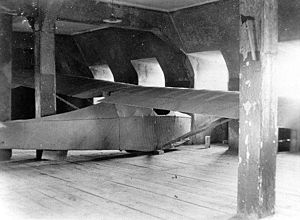
Originalglider
The original glider from 1945


Now I teach a full load of physics and it is an annual treat in my introductory course. First, I have my students decide what types of things will need to be taken into consideration. The questions fly: where did they get a bathtub? Where did they get concrete? How did no one see them? They actually built the glider?

Then I have them do the two-body problem. I have had them calculate whether the original specs would have allowed the plane to fly, and also had them calculate the drag force from the test run on the model Professor Hunt riggs up when they need 1.1g.

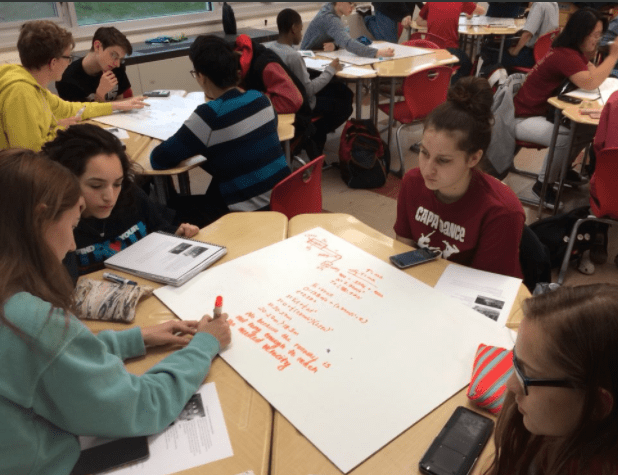
Screen Shot 2017-11-02 at 9.10.58 PM

The students get an incredible history lesson, and get to see the physics they just learned in legit action. I always pause the video when Professor Hunt is rambling off how he analyzed the data to determine the plane’s acceleration and ask my students if they caught it all. Then we go back to the video of the launch. LOOK! There are distances marked on the runway! We discuss how Professor Hunt would have determined the acceleration. How plotting d vs t is the best option. How we’ve been doing precisely that with the motion detectors in our recent pulley labs.

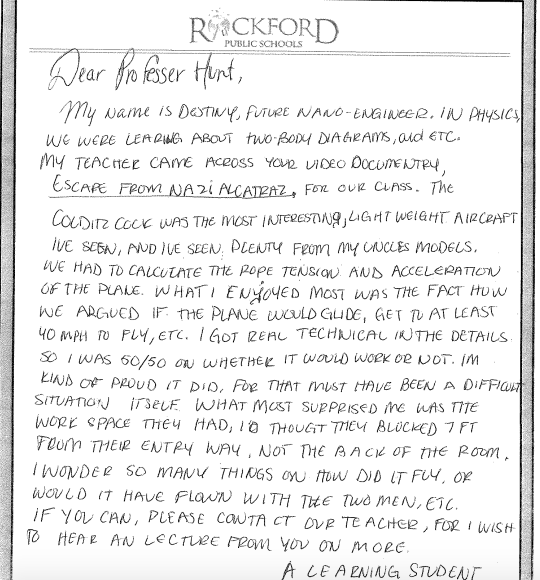
My first year doing this I split the film up over the course of three days. On the final day I asked my students to write reflective letters to Professor Hunt.

Screen Shot 2017-11-02 at 9.07.16 PM

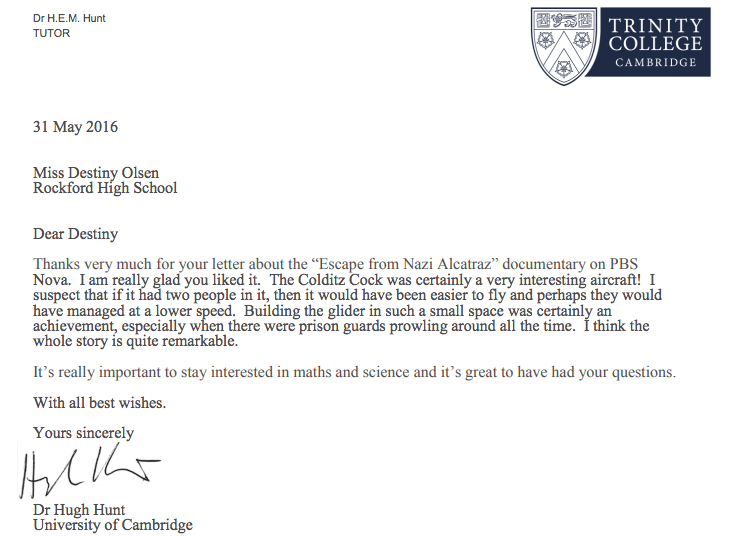
Professor Hunt actually obliged and wrote personal letters to each of the students!

Screen Shot 2017-11-02 at 9.09.01 PM


I think it’s an amazing story and my students get a lot out of it each year. When I set the video up for 7th hour after AP Physics C one of my students said to another, “oh look what they’re watching today! I love that movie!”


Teaching Methods

Modeling vs Intentional Modeling

“I use modeling, do you?”
“Uh…no, but I’m interested in learning about it”

I felt like such a noob when I had this conversation a few months ago because literally, everyone else at my group seemed to be doing this already. I was at a workshop on whiteboarding after a talk on standards-based grading and modeling and I thought, “wow, she really has it together… I have a LOT of work to do” (Does anyone else have this overwhelming feeling of inadequacy in the classroom all. the. time. or is it just the mom-guilt extended into the classroom?)

So I have started incorporating some things here and there as I’ve gone along, and I recently looked into Etkina’s resources (I started using parts of her book last year). As I poured over Etkina’s labs and our workshop speaker’s resources I realized: I HAVE BEEN DOING MODELING ALL ALONG! Mostly because it’s just the way I already think about problems. It just didn’t have a fancy name, and more importantly, I wasn’t always doing it intentionally as a teaching strategy.

I’ve decided that the intention is really the key in modeling as a teaching strategy. I think good physicists are good at models but bad at teaching them. We do it so seamlessly in our own work we fail to realize that type of thinking is not seamless or natural to the general public.

Cue modeling curriculum

Models are just any representation we use for a situation: pictures, free body diagrams, motion diagrams, graphs, mathematics etc. We need to work our kids like gymnasts, very intentionally using and practicing these models so that our students become flexible and natural at using them on their own for any scenario.

This is the paradigm shift: teach the model first, and the physics as a result of the model. Too often physics teachers (especially physics teachers not trained in physics) teach all this physics stuff, then all these equations for particular problems and then maybe shove in some graphs at the end. The problem is that students fail to see the bigger picture and physics becomes a class where students are attempting to memorize a million procedure for a million different problems, rather than learning a handful of approaches and selecting the best one or two for the problem at hand. The clearest example of this in my current classroom is how I am teaching two-body problems. I have made a huge deal about the fact that all of the physics is in the FBD. Because learning the general process for FBDs is a lot easier than trying to memorize separate processes for ramps, Atwood machines, modified atwood’s and oops! Now there’s friction!

The next most important part of this is to teach students how to communicate with one another using their models, and this is where the value of whiteboarding comes into play. I believe very strongly in letting the kids move around the room to see whiteboards without having a board representative at each board. The reason for this is that the students begin to realize that it’s hard to make sense of what someone has done if you don’t provide enough detail. Students can then ask these questions and leave them at the board before we come together as a whole group for discussion.

I decided to use modeling very intentionally in the classic coffee-filter air resistance lab. The original lab I had snagged from someone had a bunch of background info and then asked students to skets the velocity and acceleration graphs. I got really tired of marking the same things on everyone’s papers last year and realized this year that this is a perfect opportunity for modeling.

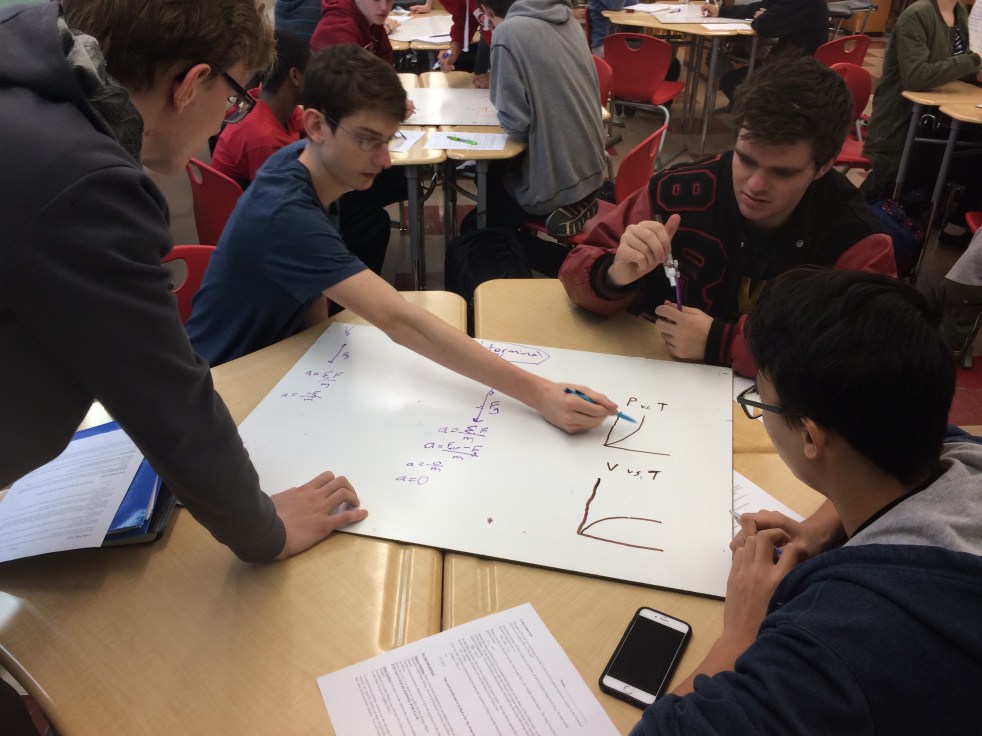
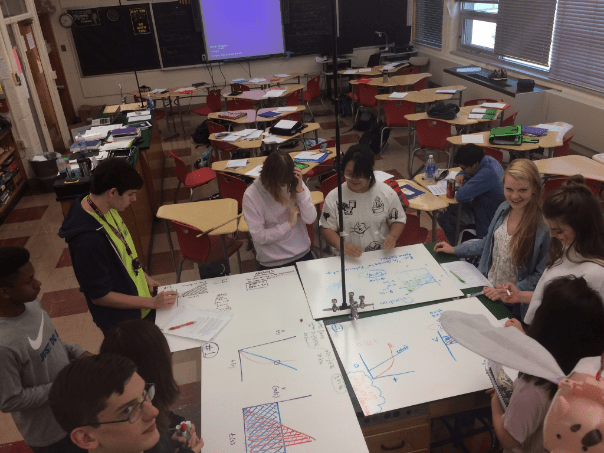
When students walked in today their desks were in groups of four with a whiteboard. I asked them for the following

  1. A free body diagram at t=0, sometime before terminal velocity, and at terminal velocity
  2. Acceleration expressions for each of the diagrams
  3. position, velocity and acceleration vs time graphs.

IMG_1632It was so cool to watch them work, discuss and argue. The FBD’s were relatively easy, the discussions mostly about whether or not to put air resistance on the t=0 diagram.

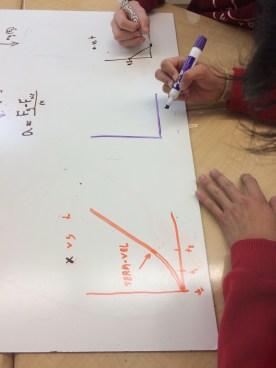
The discussions about the graphs were far more interesting. Many students were working with the graphs as unique units, rather than considering the relationships from one to the next. Inevitably we had piecewise acceleration graphs and linear acceleration graphs and linear piece-wise vs curved velocity graphs.

IMG_1633


I asked the kids to cite similarities and ask questions about differences. One group today started changing their board before attention was drawn to them. It offered a fantastic opportunity to review the graph models and review the relationships.

One of my favorites was a group that decided the curve of the velocity graph was quadratic, so they started taking the antiderivative for the position function. They noticed the constant slope portion in many of the other graphs and asked the question about it. Then they realized (#overachievers) the velocity graph wasn’t really quadratic.

I realize this particular example isn’t quite model-based learning through and through as I did not allow them to experimentally discover the exponential function relationships, rather after discussing that all of these changes were continuous I gave them a brief taste of the calculus/diff eqs ending in “solution is always in the form….” and hey, doesn’t that look like the curve we agreed upon?

We only collected data today, so I’m really curious and excited for what their write-ups are going to look like Wednesday!

I’ll keep you posted 🙂


Classroom Issues

Squishing Miss Giggles

We have a problem.

It’s a big one.

And it’s one of those problems we, as teachers, need to fix.

Unfortunately, some of the teachers are part of the problem.

msgigglesHer name is Miss Giggles. She’s actually a virus. She preys on girls who either lack confidence in their skills or actively hide their skills in order to maintain social status. Miss Giggles boasts a high of popularity, boys, and conformity.

The reality is much darker.

Miss Giggles undermines that which is unique about a girl who is talented. It undermines the strength of a woman. And it forms a false perception of the girl she has infected, to her future detriment.

You would like to think that as this girl matures, goes to college and enters the workforce she will develop antibodies to Miss Giggles and move on. Unfortunately, that is not so.

I had attended a physics teacher association meeting and a colleague infected with Miss Giggles got up to present. She literally giggled during the whole presentation. I know this is her personality, and I also know she is an amazing teacher and brilliant, but quite frankly in front of our group of peers, in that moment, she came off as silly and stupid. In fact, they were unable to answer the question they had sought out to answer in the first place, so by ending the talk with a jovial, “and we have no idea” and a laugh, it seemed as if she had wasted the mega-grant she had obtained. All the while, her arguably inferior male partner came off as put together and knowledgeable.

At a meeting at the start of the school year, we were asked to watch a video an give our impressions. Nearly every female gifted teacher who responded started her response with “I’m sorry if this isn’t right, but I thought…” I was infuriated. WE WERE ASKED OUR OPINION! YOU CAN’T BE WRONG. And yet my female colleagues were dumming themselves down in front of our (female) principal and peers.

Psychology tells us two things: first impressions are quick to form, long-lasting and difficult to change.

Miss Giggles creates a grave problem here: she creates a first impression that is incorrect, but very difficult to change. Meanwhile, we live in a world where women still strugle to have equal status with men and are minorities in highly technical fields such as physics. We have to prove our worth moreso than our male counterparts. Yet, there are a huge group of women who are undermining these efforts for equality!

I often have this conversation with my students: first about the science of impressions, and second that people will form those impressions based on how you carry yourself and how you speak. (Since they are formed in the first 10 seconds). Too often our girls will sell themselves short, “I don’t know anything! I’m going to fail this test” and more often than not, these are the smart ones. I quickly and semi-jokingly snap back at them and follow it up with a lesson in gender bias: first of all, everyone is going to believe you and judge you and secondly, would you ever hear a guy saying that? Does that mean he is actually smarter than you? Obviously, the answers are no and no. In specific cases I have had more serious, private conversations because when I know the student plans on majoring in engineering or physics I tell them that that is their goal this school year: to work on their presentation of themselves as confident and intelligent, because they are.

As teachers, I believe we have an incredibly important role with our students as mentors. First to model behaviors of strong, capable women, and secondly to tell them to cut the crap when they start exhibiting any symptoms of Miss Giggles.

I really think Hidden Figures was an incredibly powerful movie. Not just because of the story it told, but because of the brilliant job it did at portaying these women’s personalities and attitudes in a man’s world where they would certainly not be viewed as equal by their peers.

In her commencement address for Hampton College Katherine Johnson said, “Whatever I’m doing, I do the best that I can, not the best that’s available, but the best that I can, so I can’t give you any more, you have to get something more from someone else. But at all times, at all times, I do my best. You will do better if you cause other people to want to learn and you will do it better, too, all the time. You want to learn, want to teach, want to help.”

Her words are so wise and I think should be taken to heart by each of our students. Be your best. Be confident in your best.

Food

Great Balls of Fire Exhibit, Bean Science and French Soup

IMG_1595

The last few weeks have been jam-packed. Adrian’s birthday, then parent-teacher conferences immediately followed by my brother in law’s wedding in Vermont, come home to preparations for the bishop’s visit for our parish’s 60th anniversary, and finally the fall ISAAPT meeting. All good things, but it has sure been a whirlwind! Somewhere in the middle of that is meal prep and laundry and house cleaning.

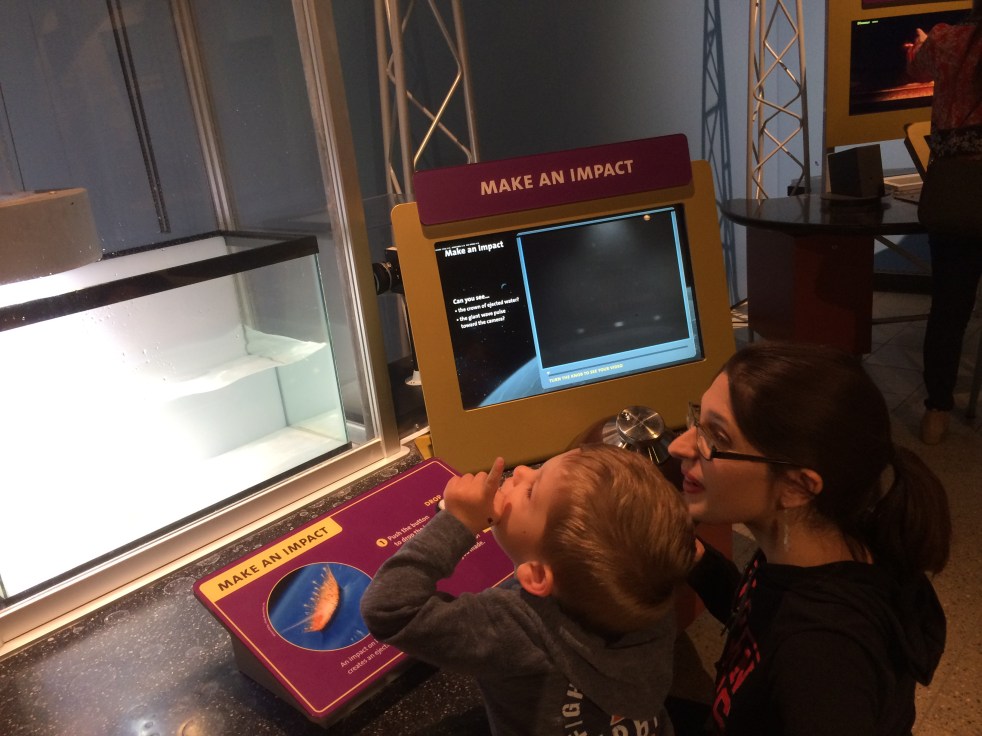
So I am relishing in today more than usual. Adrian is up at 5:30am regardless (I am dreading the arrival daylight savings!) so after grocery shopping, cleaning and laundry it was finally 10am and we went to the Discovery Center science museum, where my sister works, to visit the new traveling exhibit, “Great Balls of Fire”.

IMG_1583.JPG
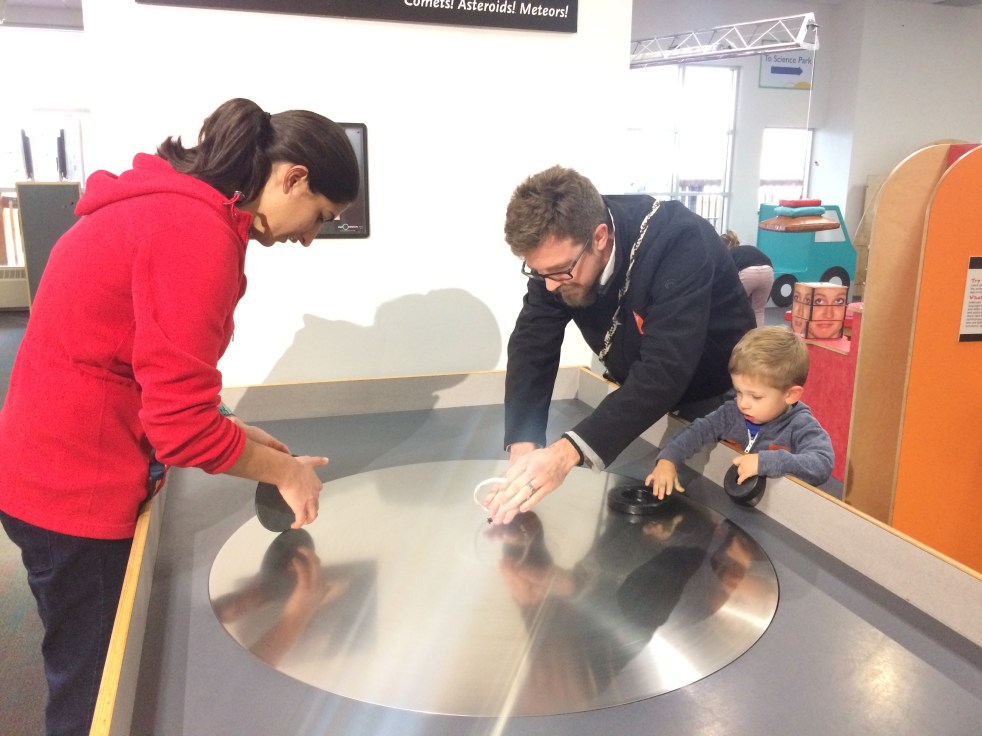
A disk of mass M and radius R is positioned on a rotating turntable with a coefficient of friction 0.2 such that its tangential velocity with respect to an observer is zero…or so we attempted…

The exhibit was pretty awesome. My favorite was the solar system simulator. You could add any component. Putting suns on top of each other generated larger suns, which progressed from red dwarfs all the way through to black holes. I was really excited about creating a binary star system that eventually collapsed, but alas, the simulation was made prior to the detection of gravitational waves so they were not modeled. Major bummer!

IMG_1587
My binary star system. My sister kept adding elements to my system. We may have been acting like 10-year-olds, but we don’t discuss this. 

When we came home I made one of our favorite French soups. It’s filled with creamy white beans and flavorful andouille sausage. I mixed in our recently harvested garden herbs and served it up with a slice of chewy baked ciabatta…heaven!

Unfortunately, when I opened the bean cans I found that nearly all of the beans were already split. Sadly this was because I didn’t bother to soak dried beans the night before.

But what is really the best way to soak beans?

Guess what…it’s not in your tap water! And DEFINITELY not in our super-hard Northern Ilinois tap water.

You see the beans’ pectin molecules are bound tightly together by calcium and magnesium ions. When the beans are soaked, the skins break apart.

Screen Shot 2017-10-28 at 2.24.14 PMAdding salt to the soaking and cooking water causes a replacement reaction, the sodium replacing the Ca and Mg, and this results in the pectin becoming far more flexible and the skins become elastic and soft allowing them to swell without breaking! You can read more about the science behind beans and some other tests here! (My favorite cookbook!)

And now, without further ado… my lunch for today!

FRENCH BEAN AND VEGETABLE SOUP

IMG_1612

  • 8 ounces flageolets or any white bean (or 3 cans)
  • 1 garlic clove, smashed and peeled
  • 1 bay leaf
  • 2 tablespoons olive oil
  • 1/2 pound andouille sausage, sliced
  • 3/4 cup, chopped leeks
  • 3/4 cup, chopped shallots
  • 1 can tomato paste
  • 3 cloves garlic, minced
  • 1 1/2 teaspoons thyme, minced
  • 1 teaspoon herbs de Provence (who do you think I am? I don’t have this on hand, I add a pinch of sage, rosemary, thyme, and oregano)
  • 1 cup sliced carrot
  • 1 can, diced tomatoes
  • 3/4 lb baby spinach
  • 5-6 cups chicken broth


If Using Dried Beans:
The night before, soak the beans in a bowl of water (with a teaspoon of salt!) with about 3 inches water over the beans.

The next day, drain the beans and transfer to a pot.  Add the smashed garlic, bay leaf and 6 cups of water and more salt! Partially cover and simmer for an hour and a half, or until tender. You may need to add more water depending on how the beans absorb the liquid.

Meanwhile, heat olive oil in a dutch oven over medium heat. Cook sausage until browned. Transfer to a plate and remove the majority of the fat, leaving about 1 tablespoon. Add the leeks, shallot and season with salt and pepper. Once they have started to soften, add tomato paste, garlic, thyme and herbs de Provence.

Then add carrot, tomatoes, canned beans (if using), sausage and chicken broth. Cook for about 10 minutes or until the veggies are just tender. Add the cooked, formally dry beans to the soup. Stir, taste and adjust seasoning as needed.

Teaching Methods · Uncategorized

Teaching to Reach the Introvert

My second-grade teacher called my mom concerned that I didn’t play with any of the kids at recess: I read a book under a tree instead. When my mom asked if this was a problem the teacher reported that I wouldn’t have any friends. I was elected to represent our class for the school council that year.

Research indicates that as much as 50-74% of the population is extroverted. It is generally viewed as a valued quality: put yourself out there, be friendly, be social. These are the rules society dictates whether it is on the elementary playground or in the workplace. Our culture favors extroversion, and many of the qualities associated with introversion are erroneously viewed as a failure to be able to advocate and insecurities with oneself.

Nowhere does extroversion seem to get a higher reward than in the classroom.  There is a huge emphasis on team and group projects, and the excellent teacher is often seen as the one where energy runs high in the room, rather than examining student behaviors and conversations. During the majority of my high school experience, most classes had a participation grade. If I did not speak in class I was guaranteed nothing higher than an 80% for participation, regardless of the fact that the rest of my work was A-work. I despised the participation grade. Some teachers pride themselves on their use of the Socratic method, but research has indicated that it’s execution this can offer the opportunity for gender bias: male students are more likely than female students to shout out or offer answers to questions, regardless of if they are correct. Teachers, in turn, are more likely to respond to those students and the quiet students are left in the dust.

I want to make perfectly clear that I am in no way, shape or form suggesting that classroom participation, presentations, and conversations should be abandoned, far from it! All of these skills are important and required for any field and for success. At the same time, if we are trying to reach all students in a way that they learn best, then we have to offer comfortable environments for the introverts in addition to the extroverts.

present
One of my extroverts discussing the solution to the problem. All students in this group worked on the same problem in pairs, then came to consensus before presenting to the class

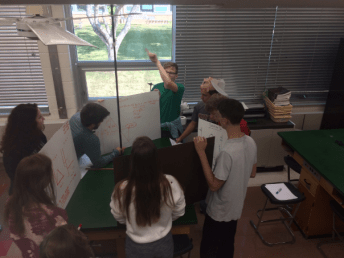
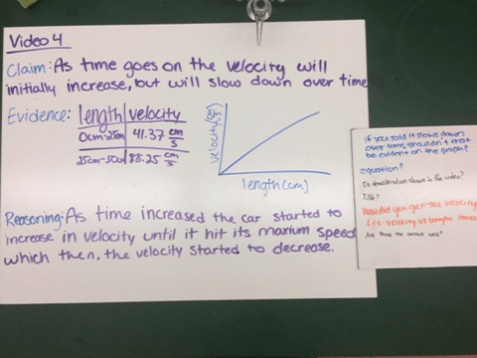
Science is all about collaboration and presentation. Students who think otherwise are in for a very rude awakening as they approach their senior year of college and enter the workforce or graduate school. A method I have recently adopted is whiteboarding. At the spring meeting of the Chicago Section of AAPT, Kelley O’Shea presented on standards-based grading in physics and lead a workshop on whiteboarding methods. (See her blog!) One of the most important aspects of whiteboarding (and teaching, for that matter) is fostering an environment where it is safe to share and safe to be wrong. In the lab setting, this consists of all of the students putting their lab results on a large whiteboard and standing in a large circle. Students comment on similarities and ask questions about differences on the boards.


whiteboard1
Sample board and commentary from students. Students assess each other’s final answers and reasoning in addition to the quality of the presented work. 

I have used this method in my teaching, but I have also included a variation on the model. Occasionally (and in the interest of time and space) I have students circulate the room to examine each of the boards. They are still asked to consider similarities and differences, but I ask them to write questions and comment down on a smaller whiteboard next to each of the large ones. After we have done this, students return to their boards, read the feedback and then I open the floor to comment on similarities and differences. This provides the introverts with a huge advantage: they still get to collaborate in their small groups, but they receive the wealth of information in the large group as well as having another avenue to participate in the whole group discussion.


The second whiteboarding method I find to be highly effective with my introverts, shy students and students who struggle is what Kelley fondly dubs, “whiteboard speed dating”. In this exercise, students are paired at a board and the entire class is given the same problem. Here’s the catch: the problem is goalless, it does not end in “calculate the _____”. Students are two write anything on the board they can (diagrams, equations, graphs, etc) in the time allotted (1-3 minutes). When time is up, partners split, everyone moves around the room to an adjacent desk and now they have a new board, a new partner, and a new perspective. The first time I tried this I, admittedly, was anxious for my most introverted student. She did not speak. ever. even to me. ever. even when asked a question. about anything. Within 3 rotations she was explaining the problem to her partner, and I’ll add: not a student she typically worked with. Working in this manner gave her the confidence to collaborate with another student. Would she get up in front of the class and explain the problem? Not today. But maybe eventually.


Uncategorized

“Don’t be scared…it’s me. Love you”

The title is the first instant message sent by AOL instant messenger in 1993. I find it to be a fitting start to this blog.

13 years ago I was one quarter into my junior year of high school. I was unwillingly forced into my first physics class and within a week I was hooked (thanks mom) My teacher seemed to be on one too many Mountain Dews…he talked more rapidly than I do (I talk really fast), he was excited all the time, and clearly brilliant.

At the same time, I was enrolled in a precalculus class with a teacher who often made me uncomfortable, his familiarity becoming increasingly bothersome.

By the time November rolled around I knew exactly what I wanted to do with my life: Physics. I was going to apply to the most elite Universities, explore the possibility of engineering, but still a 100% focus on physics and awesomeness. I was infected with an overwhelming amount of excitement and I literally could not stay in my seat during class. November was also the time for course recommendations for the following year. My math teacher did everything in his power to tell me I was inadequate and I had to fight tooth and nail to get into AP Calculus. My physics teacher, on the other hand, suggested I take AP Physics. I was so nervous and shy that I could not muster the gumption to assert that was the class I deeply wanted prior to him suggesting it. When he did I shook my head vigorously.

In the years following I had mostly excellent instructors, mentors and role models. First and foremost my AP Physics teacher, John Lewis. I can only dream to be half the teacher he is. His methodology and pedagogy were so subtle I am still recognizing and uncovering his amazing talent as a teacher.

In college, I was fortunate to not only have amazing professors, but amazing friends, starting the Society for Women in Physics at the University of Illinois at Urbana Champaign and all the while learning how to become a strong, assertive woman in STEM.

Now, I do the very thing that got me started in the first place: I teach high school physics. Too often my graduation plans were met with an unenthusiastic “oh” by my college professors. I was one of the drips leaking out of the pipeline, not pursuing the ultimate goal of the PhD. It made me question if I was settling for less than that which I was capable.

Yet I realize that my work is the only work I could ever pursue with as deep a passion and energy as I do. That is only topped by my work as a wife and mom.

I do all three. I am a Physics Teacher Momma