
A few weeks ago I posted the article We Did Improv in Physics which outlined my four-day mini-unit emphasizing communication and presentation skills. Students did this in a number of ways including deconstructing TED talks, writing a blog post about their research, and giving a two minute impromptu version of their talk, in addition to the improv workshop. While the energy and the feelings in the room were fantastic, I also collected survey data from students that I’m going to share here.
Overall Results
Before we started the unit I asked students a number of questions around presentations. One of the prompts ask students to rate their confidence when presenting in front of peers from “Very Anxious” to “Very confident”. When the unit ended I asked them how they were feeling about presenting their physics projects. The results were astounding.
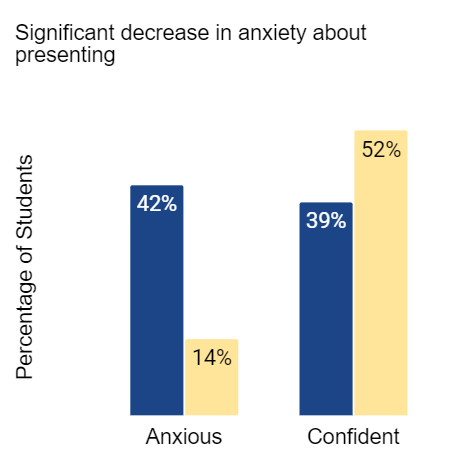
While the four day experience wasn’t quite enough to build substansial confidence (increase from 39 to 52%) the amount of anxiety significantly decreased from 42% of students reporting some level of anxiety to only 14%. About half of these students moved from anxious to neutral and the other half moved from anxious to confident.
Students were also asked to rate the statement “Being able to give presentations is an important skill for me to acquire” the number of students who marked “very important” doubled from pre to post assessment.
Students were also asked what the single, most important aspect of an excellent presentation was. While many of them stated “audience” there were also a great deal of other responses such as confidence but also things like structure, organization, and knowing your own material well

After the mini unit these responses were reduced to those that were emphasize from the lesson. An increase in the response “audience” was noted as well as an increase in mentions around the visuals. Noticeably less was “confidence”

Student Feedback On Activities
Students were prompted “Considering your final presentation, how valuable were the activities around dissecting the various talks?” Student rated on a 5 point scale from “not valuable at all” to “very valuable”. A summary of student responses for each of the three activities is below.

Turn Your Paper into a Blog Post
56% of students found the blogging activity to be useful, with only 8.7% of students reporting it was not. Some of the comments are below with scores in parenthesis:
- It helped to see how there was a different type of communication between presentations and the lab report itself. (4)
- It helped show us how to communicate our project in an understandable, engaging, and quick way. It used common language like our presentation will. (4)
- I felt like the activity where you turned the report into the blog was helpful because it showed how you would convey your report to an audience rather than someone reading it just for information. (5)
- By doing the blog post and using informal words I realized that this physics presentation was more like a conversation between our peers. We were just sharing our finding with one another and the blog post helped organize all this information. (4)
Interestingly, the students who rated the activity low still reported the value in the activity’s intention, demonstrating that the low score had more to do with their perceived needs than the intented learning.
It was somewhat helpful for making the presentation interesting and easy to understand. However, I didn’t find it helpful for actual content which I’m more concerned with. (2)
Data Viz Presentation & Evaluation
87% of students found the Data Viz presentation helpful. I think this is interesting because this was the one “lecture” that was provided and I know my students tend to prefer lectures. Still, there were some great reflections from students:
- I did not realize how much detail is given into making slideshows. For example, I would have never thought about making slides colorblind proof. (4)
- I especially liked this activity because it enabled us to visualize what we could change in our presentations through using new strategies. I especially found important how we learned to use less words and things on each slide, making them simpler. Also, the rule of thirds was a good guideline for how we laid out our slides. (5)
- It helped to see the ways the data can be shown to not over power the audience with so much information at once. (5)
Improv Workshop
48% of students found the improv workshop to be helpful with only 8.7% reporting it was not helpful. There are a couple of pieces of evidence from the commentary that support these low numbers, even though there were drastic results observed in the pre- and post- presentations. Firstly, the intention of the activities was not clear to students until we debriefed. We did improv on a Friday and debriefed on Monday. Secondly, the workshop put students very far outside of their comfort zone.
Overall Impact
Overall students were very positive towards the mini unit. A few comments of note:
- I think it was really valuable to have this unit because none of our other teachers really sit and go through what a generally good/well-rounded presentation should look like, they only focus on content/course specific presentations
- It felt like a breath of fresh air, and made me realize that communication is a huge skill in in physics apart from problem-solving obviously.
- I think that unit is helpful when it comes to sharing your findings with other people in an effective manner. I learned quite a bit about how to construct my slides to show only the important information. This unit is also helpful in feeling more comfortable presenting in front of your peers.
Students were also asked if I should run this lesson again. Every student except two said “yes”. The two exceptions marked “maybe”. Of note is that the two “maybes” expressed discomfort with the improv workshop, but had generally favorable commentary regarding the other activities.
Honestly, the results are beyond what I was hoping for. This is something I will absolutely continue.

 Physics.Teacher.Momma.
One thought on “SciComm Unit Results”