
Shortly after completing my MEd I was asked to teach the intro to educational psychology course at Rockford University. The course had recently been redesigned to focus on cognitive psychology and the science of learning. Eager, I looked around for other models at various institutions and reached out to a few collegues. One of whom referred me to the book “The ABCs of How We Learn.” It’s a wonderful and digestable text that goes into the research, provides some examples and good/bad uses of each strategy.
At a recent institute day the keynote speaker shared that in his personal research he found that, on average, teachers could only name and accurately describe three strategies they use in the classroom. So, here’s my challenge to myself: 26 strategies and 26 direct applications to the physics classroom.
A is for Analogy
What makes an analogy? Can you name one in physics? God please not the water pump as a circuit example. An analogy is where two examples have the same deep structure. Analogy then becomes a valuable tool for helping novices begin to pay attention to deep vs surface structures.
There are two ways in which we use analogies. The first is the one you are probably thinking of when you consider analogy… the water pump for a circuit, or lanes of traffic to explain what happens to current in series vs. parallel. As teachers I think we use these examples readily in the classroom as we make abstract ideas more concrete.
There is, however, an additional way to use analogy and that is by taking two or more examples and asking students to identify what about those examples is similar. I noticed that my students this year were having a more difficult time that my previous students making this leap. Have your students ever said to you “but you never taught us this problem!” or “you need to show us more problems!”. It’s not really the number of problems, it’s really a transferrence and deep structure problem. Students are not recognizing that the problem at hand is, indeed, the same problem.
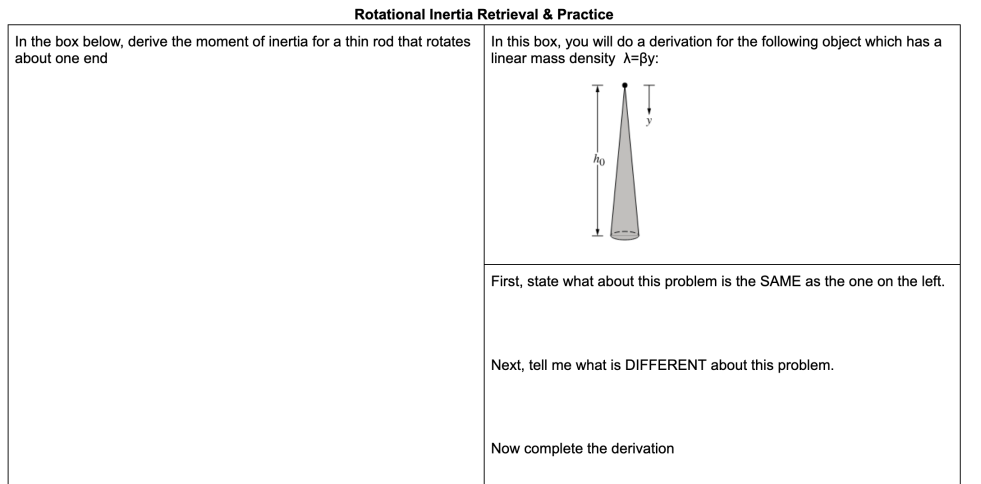
To address this I decided to set up a two-for-one cognitive strategy task (document here). First, I asked students to retrieve the worked example from the previous day. In the first instance of this task I asked them to retrieve the derivation for the moment of inerta of a rod about its end. Next, I provided students with a similar, but different problem.
For this first task I felt the problem was almost too similar, but their hesitation proved otherwise. The task was to derive the moment of inertia for a triangular rod about its end where the linear mass density was provided as a function of position. (see below)
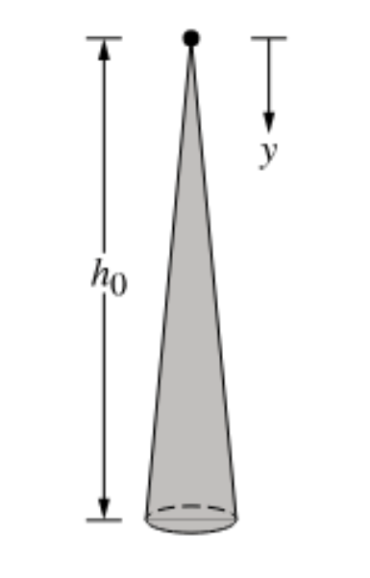
However, what I asked students to do first was to identify what about this problem was similar and different to the previous problem. After they took a stab at this we regrouped so we could discuss what I was looking for. It is similar in that it’s the rotational inertia of a rod-like object about its end. It’s different in that the linear mass density is non-uniform and is a function. Then students executed the task. As we moved through the rest of the rotation unit (where analogies abound!) this became my go-to phrase! “Before you begin, what is similar and different to what you’ve seen before?”
 Physics.Teacher.Momma.