“Legacy. What is a legacy? It’s planting seeds in a garden you never get to see.” Hamilton the Musical
I continue to reflect a great deal after the AAPT winter meeting this year. This year we are celebrating 40 years of the Physics Teaching Resource Agents and Karen Jo Matsler gave one of the plenaries. During her talk I couldn’t help be realize the legacy that I’m connected to as a physics teacher.
Karen Jo Matsler Recognized with AAPT’s 2025 Melba Newell Phillips Medal
One of the most bittersweet encounters is that with a well-loved teacher who is retiring. Over the course of a 35 year career that teacher has potentially impacted as many as 5000 of their own students, and that excludes the many more they may have impacted through extra curriculars. The best teachers become legends in their communities, and as those students grow into adults they continue to share the stories about how their teacher made a difference. I know I continue to do the same to this day.
But when a teacher retires from a school, their legacy is rarely left in the building longer than a year. A new teacher fills their place and within a single year the program either shifts into a new entity, or, in some cases, is completely decimated.
The very real truth about teaching is that although teachers leave an impact that lasts forever on their students, there is no legacy left in the very place where they poured all of that work and love.
However, that does not mean that there is no place for teachers to leave a legacy.
It is in the professional societies that legacy lives on.
I saw this while listening to Karen Jo’s plenary. Slides filled with photos of activities, demos and labs that I grew up believing were specific to the teachers in my area. No, it wasn’t that. Many of those teachers were also involved with PTRA. They brought their learning back and forth from PTRA, AAPT and their local communities.
I saw this in an interactive session I attended. At the end of the presentation I was in the back with two college faculty and one shared that she loved seeing this presentation, shared as the teacher’s own, which originated from the work of Alan Van Heuvlan. We proceeded to talk about how Alan was her adviser.
I saw this when Duane Merrill offered a presentation about creating community around “Phood, Physics and Phun”, which is also the tagline for Chicago Physics Northwest meetings.
I encounter this with nearly every conversation at AAPT, especially those who are near retirement. Each of us was inspired by someone who came before us, someone who brought us in, pushed us forward, encouraged us to grow and learn and lead.
And the memory of these educators lives on. It lives through the stories that go along with the demonstrations and the activities. It lives through the work that continues to excite and engage others in teaching. Professional societies are not only the spaces that allow current educators to network, connect, receive support and grow. They are the spaces that house the professional legacies of educators, not just as inspirational teachers, but as exemplary professionals in their craft.
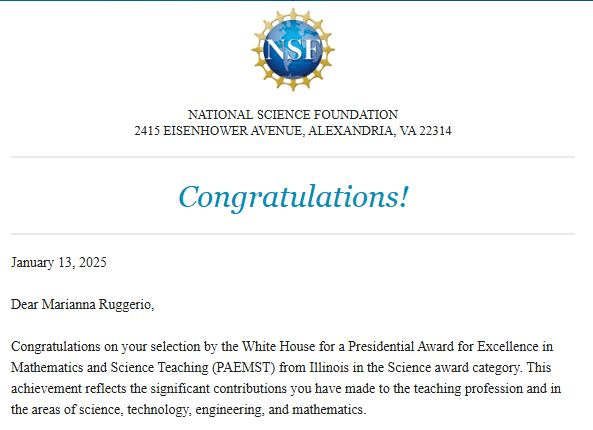
I’ve been awarded the Presidential Award in Excellence for Math and Science Teaching for 2023!
We all received an email notification this afternoon from the NSF and the White House published the press release. Over 300 educators were recognized today as they finally attended to the backlog from 2021, 2022 and 2023.
Some of us are wondering based on the language of the email if we are going to get a DC trip, especially since the Biden administration has made the announcement as he prepares his exit from the White House.
I started documenting the journey shortly after I submitted my application, mostly to give myself an outlet. Today I can publish it!
It’s February 20, 2023 as I begin this draft...
I have no idea, at this point, if I will post this, because who wants to hear about an incomplete journey or one that never arrives at the destination?
I’m in waiting for my PAEMST application to be evaluated at the state level.
I’ve noticed a number of previous awardees documented their journey, so I figure why not? If for no other reason than for myself and this post can sit in drafts.
August 1st, 2022 – Applications Open
I got the email from PAEMST and saw it immediately because I was sitting in a chair at the University of Illinois participating in the IPaSS program. I started the process to begin my application and within a few hours my twitter friend and 2019 awardee Jeremy sends me this message. It’s important to note that I might not have actually gone through with the whole process had it not been for Jeremy reaching out. It was a small gesture of validation that this process was worth it. We chat a bit about a possible lesson (I already have one in mind). I don’t leave UIUC before asking one of the post-docs if at her visit she could also record me for the purposes of my application. We set a date and I mostly don’t touch the application.
Monday October 10th – Lesson Day
Today is the day of the recording! I actually forgot and didn’t bother to wear anything extra nice or style my hair. I know I’m going to regret this later. Unfortunately the only video that turns out is 8th hour. Fortunately I still have one to use. That night I start writing my narrative based on what I can remember from earlier that day
Later that week I ask for my references. In addition to a follow up with my principal, I send one to Annie Baddoo, the coordinator for the education pathway programs at Rockford University and Maggie Mahmood, the coordinator for IPaSS.
My principal passes the letter off to the assistant principal we hired in August.
Sometime between November and December…
I’m pounding out the narrative on my couch, often working on it to procrastinate other things like grading. I reach out to get a mentor, but I hear nothing back. I contact the general PAEMST email and still hear nothing from my state coordinator. I find my state coordinator’s real email and email her there and the generic PAEMST. After this point the amazing Natalie Johnson, our math coordinator, reaches out to me. We have a wonderful phone conversation. I send her recommendations to my letter writers and hone in on my own writing. I get connected with a mentor who reads my application and says it looks great. Unsatisfied (sigh… perfectionism…) I start looking up previous winners in Illinois and decide to reach out to the 2019 winner. She agrees to read my narrative.
January
I’m anxious because as far as I’m concerned I’m just DONE with the whole process. I send follow up emails to my remaining letter writers. Tanya gets back to me with some actionable feedback. I rewrite my resume so I can actually fit everything on it. It’s a crazy editing process to maximize your space. I’m wishing my name was “Mia Kim” so my name wouldn’t use so many characters on the rec letters (that seems… inequitable?) Basically I’m panicking about anything that could be panicked about. One of the requirements for the application is a letter of recommendation from your “building principal”. The building principal has the ability to assign the rec letter to someone else, but according to the PAEMST info folks, you, the applicant, cannot list anyone other than the building principal.
In highly diverse and underfunded districts its not uncommon to have high turnover rates. I have been at my current building for 7 years and have seen no less than 15 different administrators come through. The 2022-2023 team is entirely new except for the building principal. When I sent my second request to her for the letter she asked my new evaluating principal to write it. This created an obvious amount of anxiety as he had not yet learned who I was. I drafted an email that outlined my involvement and reach within and outside of the district so he could craft that into a letter. In my opinion this was really unfair to him, but that’s just what happens in some places.
February
I finally meet with my assistant principal about my rec letter and submit my application on February 5th, just 24 hours before the deadline. After I hit the button my colleague pops in and immediately asks “what’s wrong” to which I respond “nothing”. Unconvinced he asks again, “what is wrong” I explain that truly nothing is wrong, I’ve just submitted this application I’ve been working on for the past 6 months! It’s relieving and nerve-wracking at the same time.
February to March must have been some of the worst because after obsessing daily for six months suddenly there was nothing to do but wait. In the meantime I cranked out a bunch of blog posts and an article for Edutopia. It was time to really focus on the Master’s course I was teaching that semester and my family.
March
On March 2nd I ran across the timeline that explicitly stated state finalists are determined by March 10th. Later that day I received an interruption to my 7th hour class. One of the admin walks in with a sizable edible arrangement.
My students, of course, joke that I have a secret admirer. I open the note and it’s from the PAEMST Illinois team, thanking me for applying to the program! Believe me this is NOT what my nerves need at this point!
My mind immediately goes to negative thoughts: “well, obviously they only had 3 or fewer applicant this year because these arrangements are $60, if I become a finalist it’s just because no one applied….. this arrangement is a consolation prize for all the work but none of the glory…. let’s be honest, if I get anything it’s just because I followed the directions and the rubric.”
I’m still unsure what my motivation for going through the process is anyway. I’m not seeking attention by any means, in fact the only people who know I’m applying are my rec writers, my closest colleague and my twitter family. I’m pretty sure there’s a part of me seeking validation and redemption after the trauma of my early years teaching. Not making the finalists will just confirm that I’m exactly the kind of teacher I believe myself to be: not quite enough yet.
March 8, 2023
At 6:27am I’m sitting on the couch drinking my coffee and post the daily countdown to March 10th.
I head to school as usual and I’m setting up for my AP Physics C students to learn circuits at the ungodly hour of 8:05am (Physics C at 8am is the absolute worst, by the way.)
At 8:00 my watch is buzzing as my phone rings and I see in all caps TARA BELL. I know that Tara is the science state coordinator so I’m assuming it’s good news.
“Hello?”
“Hi this is Tara Bell”
“Hi”
“How are you doing today?” (oh my god can you just tell me already?)
“Fine thanks” (my response when I really don’t want to know how you are as well.
And then she shares that the committee met last night and I’ve been selected as a finalist! She also shares that the committee was “very impressed with your application” (and I wonder if that’s just a thing they say or if it’s genuine in regard to my application vs what they’ve read before”). She also shares that they will be sending my feedback soon so I can get a jump on the addendum.
I jump out of my chair to tell my next-door chem collegue and… he’s not in the room. So I run down the hall to the workroom, bursting with excitement. No one else in the room has a clue what I’m talking about because I’ve kept it under wraps for the last six months. Next I text my husband and my siblings. But now it’s 8:04 and I have to teach!
I kept trying to get a hold of my mom (who also didn’t know about it) during my entire two preps, calling every 15-30 minutes. I realize that if she ever looks at her phone she’s going to think I’ve died, so I text her “if you see your phone before you see dad it’s good news” because I eventually got a hold of dad.
Later that afternoon I received the feedback from the state. I was actually still suprised I made it as a finalist [enter bad thoughts] because I earned the following scores: 3, 4, 3, 3, 4. The dimensions are weighted x7, x6, x5, x4, x3 so even though I earned the highest score on the last dimension, it has the smallest weight. I know that if I want a chance on the national level I need to bring those 3’s up to 4’s. Fortunately there’s a lot of strong feedback for every category… except the first one!
March 11
I created a twitter DM chat with a handful of finalists of folks I’ve followed plus a few more I’ve started talking to in the process. Scott adds a few more folks. We loosely talk about our state feedback. On Tuesday NSF holds a zoom for all of the finalists to discuss the addendum.
March 18
Scott finally puts forth that we start looking at each other’s work. An email chain is built and we start sharing our applications, state coordinator feedback and our proposed addenda. This is by far the most meaningful part of the entire process, even though it’s the one with the shortest turnaround time! It’s so great to actually read through each other’s work and see what a state finalist looks like. I quickly learn that the actual scores you earned from your state coordinators are somewhat meaningless. In our group I would probably give one application perfect 4’s across the board, even though many earned that score. Otherwise the rest of our applications are fairly comparable which makes sense given how motivated we all are to succeed.
April
I know that the national review happens around this time. One one particular weekend my mind jumps to the review and I get a stomach flip. I know this sounds weird, but I’ve had that flip before when people are talking about me.
May-December
So much nothing. I know it’s better to not think about it. 2021s are still waiting.
Janurary
Our state alumi reps plan on a recognition event. Meanwhile, the national AAPT meeting is held in New Orleans. The math alumni rep attends the meeting, now working for FermiLab. Since I know we are far removed from the formal process I ask her a bit about her side. I learn that there are around 60-some applications for the awards, and that elementary has more applicants than secondary (to my surprise). I share the twitter collaboration and how much I appreciatedo the kind of feedback we received at the state level. I also shared my fear because many of the folks in this group had received perfect or near perfect scores. My lowest scoring area was domain 1, which has the greatest weight. She assures me that I had a very strong application.
March-April
Everyone is hoping for an announcement. There is no announcement. One person posts in a facebook group they got a FBI check request for 2021 a year ago. That post is promptly removed, but I can’t help but wonder if the 2023 awardees already know.
May 16, 9:04am
I actually wrote this part on a document on my computer! They swear you to secrecy!
I’m outside with George. My husband is out of town and George was under the weather so I took the day off of school. I hear my phone that I have an email. I check it and see that it says “PAEMST Award – Requested…” I quickly open the email, skim down and see the words FBI. My heart jumps. I immediately call my husband to share the news. I know that I’m now in the running! I have to re-read the email 5 more times. It’s addressed to “PAEMST nominee” Not Finalist! Nominee! The email says I can ONLY tell immediate family. I’m literally jumping to try to shake off the excitement. I wish I could tell certain people right now: the individuals who wrote my recommendation letters, my former math teacher and PAEMST awardee, my best friend at work. But no, I can’t tell anyone for who knows how long! In fact, due to the nature of the secrecy I’m not even writing this in my WordPress draft, but offline!
3:34pm I receive the email from the PAEMST team to provide by bio, headshot and quotes for the website, “if selected”. I have about 6 days to get this completed. Interestingly, this email says that everything is strictly confidential and to tell no one. I wonder if I should mention that the email from EASE says “immediate family” but if I did that is it a test? So I don’t ask.
6/5 – I get an email from PAEMST that my bio is ready for review. I go through the now edited version of my bio, feeling ok that this means its still happening.
6/10 – It’s the last day of school and I go to my principal’s office to drop out my checkout form. He asks if I’ve heard anything from PAEMST, to which I respond, “well if I did know, it would be confidential because only the white house gets to say anything after awardees are already in DC” he then proceeds to tell me that he received an email about PAEMST to verify my employment (or something like that). He also shares there were two emails and they both went to spam!
Which takes us to today…
After 8 months of secrecy I can finally announce that I am an awardee!
I used to do lab notebooks. I used to give students grace and flexibility. Labs had due dates in the calendar, we had board meetings, time in class and I would collect the notebooks at the time of the unit exam.
The inevitable happened. Many students spent hours upon hours of time getting notebooks done the night before the test. It wasn’t that they weren’t given time in class or during the week, they just did the student thing and other classes became more important until physics was important.
That all changed a while ago.
One of the shifts I made a few years ago was adding vertical whiteboarding to the lab. Specifically, I set up the physics of the lab as a vertical white board task. I gather students together and demo the intention of the lab. Then I verbally tell students what I’d like them to go figure out.
In building thinking classrooms the key piece is the consolidation piece. I’ve done the consolidation for the lab, but what I’ve found is actually more effective is the following prompts:
You are not there until we are all there
If you’re done or stuck, go take a walk.
I first tried this the day of a formal observation(!) and I’m never going back. The energy in the room was unmatched, and the sense of accomplishment by the students was so much greater than if I had told them outright. In previous years I’d let them work the problem in their lab groups, but this meant some groups would get it right away and dive in, while others really struggled and then were behind in data collection. Doing the physics this way instead builds the community.
One year I had two challenges. The first was that my students simply were not putting in the same time, effort and care as students in previous years. I know I sound like a crabby veteran teacher, but it was truly different. I also had one student, in particular, who had extreme anxiety. My flexibility with them inevitable created more anxiety as they tackled the most pressing assignments in their heavy school load. The infrequent lab collection was a complete nightmare for them.
Meanwhile, I’ve been adamant that certain lab writeups will have theory sections. I ask that students explain using diagrams, words, and mathematical models the physics behind what we are doing. Getting students to craft an excellent theory and how it then connects to the procedure is something I’ve been trying to figure out how to best present for many years.
Although we obviously discuss these ideas before students head into the lab, students inevitably dive into the lab, record their data and would come back to writing the formal theory later.
And later is almost always an afterthought.
To support my student with anxiety and to get the rest of the class doing physics on a more regular basis, I started requiring the theory sections submitted to me the day we would begin the lab. I explained that the theory would be a draft (and in practice, I did not penalize students for not submitting it, the consequence was they had to do it all the night before the lab due date and didn’t get a chance for actionable feedback).
Student response was overwhelmingly positive. First, by putting the hard-ish deadlines in place, the quality of student work rose dramatically. Second, students had the time and space to prepare for their unit exams, rather than trying to write a bunch of physics for the lab. Third, and most persuasive, the students verbalized how much more they liked this. I had one student say “I actually feel like I know what I’m doing in the lab now!”
We can show and tell students all day long, but until they work with the content themselves and make it their own, they haven’t yet become owners of their learning.
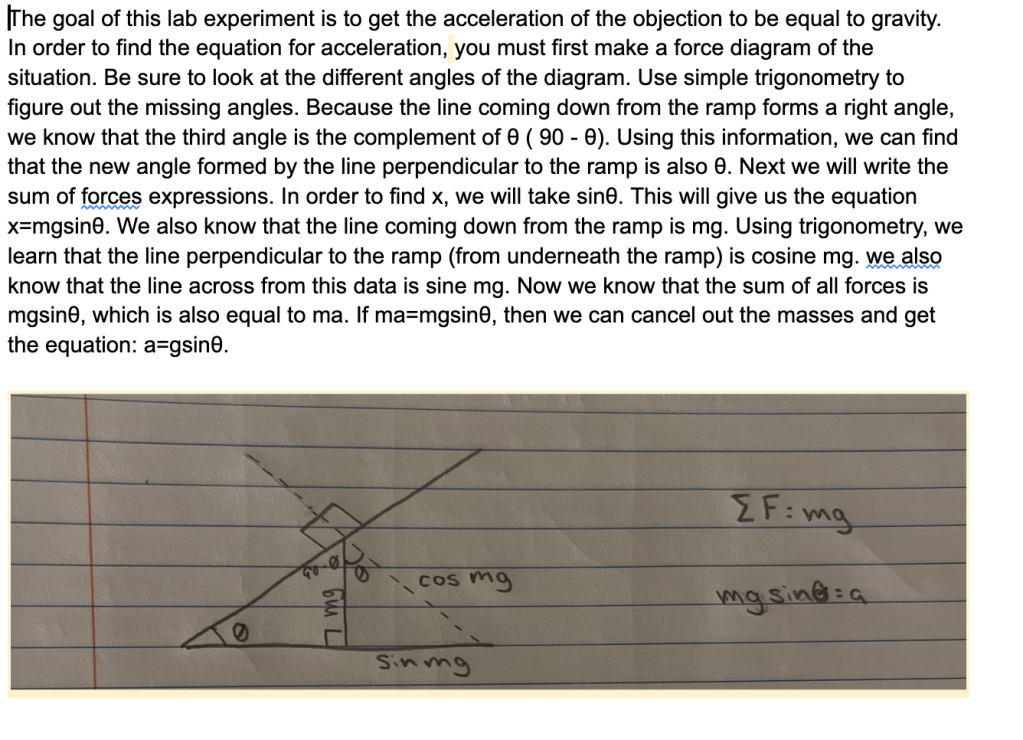
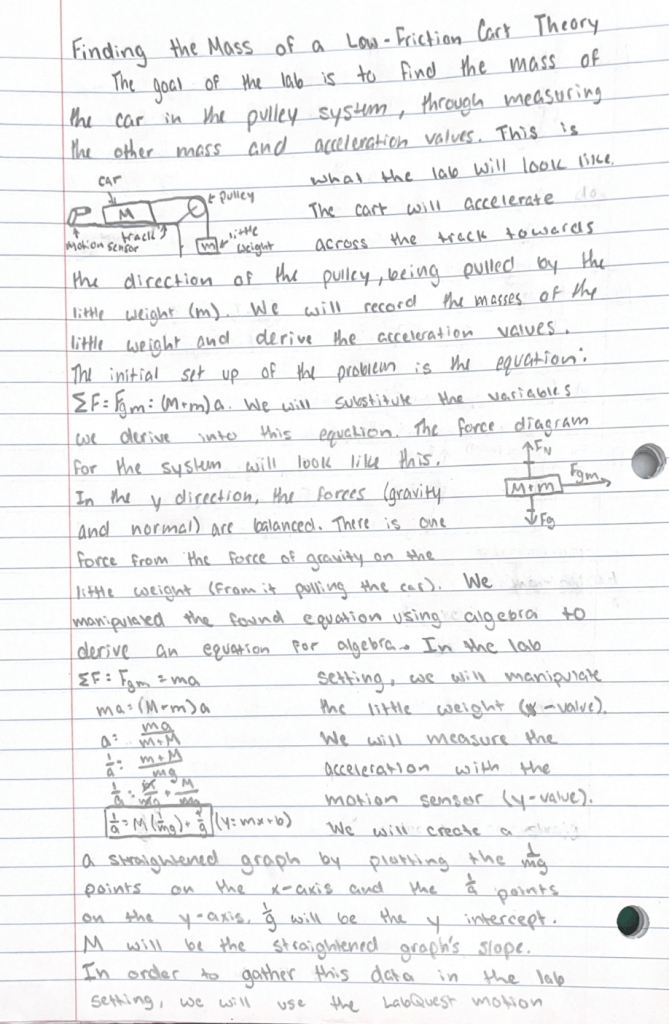
Take a look at these two drafts submitted by the same student.
The first draft was for a lab where we found the acceleration due to gravity with a ramp. This draft is typical of what I used to see often the first time I asked for a theory section:
This is done fairly well, but the representations are after-thoughts and it’s not entirely cohesive yet. I left comments on this draft and the student responded positively.
Now take a look at this same student who wrote this draft. There is one physics misconception that needs to be addressed and I’d like the formatting cleaned up, but notice the quality of the content at this point:
I’ve taken this as a win-win-win
Win 1) Students are not scrambling to provide this level of detail the night before the test or the night before lab collection way after the lab is done
Win 2) Students feel confident going into the lab about what they are doing and why they are doing it, which lets us focus our conversation on the how, which includes the procedure, the equipment, uncertainties, assumptions and error sources
Win 3) I feel way more confident that students know what they’re doing. AND, I get to support and fill some of the incomplete thinking as soon as possible.
If you’ve followed me for a while you know that I’m a huge advocate for building capacity in communication skills. I firmly believe that communication is the single most important skill in which we can educate our students. Without it brilliance has no impact.





 Physics.Teacher.Momma.