
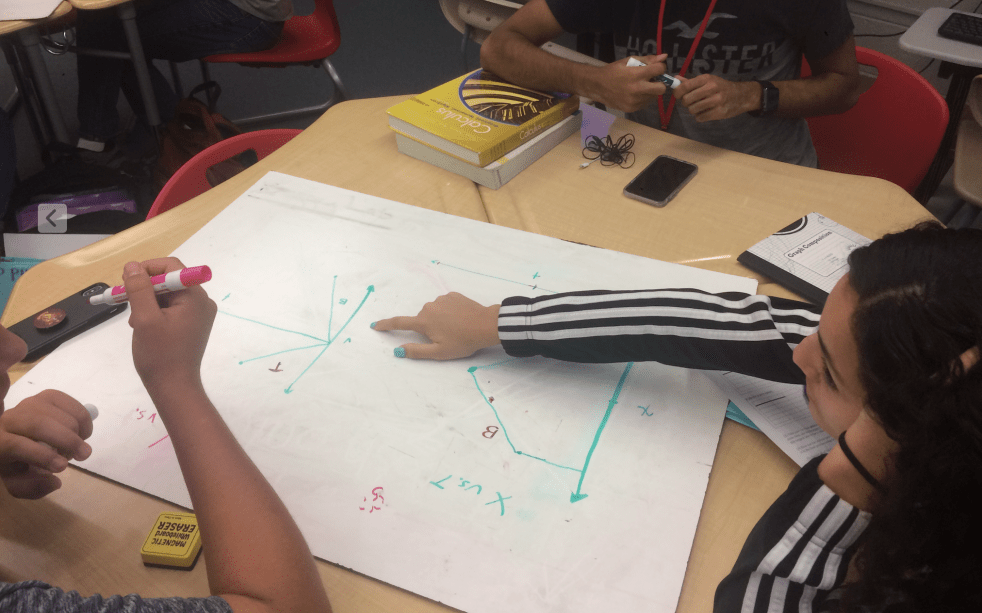
If there’s one thing I find myself iterating repeatedly to my students its the importance of writing things down. Students who are used to doing well in school, and especially in math, often find they are able to solve most problems without showing a great deal of work. In physics, however, that becomes nearly impossible. Aside from showing work for the strict mathmatical portion of a problem, what is almost always more important is that initial diagram.
One of the critical and beneficial features of drawing a picture is that it allows for cognitive offloading. By sketching a graph or a force diagram or even just a physical diagram, now there are details about the problem that no longer need to be held in the working memory, which clears space for the problem solving.
When we use whiteboards in class this also creates the additional benefit of having a shared focal point for the group, which enhances attention and focus on problem solving when working as a team.
The other benefit is that once we begin to create visualizations, we may begin to notice structures and patterns that were not initially obvious or intuitive.
In a 2011 paper, Drawing to Learn in Science, Ainsworth, Prain, and Tytler advocate bringing drawing into the science curriculum because visualization enhances student engagement, helps students learn how to represent information, helps students learn to reason in science, is a major way to communicate scientific data and models, and is a learning strategy.
Drawings also provide us, as educators, quick and descriptive insights to student understanding and possible misconceptions. What students may not be able to adaquately articulate in words may be articulated through a picture.
The initial construction of motion maps with students and a bowling ball is a great example of this. First we run several experiments: letting the ball roll freely, constantly pushing the ball in the direction of motion, pushing the ball opposite motion. As this is happening we drop a mark behind the ball at equal time intervals. This creates a physical visual on the floor which students are then asked to translate to their white boards.
Once students have completed this pattern, they are instructed to craft the arrows to indicate the direction of travel of the ball.
After this we can discuss the meaning of and how to obtain the direction of the change in velocity.
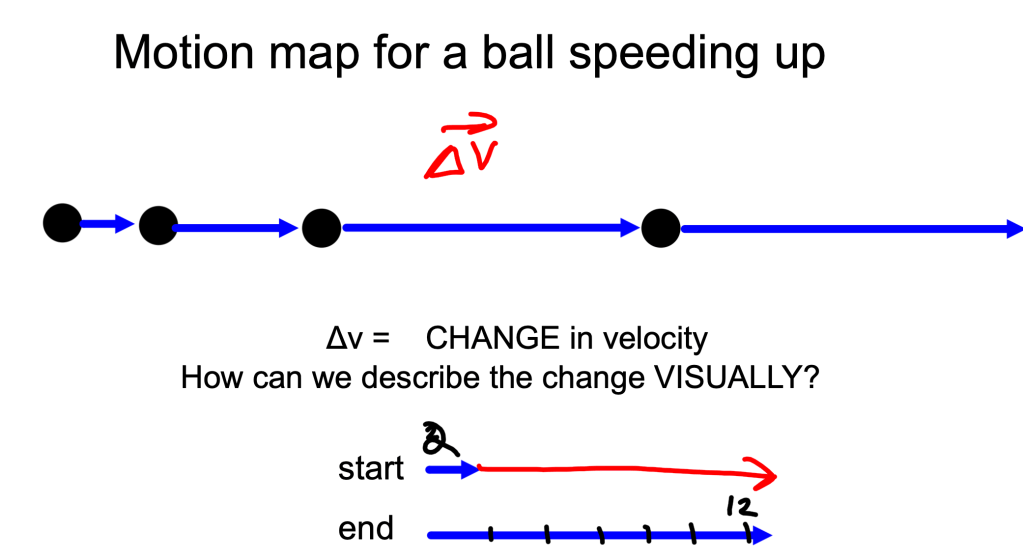
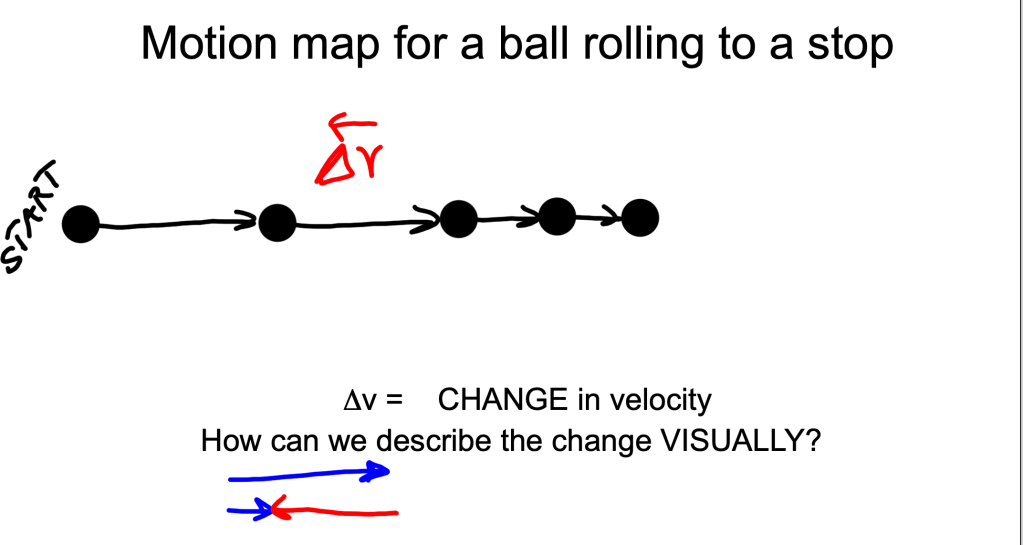
These steps are generally well-received by most students. The misconception that most students initially bring to us is that “negative acceleration means slowing down”. In this case, as we continue to provide additional cases (such as an object moving to the left while speeding up) he visualizations serve as a tool to help students undo this particular misconception. They can see for themselves that when the direction of Δv and v match, the object is speeding up, when when Δv and v are opposite the object is slowing dow.
Force diagrams and energy bar charts are additional examples of visualizations that end up being imperative for problem solving.
What frequently seems to be the challenge is that students will generally not choose to complete these vizualizations. I cannot count the number of times I’ll have a very bright student come to me in frustration and the first comment I need to make is “where is your force diagram” “where is your bar chart”. It is for this reason I believe that its critical that the vizualizations become a no-excuses requirement in the work at all times.
For example, here is the hand-out I provide my students as part of their force notes. Their homework takes an identical three-column format
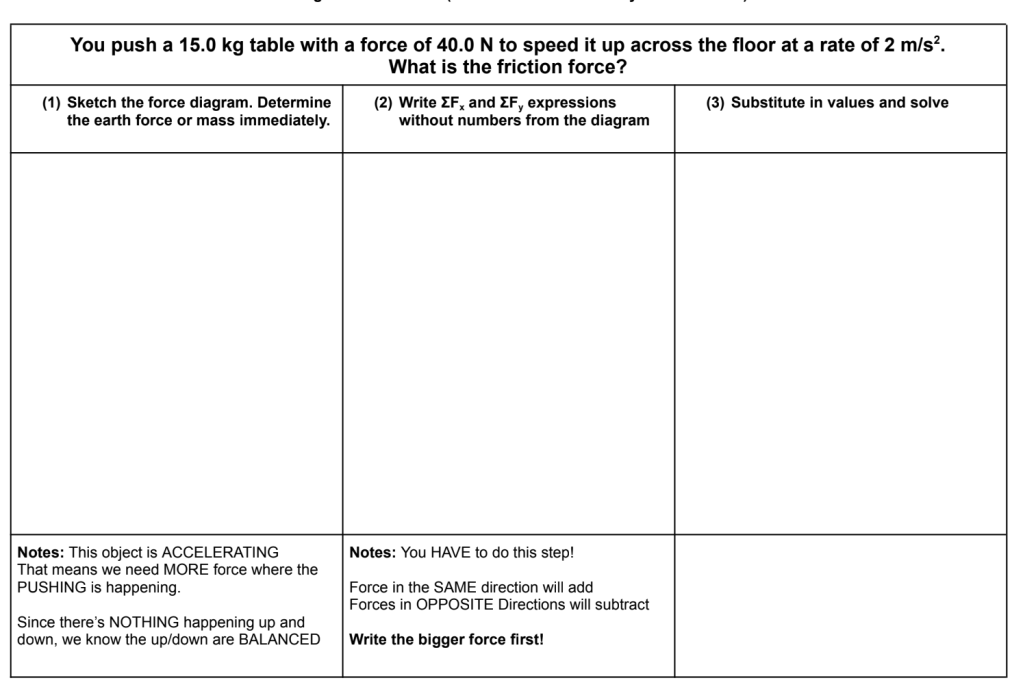
While the physicsclassroom.com interactives and conceptu builders are fantastic drill practice, the fact that they are on a screen reduces student uptake on physically creating the necessary representations. This is why I’ve created paper companions for most of the assignments I assign students. (Example below)
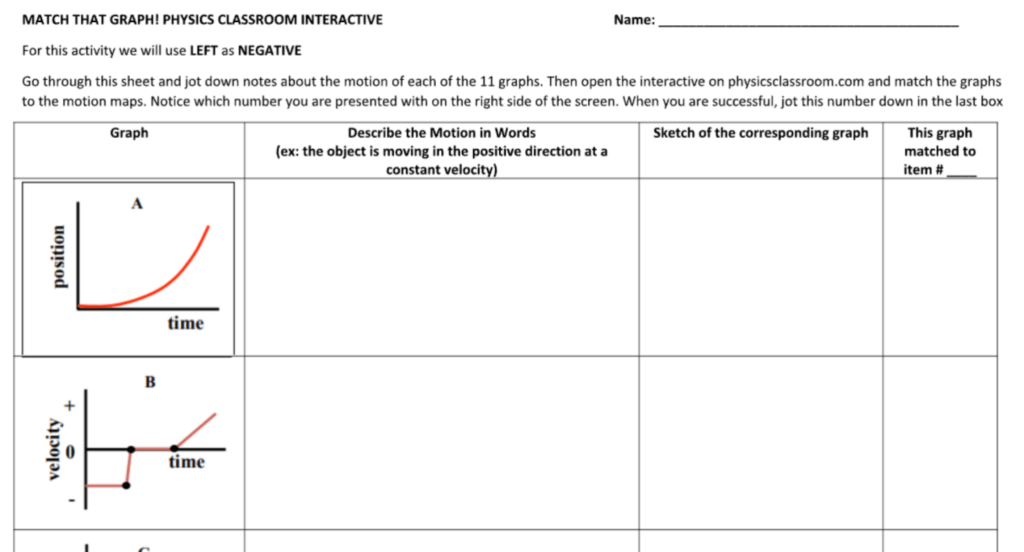
Like our students, we should actively shift our thoughts around diagrams from something we just happen to do in physics, to a critical learning tool that is backed by research and allows our students more engagement and depth thanks to cognitive offloading, emergent structure (finding patterns), and reorganization of material to get a new perspective.

