Activities · Teaching Methods

Paper Companion Activities for Pivot Interactives

You know how I feel about online work! (Looking for Physics Classroom Companion Worksheets? Find them Here!)

When I took high school physics almost everything was online. From physics classroom assignments, to the dreaded WebAssign, it was online. And because it was online, I like others, gamed the system (pre chat GPT). You know a certain number is going to show up somewhere in the answers? Enter it in all the blanks for the first submission so you can focus on the actual calculations. On the flip side was the part where you tried the problem so many times by the time you got it right you had no idea what actually worked. For the better part of my career I’ve been vehemently against all forms of online homework. There’s something about that screen that just puts a stop to the idea of using scratch paper for novice learners and we can’t have that!

(For what it’s worth, when AP went all digital I did NOT feel the urge to go digital in my classroom. I continued to do everything on paper. When APs came around I found my goal was acheived: I proctored the macro exam and did a count. 80% of physics students were using their scratch paper during the exam, while only 30% of non-physics students used their paper.)

The first exception I made to online learning was Pivot Interactives. I was using Peter’s work back when they were “Direct Measurement Videos” which meant I had paper copies originally, anyway. As Pivot upped their game (including deep randomization and autograding) I started using some of these assignments since it sure made my life easier!

However, what I’m finding with my students this year is that like my Webassign days, students are doing the minimum to get all the green checks. This looks like not reading the prompts that explain what they’re about to do next and why, not actually collecting the data for the graph and totally missing the connections between the sample measurements and the data collection.

So, I’ve started to reimplement some paper versions.

The Activities: A Journey of Trial and Error
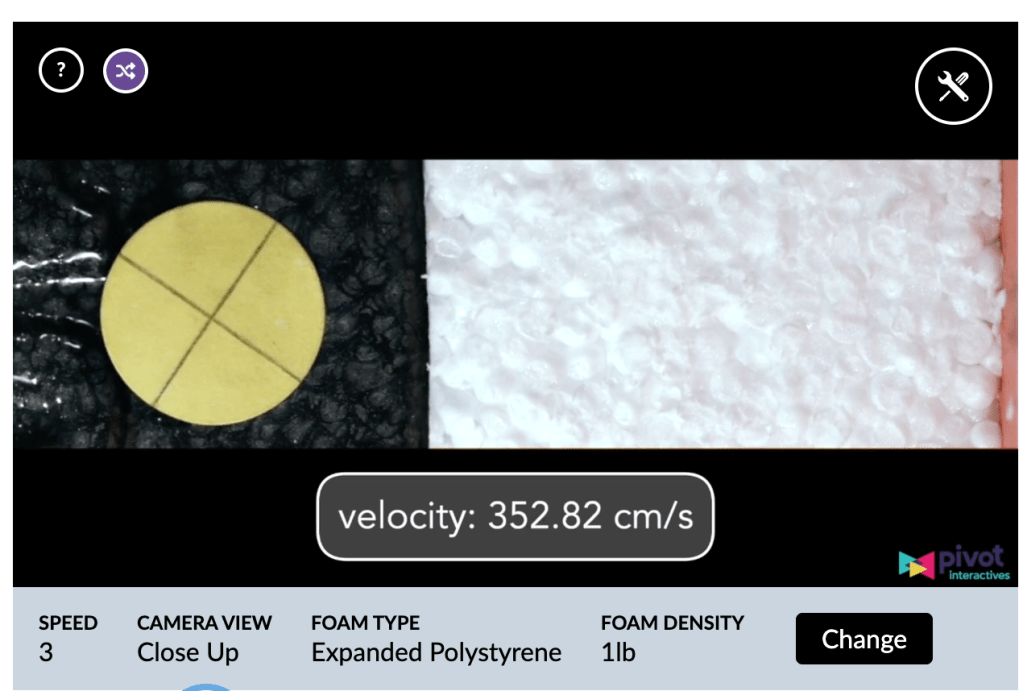
Earlier this year I assigned the helmet collisions activity. I added a prompt at the end that requested students to do the following:

  • What was the purpose of the activity?
  • Describe the procedure for conducting the investigation
  • Describe the calculations you made and why we made each calculation. You should include details regarding your values!
  • Describe what we learned from this activity about helmets as it relates to the impulse-change in momentum relationship.

This was ok, but I, arguably did this a bit hastily. I realized I wanted these documents handwritten and maybe a bit more depth/scaffholding.

A few weeks later I assigned the Explosions (Not Really) activity.
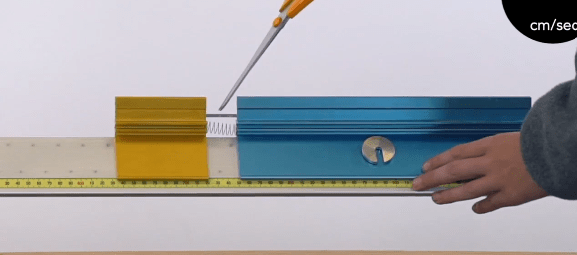
I knew that students would totally ditch all of the methods we had been using, so I decided to give them a paper to complete before the activity that related to the activity. This required them to complete the calculations with similar, but easy numbers and then have me check their work prior to the activity. This got a good chunk of kids on board, but some still struggled with the transference.

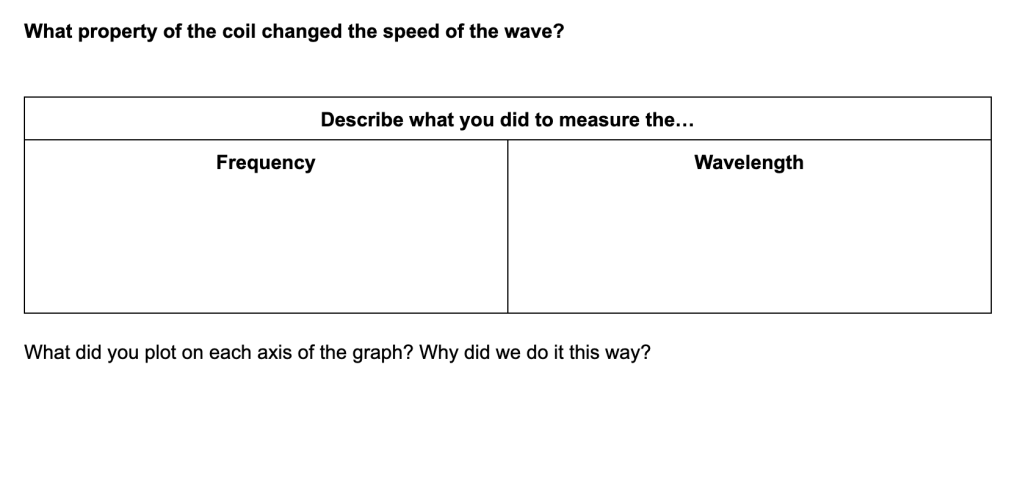
Still not completely satisfied, this past week I assigned the “Intro to Transverse Waves” activity. In this activity students are going to linearize a graph. This is a skill we don’t really cover in my regular level physics, but I like doing it at this point in the year because it’s such a powerful tool. As I anticipated, many students were ignoring the text about linearization completely. I chose a different approach to the paper copy.

I gave students this document which contains the following prompts:

First, I asked them to describe to me some of the new vocab as well as how we obtained our measurements
Next, I use a modified template from the Patterns Curriculum when students write conclusions in labs where we have graphs. It looks like this:

After investigating the behavior _______________, I conclude that there is a ______________________relationship between the [independent variable name]  and the [dependent variable name] As the [independent variable] kept increasing, the [dependent variable]_____________________________. This system of a ___________________ can be mathematically modeled as:

[write the final equation]

where the constant  [slope value]  is the [description of slope for this experiment]

I require students to write the ENTIRE paragraph from start to finish. This is not a fill in the blank activity.

This is currently my favorite interaction of the paper follow up and I’ll probably build more of these moving forward. I’m really in love with the patterns physics conclusions because it really requires students to put everything together.

Grading

I’ve noticed there’s a VERY strong correlation on these summaries between students who took the activity seriously and learned from it, vs students who did not. Because of this, the only thing I really need to grade with care is the conclusion paragraph itself. If students did the lab correctly, this paragraph looks great. If not, they usually don’t do well on this.

Do you do anything like this? What does it look like? How do you support genuine learning using online platforms?

Activities · Teaching Methods

I revised the cannon launch!

In my last post I talked about how I finally reenvisioned collisions and explosion problem solving for my on-track physics. It went so well I’m definitely going to integrate more of it into AP.

The goal of the reenvisioning was to set students up for a meaningful tennis ball cannon launch lab at the end of the lesson sequence.

If you’re unfamiliar, you create a tennis ball cannon, launch it, and have students calculate some quantity based on momentum conservation. To be honest, I haven’t run this lab since my first few years teaching for a few reasons. One was that my cannon got stolen at my first job. Then I decided that whole class labs are less effective than small group work and I hate when it looks like everyone is copying answers. The activity just wasn’t meaningful enough.

But after talking to several friends, everyone was excited about the idea of a cannon launch, so I spent my weekend rebuilding a cannon.

To open the lesson I set up and demonstrated an “explosion” with our car-track system. I ensured that one car had more mass than the other and we had some conversations about what to expect. We also talked about what the equation would look like based on our previous experiences with elastic and inelastic collisions. Students were able to correctly determine that it’s basically the opposite of an inelastic collision.

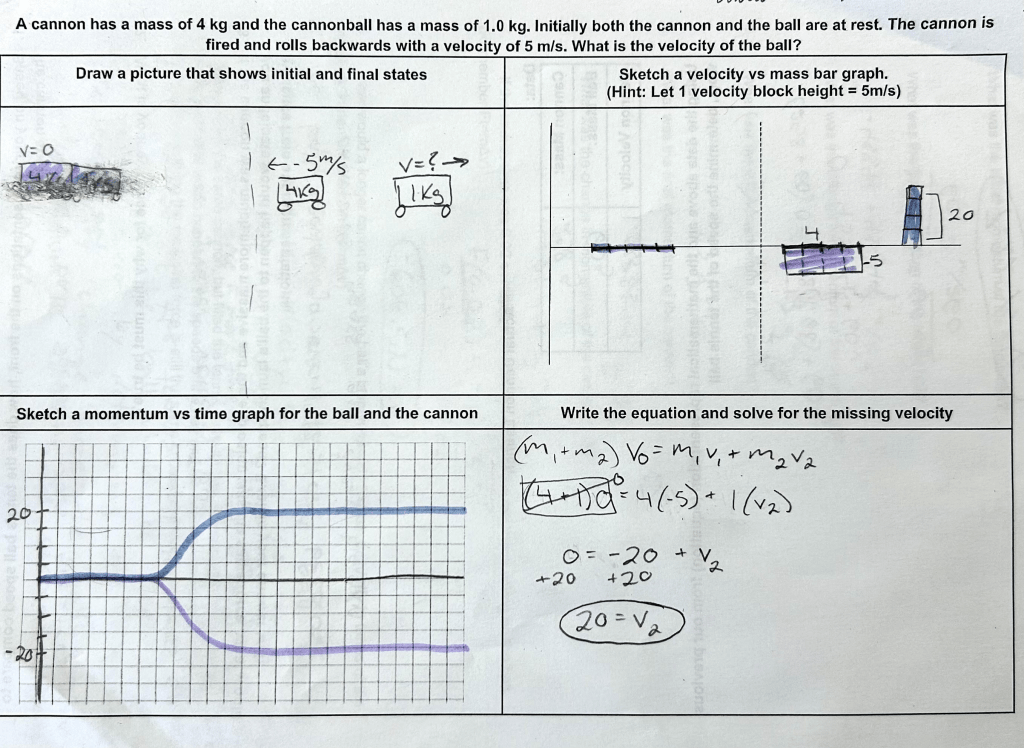
Next, I gave them the scenario where the cannon had a mass of 4.0 kg, the ball had a mass of 1.0 kg and the cannon’s launch velocity was 5 m/s. These numbers were strategically chosen. I wanted to keep whole numbers and also have a cannon-ball ratio that was similar to the actual cannon-tennis ball.

Students then completed the four representations as we’d previously done earlier in the week. Below is a student work sample.

The great thing about this was that students were able to accurately represent and predict the outcomes of the cannon-ball system before we got into the muck. This got students thinking individually and talking in small groups. We also discussed why the results made sense.

To launch the cannon I let it go through a photogate to snag the post explosion velocity and then students completed the calculations.

For the post-lab analysis I threw in a few thinkers. They included:

  • Find the average force on the ball
  • How would a longer cannon change the ball’s launch speed? Explain in terms of impulse-momentum
  • If we used the same cannon but filled the tennis ball with rice, what would happen to the speeds of the ball and cannon post explosion?

You can see a sample student response below:

These questions led to some really great conversations that brought us back to equal forces, equal momentum changes and where time falls into the mix.

Activities · Teaching Methods

How I Teach… Energy Part 4 – Energy Activities!

This is part of a series!
Part 1 (Work) Part 2 (energy bar charts) Part 3 (problem solving)


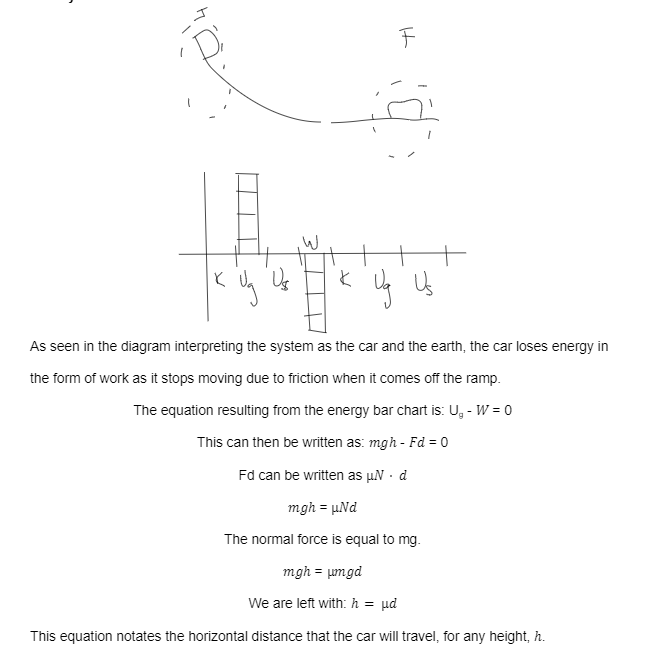
I have this lab I received from a colleague, it’s an iteration of a lab I’ve seen in other places. Basically an object goes down a ramp, gets caught by a paper catch/index card etc and students are looking for some iteration of work and energy.

In the version I have students are asked to find a relationship between height and distance. The cool thing about this is it ends up that height is directly proportional to distance and related by the coefficient of kinetic friction alone.

Student’s work looks like this:

Students are asked to complete the lab with a hot wheel car and then again with a small mass attached to the car. To students’ surprise the lines are not identical. This really bothers students until we discuss what we were actually looking for. See, the lines are still parallel, but the car with more mass is going to have a greater momentum at the bottom and will require a greater impulse to stop. It’s a fantastic conversation piece.

Student generated graph from lab

I really enjoy this lab because it requires students to consider a new problem and then apply that knowledge to a lab setting. Research has shown that students don’t really learn content in the lab, they learn lab skills. I was always a little frustrated with the disconnect between all of the work students put into the theory and then the lab results themselves. So this time I changed things up.

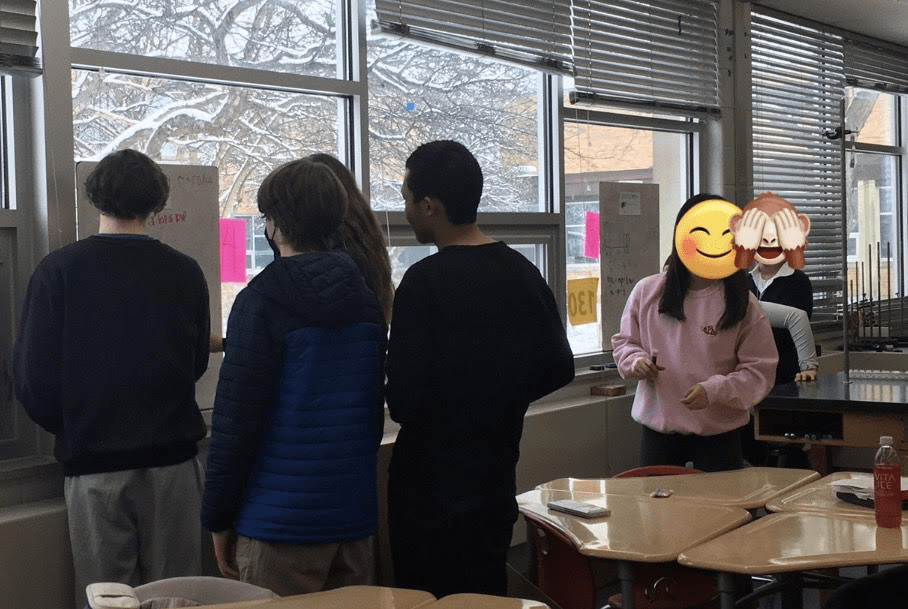
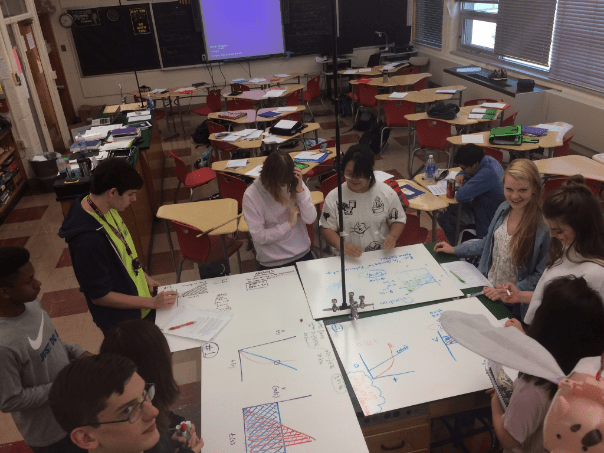
Instead of giving students the lab hand out and letting them work in groups, when students walked into the room they were put into visibly random groups. Visibly random grouping just means you create the random groups in front of students so they see it was truly random. I’ve been immersed in the book Building Thinking Classrooms and the research on this is really cool.

Once students are in their groups and at a white board that is vertically mounted, I’m in the middle of the room at a lab table with the lab set-up. I verbally explain the set up and that I want them to derive a mathematical model for the relationship between height and distance.

Vertical whiteboarding is really cool and has several advantages. First, students are standing which puts them into a more active position, this gets more of them working. Second, it’s really easy to just look around and snag ideas from other classmates. Third, since they’re already standing it’s really easy to move around the room and discuss with other groups. The first time I did this what astounded me was the sheer number of students talking. Instead of it being maybe 4 or 5 leaders it was nearly everyone in the room! There was so much collaboration and ownership of learning it was magical.

Taking a peek to get ideas is easy!

So I did this with the first part of the lab. Next, I asked them to sketch what the graph will look like with the two lines. Almost all of the students sketched the two lines on top of each other. I want them to have the experience of their data not aligning with their previous ideas and having to reconsider, so we left it at that. Then students were off.

I’m going to finish this lab this week, so I’ll have to come back to update this post, but I love this activity and vertical whiteboarding gets a 10/10 every time.

Teaching Methods

Radical Renovations: The iOLab

I visited my alma mater today. The entirety of Green Street on campus is closed to traffic due to all of the construction. Buildings have gone down and come up and I half expected time to still be frozen in the year 1967 in the physics building.

When I walked in I found quite the opposite. Not only newly renovated rooms, but there is actually a women’s bathroom on the fourth floor. (This was always a running joke)

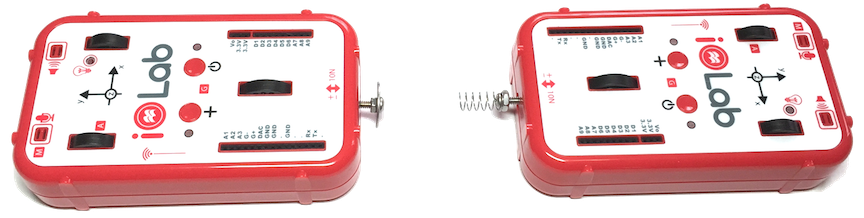
The reason I spent 6 hours in my car today, however, was to visit the Physics 101 class. iolab_remotes_redMy former adviser, Mats Selen, has been working on a new project: the iOLab. The concept is simple, it’s a multisensor system in a box. And it can do everything your $10,000 of Vernier equipment can do… for a little over $100. It connects wirelessly to your computer and runs with free, opensource software that does all of the analysis our expensive programs run.
On the other side of the coin, however, is a radical change in how the introductory level classes are being taught. When students walked into the lab, they had done a pre-lab experiment earlier…..at home…..with their iOLabs. Quite simply, they made a stack of books, put another book on top by its edge and then looked to see how the force changed with the iOLab as it was placed at different distances from the book stack. Data were submitted ahead of time for credit. Students discussed the results at the beginning of the lab and then were given their task. It’s the classic peg-board demo, however, students had to find a way to relate the force to the placement of the probe if the pivot was located in the top corner.

This was the sum total of the direction given to students.

Within about 20 minutes all students were taking measurements. Some were looking only horizontally, others were looking both horizontally and vertically. Questions arose about the approach: if we change the angle at which we hold the probe the force will change. Are we supposed to do this with a horiztontal force too? I think that’s impossible.

They were told it’d be great if they came up with a mathematical relationship, but they’re just looking for the trends.

Within an hour students were plotting their data, recognizing it was an inverse relationship and running the curve.

One group really wanted to get the formula.

Another group recognized the torques should be equal and started calculating all of the torques. Percent uncertainty was one of the objectives focused on, so I wanted to see how well they were grasping that concept. I looked at the torques and noticed the values were .14, .14, .14, .15, .16. So I asked them how they were going to decide that those were constant and not increasing. They responded that they would have to determine their percent uncertainty and compare what was acceptable to those values.

Now, clearly there are major differences between high school junior and seniors and pre-med juniors and seniors, but at the same time, it was still remarkable how they were approaching the lab, developing their experiment and writing up their labs. It is something that very much excites me about the potential use in the high school classroom (and online classrooms, and college classrooms etc)

I also asked students about their previous physics experiences. About half reported they had taken physics in high school, ranging from regular level to AP Physics 1. ALL students reported that they felt they had a FAR BETTER grasp of physics now in this course, compared to their high school course. Several students who said this felt the need to insist they still had a great high school teacher 🙂

The message, however, is clear: we need to give our students the opportunity to design and evaluate their experiments.

Also, the iOLab is a very exciting new piece of equipment. Morten Lundsgaard, currently the Coordinator of Physics Teacher Development
Instructor, is hoping to run workshops and/or a camp for high school teachers. If you are interested you should contact him!

Teaching Methods · Uncategorized

Teaching to Reach the Introvert

My second-grade teacher called my mom concerned that I didn’t play with any of the kids at recess: I read a book under a tree instead. When my mom asked if this was a problem the teacher reported that I wouldn’t have any friends. I was elected to represent our class for the school council that year.

Research indicates that as much as 50-74% of the population is extroverted. It is generally viewed as a valued quality: put yourself out there, be friendly, be social. These are the rules society dictates whether it is on the elementary playground or in the workplace. Our culture favors extroversion, and many of the qualities associated with introversion are erroneously viewed as a failure to be able to advocate and insecurities with oneself.

Nowhere does extroversion seem to get a higher reward than in the classroom.  There is a huge emphasis on team and group projects, and the excellent teacher is often seen as the one where energy runs high in the room, rather than examining student behaviors and conversations. During the majority of my high school experience, most classes had a participation grade. If I did not speak in class I was guaranteed nothing higher than an 80% for participation, regardless of the fact that the rest of my work was A-work. I despised the participation grade. Some teachers pride themselves on their use of the Socratic method, but research has indicated that it’s execution this can offer the opportunity for gender bias: male students are more likely than female students to shout out or offer answers to questions, regardless of if they are correct. Teachers, in turn, are more likely to respond to those students and the quiet students are left in the dust.

I want to make perfectly clear that I am in no way, shape or form suggesting that classroom participation, presentations, and conversations should be abandoned, far from it! All of these skills are important and required for any field and for success. At the same time, if we are trying to reach all students in a way that they learn best, then we have to offer comfortable environments for the introverts in addition to the extroverts.

present
One of my extroverts discussing the solution to the problem. All students in this group worked on the same problem in pairs, then came to consensus before presenting to the class

Science is all about collaboration and presentation. Students who think otherwise are in for a very rude awakening as they approach their senior year of college and enter the workforce or graduate school. A method I have recently adopted is whiteboarding. At the spring meeting of the Chicago Section of AAPT, Kelley O’Shea presented on standards-based grading in physics and lead a workshop on whiteboarding methods. (See her blog!) One of the most important aspects of whiteboarding (and teaching, for that matter) is fostering an environment where it is safe to share and safe to be wrong. In the lab setting, this consists of all of the students putting their lab results on a large whiteboard and standing in a large circle. Students comment on similarities and ask questions about differences on the boards.


whiteboard1
Sample board and commentary from students. Students assess each other’s final answers and reasoning in addition to the quality of the presented work. 

I have used this method in my teaching, but I have also included a variation on the model. Occasionally (and in the interest of time and space) I have students circulate the room to examine each of the boards. They are still asked to consider similarities and differences, but I ask them to write questions and comment down on a smaller whiteboard next to each of the large ones. After we have done this, students return to their boards, read the feedback and then I open the floor to comment on similarities and differences. This provides the introverts with a huge advantage: they still get to collaborate in their small groups, but they receive the wealth of information in the large group as well as having another avenue to participate in the whole group discussion.


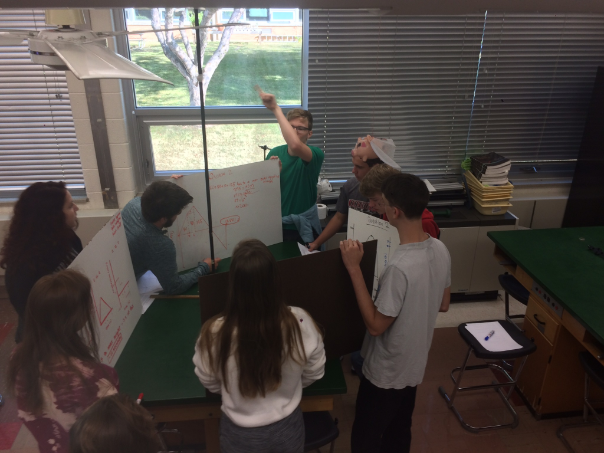
The second whiteboarding method I find to be highly effective with my introverts, shy students and students who struggle is what Kelley fondly dubs, “whiteboard speed dating”. In this exercise, students are paired at a board and the entire class is given the same problem. Here’s the catch: the problem is goalless, it does not end in “calculate the _____”. Students are two write anything on the board they can (diagrams, equations, graphs, etc) in the time allotted (1-3 minutes). When time is up, partners split, everyone moves around the room to an adjacent desk and now they have a new board, a new partner, and a new perspective. The first time I tried this I, admittedly, was anxious for my most introverted student. She did not speak. ever. even to me. ever. even when asked a question. about anything. Within 3 rotations she was explaining the problem to her partner, and I’ll add: not a student she typically worked with. Working in this manner gave her the confidence to collaborate with another student. Would she get up in front of the class and explain the problem? Not today. But maybe eventually.