
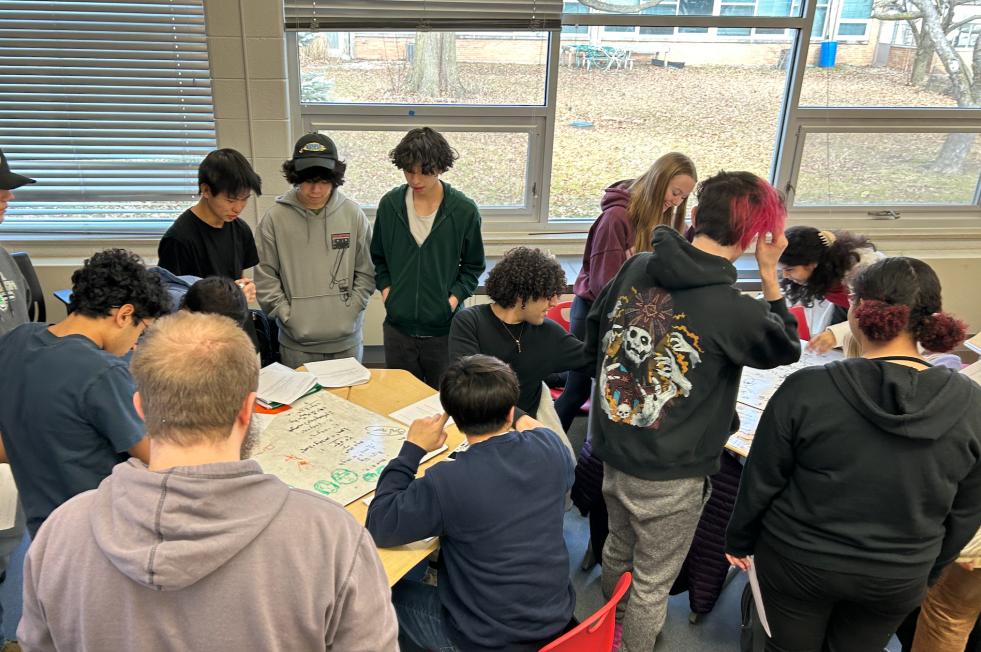
I have a saying for students, “The 100% is in the room”.
What I mean by that is that, collectively, the 100% exists. Not necessarily within one student, but when students engage in true collaboration, very often, the 100% exists.
L is for Listening and Sharing and is based on the idea that we learn more together than we do alone.
This would then suggest the power of working in small groups. However there are a few flaws that teachers fall into very often:
- Putting students in small groups alone is not going to lead to learning. Students need to know how to speak and listen to one another.
- Group selection can be powerful, but students will make assumptions about why they are in a certain group, which will influence their behavior in the group
Setting Norms for Group Behaviors/Interactions
We have all seen this in our classrooms and even in PD sessions or workshops. Some groups function together excellently, while others flounder fantastically. Setting the norms, expectations and even scaffholding the conversation is a critical component of our work.
Protocols
When we implement highly structured protocols we provide students with a predictable framework for engagement. The book Protocols for All is a great place to start and has some ideas that you’ve probably encountered. Many of these protocols are what you might classify under “ice breakers” or “team building activities.” Research has shown that taking the time to get students to work collaboratively outside of the specific content area supports their ability to work collaboratively when its time to get content-specific. What I like about a lot of these protocols is the emphasis on listening because often our best talkers are our worst listeners. In a profession that frequently values and rewards extraversion, it’s really important that we take the time to hone the seemingly less charismatic skills.
I just so happened to run across this graphic from Zaretta Hammond, author of Culturally Responsive Teaching and The Brain, that outlines a progression of protocols to support student discourse and equity.
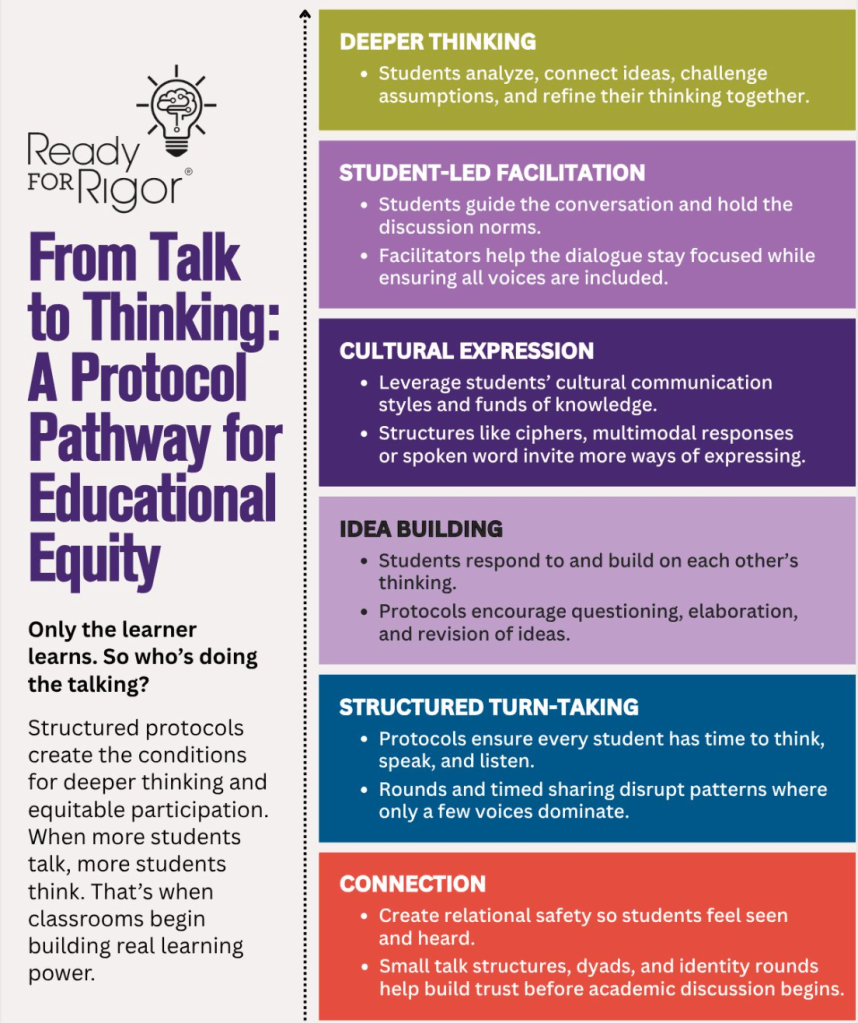
She is leading an online summer PD on this topic that you can currently register for and has a previous article with additional ideas described here
Group-Worthy Tasks
Along the same lines, the kind of task we select is critical. This has been named “group-worthy tasks”. A group-worthy task has a few key features. First, it cannot be completed in the time allotted alone, the group members must depend on each other. This requires the task to have a certain level of complexity. Second, the task must have multiple entry points for success. This means that there is a way for the students who are at a lower performance level to positively contribute, but there are higher order thinking tasks available for the upper-performance level students to address.
Marta Stoeckel and Kelly O’Shea wrote a fantastic article about Group-Worthy Tasks for The Physics Teacher in 2024. A few additional features I’d like to bring your attention to is assigning group roles of Skeptic, Facilitator, Summarizer and Navigator and providing students with a role-card during the task. The second feature is discussions around what makes someone good in science (asking good questions, making astute observations etc).
Mitigating Student-Assigned Roles of “Smartness”
In addition to frequent discussions around competencies in science and shared norms, utilizing visibly random grouping can help alleviate any self-assigned roles students create. Regardless of whether or not the groupings were random, students will often assume they’ve been placed in a group by the teacher to either carry the team, or because they are the kid who needs help. When groups are chosen randomly, and visibly (drawing cards, using a random group generator online) students are unable to make these assumptions as a choice you the teacher made. Visibly random grouping is one of the tenets in Peter Liljidahl’s Building Thinking Classrooms. I’d like to address another key aspect of his work that is critical for the effectiveness of groups, listening and sharing. When work is complete on the boards, it is now time for the teacher to implement Just in Time Telling while continuing to engage student thinking. It looks like this:
- The teacher re-groups the students away from their boards, perhaps in the center of the room or on the side. The teacher may share some key noticings about the work at this point.
- The teacher informs students we are going to “Take a walk”. The teacher moves students to a particular board she has selected in order to discuss one step of the problem that has been completed correctly.
- The teacher directs students to this particular piece and poses the question “turn to someone next to you and discuss what this group was thinking when they wrote this part down”
- The teacher then asks “someone not in this group, share with us what this person was thinking”
What do to With That Really Smart Student Who Can’t Listen
A few years back I had a group of AP students where the dynamics couldn’t have been more disparate. I had a few hyper-competitive, confident, brilliant students who would do all of the talking and solving, and then I had a few students who were quiet and thoughtful but also lacked confidence. In more than one instance the confident students convinced the quiet ones that their incorrect answer was the answer. So I tried something new. As students worked in groups to solve a problem I assigned the following roles:
The quiet students were required to do all of the writing on the whiteboard. (By the way, having a shared visual also enhances the team-experience!) They were welcome to contribute in any way they desired, but the marker was in their hands so they were responsible for the documentation.
The average students were allowed to discuss the problem, but they were not allowed to write.
The confident students were only allowed to ask questions. The way I framed it was that they were in my role as the teacher. They needed to create and frame questions in such a way so as to get their peers to get on the same wavelength that they were on… without actually giving them the answer.
The result of this was pretty cool. At least one of the kids who normally ran the show was super frustrated at first, but its because I was pushing a different skill set. Rather than just solving the problem and talking it through out loud, he now was required to carefully listen to the conversation so that he could ask the right questions to move his classmates along. The quiet students were all required to be active participants, even if they weren’t doing the talking. Since they had to do the recording, however, this required them to be engaged and ask for clarification as needed.
In November 2025, this article was published in The Physics Teacher. In the article the group lays out their summary of suggestions for effective group work based on the current litterature. Their findings are summarized in this guide:

