At the American Association of Physics Teachers Winter Meeting I had the privilege of presenting in literally the best session of the entire conference (no bias here at all). Magically, all four of our presentations beautifully complimented one another and related deeply to engaging students in metacognitive skills.
I transitioned districts this year. In my previous district I worked with a lot of students in the gifted program, a lot of students in the creative and performing arts program (who are basically also gifted) and within this culture and climate, all kids benefitted, even the ones who were not in a special program. For years I was able to get students on board with the Expert Game, and the Science of Learning Physics some trust in the process, and good relationships. This year, that hasn’t quite cut it. I’d been thinking about a way to somehow “teach” students in a way that feel like “teaching” to them about how to learn, study and grow so they might buy into the idea (which is really nothing new).
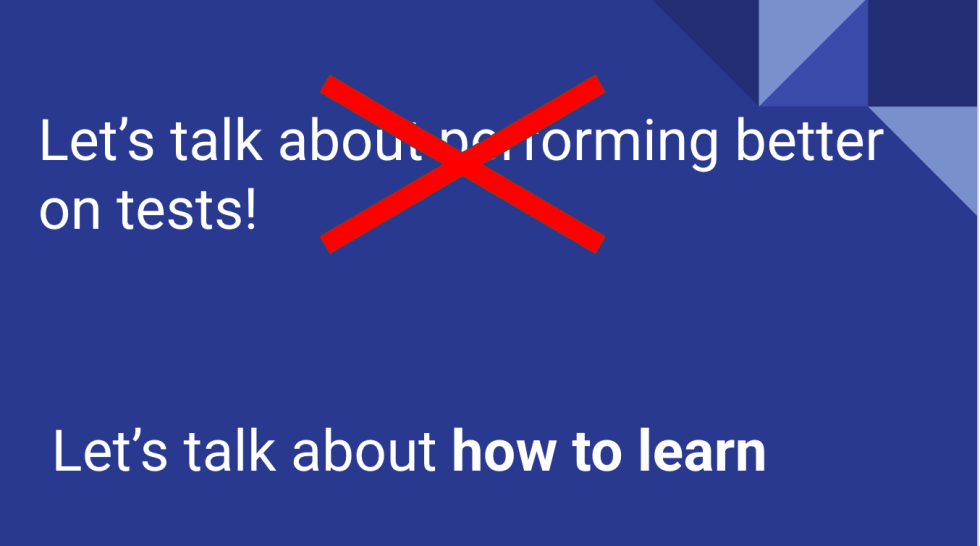
I had been digging back into Powerful Teaching and some kind of workshop was begining to materialize, albeit very, very fuzzy. And then, at Winter Meeting, Aaron Titus gets up and shares that he offers a “How to Do Better on the Test” workshop which turns out to be “How to Learn”
The workshop is grounded in the work of Dr. Saundra McGuire. There are a lot of resources of hers around the web, like this lecture here on metacognition, but primarily she has a sweet little book called Teach Yourself How to Learn. It’s short, sweet, to the point and a lot of fun to read. Dr. McGuire is a retired chemistry professor and Director Emerita of the Center for Academic Success. She is also an awardee of the Presidential Award for Excellence in Math and Science Mentorship.
Immediately in chapter one she discusses one of the aspects about college that is hardest for students: getting As and Bs in high school often comes down to memorization and regurgitation. Now, before you come with fire I know that many of us (especially if we teach AP, and definitely if you enjoy my blog) are making students do incredible things. But I also know that you can probably name more than a handful of colleagues who don’t push their students beyond memorization. Teachers who produce study guides that are basically a carbon copy of the exam. Exams that are almost all multiple choice and the math is strictly plug and chug. The dreaded triangle to “support” students doing equations like F=ma. And if not the teachers themselves, some really great high school students simply don’t get pushed beyond needing to simply show up to class to learn the information. They can get away with minimal to no homework and no studying and still do okay in the class because we see them every single day and they work hard in our rooms.
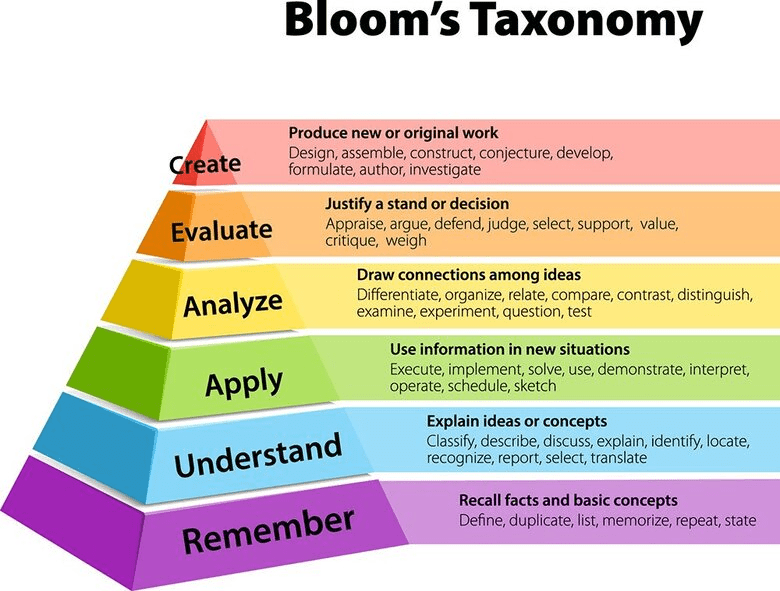
So the workshop starts by introducing students to Bloom’s Taxonomy and we have a conversation about what level they are operating at most of the time, compared to what level they need to operate at for AP Physics. What level do they think they need to operate at in college?
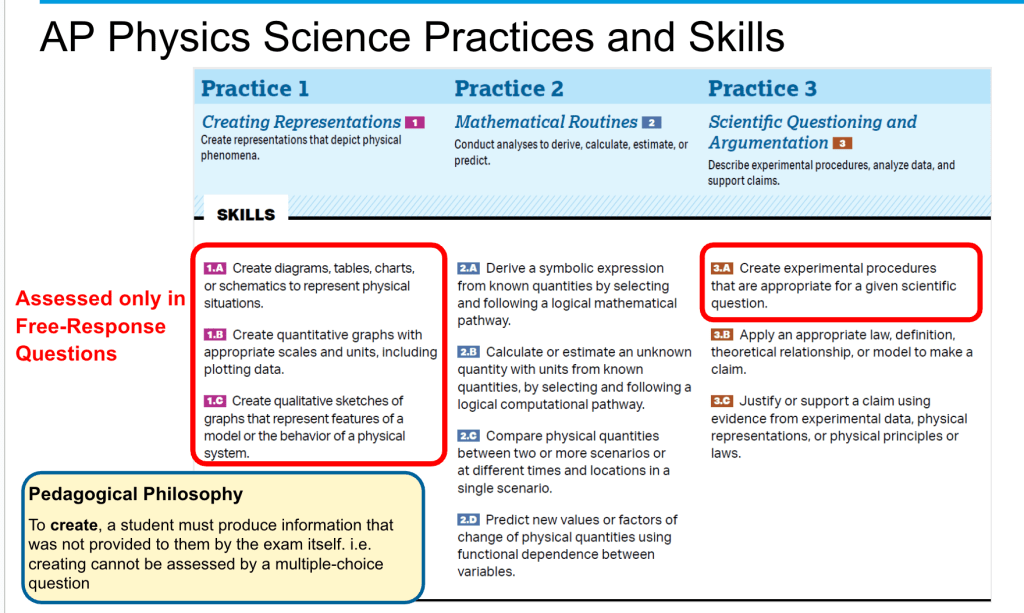
And sure enough, if you pull up the science practices and skills for AP the word “create” is literally all over the place. The top of the pyramid.
From here we took a look at a recent exam question. First I asked them a simple question:
Which of the following is true about work?
Work is effort
Work is a change in energy
Work is a force
They all know the answer. And this is a recall answer.
Then I showed them the exam question (they did really poorly on). While the question fundamentally was about the fact that work is a change in energy, what they were asked to do was apply the concept of taking an integral to calculate work and then create a graphical representation.
From here we discussed the differences between studying and learning and posed the question, “which would you work harder for? To study to get an A on a test, or prepare to teach the material to the class?”
The latter half of the workshop is about sharing strategies for doing homework, reading the text, and using practice exams. (You can find all of these in Dr. McGuire’s work and resources!)
I summarized some of these along with my personal favorites into the following list:
When you get home from school, write down everything you can remember from class that day, then compare with your class notes to identify/fill the gaps
Did you solve some problems? Grab a clean sheet of paper and solve the problem again. Compare to the example and make notes regarding your forgetting/gaps
Create a concept map to tie together big ideas and conceptual details
Make “teacher notes” as if you were preparing to teach the material
Aim for 100% mastery when you sit to study, not 85-90
As we wrapped up, the most important part of this workshop was asking students to make a commitment to do something different in the next 24 hours. I had students submit these along with some additional reflections. There were two that stood out to me today. One student reflected, “The reason this class is so challenging for me is because I haven’t had a class besides maybe Calc that required me to be at that creating level.”
A second student made an observation that knocked me over in joy:
“Physics is more than just who is smarter and has the ability to think at a higher level.”
I already know what the comments are going to look like when I share this. I’m happy to engage in a dialogue, but I’m not here for ranting.
Around the pandemic many schools started having conversations around equitable grading. Joe Feldman’s book Grading For Equity became a hot topic (originally published in 2018) and conversations, initiatives, pilots and mandates started making their way down.
So too came the complaints, “you don’t get half a paycheck for doing nothing” “so you’re telling me. a student does nothing, passes one test and then passes the class?” “if we don’t give zeros they won’t do the work!”
If you get into a deep conversation with teachers around grading, its something that is deeply personal. This in and of itself is probably a part of the problem. A lot of teachers were good at playing the game of school, checking the boxes and earning the grades. It’s really hard for teachers who “won school” to view school as anything different. Some teachers are deeply concerend with equality, “it’s not fair to the kid who worked really hard all year if another kid can just pass a test and get a good grade”. I personally have a really tough time with this one, because why should it matter? In a world where society is hell-bent on individualized education why do we care how each student gets to the finish line?
For myself, I was never a fan of putting in zeros for missing work. Students who regularly didn’t do my work in class did poorly on the tests. Students who did all of the work and missed a test are typically pretty high-strung and anxiety ridden. The zero for the missed test causes a lot of undue stress. Sure the test gets done, but at what cost?
I mentioned grading is personal. When I was a freshman in high school I became violently ill during the last week of third quarter. As such, I missed an exam in every single one of my classes, and the end of the marking period. My report card was promptly sent home with a string of Ds and Fs on it. Feverish and delirious, all I could think about was making up the missed work. It took a phone call to my counselor to assure me that I could make up the tests for me to finally rest. It sounds ridiculous in retrospect, but if you’ve ever worked with teenagers, they tend to be a little dramatic. When I returned to school (and you know how you are after a week of illness) my teachers were constantly on my back about my missed tests. I had one in every class! The only way to make up exams was in the test center after school, and I could reasonably only get one test done a day. I got caught up, and my grades were adjusted and a new report card was sent home, but I still vividly remember that horrible week.
So I pretty much always held off on entering zeros in the gradebook until I got to a point where it had been more than enough time to make up the work.
Enter grading for equity. The original grading scheme came somewhere between Yale, Harvard and Mount Holyoke. There were 4 brackets of proficiency plus failure (F). We shoehorn a 0-100 scale onto the letters and somehow 0-59 are all failing while the rest of the brackets are a mere 10 points. The argument for the 50% cut-off is simple: If you have 4 grades, 100, 100, 0, 100 that averages to a 75%. Is that student really just “average” due to the one zero? Or are they exemplary but missed one key component? Wouldn’t a B make more sense for this student? This is the change that the 50% grading floor provides.
“it lowers expectations!”
I want you to really think about this. What is our goal for students? Our pinnacle of learning? Personally, the pinnacle of learning would be that every student is able to earn an A. Realistically, I would be happy if I could get everyone to an A or B level. My expectations are that students can meet me there at a really high level. You can see why I’m then baffled at the idea that limiting the numerical possibilities of an F from 59 points to 10 is lowering expectations. Every other grade block is defined by 10 points, and adjusting the F to match the other grade blocks has no impact on my expectations on what A, B or even C level work looks like. Failing work is failing work: a failure to demonstrate any level of competence. To be completely transparent, between the grade floor and an approach to grading where letter grades are matched with level of mastery, it’s really difficult to earn the A unless you are on your A-game every. single. day. An A is never totally out of reach if a student want to earn it, but if anything my expectations are way higher than when I used points and did common teacher things like “the highest grade in the class becomes 100%” or using some weird math to make the average a certain number. It also feels a lot more honest and transparent as a mode of communication between myself, the student and the parent.
“they can do nothing all year take one test and then pass the class!”
I’ve noticed that a lot of the conversation is around the students who scrape by with a D instead of failing with a 25%. I truly wonder why so much vitriol energy is spent here. The first question I ask to that is, “if your gradebook is set up that they can pass with one assessment, does that assessment cover all of the content? I’ve never seen a student do nothing then pass a single test and pass the class. At best, they might get a 60%, but with the rest of the 50’s it’s still coming out to a 50-something and they still fail. An F is an F on the report card. As for the students who do, in fact, barely eek by with a few passing assessments…. isn’t that what a D represents anyway? That you existed in class and you learned something, but not anything near proficiency.
“You don’t get 50% of your paycheck for doing nothing!”
That’s correct, but this isn’t about “earning” 50%. It’s about making the F bracket the same size as the rest of them! You know what else my job doesn’t do? It doesn’t have a pay scale like this:
Jobs also start paying you when you’re hired, how dare you get a full salary after two weeks when you haven’t done anything to contribute to the company yet!
“We aren’t preparing them for college!”
Unless you teach at a college, stop making claims about something you experienced literal decades ago in a single program. Colleges are also undergoing shifts, both pedagogically and in terms of grading. The shifts, standards and policies can vary school to school, college to college and professor to professor.
My District Mandate and What I’m Doing
We were told the day before school started that this year the 50% grading floor was mandatory, blanks and zeros were not acceptable and our classes would be calculated with 90-10. That is, 90% of the grade is based on summative scores and 10% is formative (homework, participation etc). Any summative that is given must have at lease one retake opportunity.
Like most district mandates I certainly have my qualms, but it is what it is right now so I need a solution. Here is what I’m doing:
First, I should preface all of this by saying that I’ve been working towards standards based grading for a long time now.
AP is the place I have the most qualms for a number of reasons, mostly because making retakes is super hard, especially with the recent rewrite of the exams. I also used to have a number of different approaches around showing proficiency based on where we were in the year and the specific content. Due to this I have made one very specific shift: Every unit test is two tests.
We cover most of the content prior to the first test (for example, everything for 1D Kinematics but not projectiles, or everything in forces except multi-bodied systems). The second test is then a “built-in retake”. The second test has the entire unit’s content. If a student’s score is a letter grade higher than the first score, I change the first score to match the second. If the second score is equal or lower, both grades stand. After the second test a student may request a retake.
Retakes require deliberate practice
I have the following process for a retake:
AP students have to have their progress checks done in AP classroom. Regular students receive a selection of problems to attempt.
Students are required to schedule an appointment with me to discuss their work. We also conference on their test to highlight the good, the struggle and some tips for test taking
After the conference students are eligible for a retake at any point 24 hours after the conference. (within a 1 week window). they can also come back in to discuss more work with me if they’d like.
Benefits of the two-test system is that a lot of students do, in fact, improve the second time which eliminates the need for me to give a retake outside of class time. It also gives students a “freebie” retake. I had about 10 students request a retake after the first test. I don’t anticipate this number increasing significantly, and I can manage it.
No Finals Allowed, so I do retakes!
We got rid of finals in 2020-21, first by making them “holds harmless”. I refuse to do more work than my students, so I told them how things were going to go: if you can earn a score that is a letter grade different from your current grade, I will adjust your grade to match the exam. I do this in AP with a practice AP exam. In regular physics its a “choose your own adventure” final where students select what they want to reassess on and I only score those parts. I find that students are eagerly studying for these opportunities to demonstrate proficiency. It also means that “it isn’t over until it’s over”.
What about the 10%
Everything I score for the 10% goes in the gradebook as 10 points, so the level of proficiency is obvious. Quizzes in AP and “check-ins” are weighted at 5x, so they are “counting” as 50 points each. Formative labs are weighted at 3x. All of the rest is 1x. This allows for that 10% to be as informative as possible.
Some labs are Summative
Especially in AP, I am putting certain important labs as summatives. Students simply aren’t allowed to give me garbage. If the lab is bad, I send it back requesting/expecting revisions. In the real world? revisions are a thing. In the academic world papers are rarely accepted for publication the first time. Revisions make our good work great.
How do my students do anyway?
Here’s the bottom line: Students who always did well, still do well. The students who refuse to do anything, still refuse and still fail.
BUT…. students who don’t do anything for a long time period cam sometimes come around because they aren’t so far gone that they “don’t see the point”. I have a handful of students each year who really put forth commendable effort after big things in their lives. These students may eek by with a D or are really proud of a C.
An A is truly an exemplary student. Since I use standards based grading, earning an A means doing that near-perfect work all of the time. This is the most frustrating part for students who were used to “playing school” by checking the boxes, and this is where a lot of work is needed on my end, because the difference between the A and B needs to be crystal clear.
I know I’ll continue to think about, re-evaluate and shift the way I score and assign grades. I also know that as soon as I post this I’m going to see/hear all kinds of things. That’s ok. We’re all learning and growing, and hopefully, the ones doing the most growing are your students.
Before the Science of Reading train took off en masse, I was already excited about applying ideas from cognitive psychology in physics. In 2020 I was in the midst of my graduate studies and noticed that strategies I had “discovered” as effective were grounded in research. Previously I had attended an ISLE workshop with Eugenia Etkina and had much of the same experience, during which I learned about The Expert Game.
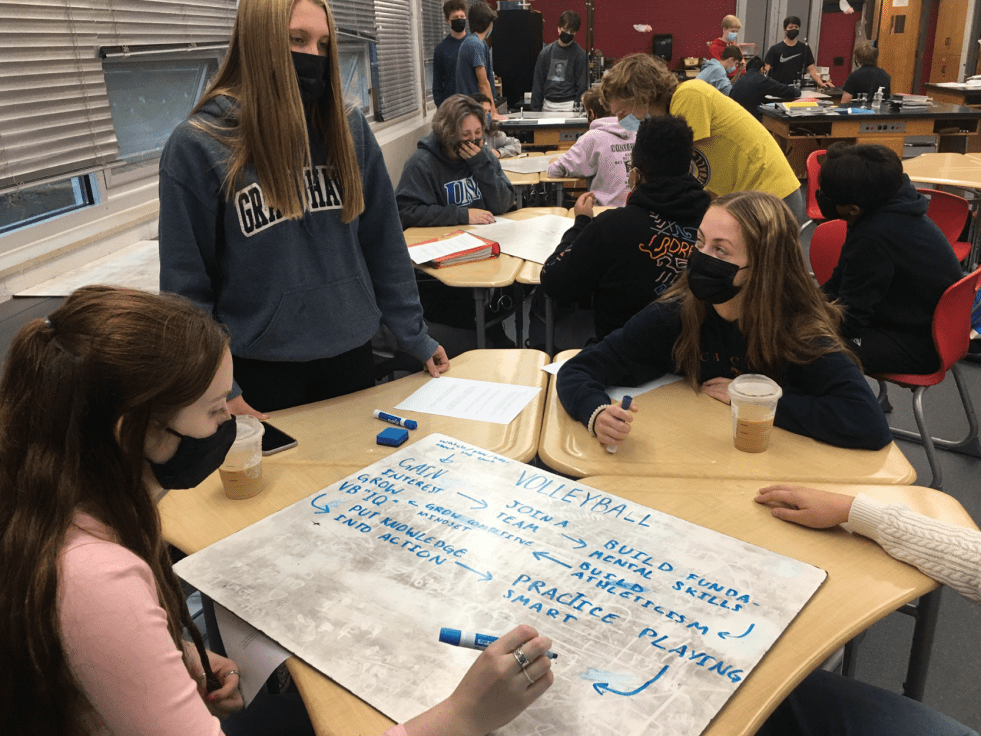
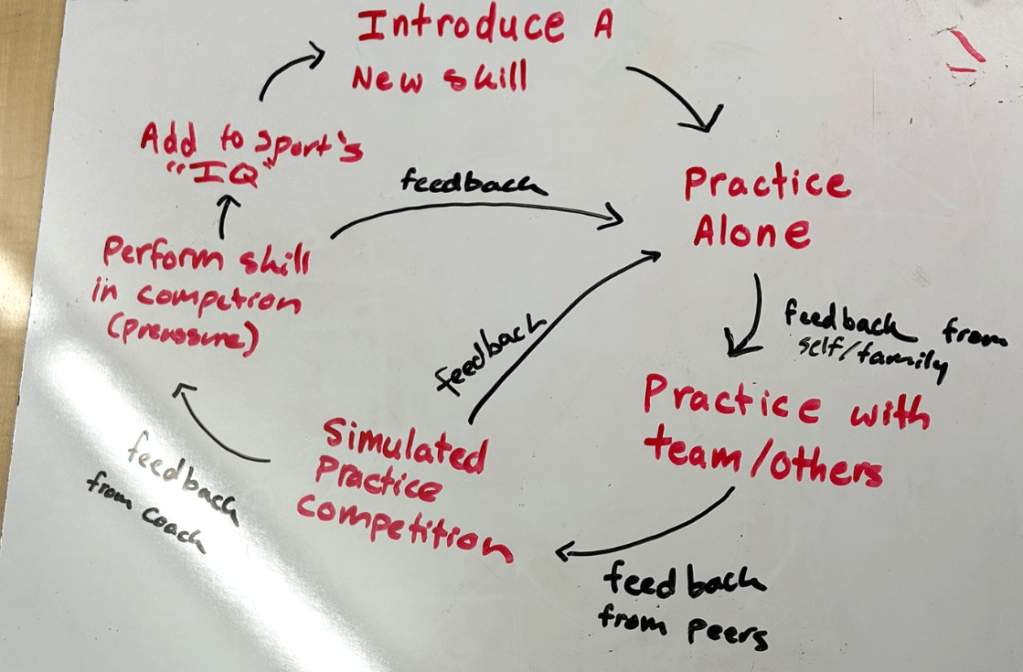
I chose to implement The Expert Game immediately after the first exam. The idea was that students needed an opportunity to experience the full learning cycle, and in some instances “fail” (by their standards) so that the expert game held meaning.
A student generated cycle of learning a sport
As I dove into the science of learning, the book The Science of Learning Physicswas also published. One of the authors, Jennifer Docktor, gave a talk for Harvard’s PoLS-T series that summarized the chapters. I decided to add this video as a homework assignment for my students. They are given the following prompt,
Watch the talk and write a short reflection (minimum 300 words) Include the following. Please dig deep and synthesize rather than simply agreeing or disagreeing.
What ideas challenged your current thinking?
What resonated with you?
What ideas challenged your current thinking about how we learn and learn best?
What do you now wonder after listening to this talk?
What resulted in an “aha” moment for you.
Lastly, as a student, what can YOU take away that you’ve learned in order to improve your learning this semester?
The reflections are always really cool to read. Check out this one reflection:
I must say that one of the things that challenged me the most was the idea of a gap between what methods students think teaches them the most and what methods actually teach them the most. The human brain can be incredibly annoying, and this feels like a prime example of it. It follows to reason that when I feel like a method is working better, I should trust those thoughts and engage with that method. However, the human brain likes things to be easy, not necessarily successful, which is something I must remain aware of and try to put into practice, seeking out the difficulties that generate learning, even if they might not be the most pleasant at first.
In particular, some students verbalize that they finally understand why my class is structured the way that it is. This was particularly noticable from students when I first assigned the lecture during the pandemic. Unlike many of my collegues I avoided lecture like the plague and put students in breakout rooms constantly. At first students complained a lot that “I wasn’t teaching them” but as the semester progressed they realized they were learning more in physics than their other classes:
The biggest realization in the video was in the “Active Learning” section (Chapter 5), where Docktor says that sharing ideas is an excellent way to learn. It’s as if she’s saying that students should keep working together. While working in groups is fun, I wasn’t sure if I was learning as much as if we did it on our own. The evidence she cites implies that the jamboards and group labs are some of the best ways for us to spend our time.
This school year I’ve been a bit overwhelmed. For the first time since I’ve been at this school my classes are all at 30+ students. We have also been given a directive that every summative must have a retake opportunity. It’s been a lot. Thanks to that, I have not gotten to reading my student reflections from three weeks ago until today.
It turns out this is a gift!
One of the shifts I made to make the retake process easier is the following: For each unit, we take the summative when we are nearly done with the content. For kinematics we covered everything except projectiles. For forces we will do everything except pulley problems and other multi bodied systems. You get the idea. Then, after we cover the final topic we take a second summative. The second summative contains all of the content and is a “built-in retake”. If students score higher on the second summative, the score will replace the first score. If they score lower then both grades stand as is in the grade book. Students can then request an additional retake. This naturally reduces the volume of extra retakes I have to give, as I already had this multiple assessment per unit practice in place.
Since I’m behind on grading, I am reading the reflections after the first exam with student data about the second exam. It’s really cool! Students who took the message to heart: that practice and active strategies trump passive ones, generally performed better on the reassessment! Students who wrote a reflection that seems stuck in their ways performed the same or worse on the second assessment. As I am reading the reflections I can now point to their own words as we go into the retake process and continue through the year.
A student who saw an entire letter grade shift on the second assessment wrote, “When studying last year, I mainly reviewed my notes. Although this process was somewhat beneficial and better than not studying at all, Dr. Docktor argues that the act of practicing the material is much more effective for students attempting to retain the information. Now that I know this, I plan to incorporate active processes into my studying for physics and my other classes.”
Meanwhile, a second student wrote,“I find the most effective method for me is a mix of passive and active learning. Using passive methods to set a base level and active methods to solidify the concepts.” this student struggled greatly on the second assessment and we will be discussing these ideas at his conference.
I think too often we get so caught in the grind of the content we need to teach, we forget that this kind of self-reflection is really the key component to deep learning. It’s not an easy thing to do well, especially when physics teachers are rarely the “touchy feely” types like you might find in english or social studies, but our students are whole humans!



 Physics.Teacher.Momma.