In My Class Today · Science of Learning · Teaching Methods

Accountability on Ungraded Homework

In Building Thinking Classrooms the way that students approach homework is different. The idea is that we know that homework is intended for practice however students often end up doing homework either to satisfy their teacher or to satisfy their parents. The result is a lot of cheating. One of the small shifts around homework is to simply change the language to what we intend, “check your understanding” However, in following the tenets of insuring student autonomy Liljedahl sets forth 4 more rules:

  1. Don’t ask about it
  2. Don’t mark it
  3. Don’t check it
  4. DO use phrases like “this is your opportunity

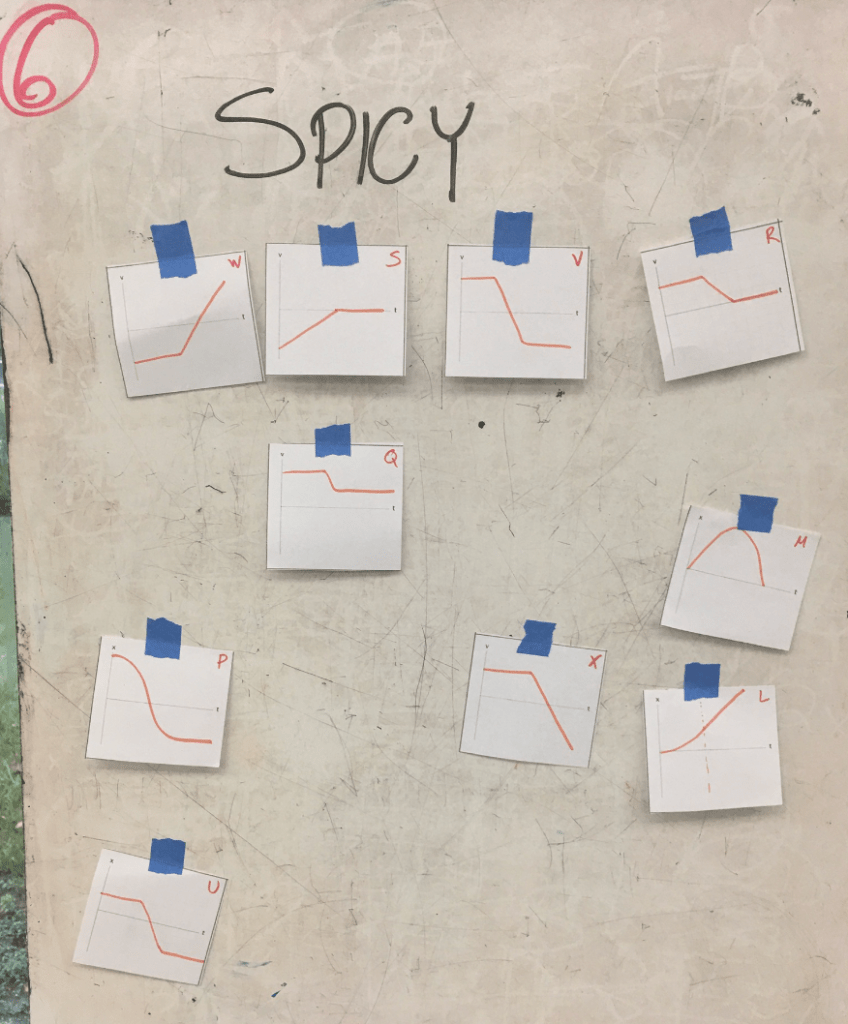
One of the neat tools for opportunity that I learned was offering “mild, medium and spicy” problems. The problems are a matter of “taste” rather than “level” and there is no expectation around how many are accomplished, just that you keep working. Students do a great job moving themselves up as they gain confidence. This year, to my glee, I actually had students ask to post the problems online so they could do more!

As fun and as engaging as this is, I still felt like there should be some way that students are accountable for their work, but in a meaningful way. So here’s what I’m doing this year:

We have work days where students might have Mild, Medium and Spicy problems, or maybe just a standard problem set. I post solutions around the room for students to check their own work as they go. This not only keeps them moving, but it also means that the questions I’m answering are a little more meaty than “is this right”. Much of the simpler questions can be answered within student groups, giving them some independence.

Following the guidelines around homework I do not have students submit the work. It’s not checked, counted or graded.

There IS, however, follow up. It lives in a google form and I ask students to evaluate themselves and then do a little more thinking so I can see where they are.
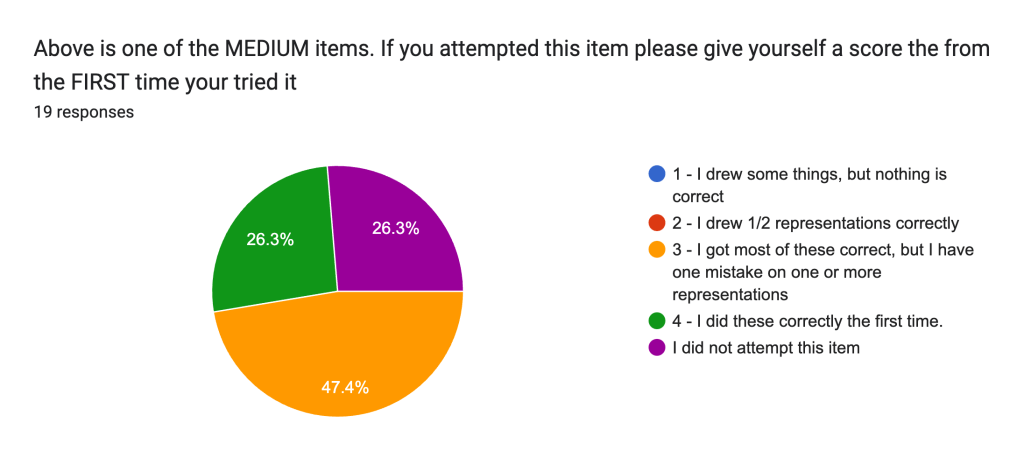
The first part of the form looks like this. I’m asking them to self-evaluate on each of the learning objectives. The four categories are akin to the way in which I will ultimately grade their assessment, but in very simple terms.

Next, students have 2-3 items that are reproduced from the solutions of the work they engaged with during class.

In this example students received a stack of position, velocity and acceleration graphs that all were associated with the same motion. I provided a photo of the key (above) followed by these prompts:

What’s great about this is that the part “A student asks this question…” are real questions I get from students! During the activity I often hear these exact questions during the work, which gives the student a second opportunity to reflect on this and address the misconception (these questions come from experience, I’m not making the form during class) Something I’m realizing I did not do consistently was first ask “why would your classmate think this” before asking how to correct the response. I’ll need to update that for next time!
Looking at the student data is really cool!

First, I get a sense of where my students believe they currently stand on the work.

I can see that we need to gain confidence on sketching a velocity graph from a verbal description (which surprised me, because in my expert blind spot that feels like the easiest one to graph!)

I can also disaggregate between how students think they are doing, and how they are actually doing.

The question referenced here was a standard free-fall parabola on the position graph(concave down) Yet 2/3 of students who attempted it did not answer some portion of it correctly!

There are some really great student responses to the question I asked about this item. Some better than others. This gives me a great launch-point when we get into free-fall specifically

I think the next step here is to overtly integrate the results from these feedback forms into class instruction. I want students to be able to make a strong connection between the practice we do in class and how it can impact their learning, even if they don’t get credit for the actual practice.

In My Class Today · Science of Learning · Teaching Methods

Note Making in an Active Classroom

I like to be challenged. In the last year as the Science of Reading has surged in use/popularity so too have the direct instruction advocates. Specifically in my space I’ve seen a lot of attacks on student-centered instruction (the type of instruction that is promoted by the National Council of Teachers in Mathematics and the NSTA) which argue that an emphasis on student thinking and problem-solving is harmful to all but the top tier students.

None of us educators who truly care about the craft are blindly and deliberately acting every day in ways to exclude students. Most of us are intentionally considering what is presented to us and how it impacts our students in the classroom. I graduated college fresh on the latest expression of inquiry-based learning making its rounds as all the rage. At that time the idea was to let students explore and then let them go where they wished. This concept drove my first day activities where my students play with various demos and lab set-ups, but it was very clear that the kinds of questions and ideas students would come up with on that first day were predictable and lacked meat. True to the advocates of direct instruction (DI) and grounded in cognitive science, the more you know the better questions you can ask.

My first year teaching was also a shift from my previous experiences in affluent schools to one where the majority of my students were highly dependent learners, for various reasons. I quickly realized that I needed to scaffold most of the resources I had from student teaching in order to support students reaching the intended goal.

In the years that followed I had a wealth of opportunities with student groups. I ended up teaching everything from co-taught freshman physics to honor’s physics at that first school and then everything from kindergarten astronomy to middle school integrated math at Northwestern’s gifted enrichment programming. Then I was back at my old high school where I tutored over 2,000 different students in science and math. That experience was eye opening in terms of how instruction impacted students, and yes, some students need more direct support.

I attended my first Investigative Science Learning Environment (ISLE) in the summer of 2018 and it was earth-shattering. Roughly a decade into teaching and the method from Rutgers University gave language and research to many of the things I had figured out along the way.

In 2022 I discovered Building Thinking Classrooms in Mathematics and in 2023 I attended a workshop with the author, Peter Liljidahl. At that workshop we focused on the later-half of the book which is arguably the most difficult to understand how to execute from the text alone. Peter explained to us that in their research what they noted was that consolidation and note-making were the critical components that made the different in lasting learning. Let me reiterate that: Peter himself shared with us that random groups, vertical whiteboarding, thinking tasks are easy to implement and certainly promote engagement but in order to get the learning to stick, the consolidation was key.

I started thinking about this in the context of any kind of active learning environment. In ISLE students go through the process of observational experiments and testing experiments and are also “representing and reasoning” along the way. After each round students are supposed to be “interrogating the text” and then practicing with problems. This works great for my gifted AP level students, but as many of us have found other student groups need more scaffolding and support. During the workshop Peter shared his latest idea for note-making.

Some context from the book. Everything is about considering the psychological messages we send to students about our expectations and their roles, and how we can make moves to flip that to re-center the student and their thinking. As renowned cognitive psychologist Daniel Willingham points out, thinking is hard and our brains do everything possible to avoid it. At the same time we also enjoy puzzles and figuring things out (did you do wordle or connections today?). In the book the idea is that notes are something that happens after engaging with thinking and in a way that you continue to think while making (not taking) the notes.

Think about that for a second. When you take notes in lecture how does that go? Are you furiously copying everything and then find yourself not remembering the actual lecture? Are you trying to furiously copy and then falling behind, leaving you frustrated? Or do your prior experiences prohibit you from taking any notes at all so you give up. We know that the act of note taking is helpful for remembering, but there are also a lot of barriers and challenges when trying to get a group of 30+ individuals to all obtain the information pertinent to their learning.

The book discusses having students “go make notes” and to write things down for “their future forgetful selves” which is a good framing, but I noticed in class that many of my students were still unsure about what that would mean.

What it Looks Like

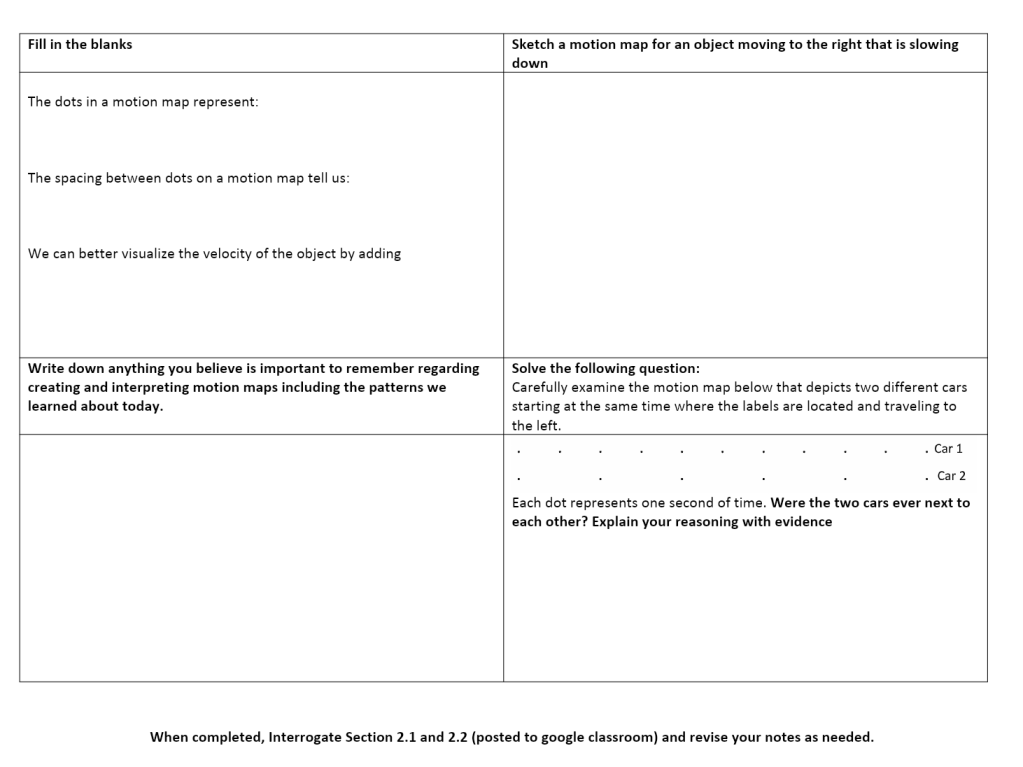
At the workshop Peter shared this really cool template (these are my notes from the workshop):

Check it out! It’s all the things the DI folks love to share are necessary and supposedly non-existent in a thinking classroom. The top is structured by the teacher. In fact, it’s two worked examples. The first is for students to fill in the blanks while the second is a similar, but different example. The bottom half is for student autonomy, though it should be noted that the “create your own example” can come from homework, the textbook etc.

The way this was presented was that students would create these notes on the whiteboards and then transfer them to their own notebooks. I cannot fathom running a lesson, and then doing the notes on boards and then having the transfer happen, so I needed something different.

Meaningful Notes in My Classroom

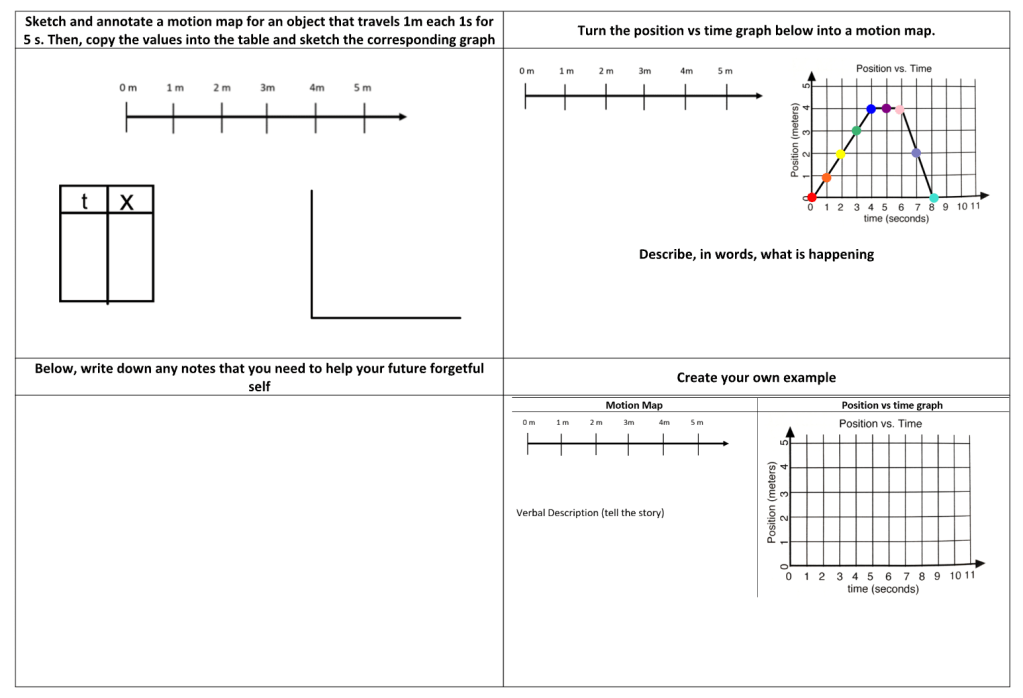
What I chose to do was to create the template and provide it to students with that teacher part already prepared. Here are a few samples:

This first set is what students completed after doing the observational experiements dropping bean bags behind a bowling ball and creating their first motion maps:

The following day I have students engage in a desmos sorting activity to continue working with motion maps as we continue the reasoning process. ISLE folks will recognize the content that is directly from the Active Learning Guides:

Next I borrow from the AMTA curriculum to start translating representations. The top half of this page was all work we do together on whiteboards.

Here’s what’s been really cool about using this style for notes:

  1. Students (and I!) are able to recognize what actually translated/processed during the class discussion. Since the first box is often work that was exactly from the discussion and whiteboarding we can hit those problem areas right away using the discussion we just had.
  2. The example is manageable. Instead of giving students 5-10 practice problems, they have just one they are required to complete. This example is either very similar to an example that was done in class or identical to the example done in class, but the example is no longer available to copy (yeah, I’m sneaking some retrieval practice in!)
  3. As students work on the top half and we have those conversations about what they are stuck on or missed I’m able to say “ok, that’s something you should probably put in the things I need to remember box!” This is also true any time I hear a student go “oooooooh!” when the lightbulb turns on.
  4. Create your own examples are actually pretty decent! Sometimes they are pretty similar to the first example, other times I see students stretching themselves.

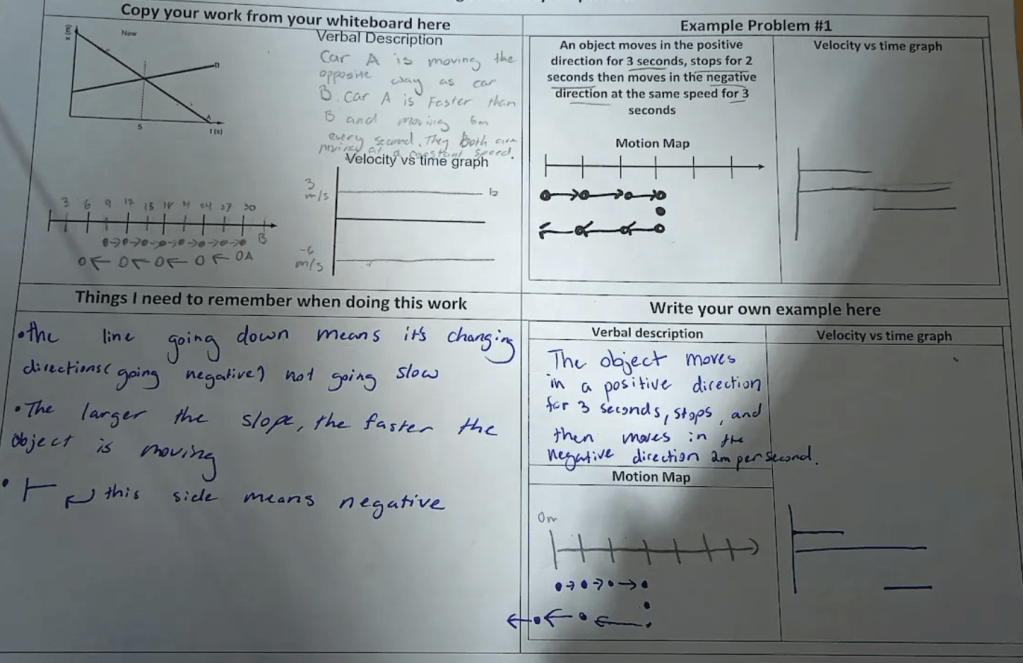
The notes that get submitted also paint a great picture of where my students are at. Check this one out. This student is pretty quiet in a class of students who are generally super vocal and asking for my help frequently.

I’m able to make a few judgements here from the work. First, this student doesn’t yet understand how to represent stop on the velocity vs time graph. Second, even though that’s the case, she does have a pretty good handle on what they were supposed to learn in the lesson that day (see the “things I need to remember”)

I’m still experimenting with this and finding ways to adjust and ensure that students are ultimately getting what I want them to get from the notes. I do feel, however, that now the notes that are on the papers are resulting in more meaningful work than when I’m expecting them to copy as I work on the board. I can still craft these so students get what I want them to get on the paper, but also provide space for autonomy and small wins to build confidence.

Concept Modeling · In My Class Today · Teaching Methods

Multiple Representations for Momentum Conservation

I did it. I finally revised how I teach momentum conservation to my on-track physics students and I’m never looking back!

It can be really hard to shift something that “works” especially if you don’t have a team. For my on-track physics students collision/explosion problems were always an “easy win” for students. We would define that “momentum is conserved” and then talk about how to solve the problems. I would lecture and show them the “table method” and then the “brute force method” and allow them to choose how they wanted to solve.

This was satisfying for students. It felt easy and students gained confidence in physics. However I was always irritated by this. They were performing a series of algorithms to get to an answer with no real understanding of the underlying ideas.

Sometimes we don’t make changes until we are forced to. I had yet to see this part of momentum done in a way that was in alignment with my overall pedagogy and it “worked” …enough. However this year during this particular set of lessons I was to be observed in my classroom. I wanted to ensure that the observation showed who I really am as a teacher, rather than a snapshot of something I had yet to address. So I started digging.

I had seen some work with momentum bar charts around the twitterverse and in Pivot Interactives and in the modeling community, but I wasn’t entirely sold on it. It felt like taking a good idea from energy and forcing it into a place it didn’t need to exist.

I looked to see what Kelly Oshea had done and found her momentum card sort, but I knew that would be too much for an introduction to the content, but it got me thinking.

The following set of four representations is what I settled upon, and here’s how it went:

First, for each of these I would demo the collision first so students had an idea of what was happening before and after the collision. We spend one day on elastic, one on inelastic and one on explosions and for each day we went through several different examples. I’m going to use our final inelastic case for this post.

1 – Draw a picture

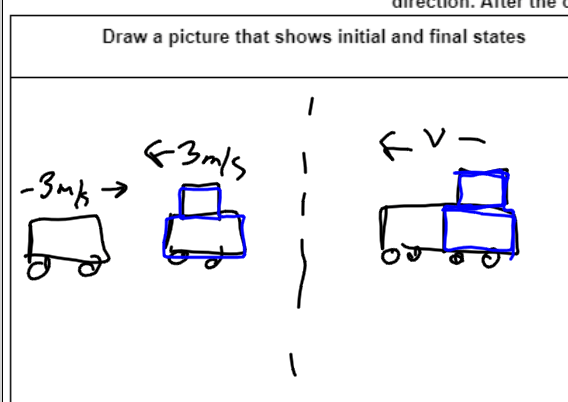
There is a reason why “a picture is worth a thousand words”. A picture allows us to easily see and locate information that we might miss in text. For example, in this problem it becomes clear that we have some direction issues, so we know that negatives are going to come into play. For the purposes of my pictures I draw my more massive cars with the added mass on top. You’ll notice I’ve also color coded the larger car as blue.

2 – Momentum Bar Charts

I finally decided to implement the bar charts. For my intro problems I used whole numbers so that we could represent them with tangible “blocks” of momentum. The block width is the mass and the height is the velocity, so in this particular case the total number of blocks is the momentum. I found my students had a hard time shifting this to a more abstract view where you could use area so this will be an emphasis next time.

You’ll notice I’ve brought the color scheme over for the blocks. In class we have already discussed that the total momentum is constant. So we draw the initial case and then we discuss what the final case is going to look like in order to keep momentum constant. Students are able to recognize that we have a total of -3 units of momentum on the initial side, so we need 3 in the final. Since this is an inelastic collision the width has to be three which means the height can only be -1. Students are already solving collision problems without realizing they are doing math! This felt like a really cool win.

3 – Momentum vs time graphs

This part is something I need to think about a little more. It was something that was “obvious” to me, but was very much not obvious to students. To me, it was “obvious” because you just slap those initial and final values on the graph. The hard part, I thought, was ensuring that you are accounting for each car in the inelastic case.

I absolutely LOVE this representation because this is where students can SEE WHY momentum is constant. The CHANGE of each object is the same size, but different in direction! It’s super satisfying!

The challenges my students had came from notions about what it “should” do. Because the cars are moving together, they want the lines to go together at the end. When I recognized this, we spent a day looking at the representations as a whole and locating where momentum is represented in each in order to construct this graph of momentum. There were a lot of “ah ha” moments when we did this. I think next time I will save this graph for last.

4 – Mathematical Model

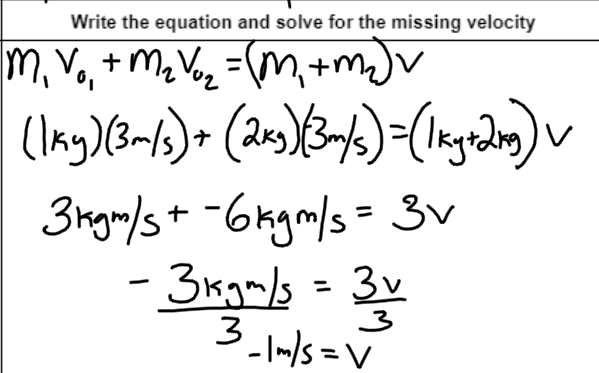
The tables are no more! With this mathematical model right next to the other representations, student can see where everything is coming from. The momentum terms, the momentum values, and the final velocity value at the end.

While this was definitely a harder task for students to complete, I feel a lot better about their conceptual understanding of what is happening in a collision. The multiple representations also mean that students have multiple ways of showing me that they understand what is happening.

In My Class Today · Teaching Methods

Deliberate Practice with Mild, Medium & Spicy Problems

As a high school teacher homework is a constant battle.

At my high school it’s an equity issue. Many of my students lack the time, space and resources to complete homework.

But also, we also know that the fundamental differentiator between excellence and mediocracy is discipline and deliberate practice. And on a very fundamental level “use it or lose it”. So how to ensure practice and ensure it in a way where learning is happening for all students?

Enter Mild, Medium and Spicy questions.

I picked this idea up from Peter Liljidahl when he joined our nationwide physics book study in April on his book Building Thinking Classrooms in Mathematics. He’s been researching this type of practice most recently in classrooms and I was finally ready to give it a try.

I knew that my students needed some extra practice on calculating quantities from kinematic graphs. They just weren’t quite there yet. I could have assigned problems. If I did, I’d get a 25-50% completion rate and mostly students who did not need the practice provided.

Instead, I did the following:

1) I made a variety of position, velocity and acceleration vs time graphs. Mild graphs had one segment, medium had 2 and spicy had 3 or more. Then, I wrote out the solutions to all of the problems. I put the problems up with tape on 3 individual whiteboard for the three flavors. The answers were on a cabinet on the other side of the room

2) We reviewed the previous week’s quiz and identified that this was the area that needed work. I explained to students they could choose the problems, gave them a paper to document their work, and pointed out the answers were provided.

3) I kid you not, I had 100% of students working for 100% of the hour.. to the point where my last class of the day (who normally line up early) were shocked that the bell rang!

Why it works:

1)Taste vs Aptitude Instead of “levels” the questions are sorted by “flavor” there is something psychologically motivating about choosing your preference rather than feeling pigeonholed by ability.

2) Do What you need – give students a task with a number of items and they want to finish as quickly as possible. Alternatively, the task is overwhelming and they don’t even begin. A single graph at a time, that is student selected (hello autonomy!) is manageable. There’s no pressure! No pressure to complete a spicy, no pressure to complete x number of problems. Just do what you need. I had two students go for the spiciest spicy. I made a comment about it and they asked me if they did it correctly if they needed to do more. Ironically, because it was so complex they were going to end up doing 7 different problems in the process anyway!

3) Get to the deep stuff – honestly, the best part of this for me were the conversations I heard students having. Some of them would get into heated arguments about the correct answer, even though they could have just looked. But just looking was like skipping to the end of the movie. The puzzle was more important than the answer. (I’m going to remind folks real quick that this is NOT my AP course)

4) Student Wins – I heard several students comment that day “I feel smart in this class.” and I cannot tell you how big of a statement that is coming from this group of students. If you know, you know.

  • Have any of you tried anything like this?
  • How do you deal with the homework problem?
  • What are you thinking about regarding this idea?
Activities · In My Class Today

SciComm Unit Results

A few weeks ago I posted the article We Did Improv in Physics which outlined my four-day mini-unit emphasizing communication and presentation skills. Students did this in a number of ways including deconstructing TED talks, writing a blog post about their research, and giving a two minute impromptu version of their talk, in addition to the improv workshop. While the energy and the feelings in the room were fantastic, I also collected survey data from students that I’m going to share here.

Overall Results

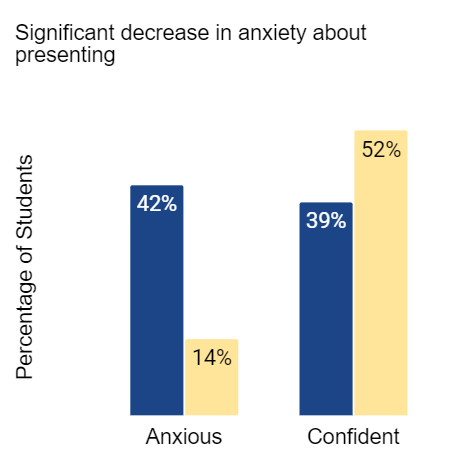
Before we started the unit I asked students a number of questions around presentations. One of the prompts ask students to rate their confidence when presenting in front of peers from “Very Anxious” to “Very confident”. When the unit ended I asked them how they were feeling about presenting their physics projects. The results were astounding.

While the four day experience wasn’t quite enough to build substansial confidence (increase from 39 to 52%) the amount of anxiety significantly decreased from 42% of students reporting some level of anxiety to only 14%. About half of these students moved from anxious to neutral and the other half moved from anxious to confident.

Students were also asked to rate the statement “Being able to give presentations is an important skill for me to acquire” the number of students who marked “very important” doubled from pre to post assessment.

Students were also asked what the single, most important aspect of an excellent presentation was. While many of them stated “audience” there were also a great deal of other responses such as confidence but also things like structure, organization, and knowing your own material well

After the mini unit these responses were reduced to those that were emphasize from the lesson. An increase in the response “audience” was noted as well as an increase in mentions around the visuals. Noticeably less was “confidence”

Student Feedback On Activities

Students were prompted “Considering your final presentation, how valuable were the activities around dissecting the various talks?” Student rated on a 5 point scale from “not valuable at all” to “very valuable”. A summary of student responses for each of the three activities is below.

Turn Your Paper into a Blog Post

56% of students found the blogging activity to be useful, with only 8.7% of students reporting it was not. Some of the comments are below with scores in parenthesis:

  • It helped to see how there was a different type of communication between presentations and the lab report itself. (4)
  • It helped show us how to communicate our project in an understandable, engaging, and quick way. It used common language like our presentation will. (4)
  • I felt like the activity where you turned the report into the blog was helpful because it showed how you would convey your report to an audience rather than someone reading it just for information. (5)
  • By doing the blog post and using informal words I realized that this physics presentation was more like a conversation between our peers. We were just sharing our finding with one another and the blog post helped organize all this information. (4)

Interestingly, the students who rated the activity low still reported the value in the activity’s intention, demonstrating that the low score had more to do with their perceived needs than the intented learning.

It was somewhat helpful for making the presentation interesting and easy to understand. However, I didn’t find it helpful for actual content which I’m more concerned with. (2)

Data Viz Presentation & Evaluation

87% of students found the Data Viz presentation helpful. I think this is interesting because this was the one “lecture” that was provided and I know my students tend to prefer lectures. Still, there were some great reflections from students:

  • I did not realize how much detail is given into making slideshows. For example, I would have never thought about making slides colorblind proof. (4)
  • I especially liked this activity because it enabled us to visualize what we could change in our presentations through using new strategies. I especially found important how we learned to use less words and things on each slide, making them simpler. Also, the rule of thirds was a good guideline for how we laid out our slides. (5)
  • It helped to see the ways the data can be shown to not over power the audience with so much information at once. (5)
Improv Workshop

48% of students found the improv workshop to be helpful with only 8.7% reporting it was not helpful. There are a couple of pieces of evidence from the commentary that support these low numbers, even though there were drastic results observed in the pre- and post- presentations. Firstly, the intention of the activities was not clear to students until we debriefed. We did improv on a Friday and debriefed on Monday. Secondly, the workshop put students very far outside of their comfort zone.

Overall Impact

Overall students were very positive towards the mini unit. A few comments of note:

  • I think it was really valuable to have this unit because none of our other teachers really sit and go through what a generally good/well-rounded presentation should look like, they only focus on content/course specific presentations
  • It felt like a breath of fresh air, and made me realize that communication is a huge skill in in physics apart from problem-solving obviously.
  • I think that unit is helpful when it comes to sharing your findings with other people in an effective manner. I learned quite a bit about how to construct my slides to show only the important information. This unit is also helpful in feeling more comfortable presenting in front of your peers.

Students were also asked if I should run this lesson again. Every student except two said “yes”. The two exceptions marked “maybe”. Of note is that the two “maybes” expressed discomfort with the improv workshop, but had generally favorable commentary regarding the other activities.

Honestly, the results are beyond what I was hoping for. This is something I will absolutely continue.

In My Class Today

That time I had to change my lesson in 15 minutes

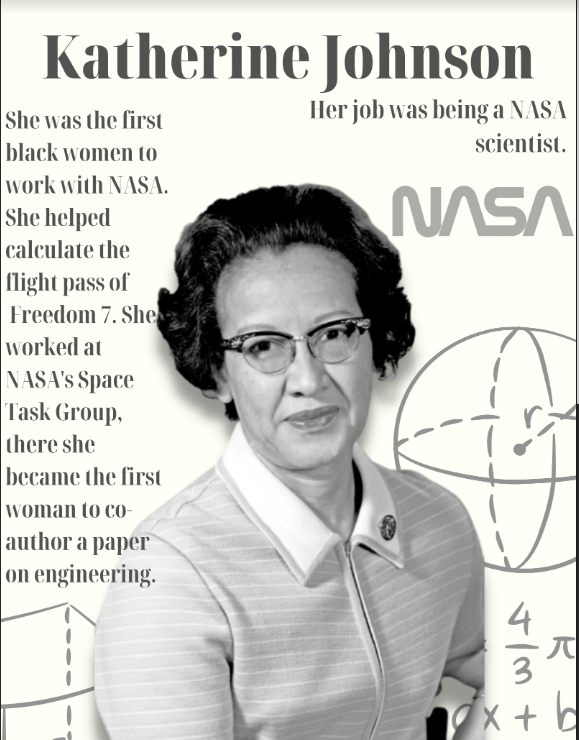
So I’m taking a break between mechanics and waves/color/sound in regular physics to run the underrep curriculum. This week was mostly setting the stage and one of the projects students had was to research a black scientist, create a poster and write a bio. FIRST of all, some of the posters WERE AMAZING (YES, those are STUDENT CREATED posters)

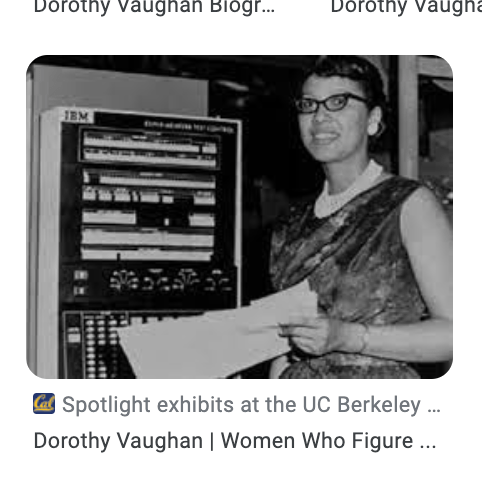
One of my students decided to research Dorothy Vaughan, the first black female supervisor for NASA. Unfortunately she kept finding photos of other computers labeled with her name. One picture, in particular had us puzzled because she didn’t quite fit anyone’s visual. I commented on how this experience in and of itself made for an interesting statement on underrepresentation and marginalization.

So today I see the NASA announcement that one of the mountains on the moon is to be named after Melba Mouton. The photo? The same one we were puzzling over! I was eager to share this with my student and I started doing a google image search for Dorothy Vaughn, specifically looking for this photo of Melba.

And WHO has it mislabeled? None other than UC Berkeley!

So I scrapped the lesson for today and we wrote. First I had the student share her story with the picture situation and then I shared the news about the moon. I gave students a framework to then write a letter to the curators of the exhibit at Berkeley, asking them to put into consideration the bigger picture of our studies from the past week.

They did this on the big post it paper and then we had a gallery walk and students crafted a final version of their group letter.

I then went through submissions and put together a final letter of their writing to send off to the two individuals listed on the exhibit.

Of course my students’ first question “will they even do anything” stung a bit because I know that comes from a place of not being heard over and over again.

But they DID!

I promptly received an email back from Berkeley that they would correct the attribution and include Melba! I am SO excited to share with my students Tuesday!

Activities · In My Class Today · New Teacher

3 Ideas for a Strong Start

It is the end of July, the back to school sales have been running for a month, the #clearthelist movement is in full force. While I keep telling myself I have ALL of August left (that’s actually a lie, I have institute the 30th/31st) many of us are starting in just a few weeks. Here are three ideas to start physics strong. These ideas are grounded in my values and beliefs around teaching physics. You can read about those here

Physics is about EXPERIMENTS

I want students to know science is investigative and that anyone can do it. Many teachers will do a team-building activity on the first day, but I prefer to let students play. This gives me a chance to observe the dynamics of each class before I begin to influence the room and it also takes any pressure off of students to perform for one another or myself. I try to set up a demonstration or lab from each of the units for the entire year. Directions for observations are left on a notecard in front of the set up. Students are asked to write down detailed observations about each demonstration. Over the weekend I ask students to find the demonstration online and learn about how it works. Students are then asked to write a claim, evidence reasoning statement about a single demonstration. Here is my handout and some of the demos I set up

Getting to Know You

When we begin class I ask students to introduce themselves, rather than butchering their names on the roster. I take notes for myself. I ask students to share their name, and how they are feeling. I will also ask them to create a flipgrid introduction with a little more info. This allows me to have their pronunciation recorded so I can review it repeatedly. Here are the prompts:

1) State your first and last name
2) What is something you’re really into, or “your thing?” This could be an interest, hobby, job, talent, etc… anything!
3) Post a picture in your video of you doing your thing or a product from your thing
4) What is one thing you wonder about one (or more) of the demos from the first day? (I wonder why….)
5) Respond to at least TWO classmates!

Physics is for Everyone!

I am a STEP-UP advocate and one of the lesson plans in the program is the Careers in Physics. In the lesson students learn about the vast scope of employment opportunities with a physics degree and then are asked to create a career profile. Students do this by taking a super short survey where they check off their interests and values and then they are matched with a professional who shares their interests. You can access the lesson plan and resources here.

I hope you find these ideas useful! What else have you done to set the tone for the year? Drop it in the comments!

By the way, I LOVE writing about how to teach physics WELL! Check out my “How I teach” series as well as “The Science of Learning Physics

Classroom Issues · In My Class Today

Identity Development in the Physics Classroom

Download posters from the featured image here

Why do you teach? It’s certainly not for the competitive salary, the great respect from society or the flexible work schedule. Do you remember writing that philosophy of education statement? What did it say then, what does it say now? Most statements say something along the lines of “I believe all students can learn” “students learn at different rates” “students need to be met where they are at” so on and so forth. What is critical here, is the use of the word “all”.

The reality is that while every teacher might say they believe in “all” our school systems are not designed for “all”. They never were designed for all. When the rubber hits the road and we’re deep in the muck of teaching we categorize “those” students, whatever that means. “Those students” will go straight to military/factory/automotive shop so “they” aren’t interested in higher math or physics. “Those” students don’t need physics because they aren’t majoring in science. A far more insidious part of this reality is that “those” students are overwhelmingly growing up in poverty and are often our Black and Hispanic students.

Furthermore, in spaces such as physics, this idea of “who” does physics is even more exacerbated in the larger scientific community. The work of identity building, literacy development and social justice do not exclusively live in the realm of english and history courses and “African American Study” courses, it is work that belongs to every single teacher who claims “all students” deserve the opportunity to learn and grow.

This work is challenging and it begins with most of us sitting with a lot of discomfort. It also involves a large volume of reading and listening on our part. In physics, especially, this work can seem even more challenging (and some argue unnecessary!) because it is not clear how this work fits in the scope of a physics class or perhaps if you are ready to tackle the work you are unsure where to begin.

I had the pleasure of diving into two incredible books this year, Culturally Reponsive Teaching and the Brain by Zaretta Hammond and Cultivating Genius by Gholdy Mohammed. I truly believe that these two texts together serve as an excellent foundation for engaging in the work of narrative shifting within you classroom. Hammond shows us how our cultural underpinnings shape the way we interpret and learn information while Mohammed brings hundreds of years of Black excellence and literacy to the forefront of education in today’s classroom.

Muhammed lays out what she calls the Historical Relevant Literacy (HRL) framework. In the framework she identifies four critical components: identity, skill development, criticality and intellectualism. One of the most important details of the framework is that culturally relevant learning should not be a one-off lesson in a particular month to celebrate a particular group, but rather engrained in every fiber of the curriculum to consistently give students the opportunity to learn about others and themselves within their coursework. 

Physics Identity Encounters

For the last few years I’ve made a deep dive into issues of representation in physics and the largest recurring theme is the importance of developing a physics identity. It became clear to me how the HRL framework could apply to my own classroom. With the added challenge of the pandemic I knew that trying to recreate and do everything with excellence would quickly lead to burn-out and failure, so I made the decision before the year began that I would make connections and relationships my number one priority, with identity development as a critical component of that priority.

Twitter and the sweeping social justice conversations has made it easier than ever. With everyone working, teaching and learning from home, many people began to develop content that was accessible to all in the form of webinars and other livestreams. I began to integrate these opportunities in a rather fluid manner into my classes. For each, I asked students to reflect on what they had heard. Specifically, I asked them to do the following:

  • Discuss a concept or theory that resonated with you
  • Discuss a concept or theory that challenged you
  • Discuss a concept or theory that left you wondering
  • Discuss a concept or theory that resulted in an “aha” moment for you.
  • Last, (if not included already), discuss how the concepts discussed might apply to you as a student.

In October I livestreamed an event from Women in Science that featured Dr. Jessica Esquivel (here’s a link to the talk). She talked about identity and the sciences, but perhaps more importantly she told her story as an AfroLatinx woman from Texas who wanted to pursue a PhD in physics and what that meant as she navigated conversations with her family, peers and colleagues.

Dr. Esquivel was also a foundational member of the #BlackInPhysics movement, which was primarily geared towards college physics students. The movement included a roll call, in which black physicists used the hashtag to introduce themselves and their work. Through this movement I learned about Tamia Williams who has put together an incredible project called Being Seen of interviews where physicists and physics students talk about how they integrate physics into their passion for the arts. Her participants reflect an immense diversity of backgrounds. Aside from the obvious coolness of this, many of my students are part of our district’s highly competitive creative and performing arts program.

The last guest of the year was a former student of mine who is finishing her physics degree. She already has an incredible story about her own journey and future plans. Not only did my students get to interact with someone who is underrepresented in physics, they heard it from someone who has truly been in their shoes.

Student Reactions

Students shared how much they enjoyed the assignments. Many of my students saw themselves in the stories that were shared. One of my students, after reflecting on her shared experience ended her reflection with, “I think videos like this should be shown more often to high school students. It was inspiring to me so I know it will be to others as well.”

Students shared themes of resilience and recognition of the systems in play in their reflections. “a theory that blew my mind was that if you can’t go down the path that you want. then you should make your pack and do not let anyone bring down your path and not let you reach your goal.”

“How and when can we all breakout of that cycle and until when will we be able to help each other instead of judging and being ashamed of mistakes that we will learn from? She really opened my eyes to see how not just physics in general but all types of sciences are competitive expertise and how some people really struggle with the subject and that it’s ok to not get it right away. Her words were comforting for me and now I really have a different perspective and input on physics from listening to her.”

Another reflected (unknowingly) on stereotype threat, “Most of the time I do ask whatever questions I have to those around me but I often hesitate in doing so for fear of sounding unintelligent. But like Olivia Lowe said, we’re all learning. No one in the class is an expert in physics. It’s likely everyone’s first course and even if it isn’t, physics is a difficult subject. It’s okay to be confused. No one should have a fear of getting the help they need.”

I was also really impressed by the impact the assignments had on my white students. One shared “I was just wondering why people struggle for being different. I don’t understand because I have never had that experience.”

I could say all of these things to my students all day long, but hearing it from someone who is in the field, who is a current student and who has shared lived experiences is far more powerful than anything I could ever lecture them about.

In case you were wondering, this is what I believe about teaching and learning. As a teacher in physics, and as a female teacher in physics, I believe it is my obligation to give all students who come to me the opportunity to expand their minds not just as students of science, but as stewards of our world and society. I belong to a school where the rich student diversity in background and expression is what gives life and vibrance to our school hallways. As an educator it is my responsibility to show students that they belong and are capable of success in any course of study they desire, because we need that same vibrance from diversity of thought and experience in order to tackle the complex problems in our world.

Teaching is so much more than ensuring students have content and content-related skills. We have the very special opportunity to help children envision and create their future trajectories in life. This is a great responsibility that we can never forget.

In My Class Today · Teaching Methods

Day 2: Thinking about Relationships

Day 1 I run a HUGE physics smorgy: 11-15 demos/lab set ups with minimal directions. Students are told to play, investigate, explore, PAY ATTENTION and ask lots of questions. This is my hook into the class for the year. I’m able to observe the students, act ridiculous and ease the MASSIVE anxiety they walk into this class with.

The next four days we actually spend working with data and relationships. Specifically to build the skills necessary to analyze data on a graph and straighten it when needed. I have a reading I ask students to do ahead of time and then we go through the straightening process. These brilliant students (half of whom are in AP Calc) are completely flabbergasted by the straightening process. It just doesn’t. make. sense to them.

I decided to try something different today on the fly, and it brought about some great conversations. First I put up blank sketches of graphs depicting a linear, squared, inverse and square root function. I asked them to put the graphs on their white boards and write the relationships. The answers consisted of the following:

  • “linear, squared, inverse and square root”
  • y=x, y=x^2 (etc)
  • y∝x y∝x^2 (etc)

This kicked off some great conversations. Are we in agreement, generally, about which is which? (yes). Are the equations really representative of the sketches? (We don’t know, there are no labels or numbers on the axes)

Next, I gave students four statements

  1. “Momentum is proportional to velocity”
  2. “A spring loaded gun is fired upward. The height of the bullet is proportional to the compression squared”
  3. “Velocity is inversely proportional to mass”
  4. “The period squared is proportional to the length of a simple pendulum”

I asked them to label the axes of their graphs with the physical quantities to match the statements. Here’s where the fun began. Students took a lot longer than I had originally anticipated completing this task. Here were the great conversations to be had:

  • In science, we usually put the independent and dependent variables on the x and y axis. With these statements, is it obvious which is which?
  • Since it’s not obvious, are answers where the axis are flipped wrong? (Not if they picked the appropriate shape!)
  • So, we often are going to use slope to talk about relationships. Like, say, if we plotted distance on the y and time on the x what would we get? (speed…minds are blown)  The cool thing is if you plot the graph “wrong” you can look at the units,  and decide if they need to flip because you’d have seconds per meter or something. The important thing is whatever you tell me the relationship is, needs to match your graph.
  • Then, of course, I let them in on the secret: we always list the y thing first. Literally all we are doing in these sentences is taking the math proportions, like y∝x^2 and saying, instead, height ∝ compression^2. It’s like the hugest lightbulb moment for students ever.

Now that they have that substitution thing in their brain, explaining how to straighten graphs is a snap. I was really pleased with the lack of frustrated and confused faces. Last year, I sadly, lost several kids during this unit. I wanted to cry so hard because we hadn’t even started physics and seriously questioned my lesson plans.

Tomorrow they finish their pendulum labs, so we’ll see how this all goes.

Meanwhile, AP Physics C is dabbling in computational physics for kinematics. More on that later.


In My Class Today

Day -2 (Teacher Institute #1)

It’s WELCOME BACK TEACHERS DAY! For the next two days we get to be immersed in three hour PD sessions morning and afternoon. I was also starkly reminded of the fact that I chose a profession that values, favors and upholds extroversion as ideal.

This morning’s activities consisted of the following:

An all staff competition of rock, paper, scissors, where the winner had to be followed around and cheered on by all the foes they had overcome. I lost on purpose (people love rocks) because I didn’t want to be followed around.

A request that we not only stand in the hallways at passing period, but come up with a greeting for all kids that is uniquely “us” and a competition for the teacher who gets to know the largest number of random students in the hallway that is not their own. I can tell you right now, as a student…I probably wouldn’t be able to survive the school day.

This afternoon I attended a well done session that was intended as an overview to trauma and how it affects students and classroom interactions. We were asked to “discuss with our neighbors” frequently as there were 400 of us in the room from across the whole K-12 district.

We need to remember that nearly HALF of the population is introverted. This means nearly half of our students are, and that many of our colleagues are as well. For those of us who are introverts, school is exhausting on an emotional level that has nothing to do with having a good day. We need to keep this in mind as we plan our beginning of the year activities, and activities throughout the year. Providing both the opportunities to be loud, boisterous and extroverted, but also the time to quietly reflect and engage in deeper, meaningful conversations.

Initially, I pose as an extrovert on the first day of school. After brief introductions it’s a day of physics demos. Students form their own groups and move flexibly from station to station. I do this because I want students to get their hands dirty without having to worry about the social aspect of school on the first day.

I, on the other hand, do a LOT of observation that day. I observe student interactions, I observe who the “outliers” are, who is quiet, who is a leader, etc. I use the combination of their assignment for that activity and their student information surveys to get a bigger picture of who they are socially and academically, and then we begin.

Have a great school year everyone!

I’m going to go take a quiet walk outside now.