Activities · Teaching Methods

I revised the cannon launch!

In my last post I talked about how I finally reenvisioned collisions and explosion problem solving for my on-track physics. It went so well I’m definitely going to integrate more of it into AP.

The goal of the reenvisioning was to set students up for a meaningful tennis ball cannon launch lab at the end of the lesson sequence.

If you’re unfamiliar, you create a tennis ball cannon, launch it, and have students calculate some quantity based on momentum conservation. To be honest, I haven’t run this lab since my first few years teaching for a few reasons. One was that my cannon got stolen at my first job. Then I decided that whole class labs are less effective than small group work and I hate when it looks like everyone is copying answers. The activity just wasn’t meaningful enough.

But after talking to several friends, everyone was excited about the idea of a cannon launch, so I spent my weekend rebuilding a cannon.

To open the lesson I set up and demonstrated an “explosion” with our car-track system. I ensured that one car had more mass than the other and we had some conversations about what to expect. We also talked about what the equation would look like based on our previous experiences with elastic and inelastic collisions. Students were able to correctly determine that it’s basically the opposite of an inelastic collision.

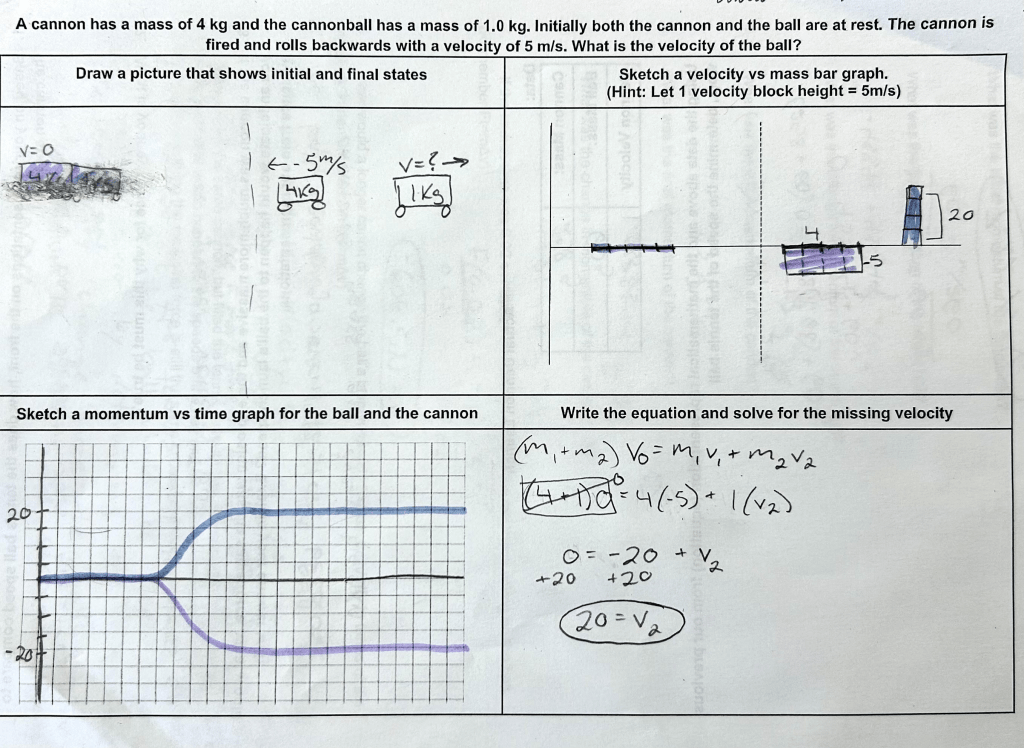
Next, I gave them the scenario where the cannon had a mass of 4.0 kg, the ball had a mass of 1.0 kg and the cannon’s launch velocity was 5 m/s. These numbers were strategically chosen. I wanted to keep whole numbers and also have a cannon-ball ratio that was similar to the actual cannon-tennis ball.

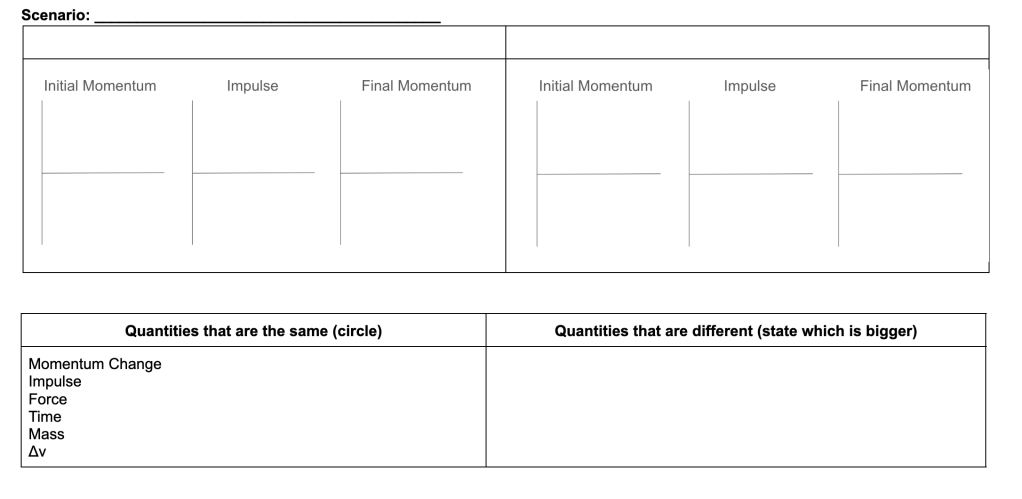
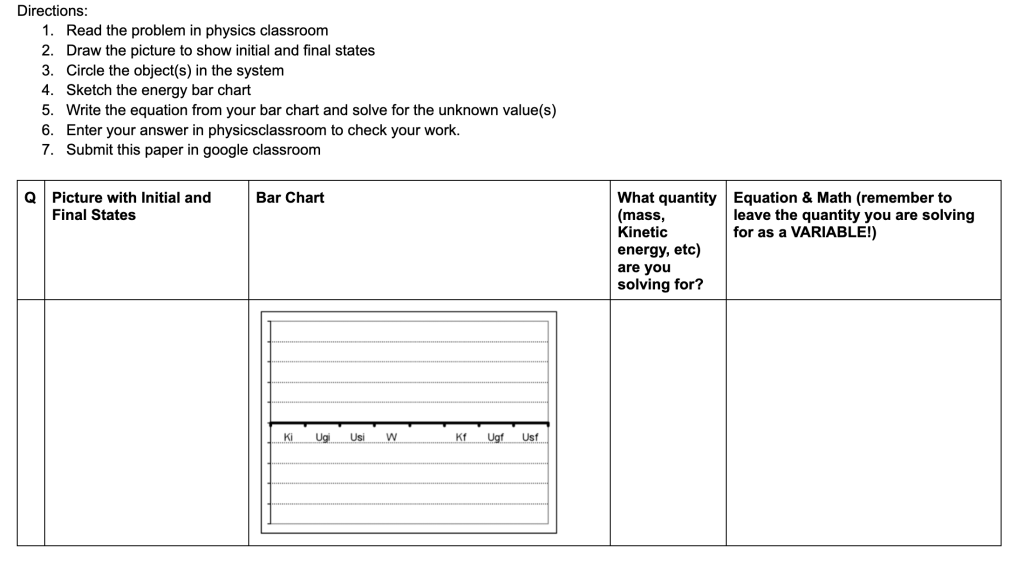
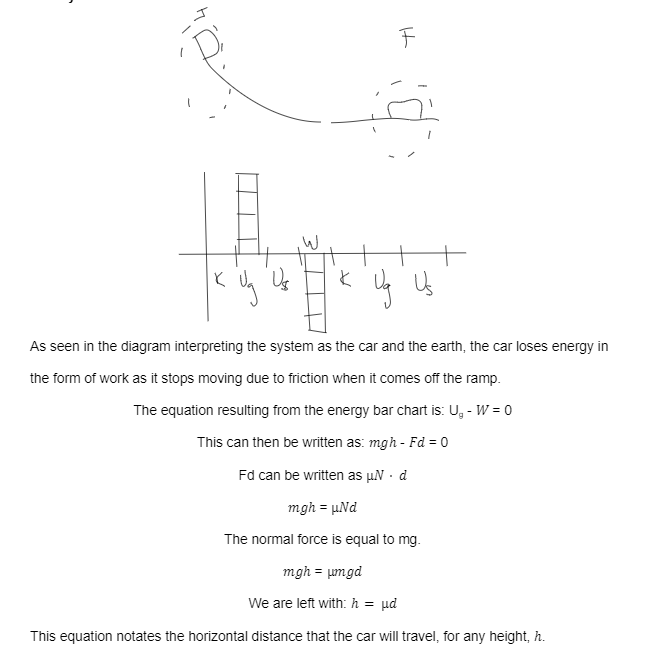
Students then completed the four representations as we’d previously done earlier in the week. Below is a student work sample.

The great thing about this was that students were able to accurately represent and predict the outcomes of the cannon-ball system before we got into the muck. This got students thinking individually and talking in small groups. We also discussed why the results made sense.

To launch the cannon I let it go through a photogate to snag the post explosion velocity and then students completed the calculations.

For the post-lab analysis I threw in a few thinkers. They included:

  • Find the average force on the ball
  • How would a longer cannon change the ball’s launch speed? Explain in terms of impulse-momentum
  • If we used the same cannon but filled the tennis ball with rice, what would happen to the speeds of the ball and cannon post explosion?

You can see a sample student response below:

These questions led to some really great conversations that brought us back to equal forces, equal momentum changes and where time falls into the mix.

Activities · In My Class Today

SciComm Unit Results

A few weeks ago I posted the article We Did Improv in Physics which outlined my four-day mini-unit emphasizing communication and presentation skills. Students did this in a number of ways including deconstructing TED talks, writing a blog post about their research, and giving a two minute impromptu version of their talk, in addition to the improv workshop. While the energy and the feelings in the room were fantastic, I also collected survey data from students that I’m going to share here.

Overall Results

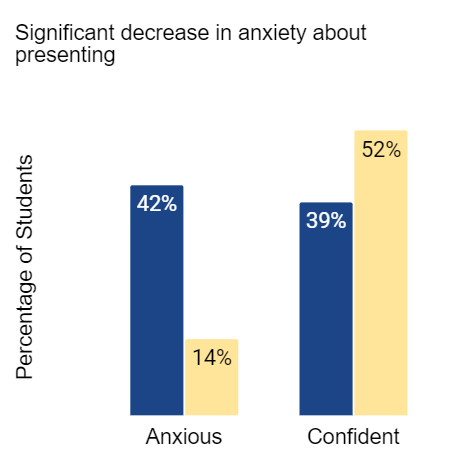
Before we started the unit I asked students a number of questions around presentations. One of the prompts ask students to rate their confidence when presenting in front of peers from “Very Anxious” to “Very confident”. When the unit ended I asked them how they were feeling about presenting their physics projects. The results were astounding.

While the four day experience wasn’t quite enough to build substansial confidence (increase from 39 to 52%) the amount of anxiety significantly decreased from 42% of students reporting some level of anxiety to only 14%. About half of these students moved from anxious to neutral and the other half moved from anxious to confident.

Students were also asked to rate the statement “Being able to give presentations is an important skill for me to acquire” the number of students who marked “very important” doubled from pre to post assessment.

Students were also asked what the single, most important aspect of an excellent presentation was. While many of them stated “audience” there were also a great deal of other responses such as confidence but also things like structure, organization, and knowing your own material well

After the mini unit these responses were reduced to those that were emphasize from the lesson. An increase in the response “audience” was noted as well as an increase in mentions around the visuals. Noticeably less was “confidence”

Student Feedback On Activities

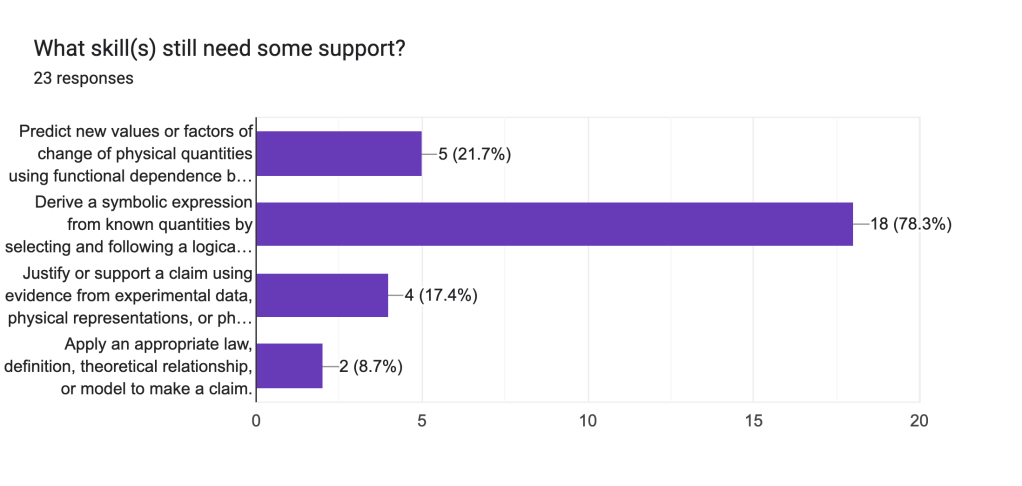
Students were prompted “Considering your final presentation, how valuable were the activities around dissecting the various talks?” Student rated on a 5 point scale from “not valuable at all” to “very valuable”. A summary of student responses for each of the three activities is below.

Turn Your Paper into a Blog Post

56% of students found the blogging activity to be useful, with only 8.7% of students reporting it was not. Some of the comments are below with scores in parenthesis:

  • It helped to see how there was a different type of communication between presentations and the lab report itself. (4)
  • It helped show us how to communicate our project in an understandable, engaging, and quick way. It used common language like our presentation will. (4)
  • I felt like the activity where you turned the report into the blog was helpful because it showed how you would convey your report to an audience rather than someone reading it just for information. (5)
  • By doing the blog post and using informal words I realized that this physics presentation was more like a conversation between our peers. We were just sharing our finding with one another and the blog post helped organize all this information. (4)

Interestingly, the students who rated the activity low still reported the value in the activity’s intention, demonstrating that the low score had more to do with their perceived needs than the intented learning.

It was somewhat helpful for making the presentation interesting and easy to understand. However, I didn’t find it helpful for actual content which I’m more concerned with. (2)

Data Viz Presentation & Evaluation

87% of students found the Data Viz presentation helpful. I think this is interesting because this was the one “lecture” that was provided and I know my students tend to prefer lectures. Still, there were some great reflections from students:

  • I did not realize how much detail is given into making slideshows. For example, I would have never thought about making slides colorblind proof. (4)
  • I especially liked this activity because it enabled us to visualize what we could change in our presentations through using new strategies. I especially found important how we learned to use less words and things on each slide, making them simpler. Also, the rule of thirds was a good guideline for how we laid out our slides. (5)
  • It helped to see the ways the data can be shown to not over power the audience with so much information at once. (5)
Improv Workshop

48% of students found the improv workshop to be helpful with only 8.7% reporting it was not helpful. There are a couple of pieces of evidence from the commentary that support these low numbers, even though there were drastic results observed in the pre- and post- presentations. Firstly, the intention of the activities was not clear to students until we debriefed. We did improv on a Friday and debriefed on Monday. Secondly, the workshop put students very far outside of their comfort zone.

Overall Impact

Overall students were very positive towards the mini unit. A few comments of note:

  • I think it was really valuable to have this unit because none of our other teachers really sit and go through what a generally good/well-rounded presentation should look like, they only focus on content/course specific presentations
  • It felt like a breath of fresh air, and made me realize that communication is a huge skill in in physics apart from problem-solving obviously.
  • I think that unit is helpful when it comes to sharing your findings with other people in an effective manner. I learned quite a bit about how to construct my slides to show only the important information. This unit is also helpful in feeling more comfortable presenting in front of your peers.

Students were also asked if I should run this lesson again. Every student except two said “yes”. The two exceptions marked “maybe”. Of note is that the two “maybes” expressed discomfort with the improv workshop, but had generally favorable commentary regarding the other activities.

Honestly, the results are beyond what I was hoping for. This is something I will absolutely continue.

Activities · In My Class Today · New Teacher

3 Ideas for a Strong Start

It is the end of July, the back to school sales have been running for a month, the #clearthelist movement is in full force. While I keep telling myself I have ALL of August left (that’s actually a lie, I have institute the 30th/31st) many of us are starting in just a few weeks. Here are three ideas to start physics strong. These ideas are grounded in my values and beliefs around teaching physics. You can read about those here

Physics is about EXPERIMENTS

I want students to know science is investigative and that anyone can do it. Many teachers will do a team-building activity on the first day, but I prefer to let students play. This gives me a chance to observe the dynamics of each class before I begin to influence the room and it also takes any pressure off of students to perform for one another or myself. I try to set up a demonstration or lab from each of the units for the entire year. Directions for observations are left on a notecard in front of the set up. Students are asked to write down detailed observations about each demonstration. Over the weekend I ask students to find the demonstration online and learn about how it works. Students are then asked to write a claim, evidence reasoning statement about a single demonstration. Here is my handout and some of the demos I set up

Getting to Know You

When we begin class I ask students to introduce themselves, rather than butchering their names on the roster. I take notes for myself. I ask students to share their name, and how they are feeling. I will also ask them to create a flipgrid introduction with a little more info. This allows me to have their pronunciation recorded so I can review it repeatedly. Here are the prompts:

1) State your first and last name
2) What is something you’re really into, or “your thing?” This could be an interest, hobby, job, talent, etc… anything!
3) Post a picture in your video of you doing your thing or a product from your thing
4) What is one thing you wonder about one (or more) of the demos from the first day? (I wonder why….)
5) Respond to at least TWO classmates!

Physics is for Everyone!

I am a STEP-UP advocate and one of the lesson plans in the program is the Careers in Physics. In the lesson students learn about the vast scope of employment opportunities with a physics degree and then are asked to create a career profile. Students do this by taking a super short survey where they check off their interests and values and then they are matched with a professional who shares their interests. You can access the lesson plan and resources here.

I hope you find these ideas useful! What else have you done to set the tone for the year? Drop it in the comments!

By the way, I LOVE writing about how to teach physics WELL! Check out my “How I teach” series as well as “The Science of Learning Physics

Activities

Souped Up Soup Can Demo

At an AP Institute I was introduced to the demonstration where you roll different cans down a ramp and a can of broth is ridiculously fast compared to others. The reason, of course, is that the low viscosity of the broth means the liquid does not spin. In turn the fast majority of the can + contents has translational energy only.

I wanted to do something more with this excersice than “guess which is which”. After some poking around I settled in on this lab that I now run each year. Be forewarned: the results aren’t spectacular, but the lab comes back with great data and a great experience. Students regularly report this is their favorite activity of the year.

We start by laying the foundation of the race. I have 5 cans: An empty can with the lids off, an empty can with lids, refried beans, condensed cream of mushroom soup and chicken broth. I provide students with the following information and ask students to rank by which gets down the fastest.

We share results and comment on similarities. Groups generally predict the empty can without lids will be last, but the rest gets messy. Did students put the refried beans because it was a cylinder or because it has the greatest mass? Where do you put the broth (many throw it in the middle). The cream of mushroom soup has a smaller diameter.. how does that matter? We’ve talked about all of this already, this is a great application.

After our discussion (mass is irrelevant, radius is irrelevant) we talk about modeling each can. The empty cans and the refried beans are obvious: hoops and cylinders. But what about the mushroom soup? When you dump it out you get a cylinder of soup in the pot, so it’s like a hoop + 2 disks + a cylinder of soup. We race the “obvious” ones…empty vs beans, empty + lids vs mushroom soup. Then we race the winners and losers… empty first. I poll the class about the beans and soup. It’s a 50-50 split. I tell them this is a good guess. We have tot race best 2 out of 3. Beans wins by a hair.

Then enter the broth.

After broth is the hands down winner, we talk about what’s happening. What is the liquid DOING? (Many studnets think itt’s spinning like a hoop). I demonstrate with a VOSS bottle and dyed water (VOSS is nice and smooth).

For homework I ask students to develop an expression for ANY object down the ramp. How can we do this? Well one thing worth noting is that every moment of inertia is some object MR². So let’s replace “some number” with k. I tell students they need to figure out the expression and what they will plot to yield a straight line and what the slope will represent.

The next day we review student work. It’s a cool derivation.

We get down to the fact that students need a graph of v² and height. Ok cool. But how will we compare our results? We go back to the models. Students are responsible for coming up with the velocity at the bottom of the ramp for their assigned can. For this activity I put students in ability-level groups, assigning the empty cans and the beans to the students who are usually C and lower, the broth to my B students and the mushroom soup to my A students. (more on that choice another day). After students have a chance to work through their derivation we review all of them. One of the things we discuss previously is that when determining velocity at the bottom it’s always the √number*g*h and that number is between 1 (hoop) and 2 (sliding only). The numbers we get all fall in line with our expectations and observations…including why mushroom soup and refried beans are such a close call!

Student work for can of chicken broth.

Before we begin the lab we need to have a discussion about reducing error. We have a major problem. Height is easy enough to measure with little uncertainty, but we are looking at an expression with final velocity SQUARED. This is problematic for several reasons. First, the square means that uncertainty is going to propagate and blow up. Second, we’re looking for FINAL velocity. Cherry-picking that data point is sure to be messy with tons of uncertainty and, frankly, a waste of our tools. So what IS consistent and reliable no matter what we do? Students quickly realize it’s acceleration! We know how to best collect that data from other labs: run a regression through the position or velocity graph. We can then use a spreadsheet to manually calculate the expected final velocity for a specified distance.

Students are able to get data that generates amazing straight lines and then they use that data to determine the moment of inertial of their cans.

Student data for chicken broth

Some of the cans will be pretty far off from the theoretical models, but that’s ok! We tried to really simplify something real and complex! (The original idea from which I got this the activity used cans filled with concrete and other materials that are much closer to the models.)

For the full activity and handouts, I’m sharing here!

Please don’t steal for profit on TPT. That harms the teachers who share, those who are in need, and our profession as a whole.