Classroom Issues

Physics Teacher Shortage? Not so Sure

“You will be SO markatable”

“You will have NO problem finding a job”

“You’re certified in physics, chemistry AND math?! You can get a job anywhere!”

Those comments have all been said to me. Because, you know, I have a physics degree, I’m a woman, and I have a pretty cool set of experiences. And yet in 2011, when the recession hit the teacher landscape, I found myself sitting in over 20 interviews with no success. I spent the next two years working as a tutor after being rejected from the physics teaching job at that school and also teaching math at night school and chemistry at summer school. I was also teaching summers and Saturdays at Northwestern’s gifted program. All of these things together plus private tutoring scrapped together a decent salary. But after 20 interviews and no success getting a full-time teaching job…I won’t even get into what that did to my feeling of self-worth, especially when I caught a student from summer school telling her classmate about me, “she’s not even a REAL teacher”, a day after which her mom showed up “lost” so she could scope me out.

Here’s a snapshot as of right now within a 50-mile radius of where I live

Screen Shot 2018-03-16 at 8.35.32 PM

That’s right! One job. And guess what is under the job description “chemistry endorsement desirable” Yep. This is not a 100% physics job. This is a physics job with a chemistry prep.

Mind you, there is no shortage of people here! My city is just under 150,000 people and our public school system consists of 5 high schools. There are numerous private schools in the area representing the Catholics, Lutherans and several other Christian denominations. There is one teacher in each building who teaches physics and I am the only teacher who gets to teach physics all day. I am also the only teacher with a degree in physics. (I am part of the 12% nationwide that’s a woman physics teacher with a degree in physics) The second sentence is the one that seems to get all of the attention by Universities and PER groups.

APS put out this report which doesn’t quite sit with me right. You see, they reported these findings, among others, regarding why individuals want to and don’t want to teach:

“by far” as the report mentions, the number one reason why individuals don’t want to teach is because they fear “uncontrollable or uninterested students”

The minute I saw this I questioned the results. WHO ON EARTH are they talking to? Well, APS, you got me to check out the whole report. Here’s who they surveyed:

Screen Shot 2018-03-16 at 8.44.44 PM

Only 64 people who completed the survey are committed teachers of high school physics! Most everyone else involved was currently within the University setting (students).

Newsflash: You have NO idea what the classroom is like until you get there. Betsy Devos is a fantastic example of this.

Turns out, when you put a person who’s mildly competent at teaching and cares for the craft, the ‘disinterest’ and misbehavior are rather subdued. Make no mistake: it takes 3-5 years to get into a groove and to start to master the management aspect, but that can be said of most any job.

The report also discussed the various incentives people are given to go into teaching:

1. “Access to high-quality courses at my institution that prepared me to be a successful teacher.” 2. “All my student loans could be forgiven if I were to teach for 5 years.” 3. “Better teaching salary.” 4. “I would not have to spend extra time in school to obtain a teaching certificate.” 5. “I would be given free tuition for extra time spent obtaining my teaching certificate.” 6. “There are currently scholarships available for people in science and math teaching certification programs. Scholarships up to $20,000/year are awarded on the condition that, after earning a certificate, one teaches two years in high-needs areas for each year of financial support.”

No surprises here, but every single one of these is an extrinsic motivating factor. While usually somewhat effective in getting the ball rolling, it is hardly sustainable when the rubber meets the road and the nitty gritty nastiness of this job break forth. And let’s be real here, if it’s money that motivates you and you’re smart in the sciences, it doesn’t take too long before you realize an engineering job in the private sector is going to let you pursue your passion AND be up for raises AND get you 6 figures a lot faster. (and you get to pee whenever you want).

I would like to posit that there are three things that need to happen if we really care about highly qualified teachers in STEM

(1) We need to devote SERIOUS time, energy, effort and money into the teachers who care about their craft of teaching and get them the support to teach physics well. PhysTec is trying to do this and is providing amazing opportunities for teachers. We need more of this. New Jersey also implemented teacher training to boost physics in their schools. They actually see physics as the gateway to STEM careers. Turns out, the results were amazing. Not only has physics enrollment boomed, it has boomed amongst minority students, and their AP scores have boomed along with it.

(2) We need to advocate for physics and STEM education outside of our STEM bubbles. Too many of us are like our students, solving the problems we already know how to solve because it feels good. Telling each other about the importance of physics makes us feel good, but how much of that is getting out to the public? To parents? To students? To board members? To administrators? To politicians? Here’s an example of the difference in two districts:

District A has a strong STEM program, including an exclusive engineering academy. District A historically has offered Conceptual, Regular, Honors, Engineering and AP Physics C. There are 11 teachers who teach physics at some point in the day and although physics is not a graduation requirement, it is a norm that all students take physics before graduation. Since district A does not offer AP Physics 1, parents band together to ask the administration to run the course so that students who want to take an AP Physics can, even if they are not engineering bound. 

District B has a weak physics program and would like to promote more students taking AP courses. However, district B refuses to run a course if less than 24 students enroll. None of the schools in the district are able to offer AP Physics. AP Biology runs sporadically. One year 20 kids signed up for AP biology but the district said this number was too small and canceled the course. Infrastructure is falling apart and although there is a 10-year facilities plan, staff have been told that they will only consider re-evaluating science rooms when they see if any money is left over. 

These kinds of things go on all over the country. The simple matter of fact is this: unless a district is well-endowed with funds and/or parent advocacy, STEM is not supported on a very basal level. Because STEM requires space and equipment, which requires funds, and requires a continuous influx of funds in order to maintain the space and equipment and up to date texts.

Most of the folks way up high in school systems are pretty clueless when it comes to the needs of STEM classes. It’s not their fault, but if no one is truly advocating, they have no reason to funnel funds in that direction

(3) Our current physics teachers need to feel valued. They need great mentors. They need networks. I was really fortunate to have this “growing up” my AP Physics teacher was huge on intentional mentoring of rising teachers, he introduced me to Physics Northwest, which got me tapped into AAPT. From there I developed an amazing network of Chicago teachers. One of the teachers I met through this network, Shannon Hughs wrote an article in The Physics Teacher about the importance of this mentorship. Shannon probably doesn’t remember this, but at one of my first PNW meetings, she was sure to come up to me and tell me about an opening at her high school. The manner in which she approached me stood out and I regretted the fact I had accepted a job already. She was already putting to work what she had learned from her mentor. Then I moved an hour and a half away from Chicago and I lost this network. After 5 years of living out here I discovered the amazing community of #iteachphysics on twitter. It is these communities and mentorships that re-invigorate my passion for teaching.

Here’s the deal: no one goes into teaching for the money. We go into it for the passion. The passion of our subject, the passion to invigorate our students, the passion to see others learn and grow. The best teachers are these people. You can’t train that and you can’t crank that out of any big PER study or think-tank group. But there’s a catch…if I can’t do my passion every day, why would I stay in it? For me, it’s because my passion for teaching and students is greater than my passion for physics. If it were the other way around I probably would have finished the MS in electrical engineering I started in 2013 and I would be working in the industry now. Yea, that’s right, I was almost one of those numbers who left the field. Because the reality was that the field left me. I was moving to a place with no jobs and I had a department head who was almost begging me to join the department (this is a much longer story than is appropriate for this blog post). I am incredibly fortunate that I am in the position I serve now, it is literally everything I have dreamed of doing.

Pushing a bunch of physics undergrads into becoming high school teachers with extrinsic motivators is only going to create two things: teachers who lack the true empathy, patience and motivation to serve a student population and a bunch of graduates who think there’s a million jobs out there when actually there are just a handful. If they land one, chances are they won’t teach physics all day. In 2014 I taught 5 sections of Earth Science with the promise that if I took that job I would have physics the following year. I love teaching, but when I got those physics classes in 2015 after not being a physics teacher proper for 4 year, it was incredible how my motivation and job satisfaction sky-rocketed.

The very real fact is that physics is still undervalued. Everyone assumes it’s too hard and unnecessary. Much like the “Oh I never did well in math” statements that can cause math anxiety in children. Every kid who walks into my classroom walks in with fear and dread because they have heard horror stories. And yet, if they talk to any single student who made it past October, the critical 10-week learning curve, that student will tell you “it’s hard, but it’s fun” or “it’s hard, but you just have to think about it” I fight these preconceived notions tooth and nail every day, but when adults everywhere are telling them otherwise, they have no reason to believe the physics teacher that physics is a good place for them to be.

Concept Modeling · In My Class Today · Teaching Methods

Pass Along – Modeling Waves

The pass along activity is one I developed shortly after attending a Kelly OShea workshop. I wanted to combine modeling with the strengths of white board speed dating and board walks. At the time I didn’t have the large whiteboards and for this particular activity I decided a piece of paper would work best.

Students have already done a reading on waves ahead of time (hopefully).

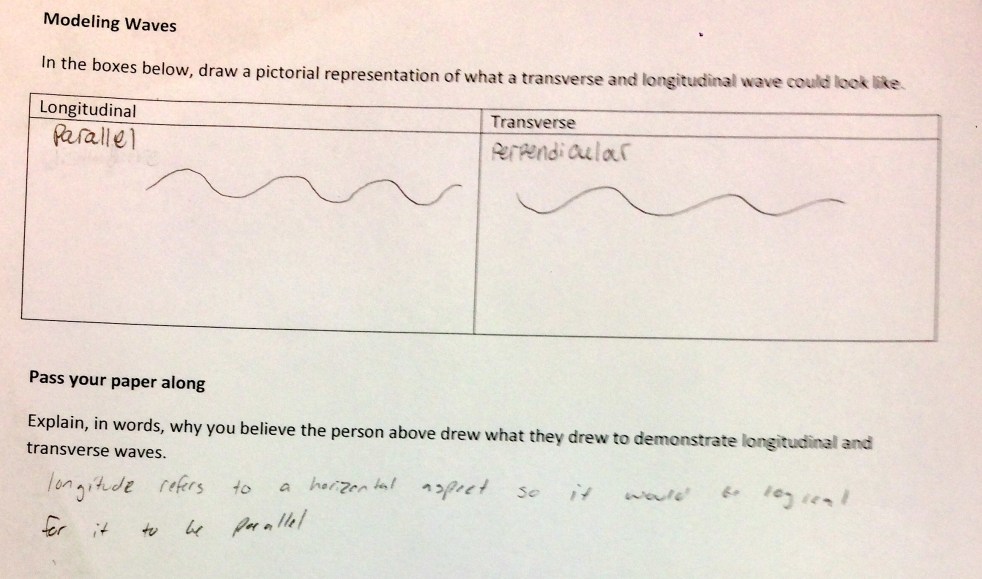
Part I: I ask students to draw in a pictorial representation of what a longitudinal and a transverse wave might look like.

IMG_7161
This is inevitably the most common drawing. Students obviously did the reading, but struggle with a pictorial representation

Students are then told to pass along their paper. I predetermine groups randomly for this activity. Three is best, but if I don’t have a factor of 3 then I put the stragglers into groups of 4. It looks like this:

Student 1 -> Student 2 -> Student 3 -> Student 1

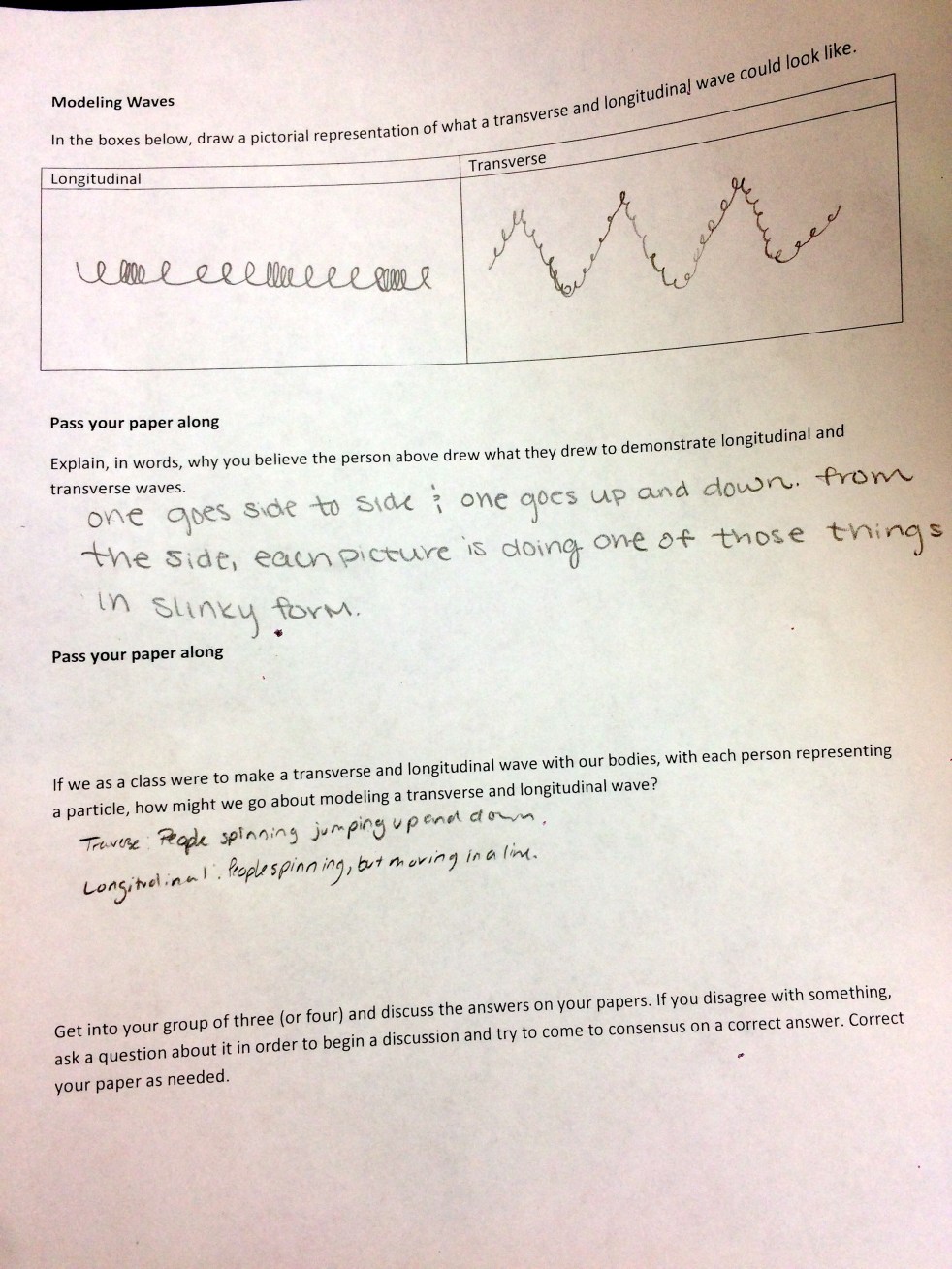
Part II: After students have passed along, they are required to look at the work done by their peer and explain, in words, why that person drew what they drew. Much like speed dating, this requires each of the students to get in the minds of their peers, but without the opportunity for their peers to explain.

IMG_7162

Students then pass along again.

The third person takes a look at the previous two answers and then has to think of a way to model each wave type with their bodies.

After the three pass alongs, students get into groups, at this point each paper has been touched by the same persons. They discuss their answers and then they have to get up in front of the class and model with their bodies each wave type.

IMG_7160

The physical modeling is great in that the kids are up and moving, but it also provides an opportunity to have a discussion about the model. 7th hour we had a discussion about whether or not doing the worm accurately models a wave (nope, the particle is moving across the room). Similarly, I had a few groups move their whole line down the room which brought up the discussion point about what a wave transfers and doesn’t transfer.

Afterwards, we will go out as a whole class and model transverse and longitudinal waves using an 8-step count.

IMG_7183
A unique representation of a longitudinal wave I hadn’t seen before
Teaching Methods

AP Physics C in the Accelerated Classroom: Addressing the Needs of the Gifted and Talented in Physics

Gifted and accelerated learners have specific needs in the classroom that frequently go unmet. It is a grievous error to assume that just because a student is gifted they will be successful. Differentiation is often viewed as incredibly labor-intensive on the part of the teacher with difficulty in grading different products fairly. This is of particular challenge in the current Advanced Placement (AP) Physics C program since, under the college board recommendations, many physics C students already have a strong foundation in mechanics from AP Physics 1 (algebra-based). This paper will share a particular example used in the lab in an AP Physics C gifted classroom and how the products are easily differentiated and scored in a fair manner.


Introduction to Gifted and Talented Learners

The first thing that must be noted is that gifted learners exist in every classroom. The second thing that must be noted is that gifted and talented looks different on each individual. Additionally, when students are put through an identification process, minority and English language learner students are overwhelmingly unidentified.

Identification of gifted and talented students is immensely important because research has shown that in the absence of the ability to nurture student talents, many of these students will, in fact, underperform. Students are either placed in environments that lack rigor and challenge and so they disengage because they are bored, or if the teacher identifies the student as “smart” the teacher often does not recognize specific markers of giftedness that contribute to student behavior in the classroom, prohibiting the teacher from allowing appropriate accommodations.

It is important that every classroom teacher become aware of giftedness so that they can best address their students. Much in the same way that we will readily allow a student with ADHD to stand during class, or use a fidget, we must also recognize that gifted and talented students have their own set of needs to be challenged and to grow.

Although there is no one blanket description for students who are gifted and talented, there are some unique markers. Much like a student who may be diagnosed with a special need, gifted and talented students’ brains are physiologically different. They have a thicker pre-frontal cortex that develops differently from their peers and they, in fact, have more and stronger neural pathways than their peers2. Not only do they think differently, they perceive the world in a different manner. In the absence of development of talent, gifted individuals can lose the strength of their pathways, rather than expanding them.

One of the most clear differences in gifted students is that they exhibit one or more over excitabilities. Overexcitabilities describe a series of traits and/or behaviors that gifted individuals feel on a level that is far more intense than the general population. These include the following: intellectual, emotional, psychomotor, sensory and imaginational. Intellectual is what people are most familiar with when they think of giftedness: avid readers, love of learning, independent thinking etc. Emotional are the students who often have an overwhelming sense of empathy for their friends and family. Due to this they are often the ones who will take up causes for advocacy. They also may exhibit extremely intense anxieties. Individuals with psychomotor over excitabilities are often misdiagnosed as having ADHD, they may talk fast, act impulsively and seem to run on little sleep. Sensory have a heightened sense in the five senses, they are often extremely interested in the arts and have a depth of interest in aesthetics. They may also, however, be unusually sensitive to smells and tastes. Individuals with imaginational overexcitabilities are the ones who are constantly daydreaming, visualizing, Males tend to score higher on the intellectual and psychomotor areas while females tend to score higher on the emotional and sensual over excitabilities3

AP Physics C for the Gifted and Talented

Acknowledging these needs for gifted students, what is a teacher to do? Two of the most important tools are acceleration and differentiation.

We often think of acceleration as grade skipping. While this is useful for many students, it is not in our grasp as classroom teachers. We should, however, not prohibit say, a sophomore, from enrolling in physics if they have met the appropriate math pre-requisites. Surprisingly, acceleration at the grade level has shown to somewhat close the gender gap in publication and salary for female students4. At the classroom level, where we have control, this means compaction of curriculum. I lean most heavily on this for my students.

Since the students in my class have all taken AP Physics 1, they have an incredible depth of conceptual foundation as it relates to mechanics. This was, indeed, the goal of the revised course. The challenge now, however, is to make AP Physics C exciting, interesting and challenging. At the same time the goal of any high school teacher should be to equip their students with the foundation for the skills needed in college.

For any STEM field, we know well that lab skills are indispensible. At the same time, we also know that creating a genuine lab experience when students have little to no lab experiences is extremely challenging. There is a certain level of base knowledge needed to have a valid lab experience from start to finish. Fortunately, students in AP Physics C have already obtained that base knowledge. The only difference is that now my students are required to incorporate calculus.


The Flipped Accelerated Classroom

I operate on the premise that first, the majority of the physics concepts should be review, and second, the lab experience is the most important experience in my classroom. While it is not imperative to student success that they be able to determine an obscure moment of inertia, it is imperative that they enter college with a basic skill set that includes troubleshooting, use of basic equipment, creativity, critical thinking and problem solving strategies. On the first day of school I gave my students the following assignment: design a product that demonstrates to me that you have mastery over all of the AP learning objectives for kinematics.

Immediately this assignment is differentiated: students have almost endless choice. They have full access to all lab equipment plus anything else they would like to use or bring in. This is, at first, an extremely challenging prospect to students. They are not used to having so much choice, their activities have more or less been dictated by the goal and/or equipment available. This is not true of real research; in that case you must select a project, investigate, and produce results.

We recently did the same with momentum. Since this topic is much more in-depth than kinematics, I assigned nightly homework sets and provided solutions the following day. The homework was not collected or scored as I am leaving it in the student’s hands to determine how much repetition is necessary for themselves. In this unit they were asked to design a lab in which all of the objectives are present. Since this project would inevitably include many other topics within mechanics I provided a little bit more guidance, encouraging students to start with a question. Within the first class period I had a group investigating a buoyant object dropped into a container of water (Fig 1)

and analyzing with Vernier VideoPhysics, another group analyzing the deflation of a balloon attached to a string with a straw, a third looking at spring pendulum, and a fourth examing a dynamics car attached to a spring on a horizontal surface. Each of these involved a varying force (not a requirement, but an option for the exemplary plus mark) and in the case of two of the experiments, students needed to study topics they had not yet covered as it related to their problem.

Student Products, Evaluation and Presentation

Student products vary n terms of level of complexity and interest, but they have always been exciting to grade. The first challenge, naturally, is scoring the product in a way that is fair for all students, given the large variety. To this end, I grade the products based on how well they meet each of the objectives, from Exemplary to Unsatisfactory. In order to permit students who are more mathematically advanced or who would like to go for the challenge, I include an exemplary plus category. At the beginning of the year this category was for any correct application of calculus, once the year progressed this category needed modification to ensure the same level of challenge.

Students are also expected to present their results and provide feedback to their peers. We do a type of poster presentation session. Students put their procedure, lab design and results on a large whiteboard. (Figure 2) , one partner circulates the room while the other remains at the board to present to their peers. During this time period students are to ask one another questions, whether it be for clarification, or as a way to offer a suggestion. (Figure 3) After students have moved through the room, original partners move together. The partner who circulated initially now must explain each board to their partner. As they do so, they are asked to leave feedback on a smaller board. At the end of this exercise, groups return to their boards and review the feedback. I then give students another few days to make adjustments and corrections before turning in the lab.

Applications for the Mixed Classroom

Allowing student choice and differentiation for gifted students is just as important as allowing other students extra time on exams or the ability to use a fidget. The reality is that just as our classrooms often will have students with special needs due to a disability, we likely also have a non-zero number of gifted students as well, who’s needs must also be met. In a mixed classroom, this might mean generating both the guided and open-ended lab. The modeling curriculum works very well for all students, but the differentiation component is key. Gifted learners should be permitted to do less repetition as long as they can prove mastery. They should be permitted to work together in class sometimes (ability-based grouping), rather than always grouped with the struggling students so they have the opportunity to flourish with like minds, much as we appreciate upon entering college.


Conclusions and Benefits

This type of activity and assessment has served multiple purposes. First, it allows for differentiation within the gifted classroom. Students have the ability to make their products as simple or complex as they determine, while still meeting the learning objectives. Secondly, it requires students to make a variety of considerations and assumptions such as which equipment will be best, how to control for a variety of variables, and which variables can be simplified due to assumptions or uncertainty measurements. (For example, in my group that examined the deflating balloon, they massed the weighted balloon on an extremely precise scale and noted it was loosing mass, even while tied. ) Students are using and improving on lab skills and techniques. Lastly, students are learning the importance of clear communication and critical evaluation. In a time where even undergraduates are expected to produce publishable research, communicating, evaluating and responding to evaluations become ever more important skills. By focusing on these at the high school level, students become better equipped for whatever their future holds.


Uncategorized

Encouraging women in STEM: What is a teacher to do? (I got published!)

This spring will mark 10 years since I stepped foot in the classroom as a student teacher. It’s always difficult for me to wrap my head around that length of time. By the 10-year mark, it would seem reasonable that a teacher could feel established and start making her way toward mastery…and yet, I still feel like a first year teacher. Due simply to life changes I have worked in five different buildings spanning 3 districts, on 2 sides of the state and have never once had the same set of preps. Only in the last two years have I felt I had the opportunity to truly build and grow a program and the students along with it.

The past two years have also been what can only be described as a special and unique experience. I had a phenominal group of students genuinely interested in the subject matter. So much so I managed to convince three of them that majoring in physics would be a great idea. All three are female.

My breadth of experiences has made me take a very critical look at what encourages student choices and what discourages them. I think too often we attribute outcomes to interest and drive, rather than inspiration and grit. I also firmly believe that while interest and drive are outside of my control, inspiration and grit are within it.

When I ran across a book review discussing a woman’s in a man’s world, specifically a “boy’s club” it immediately inspired me to write and share my experiences to expound on the question, “what do teachers do?” The answer to that question is far more multifaceted than one concluding sentence can contain.

My thoughts were accepted for publication in The Physics Teacher for the February edition, and I’m so thrilled!

http://aapt.scitation.org/doi/10.1119/1.5021425


In My Class Today · Teaching Methods

A Spin on Energy

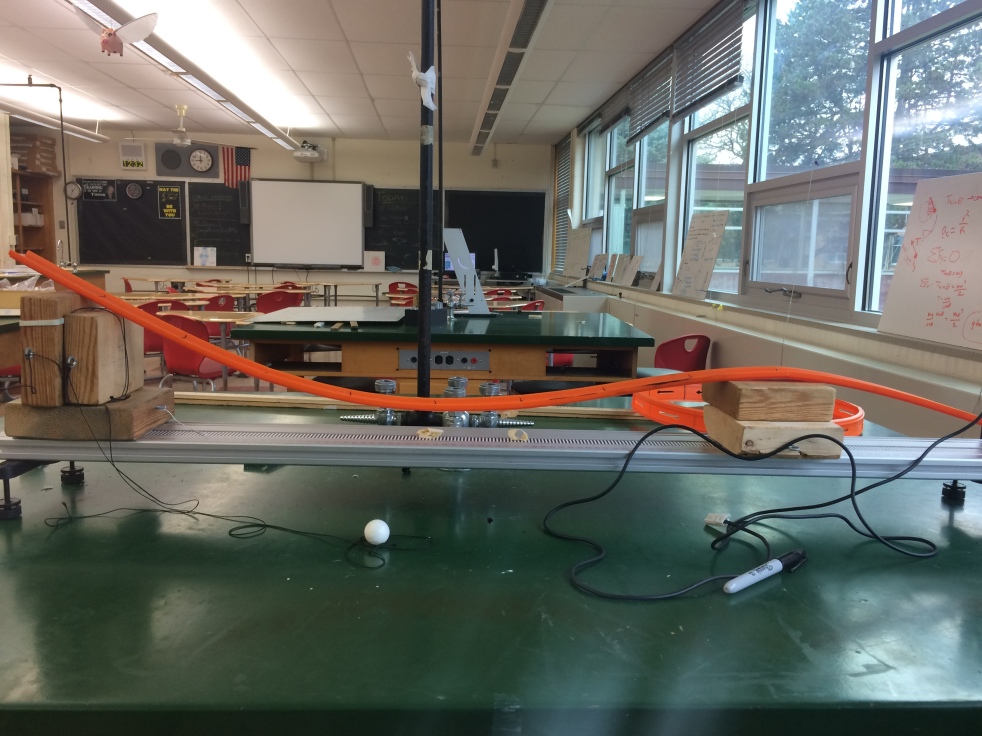
Last week I ran a pretty straightforward lab:

  1. Put 120cm of hot wheel track into a design of your choosing
  2. Run a ball down the track
  3. Record velocity with a photogate
  4. Repeat at 10-12 locations
  5. Plot the energy curves.
  6. Plot Translational vs Rotational Kinetic energies and find the rotational inertia constant.


IMG-2085
Sample track set up


Students should see a transfer of kinetic and potential energy which makes sense. Of course, students should also expect to see a decreasing total energy curve because of friction constantly taking energy from the system.

I had two fun surprises I got to incorporate:

  1. The shape of the TME curve

Inevitably this curve had a particularly sharp drop off at one moment in time. I had students sketch their tracks on their whiteboards in addition to their lab results. IMG-2087IMG-2088Do you notice anything? The largest drop off in TME corresponds to the moment where the ball is at the bottom of the hill. This serves as a great review of work and circular motion. Frictional force, as we know, is dependant on normal force. The normal force of the track changes and corresponds with its shape. We can actually predict the drop-offs in TME based on shape and even determine the work done by friction.

  1. A group with “bad” data.

Their data wasn’t actually bad, they obviously had forgotten something when they set up their formulas in the spreadsheet. But was there a way to find this without redoing the whole data spread? Absolutely. After creating a large circle to share whiteboards, we honed in on the group where the TME curve was mirroring the potential energy curve. The rest of the data seemed good…there was an obvious trade-off of PE and KE…although the curves weren’t as high as they should have been. So what was the problem? I selected a student to draw in where the energy curve should be, based on the shape of their track and everyone else’s data. She drew in the curve. Next, I asked students to note where this curve was and where the PE curve began. It was at 0.3 J with PE starting at 0.6 J Then I asked them to note where the KE curves were at… they were at 0.03 J. Notice anything??? They were off by a factor a 10! Where could a factor of 10 be? Did they forget a 9.8? Did they convert grams to kilograms properly? cm to m? Upon examination of their equations, they found the missing 10 and…TA-DA! Fantastic results.

I think it’s really important to note the value of both exercises. The lab itself was relatively simplistic, but it lent itself to fairly complex conversations.  I think this is especially true for the group with the “bad” results. How often do our students present with this and either (1) Default to “well my data must be bad” or (2) Start from scratch, rather than locating the mistake? In this way, students were able to critically analyze, strategize and problem-solve. It turned out to be a really easy fix.

Oh and the slope of the translational vs rotational KE? Yea that came out to 2/5….exactly. That’s super exciting!

Teaching Methods

Radical Renovations: The iOLab

I visited my alma mater today. The entirety of Green Street on campus is closed to traffic due to all of the construction. Buildings have gone down and come up and I half expected time to still be frozen in the year 1967 in the physics building.

When I walked in I found quite the opposite. Not only newly renovated rooms, but there is actually a women’s bathroom on the fourth floor. (This was always a running joke)

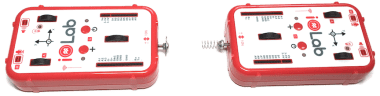
The reason I spent 6 hours in my car today, however, was to visit the Physics 101 class. iolab_remotes_redMy former adviser, Mats Selen, has been working on a new project: the iOLab. The concept is simple, it’s a multisensor system in a box. And it can do everything your $10,000 of Vernier equipment can do… for a little over $100. It connects wirelessly to your computer and runs with free, opensource software that does all of the analysis our expensive programs run.

On the other side of the coin, however, is a radical change in how the introductory level classes are being taught. When students walked into the lab, they had done a pre-lab experiment earlier…..at home…..with their iOLabs. Quite simply, they made a stack of books, put another book on top by its edge and then looked to see how the force changed with the iOLab as it was placed at different distances from the book stack. Data were submitted ahead of time for credit. Students discussed the results at the beginning of the lab and then were given their task. It’s the classic peg-board demo, however, students had to find a way to relate the force to the placement of the probe if the pivot was located in the top corner.

This was the sum total of the direction given to students.

Within about 20 minutes all students were taking measurements. Some were looking only horizontally, others were looking both horizontally and vertically. Questions arose about the approach: if we change the angle at which we hold the probe the force will change. Are we supposed to do this with a horiztontal force too? I think that’s impossible.

They were told it’d be great if they came up with a mathematical relationship, but they’re just looking for the trends.

Within an hour students were plotting their data, recognizing it was an inverse relationship and running the curve.

One group really wanted to get the formula.

Another group recognized the torques should be equal and started calculating all of the torques. Percent uncertainty was one of the objectives focused on, so I wanted to see how well they were grasping that concept. I looked at the torques and noticed the values were .14, .14, .14, .15, .16. So I asked them how they were going to decide that those were constant and not increasing. They responded that they would have to determine their percent uncertainty and compare what was acceptable to those values.

Now, clearly there are major differences between high school junior and seniors and pre-med juniors and seniors, but at the same time, it was still remarkable how they were approaching the lab, developing their experiment and writing up their labs. It is something that very much excites me about the potential use in the high school classroom (and online classrooms, and college classrooms etc)

I also asked students about their previous physics experiences. About half reported they had taken physics in high school, ranging from regular level to AP Physics 1. ALL students reported that they felt they had a FAR BETTER grasp of physics now in this course, compared to their high school course. Several students who said this felt the need to insist they still had a great high school teacher 🙂

The message, however, is clear: we need to give our students the opportunity to design and evaluate their experiments.

Also, the iOLab is a very exciting new piece of equipment. Morten Lundsgaard, currently the Coordinator of Physics Teacher Development
Instructor, is hoping to run workshops and/or a camp for high school teachers. If you are interested you should contact him!

Concept Modeling · Teaching Methods

Slicing a Cylinder for Moment of Inertia Integration

Guys….we’re in the throws of rotation. And at least one of my poor students has calculus immediately preceding AP Physics C. I feel so bad for her. The day we started she had made up a calc quiz, came to day 1 of rotational inertia, then went to calculus. Oh did I feel her pain.

Arguably the most difficult part of deriving rotational inertia is the visualization of how to go about the integration. I mean, let’s be honest, once we find how to express dm the integration is always an easy one.

Part of the problem is getting students to understand what it means to say things like dm, dV, dA, etc. They understand the definition linguistically, but it’s really hard to think of it practically. Tell them that dr^2 is zero and their minds are blown and bothered.

Day 1 of cylinders did not go well. Arguably, in part, because we were short on time. But also because the what why how was overwhelming.

I remembered a demo someone had shown where they 3D printed their objects to roll down the incline. They had actually made nesting cylinders, which then served as a great way to discuss integration.

I’m trying to think of a way to visualize each of the d-steps of the cylinder integration for my students with materials I have on hand. As I’m digging through the closet I notice the slinky coil. It’s nearly perfect!!!

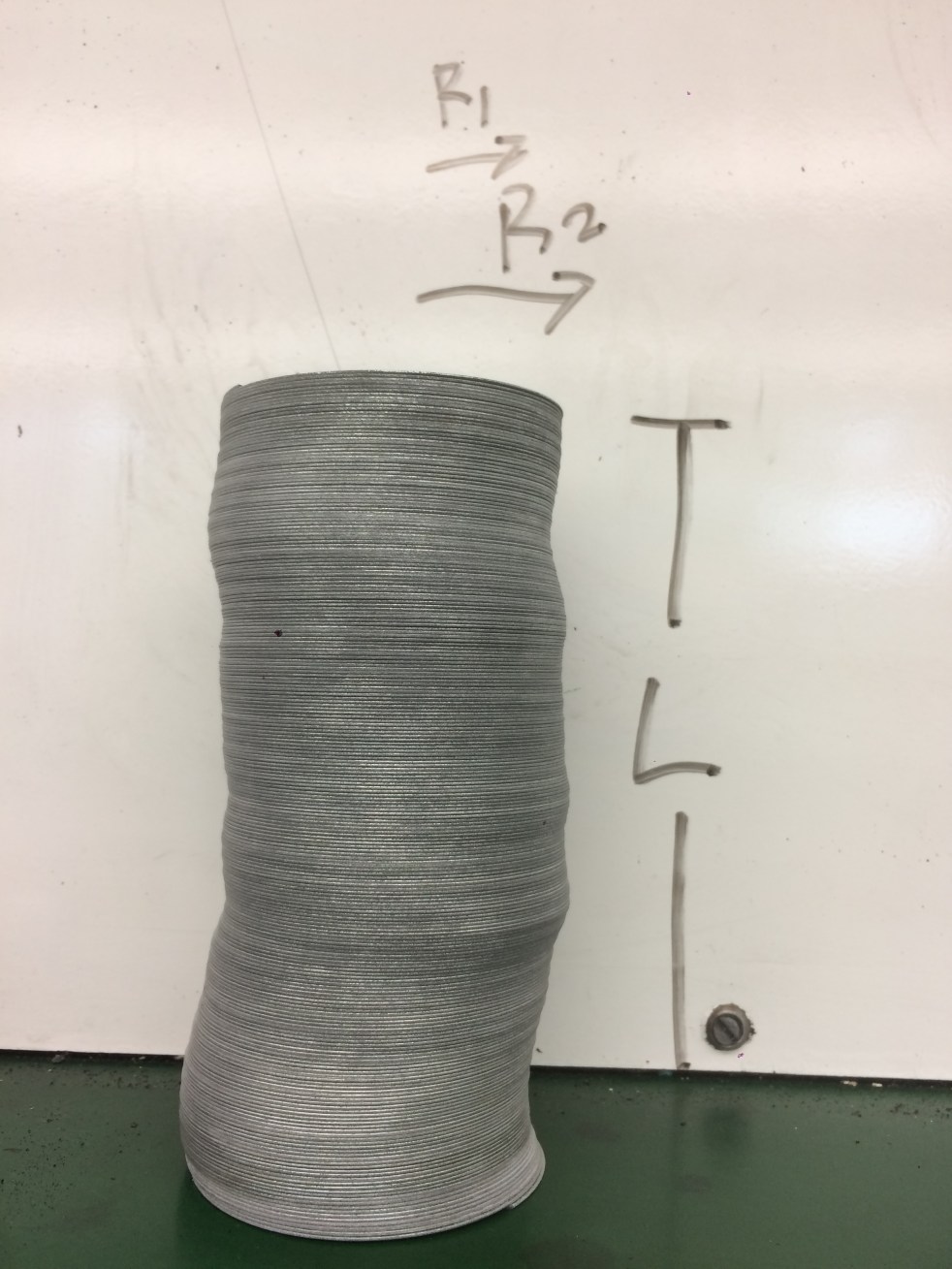
Ideally, I wish I had one with nice thick coils so we could take about the cylinder with R1 and R2, but this will suffice for the most challenging part.

So imagine you have a cylinder of length L, and inner radius R1 and outer radius R2 and would like to determine the moment of inertia about its center…

IMG-2037 (1)

First, as always let’s define rho, but we have to find dm in terms of r. So how do we do that?

Well, let’s take some horizontal slices, where each slice is dm… now we can see that dm = rho*dV…but wait… what is dV?

Well, if we make those slices infinitely small…is there really a volume left?

IMG-2040

Ah! so dV is really dA, and we are looking at it across the length of the slinky, so dm = dA*L!

Conveniently, I know that A=pi*r^2, so dA = 2*pi*r dr

And the rest is substitution!

Teaching Methods

Pumpkin Projectiles

You can smash your Halloween pumpkins! Each year at our science center, Discovery Center Museum, they will launch your pumpkins (up to 8kg) with their 10 ft trebuchet which is loaded with 400 lbs. (Why they limit by kg, but load with lb, I have no idea)

As a last minute thought, I blasted a text to my students: determine the initial launch velocity of the pumpkins. Double the points if you confirm the presence or absence of air resistance. Present in claim, evidence reasoning form. Have it ready for Monday.

Naturally, I couldn’t let my kids have all the fun (or the answers) so we went together as well. The pumpkins go way too fast/far/high to collect enough data at 60 fps, so I filmed in slo-mo (here is the original video), tracked the pumpkins on Vernier’s Video Physics app…

IMG_1964

Of course, I had to see the graphs right away…oh so pretty…

then loaded the spreadsheet into excel and adjusted the times for the slow-mo camera. Additionally, since I had been given the specs in feet, I had to convert the units to meters. (I used the length of the base of the trebuchet to set the scale).


Screen Shot 2017-11-06 at 9.09.14 PM
Can we just discuss the beauty of these regressions? The vertical velocity is broken into three parts: the launching, from release to peak, and from peak to ground. You can see how quickly air resistance comes into play. The weird fall off tail is where the iphone goes back to 60 fps in the last moments of the video


Oh how beautiful thou art, quadratic functions! Yes, air resistance is a factor, slowing the acceleration to about 3 m/s/s. There’s also a horizontal acceleration of about 1 m/s/s as well. Launch speed worked out in the ballpark of 12 m/s.

My kids who went are still crunching their numbers…we’ll see what they can produce!


Family

Pumpkin Launching

Today was launch day at Discovery Center Museum

The treb is 11 ft high with a 400 lb counterweight.

DN5k2DnXUAEqwDL

It was awesome.

More on what I made my students do later…

Also…

Ferrofluid is awesome


Family

Magic School Bus Reboot: My Take

hqdefault

Last night I introduced my son to Magic School Bus. The real version. The one I grew up with. The one I realized I still have all of S1E1 memorized. (It’s the one where they visit all *nine* planets) There were a lot of things I realized about the original looking back as an adult/teacher/parent. First of all: no one considered the consequences of having Arnold march toward the “camera” and the camera is at crotch level? Secondly: I appreciate the immense diversity included back in the late ’90s. All of the kids are smart, and the different background characters are actually played by voice actors within those respective backgrounds. Third: The show shared information. In a very jam-packed manner. And in a manner where the students would make an observation and either fit it with a model and come to a conclusion (intestinal ville are like sponges!) or pose a question that Ms. Frizzle or another student would answer.  It was based on a field trip and so each episode is like a museum exhibit on magic, but in a very “hands on” sense.

The remake, however, seems to be trying too hard at its mission of “integrating technology”. The Netflix Revival Series, “Magic School Bus Rides Again” is produced by Stuart Stone, who most of us know as the original “Ralphie” from the 1990’s series. First of all, I get the idea that this series wasn’t made for me. But they clearly intended to cater to us now parent-aged fans: Ms. Frizzle (the real one) is still there, with Lily Tomlin reprising her role. The original gang is just a few grades ahead. Our favorite lizard, Liz, is still a part of the classroom. The opening sequence is identical, but with Lin Manuel Miranda putting his own twist on the meter of the music.

And then there was the first episode: Miss Frizzle of the Future.

Now, I must preface this with something related to my work-life. Our Creative and Performing Arts Academy has their fall musical this weekend. The show is Little Shop of Horrors. Audrey II has literally taken over the school.audreyii

Now, being the sheltered individual I was/still am and since Little Shop of Horrors was just slightly before my time, I was unaware of anything about the musical or film until this weekend.

So I’m sitting down to check out the new Magic School bus and what happens?

The New Ms. Frizzle brings in her very special magical plant.

And the plant is Audrey II.

Screen Shot 2017-11-04 at 8.36.04 PM

Yea Arnold, I’m right with you on that one

So the kids go on their field trip to the Galapagos Islands. DA has an ipad in place of her books and the kids wear special goggles that trace out food hierarchies. It’s like tech integration for the sake of tech integration…which is definitely not best practice. Like, “hey kids, let’s wear these $100 goggles which will let you see ONE thing! Ok, we don’t need them ever again!” yea, no thanks.

Meanwhile, Arnold, in an attempt to foil the new Frizzle, dumps Audrey II on the Galapagos.

Well… we all know how that is going to go…

Yea…

So the theme of the episode was invasive species. Arnold goes into the future and learns that the plant has taken over the whole island. They tried to tame it with bunnies, but the bunnies took over too.

Meanwhile, I keep waiting for the plant to speak…

So Arnold goes back to the past to stop the plant from taking over…but it still breaks through the pot. The new girl, we shall call her Audrey, drop kids Audrey II.

Fortunately, she is NOT mortally wounded and does not feed herself to the plant, neither does Arnold run into it with a machete, rather the whole class kicks in to wrangle it

Screen Shot 2017-11-04 at 8.45.07 PM

Ms. Frizzle saves the day, and at the end of the episode I’m like

what

just

happened.

I wasn’t able to make it to my school’s production of Little Shop of Horrors, but apparently, it didn’t matter. I got the Magic School Bus Invasive Species Episode instead.

Needless to say, I wasn’t really impressed. I think the show tried too hard making us empathize with Arnold that, “hey kid, things are changing, and this show is going to be different” The majority of the complaints about the revival are related to the “cheap” animation and the apparent lack of creativity/weirdness of the new Ms. Frizzle, but I’m going to argue that if we can look past the superficial stuff, this revival has deeper, fundamental problems.

I recognize that generations change and we, as teachers, learn to adapt to that change, but I have a really difficult time lowering standards because “times are a-changing”. What do I mean by that? That somehow nothing is interesting if it’s not sensational. If the characters aren’t yelling at each other or at a situation that the show is boring. That this show needed to trade close, careful observation by its characters (hey, what’s that?) for sensationalism (oh my god, the plant is everywhere…and so are the bunnies). If the original show demonstrated to kids how to be scientists, the revival is demonstrating that cool gadgets are the only way to really see the world.

Maybe the other episodes are better, but my guess is given the rapid production of these Netflix reboots, there’s not much change to be anticipated.

Update 11/6: I stand corrected. Perhaps it was just the irony of the weekend. I watched the magnetism episode tonight and it was excellent. Like.. so much so I’m considering using it in my regular physics class in the spring. Explaining magnetic domains is so hard because it’s not tangible at all. I was really impressed. Granted, I still feel like the volume of science content just isn’t quite at the same level, but I certainly appriciate tacking such difficult concepts!