Infecting Students with Passion, Infusing Family with Love
Author: Marianna Ruggerio
Marianna is the Physics teacher at Auburn High School in Rockford, IL. She currently teaches AP Physics 1 and AP Physics C. When she's not in disguise as Nerdy Physics Teacher she is busy at home as Nerdy Physics Mom with her husband Fr. Jonathan and sons Adrian and George.
A few weeks ago Frank Noschese posted this question on twitter
Has any research been done on: (1) the efficacy of templates/diagrams like these? (2) whether a set of diff problems (diff scenarios, masses, forces, c.o.f., etc) are better/worse than a set of similar problems asked about the same scenario? #iteachphysicshttps://t.co/VmZeXF2sbo
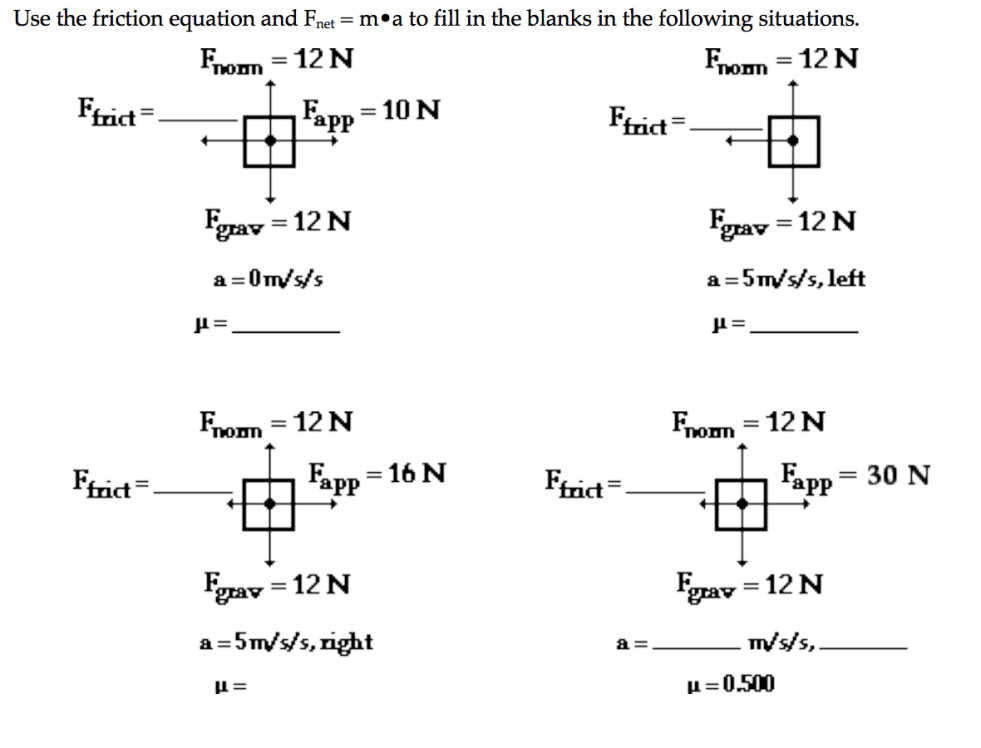
Some of you may recognize the diagrams as coming from physicsclassroom.com curriculum, which, I will admit upfront I have a big bias towards because the site is developed and maintained by one of my favorite teachers at the high school I attended. As a students I felt the website really bolstered by comprehension of physics and I continue to refer students and teachers to it.
However, if you’ve been following my posts, particularly this one, you will have read about the importance of creating “desirable difficulties” through spacing and interleaving problem types and topics. There are also some great methods out there to help students scaffold their problem-solving process to get them to take advantage of the metacognitive process so they can begin to think more like experts in their approach.
As such, this type of practice looks like the antithesis of good learning! The problems are fill in the blanks! Every problem is the same! Do any of these problems even have real meaning to the student?
So back to the question, what role do these types of problems serve?
Chapter 5 of Daniel Willingham’s Book, Why Don’t Students Like School is dedicated to the value of drill work. Drill work has gotten a bad name in the age of NGSS and common core as we push for deeper thinking and learning. However, when we practice skills repeatedly so they can become habit or second-nature, that frees up space in our working memory to focus on more difficult tasks that require deeper thinking.
We discussed earlier that the very reason novices struggle with seeing the bigger picture and conversing with themselves while they solve a problem is simply because no part of that problem is second-nature, it is all coming from working memory. A beautiful example Willingham uses is tying your shoes. Do you remember when you first learned how to do this fine-motor task? Now you can likely tie your shoes without stopping your conversation, and maybe don’t even remember you did it! Another example is driving a car. Did you ever find yourself at your destination, not quite sure how you arrived because your mind was so preoccupied with literally everything else except driving?
Your working memory has a finite limit and there’s not much you can do about it. However, when we commit processes such that they are automated, we free up some RAM, so to speak. This is where the above practice is, in fact, an excellent tool. When we drill students, we allow certain processes to automate so that they can focus on more complex ones. Consider what kinds of processes are automatic for yourself when solving these problems. You probably don’t think much about the mass-gravitational force calculation and that normal will be equal in all of these cases and you likely know immediately the direction of acceleration. Each of these would be good for a student to also have automated.
At the same time, these exercises can not be the sole mode of practice and instruction. This type of drill work should be reserved only when we are hoping to embed skills in our students in which automation will help them with more challenging tasks. However, when this type of practice is paired with retrieval, interleaving and spaced practice, it can be a powerful way for students to begin to recognize underlying structures of the problems which will provide them a solid foundation upon which to build their learning.
By the way! Drilling doesn’t have to look like a worksheet of identical problems! Check out Kelly Oshea’s Whiteboard Speed dating! It’s a phenomenal activity for several reasons, but at it’s core it’s making students do the same problem repeatedly, but in a fun way.
Questions for Consideration
What skills deserve drilling in each topic?
What skills have you drilled that should get shifted to “desirable difficulty” exercises?
In my previous post we discussed strategies for metacognition to help provide students a clear, objective judgement of learning in order to help students see their own improvement and laser-focus where they need to put in more time.
Today we are going to further explore practice and studying.
We have already discussed some of the following: that students tend to judge their own competence poorly, students mistake familiarity with competence, and student study habits, if existent, tend to rely on passive methods such as “looking over notes” and highlighting. This is part of the reason why active learning is so beneficial in the physics classroom; it creates a norm for how we approach any problem.
In the book The Science of Learning Physics, Mestre and Docktor discuss the work of cognitive scientists Elizabeth Bjork and Robert Bjork of UCLA that suggests the implementation of “desirable difficulties”. Implementing these desirable difficulties is providing students with a challenge that is just out of their comfort or familiarity zone, but not so far removed that the student shuts down. Desirable difficulties can be produced by creating certain experiences for students that, in a way, de-contextualize the problem. These methods include varying the condition of practice, spacing and interleaving.
Spaced practice is commonly known: we don’t really learn much by cramming, but students will cram nevertheless. Knowing this reality we, as teachers, can incorporate spaced practice into our classroom as part of our warm-ups and retrieval exercises or focused activities. We can also incorporate these practices in order to help students built their own study guides (particularly when combined with metacognitive strategies) I really enjoy embedding spacing as a retrieval practice like the one below. You’ll notice I give students a single word to help jog their memory just a little, because remembering from a week or two ago can be really hard!
This practice also works excellently with interleaved practice, which is when students are asked to use multiple ideas at once or in random succession (the opposite is blocked practice such as items 1-10 are newton’s laws and 11-12 are energy). Physics truly lends itself beautifully to this process because, in truth, working through a semester of physics is really working through new and layered understandings and models for how and why things happen.
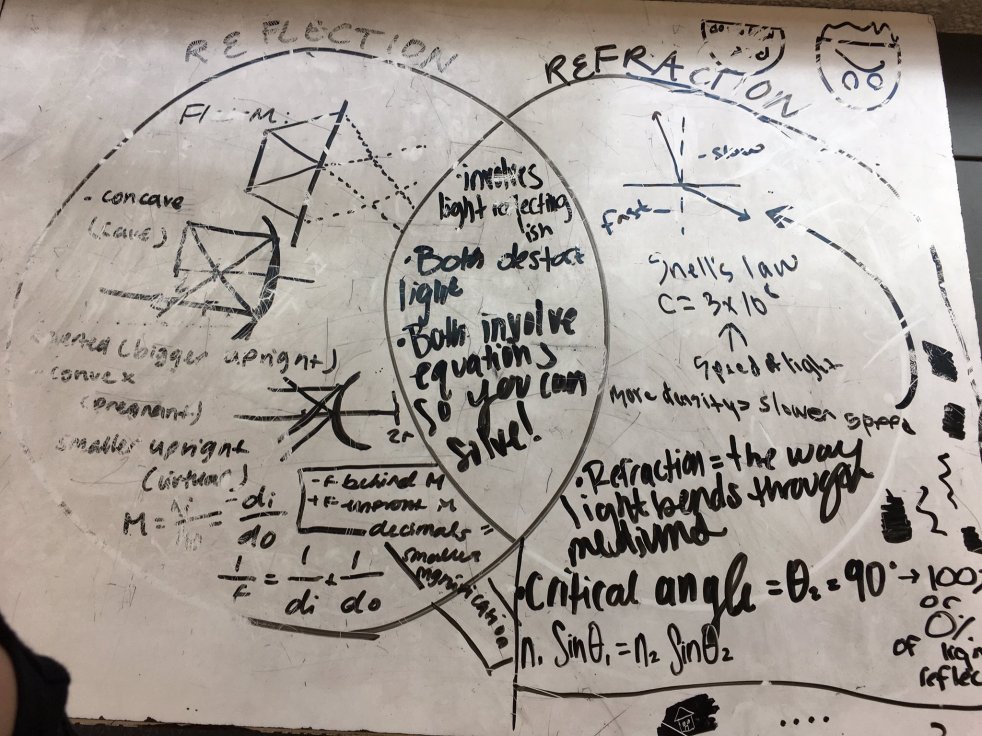
Last year I had my students do a retrieval exercise to get them to retrieve everything they could remember about reflection and refraction. After cycling through pairs and groups of fours I asked them to create a Venn diagram of the two concepts. This got students actively thinking about how refraction and the problem-solving tools connected to reflection and lead to some phenomenal conversations. It also produced a desirable difficulty: students had not thought about refraction in this way before and they were asked to interleave with reflection. Students got to walk around and look at the other boards and then come back to their board to shift or add anything they felt needed to move.
Goall-less problems are a really great way to incorporate these practices. In a goal-less problem you take off the last part of the sentence that says “find the velocity” and so on. Instead, students are asked to write down and solve everything they can about the problem. The benefit to this method is that it is the epitome of a low floor, high-ceiling activity. Even your poorest performing student should be able to draw a picture or write at least one thing down. It also removes the narrow student focus of trying to solve for the specific thing asked for, and rather makes students consider all of the possibilities. In my on-track physics classes I typically put a list of all of the representations and options they have available up on the board the first few times we do this. Goall-less problems also make for fantastic final review or assessment items.
One final note that is more personal experience than anything else. I really, really hate Webassign and other similar online homework platforms. I worked as a full time tutor in a school for two years and I was typically inundated with physics students wanting to get all of the green checks. No matter my goal, hope or intent, the majority of students generally did not care until I got them through all of the steps. In contrast, the couple of students I tutored from small, private schools without an online platform were far more interested in process. There is something about the green check and the correct numerical answer that strips away all of the process and metacognition that we work so hard to cultivate in our classrooms. I’m not sure what the answer is to this (other than this type of homework being worth close to nothing). But I am sure that when the focus in class is truly about helping students create their own knowledge that much of this type of homework becomes obsolete. I would much rather have students working out solutions on paper that they can then bring to class and have a conversation. In Webassign success is binary: you get a red X or a green check, but comprehension and learning are not binary processes, they are fluid and messy. Students need to work through the mess and celebrate the small wins along the way.
I distinctively remember this being a topic in one of my teacher prep classes. I also remember several failed attempts at weaving metacognition into my assignments. I don’t know about you, but trying to get students “thinking about their own thinking” seems really challenging, clunky and too often inauthentic. Students are fantastic at sniffing out inauthenticity, and the moment they recognize something as garbage, they approach it in full B.S. mode.
The challenge with this, of course, is that metacognition is an incredibly powerful tool within the cognitive science toolkit, and is one of the marked differences between expert vs novice thinking.
Metacognition allows students to evaluate their learning and problem solving approach, and focus for studying. Unfortunately, students frequently misjudge their skills and abilities, often confusing familiarity with content for competence. Furthermore, students who struggle may lack enough familiarity to properly identify the edge of their learning. So how do we teach students to be authentic reflective learners?
One of Mestre’s suggestions in The Science of Learning Physics is to provide students objective measures to judge their learning. Specifically, access to old exams and questions. While this is an excellent method, many high school and AP teachers may lack a deep pool of questions to make available to students. Additionally, this is limited to student studying outside of the classroom. What Dr. Agarwal suggests in her book Powerful Teaching is “engagement with feedback” in other words, whenever we have students working in our classroom, they should have the opportunity to receive meaningful feedback on their work in short order so they can reflect on their process while it is fresh, and course-correct as needed. How often do we ask a student to tell us their thought process and they respond, “I don’t even know anymore”
A method I’ve adapted to aid in this task weaves together retrieval practices with metacognition. Recall in the retrieval process students first write. down everything they can remember using only their brain. Then, if you so desire, students can pair and share (I typically do a pair and then have pairs get together into groups of four). Last, you permit students to dive into their notes. In each of these progressive phases, students should be adding the parts they received from. other sources to their papers. Adding the metacognitive level is as simple as a highlighter. Perhaps students highlight everything from their partner in yellow. Then, they highlight everything they added from their notes in green. This produces a very clear visual of what they know and what they do not know. It also produces a visual of how much they can reap from their friends and what topics or ideas were “really hard” for everyone because no one could remember it.
If. you’ve started to dig into retrieval ideas on twitter or on Dr. Agarwal’s. book or website, you’ve. seen that there are so many different ways to do retrieval, from lists to graphic organizers. Any and. all of these can utilize this highlighting method. Not only does this allow for metacognition. and accurate judgement of learning, over. time it demonstrates to students how much they have learned over a time-frame and how their own retrieval improves with practice.
Here is another brilliant idea by Jess Kirby. Not only does this incorporate metacognition and judgement of learning, it also requires students to organize the questions by the big idea (another “expert-level” concept).
Magpied a retrieval idea. Tried with high ability year 10 for intervention on physics paper 1. (Meant to be 99 questions). They have to choose a question, decide what topic it is by colour coding. Then answer it. Will be trying again! #retrievalpracticepic.twitter.com/XpsGjy3Rlg
For a more complex version of this process as it relates to problem solving I have had students combine retrieval with cornell notes.
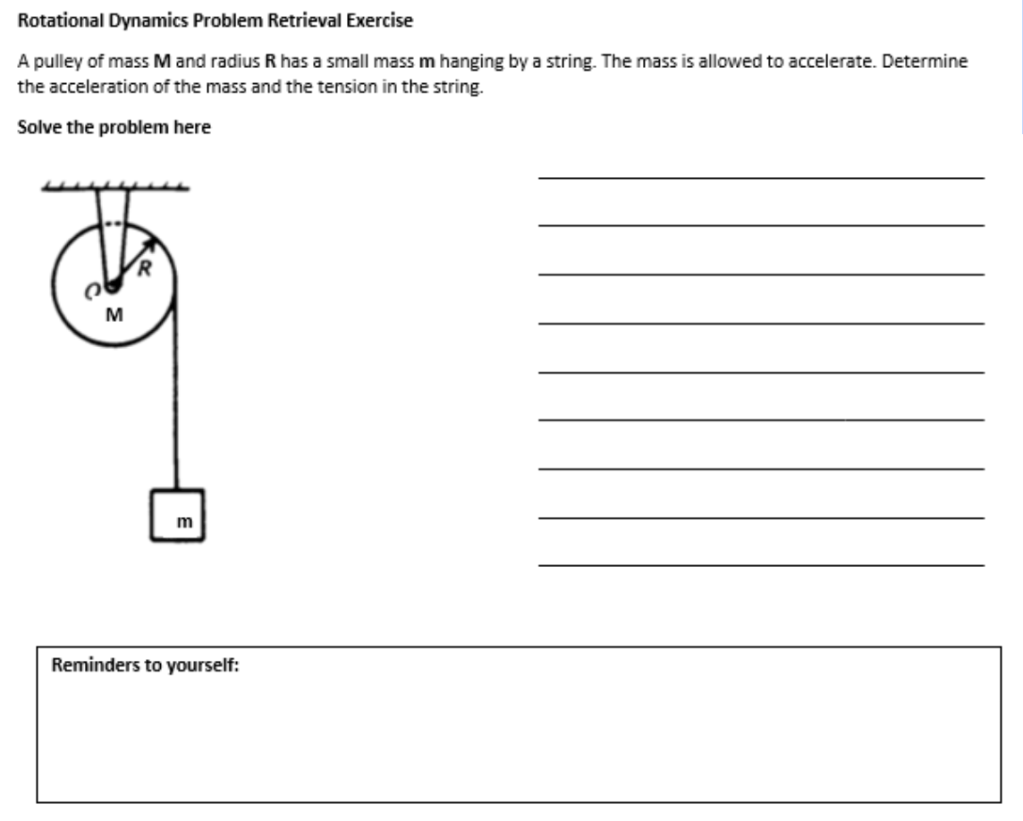
In this example I had lectured students on how to solve this exact problem the previous day. I provided them with the following notes sheet
First, I asked students to solve this problem as best they could using only their brain and what they could remember from the previous day. I only asked them to focus on the left hand side where they solved the problem.
Next, I allowed students to pull out their notes and add, edit or correct any of the steps they had missed. I asked them to color code these edits and then write out the steps in words on the right hand side.
Finally, I told students to look over their paper. Anything that needed an edit or addition (especially if “I just forgot that..”) needed to go down in the “reminders to yourself” box.
These three ideas really only scratch the surface of what is possible! If you have picked up Powerful Teaching, head over to chapter 5 for more great ideas and then share what you’ve implemented in your own classroom!
I’m going to make an assumption that most readers of my blog do not need any convincing of the benefits of an active learning environment. Even still, in the name of these posts starting from a solid research foundation I will briefly discuss the value. However, I think the bigger challenge teachers face is persisting with the active learning environment in spite of feedback from students, parents and perhaps even colleagues along the way.
The active learning model is a natural consequence of constructivist learning. Active learning has been shown to be more effective than traditional lecture, as well as most effective at uprooting and replacing common student preconceptions.
In an active learning environment the teacher takes the role as coach, facilitator and guide. Not leaving students to their own devices, but rather carefully crafting the learning experience so as to set students upon a fruitful path. Mestre lays out in his text that active learning could consist of the following:
Opportunities for students to share their ideas and reasoning individually or with their peers
Encouraging qualitative reasoning based on physics concepts
Encouraging construction and sense-making of physics knowledge; for example students are prompted to figure things out for themselves
Providing opportunities for students to engage in the process of “doing science”
Providing opportunities for students to apply their knowledge flexibly across multiple contexts (transfer to new contexts)
Helping students organize content knowledge according to some hierarchy
Teaching metacognitive strategies to students
For the first time this year, and thanks to an idea from a friend and college, Joe Milliano, I had this discussion of “where the learning happens” with my students at the start of the year, anticipating more push-back than usual due to the hybrid environment
Part of my intent in this was to point out how the “information getting” part of the class is really small compared to the student-centered and constructivism part of the class.
Mestre, likewise, encourages teachers to be completely upfront with students regarding the science of learning in order to provide them with the context for the journey we are about to embark on together. It’s important for students to know we’re not just doing this “to them” but rather we are doing this for them because it is truly the best model for their learning.
Unless your school or department is built on a Problem Based Learning model, or something comparable it is very likely that your students have not engaged in an active learning environment to this extent before, ever. Your students will likely cite that they learn best based on their learning style, they enjoy lectures and seeing examples and they study by going over their notes and re-reading the text. In fact, you can fully expect your students to think and feel like they are not learning, when they really truly are!
These common student responses are riddled with challenges for the teacher and their own learning. The best thing you can do as the instructor is to begin to have these conversations from the first day of school. Firstly, while learning preferences is certainly a thing, the truth is that difference courses require students to perform in different ways, and the way in which we ask them to perform may not match their learning style, this mismatch can then appear as incompetence if we teach to the learning style rather than the intended performance objective. Next, lectures, watching examples, going over notes and re-reading the text are all ways in which students can gain familiarity with content, but students confuse familiarity with competence. How often have you heard a student report “I get it when we do it in class, but then I forget everything on the test”.
Eugina Etkina has a wonderful, non-physics exercise to discuss the importance of students “doing the doing” as I call it. She calls it the expert game. You ask students to go around and share their “thing” that they are really interested in or really good at. Then, you group the students based on similar interests. Students are asked to come up with a flow-chart or visual on how you go from being a novice to an expert in that craft. Inevitably the results consists of things like “watch an expert” “practice” “get feedback”. This conversation then comes back around to the work in the physics class. I can watch Michael Phelps all day long, but I’m never going to be able to even swim unless I jump in the pool. Same goes for the work of physics!
Students begin to get on board with the idea of active learning when they see they are reaping the benefits. Unfortunately, physics tests do not always reflect this for our students. Enter the retake. I do retakes in a very special manner in my classroom. It’s something of an adjustment from an idea I read in an old Physics Teacher journal. I have not let students do this until the energy unit exam, only because I want students to get through that “adjustment period” I’ve mentioned previously.
Students complete the energy exam and I tell them the following day that they have a retake opportunity. Here is how it works.
I will be upfront with scoring. Students will take the exact same test over again. They must score 100% in order to get the bump.
Students do NOT get to see their original exam. They do not know their score, they do not know what they missed. This is really important.
I arrange a designated day and time in which students can come to my room to collaborate. They will receive a blank copy of the same exact test they originally took. They can use any print resource. They may not ask me questions.
One week after the collaboration students come in at a designated time to take the retake.
Scoring is easy because I’m looking for perfect papers. The bump works on a square root curve, so if the original score was a 64, the bump will be 10*sqrt(64) = 80. I really like this way of adjusting since the student who had a 96 to begin with only goes up to a 98, which makes sense since they had small errors, but the student who had a 64 and pulled of a 100 gets up to a respectable 80.
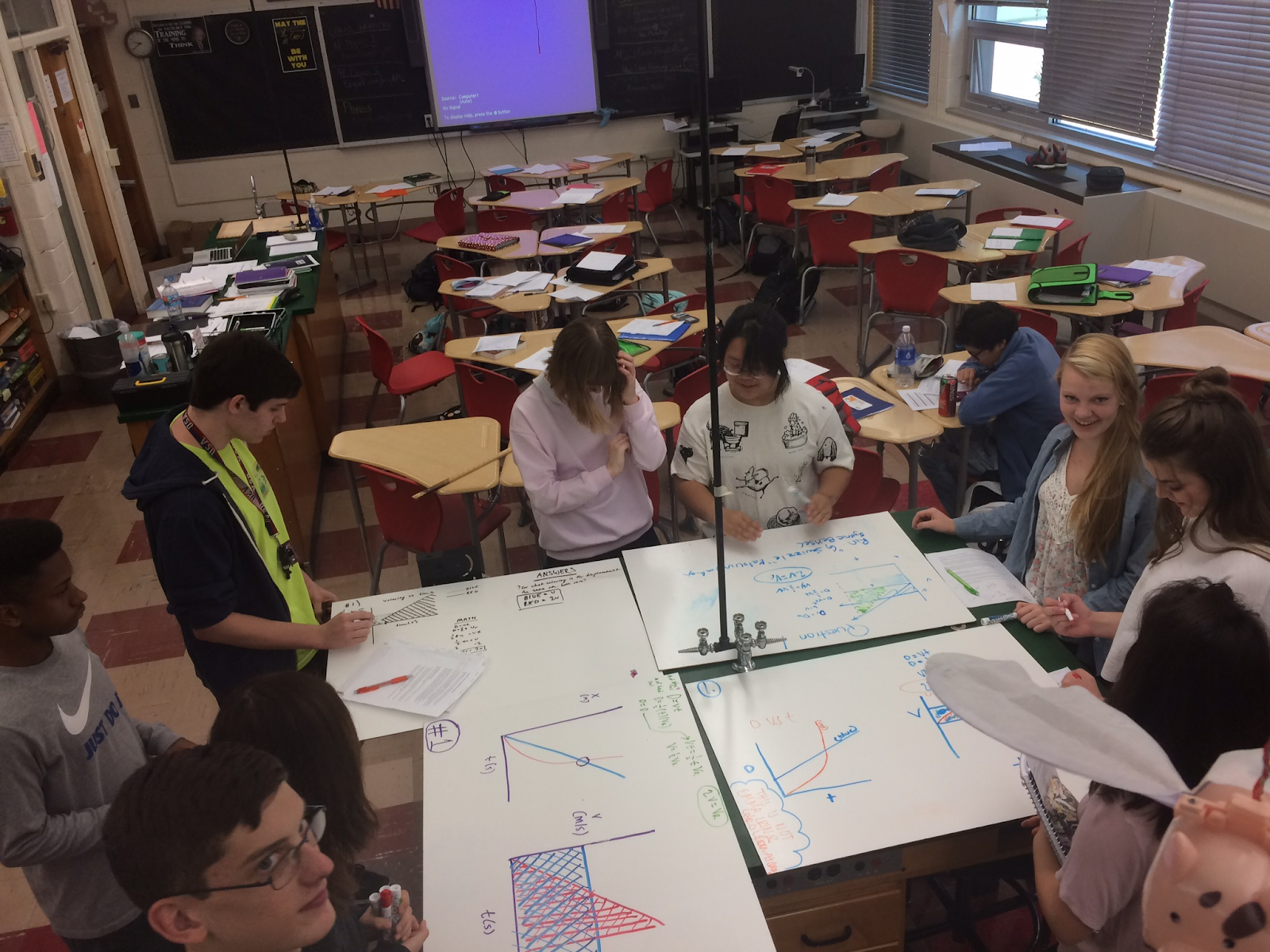
The design is where and how the magic happens. They know that 100 is possible because they are ALL together. The teamwork and camaraderie is palpable and the energy in the room is invigorating! Students also realize that they are all in this together: there’s no geniuses here, and working alone is not the best use of time. Because they need 100, students argue their point to the finish. Because they need 100 a week after they get to talk, students are making sure they fully understand how to answer the questions.
Last 5 minutes of collaboration day…the groups have opened up! Ss are talking to everyone! One student is literally skipping between groups! All but 2 #APPhysics1 Ss are here! Answers and arguments are flying! What will tomorrow bring? #iteachphysicspic.twitter.com/Qp3z5Ar9wA
I was really nervous the first time I did this with my students, but I knew I did the right thing at the end of the first session when my top student walked out of the room and said, “I thought I knew what I was doing on that test, but there was a lot I needed to learn” This student had an 87 on the first round!
I have found that one of the most critical components of an effective active learning model is creating the classroom culture where students not only feel safe to take risks, but feel safe to work together with every single student in the room. This takes a great deal of time and effort on the part of the teacher to properly construct. (Head over to Kelly OShea’s blog to learn about board meetings and speed dating, two of my favorites for building classroom culture!) Our current situation with the pandemic has made it much worse and I’m not sure how I can roll out my most favorite teaching tool under all of the current constraints (if you have ideas, drop them in the comments!)
To that end, if you are a new or novice teacher, or are looking to begin using active learning in your classroom, I would strongly encourage you to seek out teachers who also use active-learning in their classrooms. Create your own Professional Learning Network (PLC) of incredible teachers from across the country, sign up for the workshops at AAPT, or an AMTA modeling workshop so you can not only network, but have a place to have conversations about what is working and not working. Just as I tell my students, we are better together.
Story-telling as a primary means for learning and passing on information is ancient. In his book Why Don’t Student’s Like School, Daniel Willingham suggests that lesson plans are carefully constructed to tell a story.
This may seem obvious, lessons have a beginning middle and end, and perhaps some sort of conflict that students wrestle with, however in order to truly engage in effective story-telling we must be even more intentional. Willingham suggests the structure of the four C’s: Causality (the connection between information), Conflict (what challenges the student’s thinking), Complications (additional conflicts that arise en route to the goal) and Character (the players in the story and their interactions). The benefits of using storytelling is that they are digestible, since they follow a common framework, interesting and easily remembered. When we frame our lessons as creating and telling a story, we offer the opportunity for our content to be better embedded into our students’ minds.
When implementing story-telling as a lesson plan structure, Willingham advises several considerations:
Consider what part of the lesson students are most likely to think about
Think carefully about your attention-grabber so that it not only inspires, but engages your students with the intended learning
Use discovery learning with care
Design the lesson so students must engage with developing meaning
Organize the lesson around conflict.
Eugenia Etkina’s Investigative Science Learning Environment (ISLE) cycle of active learning (similar in some ways to the American Modeling Association curriculum) is one of the most powerful tools to turn physics units and lessons into stories. While that this is also a fundamental feature of the NGSS story-line model, as well as Problem-based Learning cycles. In this post I am explicitly using Etkina’s cycles due to their research-proved efficacy in the classroom.
Each of Etkina’s cycles begins with the “attention-grabber” which she calls the “need to know” Take for example, this Pepsi ad:
It’s fascinating to discuss that not only is this possible, but that it’s not even particularly incredulous: his speed at the top isn’t insanely fast. This video as an attention grabber is also particularly valuable because the entire premise of “can it be done” lies in the understanding of physics. Students can picture themselves trying to run the loop and can consider what that would feel like and what challenges might be presented. In contrast, doing a bunch of demos to “wow” students, such as whipping a penny around on a hanger, might be cool but are much more challenging for students to engage in the how and the way.
Etkina’s cycles rely on a fundamental and critical shift in how we approach the teaching and learning of physics. Specifically, that everything we do is framed in a similar context to how scientists work; everything is an experiment. (She recently published some research that highlights the cycles and I strongly suggest it for further reading). This relates to Willingham’s second point of designing discovery (we know it as inquiry) learning with care. As wonderful as inquiry is, it can be all too easy for students to head down inefficient paths if left entirely to their own devices. By framing the learning as a series of experiments with specific end-goals in mind, the teacher acts as facilitator to guide student learning down the path of interest without stifling their own creative thought.
Uniform circular motion comes at some point after forces where students have learned that a force is an interaction between objects and that when there are unbalanced forces, that results in a net force which causes an acceleration. The acceleration is in the same direction as the net force. Circular motion is often very challenging for students because so much of it is counterintuitive to students: enter the conflict. But rather than trying to explain to students (which is totally ineffective, see chapter 2 in Dr. Mestre’s book), students are engaged in a cycle of experiments to construct their understanding.
One of the first observational experiments that can be done is to ask students to get an object moving in a circle. I have seen this done in many ways, from giving students straws and a marble, to getting a students to come up with a broom and move a bowling ball in a circle. (Side-note: I overwhelmingly prefer the bowling ball example because it is much more obvious to the students what is happening) In this observational experiment students should notice two facts: first, that a force needs to constantly be applied, and second that the force is directed in towards the center of the circle. Similar, but different observational experiments allow students to confirm and refine their hypothesis (bucket of water, rollerblader holding a rope). As the cycle continues students eventual construct mathematical models and then begin to test and apply those models to a variety of situations. Here, we see Willingham’s final two points: making and discovering meaning is completely unavoidable through this model and conflict is central to the story as students continuously refine their understandings.
Students construct mathematical models from quantitative testing experiments through Pivot Ineractives
There is a great wealth to learn and discuss about active learning, but what I want to bring your attention to at this moment is how this structure creates a story. This story is not just some instructor-invented story, nor is it some obscure hypothetical problem that may be defined in a PBL lesson plan, but rather it is a story where the student is the main protagonist, and all learning and model development is directly related to the experiments performed in class and their outcomes.
Pick a lesson that starts off “today we’re going to learn about ___” that is then followed by the definition or equation for ____. Can you identify the conflict for students? Can you think of something for a “need to know” attention-grabber that would get students thinking about the conflict before you dive into your lesson? Share it in the comments.
What are your biggest fears or concerns with implementing active learning every single day in your classroom?
Have you used an NGSS storyline or PBL cycle? Talk about the four C’s as they apply (or are missing) from that lesson. Discuss Willingham’s considerations for story-telling learning and how they are or are not addressed.
One of my first posts on this blog was about modeling vs intentional modeling. If you’re new to this idea, this post might resonate with you
One of my favorite discoveries in my cognitive science journey is the expert vs novice thinker conversation, particularly as it relates to physics. Daniel Willingham discusses this in his book Why Students Don’t Like School, “experts don’t think in terms of surface features, as novices do; they think in terms of functions, or deep structure.” In Dr. Jose Mestre’s book he talks about an experiment where students were asked to sort physics problems. The experiment showed that novice students tend to sort problems by surface features whereas the “experts” sorted the problems by the big idea, specifically the major physics concept used to approach the problem.
Part of what makes physics, as a course, so difficult for all students is the necessity to move towards an expert type of thinking in order to approach problems. It is an experiment I would love to run formally, but in my experience there is a marked difference between the first 2 weeks of physics and week 10. By week 10 it’s like a switch has flipped for all of the students and the impossible is suddenly possible. Of course, there is no magic switch, rather students have begun to adapt more “expert” ways of approaching problems.
A really great example of exposing novice vs expert thinking is card sorts. Brian Frank has created an abundance of these sorts and they are amazing to work with. I particularly like the way Kelly O’Shea runs her kinematics exercise with students. First students are given just the graphs and asked to organize the cards in any meaningful way. Every time I do this assignment students decide to organize the graphs based on their shape OR they put all of the position graphs together, velocity graphs and so on. They make little to no connections between graphs (such as a parabolic position graph goes with a linear velocity graph etc). When students are satisfied the teacher realizes she forgot to pass out some cards” and drops label cards. These cards begin to get students to reorganize the cards in order to make the cross-connections. This also gives students a “second pass” with the material.
Ok, so it’s easy to see students acting like students, but how to we get them to think like physicists?
Strategies for Training Students
I love this puck problem below. The premise is beautifully simple. Same force, one puck has more mass, compare the change in momentum.
The novice student thinking looks like this:
Change in momentum is mΔv.
M is bigger on A, so A has the bigger momentum change.
FULL STOP. OR……
M is bigger on A and now I need to calculate v (lots of calculations later and fumble around with force).
The expert thinking looks like this:
Impulse is equal to change in momentum.
The force on both is the same.
The mass on A is bigger, so it will take longer to get it to the finish line.
Therefore Ft for A is bigger, so mΔv must be bigger.
Students are in shock by how simple and elegant the expert solution is. But it really just comes from ONE critical shift, pulling out the big idea rather than pointing to where change in momentum is explicitly stated.
AP provides another sweet opportunity to practice this skill and it is embedded in the paragraph-length response. Too often students see the format and just start to free-write. I discuss with them that they need to draft their response, much like a typical essay, but in a physics-friendly manner. They should (1) determine the big idea (2) set up the problem as if they were to solve it (3) Any step along the way becomes a sentence or bullet point towards the answer.
I work with students directly on this skill during classwork. I have a series of energy problems that I love to do this with. I have them whiteboard answers for speed and accuracy and I provide some very specific directions (1) Write your conservation statement (2) Write your proportionality statement (3) write your answer.
Training #APPhysics1 Ss to be direct and concise. Ss worked problems yesterday; today I required their reasoning to be brief. After providing some guidance about what each sentence should contain, the next Qs I asked them to explain on a certain # of statements. #iteachphysicspic.twitter.com/iRI6r6NQaq
AP Physics 1 Multiple Choice: The Exemplar of Expert Thinking Processes
Every year I have a few AP students who are so close to an A but can’t seem to push over the edge. Additionally, I often have a handful of students who, if you were to talk to them, clearly have a solid grasp of the content but they absolutely tank the AP Physics 1 multiple choice items. The beauty…and poison of AP Physics 1 multiple choice items is their requirement to think like an expert. The questions and responses are immensely loquacious and even though AP provides students with nearly two minutes per item students tend to fall into two traps: first, they are so used to multiple choice being factual items that you either know or don’t know and move and, and second, they try to be so careful that they lose sight of the forest for the trees. After the exam students frequently get mad that the questions were so “easy” or “obvious” “when you explain it” often placing the blame on me for not providing enough worked examples. Instead, we need to shift the narrative and turn the ownership back to the student. We cannot shame them, instead we need to train them on how to better approach any problem, not the 10 on Tuesday’s test.
I have found that having small group conversations with students about this to be highly effective. Willingham further describes in his chapter about novice vs expert thinking that experts have conversations with themselves which allows them to dissect the problem, focus on the important information and test ideas. Novices, on the other hand, rarely do this due to the cognitive load required of them. Having these conversations with my students helps train them in this type of procedure in order to make them more readily do the process on their own.
We go through the multiple choice items together and I ask them a lot of questions. I ask them to identify the big idea, then I probe them to tell me about components of that big idea that relate to the problem. Only then do we begin to look at the answer options. When you probe about the big idea first, several options quickly show themselves as incorrect. A wonderful example are the multiple choice items that you might label “Newton’s third law”. As soon as a student sees the phrasing how does the force of A on B compare to the force of B on A, the rest of the problem should be irrelevant, whether there are numbers, masses and so on. So if I were working this problem with a student I would ask them to identify it as a force problem, then I would ask them what our class definition of forces is (an interaction between objects) and since a force is defined as such, we can cut through the distractors and identify the correct answer.
Another strategy I use in my classes is I will literally hand them the exam a week prior to test day. However, I have made one very important adjustment: I take the question and all of the letter options off. Instead, students are presented with a scenario and they have the freedom to discuss with their peers the possibilities for the exam. I do this as an in-class activity, so students are not leaving the room with exam questions. Some students have reported back that this process makes them more anxious for the exam because they come up with exceedingly challenging possibilities, however in the end what it does is it allows students to perform on assessment day at the level they deserve. What happens here is, once again, students are engaged in conversations. They can transform these conversations into self-talk when they take the test. The idea that they have the actual exam in their hand means they know a 100% is possible if they talk to everyone, so they do not waste time working alone.
My tagline on this blog is “infecting students with passion” I definitely try to infiltrate their brains in several ways, and moving them towards expert thinking is one of them. As I tell them often, it’s my goal to get them to have conversations with me in their head when they sit an take the exam so it can feel as easy as a real-life conversation and they can knock it out of the park.
So tell me…
What does expert vs novice thinking look like in your classroom?
How have you tried to model or scaffold expert thinking and practices for your own students?
What are you ready to commit to doing differently when we return in January?
In light of my recent post regarding the learning and teaching of physics, which is much more than mathematical derivations, I’ve decided to dedicate a series of posts not only to what I’ve learned about teaching and learning, but also how I’ve applied those practices directly to my physics classroom. It’s time for some SciEDUComm 🙂
Often it can be easy to read a practice or idea that sounds good, in theory, but in practice seems difficult or inapplicable to the very specific setting of physics.
Pooja Agarwal explains it excellently in her book, Powerful Teaching. Retrieval leverages what cognitive scientists know about memory: that the more frequently we ask students to pull content out, the stronger the pathways become and the more easily they are able to accomplish this task when the summative assessment comes along.
Later I will discuss how I use these practices together with metacognitive practices to truly bolster student learning.
The process is rather simple: ask students to retrieve some amount of knowledge “using only your brain” Pooja explains that this should be preceded by a no-risk, easy-entry warm-up such as “what is your least favorite flavor ice cream” or “would you rather be locked out of your car or your house” the warm-ups have answers that are only correct to the unique student, but not so easy that the answer is a knee-jerk response.
Then, students are asked “using only your brain” to do one of the following:
Write down everything you can remember about __________ or from (yesterday, last week, last unit).
Write down two things you can remember about
Write down one thing you can remember about (provide a list of topics)
There are, of course, many other iterations of this and the activity can be as short or as long as you’d like. I would like to discuss two uses of this activity.
After the first day of reflection I asked students to write just two things. That was it! I collected the slips and we carried on.
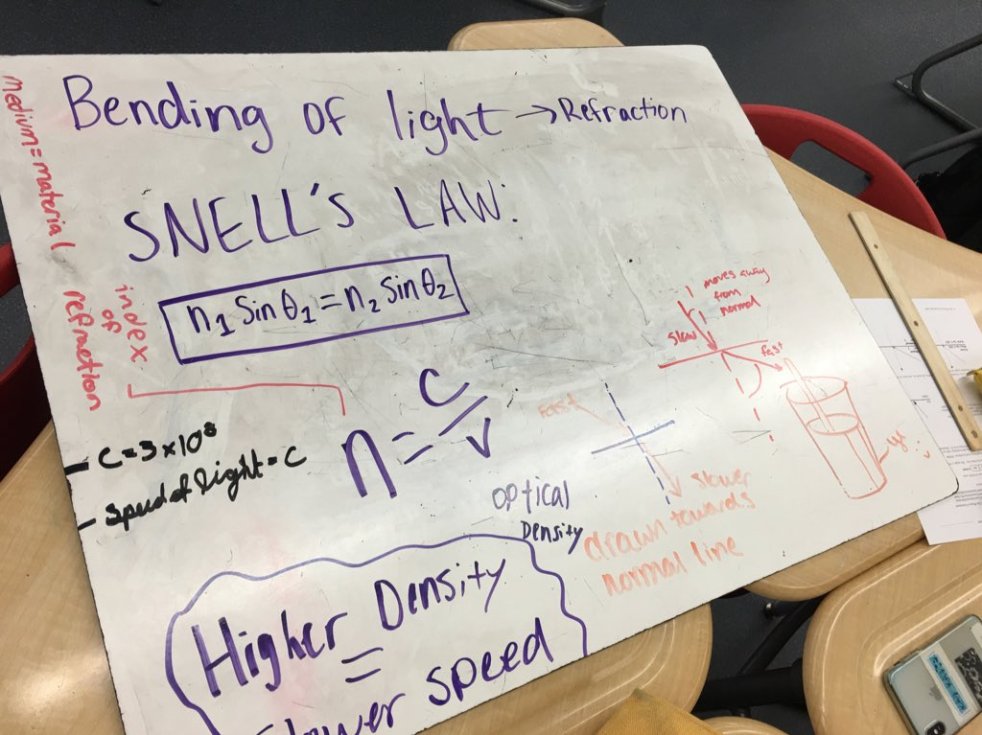
On another day, while students were learning refraction, I did the same. However, I set up my room “speed-dating” style and as students moved through the room they added something new to the boards. Eventually the boards were exhausted and by the end of it we had nearly everything on the board that we knew about refraction.
While this is a good lesson in the power of retrieval, I leveraged this moment to teach another important lesson: the 100% is always in the room. Students had, without my interference, discussed everything they knew about a topic. Too often I find students feeling that they need to do everything on their own, or they limit themselves to their friend circle. However, true collaboration takes advantage of everyone’s strengths. After we completed this activity we dove into the day’s “actual” activity that involved making observations of various refraction phenomena and then describing them.
It may seem at first glance that this process takes up additional time that cannot be sacrificed. However, as I quickly learned, the time spent actually pays off in several ways. First, students have a lot of critical conversations that would otherwise be 30 hand-raises and me going around answering the same question half a dozen times. Next, it put the learning process right in the hands of the students, and they see the pay-off. This leads to students working more efficiently and working more readily together. Thirdly, it makes it clear to students that no one has all of the answers, but together as a class they have everything.
I also generally enjoy using retrieval as a launch-point for further application and practice of whatever we are doing. While Pooja will explain that just the process of going through retrieval is important, I particularly love using it as a way to build community and confidence before jumping into a new task. I presented on this topic within my school’s small learning communities. The presentation slides can be viewed here
But what about the pandemic?
I was really sad that at the completion of my first unit using retrieval practices, students reported the best test ever and then the state shut the schools down. I have continued to do retrieval in my classes by setting up enough break-out rooms for pairs and then moving students into larger groups. Like most activities online, the process is not as seamless as it is in the classroom, but it still gives students the opportunity to practice retrieval.
Coming soon…how I used retrieval in my gifted AP class and interleaving.
Edit 3/11/2023 – For those of you who follow The Physics Girl, she is in dire condition due to long COVID and the development of ME/CFS. Please donate to her patreon. After this post, Dianna and I had a google meets call where we met. I learned that her creator process is much, much bigger than Dianna. Her former AP teacher who helps with her content creation agreed with my post, and I learned that in creating the series there was a delicate balance between the things Dianna wanted to ensure were in the videos and what was demanded from PBS/YouTube. I still stand by the fact that whoever is in charge of production (in this case, not Dianna) should be consulting experts. Period. I still stand by my original sentiments: teachers are experts in teaching, SciComm folks are experts in SciComm. They are related, but they are not the same. We would both be better working collaboratively.
I haven’t blogged recently, but in the midst of a pandemic, when teaching is really hard I take the art and the craft of teaching more seriously than ever. Unfortunately the phrase “those who can’t do, teach” has become a popular motto, bolstered by the way in which teachers are generally treated as simple public servants rather than highly educated and trained professionals. Along with this comes all of the opinions that everyone has about education. The common rebuttal is that just because I’ve been sick doesn’t mean I diagnose and treat myself…I go see the doctor.
It seems that everyone thinks they can teach, but teaching is hard. Teaching physics is harder. Teaching so students can be successful on AP Physics 1 is arguably the hardest endeavor I’ve taken on.
So The Physics Girl, Dianna Cowern, has decided that she is going to teach the world physics. Specifically for the AP Physics 1 exam. I have loved all of Diana’s work since I caught her “what is color” challenge video and I have used many of her videos ever since to excite and inspire students. Dianna has a degree in physics, worked and studied at top institutions, she has also done extensive outreach work prior to being a major scicomm personality and has received numerous accolades for her work in education. I love and have great respect for Dianna and her work. Naturally, I wanted to watch her Physics 101 videos to see if they would be a great resource for my students. I’m always looking for good resources, especially right now.
Sadly, I was completely disappointed, although not particularly surprised. I shared a quick blurb on Twitter and quickly got attacked by random followers of hers. One even asking “as a baseline, what is your physics education”
So who wants to start evaluating these from a teacher's POV? I've watched a few on double time and I'm a little disappointed Dianna… these videos look to be the classic "physics is about the right equation/lots of math". https://t.co/o013r5fP6C
I have a degree in physics from the University of Illinois (#9 in physics nationally) 10 years of teaching experience and my students score 5's at 2-3x the national average on AP1 and I have a 100% pass rate on APC. You can go away now.
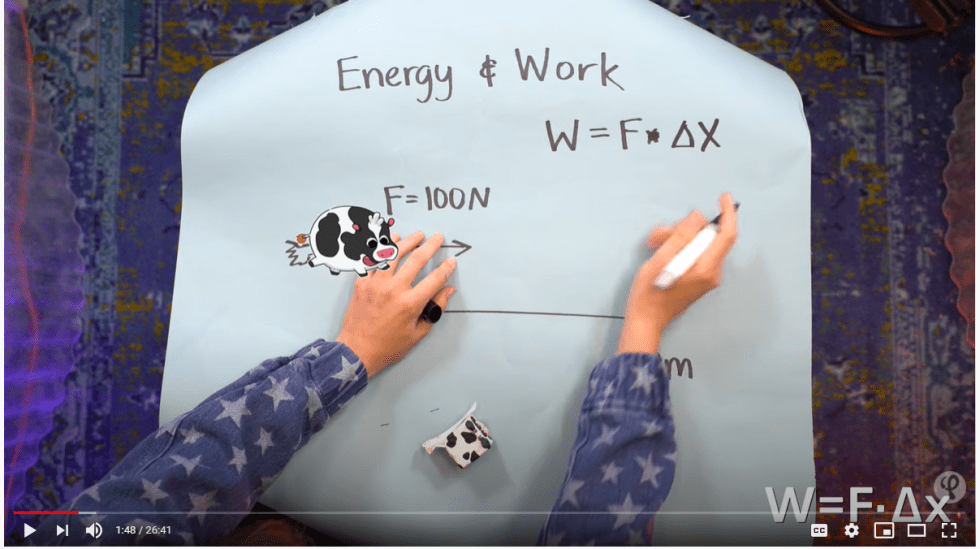
Over the years I’ve learned a great way to get a sense of a source’s pedagogy in physics is to check out how they discuss work and energy. You could argue that the whole of science is summed up in this topic.
In my course, and in AP Physics 1, we start by defining systems. Then we can discuss how work adds or removes energy from the environment to the system and the transfer of energy within the system. We spend several days working with these conceptual models before even touching equations or calculations. Dianna’s video starts by defining work as force times distance. I will be the first to admit that this is exactly how I started the unit when I was a novice teacher! That is part of the trouble, as a novice you tend to teach how you’ve been taught, not necessarily through evidence based research methods (an unfortunate pitfall of too many teacher prep programs). From there, you have to get about half-way through the video before Dianna begins to explain the concept of changes, transfers and reference points. This part of energy is absolutely critical to comprehension, but it is a side conversation without any accompanying visuals or further discussion. Instead, she jumps into the potential energy calculation.
Another topic that I’ve shifted over the course of my career is forces. Within the #iteachphysics twitterverse we had intense conversations about inertia (thanks Joe) and why the typical phrasing of Newton’s Laws is problematic. When I taught Newton’s three laws formally, I had my students change the words “action” and “reaction” in the third law to “force”. Furthermore, I now define a force, not as a “push or pull” but as an interaction between objects. This is so important because it now becomes really difficult for students to make up random forces. Students love to make up random forces on force diagrams. Fapp shows up all the time, but when you require students to define a force as an interaction and name the objects interacting, not only does the ambiguous Fapp become obsolete, Newton’s third law becomes a natural consequence.
However, aside from these language and pedagogy criticisms, my problem with Dianna’s work runs far deeper. Physics has the reputation of being too hard for most people to do or understand. Dianna has this incredible platform that has made physics accessible and interesting to so many people. On top of it, she’s not an old white guy with spectacles talking about the secrets of the universe, she’s a bubbly, attractive young woman and she frequently features a diverse range of other scientists in her videos. This is such important work and cannot be diminished. She had an incredible idea to create these videos and they really could have served as an incredible launch point for students interested in physics thinking “maybe I can do this”
Unfortunately, in our nation only 24% of teachers who teach a physics course have a degree in physics. I don’t have the numbers, but I would argue even fewer pay attention to the latest in Physics Education Research and evidence based methods. The biggest challenge in teaching physics is helping students work through the first 6-8 weeks of the course. I am very clear with my students that this is a normal adjustment period that all first-year students of physics experience regardless of age or level of the course. The challenge in physics is that to truly tackle problems efficiently you need to be able to look at a problem, identify the big idea, and then pull out the necessary components about that big idea to apply to the problem. This is what has been defined in the research as “expert thinking” which differs from “novice thinking”. Essentially, a novice will see a problem and try to force it into a previous homework problem based on whatever minutia is presented to them. A great example of this is when my AP students are presented with a graph of velocity vs time of two objects and they are asked to determine if there is an external force. To be completely honest, most students just guess. They typically say “no” because the velocities end up coming to the same place on the graph. The expert recognizes this as an Impulse-Momentum problem. The expert will then find the change in velocity of each object and see if there is an equal transfer of momentum between the two. Asking students to approach problems in this manner has never been required of them before, especially at the high-school level. The only way to get students there is to model the process, and require them to actively engage and wrestle with the material frequently. None of this is about equations. Equations and math are simply the tool. Weaving the concepts together and identifying what is important is the art of physics.
When I made my initial post I had a lot of backlash from random, non-educator followers of Dianna insisting that physics is math therefore I shouldn’t criticize the math approach in the videos. What Dianna’s videos are creating is a misleading sense of familiarity with equations, but familiarity is not comprehension, nor is it what is required of a physics student. Physics students need to be able to apply and synthesize concepts in order to properly apply the mathematics. I often tell my students that math will never be the hard part of this course. Half of my AP1 students are taking calculus, and the hardest math thing in AP1 is solving a system of two equations! As for familiarity with equations, if that was all that was required to be a great physics student then the equation sheet should serve as a cheat-sheet to success. Teaching physics is truly an art, and I am 100% confident had Dianna reached out to excellent AP teachers she would have had lots of wonderful ideas and support. Once again, teachers are put on the sidelines and our expertise is neglected.
Two years ago in November I sat in one of the large conference rooms at the district office with 19 other teachers, 17 of whom I’d never met before. Dr. Swindle, the program director, informed us that we needed to prepare to commit 24 hours per week to our new studies and reminded us that this wasn’t a free master’s because it wasn’t free to the community or our families.
I was 3 months pregnant and bracing for what I thought was going to be the biggest challenge yet: starting a master’s and delivering a newborn. We left the conference room with a Rockford University coffee mug, excitement and apprehension. Over the next year the 20 of us became family. I delivered George and edited my relevant topic paper in the hospital the following morning. I showed up to class 9 days after delivery and was quickly reminded why we are supposed to take 6 weeks to rest and heal. I thought the most challenging part was over. I had no idea.
In September on the first week of school, our district was hit by ransomware. We had no internet, no printers, no phones, no clocks, no bells, no PA system, no access to years of resources on district servers (this is part of the reason I haven’t blogged) Even still, we persisted in our studies, all the while reinventing our craft and our materials for our jobs. In December 2019 we all attended cohort 2’s research symposium, excitedly supporting our colleagues and talking about our own day soon to come. The ransomware attack had mostly been resolved and we thought we could get back to normal. We had no idea.
By March the University announced classes would no longer be in person and we shifted to zoom, where we remain. Many of us have children at home and having class over dinner time and bedtime is not exactly easy. Meanwhile many of us had to shift and rethink our research projects, now severely impacted by the pandemic. Once again we found ourselves reinventing our craft as we struggled to find effective ways to teach online learners, hybrid learners with less contact time and constantly changing schedules and constant uncertainty about what tomorrow would look like. When I entered this program, I entered with a mindset that I would just “get it done”. Completion wasn’t something to be particularly proud of because getting a master’s is just a thing “you do” as a teacher. All of that has changed. And in the process we’ve been transformed as educators and bonded forever as friends.
Day 1 I run a HUGE physics smorgy: 11-15 demos/lab set ups with minimal directions. Students are told to play, investigate, explore, PAY ATTENTION and ask lots of questions. This is my hook into the class for the year. I’m able to observe the students, act ridiculous and ease the MASSIVE anxiety they walk into this class with.
The next four days we actually spend working with data and relationships. Specifically to build the skills necessary to analyze data on a graph and straighten it when needed. I have a reading I ask students to do ahead of time and then we go through the straightening process. These brilliant students (half of whom are in AP Calc) are completely flabbergasted by the straightening process. It just doesn’t. make. sense to them.
I decided to try something different today on the fly, and it brought about some great conversations. First I put up blank sketches of graphs depicting a linear, squared, inverse and square root function. I asked them to put the graphs on their white boards and write the relationships. The answers consisted of the following:
“linear, squared, inverse and square root”
y=x, y=x^2 (etc)
y∝x y∝x^2 (etc)
This kicked off some great conversations. Are we in agreement, generally, about which is which? (yes). Are the equations really representative of the sketches? (We don’t know, there are no labels or numbers on the axes)
Next, I gave students four statements
“Momentum is proportional to velocity”
“A spring loaded gun is fired upward. The height of the bullet is proportional to the compression squared”
“Velocity is inversely proportional to mass”
“The period squared is proportional to the length of a simple pendulum”
I asked them to label the axes of their graphs with the physical quantities to match the statements. Here’s where the fun began. Students took a lot longer than I had originally anticipated completing this task. Here were the great conversations to be had:
In science, we usually put the independent and dependent variables on the x and y axis. With these statements, is it obvious which is which?
Since it’s not obvious, are answers where the axis are flipped wrong? (Not if they picked the appropriate shape!)
So, we often are going to use slope to talk about relationships. Like, say, if we plotted distance on the y and time on the x what would we get? (speed…minds are blown) The cool thing is if you plot the graph “wrong” you can look at the units, and decide if they need to flip because you’d have seconds per meter or something. The important thing is whatever you tell me the relationship is, needs to match your graph.
Then, of course, I let them in on the secret: we always list the y thing first. Literally all we are doing in these sentences is taking the math proportions, like y∝x^2 and saying, instead, height ∝ compression^2. It’s like the hugest lightbulb moment for students ever.
Now that they have that substitution thing in their brain, explaining how to straighten graphs is a snap. I was really pleased with the lack of frustrated and confused faces. Last year, I sadly, lost several kids during this unit. I wanted to cry so hard because we hadn’t even started physics and seriously questioned my lesson plans.
Tomorrow they finish their pendulum labs, so we’ll see how this all goes.
Meanwhile, AP Physics C is dabbling in computational physics for kinematics. More on that later.












 Physics.Teacher.Momma.