Teaching Methods

How I Teach… Forces (Intro, the Observational Experiments)

The first set of posts I wrote for this series was about momentum because I made such a large shift from how I used to teach to how I currently teach.

In the same vein my teaching of forces has also changed.

In the past my force unit looked like this:

  1. Inertia Day! Lots of Demos, initiation into the inertia club with club cards (you hold the card on your index finger with a penny on top and figure out how to flick the card out from the penny)
  2. F=ma. Define it, notes, define force diagrams, practice force diagrams. Practice F=ma problems.
  3. One day on action-reaction. Gloss over it; “it’s easy”

I cringe writing this out now. It was so boring! Inertia and action-reaction felt like fluff. We don’t need fluff!

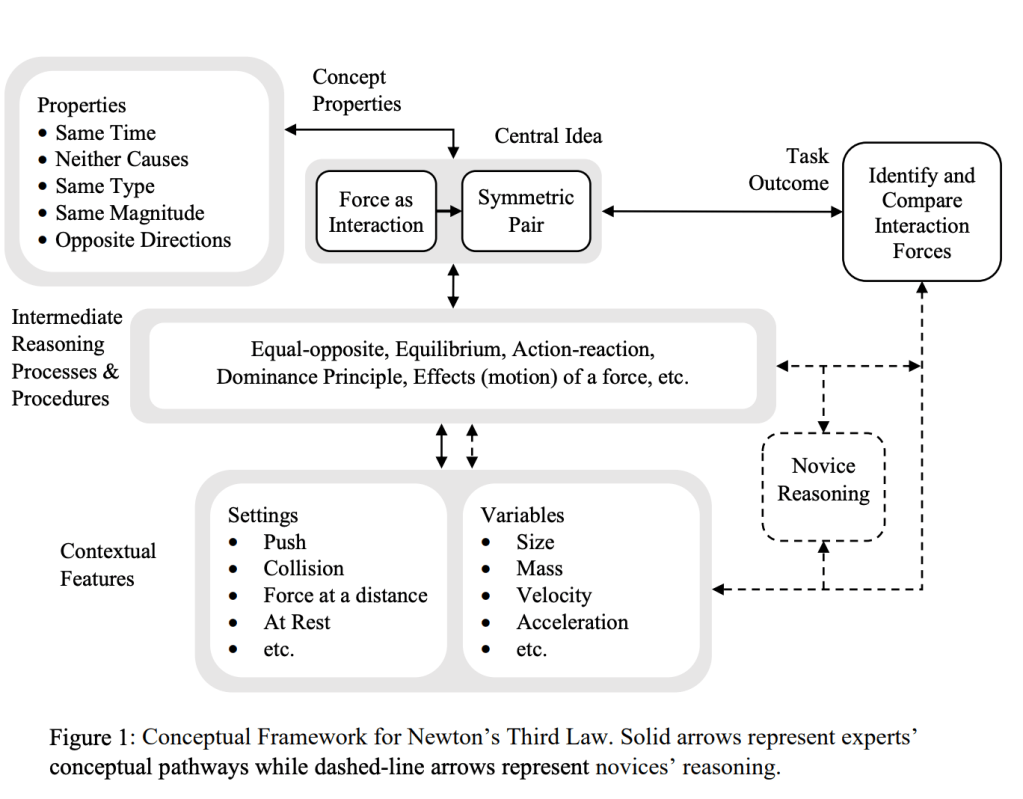
Currently, my unit structure is designed with the big ideas in mind. (Because, tenet 3: Order Matters, Language Matters) I was excited to see that the idea that teaching in a structure that models the thinking we are targetting to improve outcomes is actually supported by research, so my model draws on Lei Bao’s frameworks for force:

One of my biggest frustrations was students putting random “F(applied)” on force diagrams. It irked me to no end!

So starting with the framework for Newton’s Third Law, I turned my force unit on its head. The fundamental piece we begin with is:

A force is an interaction between objects

Observational Experiments

We start with the activity from Pivot Interactives where two cars collide.

Students are asked to separately write what they observe about the car motion and also what they observe about the force acting on each car.

After making the observations we discuss.

The primary aspect students recognize is that heavier/faster cars result in bigger forces. That’s all well annd good, but what about the force that each car experiences. Even though they’ve literally just witnessed and recorded it, they still want the heavier one to hit harder than the light one within the same collision! We closely observe this together and see that, indeed, the forces are always the same.

This is what allows us to define a force as an interaction between objects. Without a second object pushing on the ring, the ring won’t squish. Since the force is something that happens between, it must be equal and opposite.

This very small shift has been a game-changer. It is very rare for me to have students putting totally random forces on objects because “it should have one”.

From here we dive into Eugina Etkina’s ISLE cycle.

Students are asked to hold a heavy and a light object in each hand, palms up and then represent those objects with arrows on a diagram. Students are asked to label each arrow with the object interaction. This is a fun one because a lot of kids are quick to label “gravity” but when I inform them that gravity, is not in fact, an object, they have a moment of pause. Eventually all students arrive at the correct diagrams: equal sized forces on each object, bigger forces on the heavier object.

From here I diverge between AP and regular physics. In regular physics we will go directly to the mass vs weight lab where students will ultimately derive the expression F(earth) = mg. With AP we continue to follow a modeling cycle with experiments with a bowling ball down the hallway: rolling, constant force forward, constant force backward. Then I ask how we could have constant velocity AND constant force. Students are quick to say “push down” (and we are fresh off of projectiles where x and y are independent!). Then realize if we alternate “taps” that will do it (balanced forces). Students are asked to represent and reason by drawing a complete motion map, an accompanying force diagram and then look for patterns. In this way students then recognize that balanced forces will result in constant motion (including v=0) and unbalanced forces result in accelerations. For homework students will complete two exercises from the Active Learning Guide from Etkina’s book where they will continue to practice drawing motion maps and force diagrams together in order to find relevant patterns. From here we get ready for labs!

Up next… labs labs and more labs!
Quantitative Experiments with Forces

In My Class Today · Teaching Methods

Deliberate Practice with Mild, Medium & Spicy Problems

As a high school teacher homework is a constant battle.

At my high school it’s an equity issue. Many of my students lack the time, space and resources to complete homework.

But also, we also know that the fundamental differentiator between excellence and mediocracy is discipline and deliberate practice. And on a very fundamental level “use it or lose it”. So how to ensure practice and ensure it in a way where learning is happening for all students?

Enter Mild, Medium and Spicy questions.

I picked this idea up from Peter Liljidahl when he joined our nationwide physics book study in April on his book Building Thinking Classrooms in Mathematics. He’s been researching this type of practice most recently in classrooms and I was finally ready to give it a try.

I knew that my students needed some extra practice on calculating quantities from kinematic graphs. They just weren’t quite there yet. I could have assigned problems. If I did, I’d get a 25-50% completion rate and mostly students who did not need the practice provided.

Instead, I did the following:

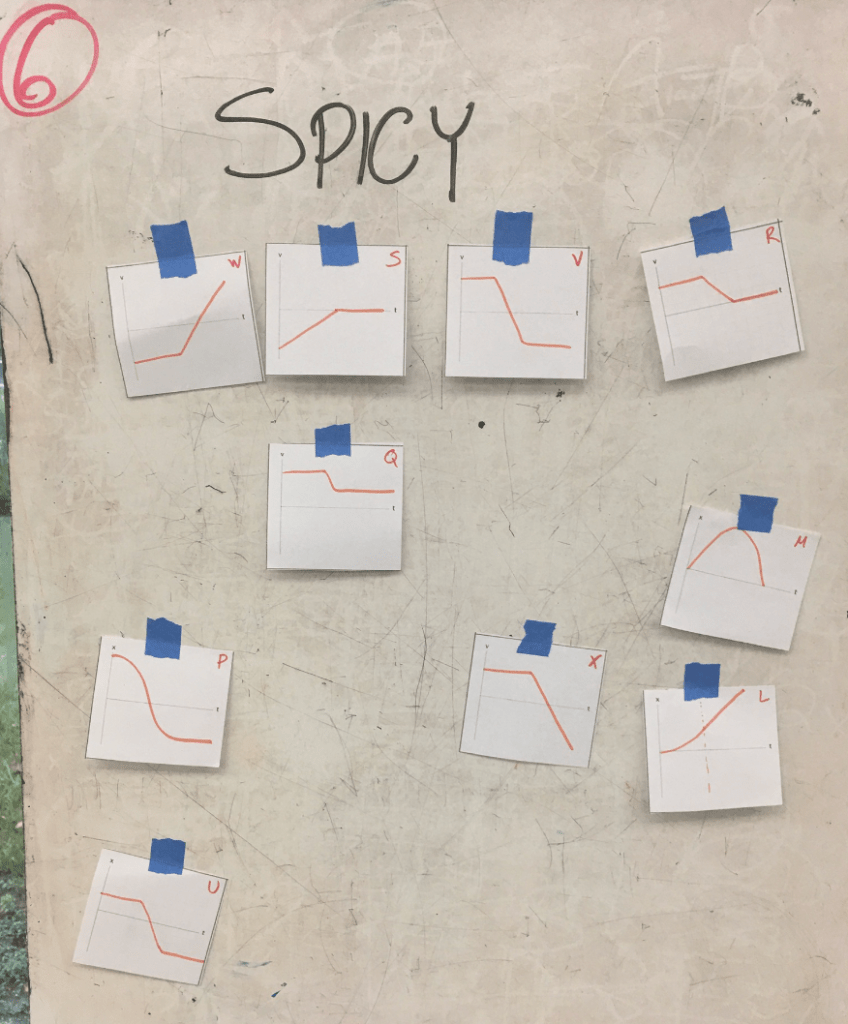
1) I made a variety of position, velocity and acceleration vs time graphs. Mild graphs had one segment, medium had 2 and spicy had 3 or more. Then, I wrote out the solutions to all of the problems. I put the problems up with tape on 3 individual whiteboard for the three flavors. The answers were on a cabinet on the other side of the room

2) We reviewed the previous week’s quiz and identified that this was the area that needed work. I explained to students they could choose the problems, gave them a paper to document their work, and pointed out the answers were provided.

3) I kid you not, I had 100% of students working for 100% of the hour.. to the point where my last class of the day (who normally line up early) were shocked that the bell rang!

Why it works:

1)Taste vs Aptitude Instead of “levels” the questions are sorted by “flavor” there is something psychologically motivating about choosing your preference rather than feeling pigeonholed by ability.

2) Do What you need – give students a task with a number of items and they want to finish as quickly as possible. Alternatively, the task is overwhelming and they don’t even begin. A single graph at a time, that is student selected (hello autonomy!) is manageable. There’s no pressure! No pressure to complete a spicy, no pressure to complete x number of problems. Just do what you need. I had two students go for the spiciest spicy. I made a comment about it and they asked me if they did it correctly if they needed to do more. Ironically, because it was so complex they were going to end up doing 7 different problems in the process anyway!

3) Get to the deep stuff – honestly, the best part of this for me were the conversations I heard students having. Some of them would get into heated arguments about the correct answer, even though they could have just looked. But just looking was like skipping to the end of the movie. The puzzle was more important than the answer. (I’m going to remind folks real quick that this is NOT my AP course)

4) Student Wins – I heard several students comment that day “I feel smart in this class.” and I cannot tell you how big of a statement that is coming from this group of students. If you know, you know.

  • Have any of you tried anything like this?
  • How do you deal with the homework problem?
  • What are you thinking about regarding this idea?
Uncategorized

Speaking at IL/Chi AAPT Meeting

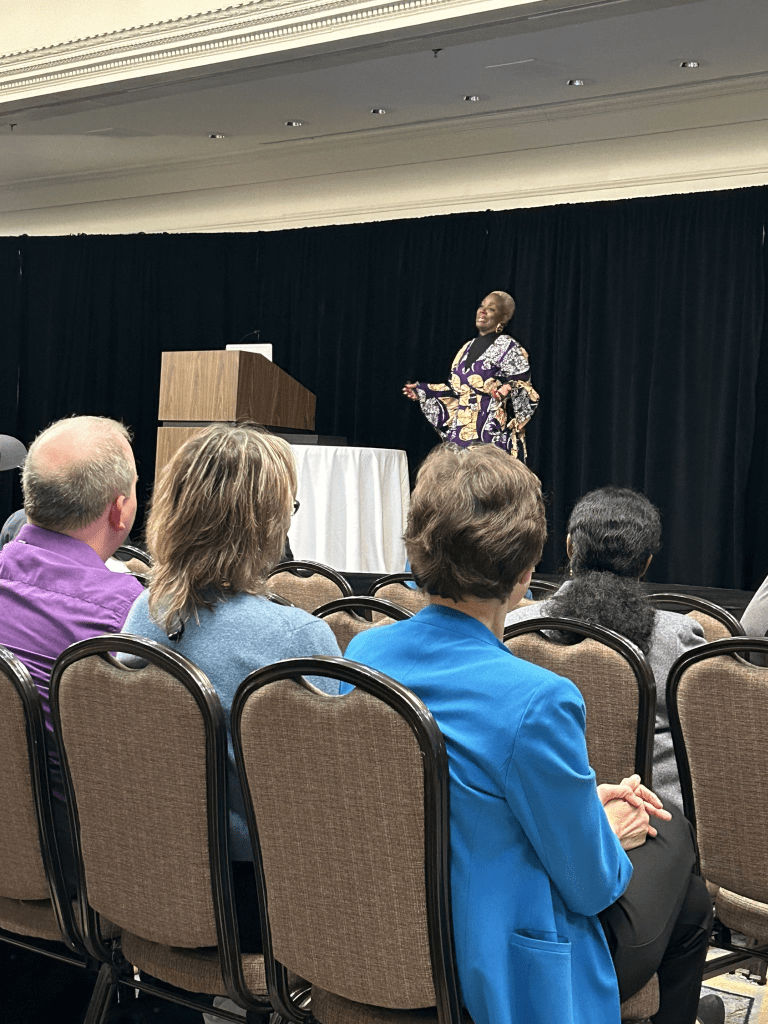
I’m super thrilled to share that October 21st I will be one of the keynote speakers for the joint Illinois/Chicago sections AAPT fall meeting. I’ll be talking about the SciComm unit I ran this last spring. If you follow me here or on Twitter you saw the journey first hand. As someone who enjoys communicating through blogging, twitter and speaking engagements this invitation means a lot to me. More info an registration here!

The joint meeting is always really exciting because we usually see a great turnout and representation from high school and college faculty. We’re also able to bring in some pretty great folks to speak.

The meeting runs Friday and Saturday. Friday morning an OpenSci Ed workshop is planned. I know there are quite a few districts rolling this curriculum out because it’s nicely aligned with NGSS. The folks running this workshop are also giving an invited talk later that afternoon.

Friday evening Ranger Mike Matthes is giving a talk about the NASA Voyager missions.

My talk is scheduled for 10 on Saturday.

I think it’s awesome that there’s a high school emphasis on the program this year!

Activities · In My Class Today

SciComm Unit Results

A few weeks ago I posted the article We Did Improv in Physics which outlined my four-day mini-unit emphasizing communication and presentation skills. Students did this in a number of ways including deconstructing TED talks, writing a blog post about their research, and giving a two minute impromptu version of their talk, in addition to the improv workshop. While the energy and the feelings in the room were fantastic, I also collected survey data from students that I’m going to share here.

Overall Results

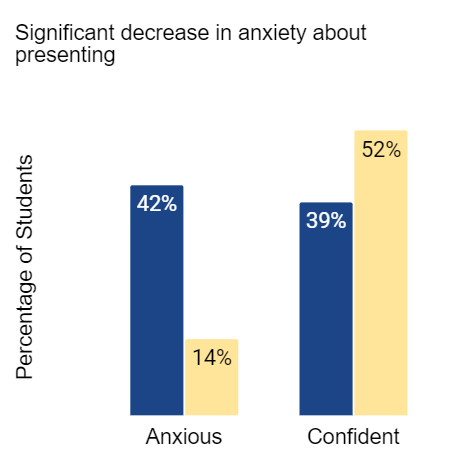
Before we started the unit I asked students a number of questions around presentations. One of the prompts ask students to rate their confidence when presenting in front of peers from “Very Anxious” to “Very confident”. When the unit ended I asked them how they were feeling about presenting their physics projects. The results were astounding.

While the four day experience wasn’t quite enough to build substansial confidence (increase from 39 to 52%) the amount of anxiety significantly decreased from 42% of students reporting some level of anxiety to only 14%. About half of these students moved from anxious to neutral and the other half moved from anxious to confident.

Students were also asked to rate the statement “Being able to give presentations is an important skill for me to acquire” the number of students who marked “very important” doubled from pre to post assessment.

Students were also asked what the single, most important aspect of an excellent presentation was. While many of them stated “audience” there were also a great deal of other responses such as confidence but also things like structure, organization, and knowing your own material well

After the mini unit these responses were reduced to those that were emphasize from the lesson. An increase in the response “audience” was noted as well as an increase in mentions around the visuals. Noticeably less was “confidence”

Student Feedback On Activities

Students were prompted “Considering your final presentation, how valuable were the activities around dissecting the various talks?” Student rated on a 5 point scale from “not valuable at all” to “very valuable”. A summary of student responses for each of the three activities is below.

Turn Your Paper into a Blog Post

56% of students found the blogging activity to be useful, with only 8.7% of students reporting it was not. Some of the comments are below with scores in parenthesis:

  • It helped to see how there was a different type of communication between presentations and the lab report itself. (4)
  • It helped show us how to communicate our project in an understandable, engaging, and quick way. It used common language like our presentation will. (4)
  • I felt like the activity where you turned the report into the blog was helpful because it showed how you would convey your report to an audience rather than someone reading it just for information. (5)
  • By doing the blog post and using informal words I realized that this physics presentation was more like a conversation between our peers. We were just sharing our finding with one another and the blog post helped organize all this information. (4)

Interestingly, the students who rated the activity low still reported the value in the activity’s intention, demonstrating that the low score had more to do with their perceived needs than the intented learning.

It was somewhat helpful for making the presentation interesting and easy to understand. However, I didn’t find it helpful for actual content which I’m more concerned with. (2)

Data Viz Presentation & Evaluation

87% of students found the Data Viz presentation helpful. I think this is interesting because this was the one “lecture” that was provided and I know my students tend to prefer lectures. Still, there were some great reflections from students:

  • I did not realize how much detail is given into making slideshows. For example, I would have never thought about making slides colorblind proof. (4)
  • I especially liked this activity because it enabled us to visualize what we could change in our presentations through using new strategies. I especially found important how we learned to use less words and things on each slide, making them simpler. Also, the rule of thirds was a good guideline for how we laid out our slides. (5)
  • It helped to see the ways the data can be shown to not over power the audience with so much information at once. (5)
Improv Workshop

48% of students found the improv workshop to be helpful with only 8.7% reporting it was not helpful. There are a couple of pieces of evidence from the commentary that support these low numbers, even though there were drastic results observed in the pre- and post- presentations. Firstly, the intention of the activities was not clear to students until we debriefed. We did improv on a Friday and debriefed on Monday. Secondly, the workshop put students very far outside of their comfort zone.

Overall Impact

Overall students were very positive towards the mini unit. A few comments of note:

  • I think it was really valuable to have this unit because none of our other teachers really sit and go through what a generally good/well-rounded presentation should look like, they only focus on content/course specific presentations
  • It felt like a breath of fresh air, and made me realize that communication is a huge skill in in physics apart from problem-solving obviously.
  • I think that unit is helpful when it comes to sharing your findings with other people in an effective manner. I learned quite a bit about how to construct my slides to show only the important information. This unit is also helpful in feeling more comfortable presenting in front of your peers.

Students were also asked if I should run this lesson again. Every student except two said “yes”. The two exceptions marked “maybe”. Of note is that the two “maybes” expressed discomfort with the improv workshop, but had generally favorable commentary regarding the other activities.

Honestly, the results are beyond what I was hoping for. This is something I will absolutely continue.

Uncategorized

We Did Improv in Physics!

Like data? Skip to the results!

My “Physics of” end of year projects have become legendary. When I introduce the project I hear kids chattering about previous projects by their friends and siblings. I started the projects after hearing Rhett Allain give his “Science of Superheros” talk at Chicago Section AAPT. My goal was always simple: pick a topic and collect data on it. How deep and how far was up to the student. How “good” the result? Also irrelevant. The project is so popular its one of my most visited posts on here and I now see teachers suggesting it as a post-AP idea.

But I couldn’t get over the fact that the presentations were lackluster. The content was fantastic! It was always in-depth and detailed but, frankly, they presentation of the content was not excellent. This was my fault. I never provided much in the way of guidelines. I had properly supported them in scaffolding a big endeavor, but I did nothing to support them beyond it.

Now, on the one hand, I gave myself a bit of grace. After all, I’m no english teacher! In fact, I’d reached out to the english teacher at one point because I knew what “excellent” looked like, but unlike physics problem solving, I had no idea how to get students from novice to expert when it came to presenting and communicating. This was a blind spot for me.

Through my own writing journey and with the help of excellent editors on staff with Edutopia I’ve started to develop a clearer image of the craft of communication. About a month ago someone dropped two titles, The Master Communicator’s Handbook and If I Understood You Would I Have This Look on My Face?

The handbook is simultaneously conversational and technical, and I began to craft an idea for a possible lesson on communication in science. Then I cracked open the Alda book. In the book Alda describes an experiment with 20 engineering students: he had them present their work, then participate in a three hour improv workshop. After the workshop they presented again and the results in their ability to relate while communicating were astounding. I didn’t want to try this, I needed it.

I began to draft my lesson plan on Twitter, in part to hold myself accountable to following through. Here’s what it looked like:

Day 1: What Does an Excellent Presentation Sound Like?

We started class with this sketch

I asked students to craft an outline for the talk. Some of the outlines were super surface level, but some of them were getting to the point like the start of this one below:

I had students share their lists to compare and discuss. After our discussion we watched the following TedX talk. What I love about Helen is that she’s a great communicator and she’s also very real and down to earth.

During the talk I asked students to notice some of the structural components from the comedy sketch:

  • When did she make her main point?
  • How many stories did she tell and what was the point?
  • When did she use illustrative language?
  • How did she use slides?

For homework students were asked to watch any two TED talks of their choosing and answer the same set of questions, followed by a comparative analysis between the two videos.

I also highlighted some points in the slide deck you can find in your templates of google slides (its the orange one). It’s based on the work of Chip and Dan Heath who are masters at motivation.

Day 2: Turn Your Lab Report Into a Blog Post

Blogging is the form of communication with which I’m most familiar and comfortable. I also knew that improv was on the horizon. Turning a formal report into a blog was my way of getting the work out of a formal, traditional format and into a more casual, conversational and presentation-worthy one. I took one of Rhett Allain’s WIRED posts and annotated it to point out structure, format and tone.

This ended up being really interesting. Some students totally flew with the tone and format. Other groups, however, made their writing look like a blog and met the word count, but the order and tone was still leaning towards formal report vs blog. I explained to students that given the time constraints I was not going to take off points, but the feedback needed to be considered when it came time to create their final presentations.

Day 3: What does an Excellent Presentation Look Like?

I was fortunate to have an incredible professor for my master’s who is a whiz at data visualization. She put together a great presentation based on the work of Stephanie Evergreen about all things slide related. This was more than just cut your words down! We talked about elements of design and the rule of thirds! We went through examples of “bad” and “improved” slides in an interactive way. Especially important was discussing how the data or your presentation must be shown inn a way that makes the results immediately obvious to your audience.

Day 4: Improv Workshop!

For the final day I took the page literally from Alan Alda’s book. I contacted a former student of mine who is getting his educator license and theatre endorsement and asked if he would lead. I shared with him a short video about the motivation for my plan and he was fully on board

Prior to this day I had told students to be prepared to talk about their project for 2 minutes. I told them nothing else. When they entered my class they found a room with no desks! Today was going to be diferent!

Eli, my invited alum, choose three games. My students had to:

  • “Pitch and sell” a random object using only gibberish (focus on tone of voice, pace, expression and body language)
  • “Watch them watching you” half the class took various audience roles (normal, kindergarteners who just won a pizza party, lawyers hearing a case) and the “actors” could only watch the audience watching them. The purpose of this was to break the barrier between audience and actor/presenter
  • The mirror game (as shown in the video).

By the end of the games there was so much joy and ease and laughter. Students got into their groups and presented to one another again. It was very different this time!

My student had the best comment that summed up the experience

“If I can sell a water cap in gibberish, I can present on anything!”

For a summary of the results and impact of these activities, check out the next post!

Uncategorized

I’m writing for ArborSci!

Twitter did it’s thing! I hopped on Twitter and started this blog at roughly the same time. Part of it came from a place of recognizing that no one is ever going to know or understand what I do in the classroom unless I actively talk publicly about what I do! I think the meritocracy myth was embedded so deeply within myself (as it is for much of us who teach) that I figured my “work will speak for itself” and recognition would come when it was earned. The reality, however, was that no one aside from my students was really ever in my classroom. My work, my learning, my successes all stayed within the four walls that I make home for 173 days per year.

So I started networking on Twitter and I started a blog. Then something amazing happened. I felt like a new teacher all over again. There were so many ideas to try, books to read, questions to consider it was nearly a firehose! For a while I lurked because of major imposter syndrome, but then I started to get comfortable with my place. Over the years my network has grown and I’ve been able to actually interact with a lot of folks at events and conferences.

One of those folks is Nicole Murawski. She recently shifted from the classroom to Arbor and hasn’t looked back. She’s loving what she’s doing and has found the right balance for her life. She messaged me a few weeks ago to share that in a conversation with some of the folks there, she dropped my name.

I’ll be honest I had so much apprehension and I didn’t respond to her message for a bit. When I finally did that lead to the phone call with Arbor (more apprehension) and then another conversation with their marketing department. On the first call they asked if I had any ideas in mind. I was honest. I was burnt out so, no. I didn’t. This is why I was so apprehensive. I’m not one to be a constant fountain of ideas. When the come, they come in full force, but I just don’t come up with stuff on the fly. (Enter hating questions like “what’s your favorite” “if you could ____ anything, what would it be” and all related ice breakers)

Within a week I received an email that they wanted to do a “lifestyle” post about ways teachers can develop over the summer. As soon as I read the email I had an outline for a post in my brain within five minutes. I sent the pitch back and had a two-week deadline to write the story.

The article was posted yesterday and went out on the Cool Stuff mailing list! Check out a snippet below and read the rest on Arbor!

As the school year winds down and summer approaches I inevitably find myself more excited about next year than what I need to plan next week. While students are in a flurry studying for AP exams and final exams, I have the rare gift of time to begin to wind down and decompress a bit. Cognitive science tells us that creativity flows when we allow ourselves to get bored.  Perhaps proctoring state exams at the end of the school year comes at just the right time for us as we edge towards the burnout of another completed school year. Once the freedom of summer arrives, finding the right balance of boredom, rest and curiosity makes for the perfect cocktail for the months ahead. Here are four ways you can find that balance, rejuvenate your mind and refresh the joy in your craft. (read the rest!)

In My Class Today

That time I had to change my lesson in 15 minutes

So I’m taking a break between mechanics and waves/color/sound in regular physics to run the underrep curriculum. This week was mostly setting the stage and one of the projects students had was to research a black scientist, create a poster and write a bio. FIRST of all, some of the posters WERE AMAZING (YES, those are STUDENT CREATED posters)

One of my students decided to research Dorothy Vaughan, the first black female supervisor for NASA. Unfortunately she kept finding photos of other computers labeled with her name. One picture, in particular had us puzzled because she didn’t quite fit anyone’s visual. I commented on how this experience in and of itself made for an interesting statement on underrepresentation and marginalization.

So today I see the NASA announcement that one of the mountains on the moon is to be named after Melba Mouton. The photo? The same one we were puzzling over! I was eager to share this with my student and I started doing a google image search for Dorothy Vaughn, specifically looking for this photo of Melba.

And WHO has it mislabeled? None other than UC Berkeley!

So I scrapped the lesson for today and we wrote. First I had the student share her story with the picture situation and then I shared the news about the moon. I gave students a framework to then write a letter to the curators of the exhibit at Berkeley, asking them to put into consideration the bigger picture of our studies from the past week.

They did this on the big post it paper and then we had a gallery walk and students crafted a final version of their group letter.

I then went through submissions and put together a final letter of their writing to send off to the two individuals listed on the exhibit.

Of course my students’ first question “will they even do anything” stung a bit because I know that comes from a place of not being heard over and over again.

But they DID!

I promptly received an email back from Berkeley that they would correct the attribution and include Melba! I am SO excited to share with my students Tuesday!

Teaching Methods

Retrieval for Study

I love using retrieval practices.

And while the practice itself is valuable without the need to do more beyond the retrieving act, I really like to add student discourse to the mix.

Today we did retrieval with a homework problem. I’ve also done something similar with notes from class. One of the keys in this activity is color coding.

My students were given an AP problem to work on over the weekend. When they arrived in class today I informed them we were going to discuss the problem but don’t pull it out! I proceeded to give students a blank copy of the problem. Students had 10 minutes to complete the problem using only their brains.

In phase two I had students discuss the problem within their table groups. At the beginning of the year I had put students in groups based on the scores of their cognitive reflection test. Students were initially in mixed groups with the hope that reflective ideas could spread. Unfortunately this backfired a bit as students on the lower end started taking passive roles. For this semester I put similar-scoring students together while also accounting for the personalities I’ve come to know. This means that I knew when I had students talking they were working in similar-ability teams. As students added or changed answers they highlighted the revisions with a highlighter.

For phase three I counted off students in groups of 4 so ideas could spread and mix. Again, students highlighted anything they added or changed with a second color.

Lastly, I went through the solutions formally, but because they had spent so much time on the nitty-gritty I was able to talk about the problem in terms of the big picture. Any lingering revisions needed to be coded in a third color.

When we finished I pointed out that the colors give them an idea of where their studies and focus need to be. Start with the first color: they have lots of resources to help them with those ideas. The second color required a spread of ideas and perhaps had a few more challenging ones in the mix.

Students commented on how they felt more confident about the work we are doing after this activity, and I just love that the paper creates a really clear visual of where they are. The best part is that this paper is just for them. No reason to feel shame because you’re in the middle of the learning process.

Uncategorized

“The 100% is always in the room!”

“Ms. Ruggerio, is this correct?”

I get asked this question so many times in a day. Early in my career I felt like lots of student questions were a sign of my relationship with students and their willingness to have a conversation to get to an answer. I quickly discovered, however, that preconceived notion was about how I asked questions of my teachers. My students, on the other hand, are usually looking to be told how to do something explicitly so they can then mimic it, rather than wrestle with the ideas on their own. This became particularly apparent with a student my second year who was clearly brilliant but would literally check in with me every step of the way. Eventually, my intervention at the time was that he could ask me two questions per class period, so he needed to choose wisely about which questions would best help him.

In hindsight, this was too harsh of a response. As the adult in in the room it is my responsibility to create an environment where students can learn and must think. Singling this student out in this way likely shamed the student and without any other kind of support there was no way for him to know what a good question necessarily was, only that his teacher was refusing to answer them.

As my classroom has moved towards more student-driven discourse and less teacher-driven lecture, so too does the responsibility for learning and thinking shift from the teacher to the student. My students just found out this week that the time has come for their big energy retake. It’s a special retake I run once a year for this assessment in particular for a number of reasons, but none more important than to teach the valuable lesson: The 100% is in the room.

It is a phrase that has become synonymous with my name amongst my students, they know it’s my thing. Whether they are in lab, or whiteboarding problems or working on a retake, I will often announce at some point in the midst of the productive struggle “the 100% is in the room!” it’s met with some eye rolls, but it’s true. And something that’s really important for me to remind them is that the 100% is not in the room because Will got 100%, the 100% is in the room because each student has some piece of knowledge that is valuable to the whole, and if they can come together as a class they can get to the 100%. Regardless of the task, individual students aren’t done until everyone is done. They need to come to consensus on an answer.

There’s a deeper lesson here about science too: the real world doesn’t provide correct answers. In science, we can declare something is true to the best of our knowledge because enough scientists have come to consensus about an idea and have the evidence to support it. There’s no science god to tell them “yes, that’s correct”. You must hold a firm belief that you have the best possible understanding with the evidence you currently have access.

I have no problem accepting the reality that the vast majority of my students will leave my classroom with little lasting knowledge of physics, and that’s ok. What I hope my students can walk away with for life is the ability to communicate, collaborate, persist, and mentally wrestle with problems, knowing that the best solutions come when we work as a team. The “smartest” people are rarely the best because they are geniuses, they are the best because they know how to pull the genius of everyone together to reach for more.

Teaching Methods

How I Teach… Energy Part 4 – Lab!

This is part of a series!
Part 1 (Work) Part 2 (energy bar charts) Part 3 (problem solving)


I have this lab I received from a colleague, it’s an iteration of a lab I’ve seen in other places. Basically an object goes down a ramp, gets caught by a paper catch/index card etc and students are looking for some iteration of work and energy.

In the version I have students are asked to find a relationship between height and distance. The cool thing about this is it ends up that height is directly proportional to distance and related by the coefficient of kinetic friction alone.

Student’s work looks like this:

Students are asked to complete the lab with a hot wheel car and then again with a small mass attached to the car. To students’ surprise the lines are not identical. This really bothers students until we discuss what we were actually looking for. See, the lines are still parallel, but the car with more mass is going to have a greater momentum at the bottom and will require a greater impulse to stop. It’s a fantastic conversation piece.

Student generated graph from lab

I really enjoy this lab because it requires students to consider a new problem and then apply that knowledge to a lab setting. Research has shown that students don’t really learn content in the lab, they learn lab skills. I was always a little frustrated with the disconnect between all of the work students put into the theory and then the lab results themselves. So this time I changed things up.

Instead of giving students the lab hand out and letting them work in groups, when students walked into the room they were put into visibly random groups. Visibly random grouping just means you create the random groups in front of students so they see it was truly random. I’ve been immersed in the book Building Thinking Classrooms and the research on this is really cool.

Once students are in their groups and at a white board that is vertically mounted, I’m in the middle of the room at a lab table with the lab set-up. I verbally explain the set up and that I want them to derive a mathematical model for the relationship between height and distance.

Vertical whiteboarding is really cool and has several advantages. First, students are standing which puts them into a more active position, this gets more of them working. Second, it’s really easy to just look around and snag ideas from other classmates. Third, since they’re already standing it’s really easy to move around the room and discuss with other groups. The first time I did this what astounded me was the sheer number of students talking. Instead of it being maybe 4 or 5 leaders it was nearly everyone in the room! There was so much collaboration and ownership of learning it was magical.

Taking a peek to get ideas is easy!

So I did this with the first part of the lab. Next, I asked them to sketch what the graph will look like with the two lines. Almost all of the students sketched the two lines on top of each other. I want them to have the experience of their data not aligning with their previous ideas and having to reconsider, so we left it at that. Then students were off.

I’m going to finish this lab this week, so I’ll have to come back to update this post, but I love this activity and vertical whiteboarding gets a 10/10 every time.