Infecting Students with Passion, Infusing Family with Love
Author: Marianna Ruggerio
Marianna is the Physics teacher at Auburn High School in Rockford, IL. She currently teaches AP Physics 1 and AP Physics C. When she's not in disguise as Nerdy Physics Teacher she is busy at home as Nerdy Physics Mom with her husband Fr. Jonathan and sons Adrian and George.
I used to do lab notebooks. I used to give students grace and flexibility. Labs had due dates in the calendar, we had board meetings, time in class and I would collect the notebooks at the time of the unit exam.
The inevitable happened. Many students spent hours upon hours of time getting notebooks done the night before the test. It wasn’t that they weren’t given time in class or during the week, they just did the student thing and other classes became more important until physics was important.
That all changed a while ago.
One of the shifts I made a few years ago was adding vertical whiteboarding to the lab. Specifically, I set up the physics of the lab as a vertical white board task. I gather students together and demo the intention of the lab. Then I verbally tell students what I’d like them to go figure out.
In building thinking classrooms the key piece is the consolidation piece. I’ve done the consolidation for the lab, but what I’ve found is actually more effective is the following prompts:
You are not there until we are all there
If you’re done or stuck, go take a walk.
I first tried this the day of a formal observation(!) and I’m never going back. The energy in the room was unmatched, and the sense of accomplishment by the students was so much greater than if I had told them outright. In previous years I’d let them work the problem in their lab groups, but this meant some groups would get it right away and dive in, while others really struggled and then were behind in data collection. Doing the physics this way instead builds the community.
One year I had two challenges. The first was that my students simply were not putting in the same time, effort and care as students in previous years. I know I sound like a crabby veteran teacher, but it was truly different. I also had one student, in particular, who had extreme anxiety. My flexibility with them inevitable created more anxiety as they tackled the most pressing assignments in their heavy school load. The infrequent lab collection was a complete nightmare for them.
Meanwhile, I’ve been adamant that certain lab writeups will have theory sections. I ask that students explain using diagrams, words, and mathematical models the physics behind what we are doing. Getting students to craft an excellent theory and how it then connects to the procedure is something I’ve been trying to figure out how to best present for many years.
Although we obviously discuss these ideas before students head into the lab, students inevitably dive into the lab, record their data and would come back to writing the formal theory later.
And later is almost always an afterthought.
To support my student with anxiety and to get the rest of the class doing physics on a more regular basis, I started requiring the theory sections submitted to me the day we would begin the lab. I explained that the theory would be a draft (and in practice, I did not penalize students for not submitting it, the consequence was they had to do it all the night before the lab due date and didn’t get a chance for actionable feedback).
Student response was overwhelmingly positive. First, by putting the hard-ish deadlines in place, the quality of student work rose dramatically. Second, students had the time and space to prepare for their unit exams, rather than trying to write a bunch of physics for the lab. Third, and most persuasive, the students verbalized how much more they liked this. I had one student say “I actually feel like I know what I’m doing in the lab now!”
We can show and tell students all day long, but until they work with the content themselves and make it their own, they haven’t yet become owners of their learning.
Take a look at these two drafts submitted by the same student.
The first draft was for a lab where we found the acceleration due to gravity with a ramp. This draft is typical of what I used to see often the first time I asked for a theory section:
This is done fairly well, but the representations are after-thoughts and it’s not entirely cohesive yet. I left comments on this draft and the student responded positively.
Now take a look at this same student who wrote this draft. There is one physics misconception that needs to be addressed and I’d like the formatting cleaned up, but notice the quality of the content at this point:
I’ve taken this as a win-win-win
Win 1) Students are not scrambling to provide this level of detail the night before the test or the night before lab collection way after the lab is done
Win 2) Students feel confident going into the lab about what they are doing and why they are doing it, which lets us focus our conversation on the how, which includes the procedure, the equipment, uncertainties, assumptions and error sources
Win 3) I feel way more confident that students know what they’re doing. AND, I get to support and fill some of the incomplete thinking as soon as possible.
If you’ve followed me for a while you know that I’m a huge advocate for building capacity in communication skills. I firmly believe that communication is the single most important skill in which we can educate our students. Without it brilliance has no impact.
I already know what the comments are going to look like when I share this. I’m happy to engage in a dialogue, but I’m not here for ranting.
Around the pandemic many schools started having conversations around equitable grading. Joe Feldman’s book Grading For Equity became a hot topic (originally published in 2018) and conversations, initiatives, pilots and mandates started making their way down.
So too came the complaints, “you don’t get half a paycheck for doing nothing” “so you’re telling me. a student does nothing, passes one test and then passes the class?” “if we don’t give zeros they won’t do the work!”
If you get into a deep conversation with teachers around grading, its something that is deeply personal. This in and of itself is probably a part of the problem. A lot of teachers were good at playing the game of school, checking the boxes and earning the grades. It’s really hard for teachers who “won school” to view school as anything different. Some teachers are deeply concerend with equality, “it’s not fair to the kid who worked really hard all year if another kid can just pass a test and get a good grade”. I personally have a really tough time with this one, because why should it matter? In a world where society is hell-bent on individualized education why do we care how each student gets to the finish line?
For myself, I was never a fan of putting in zeros for missing work. Students who regularly didn’t do my work in class did poorly on the tests. Students who did all of the work and missed a test are typically pretty high-strung and anxiety ridden. The zero for the missed test causes a lot of undue stress. Sure the test gets done, but at what cost?
I mentioned grading is personal. When I was a freshman in high school I became violently ill during the last week of third quarter. As such, I missed an exam in every single one of my classes, and the end of the marking period. My report card was promptly sent home with a string of Ds and Fs on it. Feverish and delirious, all I could think about was making up the missed work. It took a phone call to my counselor to assure me that I could make up the tests for me to finally rest. It sounds ridiculous in retrospect, but if you’ve ever worked with teenagers, they tend to be a little dramatic. When I returned to school (and you know how you are after a week of illness) my teachers were constantly on my back about my missed tests. I had one in every class! The only way to make up exams was in the test center after school, and I could reasonably only get one test done a day. I got caught up, and my grades were adjusted and a new report card was sent home, but I still vividly remember that horrible week.
So I pretty much always held off on entering zeros in the gradebook until I got to a point where it had been more than enough time to make up the work.
Enter grading for equity. The original grading scheme came somewhere between Yale, Harvard and Mount Holyoke. There were 4 brackets of proficiency plus failure (F). We shoehorn a 0-100 scale onto the letters and somehow 0-59 are all failing while the rest of the brackets are a mere 10 points. The argument for the 50% cut-off is simple: If you have 4 grades, 100, 100, 0, 100 that averages to a 75%. Is that student really just “average” due to the one zero? Or are they exemplary but missed one key component? Wouldn’t a B make more sense for this student? This is the change that the 50% grading floor provides.
“it lowers expectations!”
I want you to really think about this. What is our goal for students? Our pinnacle of learning? Personally, the pinnacle of learning would be that every student is able to earn an A. Realistically, I would be happy if I could get everyone to an A or B level. My expectations are that students can meet me there at a really high level. You can see why I’m then baffled at the idea that limiting the numerical possibilities of an F from 59 points to 10 is lowering expectations. Every other grade block is defined by 10 points, and adjusting the F to match the other grade blocks has no impact on my expectations on what A, B or even C level work looks like. Failing work is failing work: a failure to demonstrate any level of competence. To be completely transparent, between the grade floor and an approach to grading where letter grades are matched with level of mastery, it’s really difficult to earn the A unless you are on your A-game every. single. day. An A is never totally out of reach if a student want to earn it, but if anything my expectations are way higher than when I used points and did common teacher things like “the highest grade in the class becomes 100%” or using some weird math to make the average a certain number. It also feels a lot more honest and transparent as a mode of communication between myself, the student and the parent.
“they can do nothing all year take one test and then pass the class!”
I’ve noticed that a lot of the conversation is around the students who scrape by with a D instead of failing with a 25%. I truly wonder why so much vitriol energy is spent here. The first question I ask to that is, “if your gradebook is set up that they can pass with one assessment, does that assessment cover all of the content? I’ve never seen a student do nothing then pass a single test and pass the class. At best, they might get a 60%, but with the rest of the 50’s it’s still coming out to a 50-something and they still fail. An F is an F on the report card. As for the students who do, in fact, barely eek by with a few passing assessments…. isn’t that what a D represents anyway? That you existed in class and you learned something, but not anything near proficiency.
“You don’t get 50% of your paycheck for doing nothing!”
That’s correct, but this isn’t about “earning” 50%. It’s about making the F bracket the same size as the rest of them! You know what else my job doesn’t do? It doesn’t have a pay scale like this:
Jobs also start paying you when you’re hired, how dare you get a full salary after two weeks when you haven’t done anything to contribute to the company yet!
“We aren’t preparing them for college!”
Unless you teach at a college, stop making claims about something you experienced literal decades ago in a single program. Colleges are also undergoing shifts, both pedagogically and in terms of grading. The shifts, standards and policies can vary school to school, college to college and professor to professor.
My District Mandate and What I’m Doing
We were told the day before school started that this year the 50% grading floor was mandatory, blanks and zeros were not acceptable and our classes would be calculated with 90-10. That is, 90% of the grade is based on summative scores and 10% is formative (homework, participation etc). Any summative that is given must have at lease one retake opportunity.
Like most district mandates I certainly have my qualms, but it is what it is right now so I need a solution. Here is what I’m doing:
First, I should preface all of this by saying that I’ve been working towards standards based grading for a long time now.
AP is the place I have the most qualms for a number of reasons, mostly because making retakes is super hard, especially with the recent rewrite of the exams. I also used to have a number of different approaches around showing proficiency based on where we were in the year and the specific content. Due to this I have made one very specific shift: Every unit test is two tests.
We cover most of the content prior to the first test (for example, everything for 1D Kinematics but not projectiles, or everything in forces except multi-bodied systems). The second test is then a “built-in retake”. The second test has the entire unit’s content. If a student’s score is a letter grade higher than the first score, I change the first score to match the second. If the second score is equal or lower, both grades stand. After the second test a student may request a retake.
Retakes require deliberate practice
I have the following process for a retake:
AP students have to have their progress checks done in AP classroom. Regular students receive a selection of problems to attempt.
Students are required to schedule an appointment with me to discuss their work. We also conference on their test to highlight the good, the struggle and some tips for test taking
After the conference students are eligible for a retake at any point 24 hours after the conference. (within a 1 week window). they can also come back in to discuss more work with me if they’d like.
Benefits of the two-test system is that a lot of students do, in fact, improve the second time which eliminates the need for me to give a retake outside of class time. It also gives students a “freebie” retake. I had about 10 students request a retake after the first test. I don’t anticipate this number increasing significantly, and I can manage it.
No Finals Allowed, so I do retakes!
We got rid of finals in 2020-21, first by making them “holds harmless”. I refuse to do more work than my students, so I told them how things were going to go: if you can earn a score that is a letter grade different from your current grade, I will adjust your grade to match the exam. I do this in AP with a practice AP exam. In regular physics its a “choose your own adventure” final where students select what they want to reassess on and I only score those parts. I find that students are eagerly studying for these opportunities to demonstrate proficiency. It also means that “it isn’t over until it’s over”.
What about the 10%
Everything I score for the 10% goes in the gradebook as 10 points, so the level of proficiency is obvious. Quizzes in AP and “check-ins” are weighted at 5x, so they are “counting” as 50 points each. Formative labs are weighted at 3x. All of the rest is 1x. This allows for that 10% to be as informative as possible.
Some labs are Summative
Especially in AP, I am putting certain important labs as summatives. Students simply aren’t allowed to give me garbage. If the lab is bad, I send it back requesting/expecting revisions. In the real world? revisions are a thing. In the academic world papers are rarely accepted for publication the first time. Revisions make our good work great.
How do my students do anyway?
Here’s the bottom line: Students who always did well, still do well. The students who refuse to do anything, still refuse and still fail.
BUT…. students who don’t do anything for a long time period cam sometimes come around because they aren’t so far gone that they “don’t see the point”. I have a handful of students each year who really put forth commendable effort after big things in their lives. These students may eek by with a D or are really proud of a C.
An A is truly an exemplary student. Since I use standards based grading, earning an A means doing that near-perfect work all of the time. This is the most frustrating part for students who were used to “playing school” by checking the boxes, and this is where a lot of work is needed on my end, because the difference between the A and B needs to be crystal clear.
I know I’ll continue to think about, re-evaluate and shift the way I score and assign grades. I also know that as soon as I post this I’m going to see/hear all kinds of things. That’s ok. We’re all learning and growing, and hopefully, the ones doing the most growing are your students.
Before the Science of Reading train took off en masse, I was already excited about applying ideas from cognitive psychology in physics. In 2020 I was in the midst of my graduate studies and noticed that strategies I had “discovered” as effective were grounded in research. Previously I had attended an ISLE workshop with Eugenia Etkina and had much of the same experience, during which I learned about The Expert Game.
I chose to implement The Expert Game immediately after the first exam. The idea was that students needed an opportunity to experience the full learning cycle, and in some instances “fail” (by their standards) so that the expert game held meaning.
A student generated cycle of learning a sport
As I dove into the science of learning, the book The Science of Learning Physicswas also published. One of the authors, Jennifer Docktor, gave a talk for Harvard’s PoLS-T series that summarized the chapters. I decided to add this video as a homework assignment for my students. They are given the following prompt,
Watch the talk and write a short reflection (minimum 300 words) Include the following. Please dig deep and synthesize rather than simply agreeing or disagreeing.
What ideas challenged your current thinking?
What resonated with you?
What ideas challenged your current thinking about how we learn and learn best?
What do you now wonder after listening to this talk?
What resulted in an “aha” moment for you.
Lastly, as a student, what can YOU take away that you’ve learned in order to improve your learning this semester?
The reflections are always really cool to read. Check out this one reflection:
I must say that one of the things that challenged me the most was the idea of a gap between what methods students think teaches them the most and what methods actually teach them the most. The human brain can be incredibly annoying, and this feels like a prime example of it. It follows to reason that when I feel like a method is working better, I should trust those thoughts and engage with that method. However, the human brain likes things to be easy, not necessarily successful, which is something I must remain aware of and try to put into practice, seeking out the difficulties that generate learning, even if they might not be the most pleasant at first.
In particular, some students verbalize that they finally understand why my class is structured the way that it is. This was particularly noticable from students when I first assigned the lecture during the pandemic. Unlike many of my collegues I avoided lecture like the plague and put students in breakout rooms constantly. At first students complained a lot that “I wasn’t teaching them” but as the semester progressed they realized they were learning more in physics than their other classes:
The biggest realization in the video was in the “Active Learning” section (Chapter 5), where Docktor says that sharing ideas is an excellent way to learn. It’s as if she’s saying that students should keep working together. While working in groups is fun, I wasn’t sure if I was learning as much as if we did it on our own. The evidence she cites implies that the jamboards and group labs are some of the best ways for us to spend our time.
This school year I’ve been a bit overwhelmed. For the first time since I’ve been at this school my classes are all at 30+ students. We have also been given a directive that every summative must have a retake opportunity. It’s been a lot. Thanks to that, I have not gotten to reading my student reflections from three weeks ago until today.
It turns out this is a gift!
One of the shifts I made to make the retake process easier is the following: For each unit, we take the summative when we are nearly done with the content. For kinematics we covered everything except projectiles. For forces we will do everything except pulley problems and other multi bodied systems. You get the idea. Then, after we cover the final topic we take a second summative. The second summative contains all of the content and is a “built-in retake”. If students score higher on the second summative, the score will replace the first score. If they score lower then both grades stand as is in the grade book. Students can then request an additional retake. This naturally reduces the volume of extra retakes I have to give, as I already had this multiple assessment per unit practice in place.
Since I’m behind on grading, I am reading the reflections after the first exam with student data about the second exam. It’s really cool! Students who took the message to heart: that practice and active strategies trump passive ones, generally performed better on the reassessment! Students who wrote a reflection that seems stuck in their ways performed the same or worse on the second assessment. As I am reading the reflections I can now point to their own words as we go into the retake process and continue through the year.
A student who saw an entire letter grade shift on the second assessment wrote, “When studying last year, I mainly reviewed my notes. Although this process was somewhat beneficial and better than not studying at all, Dr. Docktor argues that the act of practicing the material is much more effective for students attempting to retain the information. Now that I know this, I plan to incorporate active processes into my studying for physics and my other classes.”
Meanwhile, a second student wrote,“I find the most effective method for me is a mix of passive and active learning. Using passive methods to set a base level and active methods to solidify the concepts.” this student struggled greatly on the second assessment and we will be discussing these ideas at his conference.
I think too often we get so caught in the grind of the content we need to teach, we forget that this kind of self-reflection is really the key component to deep learning. It’s not an easy thing to do well, especially when physics teachers are rarely the “touchy feely” types like you might find in english or social studies, but our students are whole humans!
Our local NPR station has an amazing podcast each Friday that centers around teachers. The host, Peter Medlin, is also an award-winning reporter on education for the station. In August, freshly home from my annual visit to the University of Illinois Physics and Secondary Schools Partnership I sat down with Peter to talk for the show (in my closet, on zoom!). It went live this week!
I knew that this show was an opportunity to share with a wider audience all that is most valuable to me as an educator. Furthermore, in a time when the teaching profession is threatened and devalued (especially this election season) I felt a duty to demonstrate just how highly skilled professionals teachers can be.
If you’re like me and prefer text, below is a summary of the podcast. I’ll also link a transcript.
We chatted about the Illinois Physics and Secondary Schools Partnership, a program that currently involves 40 teachers of physics across the state. We are able to collaborate, share resources, and gain access to some of the highest quality, evidence based practices. This is imperative when you are an “only” at your school.
This lead into a short discussion about the need for high school physics teachers, given the dearth.
Community is the source of joy and passion in teaching! (Thank you Joe Cosette for your plenary this summer!
National and local meetings and the Building Thinking Classrooms Physics book study
We wrapped up talking about the work we, as teachers, love the most and the work that’s most important: kindling the spark in students, battling systemic challenges in the education system and lasting relationships.
I was really grateful to Peter for hosting me and really happy with the product!
A Rockford educator teaches us how to think like a physicist | Teachers’ Lounge Podcast
Peter Medlin 0:04
Peter. I’m Peter Medlin, and you are listening to teachers lounge, and if this is your first time hearing our show, I’ve got great news. It’s based on a really simple idea, that we’ve all had teachers in our lives who helped us become who we are today. And every educator we have on this podcast, whether teacher, coach or professor, is nominated by the folks who listen. We want you to be a part of the show. Tell us about the educators who’ve inspired you and the folks in your community who deserve a spotlight. You can email us with your nominations and your story ideas at teachers lounge@niu.edu and on our show today is Marianna Ruggerio. She’s a physics teacher at Auburn High School in Rockford, Illinois, and we talked about her mission to teach students how to think like a physicist, and what that really means, and dispelling misconceptions people have about physics that might lead them to think it’s not a class for them.
Marianna Ruggerio 0:58
When you think about who is a physicist. People think of Albert Einstein and Isaac Newton. You’re thinking about old white guys who are geniuses, and in their room, they’re like coming up with these things all alone. You know, which is not how science is done.
Peter 1:14
Marianna says she wants to infect her students with passion. She’s so thoughtful and enthusiastic about her work, that it’s not surprising that her students start to feel that enthusiasm too, the infection spreading, if you will, as they start thinking like physicists.
Marianna 1:30
I know that I’ve done my job when a student says, Oh my gosh, I can’t drive my car without thinking about physics anymore. Or I’m always seeing physics through everything, and it’s driving me crazy.
Peter 1:43
We talk about all of that and so much more so without any further ado. How about we just jump right into our conversation with Marianna. We start off chatting about how she stays inspired through connecting with fellow teachers. Recently, she was doing that through the Illinois physics and secondary schools Partnership Program at the University of Illinois Urbana Champaign
Marianna 2:11
about four years ago. Now, this idea started at University of Illinois. So in University of Illinois, Champaign has one of the largest and oldest physics education research programs in the country.
Peter 2:25
You went to U of I too, Alma Mater.
Marianna 2:28
Yeah, I did. That’s my alma mater. And actually, I had a couple summers prior, I was at the National physics teacher association meeting the American Association of physics teachers, which is in Washington, DC, and I had just casually come across my advisor at the school, and I was literally on my way to the airport within like, 15 minutes, and he he stopped me, and he said he wanted to introduce me to someone, and shared how I was familiar with this device that he had invented, which is called the IO lab. And what’s really cool about this device is it’s they, they brand it as a lab in a box. So it’s literally this, like three inch by two and a half inch plastic box, and it has all of the different sensor materials that you would expect in your traditional lab equipment. So what in a typical classroom costs, like, 800 to $1,000 to have all of the stuff set up.
Peter 3:33
This, like lab in the box tool is like $100 and science lab, swiss army knife,
Marianna 3:37
exactly, exactly. And so he invented this and with a couple of goals for the university. So one is that this device on campus, for students who are taking physics is like one of their required textbook items. And so they buy this device, and then they have the opportunity to experiment and collect data in their dorm rooms before they go to their formal lab. So that’s kind of a cool thing. They get to be actually working with materials outside of the two hours once a week that they’re in the lab.
Peter 4:12
Especially helpful the last five years during the pandemic too. Yes,
Marianna 4:16
yes, it was. So that was really cool. The other thing the university was working on was shifting their labs from more of a like cookbook follow directions verification to having more creativity in the lab and having students really working on that designing of the lab aspect. Because something we want students to be able to do who take science is learn how to do science, which is very different from regurgitating facts, learning how to design an experiment, learning how to ask a question. That’s why the Next Generation Science Standards that Illinois has adopted. That’s part of why those came through the way that they’ve come through. So I had gotten reconnected with my advisor at this conference 10 years after graduating, and it was because. Of making that reconnection that I then received a phone call to be part of this partnership when they were first rolling it out. So the university had this idea of, well, we have all this really great stuff that we’ve researched, and we know we have the evidence that it’s effective for our students at the college level. We want to see what happens if we take this stuff that we know is great and we’ve had a whole team working on it, and we give it to high school teachers. So there were four of us. We were considered master teachers, so teachers who had experience and knew a little bit about the U of I curriculum, and they invited us on for that first year, which happened to be the pandemic. So when you mentioned it’s really convenient during the pandemic, it was really convenient during the pandemic, they specifically the four of us all taught one section of AP Physics, C, which is the AP course that’s in alignment with at U of I physics, 211 and 212 which is that introductory course for the engineering students and the physics majors. So you could, if you wanted to use that curriculum and just use it with your students, and we each used it in a different way, and they basically looked to see how we used the U of I curriculum. We also had a chance to collaborate and share ideas, which is so special because all of us were the only physics teacher in our building, which is
Peter 6:29
very case at, like, probably, I don’t know about most, but at certainly, a lot of high schools,
Marianna 6:35
definitely a lot of high schools. It’s a weird chicken and egg problem, because you’ll hear some places say that, you know, there’s this need for high school physics teachers. There aren’t enough high school physics teachers. At the same time, there was some research done by the US Department of Ed’s Office for Civil Rights that said something like two in five high schools don’t offer any physics. So you have a lot of schools that aren’t offering physics, or if they do, it’s one section. And so instead of having like a physics teacher, physics so you have maybe one person who’s teaching physics, they’re usually teaching other things, and most of the time their training is in something other than physics. So it’s the chemistry teacher, it’s the math teacher. I remember one of my early field observations I was at a small rural town outside of Champaign, and the person who was the physics teacher was also, he was actually a math teacher who taught the physics class, and he was the football coach. So you can imagine how much time you have to dedicate to the teaching of
Peter 7:35
physics. So you have the same person that’s teaching all of these different subjects at so many schools and so like, they probably don’t have the time to, like, seek out the resources that we’re talking about that you guys are able to, you know, collaborate with. And, you know, having a teacher that has access to that and is, like, really, like, inspired and like, loves physics have probably, you know, obviously, like, having a great high school teacher makes such a massive difference in inspiring students to also want to pursue science and pursue physics in college.
Marianna 8:07
Yeah, it’s really cool that you mentioned that there was some data that was recently collected by the American Institute of Physics, where they asked physics majors what got you interested in physics, and by far the most common strongest answer were informal environments. So things like the steam program through NIU or museum opportunity, so informal science education followed right behind that by that high school environment. You always say you know on the podcast that, you know the idea behind the podcast is that we’ve had teachers in our lives who have shaped who we are. And you know, really, when I think about education, is about teachers shaping students, but also it’s about students shaping their teachers. And at its pinnacle, it’s teacher shaping teachers. Because when I think about those teachers who have made an impact on me professionally, and I didn’t see this when I was a student, but I’m able to see it now. Those teachers were the ones who were very well embedded in their communities, and I grew up in the Chicago suburbs. And so out there, there’s a lot of physics at my high school. There were 10 different people who taught physics in 10 different in the building,
Peter 9:28
wow. So there was a whole team, right?
Marianna 9:30
out there, there’s a informal organization called physics Northwest, and they get together once a month, physics teachers from all over the suburbs, and we have pizza and we share demos, and it’s this really amazing community. And my high school physics teacher, you know, every time I saw him, he would be like, are you going to physics Northwest? Or are you going to the national meeting? Or are you, are you going? Are you going? And then, very quick. Are you going? Turned into, when are you presenting? And anytime I went, it was, Oh, hey, have you met so and so, you know, this is my former student, Marianna. And by the way, Marianna, this is this person, and this person and this person and making those connections. And so when I moved to Rockford, and all of a sudden I had no connections anymore, not easily. Seeking out that community became really important to me, and so when the opportunity through the partnership came to be that was something I was really eager to join, also because the partnership provides a way for me to be a leader, but within my scope of teaching, and that also meant that I was eager to pull other people in. So when we joined the program, one of the things that they shared is they’re going through the list of here’s what we expect, we expect to view was, and this is 2019, they’re sharing this before the pandemic. They say, well, one of the things we’re hoping is that you will go visit some of the other schools, of the other people who are in the program, and the other three teachers, one is out in the Naperville area, and then the other two are down in the Champaign area. And I’m like, I don’t have time to drive that far. So I did cold calls on school, local schools in the area, and I found out who the physics teacher was at Belvedere and hananiga and DeKalb High School, and I just sent emails, and I was like, Hey, there’s this program, and it’s gonna pull us together, and it’s at U of I so this is really cool, and you should join and so, and everyone I emailed picked up on it, which was really cool. So now kind of starting to pull this network together in the northern Illinois region. That’s great. And oftentimes, you know, with when districts are trying to give meaningful professional development, they’re doing this for as many people as you know. It’s supposed to be as effective to as many people as possible, and we’re such a very small specific group of people teaching physics, and so we don’t always get that meaningful professional development from there. But there’s a lot of expertise around the teaching of science, the teaching of our specific student groups that we have, and we’ve all had different experiences with things that we’ve been exposed to. So I at one of the national meetings, I was exposed to something called the investigative science learning environment, or ile, which comes out of Rutgers University, and the research behind the aisle method of teaching, which is really all about getting students to do physics, the way that physicists do physics, right? I
Peter 12:55
think we kind of mentioned this a little bit ago in the conversation too, is right? Like, I think that a lot of times, students going in when they don’t have much experience in physics, they go in thinking that, you know, this science classes, we’re gonna, we’re gonna memorize a bunch of science terms, and that’s how it’s, you know, that’s what the class is. Instead of teaching students to be scientists and to think like scientists, which, at least to me, even saying that out loud, it sounds like so much more of an empowering thing.
Marianna 13:23
Yeah, and it’s really hard to do, even if students are getting some kind of exposure to that prior to physics, physics is the first time where students are truly there’s no way around needing to take the things that you’re learning and apply it to something that’s even just a slightly different from something you’ve done before. I often tell students at the beginning of the school year, this is going to be different. This is going to be different from anything you’ve done before. Because in biology, you’re a freshman, and so you don’t have any you don’t have any you don’t have the chemistry, you don’t have the physics knowledge yet to do biology. So you do a lot of memorization in biology, and then you get to chemistry, and now there’s math. But if you really think about it, if you really think about it, it’s pretty much the same math every time. Write down your knowns, convert it to moles, use your formula, convert it back. It’s it’s and you add layers to it, but it’s still the same math, fundamentally every time. And then you get to physics, and you have all of these concepts, and now lots of math and equations. That’s the part that they’re always really scared of
Peter 14:42
you say, you like to say that physics is not just math, which is a misconception a little bit sometimes, right? No,
Marianna 14:49
yeah. I mean, physics is, I mean, I tell students, physics is not about the math, it’s, it’s about the models, and modeling and thinking in that way is. New, and that’s different. It’s about using the math as a tool, but in order to know how to use the math as a tool, we have to figure out what we’re looking at, how we’re going to think about it first, and that’s that’s challenging, and that’s challenging whether they’re taking the most advanced AP Physics or they’re taking totally conceptual level freshman physics, and just like it takes time to adjust to like a new workout routine and your muscles are sore, it takes six to 10 weeks to adjust to thinking like physicists, and once we get over that hump, it’s not so bad anymore, but those first few weeks, it’s like, it’s like muscle fatigue on the brain, and that’s, that’s always really challenging. I
Peter 15:49
forget if it was one of been one of your blogs or a presentation that you gave where you were talking about how you’d crowdsourced a bunch of other physics teachers and asked them, like, what students find to be really difficult about physics. And, you know, again, the misconception might be that people would think, Oh, it’s just the math is way too hard. The math is way too hard. But overwhelmingly it was the like critical thinking and the thinking approach and problem solving aspect of that which, again, like teaching people to think like physicists and to do that type of problem solving is also very hard for again, like students who aren’t coming in with, like, a vast physics background,
Marianna 16:28
yeah, and it’s funny when I when I posted that I want to and there’s no way to control it, but I had specifically asked that people who had been teaching physics for at least five years answer that question, because the misconception about it being super math heavy, I think, is a conception that is common amongst the general public. That’s common, you know, within the counseling departments, you know, even other teachers, that’s just from the outside looking in, that’s often the case. I tell people I teach physics and, you know, I get one of two responses, either that they hated the class, you know, or like, oh, well, you must be really smart, because there’s this assumption that it’s connected to math, but it’s, it’s really about solving problems. And I think a lot of us who are in it, and a lot of us who are in it, especially on a teaching aspect, that’s the part we enjoy so much is that problem solving part and helping our students learn how to do that. I had done that during the pandemic, and I was asking for a lot of student feedback during that time so I could pivot as I needed to. And I had one student comment at towards the end of the year that they learned that physics was about learning what questions to ask. And I was like, Oh my gosh, this is amazing. You got it. You got it 100% it is about figuring out what questions you need to ask, as opposed to what a lot of students are familiar with, especially from their math classes. And if they’re coming into physics, thinking it’s like math, they’re coming and thinking, well, if I’m going to do this problem, I write this thing down first, and then I follow these six steps in this order, and that gives me the answer. And that doesn’t work in our class. And that’s that’s part of that adjustment that gets challenging, is
Peter 18:20
that something that has been clear to you your entire time teaching, or is that something that you’ve really been able to home in on as you get more experience? Right? Because when you come in, obviously you’ve had some students teaching experience, but like you have all this content knowledge, but not necessarily communication experience, right to or again when, especially when you’re, you know, you’re not just teaching the concepts. You’re teaching, like how to be a critical thinker, how to ask the right questions that, some sounds like, something that is like, especially difficult if you’re a new teacher, and probably something that you know takes a lot of experience to really, really get good at.
Marianna 18:58
Yeah, it’s, it’s funny thinking about that and reflecting on that when I was so, when I was in high school, I actually wanted nothing to do with taking a physics class at all.
Peter 19:09
Why not? It wasn’t something that interests you. You didn’t think it was for you or
Marianna 19:13
well, so at my high school, after you took your first two years, your, you know, biology, chemistry, at that point it, you know, you could choose. It was essentially elective options. And we had, at the time, I was very, very interested in medicine, and considering going a medical route. And we had a like collaboration with the hospital across the street. And so there was this med tech class, and so you got to do a lot of work learning about that kind of work. And, you know, getting to kind of field trip over the hospital. And so I thought, like that would be really cool to do that. And I’m interested in it. And it was my mom, who was a former surgical nurse who did not take physics. Who insisted that I take physics and so and she said, and I remember her saying, You’re gonna take physics, you’re gonna like it, and I was convinced to not like it, just to prove her wrong. Oh, yeah. But that that quickly changed, very quickly changed because I was, I was a student who did always enjoy math, and I was good at math, and walking into those first few weeks of physics, physics gave math a purpose for existing, because now math is could be used as this tool to explain, to predict, to describe the world around and I just thought that was the most magical thing. Um,
Peter 20:48
so when your mom said you’re gonna take this and you’re gonna like it, it wasn’t like, you know, you’re gonna take this and you’re gonna like it like that, but it was like, You’re gonna take this and you’re going to enjoy it like she knew that youwould enjoy it.
Marianna 20:58
No, it was, yeah, it was definitely that supportive piece.
Peter 21:02
How did you know that you would enjoy it?
Marianna 21:04
I mean, I think because I had, I had always been interested in science and math and those kinds of things. And I think, you know, part of it was just being, like, generally supportive. Yeah, that helps. You probably gonna like it. You’re gonna like the challenge of it. I think was that that piece too. But it’s funny, because I had, I had had an interesting journey in in high school with regards to leveling. And I had everybody took regular biology. There was no option there, and and I had kind of slacked off, you know, towards towards the end there. And so my my teacher initially recommended me to take regular Kevin’s set of honors. And I said, Hey, I think I want to take honors. And he goes, okay. And so there’s this paper, signed the paper, and, you know, got an honors. There were some things going on in my family at the beginning of the year that made that first part of the year really challenging to focus on school at the time, but the beginning of the year is where you learn all the fundamentals for chemistry. So when rec season came around, my teacher was like, What’s your grade in math? And I was like, I have an A in math. And any like, he sighs and he thinks, and he goes, Oh, I’m going to put you in regular physics. And I was like, okay, and I was just kind of tired of fighting. I was like, well, maybe that’s I’m not smart enough, so that’s fine. And so I didn’t, I didn’t fight, and so I got in regular physics. I probably should have been in honors, but for me, being in that regular physics class, because I caught on so quickly, I also very quickly found myself being the person who was often explaining things to my classmates, and I really enjoyed that. And so I was already thinking, you know, at that time, I was thinking about how you talk about this and how you explain it to other students, and I was getting positive feedback there. But when I student taught, you know, I would go too fast or I would go too slow and and I remember it was my student teacher who said to me, he goes, You need to think about and plan out what questions you’re going to ask the students to get them where you want to go. And that was so critical, the idea of, like, Oh, you mean, you don’t just get up there and, like, talk and explain, like, I have to, like, sit and think about how to do this. And so I, I was really fortunate that in my training that was put on me right away and and something I’ve seen as I’ve progressed through my career is that, you know, as you keep learning and growing, there are things I’ve picked up along the way, and then there are things that maybe I picked it up, but then I read about it somewhere in some research article, or I experience it in a workshop, and I say, oh, that’s why it works. And now I’m doing these things intentionally, and so progressing through your career, I think, becomes a lot more about being able to hone in on that intentionality. One thing that comes up often, like, it’s a classic, any classic science question right where it’s like, here’s the situation, and then it’s like, which one is going to land first, explain your reasoning. And I was just thinking about how dumb that is, that we ask students a question that I mean, it makes sense, why we do it from a like grading standpoint, because it’s easier for me to say, Oh, you got the right answer and then read your reasoning. But from a science standpoint, like we don’t ever throw an answer out and then explain it. We start thinking about it, and then we mark that answer. And so having that conversation with my students of Yeah, it’s written this way. Don’t answer it that way, like, think through it and then check the box at the end. So it just becomes more and more intentional.
Peter 25:07
Yeah, that type of questions, like, backwards from how you would actually do it as a scientist, where, like, instead of just like, I’m gonna write down the answer, and then you have to, it almost takes more work to be like, Okay, why did I do this? And then try to, you know, come up and retroactively justify the things that you did, as opposed to, like going step by step, find, you know, applying what I know, applying the reasoning, applying them, all this stuff, until we finally reach our conclusion, which is how you know, actual scientific method stuff works. Well,
Marianna 25:39
it’s so often students will commit to a gut answer, and then they might even realize halfway through their reasoning that they’re wrong, but they’ve committed to the answer, and so they’re not willing to go back. And that idea, even outside of assessment practice, was something was another piece that I’ve grown in. I remember that one of the things that I felt very strongly about when I was kind of coming into my own as a teacher was that a lot of the teachers that I encountered early on in my career were what I would like to call showman physicists. So especially, I mean, you think about there are different organizations and groups that do like the big physics demonstration shows, and those are great, and they are fun. They’re fantastic. And I was involved in one of those organizations in college as well. The physics man is a traveling, traveling group that does physics demo shows. But the idea of being a showman in the classroom is not that’s just not my style. And there were so many things where you would set something up that was going to be intentionally tricky, like something where it’s going to do not what you expect. So the classic example is there is this apparatus that we have where you have two metal spheres, and you flip a switch and one of the spheres drops straight down, and the other one gets pushed off the ledge, so they leave at the same time. One is dropping straight down, one is thrown horizontally. And in my experience, as a student and as a student teacher, you set this up on the first day of the projectile unit, and you say to students, which is going to hit the ground first. And without fail, students say one of two things. They say the dropped one will land first because it’s going straight down and it’s the shortest distance. Or they say that the shot one lands first because it’s going faster, inevitably. That’s what they say. The truth is, is that they both hit the ground at the same time, and so this happens, and you’re like, Haha, it’s not what do you expected? And you know, and there’s this idea, you know, and I mean, it exists in psychology, that you know you have this experience, it’s counter to what you thought was going to happen. And so then, like, you’re going to remember it better, except they don’t remember it better. They still stick by whatever they said before. When you get to the unit assessment. And like, for myself being a student, I remember that that kind of environment was not an environment I wanted to engage with. Why I don’t want to offer something and then be wrong. And so when I was getting trained in aisle, the professor who was running it, her name’s Eugina Etkina, and she goes, when we do that, she goes, that’s like exposing shame when you teach in that way, and it doesn’t create that inclusive environment that’s going to have students offer up ideas, even crazy ones. And so instead, what we do now is we take the time to make observations about things, construct those models look at what’s happening. I have them work through it and think through it, and then make the prediction, and they all get it right. And that’s so cool, and that’s, I think that’s really powerful. And it the environment is so much more positive, and there’s so much more student engagement, there’s so much more student voice. It allows for a lot more students to engage. Because when I have them doing this, they’re working in small groups, as opposed to it being, you know, the demo with all 30 students and only hearing one or two voices. And so it really helps that entire environment.
Peter 29:35
You know, we talked a little bit about when you were in high school and you took that physics class, and that you found yourself helping a lot of other students that were in that class because you felt like, you know, you were able to get a little bit ahead, is that one of the moments that you had where you thought, you know, hey, I kind of like communicating this knowledge, communicating these ideas. Maybe teaching is something that I could do. I’m curious what. When did that all start to click into place for you?
Marianna 30:03
When you’re in high school, it is very difficult to see yourself as a teacher of high school students, like, because you are a high schooler, like, like this. So, I mean, I think at one point I was like, well, I could be a preschool teacher, because I, you know, like this idea of of teaching and explaining and working with people. So when I started that process of thinking about college, and I knew I was going to major in physics, and at that point, I had started to shift, and I was thinking, well, maybe engineering, that’s an option too. And I had seen that there were a number of schools that had a engineering physics program. And so when I applied to schools, I actually applied to schools that had this engineering physics program specifically, and I had my eyes set on U of I that’s that was the single one place I wanted to go. And so when I was there, even as a as a freshman, I basically was making sure that I had everything in line, that if and when I decided I wanted to switch and transfer into engineering, everything would be good to go. Because at U of I you have to apply to the education program in your sophomore year, so you major in whatever you’re going to teach, and then you apply to the program that sophomore year. So I had time to think about this and figure it out, and there were a couple of things that that had occurred. So one of them was a program that I went to over the summer as a high school student that was actually at the Greek Orthodox Seminary in Boston, and that program was all about vocation and finding your vocation in life. And it is that that program that I came home and I was like, Well, I think that teaching is the thing that I want to do, and working with other people, as opposed to working with things in engineering. But like I said, I went into college keeping the doors open. And then when I was a junior in college, I had established the Society for women in physics on campus. And when I established that organization, so there are a couple of things that happened anytime I’d run into faculty at U of I the conversation went like this, we would exchange names, and then the professor would say, where are you applying to graduate school? Not what are you doing when you graduate Where are you applying to graduate school? Like to get a PhD in physics, which only 25% of physics meters do. But that was always the question. And then I would say, Oh, I’m gonna go teach high school. And then the professor would go, Oh. And that was the end of the conversation, deflating. So I yeah, I started panicking that I was, like, settling for less, and, you know, not doing the thing I’m supposed to do. And when we established the Society for women in physics, we were also doing a lot of things that were involved with, you know, the physics graduate school stuff you don’t I mean, whether it was the very first event we hosted was like, how to get into grad school seminar, because a lot of the students from U of I do end up applying to graduate school. And then we ended up hosting the second ever Midwest undergraduate women in physics conference. And so setting that up, bringing in our speakers, doing the lab tours, those kinds of things. And I really started to panic that I needed to like do physics grad school. So much so I sat down with the person who was in charge of admissions for graduate school, and I said, I think I want to do this, but I don’t think my application would be strong enough. And he was willing to just let me stay at the university an extra year to get my master’s, to get those extra classes under my belt, which was crazy. But every summer after my sophomore year, I had gotten a job working with Northwestern University Center for Talent Development. So that’s their gifted program, and I was a TA for that program. And the very first summer, which was kind of the first time I was starting the wonder and panic. Had the most unusual year. I was a TA for an engineering and physics class for fourth through sixth grade. And in this class of 18 students, we had three students from India, like two students from China. We had a little girl from Paris. We had all these international students in there, which was so cool. I’d never had that many international students in that program ever again. But that first summer, we had all these international students. And the little girl, who was from France, she was kind of quiet, her conversational English was phenomenal. But because we. Doing physics, that technical language was not there. And so I took my four years of French in high school, but that’s it. But I started translating the class notes for her into French, and then it started to click, and, you know, the lights started coming in her eyes, and she started getting excited. And so each summer, I would go back to this program and be involved in this way with the teaching of physics. And each summer, I was like, this is the space that I need to be in, because this is the space that brings me the most joy, and this is the space where I can see that my talents can grow. The other thing for me with teaching is that I became a teacher because I love this content so much, and I love sharing that with other students and seeing them love things the way that I love things
Peter 35:59
I think infecting them with passion. You could say,
Marianna 36:03
Yes, infecting them with passion. That’s my tagline, because, and because it’s true. And the thing about infection, right? And infection is something that it becomes pervasive through, like all aspects,
Peter 36:13
and we’re all very familiar with with that concept these days.
Marianna 36:18
And that’s just, I know that I’ve done my job. I don’t I don’t need a student to like my class. I know that I’ve done my job. When a student says, Oh my gosh, I can’t drive my car without thinking about physics anymore, or I’m always seeing physics through everything, and it’s driving me crazy when I hear students say that, and it happens sometime between like December and January. I know that I’ve done my job and I that’s just the coolest thing for me.
Peter 36:46
That never gets old, to see that click into place for people,
Marianna 36:50
it’s, it’s, it’s really something special. And sometimes they’re inspired to go into physics or pursue physics, and sometimes they’re not, and that’s fine, but being able to see that joy, see people thinking in a different way. See, I get a lot of, you know, I think there are so many students that come to my class expecting to not like it, and to see joy is something that is so cool and so special. And that’s, that’s the part every time I think about because I think there’s a lot of teachers, especially after the pandemic, that think about leaving the classroom, and you know what other options are. And anytime I think about that, the question I always ask myself is, okay, even if the salary is higher, even if the job is more flexible, is that thing going to bring me more joy than I currently have and for all of the issues that exist in the system, problems and all of those things, every time I ask myself that question, the answer has always been no, that thing is not going to bring more joy than what I Get in the classroom. And it’s funny because I see, you know, colleagues of mine who have left teaching, and colleagues where I’m like, I’m Wow, I’m really surprised that that I can’t believe that that person left teaching. And actually, one of my colleagues recently, who they they left, they retired. They were fed up with the system, fed up with the problems, and they left. And I was really shocked and surprised, and I ran into them over the summer and, and she’s like, Yeah, I’m coming back. And it was, to me, it was no surprise, you know, of course, you came back because, and we had this conversation of every time I think about it, does it bring more joy? And, you know, we agreed on that, that for all the problems, that joy of working with students and being able to share a passion in something, it overrides all of the other frustrations that exist, and they are there, and they’re strong, but that piece is is just so critical.
Peter 38:59
That’s fun. Actually, in one of your you wrote a series of blogs and then, like, four specifically for new teachers. And in that, at the end of it, you post this note that I think it was your cooperating teacher when you were student teacher wrote to you, right? And they talk about, like, you know, not losing your passion for teaching, not losing your passion for for learning and sharing. And, you know, I was thinking about that because, like, of how you kind of keep the flame lit after, you know, so many years of teaching and stuff. And in my experience, like, when people it’s really when you start losing your passion for learning and, like developing the next thing and the next thing and the next thing, and once that starts to not become as enticing and as exciting, then you know, obviously you’re going to be less passionate about sharing that next thing. And I was curious again for you, it sounds like community, and obviously you know that joy that you get from the classroom. Um, is a big part of it. And also this community of other teachers you have, I’m curious again, especially like these last five years or so have been so especially challenging for for teachers that you know, if you start to feel yourself, you know, and you’re really in the midst of the school year, of getting just exhausted, and you’ve got your head down, you’re trying to put out whatever fire is nearest to you, of how you’re able to kind of keep that passion burning and and keep that lit when you’re really in the midst of it,
Marianna 40:31
it’s, it’s really hard sometimes. And I think that, you know, there’s a few things I one, I I’ve been really fortunate that I have worked in three different districts, three very different districts, in different locations. And I’m thankful for that, because that taught me that there is one there’s garbage everywhere. Doesn’t matter, there’s garbage everywhere. And so that helped to teach me the difference between the garbage that is the system of working in public schools, and that’s part of the system, and I can’t change that part, versus those parts that maybe are really specific to the space that you’re at. And so being able to separate those two things is really important being able to remember that within that scope, each of us has a circle of influence where we can make an impact. And there may be days we want to, like, burn the whole thing down and reconstruct the whole thing, but the circle of influence is that space where you can actually make an impact, and remembering that that’s the space where you can make change is important finding, you know, whatever that community, whoever those people are, to help rejuvenate you. The other thing, and there’s all kinds of memes about this, is that there is a cycle in the school year, and that cycle in the school year is wonderfully predictable, and so when we get to that October slump, just that very cognizant reminder that this is the October slump and it will pass is so critical, or those weeks right before spring break, you know that’s like, this will pass and we will get to the next thing, and then, really, truly, those community things are the things that are so rejuvenating. So I get to go right now. I’m on the board of directors for the American Association of physics teachers, so I am required to be at all the national meetings while I’m on board, which means I get to go to a national meeting in January and in July. And those become hugely rejuvenating to be around other physics teachers who share the same values and the same depth of passion that I share, and we can talk about some of the things that are really bothering us at the moment, and then we can talk about the things that are exciting us, actually a couple years ago. So there’s a book that’s become really popular in the math space called Building thinking classrooms in mathematics. And there’s a lot of ideas and principles in there that are flipping the way that we think about our classroom spaces and expectations of students and teachers. And there were several of us on Twitter who had started reading the book. And some people suggested that they you know, like, boy, if there was a book study, you know, I would read the book. And so there were three of us that said, let’s do this. Let’s make the book study. And so we we did. We started this book study. We shared it on Twitter and the Facebook groups, and we had over 100 physics teachers from across the country and one in Italy sign up for this book study that we ran synchronously and asynchronously. So thank you pandemic for teaching us how to teach. We had four zoom calls. The author joined us for one of the Zoom calls. Did a cold call. Just reached out see, hey, do you have time? And that was, that was so cool. And, you know, there were times if I was like, not feeling great at school, I could, you know, click into that or work on some of the things that I needed to work on there. And so finding that community is just absolutely imperative for continuing that joy. And you’ll find something that you can click into or latch on, and then you can get excited about something again. And but life has its ups and downs, you know, and it’s not always in one place forever.
Peter 44:45
Yeah, yeah. We mentioned up top in the conversation about the kind of thesis statement that the show has about how, you know, everyone has had a teacher that inspired them, helped them become who they are today, that sort of thing. I was curious again. For you. I know that you obviously, you work with a bunch of teachers, I’m sure, and know a ton of teachers that inspire you as even as you’re you know working as a teacher yourself, right? But generally, when I first ask you the question, when I first pose teachers in your life that you want to shout out, who made a big impact on you, who are some of the first people that come to mind for you. So
Marianna 45:21
I want to lead this with and I think I mentioned this before that. I I did not recognize the importance and value of my teachers until I became a teacher. Yeah, it wasn’t a situation of like, Oh, wow. I had this amazing teacher, and they were amazing, and they did all these amazing things. It was more like I did school and I did my thing.
Peter 45:44
Yeah, I feel that Me too,
Marianna 45:47
I recognized things as I entered this professional life and and there’s so much that I learned once I became a teacher about these teachers. So so my former AP Physics teacher, John Lewis at lyrk South High School, was just phenomenal. Had no idea how phenomenal he was when I was a student, but it was after I started teaching that that made all the difference. He was the one that was encouraging me to go to meetings. He was encouraging me to present at meetings. He was the one who made sure I got connected and and that stuck with me, not not just what I like took from that, but that model of behavior that this is how you bring someone into community. You ask them, When are you coming? You ask them, when are you presenting, or you say like you’re having a conversation, wow, that’s so cool. Why don’t you share it at the next thing? Because those conversations are so validating to your work. We’re so isolated so often, and so few people understand what we do, or can look at what we do and say, Wow, that’s good, and understand why it’s good. And so those experiences were so important. When I was a sophomore, I had another phenomenal teacher who I didn’t I knew she was phenomenal because I loved her class. Her name was Natalie jackison. She was my math teacher. She was the first person who recognized that I could be more than what I was giving her. I had an A in her class, and she told my parents at conferences, she goes, Well, she has an A, but it could be a lot higher. And she wouldn’t, she wouldn’t let me settle. But when I was in her class, she was awarded the Presidential Award for Excellence in math and science teaching. And so she was gone for a few days to go to DC to receive that award. And so, you know, as a student, you’re like, wow, they must be really special if they’re getting that award. In retrospect, I can see all of these things. She’s really involved with the National Council of Teachers in mathematics. She took a sabbatical to write a textbook with the University of Chicago. So again, she was really involved and connected in all of these other ways outside of the school that she could then bring back into the school. I mentioned my cooperating teacher was so important to me, he would drop pieces of advice that I would roll my eyes at that I, you know, in hindsight realize how important they were. You know, there’s the small things like, plan the questions, you know, do the demos. That’s fine, yes, because I messed it up. But then there were the bigger things, like, you know, someday you’re going to have a family and other things, and you’re not going to be able to spend all of your time working on teaching. And I had a couple people say those kinds of things to me. There’s another teacher who said to me, you know, there’s only so much you can do. And I was like, Gosh, you’re so lazy man. And but they all, they all recognize that I, you know, I was a go getter, I was a perfectionist, and that if I didn’t figure out where that boundary was, that I was going to burn myself out. And as much as I rolled my eyes at those statements, you know, eventually I got to a point where i i can use that as a way to set boundaries, which is important to maintaining that healthy balance and maintaining that Joy in Teaching. Rockford has this partnership with Rockford University, where teachers can get their master’s in urban ed for free, which is super amazing. And the director of that program, Annie Badu, she is just phenomenal. I did that master’s program, and I grew so much during that time, and I really have to thank Annie for that, which was so neat to be a student while I was being a teacher and to learn as I was actively in front of the classroom. So yeah. I’ll list those three for now. Yeah,
Peter 50:01
you mentioned about when you were in school, and that those teachers kind of saw something in you right then, maybe even you didn’t recognize at the time. And about how even when you were in high school, initially, you didn’t necessarily think that you wanted to take physics. And I’m thinking again about all these like, you know, the misconceptions that we were talking about, that people have about, you know, either that this is all really hard math, so I don’t want to take it, or just like, This is not a class for me. People just kind of intrinsically and that could be a school culture thing. It could be so many things that contribute to that. And I’m curious about, like, the ways, and, you know, some, maybe some of the stuff is within that circle of influence that we talked about, of trying to make physics classes inclusive for everyone, and make sure people know that they can take those classes, especially, you know, in a school like Auburn that you teach at, that is, you know, a very, very diverse school and has a whole bunch of, you know, I think majority of low income students trying to make sure that people know, everyone in the school knows that, like, this is the type of class I can take. This is for me. Yeah,
Marianna 51:09
that part is where there’s a lot of hard work that’s not, that’s not the obvious work. Part of this starts with a lot of misconceptions about what physics is and who does physics. So there’s the idea that physics must be really hard, that physics must be a lot of math. When you think about who is a physicist, people think of Albert Einstein, Isaac Newton. You’re thinking about old white guys who are geniuses, and in their room they’re like coming up with these things all alone, you know, which is not how science is done. So part of this, part of this part of the work, really and truly, is about being a history teacher and taking the time to teach a full history of science. So for example, when we talk about light and refraction, so how light bends through material. So when you look at your straw in a glass of water, and that straw looks broken and it looks magnified, and why that happens, and the math rule that makes that occur, you know, is called Snells law. And you know, Snell was a German scientist, and but if you look through the history of that, Snells law was actually first discovered by Ibn Sahl, you know, in the Middle East. And so that’s something that is important. And so that’s one of the conversations that we have, is having this full conversation around science in my class, we do actually take time to talk a little bit about conceptions and ideas in science in general, and also setting the stage for why these conversations are important and important as we’re starting to study physics. And so one of the conversations that we have is, is physics a subject that is mostly subjective, or do you think it’s mostly objective? And actually, we do this early in the year. So we’ll pose the question about is science something that is mostly objective or subjective? And I actually have students line up in the room, so we put objective on one side, subjective on the other, and they line up all over the place. So you mentioned, Auburn is a very diverse place, so there are a lot of very diverse thoughts here. And it’s really interesting to see how the students spread out. And they will, and they will start arguing with each other about it, that science is facts, and so it must be completely objective and is what we see. And then there are students that are a little bit on the way down that are saying, well, but also what comes out of science is based on the conclusions that we humans make about those observations and so funny, because that’s your experience.
Peter 54:06
This these same conversations happen in journalism classes too, right? Like, is journalism objective? Am I just the watcher on the moon that writes things down as as the events of the earth occur, or it’s like or are things, you know, the the stories that we choose to pursue are based on our personal experience and who we are and where we come from, and all these different factors. It’s so funny to this, which totally makes sense, why you guys are having those same conversations too,
Marianna 54:31
and people aren’t. People aren’t ready to, like, have that conversation in a science class, right? Like, like, you have it in a you know, if you’re doing having that conversation in, like English or social studies. It makes sense, because you have those conversations in those spaces all the time, but all of a sudden your physics teacher is asking you to do this, and it’s like, what is going on right now? You know? And then we start, we continue to have that discussion. And one of the things I ask students, this is a great example. I say, How many of you know who Onesimus is? Is, and nobody knows who Onesimus is. And Onesimus was a black slave who we can actually attribute our understanding of inoculation to, because where he was from in Africa, when like the plague would come through their like doctor would basically take, he would, like, puncture through one of the boils of somebody who was ill, and then he would put a small cut and somebody who was not ill, and then they would take the pus from the boil and put it into the person who was not ill. And this process helped people not become so sick. And so when the plague was making its way in the Boston area, he had shared this information with his slave owner, who then started inoculating people according to this knowledge from Africa. And that actually helped to slow the spread of things in the Boston area during that time frame, but that’s knowledge that that was not Western white knowledge. And so having that story is important. So we start with those stories we also have there’s this wonderful set of two lesson plans that come from a program called step up. It’s through the American Physical Society. And one of the lessons is a careers in physics lesson, because typical tagline that we talk about, about doing physics is that, if you major in physics, you can do anything in life, but anything is not helpful. So in this lesson, what we do is we ask students like, Okay, what do you think a person can a person can do with a physics major? And they say, you know, they can become a physicist, an astronomer, a physics teacher, a physics professor, you know. And then there’s this survey where students, they click on, you know, what kinds of things are important to them in a career. And then what areas are they interested in? And after they do that, the survey then matches them with a whole bunch of different people that and their biographies that do all kinds of different things, but they have a physics degree. So you have somebody who is a journalist and they have a physics degree. There’s this guy over there who’s like, he’s like, a professional skateboarder, and he has a physics degree. You know, Diana cower in the Physics Girl. Who’s those YouTube she’s a YouTuber. All these different there’s a pediatric cardiologist, so the folks in medicine, because a lot of cases, yeah, high school physics teachers in there, of course. And it’s really eye opening for students, that physics really is this foundational thing that affects how you think, how you perceive the world, and so that there’s a lot you can gain from that, even if you’re not going to go become like a classical physicist, which you think in that context. So we do, we do those kinds of things. I also, this past year, one of the things that I did was because I was actually trying to help promote students taking our most advanced course, the calculus based AP class. And I actually invited a panel of student alumni to come and who’d all taken the class, and I just wanted them to come talk about what they were doing in life. And they are doing all different things. They consultants in med school, and one kid is studying physics, but all different kinds of things, and that was really cool for students to see. The next thing that I do, that I’ll share here, is something that I call identity encounters. So with that, students are exposed to different individuals who are doing physics in different ways, from different backgrounds. So this actually the site. The idea for this came from there was another teacher who, during the pandemic, was doing interviews with people that she knew from Mount Holyoke College, and she herself was somebody who was kind of pursuing a lot of arts things in addition to her physics degree. And at Auburn, I have a lot of students that are in the Creative and Performing Arts program. And one of the students that she interviewed, she was a senior, and she was double majoring in physics and dance, and her for her senior research project, she was actually investigating the physics behind her like Capstone choreography piece for her dance class, and incorporating those things together. But in the midst of that, you know, she’s also talking about what it means to be a black woman in Physics, and what that encounter is in growing up, because that’s not something I can share with my students at all. I don’t, I don’t have that background that’s not, you know, my positionality, but that’s a way for me to share that with my students who can relate to that, and so they have a chance. It’s to see that and encounter that and reflect on that. So there’s a lot of different things that I pull in which don’t all necessarily look like traditional physics curriculum, but they’re important parts, because I think, you know, as teachers, we’re not just there conveying the content, we’re also establishing relationships with our students. And there are a lot of meaningful ways that we can do that, because whether you know, whether we intend to or not, we are explicitly and implicitly teaching our students all kinds of things about our content and who can do that, and what that looks like.
Peter 1:00:36
I think that’s a great place to wrap up. Marianna, that’s pretty much all I had for you, and I’m really glad that we got to make this happen.. Thank you so much.
That was Marianna Ruggerio. She’s a physics teacher at Auburn High School in Rockford, Illinois. Thank you so much for listening to teachers lounge as always. Feel free to nominate a teacher in your life to be on the show. It’s how we get our great guests like Marianna, send them our way to teachers lounge@niu.edu and wherever you’re here in the podcast, subscribe, leave us a rating or share with a friend if you like what we do. It really is the best way to get even more perspectives on the show. You can subscribe to the teachers lounge newsletter if you want to keep up to date with everything going on with the show. You can find a link to do that on this episode’s page over at W nij.org A big thank you to the Northern Illinois band. Kind us for the music you hear each and every episode of the show, and I’ve been your host, Peter Medlin, and we’ll be back with a new episode of teachers lounge very soon. See ya
In Building Thinking Classrooms the way that students approach homework is different. The idea is that we know that homework is intended for practice however students often end up doing homework either to satisfy their teacher or to satisfy their parents. The result is a lot of cheating. One of the small shifts around homework is to simply change the language to what we intend, “check your understanding” However, in following the tenets of insuring student autonomy Liljedahl sets forth 4 more rules:
Don’t ask about it
Don’t mark it
Don’t check it
DO use phrases like “this is your opportunity“
One of the neat tools for opportunity that I learned was offering “mild, medium and spicy” problems. The problems are a matter of “taste” rather than “level” and there is no expectation around how many are accomplished, just that you keep working. Students do a great job moving themselves up as they gain confidence. This year, to my glee, I actually had students ask to post the problems online so they could do more!
As fun and as engaging as this is, I still felt like there should be some way that students are accountable for their work, but in a meaningful way. So here’s what I’m doing this year:
We have work days where students might have Mild, Medium and Spicy problems, or maybe just a standard problem set. I post solutions around the room for students to check their own work as they go. This not only keeps them moving, but it also means that the questions I’m answering are a little more meaty than “is this right”. Much of the simpler questions can be answered within student groups, giving them some independence.
Following the guidelines around homework I do not have students submit the work. It’s not checked, counted or graded.
There IS, however, follow up. It lives in a google form and I ask students to evaluate themselves and then do a little more thinking so I can see where they are.
The first part of the form looks like this. I’m asking them to self-evaluate on each of the learning objectives. The four categories are akin to the way in which I will ultimately grade their assessment, but in very simple terms.
Next, students have 2-3 items that are reproduced from the solutions of the work they engaged with during class.
In this example students received a stack of position, velocity and acceleration graphs that all were associated with the same motion. I provided a photo of the key (above) followed by these prompts:
What’s great about this is that the part “A student asks this question…” are real questions I get from students! During the activity I often hear these exact questions during the work, which gives the student a second opportunity to reflect on this and address the misconception (these questions come from experience, I’m not making the form during class) Something I’m realizing I did not do consistently was first ask “why would your classmate think this” before asking how to correct the response. I’ll need to update that for next time!
Looking at the student data is really cool!
First, I get a sense of where my students believe they currently stand on the work.
I can see that we need to gain confidence on sketching a velocity graph from a verbal description (which surprised me, because in my expert blind spot that feels like the easiest one to graph!)
I can also disaggregate between how students think they are doing, and how they are actually doing.
The question referenced here was a standard free-fall parabola on the position graph(concave down) Yet 2/3 of students who attempted it did not answer some portion of it correctly!
There are some really great student responses to the question I asked about this item. Some better than others. This gives me a great launch-point when we get into free-fall specifically
I think the next step here is to overtly integrate the results from these feedback forms into class instruction. I want students to be able to make a strong connection between the practice we do in class and how it can impact their learning, even if they don’t get credit for the actual practice.
I like to be challenged. In the last year as the Science of Reading has surged in use/popularity so too have the direct instruction advocates. Specifically in my space I’ve seen a lot of attacks on student-centered instruction (the type of instruction that is promoted by the National Council of Teachers in Mathematics and the NSTA) which argue that an emphasis on student thinking and problem-solving is harmful to all but the top tier students.
None of us educators who truly care about the craft are blindly and deliberately acting every day in ways to exclude students. Most of us are intentionally considering what is presented to us and how it impacts our students in the classroom. I graduated college fresh on the latest expression of inquiry-based learning making its rounds as all the rage. At that time the idea was to let students explore and then let them go where they wished. This concept drove my first day activities where my students play with various demos and lab set-ups, but it was very clear that the kinds of questions and ideas students would come up with on that first day were predictable and lacked meat. True to the advocates of direct instruction (DI) and grounded in cognitive science, the more you know the better questions you can ask.
My first year teaching was also a shift from my previous experiences in affluent schools to one where the majority of my students were highly dependent learners, for various reasons. I quickly realized that I needed to scaffold most of the resources I had from student teaching in order to support students reaching the intended goal.
In the years that followed I had a wealth of opportunities with student groups. I ended up teaching everything from co-taught freshman physics to honor’s physics at that first school and then everything from kindergarten astronomy to middle school integrated math at Northwestern’s gifted enrichment programming. Then I was back at my old high school where I tutored over 2,000 different students in science and math. That experience was eye opening in terms of how instruction impacted students, and yes, some students need more direct support.
I attended my first Investigative Science Learning Environment (ISLE) in the summer of 2018 and it was earth-shattering. Roughly a decade into teaching and the method from Rutgers University gave language and research to many of the things I had figured out along the way.
In 2022 I discovered Building Thinking Classrooms in Mathematics and in 2023 I attended a workshop with the author, Peter Liljidahl. At that workshop we focused on the later-half of the book which is arguably the most difficult to understand how to execute from the text alone. Peter explained to us that in their research what they noted was that consolidation and note-making were the critical components that made the different in lasting learning. Let me reiterate that: Peter himself shared with us that random groups, vertical whiteboarding, thinking tasks are easy to implement and certainly promote engagement but in order to get the learning to stick, the consolidation was key.
I started thinking about this in the context of any kind of active learning environment. In ISLE students go through the process of observational experiments and testing experiments and are also “representing and reasoning” along the way. After each round students are supposed to be “interrogating the text” and then practicing with problems. This works great for my gifted AP level students, but as many of us have found other student groups need more scaffolding and support. During the workshop Peter shared his latest idea for note-making.
Some context from the book. Everything is about considering the psychological messages we send to students about our expectations and their roles, and how we can make moves to flip that to re-center the student and their thinking. As renowned cognitive psychologist Daniel Willingham points out, thinking is hard and our brains do everything possible to avoid it. At the same time we also enjoy puzzles and figuring things out (did you do wordle or connections today?). In the book the idea is that notes are something that happens after engaging with thinking and in a way that you continue to think while making (not taking) the notes.
Think about that for a second. When you take notes in lecture how does that go? Are you furiously copying everything and then find yourself not remembering the actual lecture? Are you trying to furiously copy and then falling behind, leaving you frustrated? Or do your prior experiences prohibit you from taking any notes at all so you give up. We know that the act of note taking is helpful for remembering, but there are also a lot of barriers and challenges when trying to get a group of 30+ individuals to all obtain the information pertinent to their learning.
The book discusses having students “go make notes” and to write things down for “their future forgetful selves” which is a good framing, but I noticed in class that many of my students were still unsure about what that would mean.
What it Looks Like
At the workshop Peter shared this really cool template (these are my notes from the workshop):
Check it out! It’s all the things the DI folks love to share are necessary and supposedly non-existent in a thinking classroom. The top is structured by the teacher. In fact, it’s two worked examples. The first is for students to fill in the blanks while the second is a similar, but different example. The bottom half is for student autonomy, though it should be noted that the “create your own example” can come from homework, the textbook etc.
The way this was presented was that students would create these notes on the whiteboards and then transfer them to their own notebooks. I cannot fathom running a lesson, and then doing the notes on boards and then having the transfer happen, so I needed something different.
Meaningful Notes in My Classroom
What I chose to do was to create the template and provide it to students with that teacher part already prepared. Here are a few samples:
This first set is what students completed after doing the observational experiements dropping bean bags behind a bowling ball and creating their first motion maps:
The following day I have students engage in a desmos sorting activity to continue working with motion maps as we continue the reasoning process. ISLE folks will recognize the content that is directly from the Active Learning Guides:
Next I borrow from the AMTA curriculum to start translating representations. The top half of this page was all work we do together on whiteboards.
Here’s what’s been really cool about using this style for notes:
Students (and I!) are able to recognize what actually translated/processed during the class discussion. Since the first box is often work that was exactly from the discussion and whiteboarding we can hit those problem areas right away using the discussion we just had.
The example is manageable. Instead of giving students 5-10 practice problems, they have just one they are required to complete. This example is either very similar to an example that was done in class or identical to the example done in class, but the example is no longer available to copy (yeah, I’m sneaking some retrieval practice in!)
As students work on the top half and we have those conversations about what they are stuck on or missed I’m able to say “ok, that’s something you should probably put in the things I need to remember box!” This is also true any time I hear a student go “oooooooh!” when the lightbulb turns on.
Create your own examples are actually pretty decent! Sometimes they are pretty similar to the first example, other times I see students stretching themselves.
The notes that get submitted also paint a great picture of where my students are at. Check this one out. This student is pretty quiet in a class of students who are generally super vocal and asking for my help frequently.
I’m able to make a few judgements here from the work. First, this student doesn’t yet understand how to represent stop on the velocity vs time graph. Second, even though that’s the case, she does have a pretty good handle on what they were supposed to learn in the lesson that day (see the “things I need to remember”)
I’m still experimenting with this and finding ways to adjust and ensure that students are ultimately getting what I want them to get from the notes. I do feel, however, that now the notes that are on the papers are resulting in more meaningful work than when I’m expecting them to copy as I work on the board. I can still craft these so students get what I want them to get on the paper, but also provide space for autonomy and small wins to build confidence.
Rockford University Pathway Students host current Rockford Public School students on campus, April 2023
Back in June EdWeek posted this OpEd about the problem with Grow Your Own programs. It just came across my LinkedIn feed today. I was curious what the arugment was because I enjoy picking things apart, but this piece wasn’t it.
The argument is a personal opinion rather than a critical examination of the practice. (Which is fine for an OpEd, but I usually appreciate the way issues are critically examined in EdWeek and I was disappointed) The article states that the problem is that asking students to “sign” and “commit” to becoming a teacher is problematic because high school students don’t really know what they want to do in life and we shouldn’t be forcing them into anything. I don’t see the difference in grow your own form any other major-specific scholarship program. Should we cancel all of the STEM scholarships because students might decide to switch to creative writing?
As a profession, teaching does a poor job at advertising the benefits teachers regularly report. As such, we do a pretty poor job recruiting future teachers. Grow your own is definitely an opportunity, but at the end of the day its typically a scholarship program. If a student decides teaching is no longer for them, they lose the scholarship. That’s no different from other major-specific scholarships.
The article cites that grow your own tackles the teaching shortage strategically since the majority of teachers work where they grew up. However, this is not the whole story for many of these programs. Many grow your owns are situated in highly diverse districts, yet we know that teaching is 80% white women. Grow your own programs also seek to create a teaching population that mirrors the diversity of the student population. In a robust program, such as the one in Rockford Public Schools, there are also opportunities for teachers to earn master’s degrees and principal licensure, creating avenues for continued growth and leadership.
There are challenges with these programs to be critically considered, but not committing to teaching as a high school senior.
In my district students who complete the pathway program also do their clinical hours in the district, student teach in the district and then have priority in the district. It is this small piece that I take issue with: we never give our pre-service teachers the opportunity to see the larger system for what it is.
When I started my career I was hired in a suburban school that was pretty diverse and strongly impacted by white flight. There were a lot of serious leadership problems in the school and most of the union was in the math department. A lot of folks complained about everything all of the time and so it was easy to assume that everything was wrong.
After two years I got to work at the high school I had attended. At the time the school was the DisneyLand of teaching. Teachers and admin worked collaboratively while mantaining autonomy, and everyone in the building worked hard to protect each other. Yet, there were a buch of things that were exactly the same as at my previous position. The difference was how they were managed.
After another two years I landed my current role in a large, urban-emergent district. There is a history of some really toxic leadership, a segregation lawsuit and all of the usual issues in a large public institution. However, thanks to my previous experiences I had the capacity to sort out the difference between the system, the leadership and the school (because teachers can create problems too). I also had the capacity to recognize where my circle of influence existed. Once you find this, trying to tackle problems within the system feels like something you can actually do! It creates the freedom to accept what I cannot change, and give 150% to the things I can.
That is one of the barriers I believe Grow-Your-Own has to creating transformative teachers. I firmly believe that my wealth of experience in different districts is what allows me to apply my unique strengths and talents for the good of my community without letting the garbage that is just part of teaching in a US public school system get in the way.
There are constructive arguments and conversations we can have around grow your own. This contributer’s opinion is not it.
Since 2020 I’ve been a fellow in the Illinois Physics and Secondary Schools Partnership program. The program was funded by a sizable grant from the NSF.
The concept was simple: the University provides their high-quality, evidence-based curriculum and lab device (iOLab) and the teachers share their practices with each other. In fact, the original main questions for the study were the following:
How does IPaSS impact teachers? practice?
Does the program encourage student proficiency in physics and their pursuit of STEM topics beyond the course?
What aspects of the U of I curricula must be adapted to the structures of the high school classroom to best serve high school student populations?
The outcome has been so much more: Every teacher’s work is enhanced, which, in turn, enhances the experience of their students. This program has impacted around 12,000 students in the state of Illinois. According to AIPs data, there are around 60,000 students who take physics in Illinois each year (4% of the national enrollment), and according to the most recent study, high school teachers were the second most impactful influencers for physics undergrad students.
We know we have an access problem when it comes to high school physics. We know that most teachers of physics do not have a background in physics and teach other courses in addition to physics.
Specialists are teachers with a physics degree. Career teachers have a degree in something other than physics, but teach mostly physics.
High school teachers are easily isolated and many teachers in schools with the highest diversity and the highest need lack resources to access quality content.
Through this program the 40 teachers involved, who are a representative sample of teachers in the state and physics teachers nationally. We have new teachers, new-to-physics teachers, rural, private, suburban, urban, teachers from underrepresented groups, teachers near retirement, it’s truly an amazing group. No matter where an educator is in their journey, they find themselves learning and energized by the community. As a result, we have this positive learning environment where autonomy is creating a space for true growth.
This is the key to the program: respecting educators as professionals, and giving them the autonomy, time, space and resources to create excellence.
A lot of funding goes towards fancy programs: QuarkNet, Quantum for All, etc. But the reality is that there are a bunch of teachers who just need access to exemplary resources in physics. Additionally, the fancy programs are typically a canned curriculum, and so exotic it becomes difficult for a teacher to be creative as the gap between what they know and what the program is aimed towards can be great.
Instead, this program allows teachers to bring what they know and improve upon it. The result is that teachers actually know a lot, and when given the time and space can create even better products! Instead of insisting that all teachers implement x, this program recognizes that teacher A learned about amazing j, teacher B has been trained in k and teacher C has gone to a workshop on m. The program allows all of these teachers to share these programs, resources and pedagogies and then teachers can adapt them as they make sense in their context. If a teacher wants more training, they know how and where to access the formal training.
But it’s a lot more than this. We joke that we have two week of “physics camp” and, frankly, it’s true! We bond in a way that goes beyond colleagues, we are friends and family and we support each other beyond the classroom.
For myself, more than anything this program has provided a place to not only grow and network, but to develop as a teacher-leader without leaving the classroom for another profession. Each year I come home in awe that I get to do this. I can’t wait to see what we do next.
In my last post I talked about how I finally reenvisioned collisions and explosion problem solving for my on-track physics. It went so well I’m definitely going to integrate more of it into AP.
The goal of the reenvisioning was to set students up for a meaningful tennis ball cannon launch lab at the end of the lesson sequence.
If you’re unfamiliar, you create a tennis ball cannon, launch it, and have students calculate some quantity based on momentum conservation. To be honest, I haven’t run this lab since my first few years teaching for a few reasons. One was that my cannon got stolen at my first job. Then I decided that whole class labs are less effective than small group work and I hate when it looks like everyone is copying answers. The activity just wasn’t meaningful enough.
But after talking to several friends, everyone was excited about the idea of a cannon launch, so I spent my weekend rebuilding a cannon.
To open the lesson I set up and demonstrated an “explosion” with our car-track system. I ensured that one car had more mass than the other and we had some conversations about what to expect. We also talked about what the equation would look like based on our previous experiences with elastic and inelastic collisions. Students were able to correctly determine that it’s basically the opposite of an inelastic collision.
Next, I gave them the scenario where the cannon had a mass of 4.0 kg, the ball had a mass of 1.0 kg and the cannon’s launch velocity was 5 m/s. These numbers were strategically chosen. I wanted to keep whole numbers and also have a cannon-ball ratio that was similar to the actual cannon-tennis ball.
Students then completed the four representations as we’d previously done earlier in the week. Below is a student work sample.
The great thing about this was that students were able to accurately represent and predict the outcomes of the cannon-ball system before we got into the muck. This got students thinking individually and talking in small groups. We also discussed why the results made sense.
To launch the cannon I let it go through a photogate to snag the post explosion velocity and then students completed the calculations.
For the post-lab analysis I threw in a few thinkers. They included:
Find the average force on the ball
How would a longer cannon change the ball’s launch speed? Explain in terms of impulse-momentum
If we used the same cannon but filled the tennis ball with rice, what would happen to the speeds of the ball and cannon post explosion?
You can see a sample student response below:
These questions led to some really great conversations that brought us back to equal forces, equal momentum changes and where time falls into the mix.
I did it. I finally revised how I teach momentum conservation to my on-track physics students and I’m never looking back!
It can be really hard to shift something that “works” especially if you don’t have a team. For my on-track physics students collision/explosion problems were always an “easy win” for students. We would define that “momentum is conserved” and then talk about how to solve the problems. I would lecture and show them the “table method” and then the “brute force method” and allow them to choose how they wanted to solve.
This was satisfying for students. It felt easy and students gained confidence in physics. However I was always irritated by this. They were performing a series of algorithms to get to an answer with no real understanding of the underlying ideas.
Sometimes we don’t make changes until we are forced to. I had yet to see this part of momentum done in a way that was in alignment with my overall pedagogy and it “worked” …enough. However this year during this particular set of lessons I was to be observed in my classroom. I wanted to ensure that the observation showed who I really am as a teacher, rather than a snapshot of something I had yet to address. So I started digging.
I had seen some work with momentum bar charts around the twitterverse and in Pivot Interactives and in the modeling community, but I wasn’t entirely sold on it. It felt like taking a good idea from energy and forcing it into a place it didn’t need to exist.
I looked to see what Kelly Oshea had done and found her momentum card sort, but I knew that would be too much for an introduction to the content, but it got me thinking.
The following set of four representations is what I settled upon, and here’s how it went:
First, for each of these I would demo the collision first so students had an idea of what was happening before and after the collision. We spend one day on elastic, one on inelastic and one on explosions and for each day we went through several different examples. I’m going to use our final inelastic case for this post.
1 – Draw a picture
There is a reason why “a picture is worth a thousand words”. A picture allows us to easily see and locate information that we might miss in text. For example, in this problem it becomes clear that we have some direction issues, so we know that negatives are going to come into play. For the purposes of my pictures I draw my more massive cars with the added mass on top. You’ll notice I’ve also color coded the larger car as blue.
2 – Momentum Bar Charts
I finally decided to implement the bar charts. For my intro problems I used whole numbers so that we could represent them with tangible “blocks” of momentum. The block width is the mass and the height is the velocity, so in this particular case the total number of blocks is the momentum. I found my students had a hard time shifting this to a more abstract view where you could use area so this will be an emphasis next time.
You’ll notice I’ve brought the color scheme over for the blocks. In class we have already discussed that the total momentum is constant. So we draw the initial case and then we discuss what the final case is going to look like in order to keep momentum constant. Students are able to recognize that we have a total of -3 units of momentum on the initial side, so we need 3 in the final. Since this is an inelastic collision the width has to be three which means the height can only be -1. Students are already solving collision problems without realizing they are doing math! This felt like a really cool win.
3 – Momentum vs time graphs
This part is something I need to think about a little more. It was something that was “obvious” to me, but was very much not obvious to students. To me, it was “obvious” because you just slap those initial and final values on the graph. The hard part, I thought, was ensuring that you are accounting for each car in the inelastic case.
I absolutely LOVE this representation because this is where students can SEE WHY momentum is constant. The CHANGE of each object is the same size, but different in direction! It’s super satisfying!
The challenges my students had came from notions about what it “should” do. Because the cars are moving together, they want the lines to go together at the end. When I recognized this, we spent a day looking at the representations as a whole and locating where momentum is represented in each in order to construct this graph of momentum. There were a lot of “ah ha” moments when we did this. I think next time I will save this graph for last.
4 – Mathematical Model
The tables are no more! With this mathematical model right next to the other representations, student can see where everything is coming from. The momentum terms, the momentum values, and the final velocity value at the end.
While this was definitely a harder task for students to complete, I feel a lot better about their conceptual understanding of what is happening in a collision. The multiple representations also mean that students have multiple ways of showing me that they understand what is happening.


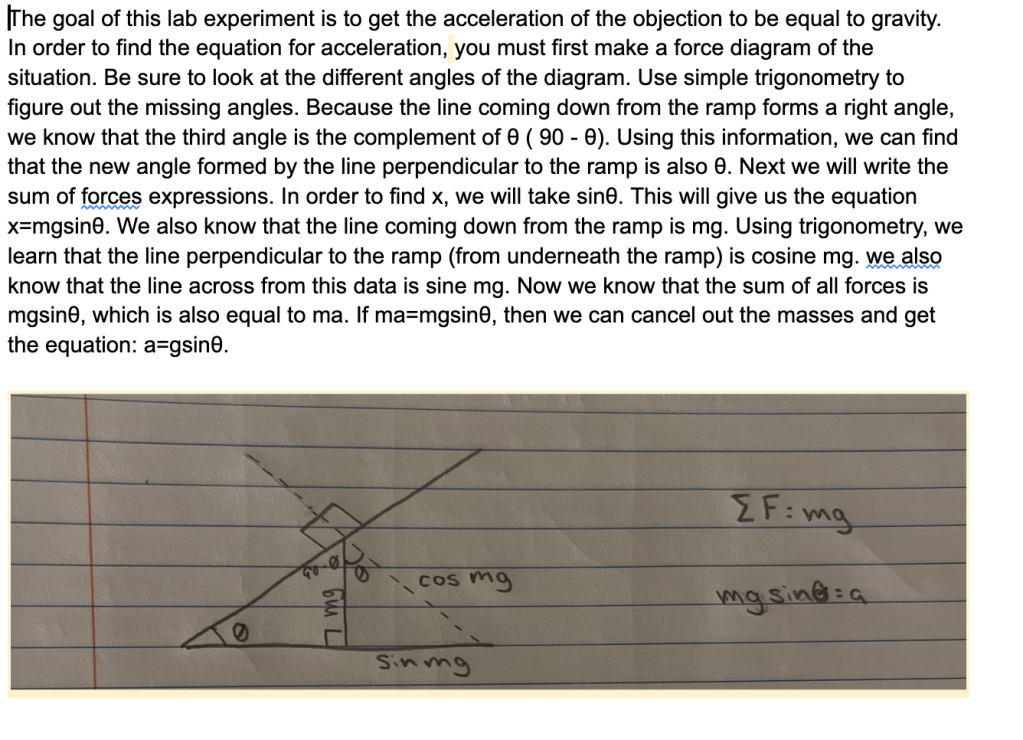
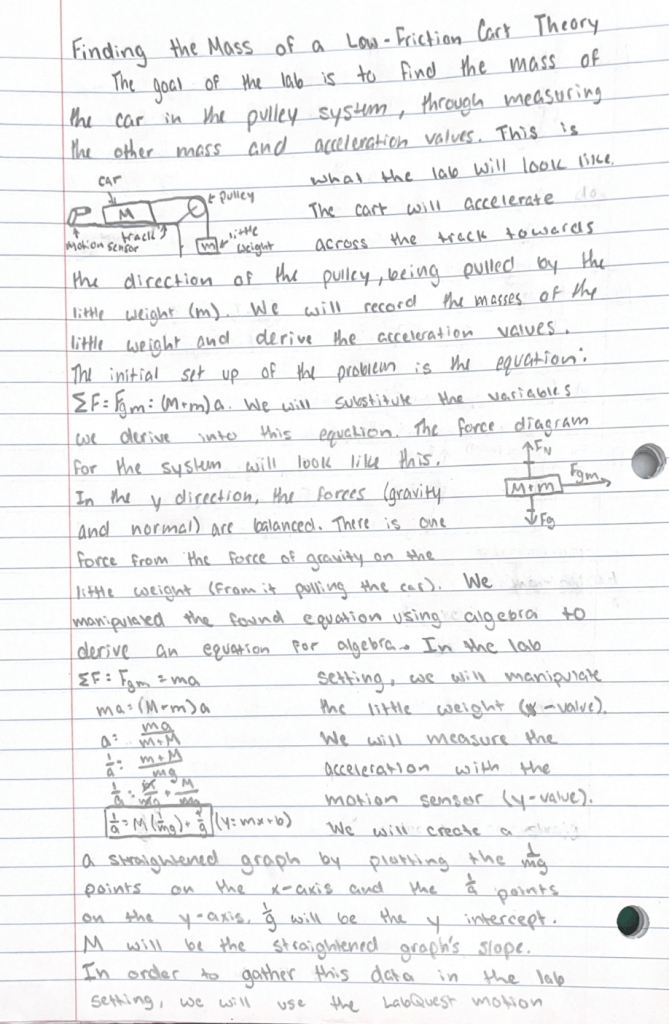



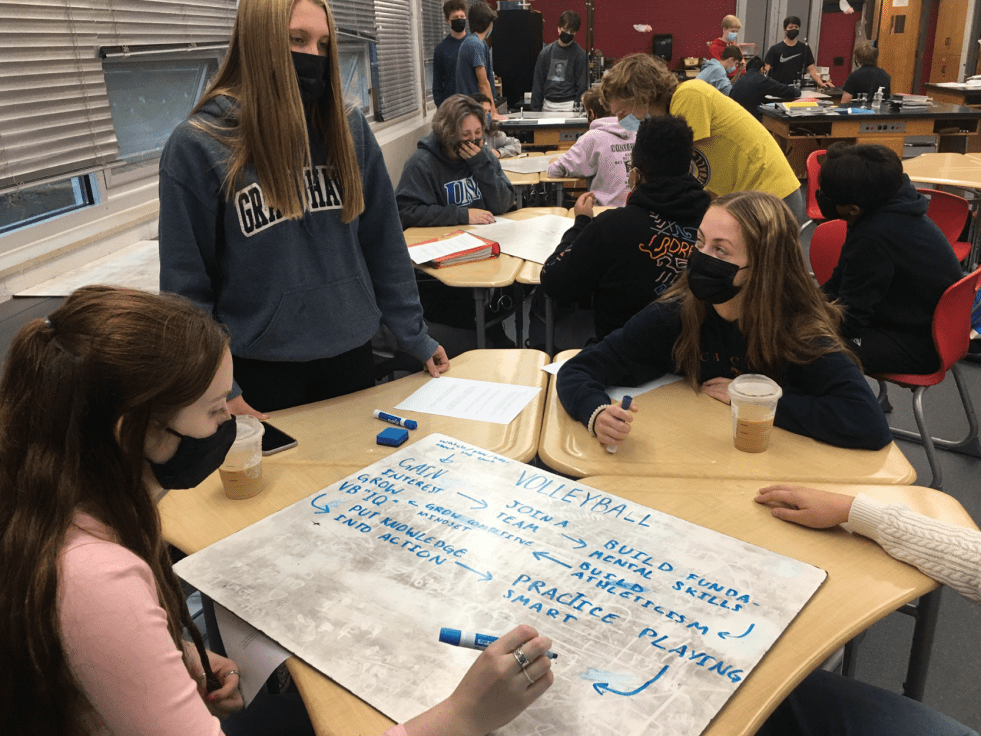
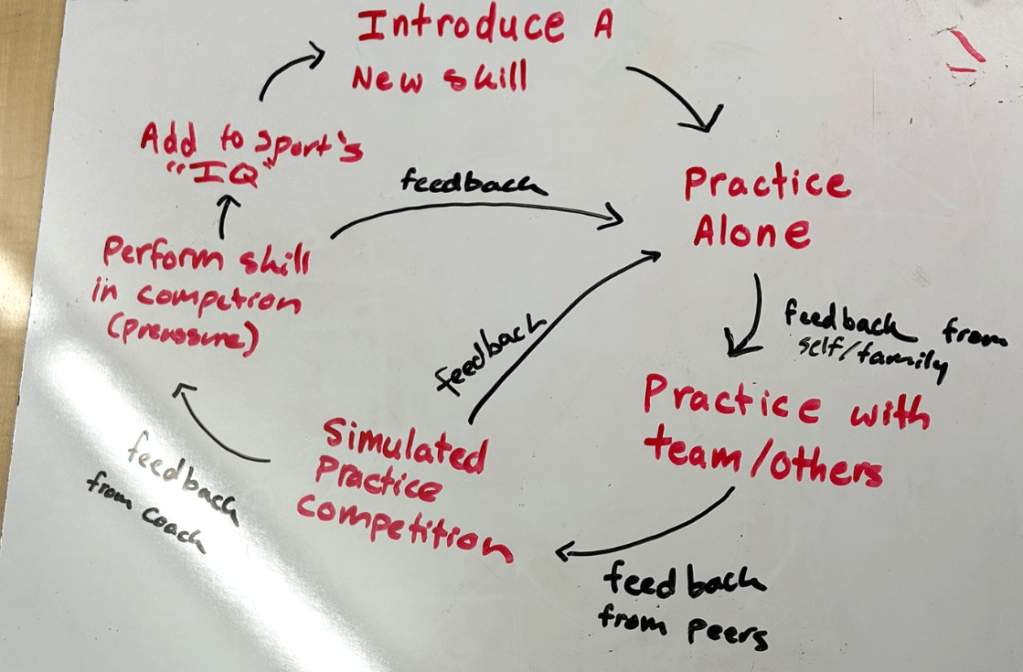


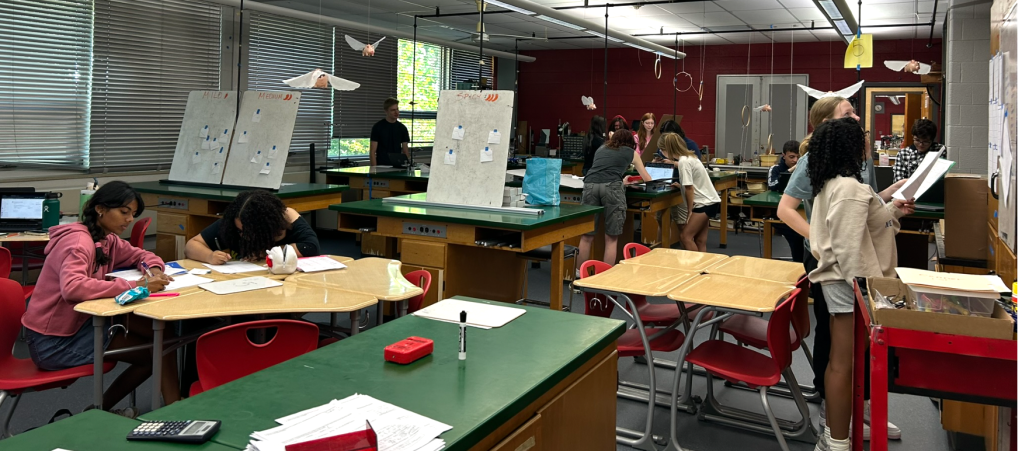


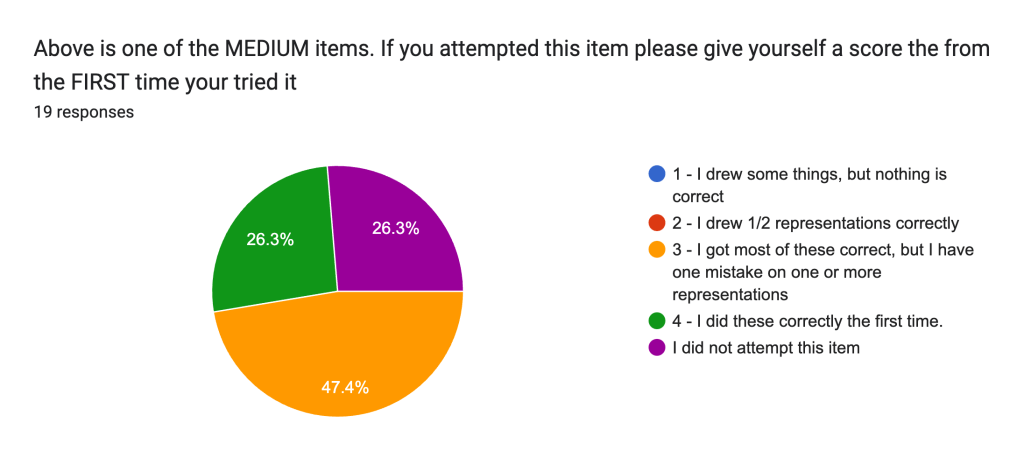


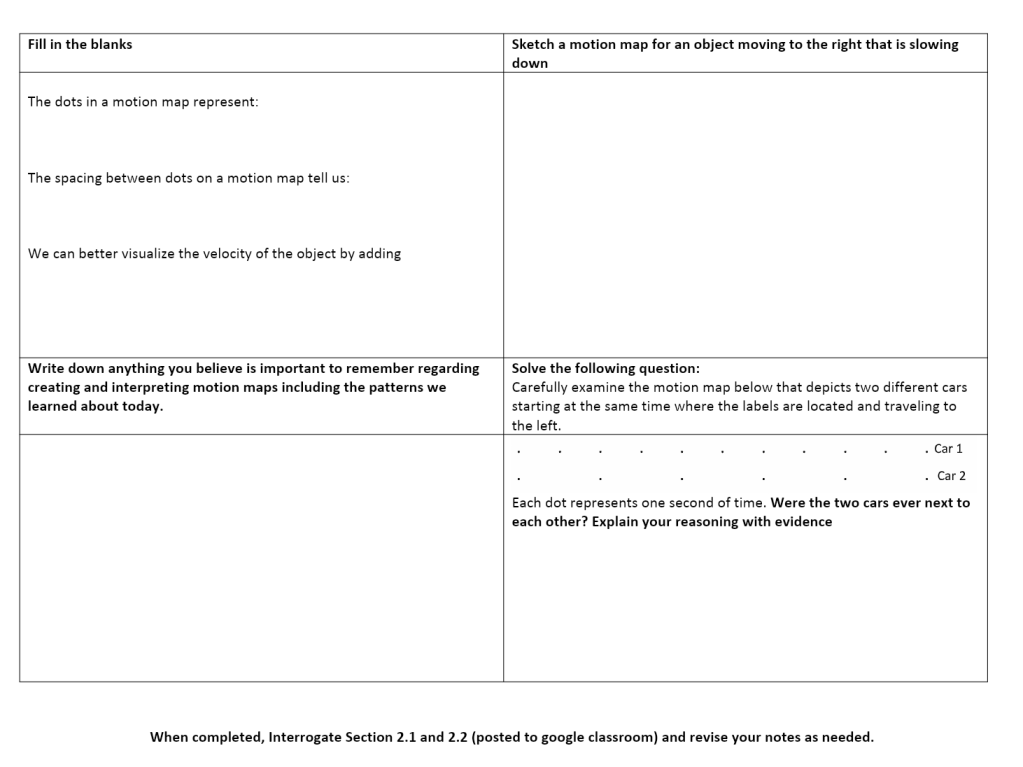

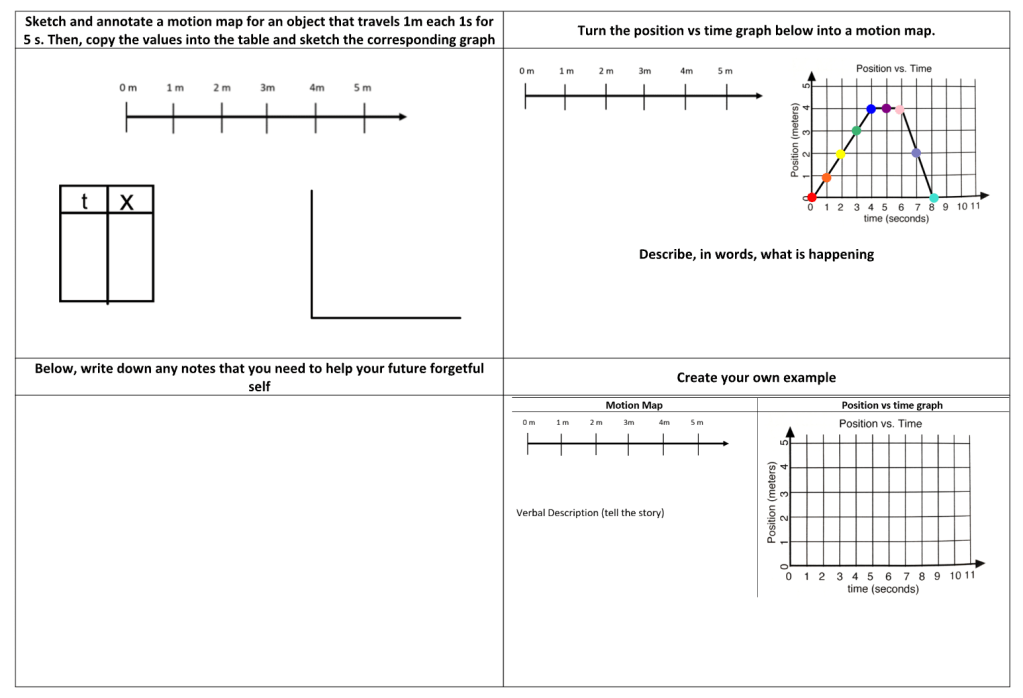

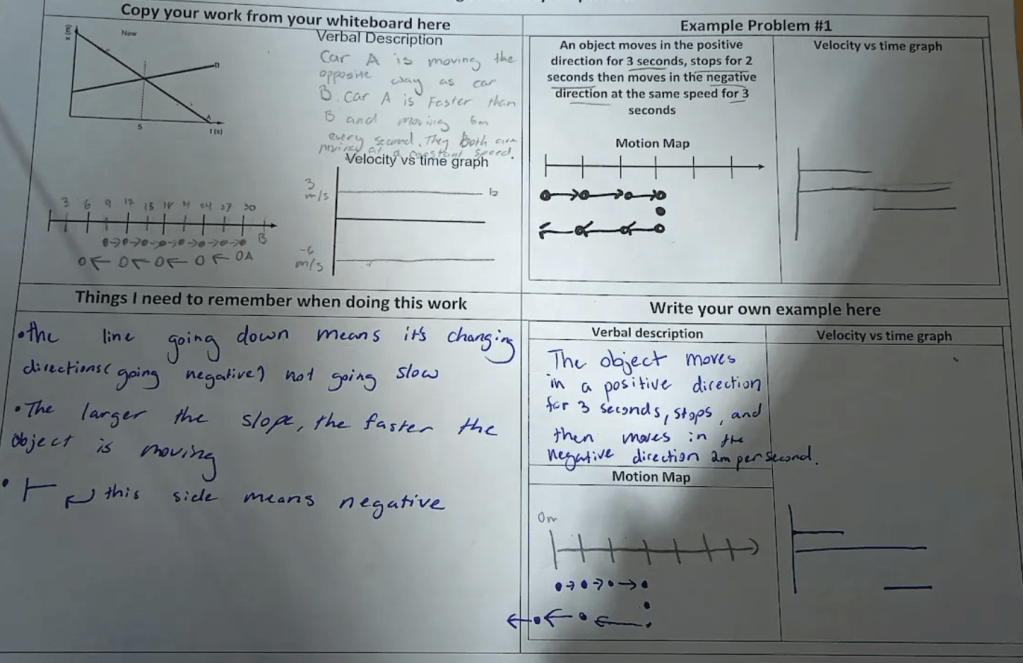

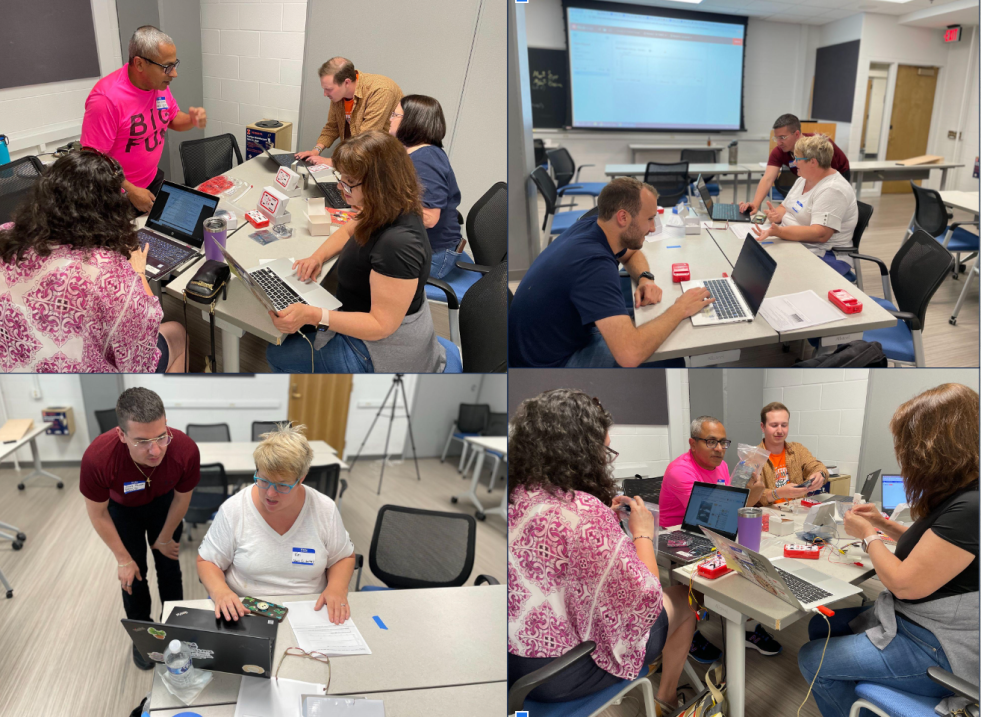
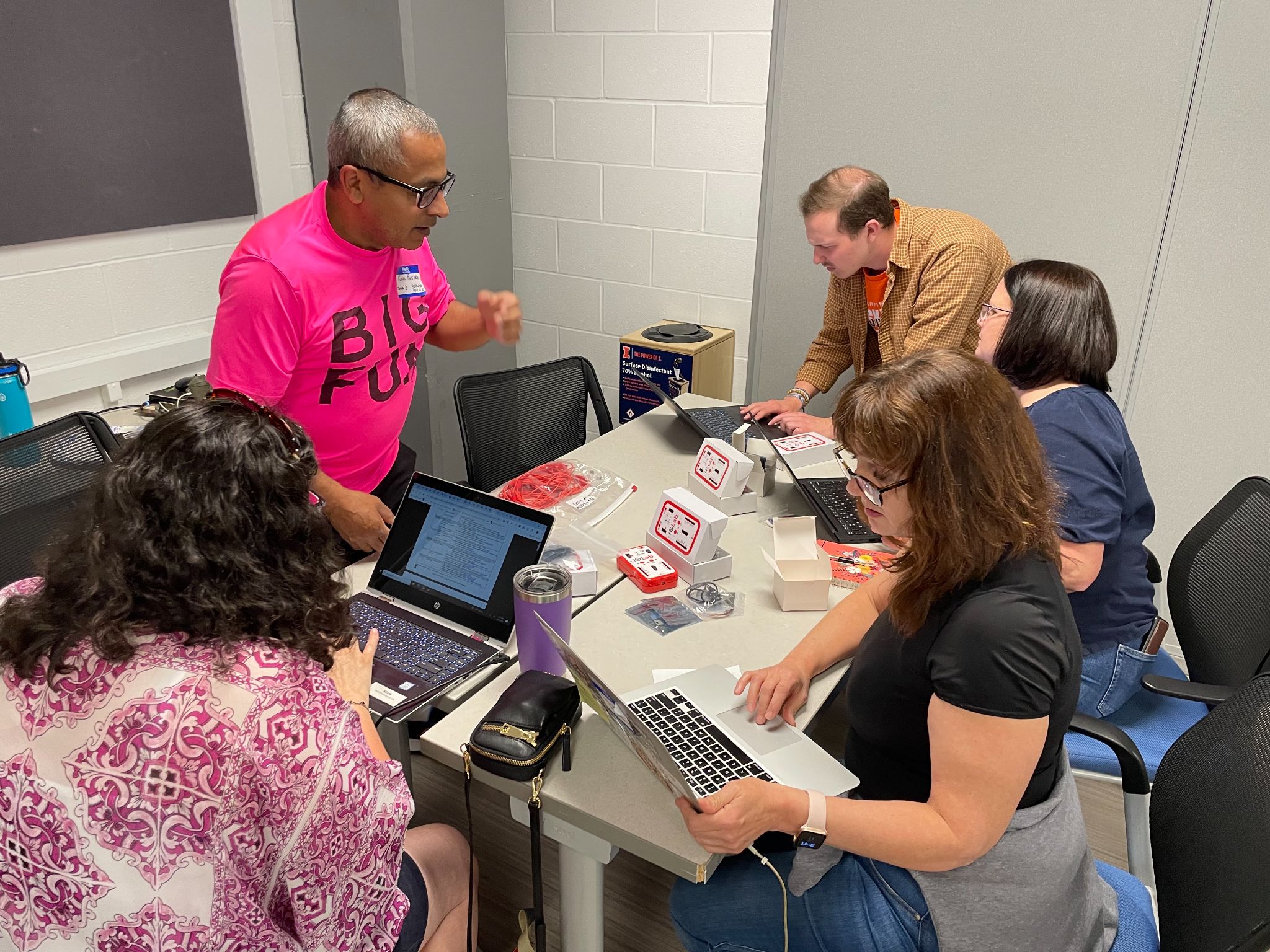
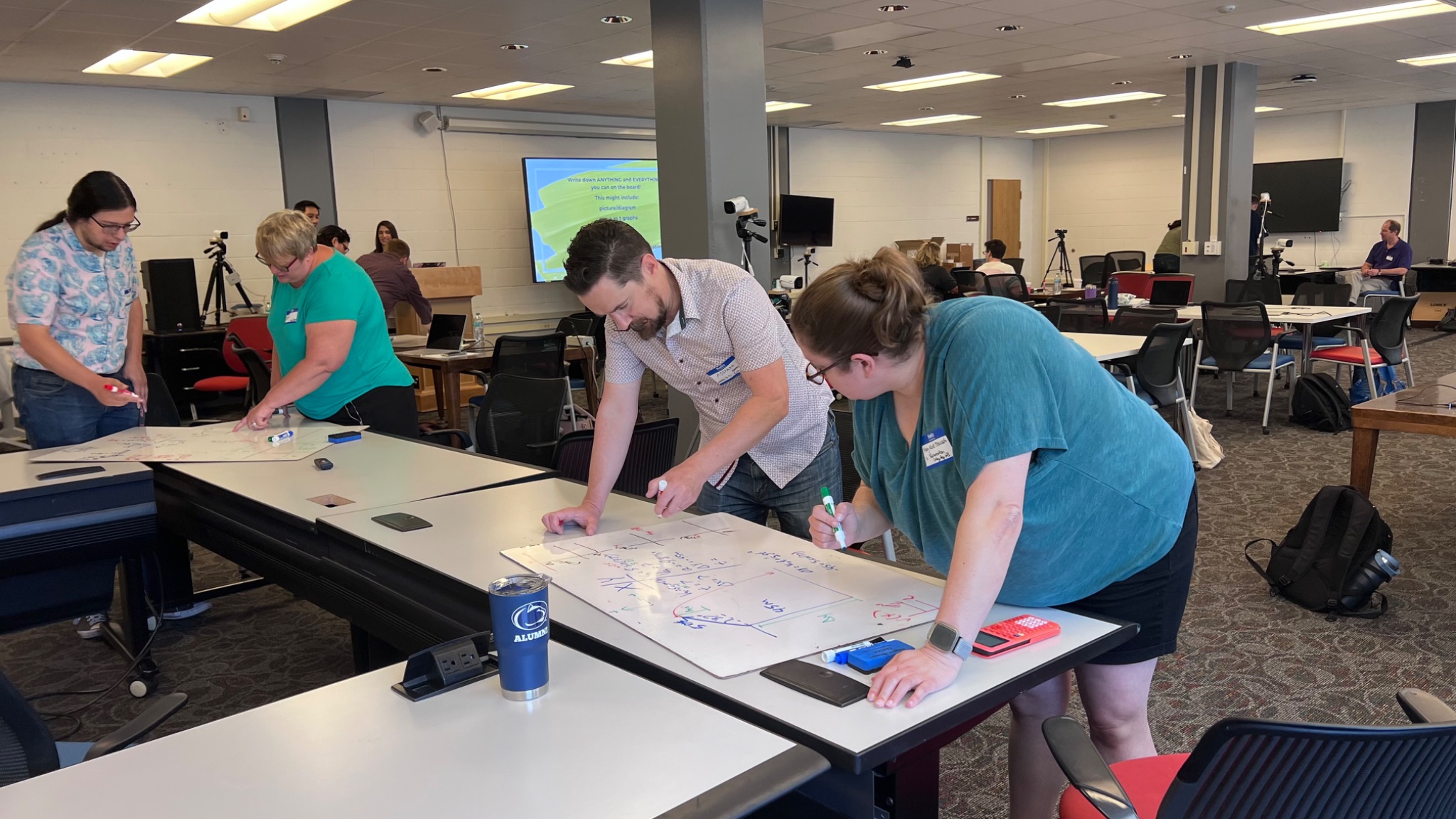

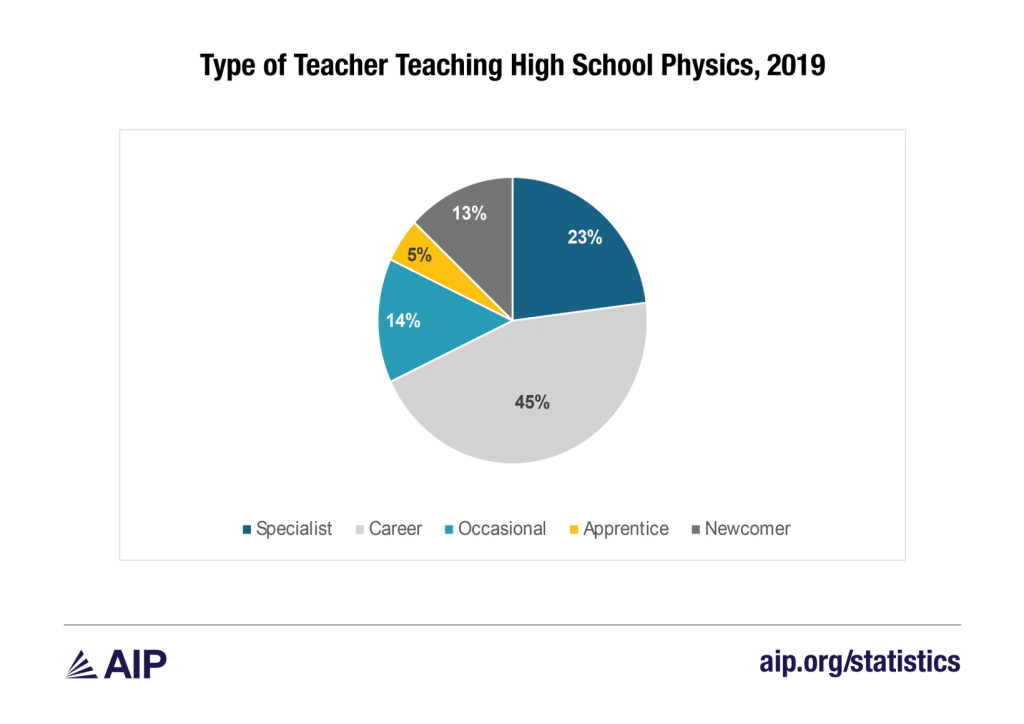
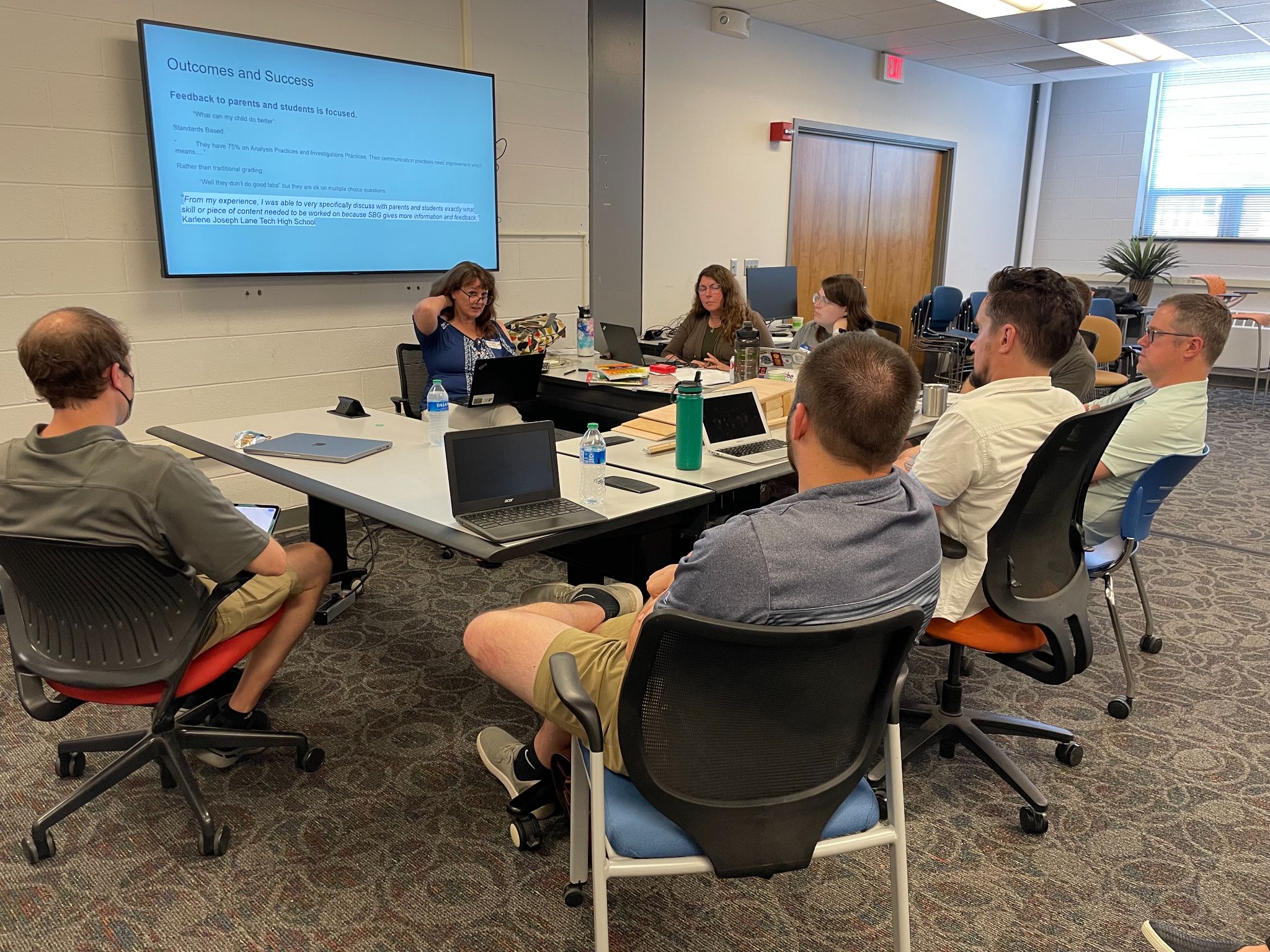

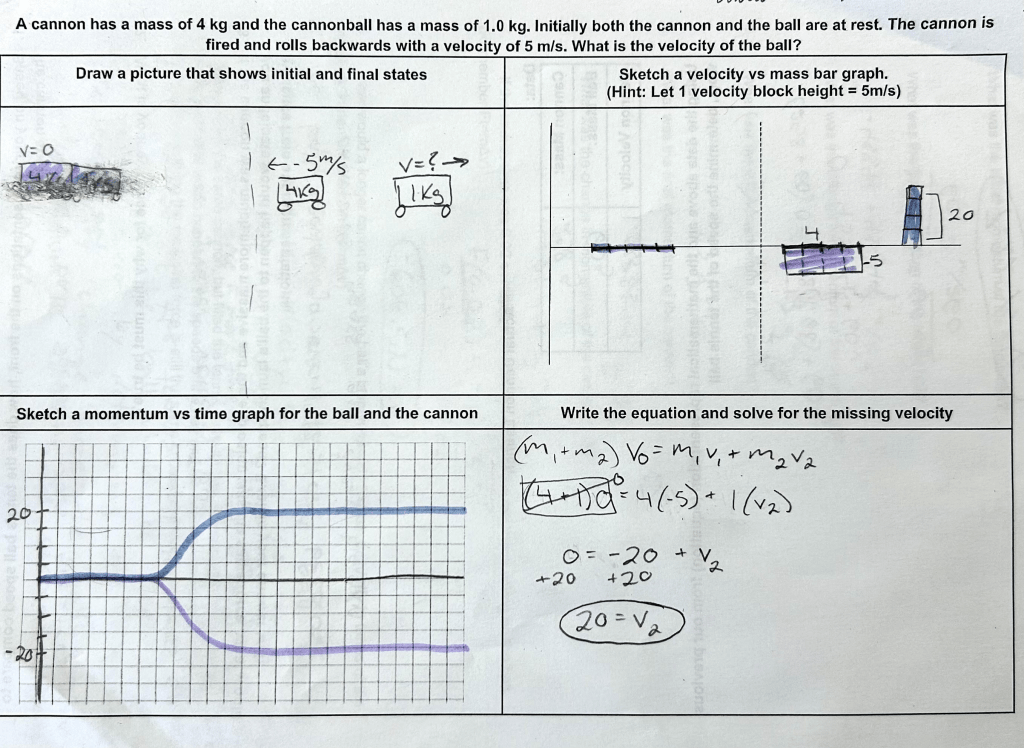




 Physics.Teacher.Momma.