Infecting Students with Passion, Infusing Family with Love
Author: Marianna Ruggerio
Marianna is the Physics teacher at Auburn High School in Rockford, IL. She currently teaches AP Physics 1 and AP Physics C. When she's not in disguise as Nerdy Physics Teacher she is busy at home as Nerdy Physics Mom with her husband Fr. Jonathan and sons Adrian and George.
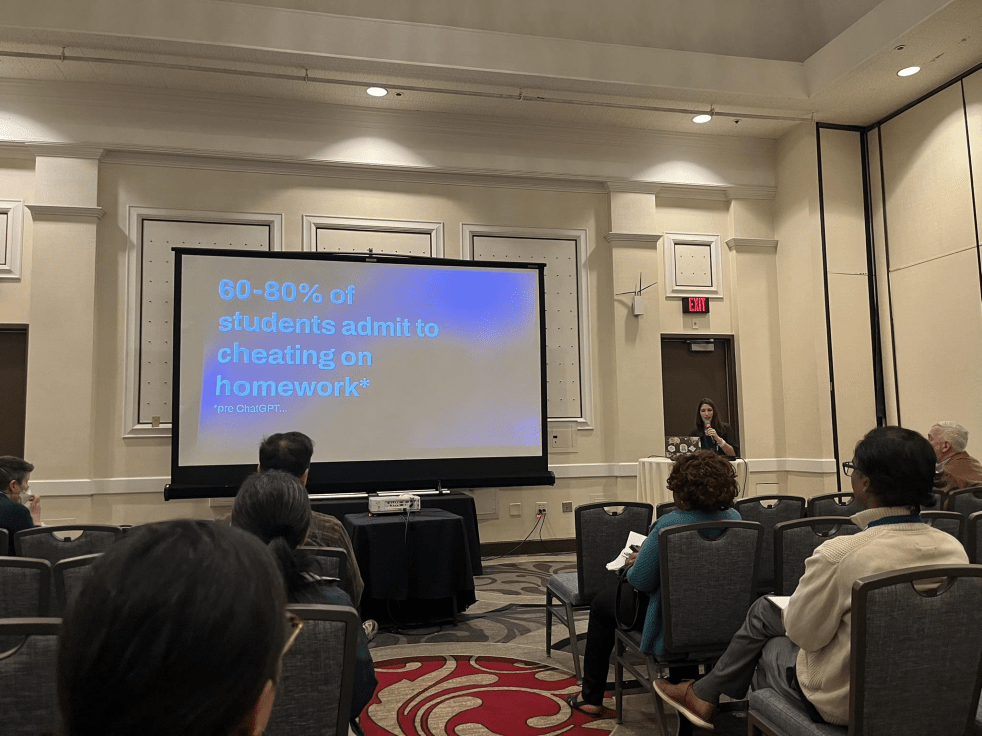
When I took high school physics almost everything was online. From physics classroom assignments, to the dreaded WebAssign, it was online. And because it was online, I like others, gamed the system (pre chat GPT). You know a certain number is going to show up somewhere in the answers? Enter it in all the blanks for the first submission so you can focus on the actual calculations. On the flip side was the part where you tried the problem so many times by the time you got it right you had no idea what actually worked. For the better part of my career I’ve been vehemently against all forms of online homework. There’s something about that screen that just puts a stop to the idea of using scratch paper for novice learners and we can’t have that!
(For what it’s worth, when AP went all digital I did NOT feel the urge to go digital in my classroom. I continued to do everything on paper. When APs came around I found my goal was acheived: I proctored the macro exam and did a count. 80% of physics students were using their scratch paper during the exam, while only 30% of non-physics students used their paper.)
The first exception I made to online learning was Pivot Interactives. I was using Peter’s work back when they were “Direct Measurement Videos” which meant I had paper copies originally, anyway. As Pivot upped their game (including deep randomization and autograding) I started using some of these assignments since it sure made my life easier!
However, what I’m finding with my students this year is that like my Webassign days, students are doing the minimum to get all the green checks. This looks like not reading the prompts that explain what they’re about to do next and why, not actually collecting the data for the graph and totally missing the connections between the sample measurements and the data collection.
So, I’ve started to reimplement some paper versions.
The Activities: A Journey of Trial and Error
Earlier this year I assigned the helmet collisions activity. I added a prompt at the end that requested students to do the following:
What was the purpose of the activity?
Describe the procedure for conducting the investigation
Describe the calculations you made and why we made each calculation. You should include details regarding your values!
Describe what we learned from this activity about helmets as it relates to the impulse-change in momentum relationship.
This was ok, but I, arguably did this a bit hastily. I realized I wanted these documents handwritten and maybe a bit more depth/scaffholding.
A few weeks later I assigned the Explosions (Not Really) activity.
I knew that students would totally ditch all of the methods we had been using, so I decided to give them a paper to complete before the activity that related to the activity. This required them to complete the calculations with similar, but easy numbers and then have me check their work prior to the activity. This got a good chunk of kids on board, but some still struggled with the transference.
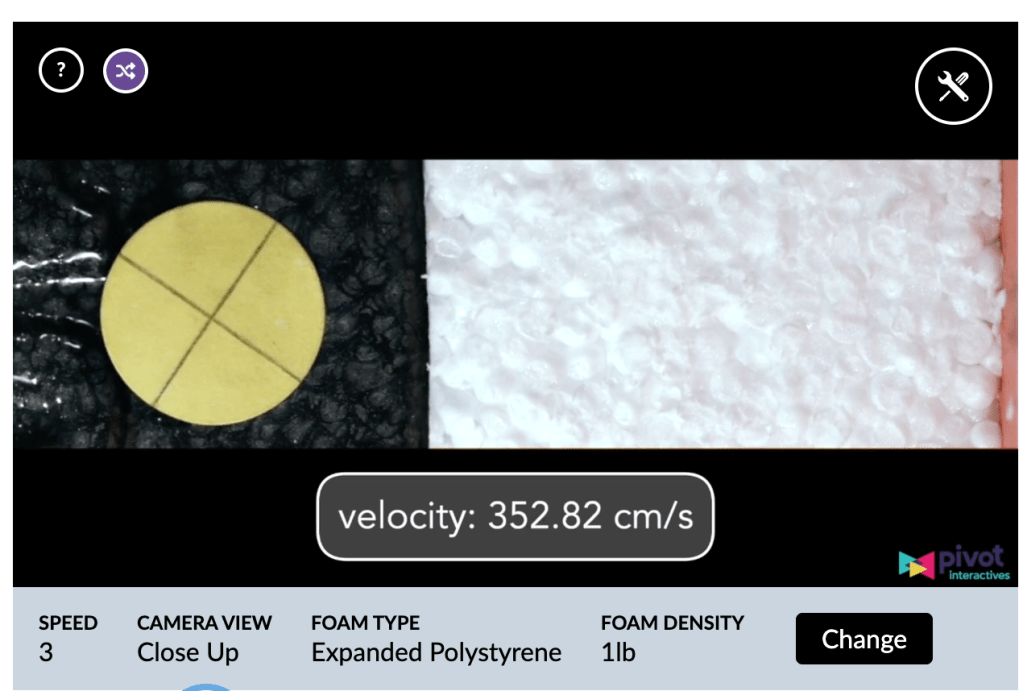
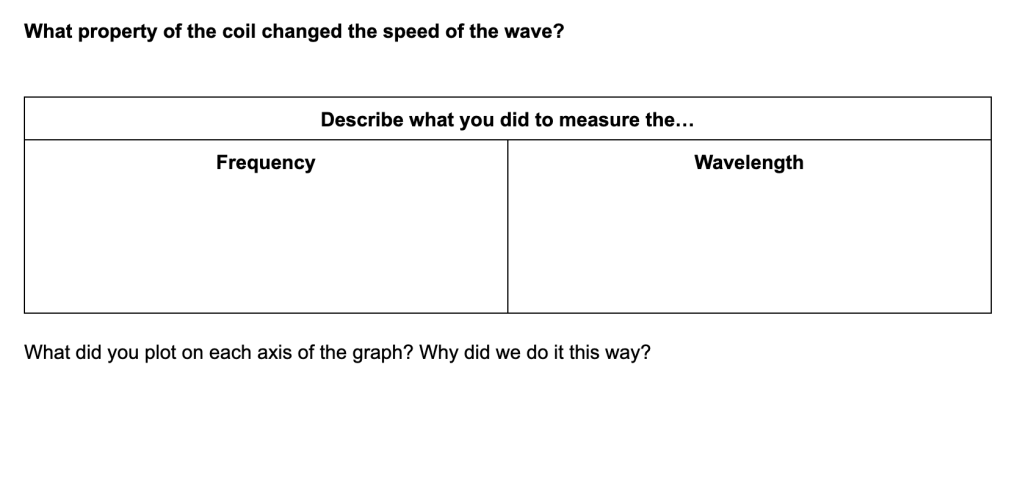
Still not completely satisfied, this past week I assigned the “Intro to Transverse Waves” activity. In this activity students are going to linearize a graph. This is a skill we don’t really cover in my regular level physics, but I like doing it at this point in the year because it’s such a powerful tool. As I anticipated, many students were ignoring the text about linearization completely. I chose a different approach to the paper copy.
First, I asked them to describe to me some of the new vocab as well as how we obtained our measurements
Next, I use a modified template from the Patterns Curriculum when students write conclusions in labs where we have graphs. It looks like this:
After investigating the behavior _______________, I conclude that there is a ______________________relationship between the [independent variable name] and the [dependent variable name] As the [independent variable] kept increasing, the [dependent variable]_____________________________. This system of a ___________________ can be mathematically modeled as:
[write the final equation]
where the constant [slope value] is the [description of slope for this experiment] .
I require students to write the ENTIRE paragraph from start to finish. This is not a fill in the blank activity.
This is currently my favorite interaction of the paper follow up and I’ll probably build more of these moving forward. I’m really in love with the patterns physics conclusions because it really requires students to put everything together.
Grading
I’ve noticed there’s a VERY strong correlation on these summaries between students who took the activity seriously and learned from it, vs students who did not. Because of this, the only thing I really need to grade with care is the conclusion paragraph itself. If students did the lab correctly, this paragraph looks great. If not, they usually don’t do well on this.
Do you do anything like this? What does it look like? How do you support genuine learning using online platforms?
At the American Association of Physics Teachers Winter Meeting I had the privilege of presenting in literally the best session of the entire conference (no bias here at all). Magically, all four of our presentations beautifully complimented one another and related deeply to engaging students in metacognitive skills.
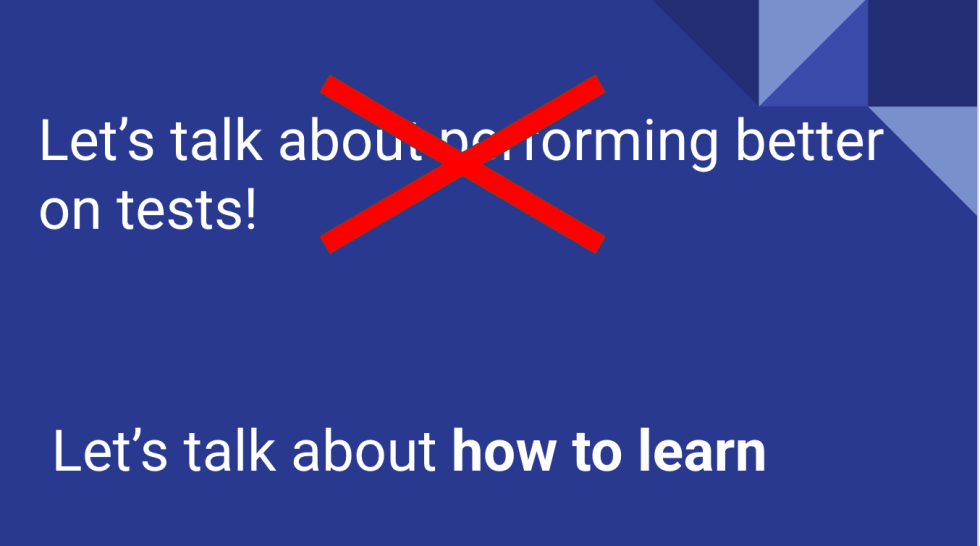
I transitioned districts this year. In my previous district I worked with a lot of students in the gifted program, a lot of students in the creative and performing arts program (who are basically also gifted) and within this culture and climate, all kids benefitted, even the ones who were not in a special program. For years I was able to get students on board with the Expert Game, and the Science of Learning Physics some trust in the process, and good relationships. This year, that hasn’t quite cut it. I’d been thinking about a way to somehow “teach” students in a way that feel like “teaching” to them about how to learn, study and grow so they might buy into the idea (which is really nothing new).
I had been digging back into Powerful Teaching and some kind of workshop was begining to materialize, albeit very, very fuzzy. And then, at Winter Meeting, Aaron Titus gets up and shares that he offers a “How to Do Better on the Test” workshop which turns out to be “How to Learn”
The workshop is grounded in the work of Dr. Saundra McGuire. There are a lot of resources of hers around the web, like this lecture here on metacognition, but primarily she has a sweet little book called Teach Yourself How to Learn. It’s short, sweet, to the point and a lot of fun to read. Dr. McGuire is a retired chemistry professor and Director Emerita of the Center for Academic Success. She is also an awardee of the Presidential Award for Excellence in Math and Science Mentorship.
Immediately in chapter one she discusses one of the aspects about college that is hardest for students: getting As and Bs in high school often comes down to memorization and regurgitation. Now, before you come with fire I know that many of us (especially if we teach AP, and definitely if you enjoy my blog) are making students do incredible things. But I also know that you can probably name more than a handful of colleagues who don’t push their students beyond memorization. Teachers who produce study guides that are basically a carbon copy of the exam. Exams that are almost all multiple choice and the math is strictly plug and chug. The dreaded triangle to “support” students doing equations like F=ma. And if not the teachers themselves, some really great high school students simply don’t get pushed beyond needing to simply show up to class to learn the information. They can get away with minimal to no homework and no studying and still do okay in the class because we see them every single day and they work hard in our rooms.
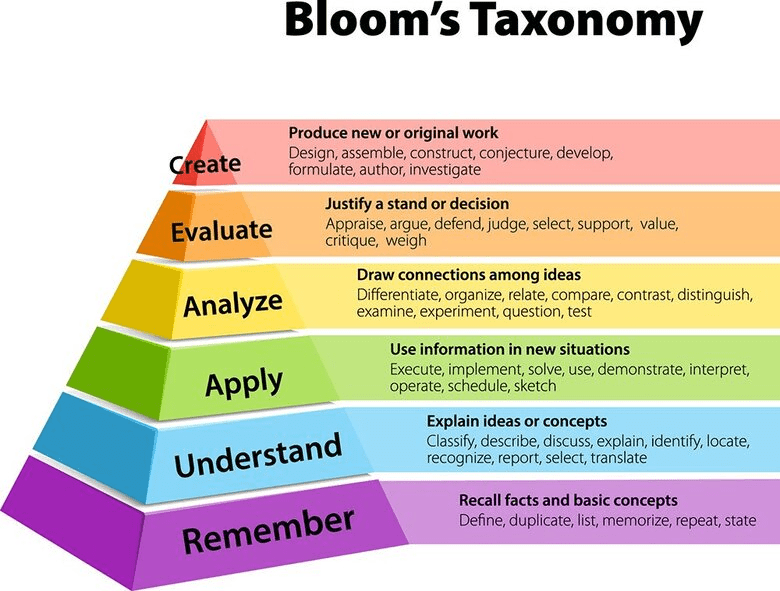
So the workshop starts by introducing students to Bloom’s Taxonomy and we have a conversation about what level they are operating at most of the time, compared to what level they need to operate at for AP Physics. What level do they think they need to operate at in college?
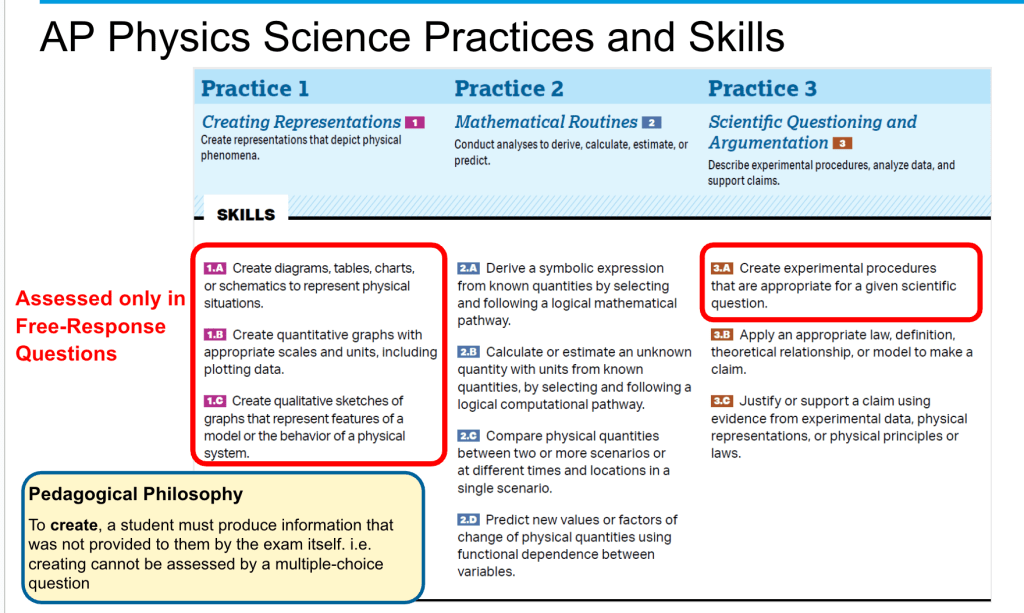
And sure enough, if you pull up the science practices and skills for AP the word “create” is literally all over the place. The top of the pyramid.
From here we took a look at a recent exam question. First I asked them a simple question:
Which of the following is true about work?
Work is effort
Work is a change in energy
Work is a force
They all know the answer. And this is a recall answer.
Then I showed them the exam question (they did really poorly on). While the question fundamentally was about the fact that work is a change in energy, what they were asked to do was apply the concept of taking an integral to calculate work and then create a graphical representation.
From here we discussed the differences between studying and learning and posed the question, “which would you work harder for? To study to get an A on a test, or prepare to teach the material to the class?”
The latter half of the workshop is about sharing strategies for doing homework, reading the text, and using practice exams. (You can find all of these in Dr. McGuire’s work and resources!)
I summarized some of these along with my personal favorites into the following list:
When you get home from school, write down everything you can remember from class that day, then compare with your class notes to identify/fill the gaps
Did you solve some problems? Grab a clean sheet of paper and solve the problem again. Compare to the example and make notes regarding your forgetting/gaps
Create a concept map to tie together big ideas and conceptual details
Make “teacher notes” as if you were preparing to teach the material
Aim for 100% mastery when you sit to study, not 85-90
As we wrapped up, the most important part of this workshop was asking students to make a commitment to do something different in the next 24 hours. I had students submit these along with some additional reflections. There were two that stood out to me today. One student reflected, “The reason this class is so challenging for me is because I haven’t had a class besides maybe Calc that required me to be at that creating level.”
A second student made an observation that knocked me over in joy:
“Physics is more than just who is smarter and has the ability to think at a higher level.”
When I was in college my E&M professor introduced me to the falstad apps. It was literally this guy who created a bunch of different JAVA sims. E&M is notoriously challenging due to needing to think and reason in three-dimensional space, so we were encouraged to use the apps to help us visualize static fields.
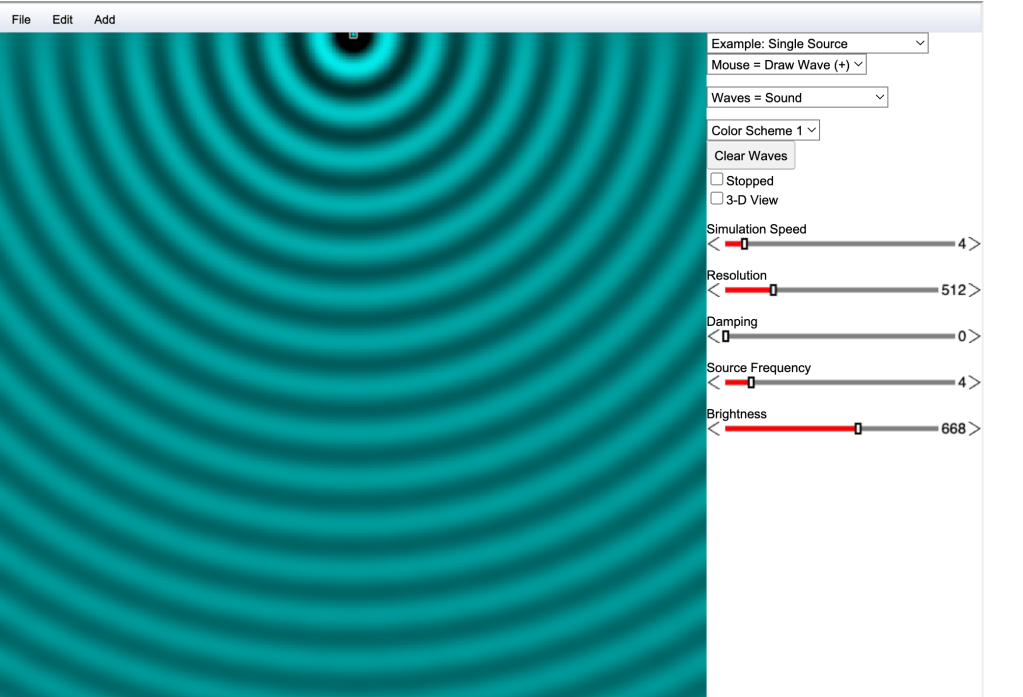
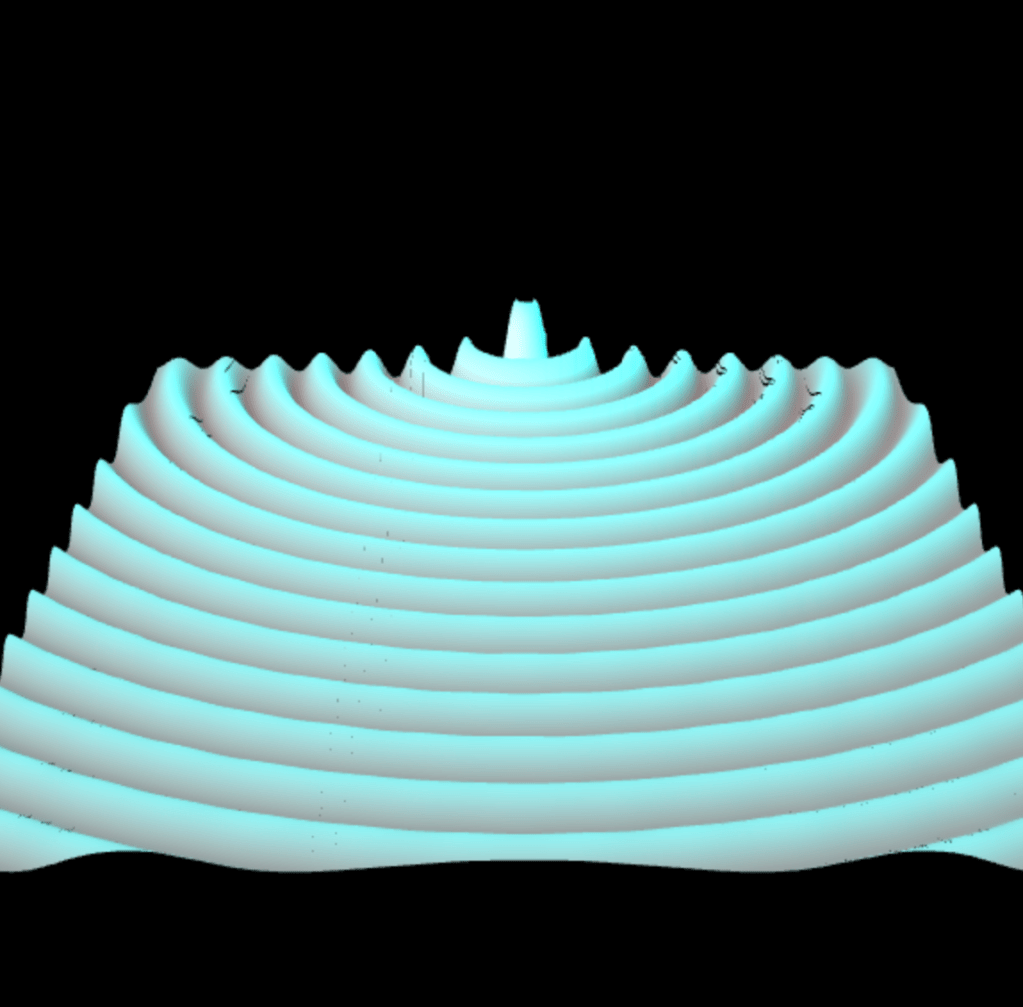
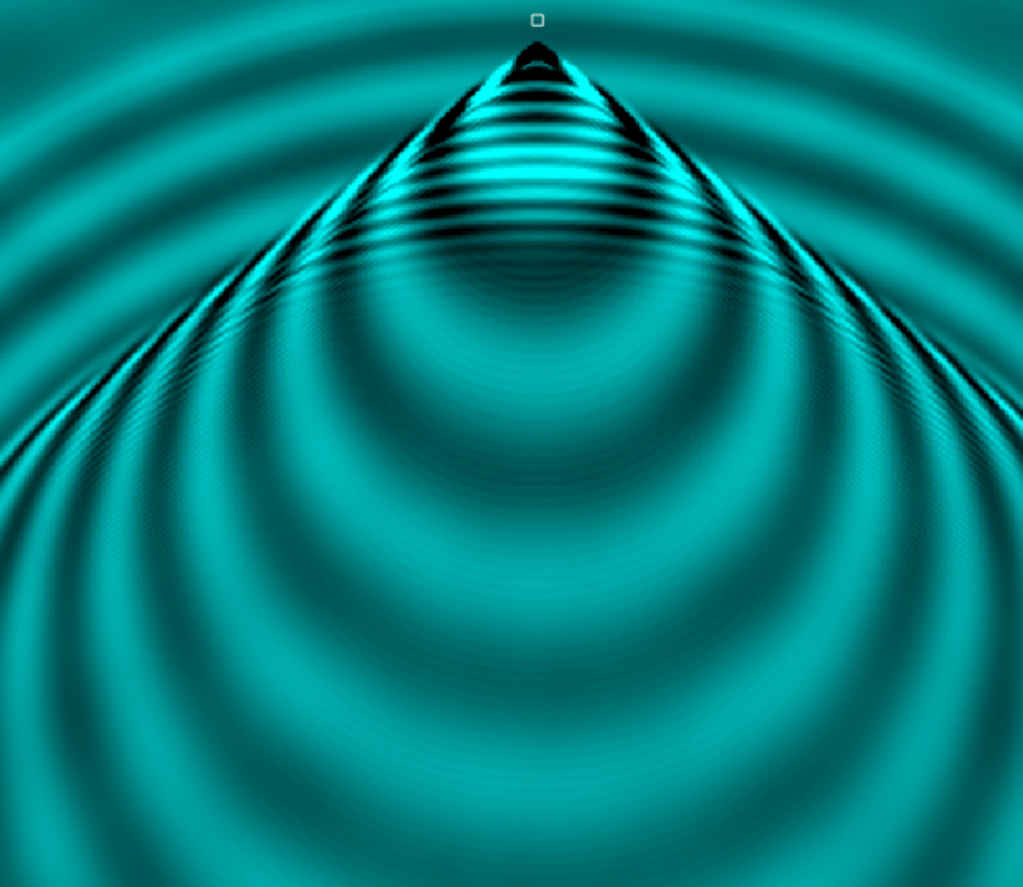
When I started teaching I decided to poke around and see what else Falstad had created. One of his simulations I use year over year is his ripple tank. It’s incredibly powerful and way less cumbersome than setting up the actual water tables (which was just unfeasible being the only physics teacher with 3 preps)
When the app opens it’s pretty simple. A “faucet” wave like the one in the Phet sim is present. You can see the sliders to adjust for damping and frequency. You can move the source where ever you like and can even toggle into 3D view
What’s pretty awesome is the list of “examples” you can select from the drop down menu.
Single slit, double slit, two-sources, refraction, total internal reflection and a whole slew of topics. You also have complete freedom to add to the simulation using the “add” menu bar at the top.
For my students, we start our waves unit in the following way.
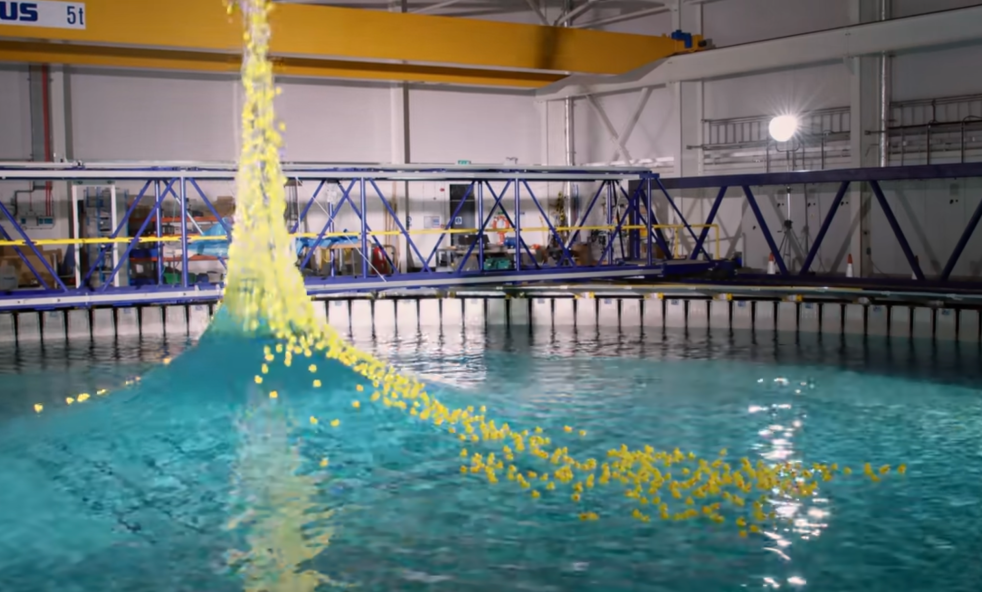
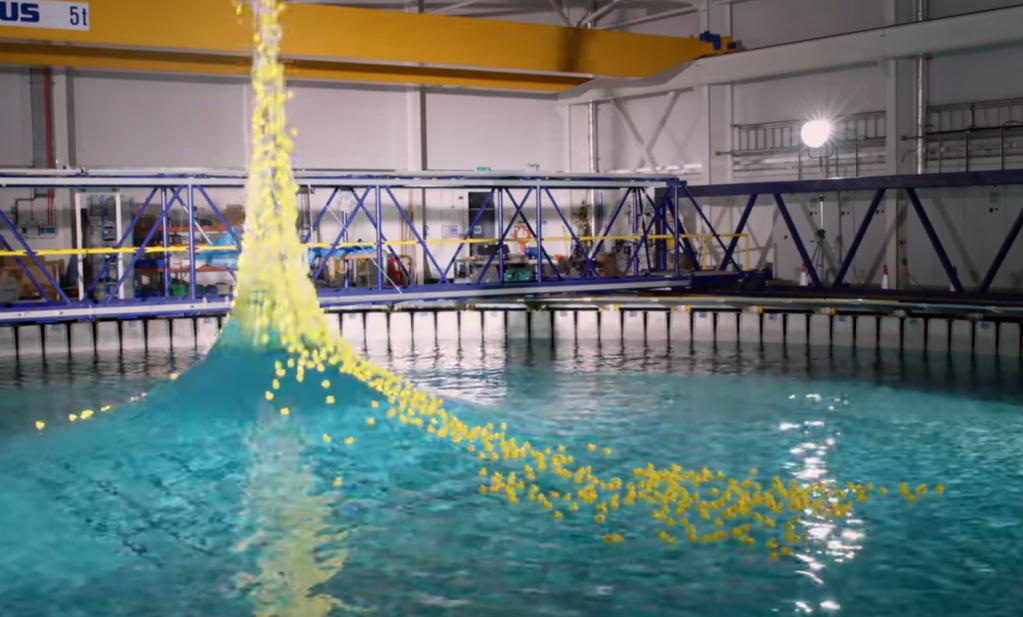
There’s a lot of really great phenomena here. From constructive interference, to refraction and lenses (pay attention to the grid image in the column) to the idea that waves transport energy, not matter.
This activity typically takes a class period and a half. For my advanced students they can usually finish in a class period or I can assign the rest for homework.
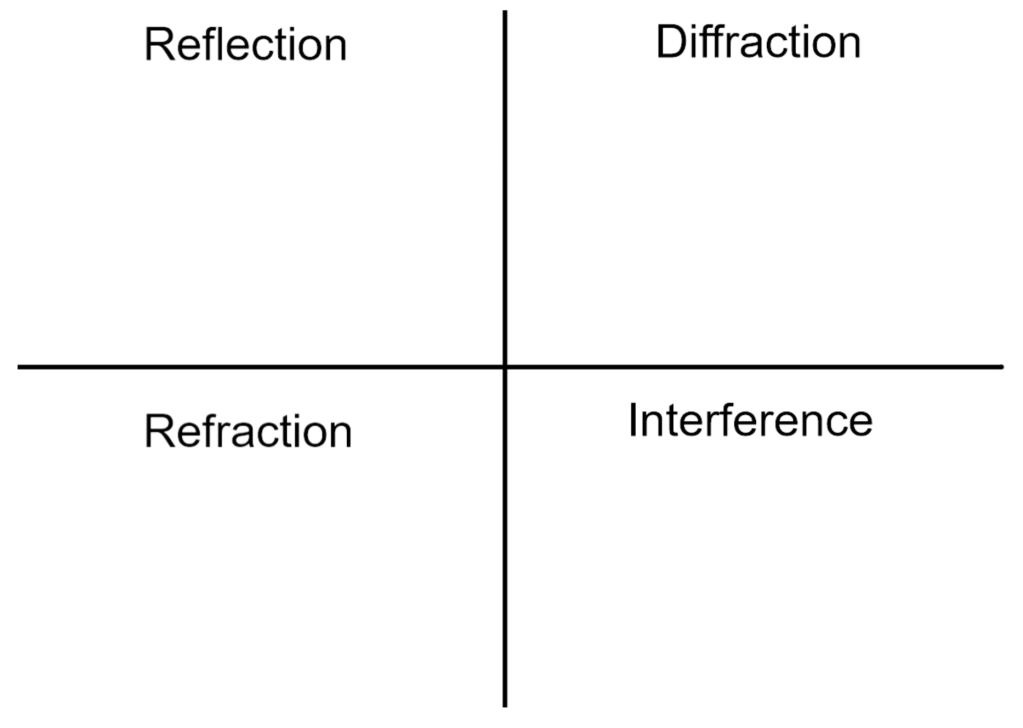
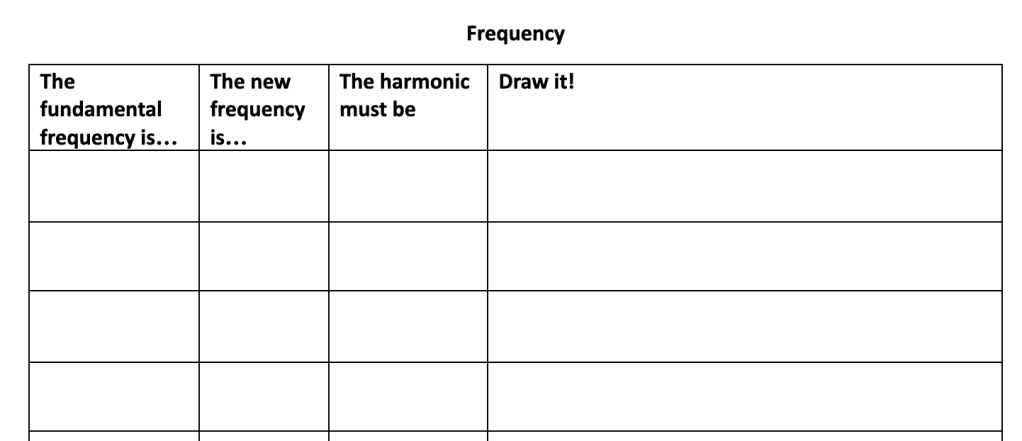
When students return the following day, I put this graphic organizer up and prompt them to write their own definition of the behavior based on their observations and a diagram to go with it
During the unit I come back to this app quite often.
We discuss how the design of an auditorium is based on nodal lines
I can drag the single source around to demonstrate doppler effect and sonic booms
If there’s a phenomena I want students to be able to observe, pause and manipulate… there’s usually a way to do it.
The Physics Classroom holds a place near and dear to my heart.
For years I thought it was my special secret. Long, long ago the url was something like physicsclassroom.glenbrook225.k12.il.us because it was a site hosted on my High School’s sever. The main author was Tom Henderson, one of the best educators at GBS. Tom taught the most advanced freshman in chem-phys, as well as the conceptual physics course. He had a great handle on meeting kids where they were at and explaining physics in a way that made sense as a student.
It wasn’t until much later I realzied that physics classroom was a well known resource for physics teachers across the nation.
As a student, something I realized was that what I found fun, challenging and helpful to my learning in physics was often a barrier and frustration to my classmates. Getting an “O Drats” without a way or opportunity to reflect or see where an error was made became maddening and frustrating. At the same time the essence of drilling a tiny skill is so valuable for long term learning.
I steered clear of most online homeworks for a long, long time (webassign also traumatized me). I knew that too often the real work that needed to happen to actually learn was skipped by most students in search of elusive green checks. By the time you got the checks, you had no memory of what actually worked.
Over the last few years I’ve started developing handouts to go along with some of the physics classroom activity sets. I only have a few, but enough that I feel like they are worth sharing publicly at this point. The goal is to get students thinking, writing and documenting as they work through the physics classrom activities. It also provides me with documentation. I will admit, another motivation for this was the fact that I did not have a paid subscription to task tracker. Now that I do, I’m developing more of these and will continue to share and post them here as I develop them.
What I’ve found is that more students are able to move through more problems with more success and confidence. Definitely a win! They hate me for slowing them down with the paper documentation, but I see it as a win.
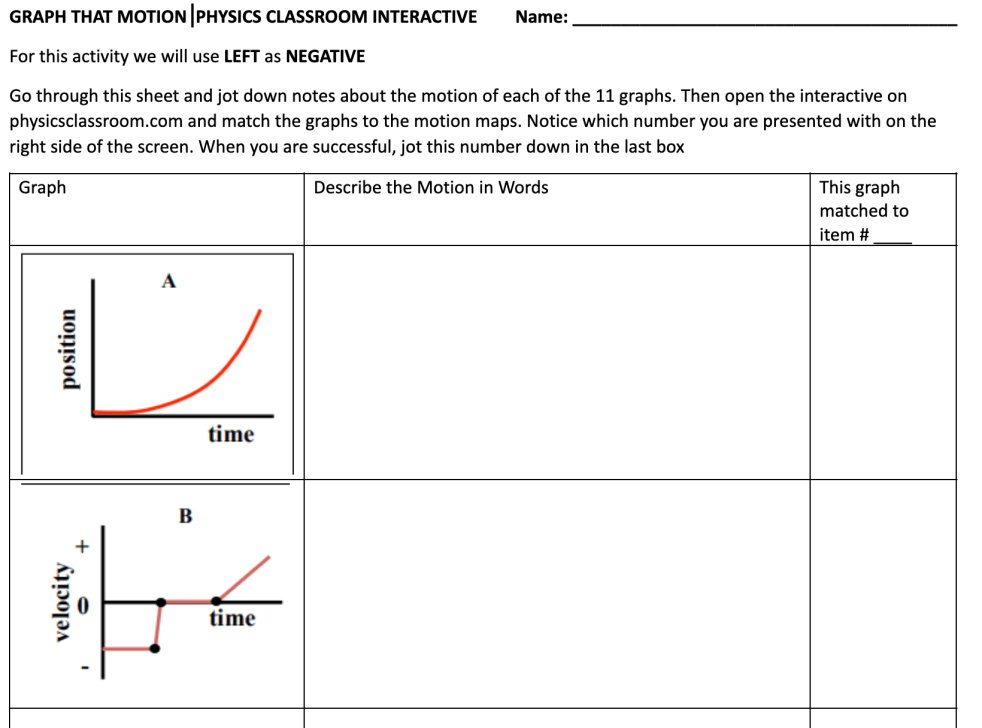
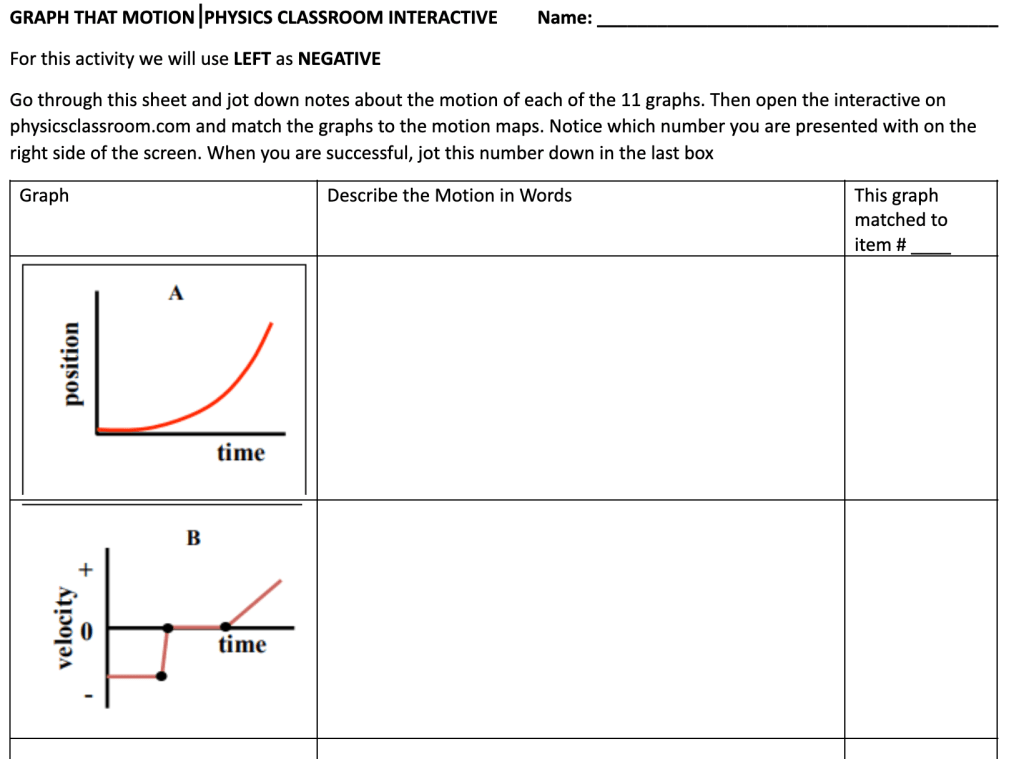
In the paper document (preview below) I ask students to first describe the motion in words. This way, when they watch the little car drive across the screen and make the dot diagram, they know what they are looking for
Kinematics Calculator Pad Sets
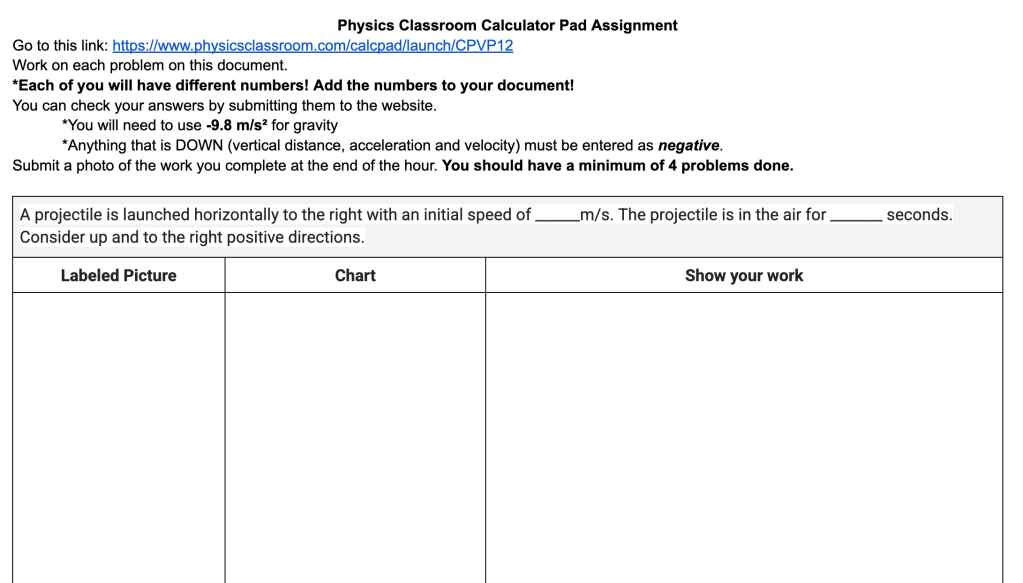
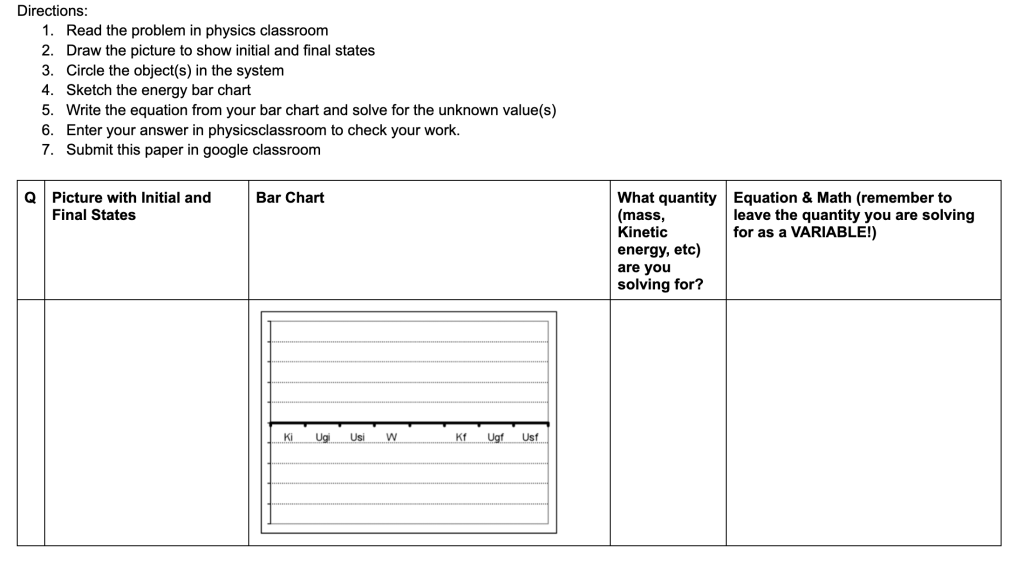
In the paper document, students are prompted to make their picture, their chart of variables and solve the problem by selecting an equation then substituting values as needed. This is a second version (sample below) that is specific to set 12, and provides more room for student work.
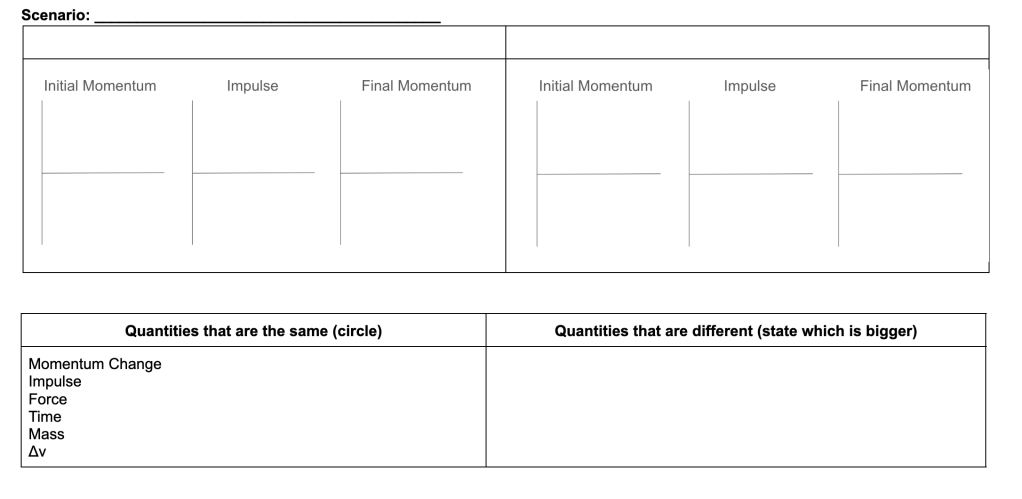
The first few pages of this document are notes in which we construct the momentum bar charts for different situations and identify what is the same and different. Then students go to the concept checker and I ask them to create the bar charts and document the similarities/differences prior to making their selections. A preview is below and here is the handout
It’s been two weeks since I got back from the AAPT Winter meeting inVegas and I’ve barely had time to sit and reflect. I’ve made some big changes this school year. Exactly one year ago I interviewed for the AP Physics position in a new district. It was one of the more challenging decisions I’ve needed to make in my career, and the first time I was walking into an interview fully confident of who I am as an educator, what I want in my future and in complete control. (When I took my position at Auburn I was confident, but hadn’t yet taught an AP course). With a new position comes new challenges and adjustments, but a new position paired with experience and confidence also brings the opporuntity to recognize challenge for what it is: an opportunity to search for innovative solutions. That’s one of the best parts of teaching; getting challenged in ways that require creativity.
With challenge comes a heavy mental load and so when the deadline came around for the AAPT abstracts I quickly threw together an abstract related to holding students accountable when we do work a la Building Thinking Classrooms (Accountability on Ungraded Homework) but had only shared here on the blog. A part of me felt pretty lame as this particular idea didn’t feel as exciting as I thought it should be for presentation, but I’ve learned that we are typically our own worst critics, and it’s always valuable to go ahead and present anyway. (Here are the presentation slides)
As it turned out, my session was loaded with three other awesome talks that all complemented one another really, really well. Aaron Titus talked about his “how to test better” workshop which is secretly a “How to Learn” workshop. Another faculty member talked about standards based grading at his college and Kathy Willard at Case Western talked about some metacognitive work she’s engaging students with. This session, tied with the AP sessions that took a deep dive into the science practices got me thinking about how to put all of this together to support my students.
The result? An FRQ reflection form.
Part of this spawned from the fact that we had -30 windchills last Friday and a remote learning day. With remote learning obtaining student feedback is more critical than ever for me, but I realized this would be a good strategy to maintain for all FRQ practice.
The Process
Students complete an FRQ alone under timed conditions
Students flip their work upside down and move to vertical whiteboards. They are permitted the next 15 minutes to discuss the problem and they can whiteboard their work/discussion as they go. This is a riff on friends-no-pens due to the complexity of the problem.
As students wrap their discussion, I ask them to consider how the points are distributed.
Students return to their original work and have 10 minutes to revise/add to their work. The way my room is set up students CANNOT see the work on the whiteboards
Students self-score the FRQ. I ask them to give themselves a first pass and second pass score.
Students complete the reflection
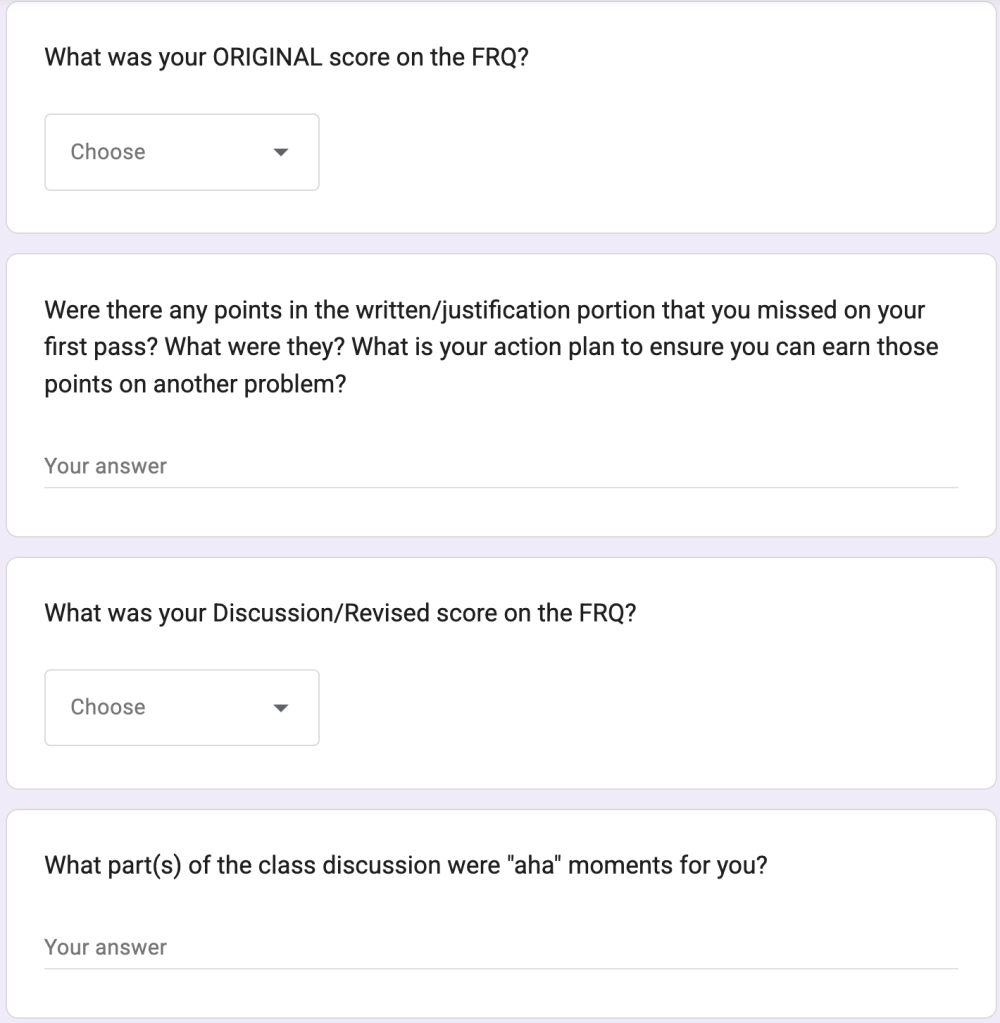
The reflection is a google form. The nice thing about this is that in addition to collecting this data easily, I can link multiple forms to the same spreadsheet to track changes over time.
The Google Form Reflection
This first part is asking students to think metacognitively in a few ways. First, I want them to see the gap between their individual and group-think. In a highly collaborative classroom, sometimes students think they have a better handle on the material than they actually do. The first pass at the FRQ gives them a chance to see what they are capable of alone. The second pass allows them to see that they can and do understand more physics than they might give themselves credit for, but it’s not currently encoded in their long term memory. This gives students a place to identify as a study need.
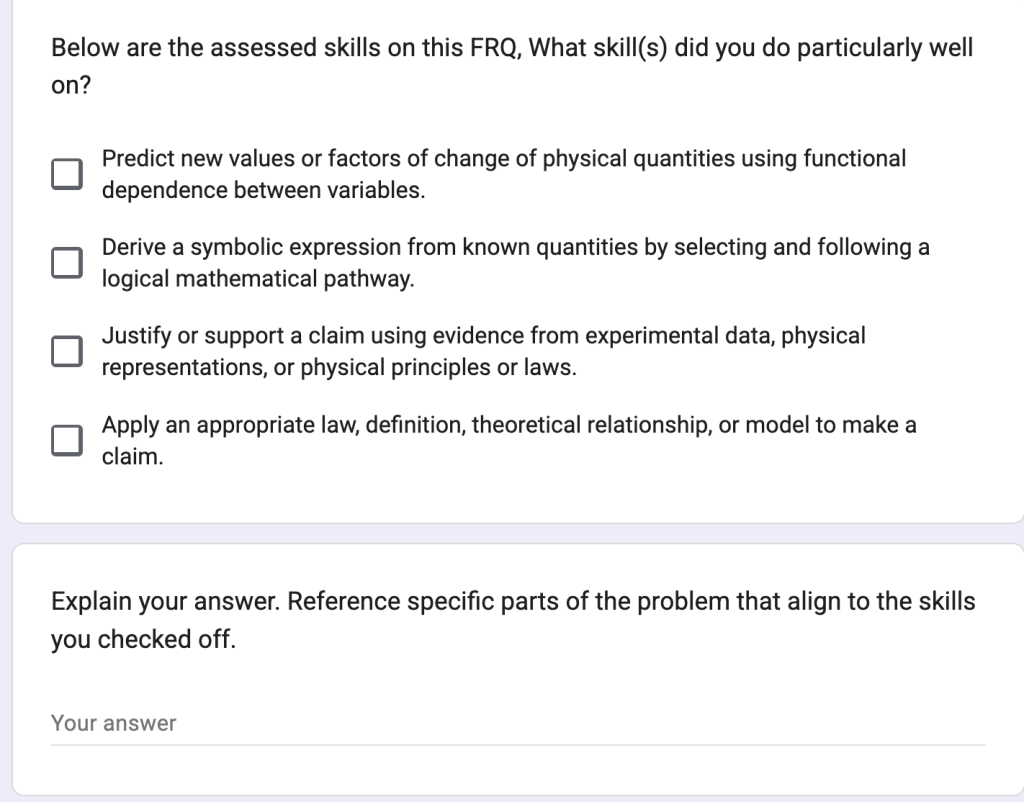
Next, I use the standards information available in AP classroom to provide students a check-list of the skills that were assessed. I ask them to identify both what they did well on and what they did not do well on.
To wrap it all up I ask a final question to get a guage on what my students believe they need more of.
Looking At Results
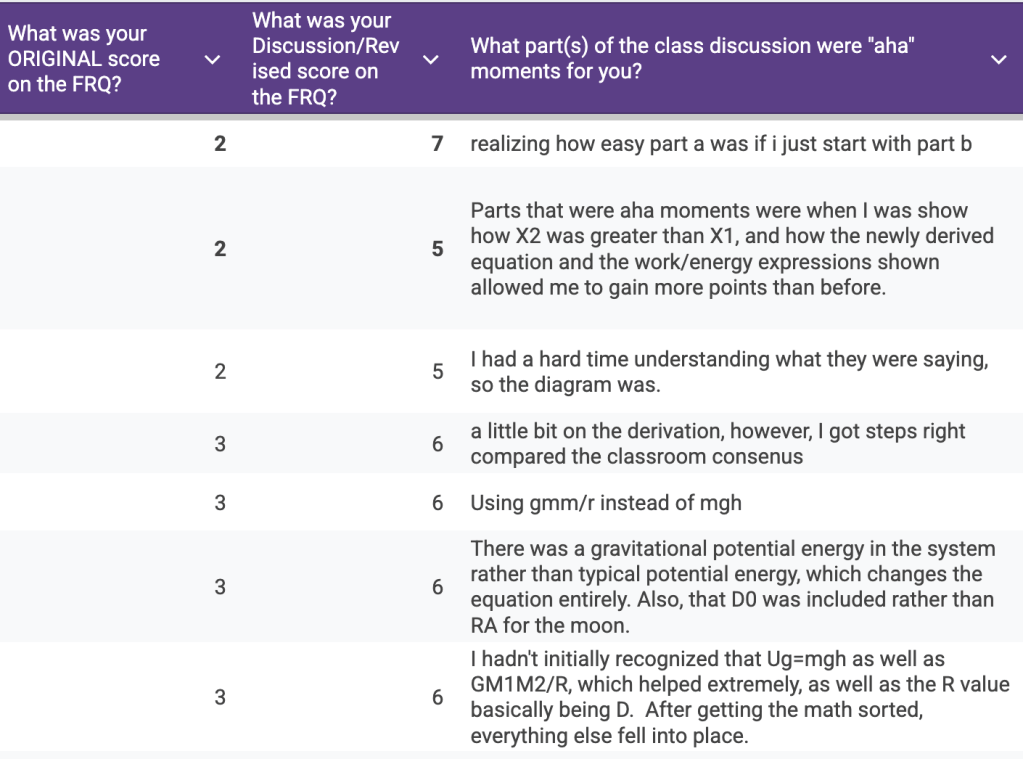
Below is a snapshot of some of my student results and reflections. I sorted the original scores from lowest to higest so you can see the improvements. This was a Translation Between Representations question which is worth a total of 8 points.
First, observe how much scores increased from original to group think! But what I think is particularly important is that this work happened without access to notes of any kind before and after conversation. When students return to their papers they no longer had access to the whiteboard work.
Next, I think some of the “aha” moments are particularly important and poingnent. I especially love the first one that is more about testing strategy. (This particular student is a rockstar, but the physics assessments have been rough for them).
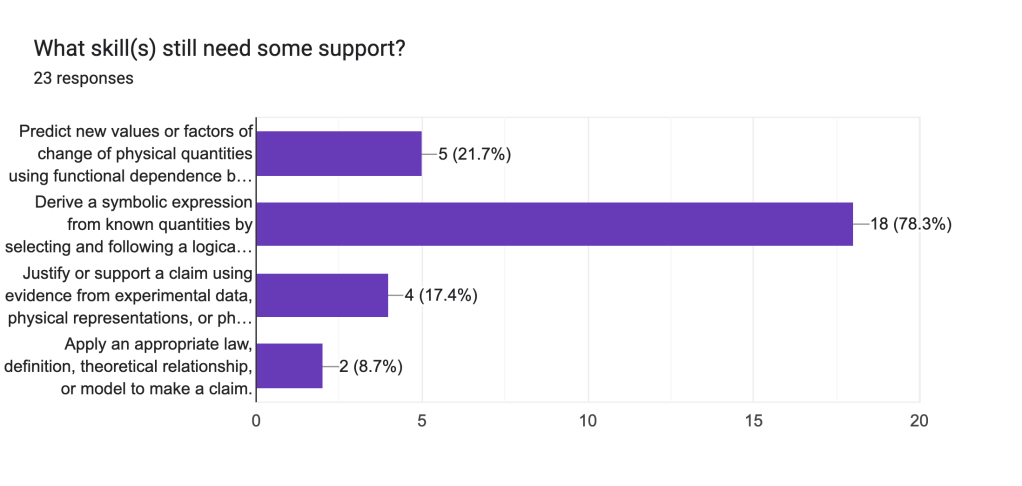
I thought this data was particularly interesting:
I think anyone who teaches AP knows kids dread the word “derive” like we’re asking them to be Einstein Geniuses (more on that in another reflection another day). Interestingly, my students reported that they all need help on derive, but actually my data from AP classroom and testing informs me that functional dependence is actually one of their weak spots. And yet, students aren’t overwhelmingly identifying it as one. I’ve determined that this particular blind spot is going to be an area of focus these last few months as we enter the final lap.
Asking students where they struggle is always telling regarding their thought processes. Currently many of my students are still stuck in a very algorithmic way of thinking/approaching physics rather than working big picture down and it remains telling in their responses. This is still really valuable information because in order to get students where I need them to be I need to meet them were they are at first.
I returned from doing work at the district office to a disaster.
My students were supposed to take their “check-in” (that’s what I call quizzes because their function is to literally check in on student learning) and at first glance I was walking into a mess.
Students should of had enough time to finish the two problems, however the vast majority of my class had half of the assessment blank.
I started looking at the students who finished.
Only three.
All three had done great!
But I have 30 students in this class. Not good.
At first, I will admit I was really upset for a number of reasons.
So I started planning what we were going to do. When I looked more closely at the assessment I noticed that about two thirds of the class was actually doing pretty ok, they just needed more time. Regardless of the fact that I felt strongly that they had enough time, I couldn’t argue the evidence that what was complete was good.
The students who had not done anything beyond opening the assessment were the same ones who have been disengaging with the material and straight up refusing to attempt. As much as I was frustrated that this was on the student (because, after all, my other class is flying and the students who are doing things every day are succeeding). I took a deep breath and regrouped.
What if I made it tactile?
We’ve been working on multiple representations for momentum. So I made up little squares to represent units of momentum. I made a set of red and blue (for each car) and added labels for 1 kg across the bottom and 1 m/s upward.
Sample of cards. This could represent a 2kg and a 1kg object stuck together post-collision moving at 2 m/s
Within table groups I assigned group roles that I borrowed from Marta Stoeckel (check out her article with Kelly OShea!) and then also added a task, one representation needed to be done by each student in the group on the large white board and then they were all responsible for doing it on their own paper.
Step by step we worked through the original problem in small groups. Since I had reduced my “class size” to eight, I was able to give the students with the most need all the attention they needed while the rest of my class completed their assigned tasks.
One of the cool features, aside from students commenting that they liked placing the blocks, was that it allowed us to discuss the limitations of using discrete blocks. In the assessment problem the final velocity was 3.6 m/s, so while I had some students show 22 blocks, demonstrating they understood that the total momentum was constant, they had uneven heights for an inelastic collision. It’s better, then, to just label height and width and go from there.
By the end of the hour everyone was happy.
My three students who did great were given this handout. They were asked to come to consensus and then reflect on their gaps/needs. I checked in with them at the end and they were able to communicate confidence and what they needed.
The large group felt satisfied that they had the chance to go back into their assessment. When I went back in to review the work I found that their performance matched my previous hour, even though they take more time.
The small groups were kind of amazing. Most of these students had been really checked out, but this small shift got pretty much everyone fully on board and verbalizing that they understood what was happening. In order to make up for the assessment, a second problem was on the backside of the worksheet for them to do independent of my help.
At the end of the day I reflected on how the only reason I was able to do this on the fly is due to the fact that I’ve been teaching for a long time. This was a new-to-me activity (although I’ve set up differentiated groups like this before) but at the same time this was effectly three different lesson plans in the same space. Elementary teachers might laugh at my overwhelm, but the reality is that teachers (all of us) are simply not given the kind of time required to plan high quality experiences for our students. This also shows how important data is in our work. Data can allow us to be a bit more objective in our judgements, moving from “they didn’t do anything” to “what else could I try to fill their needs?”
This job is challenging, but it wouldn’t be fun if it wasn’t!
“Legacy. What is a legacy? It’s planting seeds in a garden you never get to see.” Hamilton the Musical
I continue to reflect a great deal after the AAPT winter meeting this year. This year we are celebrating 40 years of the Physics Teaching Resource Agents and Karen Jo Matsler gave one of the plenaries. During her talk I couldn’t help be realize the legacy that I’m connected to as a physics teacher.
Karen Jo Matsler Recognized with AAPT’s 2025 Melba Newell Phillips Medal
One of the most bittersweet encounters is that with a well-loved teacher who is retiring. Over the course of a 35 year career that teacher has potentially impacted as many as 5000 of their own students, and that excludes the many more they may have impacted through extra curriculars. The best teachers become legends in their communities, and as those students grow into adults they continue to share the stories about how their teacher made a difference. I know I continue to do the same to this day.
But when a teacher retires from a school, their legacy is rarely left in the building longer than a year. A new teacher fills their place and within a single year the program either shifts into a new entity, or, in some cases, is completely decimated.
The very real truth about teaching is that although teachers leave an impact that lasts forever on their students, there is no legacy left in the very place where they poured all of that work and love.
However, that does not mean that there is no place for teachers to leave a legacy.
It is in the professional societies that legacy lives on.
I saw this while listening to Karen Jo’s plenary. Slides filled with photos of activities, demos and labs that I grew up believing were specific to the teachers in my area. No, it wasn’t that. Many of those teachers were also involved with PTRA. They brought their learning back and forth from PTRA, AAPT and their local communities.
I saw this in an interactive session I attended. At the end of the presentation I was in the back with two college faculty and one shared that she loved seeing this presentation, shared as the teacher’s own, which originated from the work of Alan Van Heuvlan. We proceeded to talk about how Alan was her adviser.
I saw this when Duane Merrill offered a presentation about creating community around “Phood, Physics and Phun”, which is also the tagline for Chicago Physics Northwest meetings.
I encounter this with nearly every conversation at AAPT, especially those who are near retirement. Each of us was inspired by someone who came before us, someone who brought us in, pushed us forward, encouraged us to grow and learn and lead.
And the memory of these educators lives on. It lives through the stories that go along with the demonstrations and the activities. It lives through the work that continues to excite and engage others in teaching. Professional societies are not only the spaces that allow current educators to network, connect, receive support and grow. They are the spaces that house the professional legacies of educators, not just as inspirational teachers, but as exemplary professionals in their craft.
Welcome, I’m so glad you’re here. Do you know so and so? Let me introduce you. You should give a presentation about that idea; I would love to hear more.
These three simple statements were something that I came to believe were a norm of the physics teacher community. Early in my career I took for granted just how transformative they are, and how special the community I had entered was. It’s because of this that I find myself frequently repeating these same words over and over at events like our national meetings. Unlike other aspect within our community, I’m not sure there’s a particular person these can be tied to, yet everyone has a story about an individual person who pushed them forward in the community. I’ve seen the great power of these simple three sentences
Welcome to the community, I’m so glad that you’re here
When it’s your first time at a large conference like AAPT, it can be so easy to feel isolated. A large conference is a large undertaking. You have to arrange a great deal of finances, rearrange your schedule, arrange for substitute teachers and lesson plans, and it can be defeating to do all of this work just to feel alone at the conference. What was the point? Hearing, “I’m so glad you’re here” makes it inevitable for a smile to spread infectiously from one person to the next.
“Have you met so and so? Let me introduce you”
This weekend I met one of my student’s professors!
So many of us are quick to say that the reason we come back meeting after meeting after meeting is because of the community. In order to form community, you naturally need to have more than one person as a familiar face.
Engaging in conversations with others with a true curiosity to learn about the other person does a few things. First, when we engage others with curiosity they immediately feel valued! It’s actually been researched, the more a person engages positively with others, the more positively viewed they are by others! It seems simple, but as in all relationships, creating a strong community is about building up others, not trying to make ourselves look impressive. The second piece is that if we lead with true curiosity, we may find ourselves easily connecting members of the community with one another, bringing them in. I’ve witnessed this and participated in this first hand on so many occasions, I find myself eager to engage in opportunities for helping others connect.
You should give a presentation about that idea; I would love to hear more.
Without a long CV to create for a tenure dossier, high school teachers don’t necessarily have a specific, extrinsic motivator to give a presentation at a conference. Add to that these national conferences can create huge waves of intimidation and imposter syndrome. “What do I possibly have to offer?” a teacher asks themselves. “Everyone knows so much more than me” or “I’m sure they’ve seen this before”. Of course, as I’ve learned and many others have learned, it’s simply not true. Telling someone that an idea that they have from a casual conversation should be presented at a conference is validating and empowering. And when that presentation happens? It creates one of the strongest positive feedback loops you can gain from community. Quickly, you find yourself presenting out of a desire to give back to the community that has given so much.
“Hi. Welcome to the community. I’m so glad you’re here.” Now there’s joy across my face.
“Have you met so and so? Let me introduce you” Now I have someone with whom I can relate and possibly co-create.
“That’s such a great idea. I’d love to hear more about it. You should present it.” I gain the confidence to get up in front of my peers share my ideas, and it results at a positive feedback loop where people ask questions and come up to me and tell me that they liked my idea.
After those three questions have been answered, and after you’ve been the one presenting, now it’s your turn. It’s your second, third, fourth time presenting at the conference. Are you asking those questions?
So glad to see you. Have you met so and so? I hope you present that I want to learn more.
This is how our community grows, and it’s how each of us is able to grow within our community.
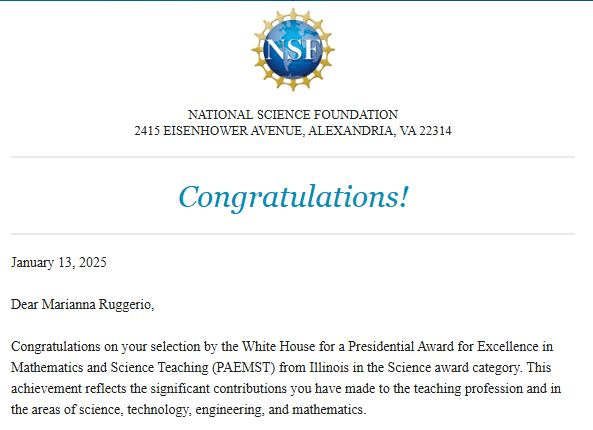
I’ve been awarded the Presidential Award in Excellence for Math and Science Teaching for 2023!
We all received an email notification this afternoon from the NSF and the White House published the press release. Over 300 educators were recognized today as they finally attended to the backlog from 2021, 2022 and 2023.
Some of us are wondering based on the language of the email if we are going to get a DC trip, especially since the Biden administration has made the announcement as he prepares his exit from the White House.
I started documenting the journey shortly after I submitted my application, mostly to give myself an outlet. Today I can publish it!
It’s February 20, 2023 as I begin this draft...
I have no idea, at this point, if I will post this, because who wants to hear about an incomplete journey or one that never arrives at the destination?
I’m in waiting for my PAEMST application to be evaluated at the state level.
I’ve noticed a number of previous awardees documented their journey, so I figure why not? If for no other reason than for myself and this post can sit in drafts.
August 1st, 2022 – Applications Open
I got the email from PAEMST and saw it immediately because I was sitting in a chair at the University of Illinois participating in the IPaSS program. I started the process to begin my application and within a few hours my twitter friend and 2019 awardee Jeremy sends me this message. It’s important to note that I might not have actually gone through with the whole process had it not been for Jeremy reaching out. It was a small gesture of validation that this process was worth it. We chat a bit about a possible lesson (I already have one in mind). I don’t leave UIUC before asking one of the post-docs if at her visit she could also record me for the purposes of my application. We set a date and I mostly don’t touch the application.
Monday October 10th – Lesson Day
Today is the day of the recording! I actually forgot and didn’t bother to wear anything extra nice or style my hair. I know I’m going to regret this later. Unfortunately the only video that turns out is 8th hour. Fortunately I still have one to use. That night I start writing my narrative based on what I can remember from earlier that day
Later that week I ask for my references. In addition to a follow up with my principal, I send one to Annie Baddoo, the coordinator for the education pathway programs at Rockford University and Maggie Mahmood, the coordinator for IPaSS.
My principal passes the letter off to the assistant principal we hired in August.
Sometime between November and December…
I’m pounding out the narrative on my couch, often working on it to procrastinate other things like grading. I reach out to get a mentor, but I hear nothing back. I contact the general PAEMST email and still hear nothing from my state coordinator. I find my state coordinator’s real email and email her there and the generic PAEMST. After this point the amazing Natalie Johnson, our math coordinator, reaches out to me. We have a wonderful phone conversation. I send her recommendations to my letter writers and hone in on my own writing. I get connected with a mentor who reads my application and says it looks great. Unsatisfied (sigh… perfectionism…) I start looking up previous winners in Illinois and decide to reach out to the 2019 winner. She agrees to read my narrative.
January
I’m anxious because as far as I’m concerned I’m just DONE with the whole process. I send follow up emails to my remaining letter writers. Tanya gets back to me with some actionable feedback. I rewrite my resume so I can actually fit everything on it. It’s a crazy editing process to maximize your space. I’m wishing my name was “Mia Kim” so my name wouldn’t use so many characters on the rec letters (that seems… inequitable?) Basically I’m panicking about anything that could be panicked about. One of the requirements for the application is a letter of recommendation from your “building principal”. The building principal has the ability to assign the rec letter to someone else, but according to the PAEMST info folks, you, the applicant, cannot list anyone other than the building principal.
In highly diverse and underfunded districts its not uncommon to have high turnover rates. I have been at my current building for 7 years and have seen no less than 15 different administrators come through. The 2022-2023 team is entirely new except for the building principal. When I sent my second request to her for the letter she asked my new evaluating principal to write it. This created an obvious amount of anxiety as he had not yet learned who I was. I drafted an email that outlined my involvement and reach within and outside of the district so he could craft that into a letter. In my opinion this was really unfair to him, but that’s just what happens in some places.
February
I finally meet with my assistant principal about my rec letter and submit my application on February 5th, just 24 hours before the deadline. After I hit the button my colleague pops in and immediately asks “what’s wrong” to which I respond “nothing”. Unconvinced he asks again, “what is wrong” I explain that truly nothing is wrong, I’ve just submitted this application I’ve been working on for the past 6 months! It’s relieving and nerve-wracking at the same time.
February to March must have been some of the worst because after obsessing daily for six months suddenly there was nothing to do but wait. In the meantime I cranked out a bunch of blog posts and an article for Edutopia. It was time to really focus on the Master’s course I was teaching that semester and my family.
March
On March 2nd I ran across the timeline that explicitly stated state finalists are determined by March 10th. Later that day I received an interruption to my 7th hour class. One of the admin walks in with a sizable edible arrangement.
My students, of course, joke that I have a secret admirer. I open the note and it’s from the PAEMST Illinois team, thanking me for applying to the program! Believe me this is NOT what my nerves need at this point!
My mind immediately goes to negative thoughts: “well, obviously they only had 3 or fewer applicant this year because these arrangements are $60, if I become a finalist it’s just because no one applied….. this arrangement is a consolation prize for all the work but none of the glory…. let’s be honest, if I get anything it’s just because I followed the directions and the rubric.”
I’m still unsure what my motivation for going through the process is anyway. I’m not seeking attention by any means, in fact the only people who know I’m applying are my rec writers, my closest colleague and my twitter family. I’m pretty sure there’s a part of me seeking validation and redemption after the trauma of my early years teaching. Not making the finalists will just confirm that I’m exactly the kind of teacher I believe myself to be: not quite enough yet.
March 8, 2023
At 6:27am I’m sitting on the couch drinking my coffee and post the daily countdown to March 10th.
I head to school as usual and I’m setting up for my AP Physics C students to learn circuits at the ungodly hour of 8:05am (Physics C at 8am is the absolute worst, by the way.)
At 8:00 my watch is buzzing as my phone rings and I see in all caps TARA BELL. I know that Tara is the science state coordinator so I’m assuming it’s good news.
“Hello?”
“Hi this is Tara Bell”
“Hi”
“How are you doing today?” (oh my god can you just tell me already?)
“Fine thanks” (my response when I really don’t want to know how you are as well.
And then she shares that the committee met last night and I’ve been selected as a finalist! She also shares that the committee was “very impressed with your application” (and I wonder if that’s just a thing they say or if it’s genuine in regard to my application vs what they’ve read before”). She also shares that they will be sending my feedback soon so I can get a jump on the addendum.
I jump out of my chair to tell my next-door chem collegue and… he’s not in the room. So I run down the hall to the workroom, bursting with excitement. No one else in the room has a clue what I’m talking about because I’ve kept it under wraps for the last six months. Next I text my husband and my siblings. But now it’s 8:04 and I have to teach!
I kept trying to get a hold of my mom (who also didn’t know about it) during my entire two preps, calling every 15-30 minutes. I realize that if she ever looks at her phone she’s going to think I’ve died, so I text her “if you see your phone before you see dad it’s good news” because I eventually got a hold of dad.
Later that afternoon I received the feedback from the state. I was actually still suprised I made it as a finalist [enter bad thoughts] because I earned the following scores: 3, 4, 3, 3, 4. The dimensions are weighted x7, x6, x5, x4, x3 so even though I earned the highest score on the last dimension, it has the smallest weight. I know that if I want a chance on the national level I need to bring those 3’s up to 4’s. Fortunately there’s a lot of strong feedback for every category… except the first one!
March 11
I created a twitter DM chat with a handful of finalists of folks I’ve followed plus a few more I’ve started talking to in the process. Scott adds a few more folks. We loosely talk about our state feedback. On Tuesday NSF holds a zoom for all of the finalists to discuss the addendum.
March 18
Scott finally puts forth that we start looking at each other’s work. An email chain is built and we start sharing our applications, state coordinator feedback and our proposed addenda. This is by far the most meaningful part of the entire process, even though it’s the one with the shortest turnaround time! It’s so great to actually read through each other’s work and see what a state finalist looks like. I quickly learn that the actual scores you earned from your state coordinators are somewhat meaningless. In our group I would probably give one application perfect 4’s across the board, even though many earned that score. Otherwise the rest of our applications are fairly comparable which makes sense given how motivated we all are to succeed.
April
I know that the national review happens around this time. One one particular weekend my mind jumps to the review and I get a stomach flip. I know this sounds weird, but I’ve had that flip before when people are talking about me.
May-December
So much nothing. I know it’s better to not think about it. 2021s are still waiting.
Janurary
Our state alumi reps plan on a recognition event. Meanwhile, the national AAPT meeting is held in New Orleans. The math alumni rep attends the meeting, now working for FermiLab. Since I know we are far removed from the formal process I ask her a bit about her side. I learn that there are around 60-some applications for the awards, and that elementary has more applicants than secondary (to my surprise). I share the twitter collaboration and how much I appreciatedo the kind of feedback we received at the state level. I also shared my fear because many of the folks in this group had received perfect or near perfect scores. My lowest scoring area was domain 1, which has the greatest weight. She assures me that I had a very strong application.
March-April
Everyone is hoping for an announcement. There is no announcement. One person posts in a facebook group they got a FBI check request for 2021 a year ago. That post is promptly removed, but I can’t help but wonder if the 2023 awardees already know.
May 16, 9:04am
I actually wrote this part on a document on my computer! They swear you to secrecy!
I’m outside with George. My husband is out of town and George was under the weather so I took the day off of school. I hear my phone that I have an email. I check it and see that it says “PAEMST Award – Requested…” I quickly open the email, skim down and see the words FBI. My heart jumps. I immediately call my husband to share the news. I know that I’m now in the running! I have to re-read the email 5 more times. It’s addressed to “PAEMST nominee” Not Finalist! Nominee! The email says I can ONLY tell immediate family. I’m literally jumping to try to shake off the excitement. I wish I could tell certain people right now: the individuals who wrote my recommendation letters, my former math teacher and PAEMST awardee, my best friend at work. But no, I can’t tell anyone for who knows how long! In fact, due to the nature of the secrecy I’m not even writing this in my WordPress draft, but offline!
3:34pm I receive the email from the PAEMST team to provide by bio, headshot and quotes for the website, “if selected”. I have about 6 days to get this completed. Interestingly, this email says that everything is strictly confidential and to tell no one. I wonder if I should mention that the email from EASE says “immediate family” but if I did that is it a test? So I don’t ask.
6/5 – I get an email from PAEMST that my bio is ready for review. I go through the now edited version of my bio, feeling ok that this means its still happening.
6/10 – It’s the last day of school and I go to my principal’s office to drop out my checkout form. He asks if I’ve heard anything from PAEMST, to which I respond, “well if I did know, it would be confidential because only the white house gets to say anything after awardees are already in DC” he then proceeds to tell me that he received an email about PAEMST to verify my employment (or something like that). He also shares there were two emails and they both went to spam!
Which takes us to today…
After 8 months of secrecy I can finally announce that I am an awardee!








 Physics.Teacher.Momma.