

In studies around expert teachers one salient feature is that expert teachers provide students learning opportunities to shift their thinking. Specifically, those opportunities should include productive struggle, explicit connections of task to concept and deliberate practice, where there is an opportunity to receive feedback. (Stigler & Miller, 2018)
In the last year I’ve started implementing practices from Peter Liljidahl’s Building Thinking Classrooms in Mathematics and I wanted to share an activity we did this week.
We did this task at vertical whiteboards which have the advantage of keeping students in an active position that is also easy for them to travel across the room to get ideas from other students. Time to task and engagement tends to be much higher.
We have been studying forces and I had a nagging feeling that my student thinking was all over the place, in pieces. I needed to bring them coherence!
Enter thin-slicing. Thin slicing is when students are provided one problem at a time which increase in difficulty but only slightly.
Slightly off thee Lilijdahl path, I choose to gather students together to review and capture the problem solving process for any force problem.
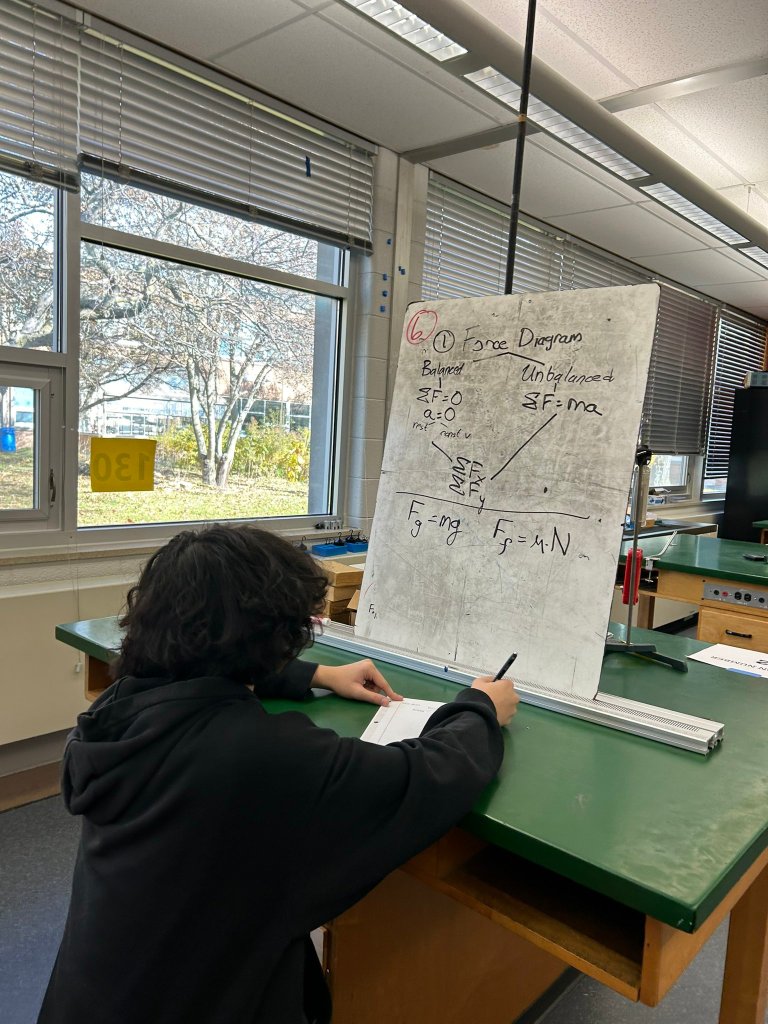
After this everyone drew cards and we were off! (there is research that visibly random grouping reduces students assuming a certain role in the group due to perceived intentions)
They were asked to divide their board into four regions.
For the first region students were asked to sketch the force diagram of a lab car on the track at rest.
As students finished I asked them to sketch the car, now being pushed with a constant force F
At this point I could already see there were some gaps so we did a quick consolidation.
I pulled the class together (this physically and psychologically separates students from their work) then pulled the class over to where a student had Fg = N. Students were asked to turn to a neighbor and discuss what the group was thinking. Then I asked “someone not in this group share what this group was thinking”.
Next, we traversed across the room to a board where the team had taken things a step further and wrote mg = N. We did the same protocol and discussed that we should go ahead and substitute anywhere we can substitute.
Next we went to another board to look at the face with a constant force. Same protocol, then back to the boards.
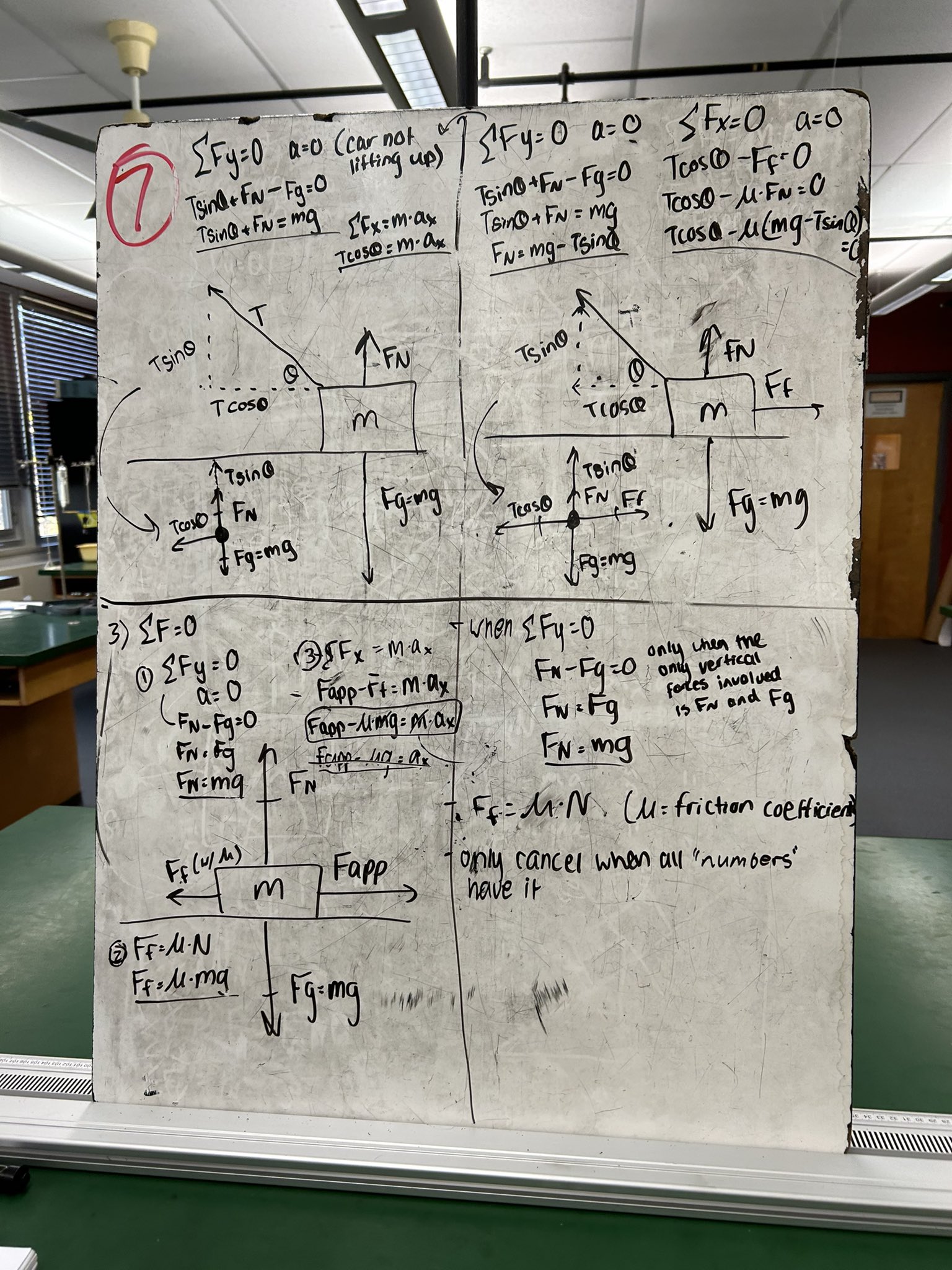
In the third box students were asked to complete the diagram and force expressions now with a coefficient of μ between the car and the track.
As students wrapped up in the fourth box they were asked to write down “things to remember”. This was a really remarkable opportunity for me because if I saw “memorize equation for ___” I had a good idea of where that student’s understanding was, compared to “write sum of forces in x and y and set to 0 or ma”)
Next, I asked them to erase the top two boxes.
In the clean first box I asked students to now represent the car being pulled with a constant tension force up at an angle. No friction in this case.
Again, we did a quick consolidation. We examined a board for breaking components down, then we examined another board that had correctly determined that the normal force was less than gravity.
Last, we added friction to the problem. Students were then asked to add to their notes box and then document whatever final notes they needed into their notebooks
The entire whiteboard process took only 40 minutes.
In this time students solved 5 different, but related physics problems.
They practiced and received feedback and made corrections to the problem solving process.
We could compare similar, but different cases.
I could have just made this a worksheet, but this was so much more powerful! Not only was there high student engagement, but student attitudes were, likewise, sky high by the end of class!
Something of note: In a thinking classroom students are never allowed to be “done”. As groups finish one problem, they get the next task. We consolidate before all groups are finished. If groups are done it’s hard to get them started again.

 Physics.Teacher.Momma.
This is fantastic! With my first year of BTC, I did not have an understanding of how to thin-slice and consolidate, but your detailed blog-post provides an excellent template. Thanks so much!
I would love to learn more, and maybe correspond by email if you are interested.
LikeLike